 by Tom Gurney
Tom Gurney BSc (Hons) is an art history expert with over 20 years experience
Published on June 19, 2020 / Updated on November 25, 2026
Email: tomgurney1@gmail.com / Phone: +44 7429 011000
My First Sermon: Introduction
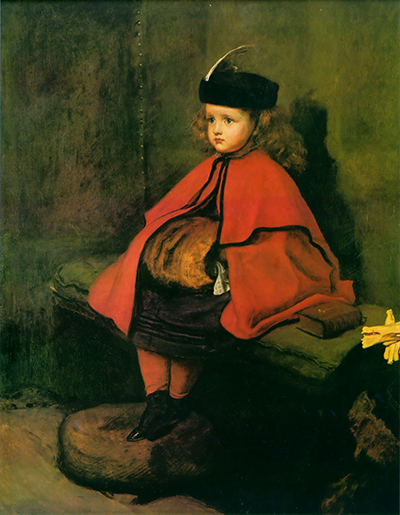
In John Everett Millais’s My First Sermon, a small girl sits so still that the tilt of her chin seems full of effort. Her hands disappear into a fur muff, her shoes meet on a low cushion, and her eyes stay fixed on someone outside the painting. Millais’s daughter Effie posed for the figure. The 1863 oil on canvas, which measures 92 × 77 cm in the City of London’s catalogue, is in the Guildhall Art Gallery. [1] [2]
At a Glance
- Date1863 [1][2]
- MediumOil on canvas [1]
- CollectionGuildhall Art Gallery, 701 [1][2]
- SitterThe artist’s daughter Effie [2]
This work across John Everett Millais’s career
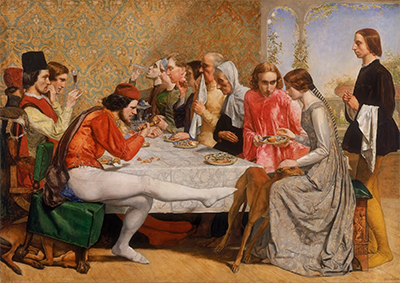
Isabella
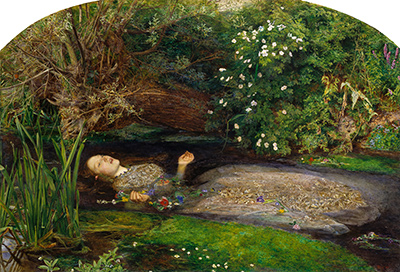
1848–49Ophelia
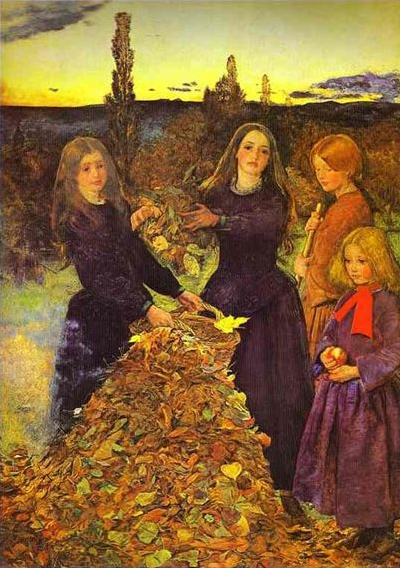
1851–52Autumn Leaves
1855–56Dew-Drenched Furze
1889–90Contents
- The work of sitting still
- A church pew and a family sitter
- From the Academy to Grafton Street
- The smaller paintings and Barlow’s mezzotint
- Annotated details
The work of sitting still
A feather rises from Effie’s dark hat, but her gaze runs almost horizontally across the painting. The difference matters. She sits upright against the high back of the pew and looks slightly to our left. Her lips part a little, and one cheek catches more light than the other. Millais has given her just enough of a turn to make it feel as though someone has caught and held her attention. The title locates that person for us. The preacher’s face, gestures and words are all left outside the frame. We have to discover what it is like to listen by watching the person who is listening. [2]
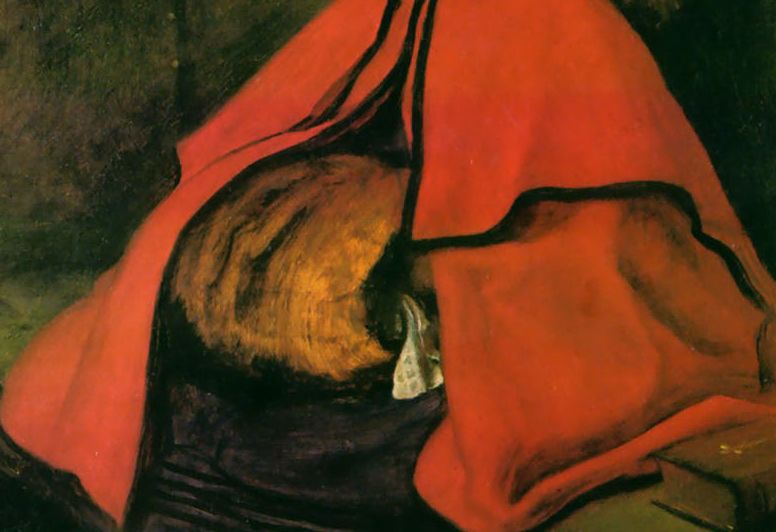
The light makes its way down from her face to the broad scarlet cape. A dark edge cuts across the red at her elbow, and the ribbons beneath her chin follow the opening at the front. In the centre, where we might expect an expressive gesture from the hands, there is the rounded, softly lit surface of the muff. The cape spreads wider than Effie’s body and nearly blankets the dark skirt beneath it. The repeated red of the stockings draws the eye back to the smallness of her legs. The clothes let Millais show how tightly she holds herself while making her shape easy to pick out from the dim surroundings. [2]
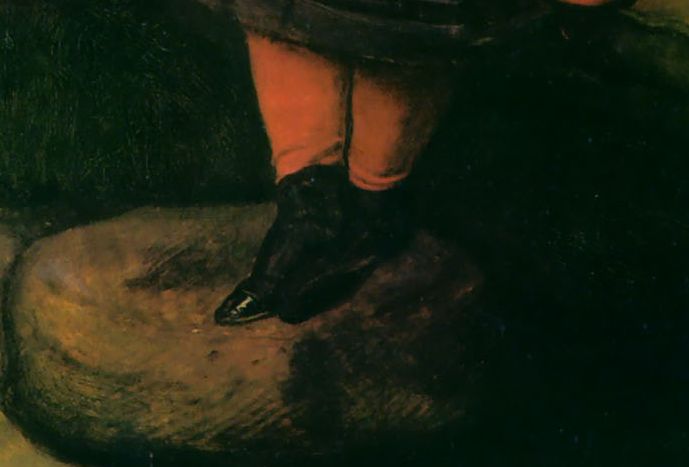
Look along the seat to the right. There is a closed book, usually identified as a prayer book, and a pair of gloves so close to the edge that they are partly cut off. They leave room for the idea of an adult companion, even though Effie has the whole visible pew to herself. Down at her feet, the cushion fills the drop between the bench and the floor. It gives her a place to keep her shoes together. Look up from there and the upright seam of the pew seems to rise an unusually long way beside her. An ordinary piece of church furniture becomes a measure of what it takes for a small child to sit like an adult. [2] [3]
A church pew and a family sitter
Guildhall identifies the pew as one of the old high-backed seats at All Saints Church, Kingston upon Thames, where Millais’s parents lived nearby. The gallery dates his work on the pew to December 1862, shortly before the old seating was removed. There is enough of it in the picture to make the height and enclosure of the seat felt. The close framing leaves most of the church to the imagination. For a painting about going somewhere new, the familiar weight and texture of things within reach are unusually important. [2] [4]
Effie shared her name with her mother, Effie Gray, and was the eldest of Millais’s daughters. Art historian Naoko Asano places her sittings at the beginning of a series in which the children helped their father build a reputation for childhood subjects. Young Effie returned as the model for The Minuet, while her sisters Mary and Alice later sat for different pictures. Asano also relates an account of Effie wearing her recognisable red cloak to social gatherings. Viewers who knew the picture could recognise the clothes on the child herself. In the painting, we have almost the reverse experience. A particular hat, cape and pair of stockings give an ordinary childhood milestone the specificity of a portrait. [5]
The subject belongs to the tradition of the fancy picture, in which a model acts out a character or a situation. There is no need for visitors to know whose daughter the girl is to recognise her concentration. Japanese scholar Mirei Saga points to fashion coverage of girls’ capes in the October 1862 La Mode illustrée and treats the picture’s dress as part of the world its first viewers knew. The cloak would have looked current alongside the old church seat. Saga also sees a connection between the girl’s absorption and the value many middle-class Victorian viewers placed on diligence and piety. The painting offers them an ideal that they can recognise in the motions and dress of everyday life. [2] [5] [6]
From the Academy to Grafton Street
Millais exhibited My First Sermon as no. 7 at the Royal Academy in 1863. He also showed The Eve of St Agnes and The Wolf’s Den. The latter turns the space below a grand piano into a den for children pretending to be wolves. The Art-Journal reviewer praised both pictures of children for their truth to life. In the girl at church, the writer singled out her face, posture and clothes and took her expression to show that she was following every word. The review found much to fault in The Eve of St Agnes, a nocturnal scene inspired by Keats. The difference gives a sense of how readily viewers could agree on Effie’s liveliness and the clarity of this small scene, even when Millais’s other work divided them. [7]
For the Archbishop of Canterbury, the painting suggested a moral use for art. The Art-Journal reported that, at the Academy dinner, he drew attention to the girl’s piety while speaking about the sympathy viewers could feel for children in paintings. A May review in The Reader also praised Millais’s ability to convey thought through a child’s face, though it jokingly doubted that the girl would ever listen so respectfully again. These are two contemporary readings of the same expression. Her stillness could make her a model of devotion or remind an adult how briefly a first experience can command such complete attention. [4] [7] [8]
In July, the picture was advertised in Dublin. An invitation preserved in the National Library of Ireland asks the collector Jasper Robert Joly to see it from 27 July at Thomas Cranfield’s Fine Art Gallery, 115 Grafton Street. Admission was free by card, and the invitation emphasised that the showing would be brief. Cranfield had a paragraph from the 4 May Times review reprinted on the card. The newspaper had admired both the child as a subject and Millais’s handling of shade. What London critics said about the picture became part of how it was presented to an audience in another city. [9]
The smaller paintings and Barlow’s mezzotint
The popular composition soon existed in several forms. Millais’s son describes his father making an oil replica over two long working days before going north in August 1863. Sotheby’s has catalogued two small versions by Millais himself, a 33 × 23 cm oil on panel and a separate watercolour with gouache. Both catalogue accounts connect their respective versions to the dealer Thomas Agnew & Sons, though with different degrees of certainty. Sotheby’s cites letters to Millais’s wife about a small Agnew sketch and a nearly finished replica. A manuscript at the Morgan Library, kept in his wife’s account book, lists The First Sermon alongside the other paintings of 1863. The surviving works show the artist returning to the image at a scale that changes the experience of looking at it. The Guildhall canvas gives room to the dark pew around the child. On a small panel or sheet, the whole episode draws closer to the viewer. [3] [4] [10] [11]
Thomas Oldham Barlow made a mezzotint after the composition in 1865. The Wellcome impression has an arched top and an image area of 53.3 × 38.5 cm. It carries Millais’s monogram and 1863 date on the right and Barlow’s monogram and 1865 date on the left. The credit below identifies the painter and engraver, while this particular impression has no title lettering. The two dates make the separate work of painting and engraving visible on the page. In mezzotint, a roughened plate can print a deep dark, and smoothing selected areas brings up lighter tones. The medium could translate the dim pew and lit face into gradations of ink. It had to make Effie stand out from the shadow without the scarlet that does so much of that work in oil. [12] [13]
The National Trust holds framed impressions of both sermons at Castle Ward in County Down. In 1898 the auction catalogue of Millais’s own proof engravings also listed signed Barlow impressions of the two subjects together. The original canvases were lent by Charles Gassiot to the Royal Academy’s Millais memorial exhibition that year and came to the Guildhall through the Gassiot bequest in 1902. In 2008 both pictures were shown in Tokyo, among the fancy pictures in the Bunkamura retrospective. The canvases had first reached the Academy audience a year apart. Shiori Koga has drawn attention to that interval as part of the way viewers encountered the pair. In My Second Sermon, Effie falls asleep. The first painting has its own slow action. Looking back at the held chin, tucked hands and carefully placed feet, we see how much Millais could make happen while a child stayed in her seat. [1] [2] [14] [15] [16] [17] [18]
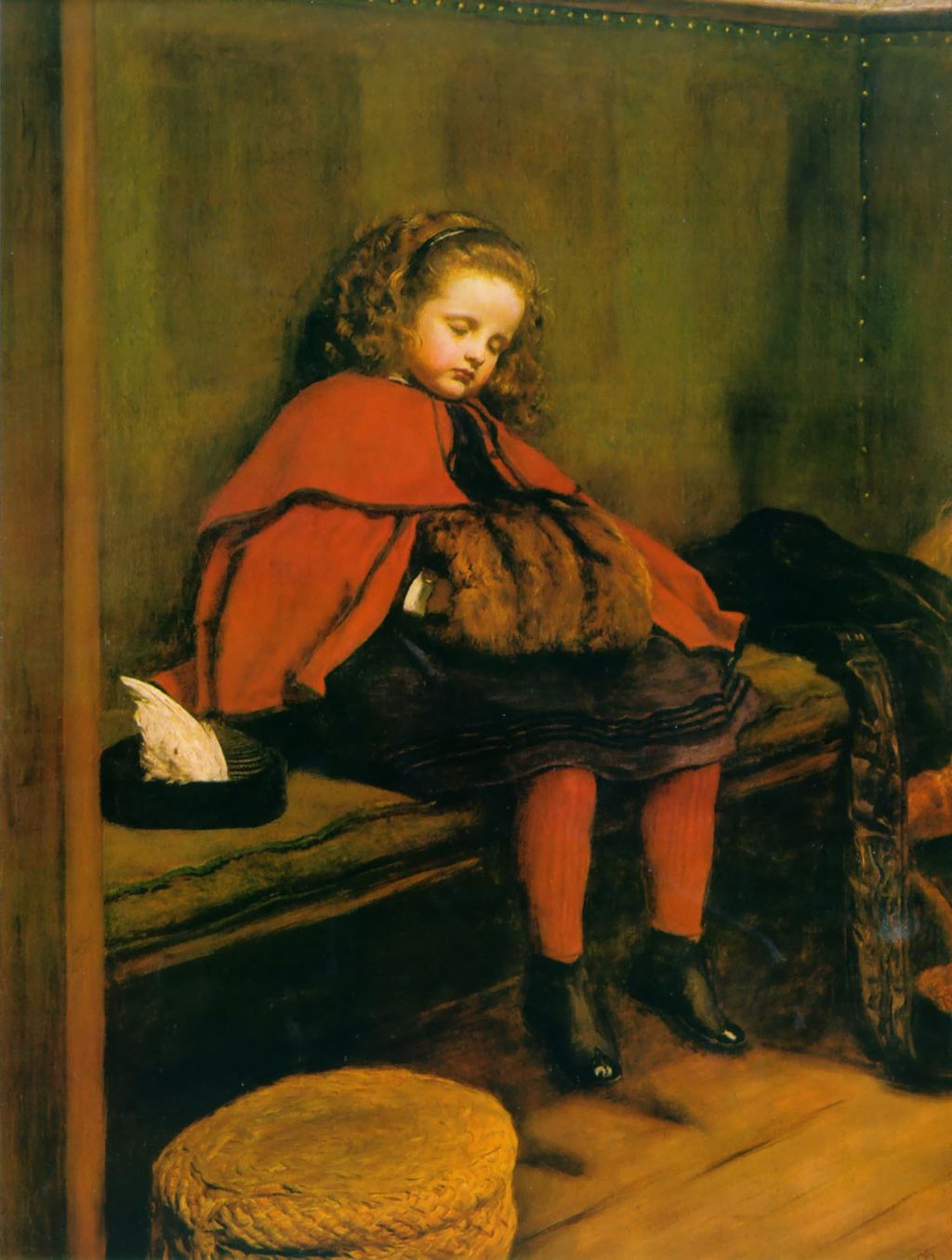
My Second Sermon, oil on canvas, Guildhall Art Gallery, 702. The Guildhall sequel shows Effie asleep and her hat resting on the bench. Image source. Public domain.
Annotated Details from My First Sermon
The numbered points identify visible features discussed in this article. Return from each detail to the numbered overview. My First Sermon, oil on canvas, Guildhall Art Gallery, 701. Image source. Public domain.
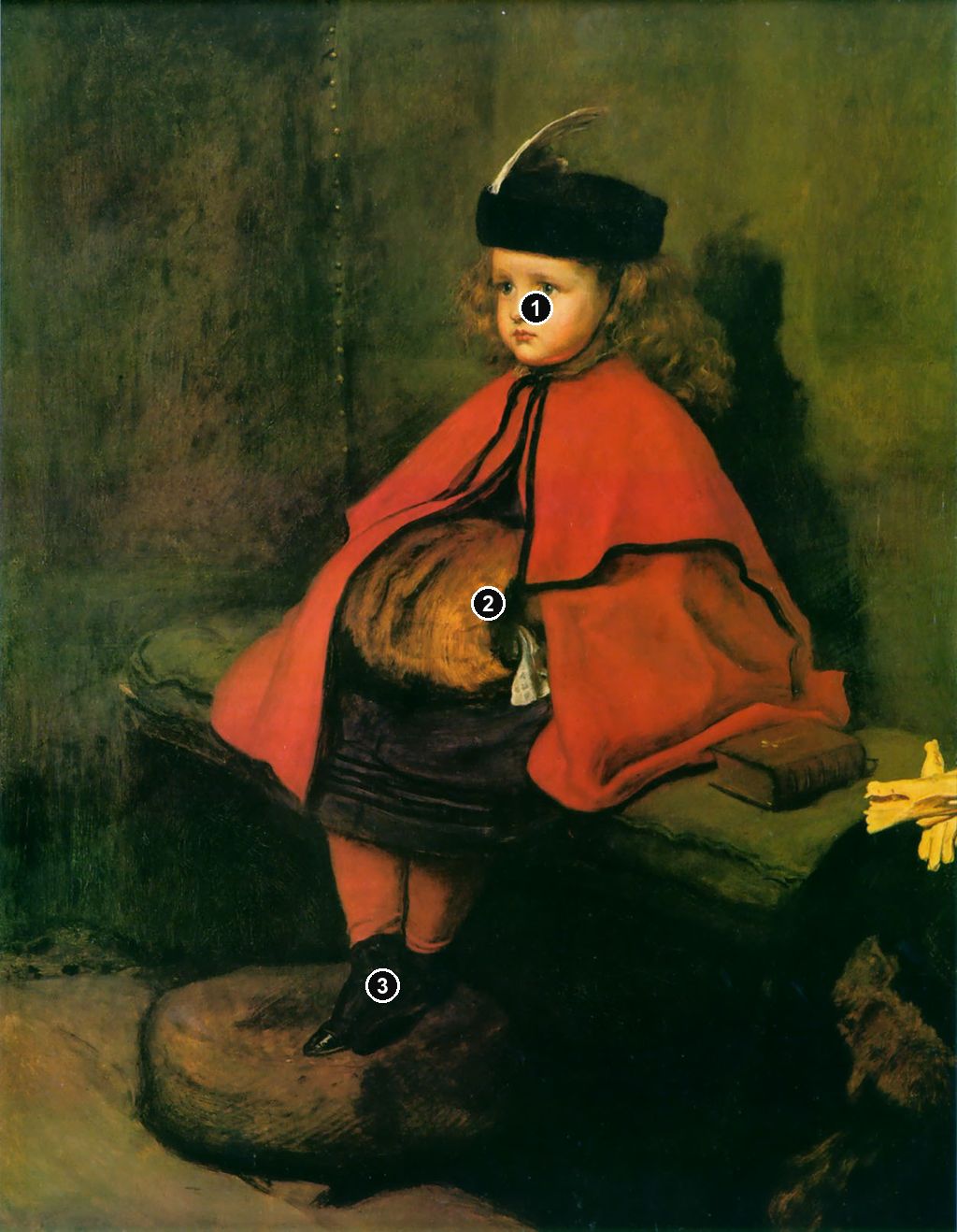
Details from MY FIRST SERMON
Compare the cropped details with the source images above. Notice how their colours, shapes and positions contribute to the larger compositions.
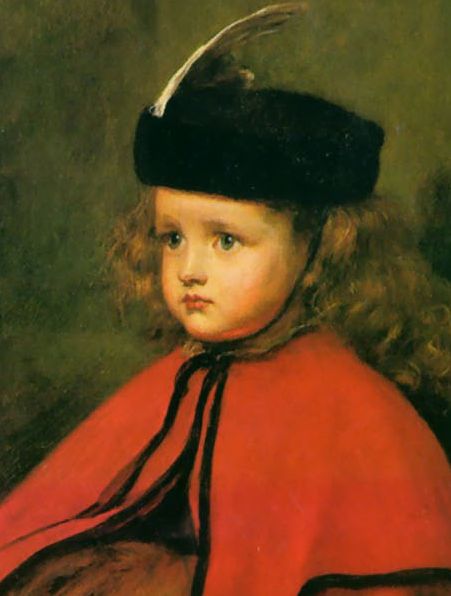
Effie’s attentive face
Her face turns just off centre. The narrow line of light gathers the expression below the dark cap.
The fur muff and red cloak
The broad cloak encloses the smaller shape of the muff. The muff covers her hands and helps account for the still outline of her pose.
Boots and cushion
The cushion lifts the girl’s feet above the floor. Its place directly below the hem draws attention to the scale of a child seated in an adult pew.
John Everett Millais artwork directory
Browse paintings and drawings covered in these articles, including related works held in public collections. Reproductive engravings and editions are discussed on the Prints page.
Prints and illustrated editions
- The Baby-House, 1872. Etching by Millais.
- The Good Shepherd, 1864. Wood engraving designed by Millais, engraved and printed by the Dalziel Brothers.
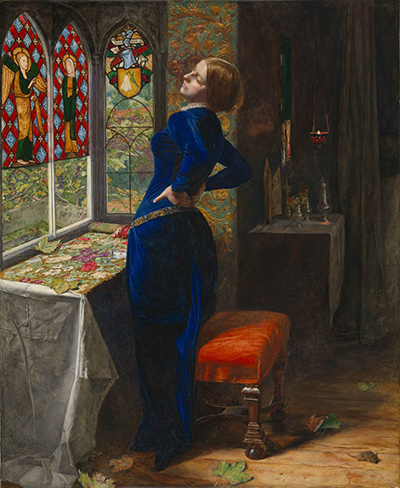
- Mariana, 1857. Wood engraving designed by Millais and cut by the Dalziel Brothers for the Moxon Tennyson.
- The Proscribed Royalist, 1858. Mixed-method engraving by William Henry Simmons after Millais.
| Name | Date | Medium |
|---|---|---|
| Pizarro Seizing the Inca of Peru | 1846 | Painting |
| The Young Men of Benjamin Seizing Their Brides | 1847 | Painting |
| Isabella | 1848–49 | Painting |
| Christ in the House of His Parents (‘The Carpenter’s Shop’) | 1849–50 | Painting |
| Ferdinand Lured by Ariel | 1849–50 (monogram dated 1849) | Painting |
| Study for Christ in the House of His Parents, Tate N04623 | c. 1849 | Drawing |
| Study for Christ in the House of His Parents, Tate N04792 | c. 1849 | Drawing |
| Study for Mariana in the Moated Grange | 1850 | Drawing |
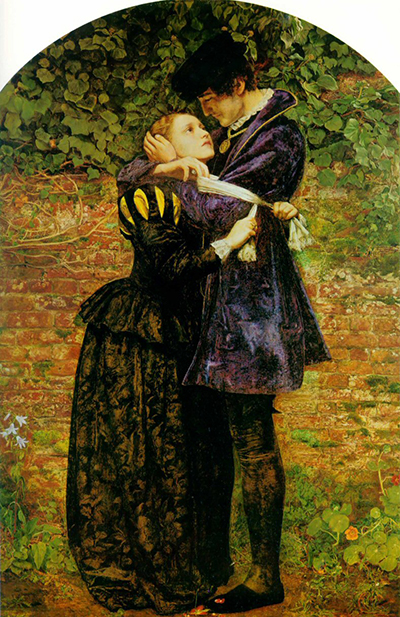
| A Huguenot, on St Bartholomew’s Day, Refusing to Shield Himself from Danger by Wearing the Roman Catholic Badge | 1851–52 (exhibited 1852) | Painting |
| Mariana | 1851 | Painting |
| Ophelia | 1851–52 | Painting |
| The Bridesmaid | 1851 | Painting |
| The Return of the Dove to the Ark | 1851 | Painting |
| The Order of Release 1746 | 1852–53 | Painting |
| The Proscribed Royalist, 1651 | 1852–53 (exhibited 1853) | Painting |
| Portrait of John Ruskin | 1853–54 | Painting |
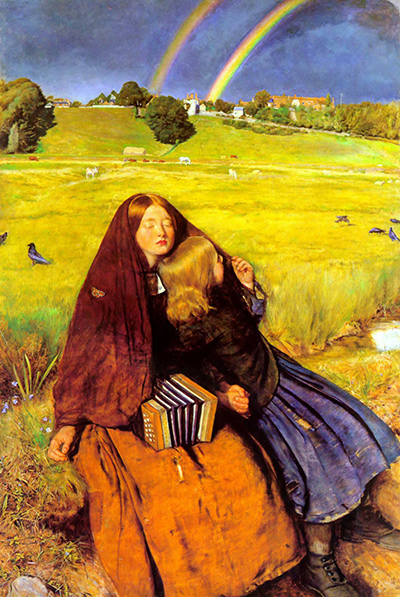
| The Blind Girl | 1854–56 | Painting |
| Autumn Leaves | 1855–56 (Manchester labels 1856) | Painting |
| A Dream of the Past: Sir Isumbras at the Ford | 1856–57, later revised | Painting |
| The Vale of Rest | 1858–59 | Painting |
| Study for The Black Brunswicker, Tate A00812 | c. 1860 | Drawing |
| Study for The Black Brunswicker, Tate A00813 | c. 1860 | Drawing |
| Study for The Black Brunswicker, Tate A00814 | c. 1860 | Drawing |
| The Black Brunswicker | 1860 | Painting |
| The Ransom | 1860–62 | Painting |
| My First Sermon | 1863 | Painting |
| My Second Sermon | 1864 | Painting |
| Joan of Arc | 1865 | Painting |
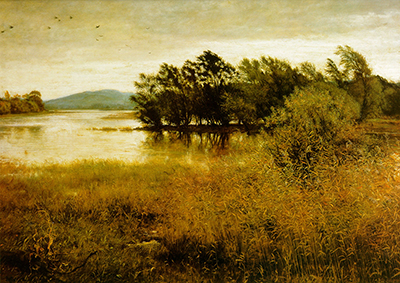
| Chill October | 1870 (exhibited 1871) | Painting |
| The Boyhood of Raleigh | 1870 | Painting |
| The Knight Errant | 1870 | Painting |
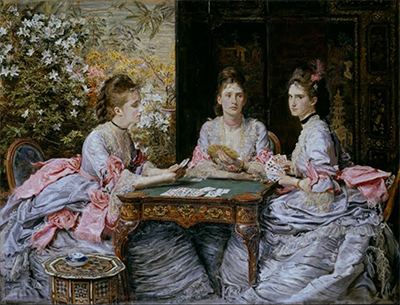
| Hearts are Trumps | 1872 | Painting |
| The North-West Passage | 1874 | Painting |
| Louise Jane Jopling | 1879 | Painting |
| William Ewart Gladstone, NPG 3637 | 1879 | Painting |
| Bubbles | 1886 | Painting |
| Portia | 1886 | Painting |
| Dew-Drenched Furze | 1889–90 | Painting |
| Ducklings | 1889 | Painting |
| Portrait of Sarah Hammond | 1891 | Painting |
Discussion
Look again at the images and ideas explored in My First Sermon. These editorial prompts invite your observations.
Reader Insights
Which object most helps you understand the scale of the pew relative to the child?
How does the child’s posture guide your eye when you compare it with the sequel?
Join the Conversation
Share a detail, comparison or question about My First Sermon below.
References
- London Picture Archive, City of London Corporation, My First Sermon, Guildhall Art Gallery accession 701. View source.
- City of London Corporation, My First Sermon, collection image and interpretive record. View source.
- Sotheby’s, My First Sermon, watercolour and gouache, lot 140, catalogue note on the depicted objects. View source.
- John Guille Millais, The Life and Letters of Sir John Everett Millais, abridged edition, 1905, p. 198. View source.
- Naoko Asano, ‘More than Models and Muses: The Women of John Everett Millais’ Domestic Circle and Their Contributions’, Bulletin of the National Museum of Western Art, no. 25, 2021, pp. 15–16. View source.
- Mirei Saga, ‘The Background and Development of J. E. Millais’s Fancy Pictures’, Japanese master’s thesis synopsis, University of Tsukuba, chapter 3. View source. (in Japanese).
- The Art-Journal, Royal Academy exhibition review, 1 June 1863, pp. 108–109. View source.
- The Reader, ‘Art. Royal Academy (First Notice)’, 9 May 1863, pp. 461–462, transcribed by the Victorian Web. View source.
- National Library of Ireland, Thomas Cranfield’s invitation to Jasper Robert Joly to view My First Sermon, July 1863. View source.
- Sotheby’s, My First Sermon, oil on panel, lot 30, 2017. View source.
- The Morgan Library & Museum, manuscript catalogue of Millais’s work, MA 4987, including The First Sermon. View source.
- Wellcome Collection, Thomas Oldham Barlow after John Everett Millais, A Little Girl Attending Her First Sermon, 1865, 673369i. View source.
- The Metropolitan Museum of Art, ‘The Printed Image in the West: Mezzotint’. View source.
- National Trust, My First Sermon and My Second Sermon, engravings after Millais by Barlow, Castle Ward, NT 834246. View source.
- Christie, Manson & Woods, Catalogue of Modern Artists’ Proof Engravings, after His Own Works, the Property of Sir J. E. Millais, 21 March 1898, lot 137. View source.
- Royal Academy of Arts, Exhibition of Works by the Late Sir John Everett Millais, 1898, nos. 20 and 26. View source.
- Shiori Koga, ‘An Interlude Between Two Paintings’, Japanese conference abstract on Millais’s two sermon pictures, Kyushu University. View source. (in Japanese).
- Akira Ishizuka, ‘An Examination of Exhibitions and Publications Focusing on the Life and Art of John Everett Millais’, Kwassui Bulletin, no. 55, p. 35, checklist discussion of the Japanese retrospective. View source. (in Japanese).