 by Tom Gurney
Tom Gurney BSc (Hons) is an art history expert with over 20 years experience
Published on June 19, 2020 / Updated on November 25, 2026
Email: tomgurney1@gmail.com / Phone: +44 7429 011000
Dew-Drenched Furze: Introduction
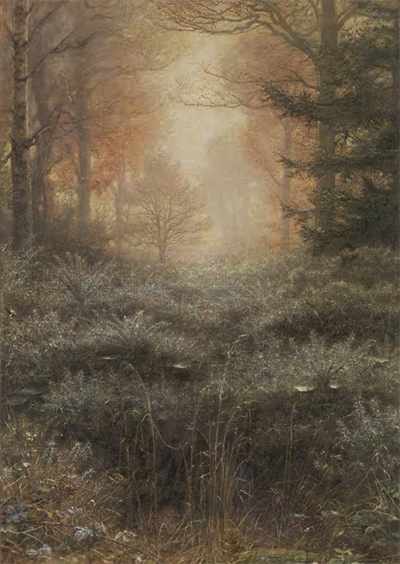
A pale opening between the trees draws the eye into John Everett Millais’s Dew-Drenched Furze. Before it gets very far, there is a thicket to look through. The gorse is so thick with fine, bright marks that it seems to be giving off some of the light coming from deeper in the wood. Millais painted this view at Murthly in Perthshire in 1889–90. The oil on canvas, now in Tate’s collection, is 173.2 centimetres high and 123 centimetres wide. The height matters as much as the size. It gives a patch of low-growing shrubs the presence of a whole landscape. [1] [2] [3]
At a Glance
- Date1889–90 [1][2]
- MediumOil on canvas [1][2]
- Dimensions173.2 × 123 cm [1][2]
- CollectionTate, T12865 [1]
This work across John Everett Millais’s career
Contents
- How the light comes through
- A morning at Murthly
- Two pheasants in the early record
- What the title takes from Tennyson
- Exhibitions and the gift to Tate
- Annotated details
How the light comes through
Start at the bottom, among the long grasses and scattered leaves. The grasses stand out in thin, ochre strokes against dark pockets of ground. Higher up, their lines give way to the tangled growth of the gorse. Pale dots collect along the tops of the bushes and thin out in the hollows. From a distance they form a nearly continuous veil. Up close, there are gaps and changes in density. Those variations give the thicket a depth of its own before the eye reaches the trees. [1]
The sides of the picture have different weights. On the left a tall trunk has enough light on its surface for the bark to register. On the right a darker mass of foliage projects towards the bright centre. Bare branches reach across the top. The arrangement is balanced enough to suggest an opening or avenue, with irregularities that interrupt the view at each distance. Follow the small tree just left of the brightest part. Its branches are sharp enough to pick out individually, while the trees farther back almost dissolve into the light. The canvas sets the fineness of those distant branches against that of the nearest stems, even as the contrast softens from one plane to the next. [1]
Furze is another name for gorse, the spiny shrub also called whin. The plant’s many branching points give Millais repeated places for a glint to catch. Dew forms on plant surfaces when they cool enough for water vapour to condense. Each drop is small, but a mass of them can make a whole shrub look lighter. Writing for Tate, the horticulturist Matthew Pottage also draws attention to the moisture-laden cobwebs. They help explain why the sheen appears to hang between the stems in places. The finest strokes let us see the structure of the plant and the air around it at once. [4] [5] [6]
At the centre, brightness spreads across an area where individual shapes become harder to distinguish. Near the front, it breaks into countless separate strokes. Millais makes one morning’s illumination legible at both scales. Tate has drawn attention to the almost abstract effect of the worked surface, especially in the foliage. Glance across that part of the picture without following a single branch and the marks seem to form a pattern all their own. Look again for stems and gaps, and the pattern resolves into a bank of living growth. [1] [3]
A morning at Murthly
Millais’s son John Guille remembered that his father had gone north for sport in the autumn of 1889. One November morning the dew on the long grass and the webs between the gorse bushes caught his attention. In the son’s account the viewpoint lay near the old sawmill road, in a wooded part of the estate that the family knew from shooting. That recollection brings the setting down to a particular locality. The glade’s remoteness on the canvas comes partly from what Millais chose to include. The opening is framed entirely by growth and light, even though the painter could reach his spot from a road. [3] [7]
A chance encounter with the light was only the beginning of the work. John Guille recalled that the family were doubtful as the painting took shape and grew enthusiastic only near the finish. That change of mind makes sense in front of the canvas. The shape of a trunk or bush is fairly easy to recognise in isolation. A net of pale touches begins to look like dew when the eye can follow it across the irregular shadows of a bush. The recollection tells us how the developing picture struck the household. The painting shows how much the effect depends on the relationships among small marks over a very large surface. [1] [7]
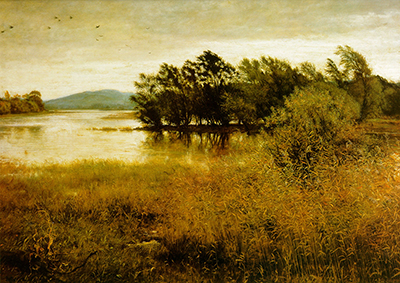
An earlier Scottish landscape, Chill October, spreads its reeds, river and sky across a broad canvas. The spaces between its bands of vegetation and water let the eye travel laterally towards a far horizon. Dew-Drenched Furze gives comparable weight to ordinary growth but gathers the view into a narrow opening. A greater share of the picture belongs to things a few steps from where the painter stood. [1] [8]
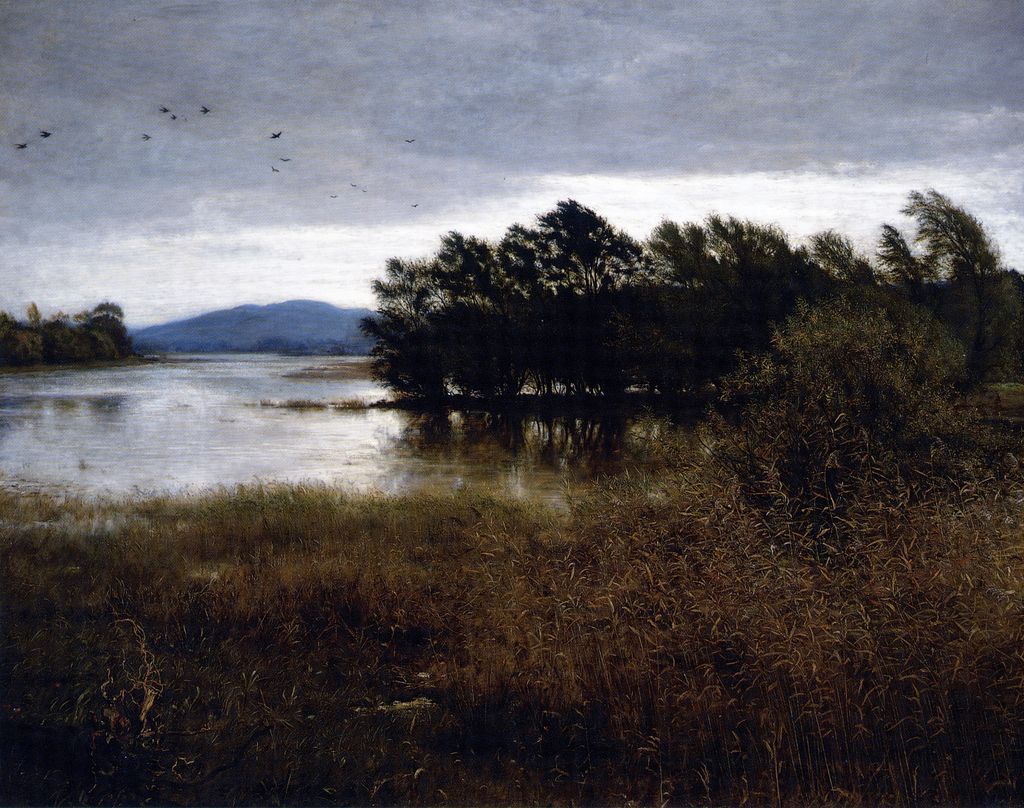
Chill October, oil on canvas, 1870. The broad Tay composition builds its depth from reeds, water and the distant horizon. Jasonmillais. Image source. CC BY-SA 4.0. Resized for the web. This derivative uses the same CC BY-SA 4.0 licence.
Two pheasants in the early record
The Royal Academy’s 1898 memorial exhibition catalogue describes two pheasants in the immediate foreground and records a monogram dated 1890. One bird had caused Millais and his son considerable trouble. John Guille remembered drawing pheasants in a range of poses and catching a wild bird so that his father could study it. He also says that he tried painting the cock himself at his father’s request. The result looked stiff to him, and his father painted over it. In the son’s telling, his father had hoped that the bird, set in the place he chose, would make the scene feel more still. The idea depended on how quietly the bird could be made to occupy its patch of ground. [7] [9]
That episode belongs to the making of the picture. A later change is reported by Jacqueline Banerjee, citing Malcolm Warner’s catalogue of Victorian painting. According to that account, the cock pheasant was removed in cleaning before a 1967 exhibition. The Academy description establishes that both birds were visible in 1898, while the family biography and the later account describe two different interventions. One tells us how the painter revised the bird. The other helps explain why the foreground a visitor sees today differs from the one recorded at the memorial exhibition. [7] [9] [10]
What the title takes from Tennyson
The name comes from section XI of Alfred Tennyson’s In Memoriam A.H.H., published in 1850 in memory of his friend Arthur Henry Hallam. The verse describes a quiet morning and pauses over “these dews that drench the furze”. Spider silk glints green and gold in the next lines. The speaker’s attention then moves out across fields and towers towards the sea before turning inward. The calm in his own heart feels like despair. A chestnut falling through leaves is almost the only note of disturbance at the beginning. The morning’s quiet gives grief room to be felt. [1] [11]
Millais takes the phrase about the dew and leaves its surroundings to the reader’s memory. His view stops within the wood, with no plain stretching towards the sea. The light and the wet growth carry the association into the narrower space. The literary scholar Kate Flint reads the late landscape as a painting about how memory can arise from immediate sensations. In this reading, the delay while we make out the woods matters. The glints are present to the eye for an instant before they become recognisable as drops or strands, and the title can make that moment of recognition feel like a recollection. [11] [12]
When Millais wrote to his daughter Mary from Birnam, he described walking down to the river to say goodbye and being moved to tears as lines from Tennyson’s A Farewell came to mind. In that short poem a speaker takes leave of a stream and imagines the sun and moon continuing to shine on it after his departure. The letter gives us a moment when Millais himself put poetry and the feeling of leaving a place together. [7] [13]
Exhibitions and the gift to Tate
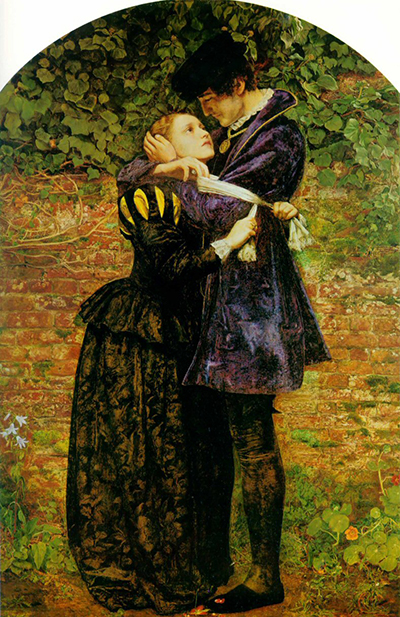
A London art report published in the Otago Daily Times in July 1890 places the painting in that year’s New Gallery exhibition. The correspondent singles out Dew-Drenched Furze while assessing what the New Gallery and its rival, the Grosvenor, had to offer that season. A profile in the New Zealand Graphic that September takes the picture as one end of a long career, with the 1852 Huguenot at the other. The two reports show that the woodland had already caught the attention of readers far from Perthshire while Millais was still painting there. [14] [15]
Mrs Sandars lent Dew-Drenched Furze to the Academy in 1898. The picture was acquired by the artist’s grandson Sir Ralph Millais in 1978. It was on loan to Tate from 1996 to 2000, a period that included the exhibition Symbolism in Britain in 1998. It also appeared in Tate’s 2007 Millais retrospective. In 2009 the artist’s great-grandson Geoffroy Millais gave it to Tate in memory of his father, Sir Ralph. [3] [6] [9]
The painting later travelled to Tokyo and Osaka for Light: Works from the Tate Collection in 2023–24. The Japanese exhibition put Millais’s woodland alongside other ways of painting changing outdoor light, including views by Sisley and Monet. Its position there makes sense even for a viewer who has never read Tennyson. Much of the light is apparent only through the surfaces it touches, from the misty gaps between the trees to the wet strands low down in the gorse. [2] [16]
Annotated Details from Dew-Drenched Furze
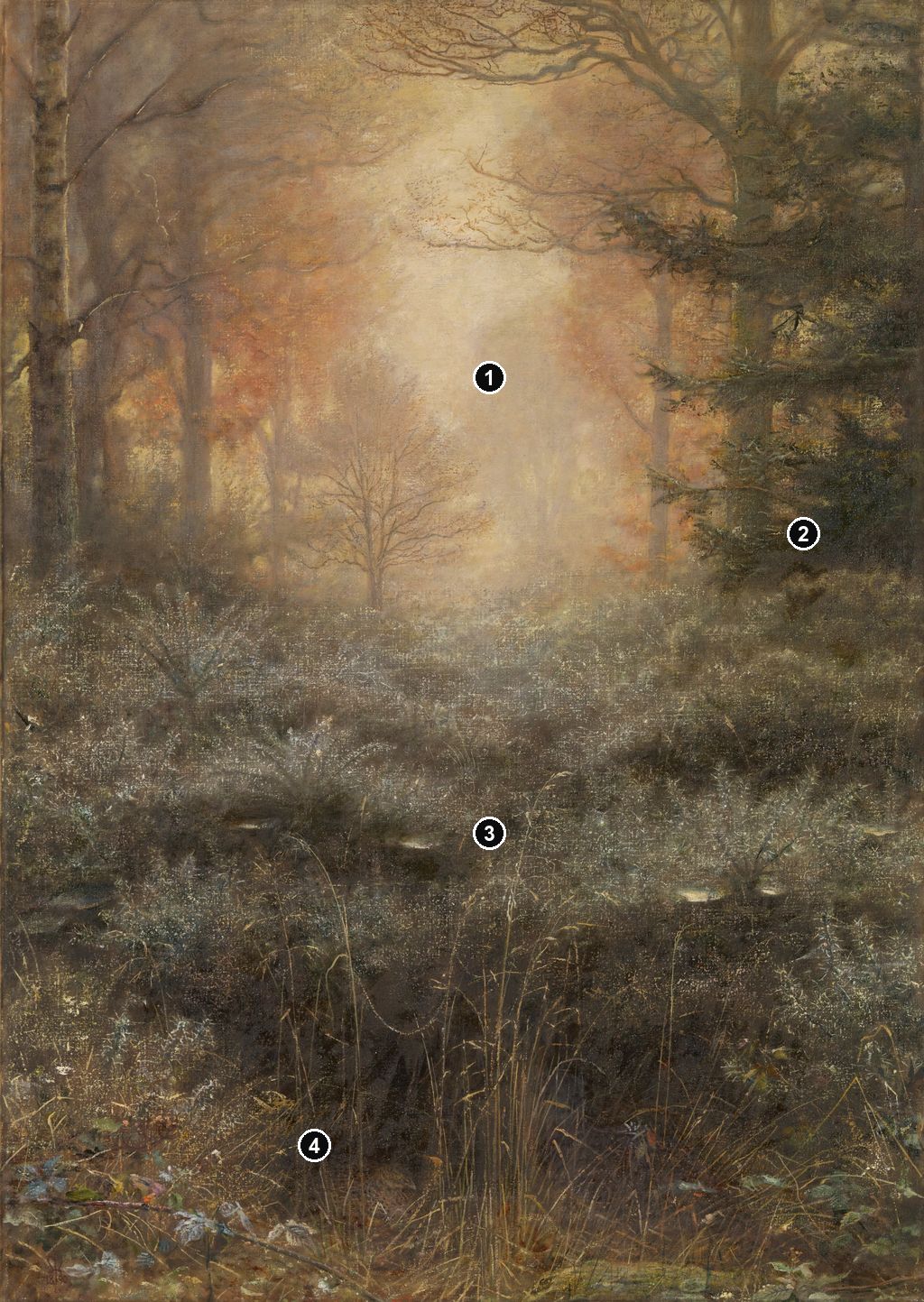
The numbered points identify visible features discussed in this article. Return from each detail to the numbered overview. Dew-Drenched Furze, oil on canvas, Tate, T12865. Image source. Public domain.
Details from DEW-DRENCHED FURZE
Compare the cropped details with the source images above. Notice how their colours, shapes and positions contribute to the larger compositions.
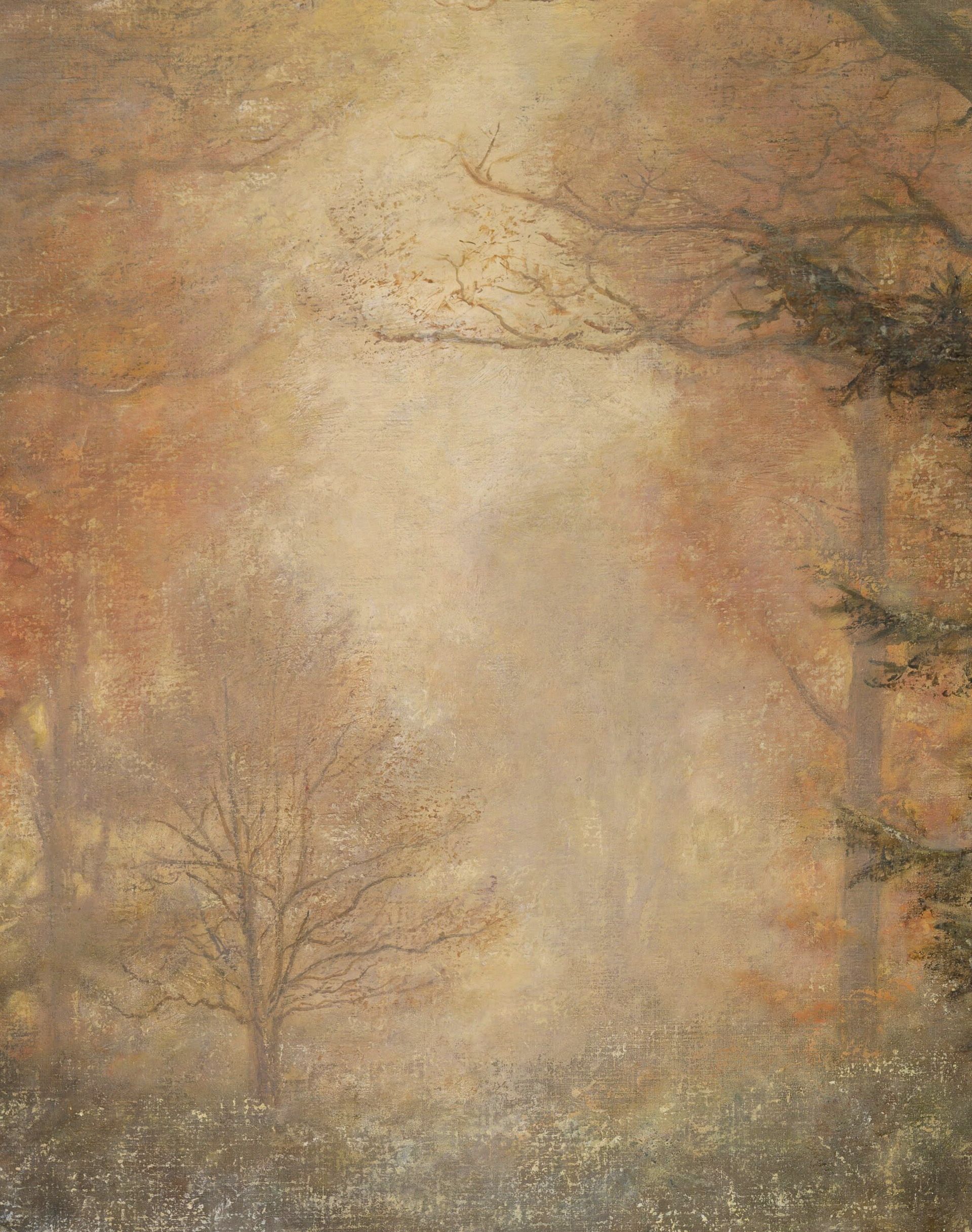
Light among the trees
The strongest light is set beyond the near trees. Smaller branches and trunks remain just visible as they cross the lighter air.
A dark evergreen edge
The darker foliage at the right gives the returning light an edge. Thin twigs and thicker branches break its outline.
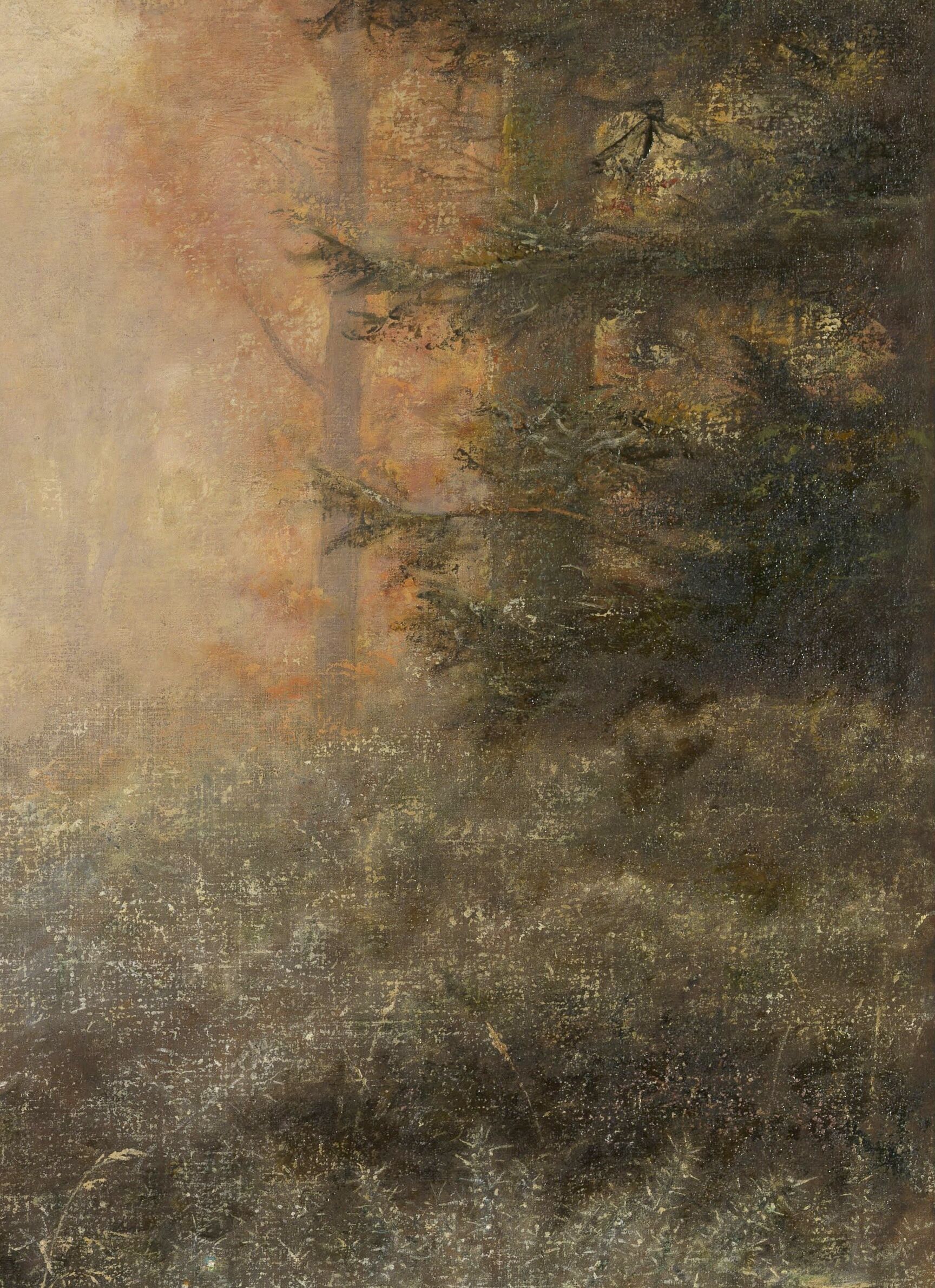
The shine on the undergrowth
Scattered marks of pale paint sit on the darker ground. They give the damp plants a low, uneven gleam distinct from the light between the trees.
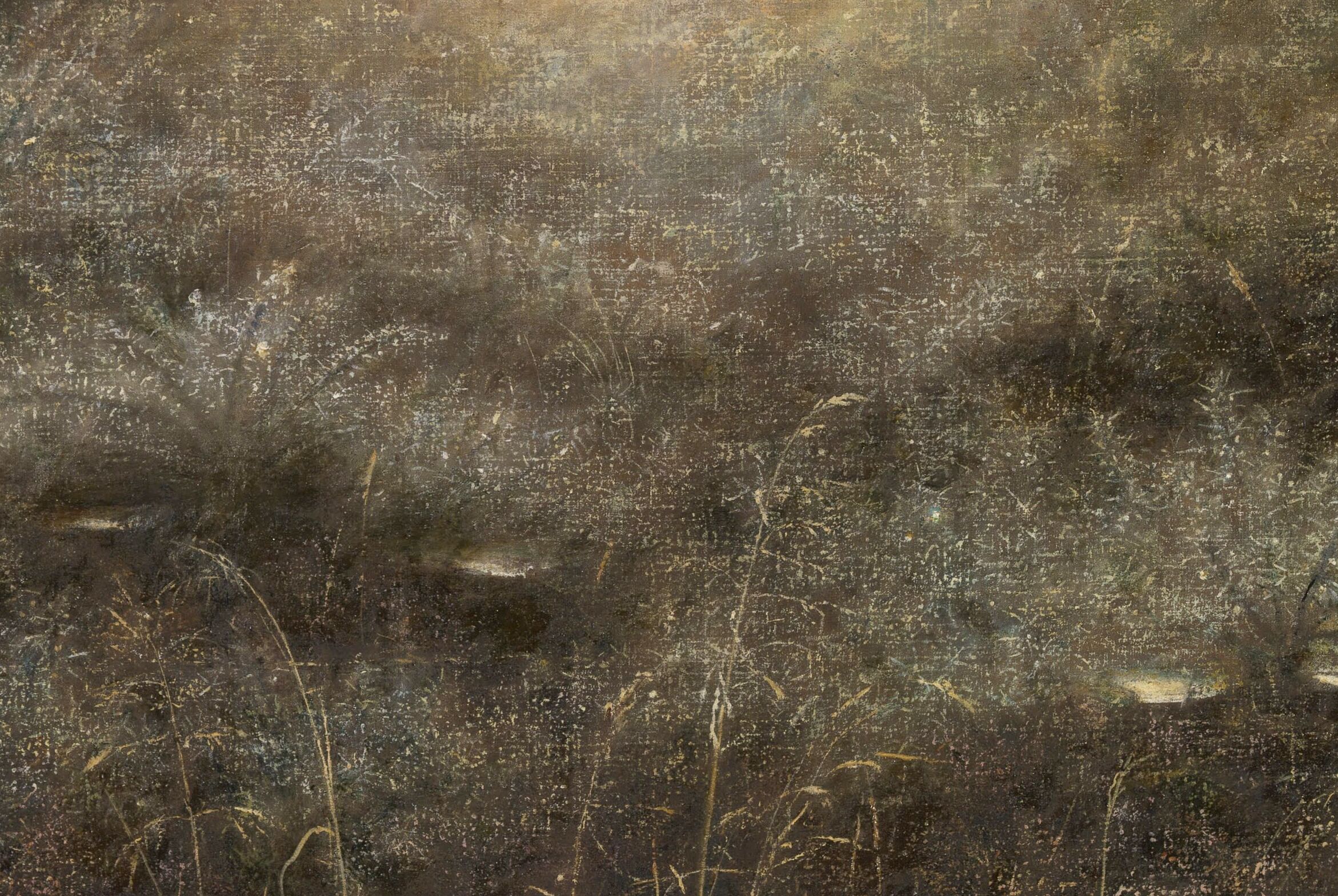
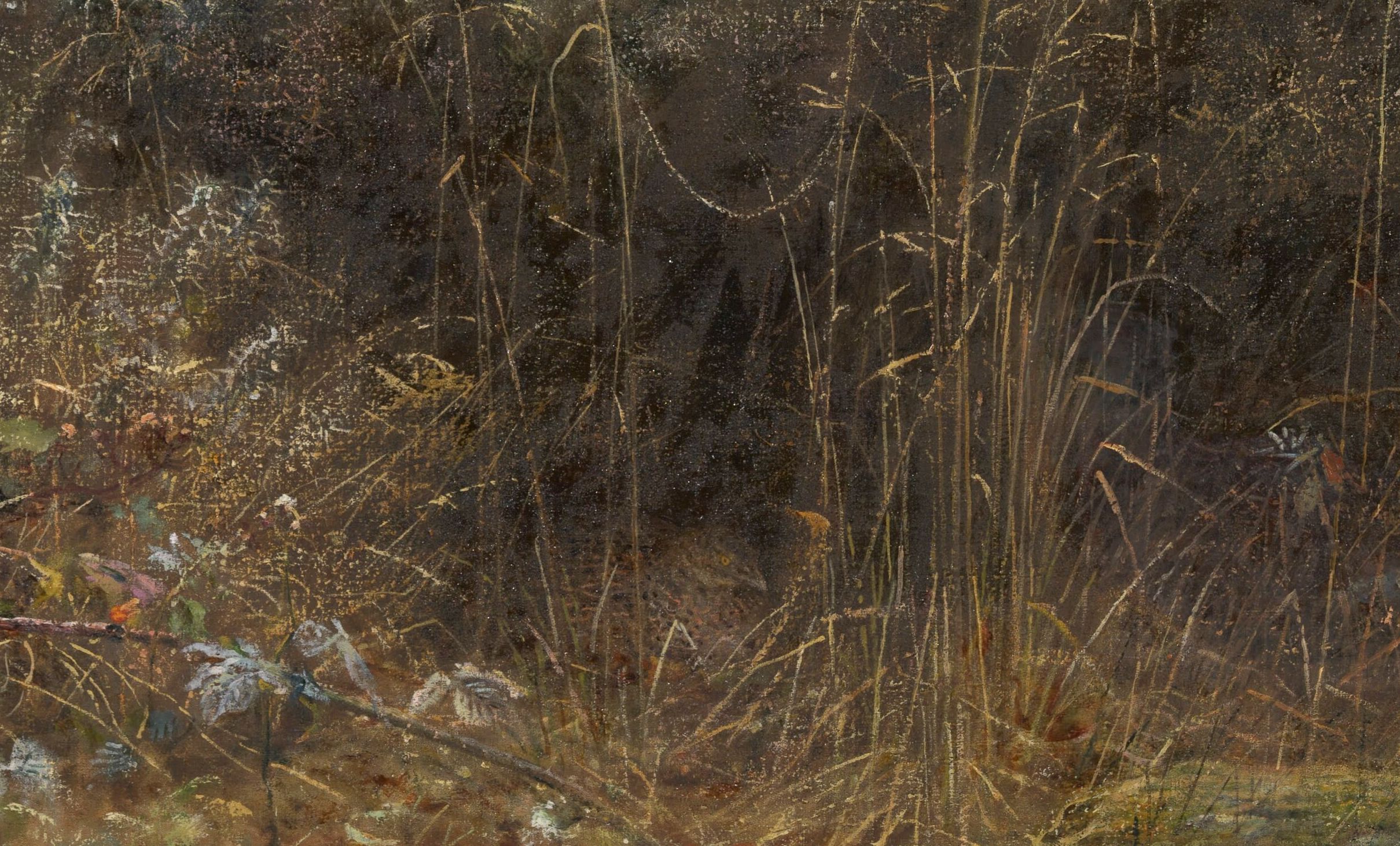
Last year’s stems and leaves
The foreground reveals uneven stalks, dry leaves and duller patches between the light strokes. Their detail becomes stronger as the distant trees grow less distinct.
John Everett Millais artwork directory
Browse paintings and drawings covered in these articles, including related works held in public collections. Reproductive engravings and editions are discussed on the Prints page.
Prints and illustrated editions
- The Baby-House, 1872. Etching by Millais.
- The Good Shepherd, 1864. Wood engraving designed by Millais, engraved and printed by the Dalziel Brothers.
- Mariana, 1857. Wood engraving designed by Millais and cut by the Dalziel Brothers for the Moxon Tennyson.
- The Proscribed Royalist, 1858. Mixed-method engraving by William Henry Simmons after Millais.
| Name | Date | Medium |
|---|---|---|
| Pizarro Seizing the Inca of Peru | 1846 | Painting |
| The Young Men of Benjamin Seizing Their Brides | 1847 | Painting |
| Isabella | 1848–49 | Painting |
| Christ in the House of His Parents (‘The Carpenter’s Shop’) | 1849–50 | Painting |
| Ferdinand Lured by Ariel | 1849–50 (monogram dated 1849) | Painting |
| Study for Christ in the House of His Parents, Tate N04623 | c. 1849 | Drawing |
| Study for Christ in the House of His Parents, Tate N04792 | c. 1849 | Drawing |
| Study for Mariana in the Moated Grange | 1850 | Drawing |
| A Huguenot, on St Bartholomew’s Day, Refusing to Shield Himself from Danger by Wearing the Roman Catholic Badge | 1851–52 (exhibited 1852) | Painting |
| Mariana | 1851 | Painting |
| Ophelia | 1851–52 | Painting |
| The Bridesmaid | 1851 | Painting |
| The Return of the Dove to the Ark | 1851 | Painting |
| The Order of Release 1746 | 1852–53 | Painting |
| The Proscribed Royalist, 1651 | 1852–53 (exhibited 1853) | Painting |
| Portrait of John Ruskin | 1853–54 | Painting |
| The Blind Girl | 1854–56 | Painting |
| Autumn Leaves | 1855–56 (Manchester labels 1856) | Painting |
| A Dream of the Past: Sir Isumbras at the Ford | 1856–57, later revised | Painting |
| The Vale of Rest | 1858–59 | Painting |
| Study for The Black Brunswicker, Tate A00812 | c. 1860 | Drawing |
| Study for The Black Brunswicker, Tate A00813 | c. 1860 | Drawing |
| Study for The Black Brunswicker, Tate A00814 | c. 1860 | Drawing |
| The Black Brunswicker | 1860 | Painting |
| The Ransom | 1860–62 | Painting |
| My First Sermon | 1863 | Painting |
| My Second Sermon | 1864 | Painting |
| Joan of Arc | 1865 | Painting |
| Chill October | 1870 (exhibited 1871) | Painting |
| The Boyhood of Raleigh | 1870 | Painting |
| The Knight Errant | 1870 | Painting |
| Hearts are Trumps | 1872 | Painting |
| The North-West Passage | 1874 | Painting |
| Louise Jane Jopling | 1879 | Painting |
| William Ewart Gladstone, NPG 3637 | 1879 | Painting |
| Bubbles | 1886 | Painting |
| Portia | 1886 | Painting |
| Dew-Drenched Furze | 1889–90 | Painting |
| Ducklings | 1889 | Painting |
| Portrait of Sarah Hammond | 1891 | Painting |
Discussion
Look again at the images and ideas explored in Dew-Drenched Furze. These editorial prompts invite your observations.
Reader Insights
Follow the light from the spaces between the trunks to the foreground. Which passage looks wettest?
How would you read the quiet scene if you encountered the painting before learning its title?
Join the Conversation
Share a detail, comparison or question about Dew-Drenched Furze below.
References
- Tate, Dew-Drenched Furze, collection record T12865. View source.
- The National Art Center, Tokyo, Light: Works from the Tate Collection, Japanese and English exhibition checklist, no. 27, 2023. View source.
- Tate, “Major late landscape by Millais, Dew-Drenched Furze, donated to Tate”, acquisition announcement, 2009. View source.
- Royal Botanic Gardens, Kew, Ulex L., Plants of the World Online. View source.
- Met Office, “Dew”. View source.
- Matthew Pottage, “Details, Details: John Everett Millais’s Dew-Drenched Furze 1889–90”, Tate Etc., issue 44, 2018. View source.
- John Guille Millais, The Life and Letters of Sir John Everett Millais, President of the Royal Academy, one-volume edition, 1905, pp. 316–17 and 333–34. View source.
- National Trust, Chill October, collection record 1226560.1, reproductive etching and description of the original painting. View source.
- Royal Academy of Arts, Exhibition of Works by the Late Sir John Everett Millais, winter exhibition catalogue, 1898, p. 32, no. 97. View source.
- Jacqueline Banerjee, “Dew-drenched Furze by Sir John Everett Millais”, The Victorian Web, citing Malcolm Warner, The Victorians: British Painting, 1837–1901, p. 76. View source.
- Alfred Tennyson, In Memoriam A.H.H., section XI, 1850, University of Wyoming electronic text. View source.
- Kate Flint, “Painting memory”, Textual Practice, vol. 17, no. 3, 2003, pp. 527–42, especially pp. 533–34. View source.
- Alfred Tennyson, “A Farewell”, Poems, vol. II, 1843. View source.
- Otago Daily Times, “Academy Sketches”, London report printed under “Australian News”, 3 July 1890. View source.
- New Zealand Graphic, “Sir John Millais”, 6 September 1890, p. 8. View source.
- Nakanoshima Museum of Art, Osaka, Light: Works from the Tate Collection, Japanese and English exhibition checklist, room 6, no. 27, 2023–24. View source.