 by Tom Gurney
Tom Gurney BSc (Hons) is an art history expert with over 20 years experience
Published on June 19, 2020 / Updated on November 25, 2026
Email: tomgurney1@gmail.com / Phone: +44 7429 011000
Joan of Arc: Introduction
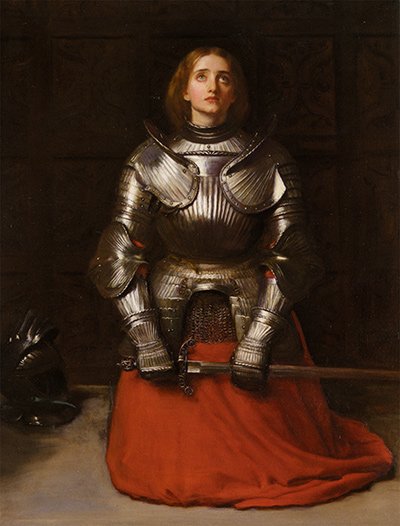
Joan kneels in armour, both hands closed around her sword. Her helmet is on the floor and she looks up past the viewer. John Everett Millais painted the French heroine in oil on an upright canvas 82 cm high and 62 cm wide. The Royal Academy exhibited it in London in 1865 as no. 208. The painting is signed with Millais’s monogram at the lower left. [1] [2] [3]
At a Glance
- Date1865 [1][2]
- MediumOil on canvas [1]
- SubjectJoan kneels in armour with a sword across her hands [1][2]
- Documented sale listingSotheby’s London, 27 November 2003 [1]
This work across John Everett Millais’s career
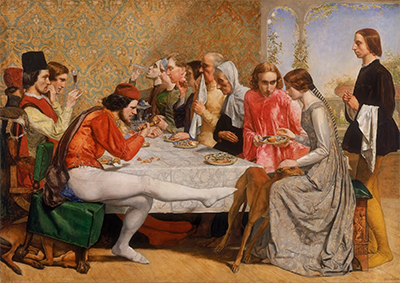
Isabella
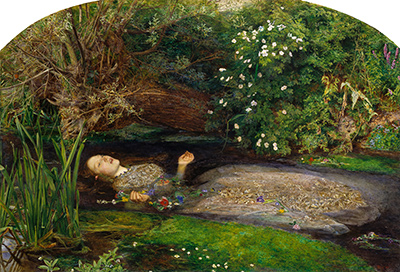
1848–49Ophelia
1851–52Autumn Leaves
1855–56Dew-Drenched Furze
1889–90Contents
- The sword, the armour and the red skirt
- What moment in Joan’s life is shown?
- The Victorian model and the Academy audience
- Joan in Ingres and Rossetti
- Exhibitions and whereabouts
- Annotated details
The sword, the armour and the red skirt
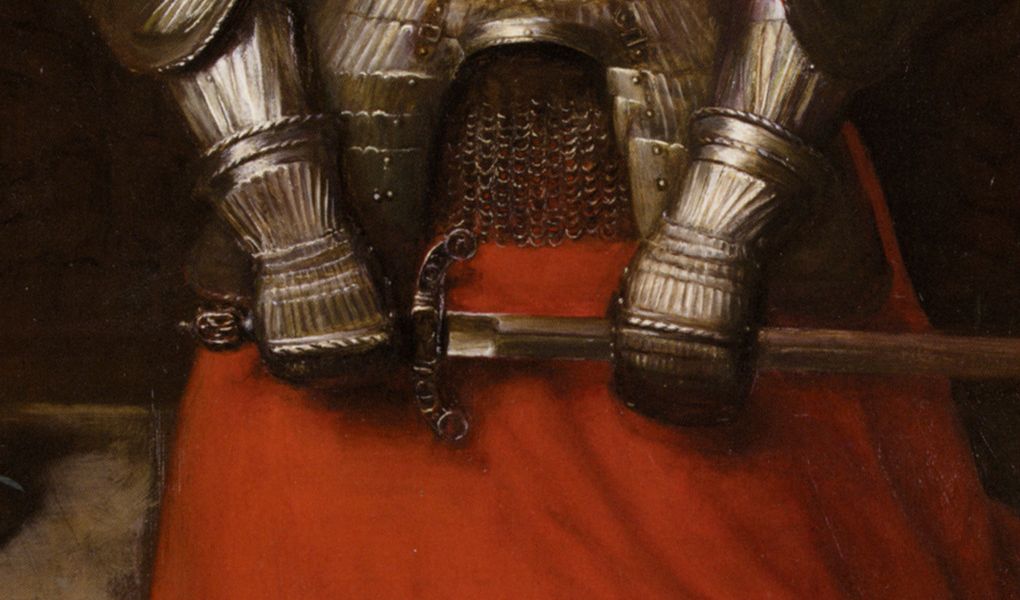
The sword lies almost level across Joan’s skirt. One gauntlet is near the hilt and the other rests farther along the weapon. The spacing between her hands lets the blade carry the eye across the figure and out towards the edge of the canvas. Her gaze takes it upwards again. Although her shoulders face us squarely, the tilt of her chin keeps her attention beyond us. The steady hands and the searching look give the pose the tension of someone waiting for an answer. [1] [2]
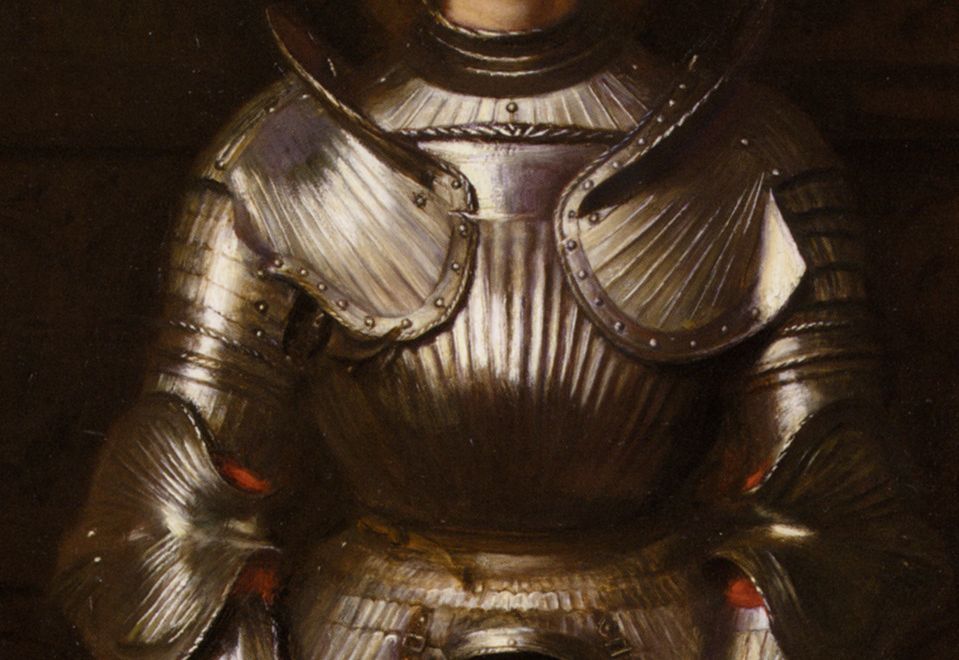
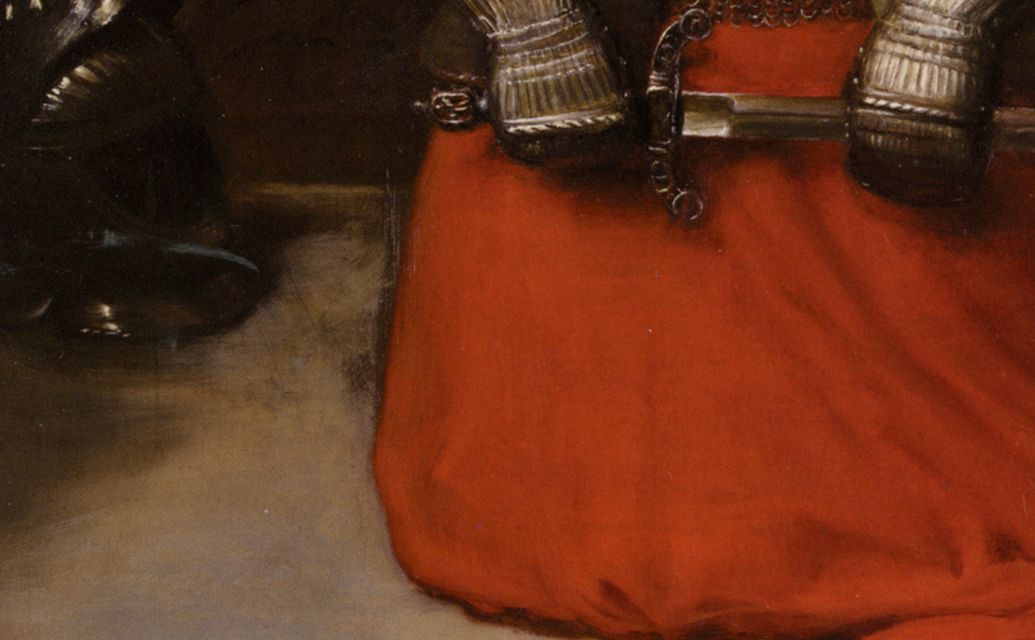
Millais paints the different surfaces in close company. Pale highlights gather in strips along the ridges and curves of the breastplate. Below, the finer pattern of mail shows between the larger plates and the skirt. The red cloth takes the light in broad folds and pools on the floor, making the grey of the armour look cooler. Behind Joan are the divisions of dark panelling. They run across the room at the level of her shoulders and elbows but recede into shadow. The smooth floor gives the helmet a place of its own, low at the left, with a few sharp reflections that echo the brightness around Joan’s wrists. The uncovered face is the warmest patch of light above the skirt. [1] [2]
The brightness of the armour was conspicuous to viewers in 1865. Sotheby’s later catalogue cites The Art Journal for its praise of the painted steel and reports that The Times thought the armour drew some attention away from the head. The same Times review also saw pain, uncertainty and religious conviction in Joan’s expression. Those are two responses to the same arrangement. It takes time for the eye to leave the bright metal, just as it takes time to settle on an emotion in the face above it. [1]
What moment in Joan’s life is shown?
The French museum devoted to Joan in Rouen traces the voices to her childhood in Domrémy. Joan said she began to hear them at about thirteen and identified them with Michael, Catherine and Margaret. In the closing decades of the Hundred Years’ War, she went to see the dauphin Charles, took part in the relief of Orléans and was present at his coronation as Charles VII at Reims in 1429. She was captured the following year and executed at Rouen in 1431 after an ecclesiastical trial. The verdict was annulled in 1456. Her canonisation came in 1920, long after Millais’s painting. [4]
The voices help explain what a nineteenth-century viewer could imagine Joan attending to. The picture leaves the experience with her. We see no saint above the figure and hear nothing of the words to which she might be listening. Joan already wears armour, so the image brings the later warrior into a pose that can recall her earlier calling without establishing a particular event. The Grosvenor Gallery’s 1886 catalogue described a crisis in her fortunes and remarked on how restrained her pose was beside other treatments of the subject. That reading fits a picture in which the story has been narrowed to a set of physical decisions. She kneels bareheaded and holds on to her sword. [1] [2] [4] [5]
The pairing of armour and skirt has invited different readings. Clare Broome Saunders sees the close interior, neatly arranged hair and full red skirt as giving the warrior the appearance of a young Victorian woman. Dorota Osińska emphasises how the picture lets maidenhood and chivalry coexist. The clothes give both readings something to hold on to. The skirt suggests the dress of a model in the painter’s own world, while the armour implies the public responsibilities of the person she plays. In the face and hands, the effort of maintaining the pose belongs to one woman. [6] [7]
The Victorian model and the Academy audience
John Guille Millais names Miss Muir Mackenzie as the model in the chronological list of his father’s oil paintings. In the same book he identifies the sitter for Esther, also exhibited in 1865, as Susan Ann Mackenzie, and relays a studio recollection that calls her Miss Muir Mackenzie. That makes Susan a plausible identification for the model in Joan of Arc. The entry for Joan gives only the surname. The National Portrait Gallery records Susan Anne Eliza Muir-Mackenzie by her full name in Julia Margaret Cameron’s 1865 photograph Boadicea. The photograph documents Susan posing as another historical heroine in the same year. [3] [8] [9]
The Academy’s 1865 exhibition gave viewers several examples of how Millais set a figure from the past before them. Esther was shown alongside Joan of Arc and The Romans Leaving Britain. With Esther, the exhibition register preserves a biblical quotation placing the queen at the point when she enters the king’s court. The record for Joan of Arc gives the name alone. The Examiner took the availability of the subject to British viewers for granted. In its May 1865 review, the paper argued that an English audience could recognise both religious conviction and patriotism in the French heroine’s resistance. The political and devotional meanings of the picture could travel together even across the old lines of the war. [3] [10]
A letter from Millais to his wife Effie catches him at work on several of these pictures. He reports that Joan of Arc had gone, that he had begun duplicates of Esther, and that he was expecting the dealer Agnew to send for another painting. Naoko Asano, writing in the bulletin of Japan’s National Museum of Western Art, places that letter among the evidence for Effie’s role in the business of the studio. The note catches a moment when pictures that the Academy had shown together were taking different paths through the studio and into the market. [8] [11]
Joan in Ingres and Rossetti
Ingres chose an identifiable ceremony for his 1854 painting at the Louvre. His Joan stands at the coronation of Charles VII in Reims Cathedral, with one hand resting on the altar and the other carrying her standard. The blue cloth strewn with gold fleurs-de-lis, the vessels on the altar and the accompanying figures supply the setting and the occasion. The Louvre records that the canvas was shown in Orléans during the Joan festivities of 1854. Millais also gives his Joan a helmet she has set aside. In Ingres, the helmet lies on the altar steps and the standing figure belongs to a company of witnesses. In Millais, it lies beside a kneeling figure whose response we have to read from her face. [1] [2] [12]
Dante Gabriel Rossetti made the sword the object of a devotional gesture. In his 1863 oil in Strasbourg, Joan lifts it to her lips. The tighter framing brings her face and the gesture close to the viewer. Millais keeps Joan’s mouth, hands and sword apart and turns her attention upwards. The differences matter because the armour and sword were already familiar ways to identify the heroine. [1] [13]
A Chilean Museo Histórico Nacional study makes the point from a different direction. In José Mercedes Ortega’s 1897 picture of Inés de Suárez, the museum recognises the same combination of red dress, armour and sword as an established costume of Joan imagery. Ortega’s figure raises her weapon as she takes a leading role in the Spanish defence of Santiago in 1541. The red skirt, armour and sword can serve an action scene just as readily as they can focus attention on Millais’s solitary figure. [1] [14]
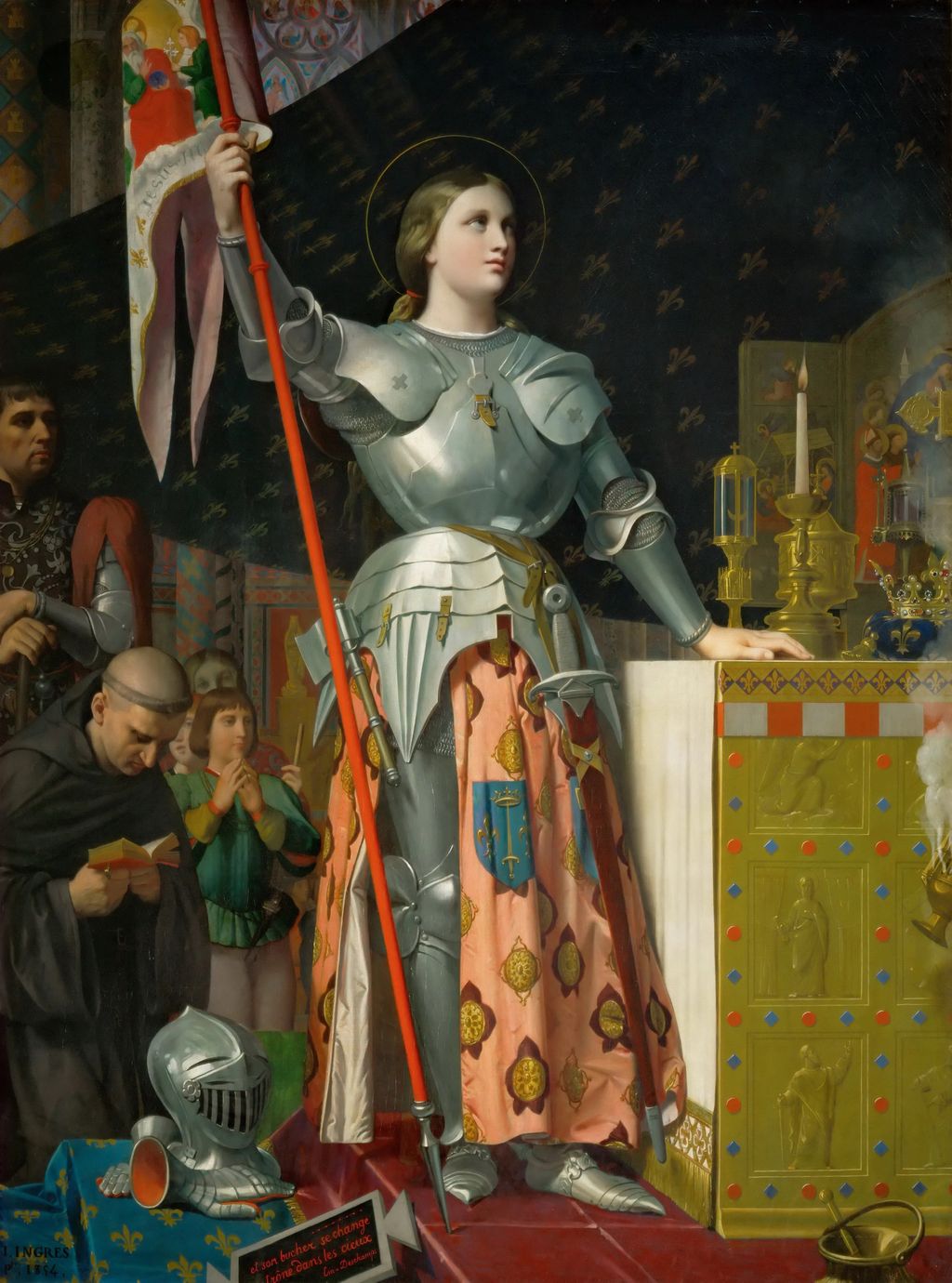
Jean-Auguste-Dominique Ingres, Joan of Arc at the Coronation of Charles VII, 1854. Louvre, MI 667. The standard and altar place Joan at a public coronation. Image source. Public domain.
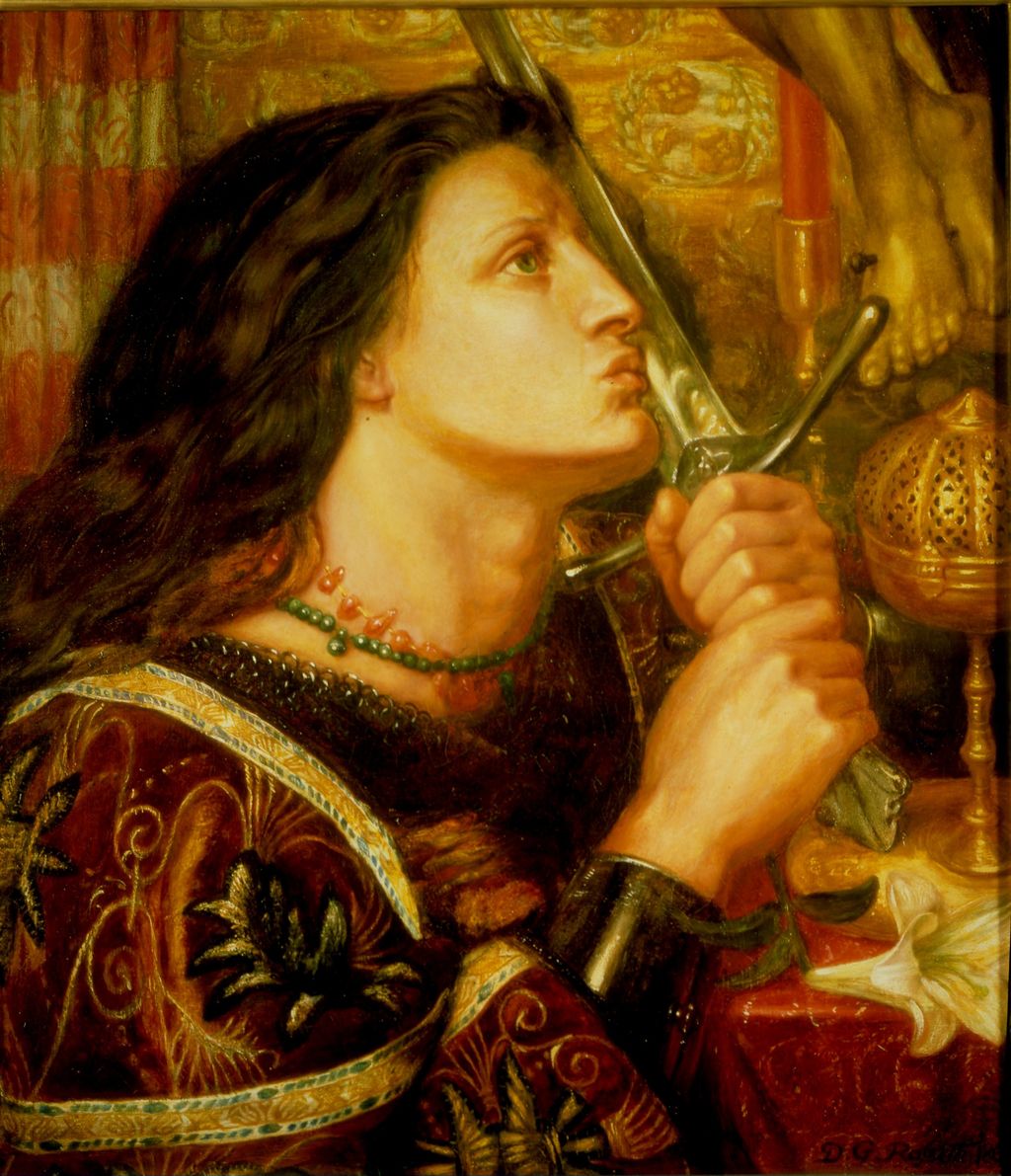
Dante Gabriel Rossetti, Joan of Arc Kissing the Sword of Deliverance, 1863, oil on canvas. Musée d’Art moderne et contemporain de Strasbourg, 55.996.8.1. Rossetti places the blade at Joan’s lips and frames the gesture close to the viewer. Image source. Public domain.
Exhibitions and whereabouts
Both the Grosvenor Gallery in 1886 and the Royal Academy’s memorial exhibition in 1898 named William Cuthbert Quilter as the lender. At the latter show the canvas was no. 16. Sotheby’s traces the ownership back to Frederick T. Turner and records that Agnew bought it at his 1878 sale and that the picture appeared again at Quilter’s 1909 sale. It also records the 1922 exhibition at the Walker Art Gallery, the 1967 retrospective in Liverpool and London, and an extended historical loan to the Fitzwilliam Museum in Cambridge. [1] [2] [5]
Sotheby’s listed the painting in London in November 1999 as lot 138 and offered it again on 27 November 2003 as lot 25 in Important British Pictures. The 2003 catalogue describes it as coming from a private collection. The painting’s present whereabouts are unconfirmed. [1] [15]
Annotated Details from Joan of Arc
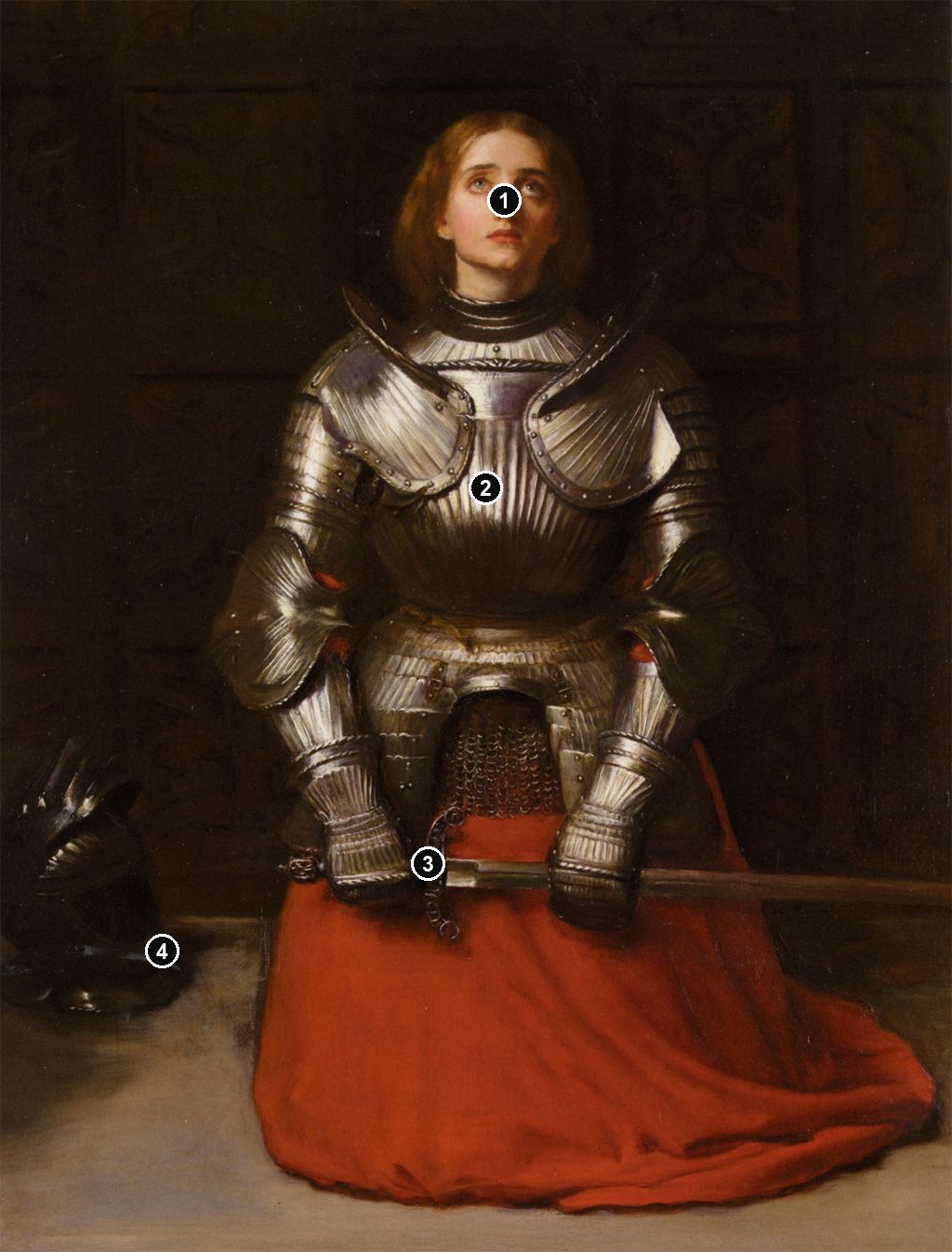
The numbered points identify visible features discussed in this article. Return from each detail to the numbered overview. Joan of Arc, oil on canvas, 1865. Image source. Public domain.
Details from JOAN OF ARC
Compare the cropped details with the source images above. Notice how their colours, shapes and positions contribute to the larger compositions.
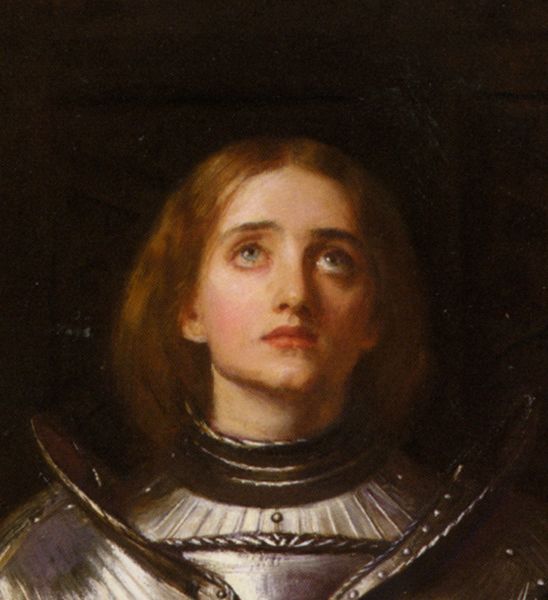
The lifted face
Joan looks upwards, above the level of her shoulders. Her face is lit against the dark interior, with space above her gaze.
Reflections on the armour
Raised ridges and plate edges gather light across the breastplate and shoulders. The unarmoured face stands apart from those hard, repeated surfaces.
Gloved hands and the sword
The blade extends across the lower part of the armour. The two hands hang close to the sword while the head stays lifted.
Helmet and red skirt
The dark helmet has been set aside at left. Beyond it, the skirt spreads over the floor and carries the brightest colour to the lower edge.
John Everett Millais artwork directory
Browse paintings and drawings covered in these articles, including related works held in public collections. Reproductive engravings and editions are discussed on the Prints page.
Prints and illustrated editions
- The Baby-House, 1872. Etching by Millais.
- The Good Shepherd, 1864. Wood engraving designed by Millais, engraved and printed by the Dalziel Brothers.
- Mariana, 1857. Wood engraving designed by Millais and cut by the Dalziel Brothers for the Moxon Tennyson.
- The Proscribed Royalist, 1858. Mixed-method engraving by William Henry Simmons after Millais.
| Name | Date | Medium |
|---|---|---|
| Pizarro Seizing the Inca of Peru | 1846 | Painting |
| The Young Men of Benjamin Seizing Their Brides | 1847 | Painting |
| Isabella | 1848–49 | Painting |
| Christ in the House of His Parents (‘The Carpenter’s Shop’) | 1849–50 | Painting |
| Ferdinand Lured by Ariel | 1849–50 (monogram dated 1849) | Painting |
| Study for Christ in the House of His Parents, Tate N04623 | c. 1849 | Drawing |
| Study for Christ in the House of His Parents, Tate N04792 | c. 1849 | Drawing |
| Study for Mariana in the Moated Grange | 1850 | Drawing |
| A Huguenot, on St Bartholomew’s Day, Refusing to Shield Himself from Danger by Wearing the Roman Catholic Badge | 1851–52 (exhibited 1852) | Painting |
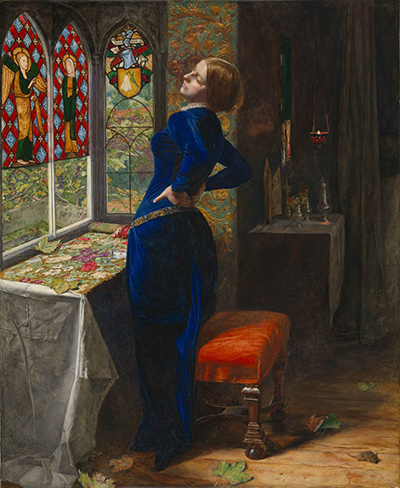
| Mariana | 1851 | Painting |
| Ophelia | 1851–52 | Painting |
| The Bridesmaid | 1851 | Painting |
| The Return of the Dove to the Ark | 1851 | Painting |
| The Order of Release 1746 | 1852–53 | Painting |
| The Proscribed Royalist, 1651 | 1852–53 (exhibited 1853) | Painting |
| Portrait of John Ruskin | 1853–54 | Painting |
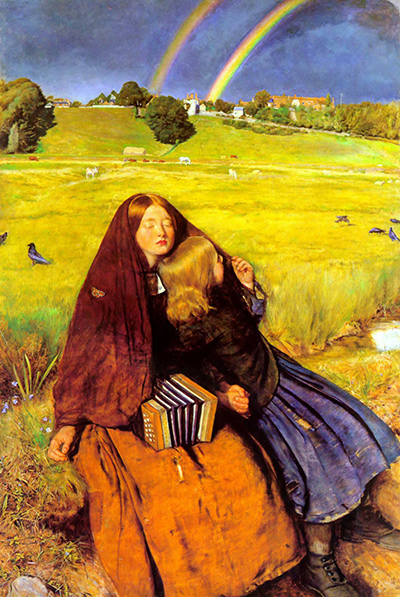
| The Blind Girl | 1854–56 | Painting |
| Autumn Leaves | 1855–56 (Manchester labels 1856) | Painting |
| A Dream of the Past: Sir Isumbras at the Ford | 1856–57, later revised | Painting |
| The Vale of Rest | 1858–59 | Painting |
| Study for The Black Brunswicker, Tate A00812 | c. 1860 | Drawing |
| Study for The Black Brunswicker, Tate A00813 | c. 1860 | Drawing |
| Study for The Black Brunswicker, Tate A00814 | c. 1860 | Drawing |
| The Black Brunswicker | 1860 | Painting |
| The Ransom | 1860–62 | Painting |
| My First Sermon | 1863 | Painting |
| My Second Sermon | 1864 | Painting |
| Joan of Arc | 1865 | Painting |
| Chill October | 1870 (exhibited 1871) | Painting |
| The Boyhood of Raleigh | 1870 | Painting |
| The Knight Errant | 1870 | Painting |
| Hearts are Trumps | 1872 | Painting |
| The North-West Passage | 1874 | Painting |
| Louise Jane Jopling | 1879 | Painting |
| William Ewart Gladstone, NPG 3637 | 1879 | Painting |
| Bubbles | 1886 | Painting |
| Portia | 1886 | Painting |
| Dew-Drenched Furze | 1889–90 | Painting |
| Ducklings | 1889 | Painting |
| Portrait of Sarah Hammond | 1891 | Painting |
Discussion
Look again at the images and ideas explored in Joan of Arc. These editorial prompts invite your observations.
Reader Insights
What happens to your reading if you start at the sword and follow the armour up to Joan’s face?
How does the place where Millais sets the helmet change the appearance of a figure otherwise wearing armour?
Join the Conversation
Share a detail, comparison or question about Joan of Arc below.
References
- Sotheby’s, Joan of Arc, lot 25, Important British Pictures, London, 2003. View source.
- Royal Academy of Arts, Exhibition of Works by the Late Sir John Everett Millais, 1898 Winter Exhibition catalogue, no. 16. View source.
- Algernon Graves, The Royal Academy of Arts, vol. V, p. 245, entries for 1865. View source.
- Historial Jeanne d’Arc, Dossier pédagogique, sections on Joan’s voices and chronology, Rouen. View source.
- Grosvenor Gallery, Exhibition of the Works of Sir John E. Millais, London, 1886, no. 11. View source.
- Clare Broome Saunders, Re-reading the Legend: Medievalism as a Discourse of Empowerment in the Work of Women Writers and Artists, circa 1830–1900, Durham University, 2005, pp. 176–177. View source.
- Dorota Osińska, ‘Womanhood, Liminality, and Christian Iconography: Augusta Webster’s “Jeanne D’Arc”’, Explorations, vol. 11, 2023, note 2. View source.
- John Guille Millais, The Life and Letters of Sir John Everett Millais, account of Esther and appendix, chronological list of oil paintings. View source.
- National Portrait Gallery, Julia Margaret Cameron, ‘Boadicea’ (Susan Anne Eliza Muir-Mackenzie), 1865, NPG x18026. View source.
- The Examiner, Royal Academy review, 13 May 1865, issue 2989. View source.
- Naoko Asano, ‘More than models and muses: The women of John Everett Millais’ domestic circle and their contributions’, Bulletin of the National Museum of Western Art, no. 25, p. 15 and note 35. View source.
- Musée du Louvre, Jean-Auguste-Dominique Ingres, Jeanne d’Arc au sacre du roi Charles VII, dans la cathédrale de Reims, 1854, MI 667. View source. (in French).
- Ministère de la Culture, Joconde, Dante Gabriel Rossetti, Jeanne d’Arc embrassant l’épée de la Délivrance, Strasbourg, 1863, 55.996.8.1. View source. (in French).
- Museo Histórico Nacional, Chile, José Mercedes Ortega, Inés de Suárez en defensa de la ciudad de Santiago, in El mundo es uno solo y diverso, p. 127. View source.
- Sotheby’s, Important British Pictures, L03123, London, 27 November 2003, listing for lot 25. View source.