 by Tom Gurney
Tom Gurney BSc (Hons) is an art history expert with over 20 years experience
Published on June 19, 2020 / Updated on November 25, 2026
Email: tomgurney1@gmail.com / Phone: +44 7429 011000
The Knight Errant: Introduction
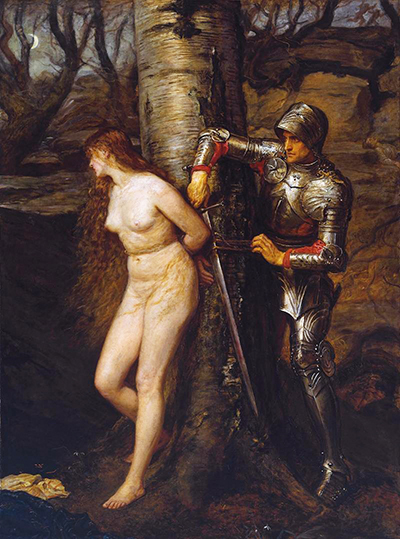
A knight in armour leans across a tree trunk to cut the bonds of a woman. She turns her face into the shadows. Behind them, two figures are fleeing through the trees, and a man lies on the ground at the right. John Everett Millais painted The Knight Errant in 1870 and showed it that year at the Royal Academy. At 184.1 by 135.3 centimetres, the Tate oil painting gives the two principal figures almost the presence of people standing in front of us. The woman's turn away feels decisive at that scale. It was also a decision Millais made after the picture was first shown. [1] [2] [3] [4]
At a Glance
- Date1870 [1]
- MediumOil on canvas [1]
- CollectionTate, N01508 [1]
- SubjectA knight frees a woman tied to a tree in a moonlit wood [1][3]
This work across John Everett Millais’s career
Isabella
1848–49Ophelia
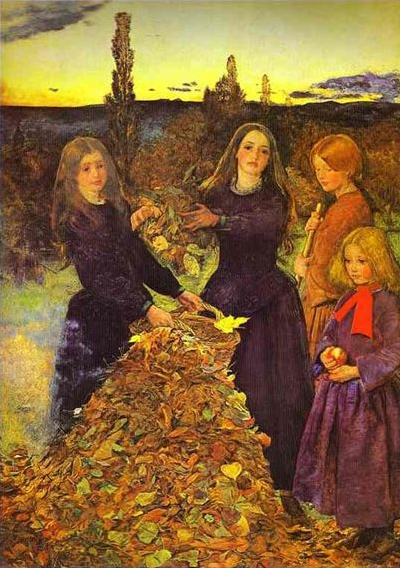
1851–52Autumn Leaves
1855–56Dew-Drenched Furze
1889–90Contents
- A rescue at close quarters
- The chivalry of the title
- Why the nude drew criticism
- The face Millais replaced
- From Andromeda to Yokohama
- Annotated details
A rescue at close quarters
Millais sends the eye into the woods and pulls it sharply back. A slender moon and the distant men give the scene a depth that the two figures in front almost close off. The pale upright of the silver birch makes a division between them. The woman stands on one side, the knight braces himself on the other, and his blade crosses the divide. He bows his head to see what he is doing. Below them, the flowers and cast-off clothes occupy the same foreground as the stones and the fallen man. Millais gives the rescue a before and an after in very little space. The fugitives, the blood on the sword and the figure on the ground suggest the violence that has just taken place. The loosened bonds are still a moment away. [1] [3] [4]
Light does as much as the sword to link the two sides of the canvas. The knight's armour is broken up by bright seams, overlapping plates and warm accents. The woman's skin and the silvery bark give the eye much larger areas of pale colour to follow. The woodland sets off these surfaces, and is specific enough to seem like a place the figures could have entered from an ordinary road. Millais's son John Guille wrote that both figures were painted from models and that his father painted the woodland background at Wortley Chase. Tate curator Rebecca Virag relates the armour to examples Millais had seen in the Tower of London. A scene of imagined chivalry could thus be built up from close study of actual bodies, armour and trees. [3] [5]
The armour also has a part in the story. It protects the one figure free to move, and it allows him to reach into the woman's space while remaining physically separate from her. The art historian Judith Rauser reads the difference between skin and metal as a difference in power. The knight's encased body belongs to a world of craft and action. The captive has been deprived even of her clothes, and the light marks that vulnerability out across the room. The tree can feel like a screen he is trying to work around as much as a thing to which she is tied. It partly hides each figure from the other, even as the painting makes both available to the audience. [3] [6]
The chivalry of the title
A knight errant is a wandering knight in search of adventures through which he can show his chivalry. When the picture was first shown, entry 202 in the Royal Academy catalogue presented the order as one founded to protect widows and orphans and help young women in danger. Millais supplied the wording for the display. It invited visitors to see the sword as an instrument of rescue. The ordinary tree, the scattered clothes and the hurried movements visible in the distance take the place of the fuller histories that a named hero or a familiar story might have supplied. The picture gives the woman no name and leaves the details of her capture outside the frame. [3] [4] [6]
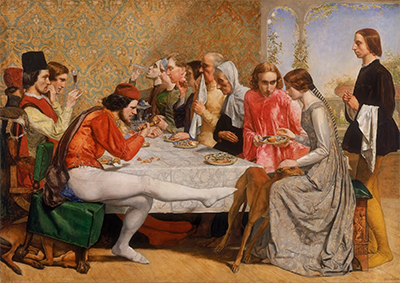
Millais had tried a different kind of chivalric scene in A Dream of the Past: Sir Isumbras at the Ford, exhibited in 1857. There a named knight carries two children across a river on horseback, in an incident the artist added to the medieval romance. The broad view makes room for the crossing and for the children to be seen with their protector. In the narrower Knight Errant, the central tree brings the rescue down to the distance an arm can reach. The work of helping involves a close encounter with someone exposed to view. It was her appearance, as much as the story of her rescue, that drew the attention of Academy reviewers. [3] [7]
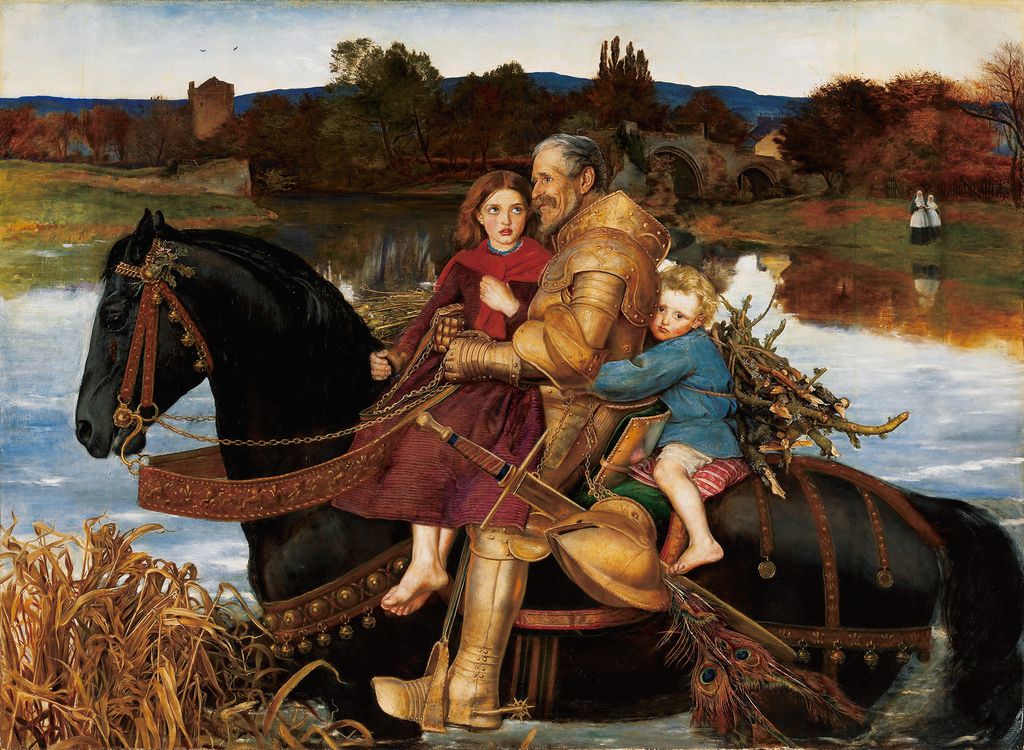
A Dream of the Past: Sir Isumbras at the Ford, oil on canvas, Lady Lever Art Gallery, LL3625. Millais’s earlier rescue uses an open ford and a crowded horse, setting a different distance between the figures and the viewer. Image source. Public domain.
Why the nude drew criticism
This was an unusual full-length treatment of the female nude for Millais. For a reviewer in the June 1870 Art Journal, Millais's treatment of the woman came too close to ordinary life. The reviewer set her against the nudes of artists such as Frederic Leighton and George Frederic Watts, whose figures seemed to belong more readily to the world of myth and imagination. The Athenæum also registered the difference between the convincing equipment of the knight and a woman whose appearance brought the living model to mind. The painter had taken care over things the audience could recognise, down to the pressure of the bonds. Such attention helped viewers believe in the rescue and also made the nude harder to see as a conventional figure from romance. [3] [6] [8]
Virag situates the painting in an English tradition of painting the nude associated with William Etty, whom Millais admired. Etty's Britomart Redeems Faire Amoret offers an older version of the armed rescuer and the bound woman. Etty had a named story to turn to in Edmund Spenser's The Faerie Queene, where Britomart enters the chamber of a sorcerer holding Amoret. Millais had a brief catalogue statement of purpose, and some viewers drew their own conclusions about the woman. The dispute over her appearance could slide into a judgement of her character, with an implied suspicion that she was responsible for her predicament. The picture itself supplies no grounds for that verdict. The same Academy exhibition included Edward Poynter's Andromeda, a smaller canvas of a chained woman. As Rauser points out, this more idealised female nude was favourably received. A subject that could win approval under the sign of ancient myth proved harder to accept when it looked so much like an encounter between living people. [3] [6] [9]
The painting's later reception shows how much these judgements could change. John Guille Millais remembered the public outcry as prudery and defended his father's handling of the subject. The early biographer A. L. Baldry likewise found the treatment discreet and praised it as an achievement in drawing and painting the nude. Both were writing with the benefit of hindsight, after Millais had altered the picture and it had passed from private hands into a public collection. Their praise helps explain how a work that troubled the first reviewers could come to be held up as an example of propriety. [3] [5] [10]
The face Millais replaced
The crucial change affected the woman's head and upper body. In Virag's account of Tate's X-ray evidence, the earlier head and torso turned towards the knight. The encounter originally allowed for eye contact. As the painting went unsold after the initial criticism, Millais cut out the section of canvas carrying the head and chest and painted a replacement for that area, with the woman turning her face away. John Guille remembered the picture hanging at home in Cromwell Place and recalled the earlier woman looking out at the spectator. Tate's reading places the line of sight towards the knight. Both accounts trace the averted face to a decision Millais made after working up the figure. The physical evidence carries the story further, because the earlier face survives in a different picture. [3] [5] [11]
Millais had the extracted piece sewn into another canvas. He incorporated it into The Martyr of the Solway, dated by the Walker Art Gallery to about 1871 and, according to Virag, exhibited in 1872. The Walker picture represents Margaret Wilson, a Scottish Covenanter who was bound and left to drown as the tide rose. Millais clothed the figure and adapted the face for its new setting. A radiograph of the Walker painting reproduced by Franco Moretti shows traces of the earlier figure beneath the visible image. Compare the finished works and the difference in the scale of the story is striking. The Walker painting gives one named woman the space almost entirely to herself, while the Tate picture divides attention between two people caught in an action. The reusable piece had carried a figure from one narrative of captivity into another. [3] [11] [12]
The turn of the woman's face changes the rhythm of the rescue. In the present picture, the knight's eyes stay with his task and hers are directed away. The movement that joins them is the reaching of his sword arm. In the earlier arrangement, as Tate describes it, the woman's look would have provided a line back across the gap. It is easy to imagine that this would have made the instant feel like a meeting as well as a rescue. The revision leaves the outcome of the action clear while making it harder to guess what either person means to the other. [1] [3] [6]
From Andromeda to Yokohama
The familiar story of Andromeda offers one way to see what Millais left open. Perseus finds her chained to a rock and saves her from a sea monster. Charles Kingsley and William Morris each retold the story in verse before Millais painted his scene. More than a century later, the Museo Thyssen-Bornemisza put The Knight Errant in the section on the chained Andromeda in its 2009 exhibition Lágrimas de Eros. In that setting the exposed woman and the armoured rescuer could be seen as a Victorian reworking of a familiar arrangement of bodies and power. Millais's darkness and the barrier of the tree give the arrangement its own character. His knight has to reach around the trunk, and the woman's danger is suggested by figures and objects the viewer must pick out in the dark. [2] [6] [13] [14]
The painting also found an attentive reader in Japan. In 1904 the painter Shimomura Kanzan made a smaller copy in water-based colour on paper while studying in England. The Yokohama Museum of Art, which holds the copy, draws attention to its handling of translucent skin and the texture of the armour. The shift in materials makes these features especially interesting. Kanzan had to translate effects that Millais built up in oils into colour on paper, while also compressing the full-length figures into a sheet a little over a metre high. The result is a record of how closely another painter studied the contrast between exposed skin and worked metal. [15]
After the revised oil sold in 1874, it eventually passed to Sir Henry Tate, who presented it in 1894. The Bowes Museum received it on loan in 1920 as part of an exchange with the Tate Gallery. A century later it returned for the Bowes exhibition The Pre-Raphaelite Knights. In that setting the armour and chivalric action were again prominent. Madrid had placed the emphasis on the bound figure eleven years earlier, while Kanzan had looked closely at the way the surface was painted. Each directs the eye back to the same meeting point, where the blade reaches across the bark and the two figures remain apart. [1] [2] [3] [5] [14] [15] [16]
Annotated Details from The Knight Errant
The numbered points identify visible features discussed in this article. Return from each detail to the numbered overview. The Knight Errant, oil on canvas, Tate, N01508. Canvas crop from a 2023 exhibition photograph. Rainer Halama (Wuselig). Image source. CC BY-SA 4.0. Frame cropped from the photograph. Numbered overview and detail crops use CC BY-SA 4.0.
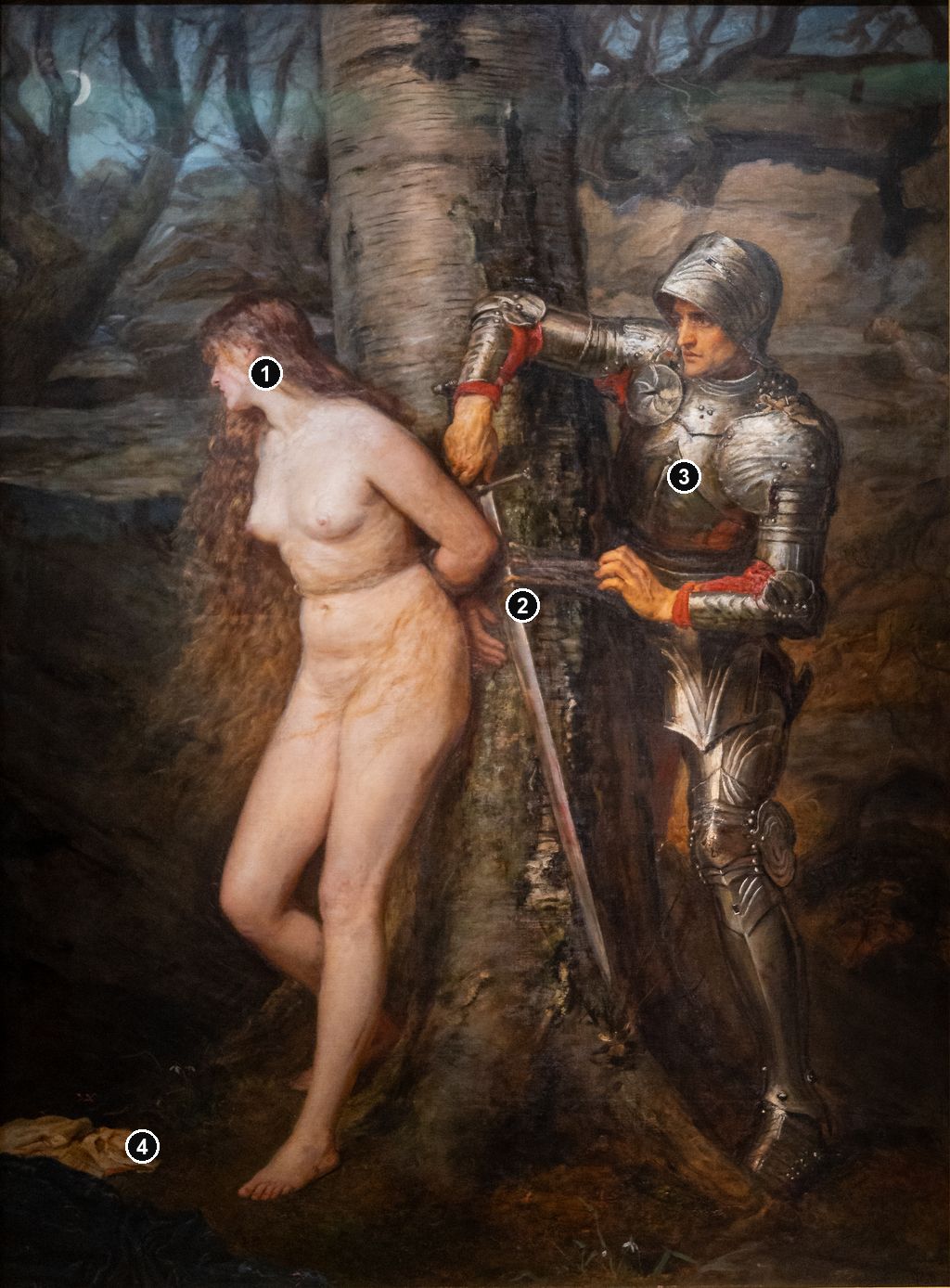
Details from THE KNIGHT ERRANT
Compare the cropped details with the source images above. Notice how their colours, shapes and positions contribute to the larger compositions.
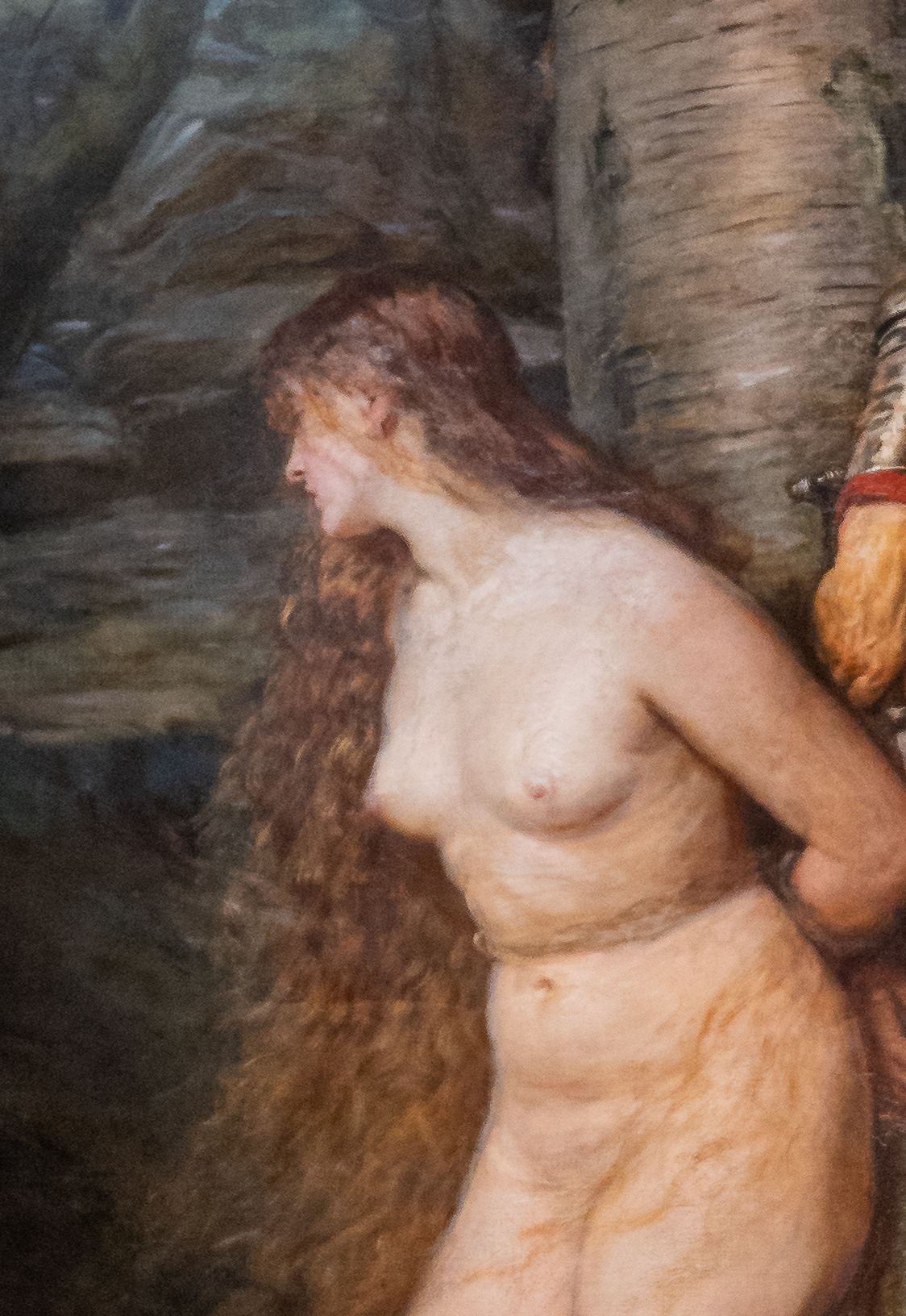
The woman looks away
The woman’s head turns to the side while her hands remain behind the trunk. The direction of her gaze separates her attention from the knight’s work.
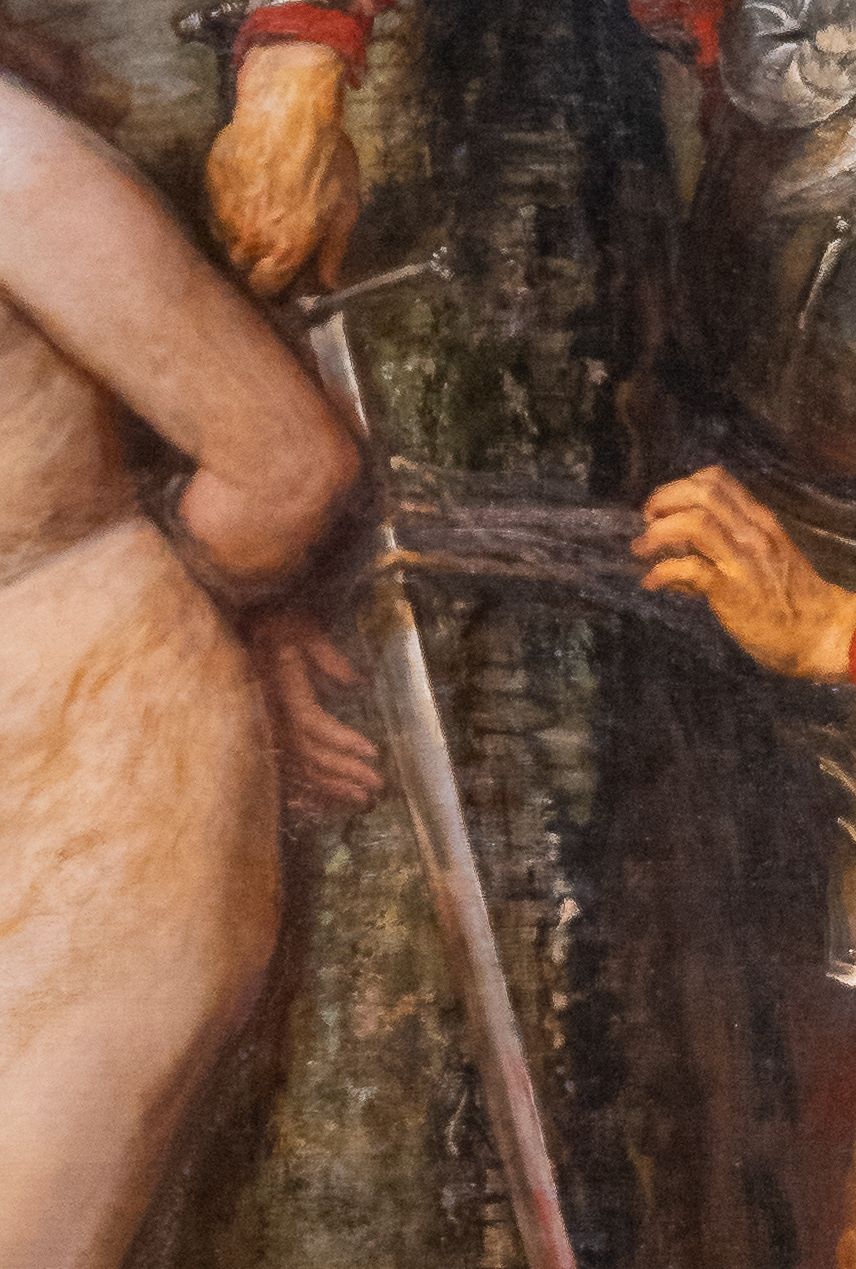
The bonds and the long blade
The binding crosses the pale tree trunk beside the knight’s hands. Follow the sword down from the point where he frees her.
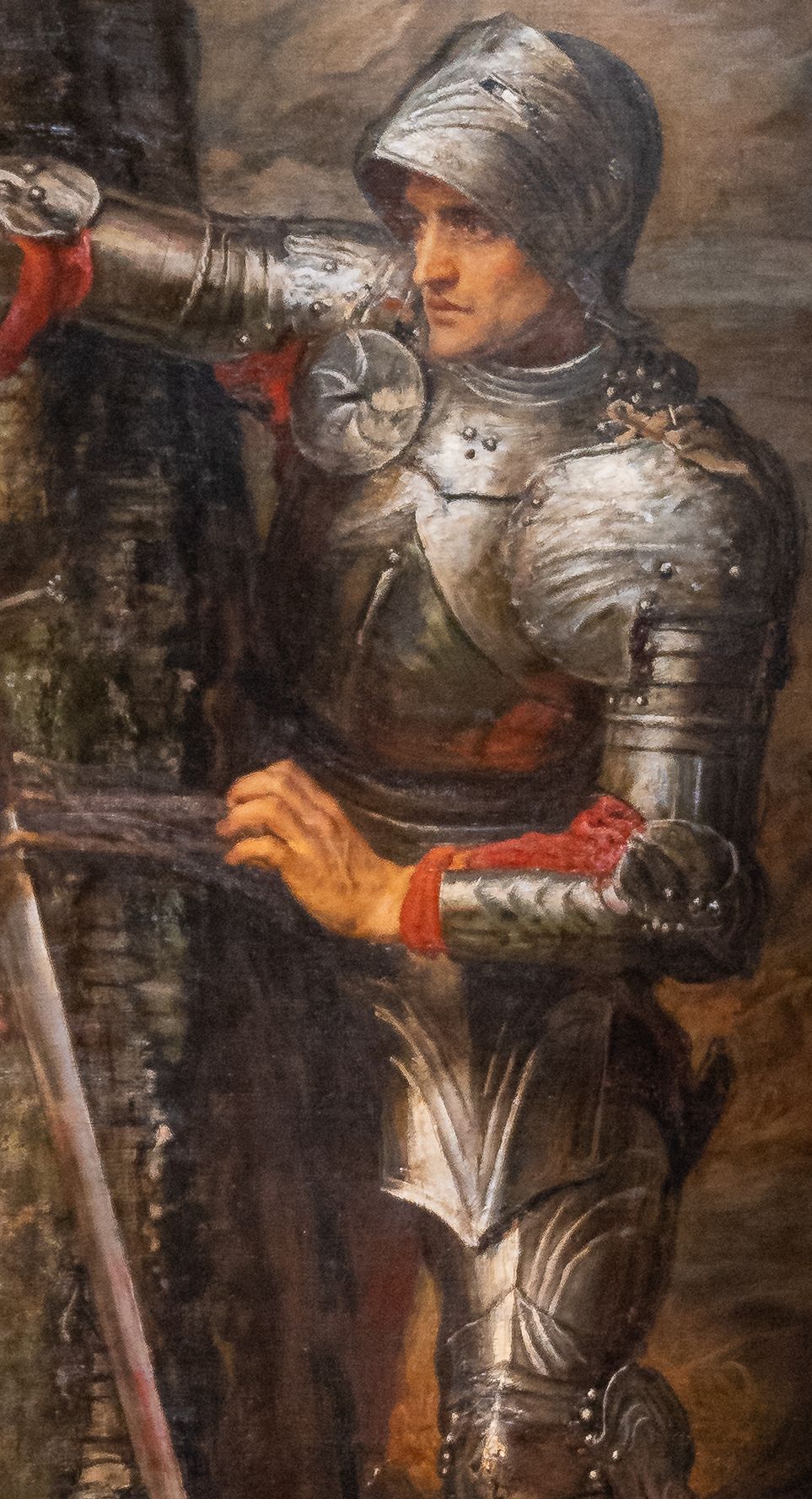
Armour against the tree
The upper plates catch the light in small strokes, while the trunk sends broader bands of light and shadow through the centre.
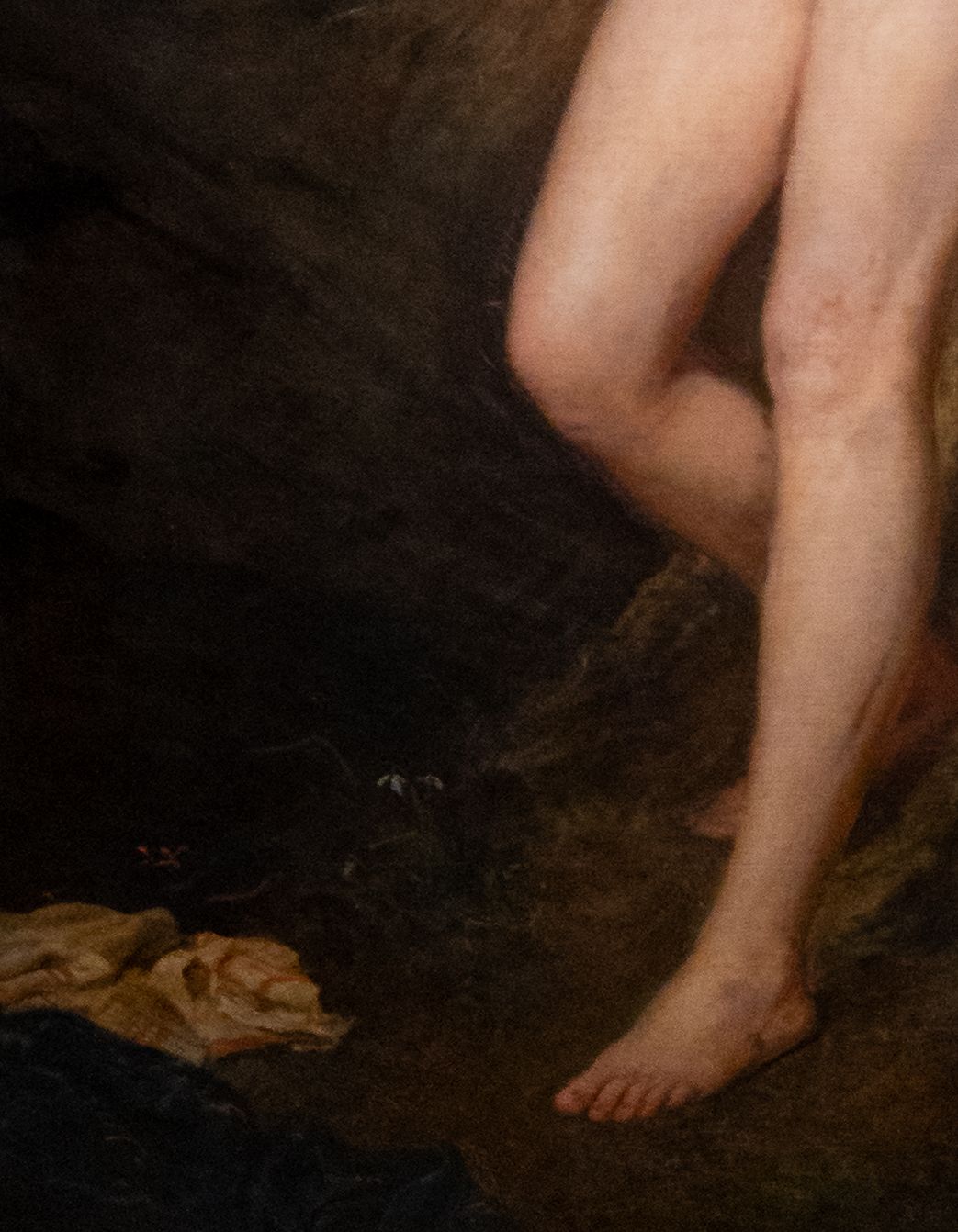
Clothing on the ground
A pale bundle interrupts the dark ground near the woman’s feet. It brings the danger and disorder of the scene into the foreground.
John Everett Millais artwork directory
Browse paintings and drawings covered in these articles, including related works held in public collections. Reproductive engravings and editions are discussed on the Prints page.
Prints and illustrated editions
- The Baby-House, 1872. Etching by Millais.
- The Good Shepherd, 1864. Wood engraving designed by Millais, engraved and printed by the Dalziel Brothers.
- Mariana, 1857. Wood engraving designed by Millais and cut by the Dalziel Brothers for the Moxon Tennyson.
- The Proscribed Royalist, 1858. Mixed-method engraving by William Henry Simmons after Millais.
| Name | Date | Medium |
|---|---|---|
| Pizarro Seizing the Inca of Peru | 1846 | Painting |
| The Young Men of Benjamin Seizing Their Brides | 1847 | Painting |
| Isabella | 1848–49 | Painting |
| Christ in the House of His Parents (‘The Carpenter’s Shop’) | 1849–50 | Painting |
| Ferdinand Lured by Ariel | 1849–50 (monogram dated 1849) | Painting |
| Study for Christ in the House of His Parents, Tate N04623 | c. 1849 | Drawing |
| Study for Christ in the House of His Parents, Tate N04792 | c. 1849 | Drawing |
| Study for Mariana in the Moated Grange | 1850 | Drawing |
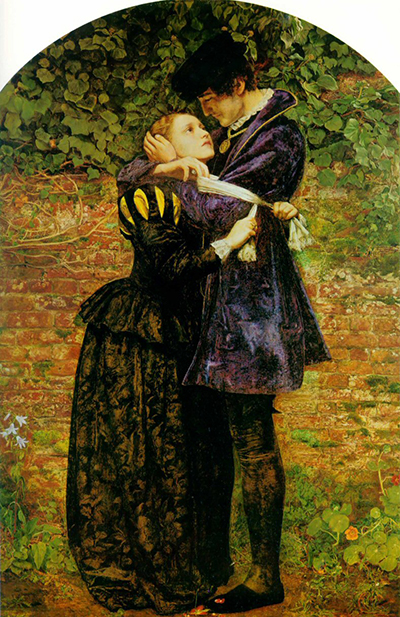
| A Huguenot, on St Bartholomew’s Day, Refusing to Shield Himself from Danger by Wearing the Roman Catholic Badge | 1851–52 (exhibited 1852) | Painting |
| Mariana | 1851 | Painting |
| Ophelia | 1851–52 | Painting |
| The Bridesmaid | 1851 | Painting |
| The Return of the Dove to the Ark | 1851 | Painting |
| The Order of Release 1746 | 1852–53 | Painting |
| The Proscribed Royalist, 1651 | 1852–53 (exhibited 1853) | Painting |
| Portrait of John Ruskin | 1853–54 | Painting |
| The Blind Girl | 1854–56 | Painting |
| Autumn Leaves | 1855–56 (Manchester labels 1856) | Painting |
| A Dream of the Past: Sir Isumbras at the Ford | 1856–57, later revised | Painting |
| The Vale of Rest | 1858–59 | Painting |
| Study for The Black Brunswicker, Tate A00812 | c. 1860 | Drawing |
| Study for The Black Brunswicker, Tate A00813 | c. 1860 | Drawing |
| Study for The Black Brunswicker, Tate A00814 | c. 1860 | Drawing |
| The Black Brunswicker | 1860 | Painting |
| The Ransom | 1860–62 | Painting |
| My First Sermon | 1863 | Painting |
| My Second Sermon | 1864 | Painting |
| Joan of Arc | 1865 | Painting |
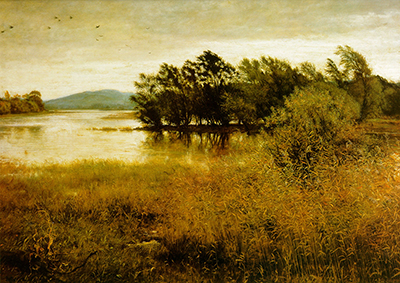
| Chill October | 1870 (exhibited 1871) | Painting |
| The Boyhood of Raleigh | 1870 | Painting |
| The Knight Errant | 1870 | Painting |
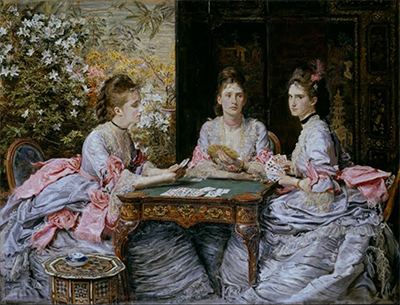
| Hearts are Trumps | 1872 | Painting |
| The North-West Passage | 1874 | Painting |
| Louise Jane Jopling | 1879 | Painting |
| William Ewart Gladstone, NPG 3637 | 1879 | Painting |
| Bubbles | 1886 | Painting |
| Portia | 1886 | Painting |
| Dew-Drenched Furze | 1889–90 | Painting |
| Ducklings | 1889 | Painting |
| Portrait of Sarah Hammond | 1891 | Painting |
Discussion
Look again at the images and ideas explored in The Knight Errant. These editorial prompts invite your observations.
Reader Insights
How does the group change when you follow the woman’s gaze before looking at the knight’s sword?
Which areas of moonlight help you understand the scene without reading the exhibition title?
Join the Conversation
Share a detail, comparison or question about The Knight Errant below.
References
- Tate, The Knight Errant, 1870, collection N01508. View source.
- Ministerio de Cultura, Boletín Oficial del Estado, order CUL/1966/2009, schedule entry 22, measurements and Tate loan. View source.
- Rebecca Virag, Tate Britain commentary on The Knight Errant, reproduced by Victorian Web. View source.
- Royal Academy of Arts, The Exhibition of the Royal Academy of Arts, 1870, p. 15, no. 202. View source.
- John Guille Millais, The Life and Letters of Sir John Everett Millais, printed p. 225. View source.
- Judith Rauser, Körper in Eisen, Universität Hamburg, section on Millais and fig. 49. View source.
- Royal Academy of Arts and the Paul Mellon Centre, The Royal Academy Summer Exhibition: A Chronicle, ‘1857: A “Catastrophe” at the Royal Academy’. View source.
- Mariam Hale, ‘Magic Casements’: Fantasy in Victorian Art, discussion of The Art Journal Academy review, June 1870, p. 164. View source.
- York Art History Collaborations, William Etty: Art and Controversy, Britomart Redeems Faire Amoret. View source.
- A. L. Baldry, Millais, discussion of the nude and plate III. View source.
- Franco Moretti, ‘Fog’, New Left Review 81, figs. 3–5, including the radiograph of The Martyr of the Solway. View source.
- Walker Art Gallery, The Martyr of the Solway, about 1871, collection text syndicated by Google Arts & Culture. View source.
- Sally King, ‘Nudes and Knights: Millais’s The Knight Errant’, Brown University art history essay. View source.
- Museo Thyssen-Bornemisza, ‘Andrómeda encadenada’, Lágrimas de Eros, chapter 6. View source.
- Sae Yatsuyanagi, Yokohama Museum of Art, Shimomura Kanzan’s copy of The Knight Errant, 1904, 88-DRJ-010. View source.
- The Bowes Museum, ‘Millais Returns to The Bowes Museum’, including curator’s report TBM/1/1/5/2. View source.