 by Tom Gurney
Tom Gurney BSc (Hons) is an art history expert with over 20 years experience
Published on June 19, 2020 / Updated on November 25, 2026
Email: tomgurney1@gmail.com / Phone: +44 7429 011000
The Black Brunswicker: Introduction
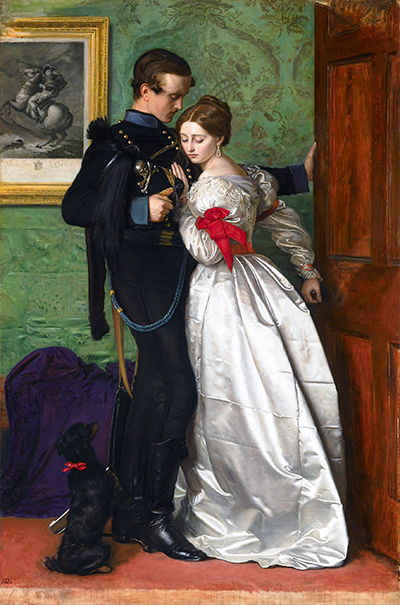
In John Everett Millais’s The Black Brunswicker, a soldier draws open a door and a woman in a white satin dress tries to keep it shut. Her right hand holds the handle, while her left presses against his chest. He looks down at her from close quarters, and a small dog sits up beside them. The scene imagines a farewell during the Waterloo campaign of 1815. Millais exhibited the oil on canvas at the Royal Academy in 1860. The original is in the Lady Lever Art Gallery collection at Port Sunlight, where it is numbered LL 3643. National Museums Liverpool also uses the title The Black Brunswickers. [1] [2] [3] [4]
At a Glance
- Date1860 [1][2][3]
- MediumOil on canvas [2]
- CollectionLady Lever Art Gallery, LL 3643 [2]
- Related versionReplica by John Everett and William Henry Millais, Royal Scottish Academy [5]
This work across John Everett Millais’s career
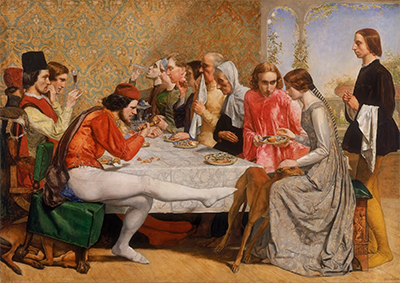
Isabella
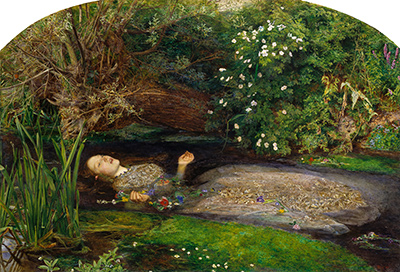
1848–49Ophelia
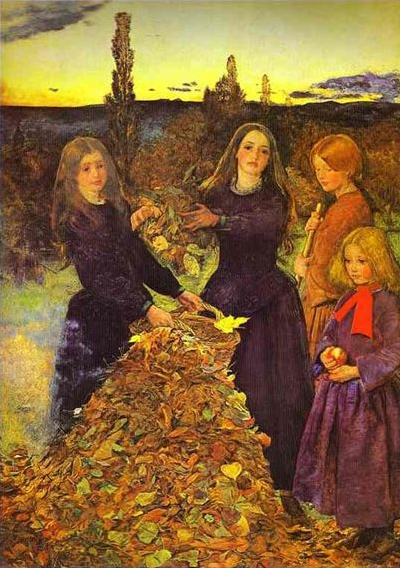
1851–52Autumn Leaves
1855–56Dew-Drenched Furze
1889–90Contents
- The struggle at the door
- The Black Brunswickers and the Waterloo campaign
- Costume and the two models
- Napoleon on the wall
- At the Royal Academy and after
The struggle at the door
The narrow composition gives the couple just enough room to lean in different directions. The soldier’s arm reaches across the top of the door, following the movement that would take him out of the room. His head bends towards the woman, still within reach of the hand she has spread on his chest. There are two kinds of contact in her pose, and it is worth tracing both. With one hand she touches him almost as she would in an embrace. With the other she acts directly on the door. A strip of shadow along its edge measures how far he has got. [2] [3]
The eye falls readily on the satin because it takes up so much of the lower canvas. The folds change from silver-grey to white where they catch the light, and the red bows mark where the fabric gathers at the sleeve and waist. The dark jacket absorbs more of the light, although small metal highlights and lines of braid give it shape. Against the smooth expanses of the dress, the patterned wall looks particularly dense. At floor level the dog’s ribbon repeats the red above, and its lifted head redirects attention to the couple. The animal can be read as a companion responding to the disturbance, or as a smaller echo of the woman’s appeal. [2] [6]
The Black Brunswickers and the Waterloo campaign
The death’s-head badge on the tall cap in the soldier’s hand places the scene in the history of Brunswick. The Braunschweigisches Landesmuseum traces the name Schwarze Schar, or Black Band, to the black dress and skull badge of the volunteer corps raised in 1809 by Duke Friedrich Wilhelm of Brunswick-Oels. After the Napoleonic occupation, the corps made its way to the North Sea and the duke went into exile in Britain. When he returned to Brunswick, he raised a new force in 1814. Costume historian Ann Nix points out that the name Black Brunswickers was applied to both formations, and that men of the earlier corps had also served with the British army. [6] [7]
The duke died at Quatre Bras on 16 June 1815, two days before Waterloo. A print in the National Army Museum depicts his death on the battlefield. Millais chose a moment indoors, before an unnamed member of the corps leaves his companion. The Duchess of Richmond’s ball in Brussels on 15 June provides one possible context for the formal dress and hurried farewell, although the painting supplies few clues to a particular address or occasion. Nix also points out that attendance at the ball was restricted and that the soldier’s uniform includes details associated with ordinary troopers. John Guille Millais, writing about his father’s painting decades later, allowed for either the eve of Waterloo or that of Quatre Bras. [4] [6] [7] [8]
Costume and the two models
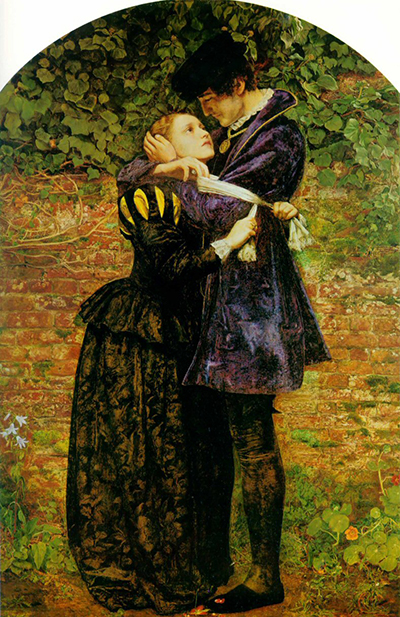
Millais sought information about the Brunswick cavalry from William Howard Russell, the war correspondent of The Times. In a letter to his wife Effie dated 18 November 1859, he described his ambition to make a companion to A Huguenot. He first imagined the woman sewing a band of black mourning crêpe around her sweetheart’s arm while begging him to stay. In A Huguenot, a woman tries to fasten a white badge to protect her lover, and he pulls it loose while holding her close. By the time Millais painted the Brunswicker, the door handle had taken over the dramatic work of the band. Her fingers now have something solid to hold, and the dark opening records how much ground she has already lost. [4]
The search for military information gave Millais particulars he could use selectively. In Nix’s analysis, the blue and yellow sash recalls the duke’s cavalry, while details such as the trousers tucked into the boots are consistent with Brunswick hussars in British service. She observes that the jacket’s bright buttons depart from the black buttons she found on historical examples. The young woman’s hair and the full silhouette of her satin dress suggest the 1830s or early 1840s to Nix. A fashionable gown of 1815 might have had a higher waist and far less volume. The dress in the painting makes the woman’s position at the door visible from across an exhibition room, its light surface spreading across the space where the hussar needs to pass. [6]
Katey Dickens, the younger daughter of Charles and Catherine Dickens, posed for the woman. She had taken art lessons as a teenager and went on to exhibit work herself at the Royal Academy under her married name, Kate Perugini. Millais’s son remembered that the man was a private from the 1st Life Guards whom the painter selected after seeing the regiment on parade. Their closeness in the painting was assembled from separate sittings. According to the same family account, the soldier held a lay figure, a wooden studio model, and Katey leaned against one for her part of the pose. Her recollection of the sittings, printed in the family biography, describes being asked to step down and look at the picture when Millais felt he could no longer judge what he was seeing. [4] [9]
Napoleon on the wall
The framed print above the couple reproduces Jacques-Louis David’s composition of Napoleon crossing the Alps at the Great Saint Bernard Pass. The first painting, now at Malmaison, was commissioned by Charles IV of Spain after the French army crossed the Alps in May 1800. Napoleon commissioned further versions, with variations in the horse, cloak and harness. The small image in Millais’s room can be identified by the rearing horse and raised arm without assigning it to a particular version or surviving print. [10] [11]
David showed Napoleon, then First Consul, directing movement across a mountain pass. In Millais’s room that confident gesture survives at the scale of a framed print. Below it, a different cavalryman has yet to get through a domestic door. The horse turns our attention upwards while the little dog, which also rises on its hind legs, brings it back down. Historian Georg Eckert reads the woman’s averted gaze as a refusal to share the priorities suggested by the two martial figures. In that reading, her action puts the private cost of the campaign in view. The presence of Napoleon could also be read as a clue to her sympathies. The catalogue writer for Millais’s 1886 Grosvenor Gallery exhibition tentatively proposed just that, showing how much viewers were willing to infer from the room’s furnishings. [12] [13]
At the Royal Academy and after
On 2 May 1860, Millais wrote to Effie that he had retouched the woman at the Academy. He called the result “by far the most satisfactory work I ever sent there”. His son later remembered enthusiastic visitors and a cooler press. The reviews themselves show how differently the small gestures could be understood. The Examiner saw quiet resignation in the woman’s face and treated the dog as a reminder of happier times. The Spectator review, as transcribed by Paolo Giudici, imagined that the woman had revealed the depth of her feelings only in trying to stop the departure. The first reading gives the pair a long intimacy, while the second makes the woman’s hand on the door an unexpected confession. [4] [14] [15]
According to the family biography, the dealer Ernest Gambart bought the painting for 1,000 guineas. Its popularity gave Millais more work almost immediately. He told Effie on 3 May that he was to paint a same-scale duplicate when the original came back from the Academy. By August he reported that his brother William Henry was helping with it and that the copying was proving harder than he had expected. The Royal Scottish Academy lists both brothers as artists of its oil on canvas, 1993.471, and credits William Henry with completing it. Tate holds a separate group of three graphite studies on paper from around 1860, given by Gilbert Dalziel in 1924. The Academy’s account also cites a technical study that found a grid of lines and pinholes on the original. The record raises the possibility that the pinholes were involved in making the replica, but leaves the purpose of the grid open. The evidence for the brothers’ collaboration comes from the letters. [4] [5] [16]
The original soon passed into the collection of the Leeds stockbroker Thomas Plint. When the collection was sold in 1862, The Art Journal reported that Graves bought the painting for 780 guineas. The painting returned to the Royal Academy in 1898, at the memorial exhibition where the executors of James Renton were named as its lenders. The sales and loans mark changes in who could see the canvas that the reproductions were meanwhile making familiar. [3] [17]
Thomas Lewis Atkinson made a mezzotint after the painting, listed as an 1864 engraving in the Victorian Era Exhibition of 1897. The British Library holds a small albumen photograph of the composition by an unknown photographer, dated around 1864. An advertisement in The Bombay Gazette in January 1866 offered photographic copies of popular engravings, including Black Brunswickers and The Huguenot. Reduced to tones on paper, the gesture at the door still depended on the same decisive contrast between the broad light dress and the dark uniform. Millais had placed a print of a famous painting in his fictional room, and within a few years photographs and engravings of his own work were travelling far beyond the Academy. [18] [19] [20]
John Everett Millais artwork directory
Browse paintings and drawings covered in these articles, including related works held in public collections. Reproductive engravings and editions are discussed on the Prints page.
Prints and illustrated editions
- The Baby-House, 1872. Etching by Millais.
- The Good Shepherd, 1864. Wood engraving designed by Millais, engraved and printed by the Dalziel Brothers.
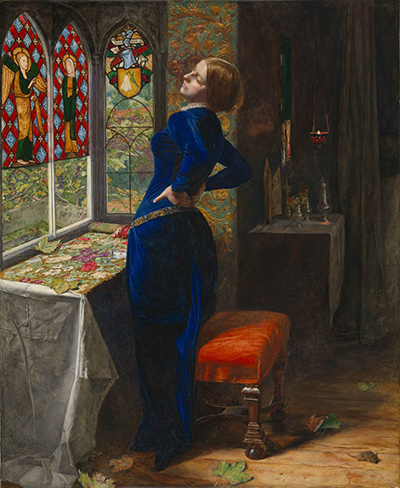
- Mariana, 1857. Wood engraving designed by Millais and cut by the Dalziel Brothers for the Moxon Tennyson.
- The Proscribed Royalist, 1858. Mixed-method engraving by William Henry Simmons after Millais.
| Name | Date | Medium |
|---|---|---|
| Pizarro Seizing the Inca of Peru | 1846 | Painting |
| The Young Men of Benjamin Seizing Their Brides | 1847 | Painting |
| Isabella | 1848–49 | Painting |
| Christ in the House of His Parents (‘The Carpenter’s Shop’) | 1849–50 | Painting |
| Ferdinand Lured by Ariel | 1849–50 (monogram dated 1849) | Painting |
| Study for Christ in the House of His Parents, Tate N04623 | c. 1849 | Drawing |
| Study for Christ in the House of His Parents, Tate N04792 | c. 1849 | Drawing |
| Study for Mariana in the Moated Grange | 1850 | Drawing |
| A Huguenot, on St Bartholomew’s Day, Refusing to Shield Himself from Danger by Wearing the Roman Catholic Badge | 1851–52 (exhibited 1852) | Painting |
| Mariana | 1851 | Painting |
| Ophelia | 1851–52 | Painting |
| The Bridesmaid | 1851 | Painting |
| The Return of the Dove to the Ark | 1851 | Painting |
| The Order of Release 1746 | 1852–53 | Painting |
| The Proscribed Royalist, 1651 | 1852–53 (exhibited 1853) | Painting |
| Portrait of John Ruskin | 1853–54 | Painting |
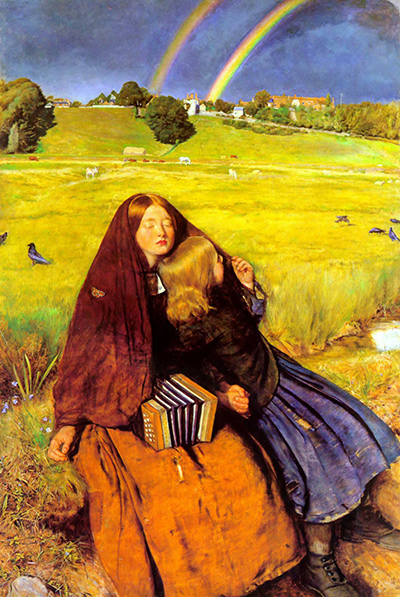
| The Blind Girl | 1854–56 | Painting |
| Autumn Leaves | 1855–56 (Manchester labels 1856) | Painting |
| A Dream of the Past: Sir Isumbras at the Ford | 1856–57, later revised | Painting |
| The Vale of Rest | 1858–59 | Painting |
| Study for The Black Brunswicker, Tate A00812 | c. 1860 | Drawing |
| Study for The Black Brunswicker, Tate A00813 | c. 1860 | Drawing |
| Study for The Black Brunswicker, Tate A00814 | c. 1860 | Drawing |
| The Black Brunswicker | 1860 | Painting |
| The Ransom | 1860–62 | Painting |
| My First Sermon | 1863 | Painting |
| My Second Sermon | 1864 | Painting |
| Joan of Arc | 1865 | Painting |
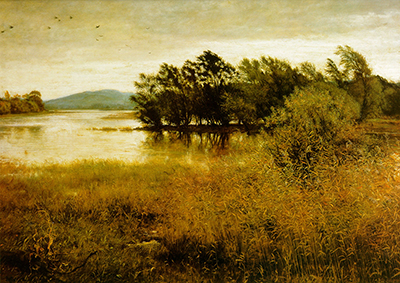
| Chill October | 1870 (exhibited 1871) | Painting |
| The Boyhood of Raleigh | 1870 | Painting |
| The Knight Errant | 1870 | Painting |
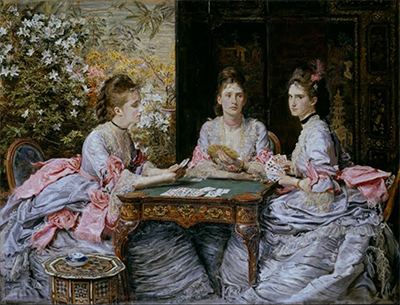
| Hearts are Trumps | 1872 | Painting |
| The North-West Passage | 1874 | Painting |
| Louise Jane Jopling | 1879 | Painting |
| William Ewart Gladstone, NPG 3637 | 1879 | Painting |
| Bubbles | 1886 | Painting |
| Portia | 1886 | Painting |
| Dew-Drenched Furze | 1889–90 | Painting |
| Ducklings | 1889 | Painting |
| Portrait of Sarah Hammond | 1891 | Painting |
Discussion
Look again at the images and ideas explored in The Black Brunswicker. These editorial prompts invite your observations.
Reader Insights
What does the pair’s position around the door show before you have followed the colours or uniforms?
How does the dog’s position change the way you read this parting?
Join the Conversation
Share a detail, comparison or question about The Black Brunswicker below.
References
- National Museums Liverpool, The Black Brunswickers, reproduction of the Lady Lever Art Gallery painting. View source.
- National Museums Liverpool via Art UK, The Black Brunswicker, Lady Lever Art Gallery, LL 3643. View source.
- Royal Academy of Arts, Exhibition of Works by the Late Sir John Everett Millais, 1898, p. 12, no. 21. View source.
- John Guille Millais, The Life and Letters of Sir John Everett Millais, vol. I, 1899, pp. 179–187, including the artist’s 18 November 1859 and 2 May 1860 letters and Katey Dickens’s account of the sittings. View source.
- Royal Scottish Academy, The Black Brunswicker, 1993.471, replica by John Everett Millais and William Henry Millais, with Malcolm Warner’s catalogue notes and extracts from the artist’s letters. View source.
- Ann Nix, “An Insight into the Costume of the Black Brunswicker,” Costume and Textile Association Miscellany, 2019, pp. 17–18. View source.
- Braunschweigisches Landesmuseum, “Wann ist ein Held ein Held?”, exhibition research on Friedrich Wilhelm of Brunswick and the Schwarze Schar. View source. (in German).
- National Army Museum, Death of the Duke Frederick William of Brunswick-Oels at Quatre Bras the 16th June 1815, 1971-02-33-309-1. View source.
- Charles Dickens Museum, “A Closer Look: the Language of Flowers,” Katey Dickens’s training, exhibitions and modelling. View source.
- Sotheby’s, Joan of Arc, London, 2003, lot 25, comparative discussion identifying the engraving in The Black Brunswicker. View source.
- Musée national des châteaux de Malmaison et de Bois-Préau, Le Premier consul franchissant les Alpes au col du Grand-Saint-Bernard. View source.
- Georg Eckert, “Umbrüche und ihre Helden – Helden und ihre Umbrüche,” in Umbrüche und Umdeutungen, Wallstein, 2024, p. 28 and fig. 3. View source. (in German).
- Grosvenor Gallery, Exhibition of the Works of Sir John E. Millais, 1886, no. 123. View source.
- The Examiner, “Royal Academy Exhibition,” 5 May 1860. View source.
- Paolo Giudici, Royal College of Art doctoral thesis, “The Black Brunswicker,” pp. 133–138, including a transcription of The Spectator, 12 May 1860, p. 456. View source.
- Tate, Study for ‘The Black Brunswicker’, three graphite studies A00812–A00814 in the Tate collection dataset. View source.
- The Art Journal, “Picture Sales,” 1862, pp. 105–106, report on the sale of Thomas Plint’s collection. View source.
- Victorian Era Exhibition, Earl’s Court, 1897, catalogue no. 1000, Thomas Lewis Atkinson’s engraving after Millais. View source.
- British Library, The Black Brunswicker, Photo 1246/1(62), albumen print by an unknown photographer, c.1864. View source.
- The Bombay Gazette, 30 January 1866, “Photographic Prints” advertisement. View source.