 by Tom Gurney
Tom Gurney BSc (Hons) is an art history expert with over 20 years experience
Published on June 19, 2020 / Updated on November 25, 2026
Email: tomgurney1@gmail.com / Phone: +44 7429 011000
John Everett Millais Biography: Introduction
In April 1853, William Holman Hunt drew John Everett Millais in chalk at Millais’s London studio. On the sheet he addressed the drawing to Thomas Woolner, a fellow member of the Pre-Raphaelite Brotherhood who had left for Australia. The sitting belonged to an exchange arranged by Dante Gabriel Rossetti: friends in London and Melbourne would make drawings, write letters or compose verses on the same day and send them across the world. Millais had helped found the Brotherhood less than five years earlier. The portrait catches the group at a moment when friendship still held it together and its members were already taking their careers in different directions. [1]
That November, Millais was elected an Associate of the Royal Academy. He would go on to paint leading figures of Victorian public life, illustrate serial fiction, develop a sustained landscape practice in Scotland and eventually become the Academy’s president. Those parts of his working life overlapped. The story runs through several places where pictures took shape: a studio in the Millais family home, a riverbank in the Trossachs, the crowded pages of a literary magazine and a purpose-built house in Kensington. [2] [3]
At a Glance
- Life1829–1896 [2]
- TrainingRoyal Academy Schools, admitted in 1840 [2][4]
- FamilyMarried Euphemia Chalmers Gray in 1855 [5]
- Royal AcademyAssociate in 1853, full Academician in 1863 and President in 1896 [2][3]
John Everett Millais in context
Pre-Raphaelite Brotherhood
Founded in 1848 [2]Victorian illustration and exhibition painting
Later 1850s and 1860s [6]Later portraiture and landscape
1870s–1890s [7]John Ruskin
1819–1900William Holman Hunt
1827–1910Dante Gabriel Rossetti
1828–1882John Everett Millais
1829–1896 [2]Vincent van Gogh
1853–1890Isabella
1848–49Ophelia
1851–52Autumn Leaves
1855–56Dew-Drenched Furze
1889–90Contents
- Childhood in Jersey and training in London
- The Brotherhood and the Academy exhibitions
- Effie Gray and a working household
- Illustration, full membership and Scotland
- Kensington, portraiture and public standing
- The Royal Academy presidency and Millais’s death
- Millais after 1896
Childhood in Jersey and training in London
John Everett Millais was born in Southampton on 8 June 1829 and spent his early childhood in Jersey. His parents recognised his ability to draw and encouraged his training. The family moved to London in 1838, placing him close to professional instruction. His mother, Emily, helped lay the groundwork for a career in which members of the household would regularly take part. The support encompassed formal study and, as the paintings grew more ambitious, practical help in getting them made. [2] [8]
Millais entered the Royal Academy Schools on 12 December 1840 at eleven. The Academy’s 1898 memorial catalogue distinguishes that admission from a preliminary probationer’s drawing made the previous July. Both dates belong to his education. In 1843, he won the Schools’ first silver medal for drawing from an antique sculpture, the kind of exercise that taught a young artist to translate a three-dimensional form onto paper through outline and shading. He earned the gold medal for historical painting in 1847 with The Young Men of Benjamin Seizing Their Brides. By then, he had already made his first appearance as an exhibitor at the Academy with Pizarro Seizing the Inca of Peru in 1846. Training, awards and public exhibition were three distinct steps, achieved in quick succession. [4]
The Schools also gave him a circle of contemporaries. He and William Holman Hunt met while drawing in the British Museum’s sculpture galleries, before Hunt entered the Schools in 1844. Hunt was the older of the two, though Millais had already advanced further in his training. In the retrospective account preserved by the National Portrait Gallery, Hunt remembered a younger artist whose ability impressed him and whose encouragement mattered. The conventions both men would soon challenge were ones they knew at first hand, and the Academy exhibition gave them a place to make their challenge public. [1] [9]
Four stages of John Everett Millais’s career
These periods group related developments; painting, travel and local work overlap across their boundaries.
Painting close to what he could see
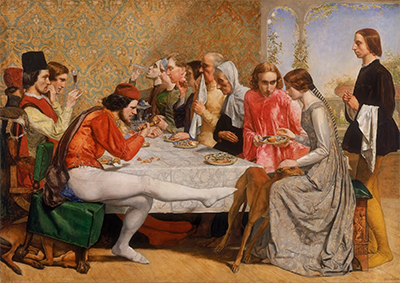
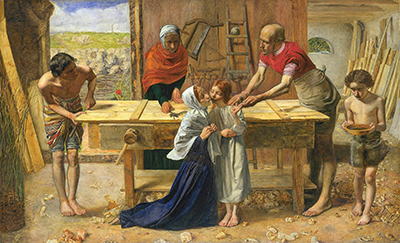
Millais trained at the Royal Academy Schools and helped found the Pre-Raphaelite Brotherhood in 1848. At the Academy, Isabella and Christ in the House of His Parents put ordinary gestures and things at the centre of ambitious subjects. [2] [4] [9] [10]
Making pictures at home and for print
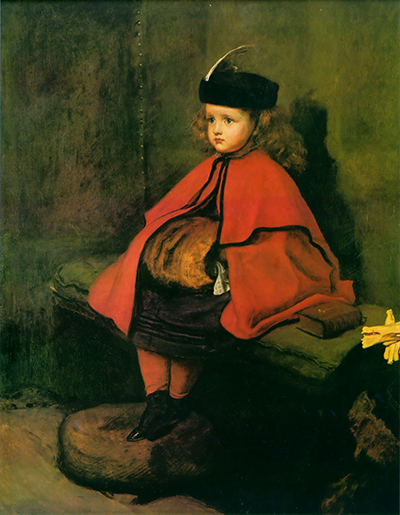
Effie Gray helped recruit sitters, and their children posed for pictures including the two Sermons. Millais also designed images that engravers translated into woodcuts for books and periodicals. [8] [6] [11]
The Brotherhood and the Academy exhibitions
In 1848 Millais, Hunt and Dante Gabriel Rossetti helped form the seven-member Pre-Raphaelite Brotherhood. Early meetings took place in Millais’s studio in Gower Street. The members discussed one another’s work and looked to Gothic and early Renaissance art for alternatives to the formulas of contemporary academic painting. They shared a commitment to close observation, even when their interests ranged from modern life to religion and poetry. For Millais, a working method took shape in which observation of local people and places could give a distant story physical immediacy. [1] [2] [10]
In 1849 the Academy hung Isabella and Hunt’s Rienzi near each other in its Middle Room. The prominent setting made it unusually easy to notice both young exhibitors. Each used the initials PRB, a badge of shared purpose in a setting where the letters ARA and RA signalled official rank. The art historian Sarah Victoria Turner finds that the pictures generally received a favourable hearing that year, although some observers were puzzled by their turn to older styles and subjects. Millais’s relationship with the Academy involved public opportunity from the outset. [9]
The next year, Christ in the House of His Parents became the focus of a much more hostile exchange. Charles Dickens attacked it in Household Words in June 1850, taking offence at Millais’s treatment of the Holy Family as recognisable working people. The picture placed a carpenter’s trade and a small domestic injury at the centre of a sacred subject. Millais’s father modelled for Joseph’s head and his sister-in-law Mary Hodgkinson for the Virgin. As Naoko Asano notes, the artist’s cousin Edward Benest later recalled the parents discussing the picture with their son before he began painting. The account comes from a family witness. It gives a sense of how discussion and modelling could be organised at home, alongside the artist’s more visible association with the Brotherhood. [8] [10] [15]
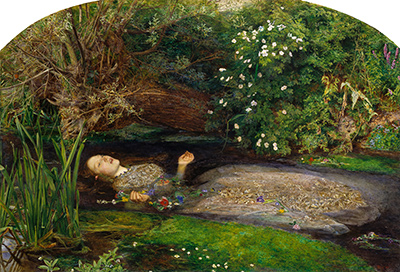
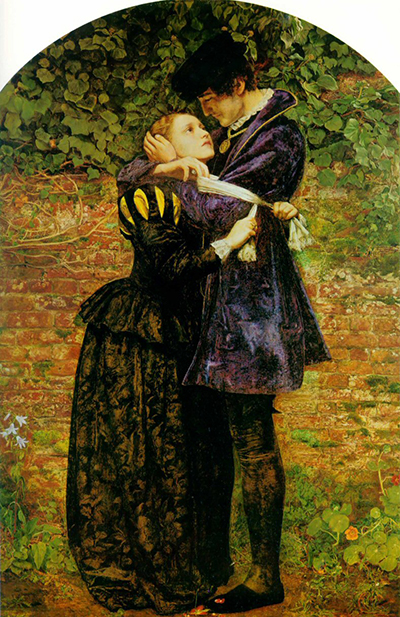
Emily’s involvement extended to research. Asano traces her part in sourcing and researching historical clothes for A Huguenot, while the lace for the white armband came through Martha Combe. Such arrangements made it possible to combine a subject set in sixteenth-century France with objects and plants Millais could study directly. He and Hunt worked near one another at Worcester Park Farm in Surrey. For Ophelia, exhibited in 1852, Millais painted the setting by the Hogsmill River and worked separately on the figure with Elizabeth Siddal in the studio. The picture brought two places and two kinds of sustained work together on one canvas. [2] [8] [16]
The Brotherhood’s early closeness proved difficult to sustain as members travelled and took up different kinds of work. Woolner’s departure in 1852 prompted the drawing exchange the following spring. Hunt’s chalk portrait still carries its date and its dedication to Woolner. Hunt later recalled making it while Millais drew William Michael Rossetti and Frederic George Stephens. A project that began with a letter became a day of sittings, drawings to be shipped and a group of pictures to hang together in a studio far from Gower Street. For Millais, 1853 also brought his election as an Associate of the Royal Academy on 7 November. He was twenty-four. [1] [3]
Effie Gray and a working household
Euphemia Chalmers Gray, known as Effie, had first sat for Millais while married to the critic John Ruskin. In The Order of Release 1746 she supplied the face of the woman presenting the order to free a prisoner. In the summer of 1853 Millais travelled with the Ruskins to the Trossachs, where he began the landscape for his portrait of John Ruskin. The sitter’s father commissioned the painting. Its production spanned two years and two kinds of workplace: Ruskin sat to Millais in London in 1854, and Millais returned to Brig o’ Turk to finish the landscape. Effie’s marriage to Ruskin was annulled in 1854. The Scottish marriage register records her marriage to Millais on 3 July 1855. [17] [5]
The year of their marriage also brought Millais a wider exhibition audience. His three pictures at the Paris Exposition Universelle included Ophelia, The Order of Release and The Return of the Dove to the Ark. Gustave Planche, reviewing the British exhibits for the French Revue des Deux Mondes, found the first moving and poetic despite his objections to the colour, and dismissed the other two for their execution. A Spanish report in the Gaceta de Madrid placed Millais alongside Landseer and other British artists showing small pictures in the same long gallery. Where the Academy had made him visible as a member of a new group, the Paris exhibition presented him to readers abroad as a painter within a national school. [18] [19]
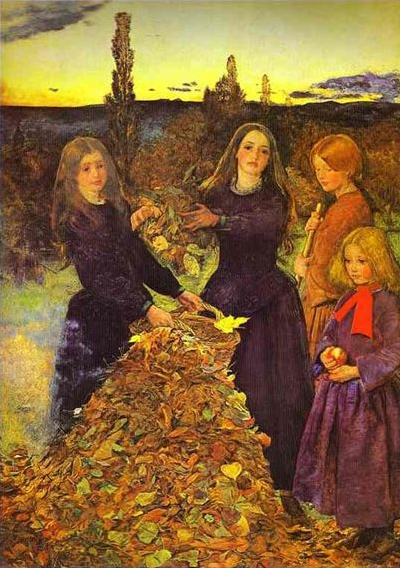
The couple spent part of their early married life in Scotland and had eight children. The local friendships and family ties that came with their marriage affected how Millais found sitters. Effie’s younger sisters Sophie and Alice Gray posed for Autumn Leaves, with two local girls whom Effie recruited. Asano traces the encounters through which she found them, including a visit to a bedridden woman whose granddaughter, Isabella Nichol, became one of the sitters. Finding the children was part of making the picture possible. Effie could recognise suitable models in the course of her own activities and bring them within reach of the studio. [2] [8] [5]
Family modelling continued when the couple’s own children were old enough to sit. Their daughter Effie appears in both My First Sermon and My Second Sermon. Other children took part in pictures with different demands: Mary sat for Waking, Alice for Sleeping, and Sophia for A Flood. These were sustained sessions, with repeated poses and attention to costume. Asano traces the growing experience of the daughters as sitters and the way the resulting pictures reached a market for images of children. A painting could draw on a relationship within the household and then take on a public life of its own. [8]
Effie also took on work that left a trail in correspondence. In 1863, she reported to her mother that Millais was behind with The Eve of St Agnes and worried whether he could finish in time to send the work to the Academy. Six years later, she wrote to Millais describing how she had secured a commission from William Cunliffe-Brooks to paint his daughter Amy. She had discussed two sizes and two fees, settling on a full-length portrait for 2,000 guineas. The surviving letter records her dealing with the scale and presentation of a picture as well as the terms of payment. Asano’s account draws out the connection between domestic correspondence and the commercial arrangements on which a busy portrait practice depended. [8]
That work could also involve persuading a reluctant sitter. In Asano’s account of the making of The North-West Passage, Effie negotiated with the writer and adventurer Edward John Trelawny after he turned down Millais’s request. She agreed to accompany his niece to a series of Turkish baths in exchange for his sittings. The story stands beside the plainly businesslike terms of the Brooks letter. Recruiting friends and relatives, working with strangers and negotiating portrait fees called for different skills, all of which the household could draw on. [8]
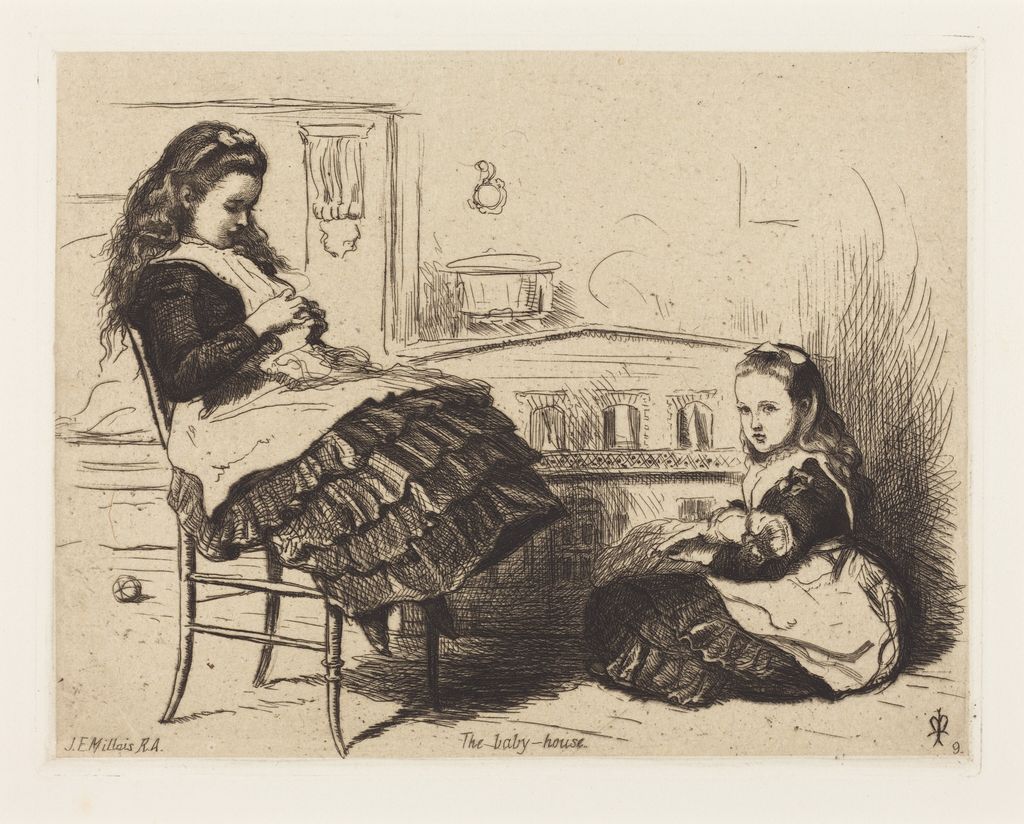
John Everett Millais, The Baby-House, 1872. Etching on chine appliqué. National Gallery of Art, Washington, Ailsa Mellon Bruce Fund, 1983.36.1. Two girls appear in a domestic interior in an etching printed from a plate Millais worked himself. Image source. Public domain.
Illustration, full membership and Scotland
From the late 1850s into the 1860s, Millais also worked for publishers. His illustrations appeared in periodicals including Once a Week and The Cornhill Magazine. The first bound volume of the Cornhill, covering January to June 1860, gives a sense of the division of labour. It includes work by several illustrators and credits the Dalziel Brothers, William James Linton and Joseph Swain among the engravers. In the illustration to Richard Monckton Milnes’s Unspoken Dialogue, opposite page 194, the Met credits the design to Millais and the wood engraving to the Dalziels. Millais supplied an image that another workshop had to translate into a printable surface. Readers met his work alongside poetry and instalments of fiction, on a scale and schedule quite different from those of the summer exhibition. [2] [6]
The family was living at 7 Cromwell Place in Kensington by 1861. Millais became a full Royal Academician on 18 December 1863, ten years after his election as an Associate. Full membership brought an institutional role alongside the work of exhibiting. He served on the Academy’s council in several periods between 1865 and 1883. The dates chart a gradual expansion of responsibility within the institution where he had once drawn as a student. [2] [3]
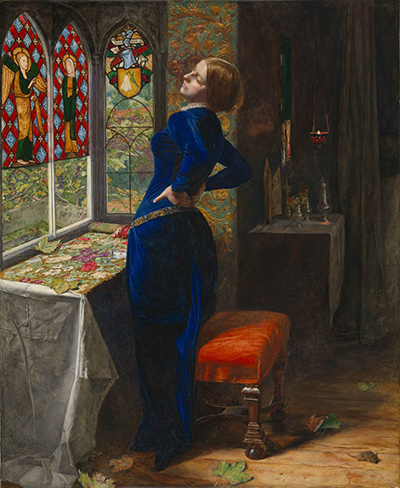
Scotland also offered a public for his pictures. David Wilson traces exhibitions of Mariana, Ophelia and Autumn Leaves at the Royal Scottish Academy in 1852, 1853 and 1858 respectively. Such exhibitions enabled artists in Scotland to see the paintings directly, and opened a local critical conversation. Wilson cites an 1852 review in The Scotsman that valued the worn expression and unusual complexion of Mariana for their poetic feeling. Millais became an honorary member of the Royal Scottish Academy in 1866. Over the same years, family visits and a growing interest in fishing and shooting took him back to Scotland. The institutional relationship and the time he spent outdoors both preceded his sustained work as a landscape painter. [2] [11]
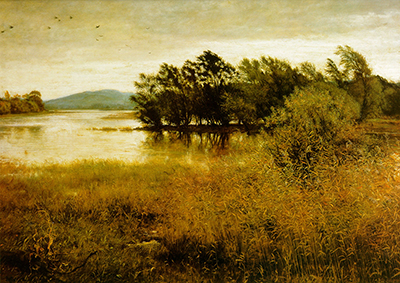
An anonymous photograph dated to about 1865 in the Musée d’Orsay shows Millais after fishing. The picture belongs to a different set of records from formal portraits and exhibition catalogues. It documents an activity that regularly brought him into the countryside. In an 1882 letter reproduced by the Academy, Millais described painting Chill October beside a backwater of the Tay near Kinfauns, dealing with wind and rain as he worked directly on the canvas. He recalled reserving some work on the overall effect for the studio. Painted in 1870 and exhibited in 1871, it marks a point when landscape became a sustained subject in its own right. Millais could take the outdoor practice he had applied to settings in the 1850s and give the terrain, weather and light the whole picture. [4] [20]
News and images of the landscapes travelled. In a letter to Anthon van Rappard in May 1882, Vincent van Gogh described Anton Mauve’s enthusiasm on seeing Chill October. Van Gogh brought it up while discussing the regard Dutch painters had for British art. His remark offers a particular example of Millais’s work being discussed among artists outside Britain during his lifetime. It records a response to a landscape from the same period that brought Millais important portrait commissions. [13]
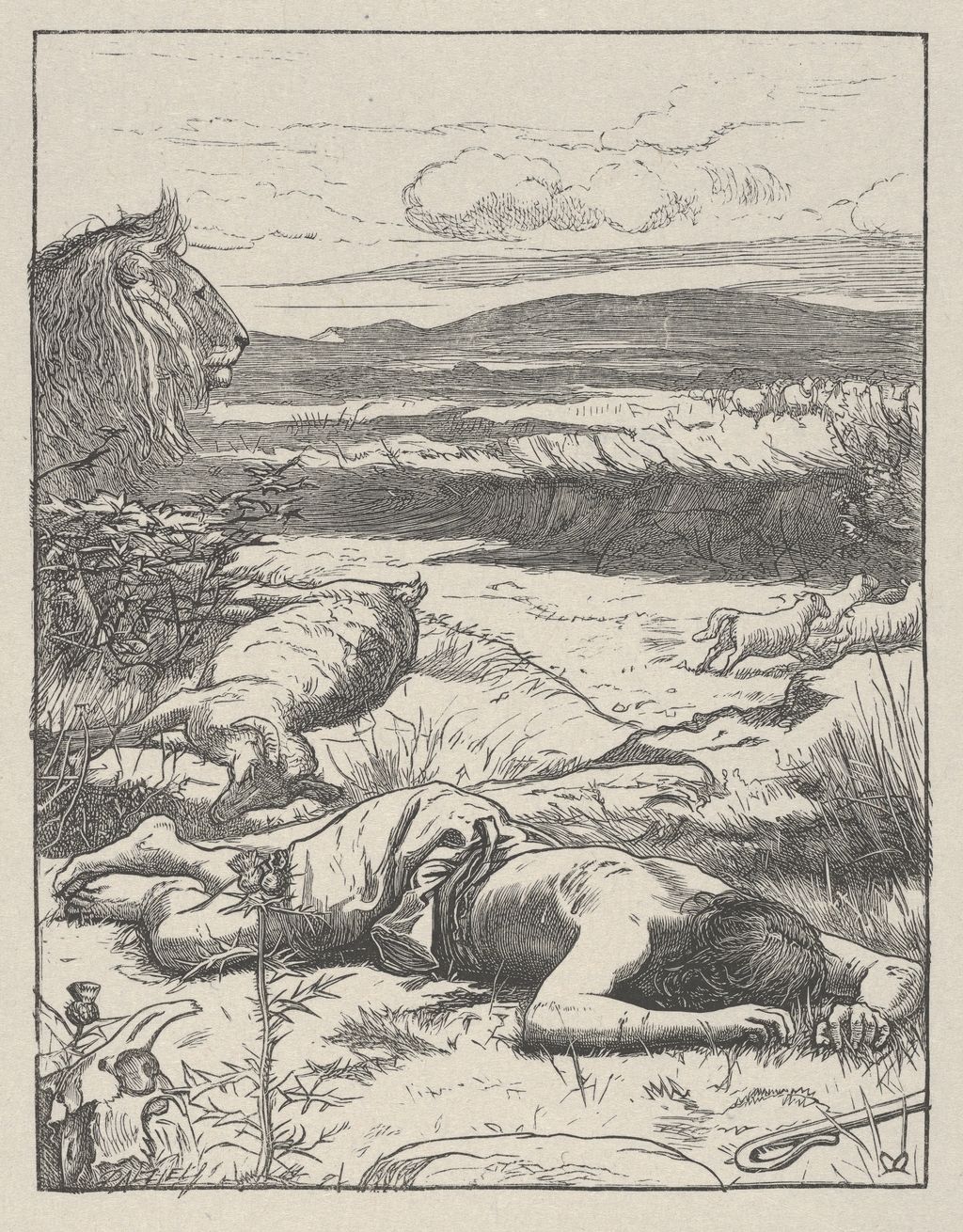
John Everett Millais, design, engraved and printed by the Dalziel Brothers. The Good Shepherd, 1864, wood-engraved proof. Metropolitan Museum of Art, Rogers Fund, 1921, 21.68.4(20). Millais’s design was cut and printed by the Dalziel Brothers. Image source. CC0 / Public domain.
Kensington, portraiture and public standing
Millais commissioned a house at 2 Palace Gate from the architect P. C. Hardwick in the 1870s. [12] The move from Cromwell Place to a house with a large studio gave him room for canvases and sitters. Visitors could encounter an artist at work on several pictures at once. Writing in 1885, the critic Walter Armstrong remembered Millais turning away from an easel, holding a palette and brushes, his face lit by the studio window. By then Millais exhibited at the Grosvenor Gallery as well as the Academy, and the Fine Art Society had held his first retrospective, in 1881. The premises and the exhibitions made different parts of his work visible to patrons, visitors and the wider public. [2]
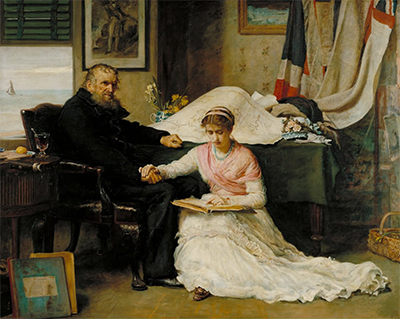
Millais had returned to international competition by 1878, when he received a medal of honour at the Paris Universal Exhibition. The sculptor Joseph Edgar Boehm, writing from Paris on 30 April, described how strongly Millais’s exhibits struck him on entering the first room of the British art section. He singled out the old mariner in The North-West Passage and the portrait of Madame Bischoffsheim. John Guille Millais also names Chill October among the works sent. The display brought together the landscape, subject painting and portraiture on which Millais was working at the time. [21]
In 1879 he exhibited a portrait of William Ewart Gladstone at the Academy. The painter Archibald Stuart-Wortley recalled that Gladstone visited his studio and described sitting for Millais. In the account reproduced by Millais’s son, John Guille, Gladstone said, “I never saw such a power of concentration in any man.” He also recalled spending relatively few hours in the studio for that particular portrait. The testimony concerns the 1879 picture formerly owned by the Duke of Westminster, one of several times Millais painted Gladstone. Since it comes through a fellow painter and the family biography, it preserves the impression of a sitting along with the perspective of those who chose to record it. [22] [23]
In 1886 the Grosvenor Gallery mounted an extensive exhibition of Millais’s work. The catalogue thanks Frederic George Stephens for its explanatory notes. The same Stephens who had begun a portrait at the Gower Street drawing exchange in 1853 now interpreted Millais’s paintings for an exhibition audience. The catalogue brought an account of the paintings’ subjects and history into the exhibition with them. [1] [24]
The late studio also drew on other professions. A photograph published by the art historian Lucy Oakley shows Bubbles and the early state of the Met’s Portia on easels at Palace Gate around 1885–86. A separate photograph of that earlier state, attributed to Rupert Potter and dated December 1885, records a woman in a Greek dress. Millais later recast the figure as Shakespeare’s Portia, using a costume lent by the actress Ellen Terry. Kate Dolan posed for the character. The photograph, the costume and the evidence beneath the paint document a change of subject in progress. They also show how a photographer, a sitter and a theatre performer could contribute different things to a single work. [25] [26]
The other painting in the studio photograph took a different route into public life. Bubbles passed from Millais to the publisher William Ingram and subsequently to Thomas Barratt of A. & F. Pears. Its association with Pears soap followed those changes of ownership. An image of a child painted at Palace Gate became familiar to people who might never have seen the canvas or visited an Academy exhibition. At the same time, Millais continued to paint portraits for individual patrons. In 1891, for example, Charles J. Wertheimer commissioned the portrait of Sarah Hammond now in the Musée d’Orsay. The commission and the commercial reproduction coexisted within the career and reached very different audiences. [25] [27] [28]
The Royal Academy presidency and Millais’s death
Millais received a hereditary baronetcy in 1885. The Official Roll lists the creation of the baronetcy of Millais of Palace Gate on 16 July. Academy office followed on its own timetable. He substituted for Frederic Leighton during Leighton’s absence in 1895 and was formally elected President on 20 February 1896, after Leighton’s death. Letters to Philip Hermogenes Calderon, held at the Yale Center for British Art, record his concern about the speaking duties the position entailed. He was already suffering from throat cancer. [3] [29] [14]
At the Academy banquet in 1895, as reported by his son, Millais recalled that the Schools had given him a free artistic education and said he owed the Academy “a debt of gratitude I can never repay.” He remembered particular objects and places within the institution, including its casts, library and benches. The recollection concerned the education he had received there. It brings the young student’s daily experience into view alongside the much better known episodes in which the exhibition became a setting for public disagreement. [30]
Millais was still making ambitious subject paintings late in life. The Academy memorial catalogue dated Speak! Speak! to 1895 and included works from his final exhibition year. His presidency lasted less than six months. He died at Palace Gate on 13 August 1896, aged sixty-seven, and was buried in St Paul’s Cathedral near J. M. W. Turner. Thomas Brock’s statue, erected in 1905 and recorded in Historic England’s list entry at Tate, subsequently gave him a public memorial in the city where he had trained, exhibited and worked. [2] [4] [31]
Millais after 1896
The Academy’s winter memorial exhibition of 1898 put student drawings and work from Millais’s final years within the same survey. Writing in the German journal Kunstchronik, O. von Schleinitz treated Christ in the House of His Parents as representative of early Pre-Raphaelitism, associated A Huguenot and Ophelia with the artist’s rise, and saw Chill October among the works opening a more independent phase. The review shows how soon a visitor could trace several stages through the long career and assign a significant place to the later landscapes. [4] [32]
Later writers often measured Millais’s art against the standards of his Pre-Raphaelite youth. The Japanese scholar Akira Ishizuka traces how that judgement shaped the history of scholarship and how later exhibitions and studies widened the field. The National Portrait Gallery’s 1999 portrait exhibition, for example, treated family sitters, children and figures of public life as subjects worth examining within Victorian society. The retrospective that opened at Tate Britain in 2007 and travelled to Amsterdam, Kitakyushu and Tokyo in 2008 placed paintings beside drawings and presented the later work across several genres. Its categories overlapped in time, as the artist’s actual working commitments did. [7] [33] [34]
Evidence from the household and studio helps explain that overlap. A letter may show Effie securing the fee and size of a portrait while a studio photograph shows Millais changing the subject of another canvas. Exhibition records can place a Scottish landscape and a public likeness within a few years of each other. Across his life, some of the most decisive changes in his practice are visible in where he worked, who could help him and which public he hoped to reach. The paintings show how many different pictures came out of those arrangements. [8] [25] [7]
Further reading
The artist’s later correspondence can be read alongside the modern Tate exhibition catalogue.
The Life and Letters of Sir John Everett Millais, Volume 2. John Guille Millais. Cambridge University Press reprint of the 1899 edition. ISBN 9781108051736.
The artist’s son assembled family records and correspondence, including evidence for the later paintings and views of the artist given by people who knew him. View the publisher’s record.
Millais. Jason Rosenfeld and Alison Smith. Tate Publishing, 2007. ISBN 9781854377463.
The Tate retrospective catalogue considers sculpture and works on paper alongside the paintings, and gives the early and late work room within one career survey. View the catalogue record.
John Everett Millais artwork directory
Browse paintings and drawings covered in these articles, including related works held in public collections. Reproductive engravings and editions are discussed on the Prints page.
Prints and illustrated editions
- The Baby-House, 1872. Etching by Millais.
- The Good Shepherd, 1864. Wood engraving designed by Millais, engraved and printed by the Dalziel Brothers.
- Mariana, 1857. Wood engraving designed by Millais and cut by the Dalziel Brothers for the Moxon Tennyson.
- The Proscribed Royalist, 1858. Mixed-method engraving by William Henry Simmons after Millais.
| Name | Date | Medium |
|---|---|---|
| Pizarro Seizing the Inca of Peru | 1846 | Painting |
| The Young Men of Benjamin Seizing Their Brides | 1847 | Painting |
| Isabella | 1848–49 | Painting |
| Christ in the House of His Parents (‘The Carpenter’s Shop’) | 1849–50 | Painting |
| Ferdinand Lured by Ariel | 1849–50 (monogram dated 1849) | Painting |
| Study for Christ in the House of His Parents, Tate N04623 | c. 1849 | Drawing |
| Study for Christ in the House of His Parents, Tate N04792 | c. 1849 | Drawing |
| Study for Mariana in the Moated Grange | 1850 | Drawing |
| A Huguenot, on St Bartholomew’s Day, Refusing to Shield Himself from Danger by Wearing the Roman Catholic Badge | 1851–52 (exhibited 1852) | Painting |
| Mariana | 1851 | Painting |
| Ophelia | 1851–52 | Painting |
| The Bridesmaid | 1851 | Painting |
| The Return of the Dove to the Ark | 1851 | Painting |
| The Order of Release 1746 | 1852–53 | Painting |
| The Proscribed Royalist, 1651 | 1852–53 (exhibited 1853) | Painting |
| Portrait of John Ruskin | 1853–54 | Painting |
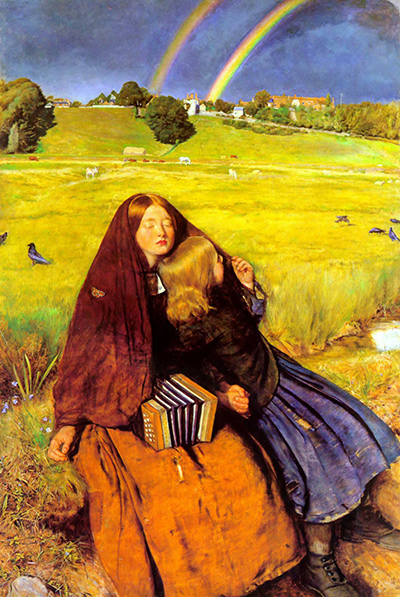
| The Blind Girl | 1854–56 | Painting |
| Autumn Leaves | 1855–56 (Manchester labels 1856) | Painting |
| A Dream of the Past: Sir Isumbras at the Ford | 1856–57, later revised | Painting |
| The Vale of Rest | 1858–59 | Painting |
| Study for The Black Brunswicker, Tate A00812 | c. 1860 | Drawing |
| Study for The Black Brunswicker, Tate A00813 | c. 1860 | Drawing |
| Study for The Black Brunswicker, Tate A00814 | c. 1860 | Drawing |
| The Black Brunswicker | 1860 | Painting |
| The Ransom | 1860–62 | Painting |
| My First Sermon | 1863 | Painting |
| My Second Sermon | 1864 | Painting |
| Joan of Arc | 1865 | Painting |
| Chill October | 1870 (exhibited 1871) | Painting |
| The Boyhood of Raleigh | 1870 | Painting |
| The Knight Errant | 1870 | Painting |
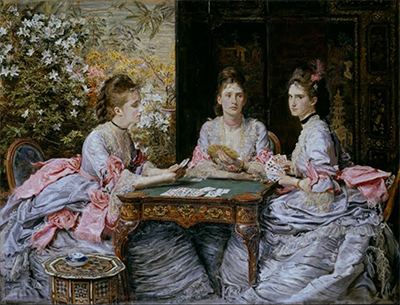
| Hearts are Trumps | 1872 | Painting |
| The North-West Passage | 1874 | Painting |
| Louise Jane Jopling | 1879 | Painting |
| William Ewart Gladstone, NPG 3637 | 1879 | Painting |
| Bubbles | 1886 | Painting |
| Portia | 1886 | Painting |
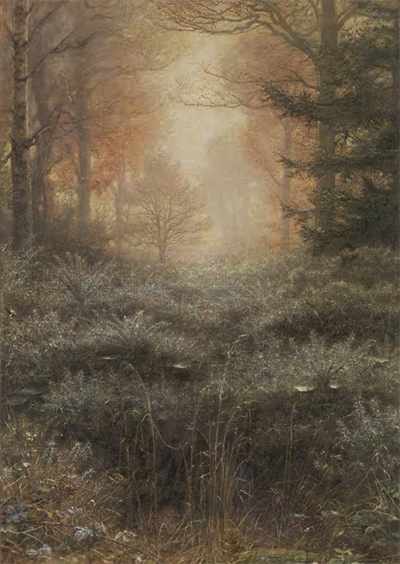
| Dew-Drenched Furze | 1889–90 | Painting |
| Ducklings | 1889 | Painting |
| Portrait of Sarah Hammond | 1891 | Painting |
Discussion
Look again at the images and ideas explored in John Everett Millais Biography. These editorial prompts invite your observations.
Reader Insights
Which of Millais’s working relationships changes how you read one of his pictures?
What do the school prizes, public exhibitions and household correspondence each reveal about the work needed to become a painter?
Join the Conversation
Share a detail, comparison or question about John Everett Millais Biography below.
References
- National Portrait Gallery, Sir John Everett Millais, 1st Bt, William Holman Hunt, NPG 2914, extended catalogue entry, “Inscription” and “This portrait”. View source.
- National Portrait Gallery, Sir John Everett Millais, 1st Bt, Later Victorian Portraits Catalogue, biography and references. View source.
- University of Glasgow, “Sir John Everett Millais PRA”, Mapping the Practice and Profession of Sculpture in Britain and Ireland 1851–1951, institutional connections and sources. View source.
- Royal Academy of Arts, Exhibition of Works by the Late Sir John Everett Millais (1898), introductory biography, nos. 108 and 110 and chronological index. View source.
- National Records of Scotland, “Love lost and found in the Kinnoull kirk session minutes”, marriage certificate dated 3 July 1855, Statutory Register of Marriages, 1855, 369/1, p. 6. View source.
- Metropolitan Museum of Art, The Cornhill Magazine, vol. 1, January–June 1860, 35.53.109, including the linked engraving from Unspoken Dialogue, opposite p. 194. View source.
- Akira Ishizuka, “An Examination of Exhibitions and Publications Focusing on the Life and Art of John Everett Millais”, Kwassui Bulletin 55, pp. 13, 28–32. View source. (in Japanese).
- Naoko Asano, “More than Models and Muses: The Women of John Everett Millais’ Domestic Circle and Their Contributions”, Journal of the National Museum of Western Art 25 (2021), pp. 5–22, especially pp. 5–7, 9–16. View source.
- Sarah Victoria Turner, “1849: The Arrival of the ‘PRB’”, The Royal Academy Summer Exhibition: A Chronicle, 1769–2018. View source.
- National Gallery of Art, Pre-Raphaelites: Victorian Art and Design, 1848–1900, exhibition brochure, “Origins”. View source.
- David Wilson, The Art of Faith in a World of Progress: From Transcendence to Immanence, University of St Andrews doctoral thesis, vol. 1, pp. 95–96 and n. 208. View source.
- Historic England, “2, Palace Gate SW7”, National Heritage List entry 1065933, “Details”. View source.
- Vincent van Gogh, letter 232 to Anthon van Rappard, The Hague, 28 May 1882, Vincent van Gogh: The Letters. View source.
- Yale Center for British Art, Guide to the Philip Hermogenes Calderon Correspondence from John Everett Millais and Frederic Leighton, p. 5, scope and contents. View source.
- Charles Dickens, “Old Lamps for New Ones”, Household Words, vol. 1, no. 12 (15 June 1850), pp. 265–267, Dickens Journals Online. View source.
- Tate Britain, Ophelia, collection interpretation at Google Arts & Culture. View source.
- Ashmolean Museum, Portrait of John Ruskin by John Everett Millais, WA2013.67. View source.
- Gustave Planche, “Exposition des Beaux-Arts. L’École anglaise”, Revue des Deux Mondes, vol. 11 (1855), pp. 465–486, the discussion of Millais beginning p. 479. View source. (in French).
- Gaceta de Madrid, “Exposición Universal de París”, issue 1022, 22 October 1855, account of the rooms of the fine arts exhibition. View source. (in Spanish).
- Musée d’Orsay, Le peintre John Everett Millais de retour de pêche, anonymous photograph, c. 1865, PHO 1984 97 bis. View source. (in French).
- John Guille Millais, The Life and Letters of Sir John Everett Millais, vol. II (1899), pp. 263–264, “Praise from France”, including J. E. Boehm’s letter of 30 April 1878. View source.
- Barbara Pezzini, “1888: Gladstone’s Portrait and the Changing Iconography of Liberalism”, The Royal Academy Summer Exhibition: A Chronicle, 1769–2018, fig. 3 and discussion. View source.
- John Guille Millais, The Life and Letters of Sir John Everett Millais, vol. II (1899), pp. 245–248, Archibald Stuart-Wortley’s recollection. View source.
- Grosvenor Gallery, Exhibition of the Works of Sir John E. Millais (1886), opening acknowledgement and catalogue notes. View source.
- Lucy Oakley, “The Evolution of Sir John Everett Millais’s Portia”, Metropolitan Museum Journal 16 (1981), pp. 185–188, figs. 5–7. View source.
- Metropolitan Museum of Art, Portia, 1886, 06.1328, current catalogue entry and object interpretation. View source.
- Rossetti Archive, Bubbles, archival and production histories. View source.
- Musée d’Orsay, Portrait de Sarah Hammond, RF MO P 2023 6, “Historique – Provenance”. View source.
- The London Gazette, Official Roll of the Baronets, supplement to issue 28804, p. 1505, entry 920, “Millais of Palace Gate”. View source.
- John Guille Millais, The Life and Letters of Sir John Everett Millais, vol. II (1899), p. 362, printed account of the 1895 Royal Academy banquet speech. View source.
- Historic England, “Statue of Sir John Millais at West Corner of Tate Gallery”, National Heritage List entry 1222797, “Details”. View source.
- O. von Schleinitz, “Die Millais-Ausstellung in der Royal Academy in London”, Kunstchronik, new series IX, no. 16 (24 February 1898), pp. 258–259. View source. (in German).
- Van Gogh Museum, Overzicht tentoonstellingen geweest, 2008 listing, “John Everett Millais”, 15 February–18 May 2008. View source. (in Dutch).
- Bunkamura Museum of Art, John Everett Millais, Tokyo, 30 August–26 October 2008, exhibition archive. View source. (in Japanese).