 by Tom Gurney
Tom Gurney BSc (Hons) is an art history expert with over 20 years experience
Published on June 19, 2020 / Updated on November 25, 2026
Email: tomgurney1@gmail.com / Phone: +44 7429 011000
John Everett Millais Quotes: Introduction
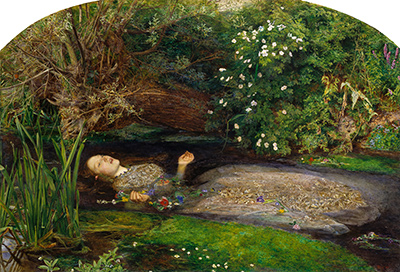
In July 1851, John Everett Millais wrote to his friend Martha Combe about painting the river for Ophelia. The flies of Surrey, he observed, were “more muscular” than those he had encountered before. The insects were one of several irritants that made their way into his letter. Other lines associated with Millais have a different history. Advice about painting with a shovel comes from the recollections of a pupil. Some of the sharpest words attached to his pictures were written by critics. The circumstances in which each person spoke or wrote help explain why these remarks have survived and what they tell us about the paintings. [1]
At a Glance
- LettersTo Martha Combe and to the Dalziel Brothers [1][2]
- Remembered remarksEdward Benest and Archibald Stuart-Wortley [1][3]
- Contemporary criticismCharles Dickens, John Ruskin and Gustave Planche [4][5][6]
Contents
- Millais’s letters about pictures in progress
- What Millais told his engravers
- Remarks remembered by people who knew him
- What Dickens and Ruskin wrote about Millais
- How critics in Paris and Germany judged the work
Millais’s letters about pictures in progress
Millais dated his letter to Martha Combe 2 July 1851 and gave his address as Surbiton Hill, Kingston. He and William Holman Hunt lodged together and walked to separate painting sites. His account moves from repetitive dinners to cramped hours beneath an umbrella, the threat of a trespass summons and swans stripping the water plants he wanted to paint. He imagined that a gust might sweep him into the river and acquaint him with Ophelia’s predicament. The unruly riverbank in the letter belongs to the making of the background. The figure of Ophelia was painted later from Elizabeth Siddal in the studio. The two settings allowed him to work at length on conditions that could scarcely have been sustained together, even though the finished picture joins the woman and the stream in a single moment. [1]
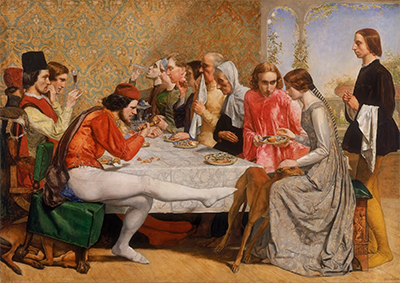
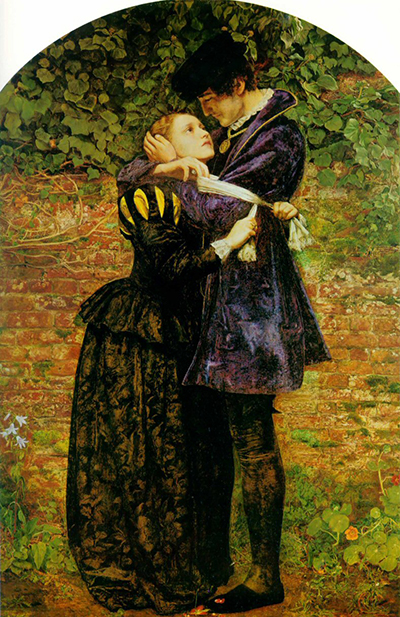
Millais could be equally precise about the effect he wanted a picture to have. In a letter to Martha Combe dated 22 November 1851, he said of the work that became A Huguenot that it would “but slightly suggest the horror of a massacre”. He had been painting the garden wall and was imagining the conversation that would take place in front of it. In the picture, a woman tries to fasten a white band around her lover’s arm and he resists. The band might allow him to pass as Catholic during the violence of St Bartholomew’s Day. The letter explains the burden borne by that small piece of cloth. Millais could keep the danger outside the garden so long as he made the figures’ opposed intentions visible in their hands. [1]
In the same letter, Millais tells Martha that his brother had reported Dr Hesse’s reading of The Return of the Dove to the Ark as an allegory of a return to Roman Catholicism. Millais greets this interpretation with dry amusement and predicts that the Huguenot subject, too, will be made to serve somebody’s argument. The two passages, read together, show how readily a viewer could carry a religious controversy from one picture into the next. There are also three people in the chain of transmission before the reader reaches the page: Hesse as the reported interpreter, Millais’s brother as the intermediary and Millais as the letter writer. Millais’s reaction is his own. Hesse’s interpretation reaches us through someone else’s account. [1]
What Millais told his engravers
In an undated letter to the Dalziel brothers, printed in their 1901 memoir, Millais said that he drew the compositions for the parables “perhaps a dozen times” before settling on them. He also recalled revising The Hidden Treasure on the block itself at least six times. The letter opens with his explanation of a design for The Leaven. He sets out where the women and the loaves are in relation to the oven and window, the sort of practical decision that allows a small image to tell its story without crowding. He ranked the time spent arranging a design above the time spent executing the drawing. His estimate of a dozen versions gives the publishers a reason for the delay and gives the reader a sense of where the effort went. [2]
The memoir also prints a note dated 6 November 1863 in which Millais assessed proofs. He was satisfied with The Good Shepherd and had a small change in mind for a face in another image. The Metropolitan Museum of Art holds a proof of The Good Shepherd engraved and printed by the Dalziels. It measures less than fourteen centimetres high at the image. Millais supplied the design and reviewed the proof, and skilled engravers cut the block from his drawing. Effie Millais also corresponded with the brothers. In a letter dated 26 November, with no year supplied in the memoir, she explained how he set his painting aside when he could give the parables his full attention. Read alongside his assurances to the engravers, her account shows why the work fit uneasily around his other commitments. [2] [7]
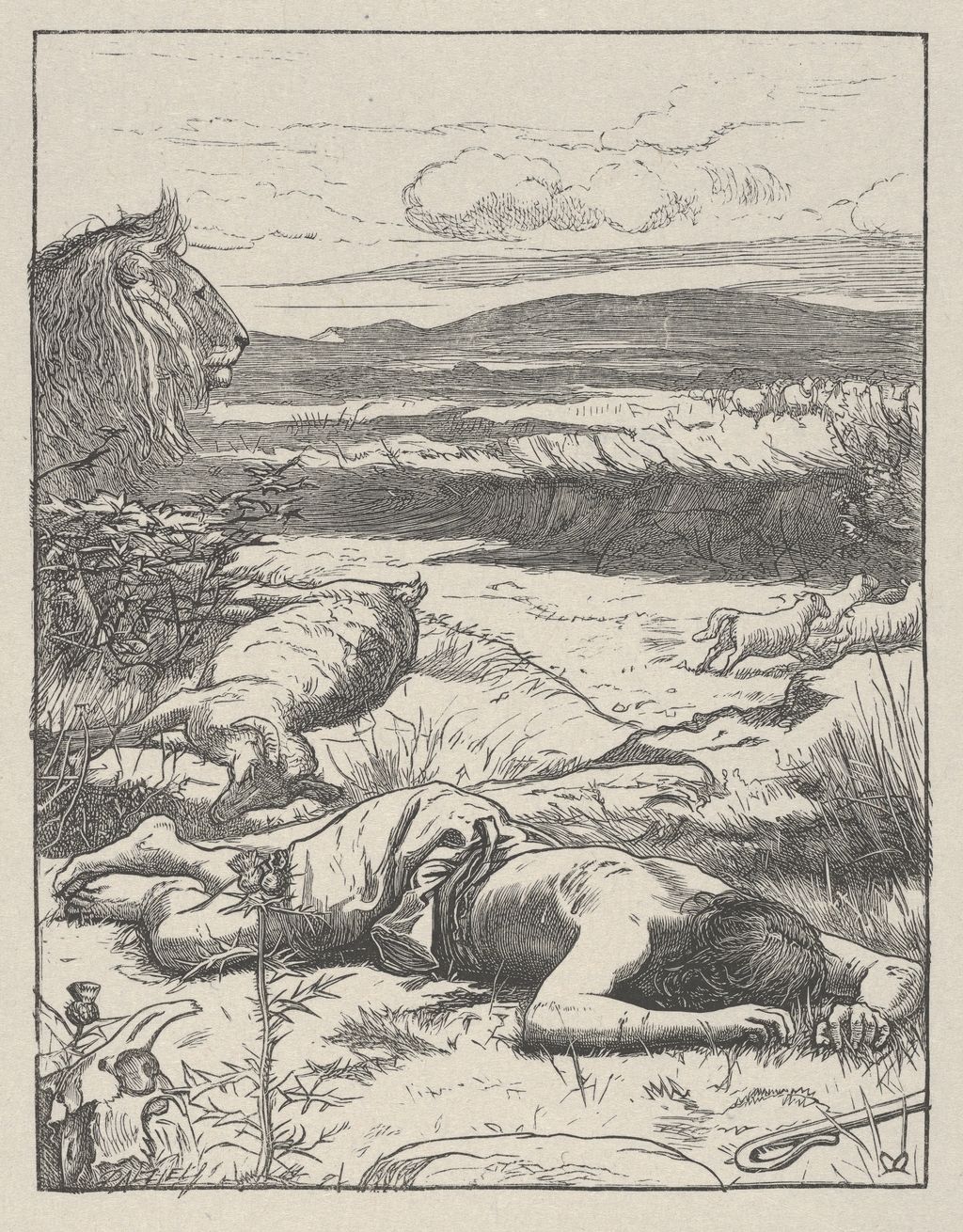
John Everett Millais, design, engraved and printed by the Dalziel Brothers. The Good Shepherd, 1864, wood-engraved proof. Metropolitan Museum of Art, Rogers Fund, 1921, 21.68.4(20). The proof preserves the relationship between the dark foreground and the open field described in the engraving discussion. Image source. CC0 / Public domain.
Remarks remembered by people who knew him
Edward Benest, Millais’s cousin, recalled visiting the rooms in Gower Street while the artist was working on Christ in the House of His Parents. Benest remembered that Millais could paint and talk energetically at the same time. Asked how he managed it, Millais tapped his forehead. “I have painted every touch in my head,” he replied, in Benest’s account. Benest also describes consultation with members of the family and the late addition of the young John the Baptist, carrying a bowl of water. The apparent ease of painting while talking came after a good deal of thinking, and the picture could still change on the canvas. It is a scene from a family recollection printed decades after the work was made, with Benest’s questions and observations shaping what we hear. [1]
The pupil Archibald Stuart-Wortley remembered different advice. In the account he supplied for John Guille Millais’s Life and Letters, he recalled his teacher saying, “Paint it with the shovel if you can’t get your effect any other way.” Stuart-Wortley was discussing texture and the appearance of the painted surface. He describes Millais working freely with a palette knife while still picking out eyelashes with a fine sable brush. The joke gives the painter license to choose whatever tool serves the passage in front of him. The eyelashes matter to the anecdote: the broadest handling and the smallest marks could belong to the same picture. The book dates the beginning of their lessons to a visit in 1874. Stuart-Wortley gives the advice without a date or a named canvas. [3]
What Dickens and Ruskin wrote about Millais
Charles Dickens addressed his readers as if they were standing before Christ in the House of His Parents at the Royal Academy. In “Old Lamps for New Ones”, published in Household Words on 15 June 1850, he prepared them for “the lowest depths of what is mean, odious, repulsive, and revolting”. The opening turns the cry of the magician in Aladdin into a joke about trading the achievements of later centuries for an older model of art. By the time Dickens brings his imaginary audience into the carpenter’s shop, he has already cast the painting as evidence of a retreat from artistic and social progress. His insults about the child and the kneeling woman expose the weight he put on beauty in a depiction of the Holy Family. The roughness of the scene, which gave the religious action a recognisable working setting, was precisely what his satire made offensive. [4]
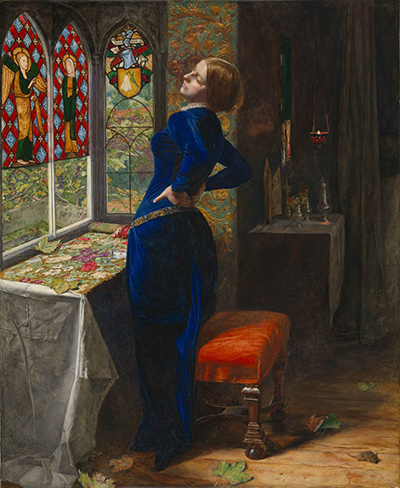
John Ruskin’s letters to The Times the following May gave readers more specific things to look at. On 13 May 1851 he praised the white drapery on the table in Mariana and the clothing of the right-hand figure in The Return of the Dove to the Ark. He identified a fault in the perspective of the green curtain in Mariana. In his second letter, published on 30 May, he objected to the features of the figure on the left in the Dove and directed the reader’s eye towards the expression of the stooping figure, the bird’s ruffled feathers and the “ease of touch and mastery of effect” in the hay. Ruskin asked readers to judge each part of the picture on what it achieved. The apparent effortlessness of the brushwork on the hay also helped him answer the charge that the painters of the Brotherhood simply imitated early models. [5]
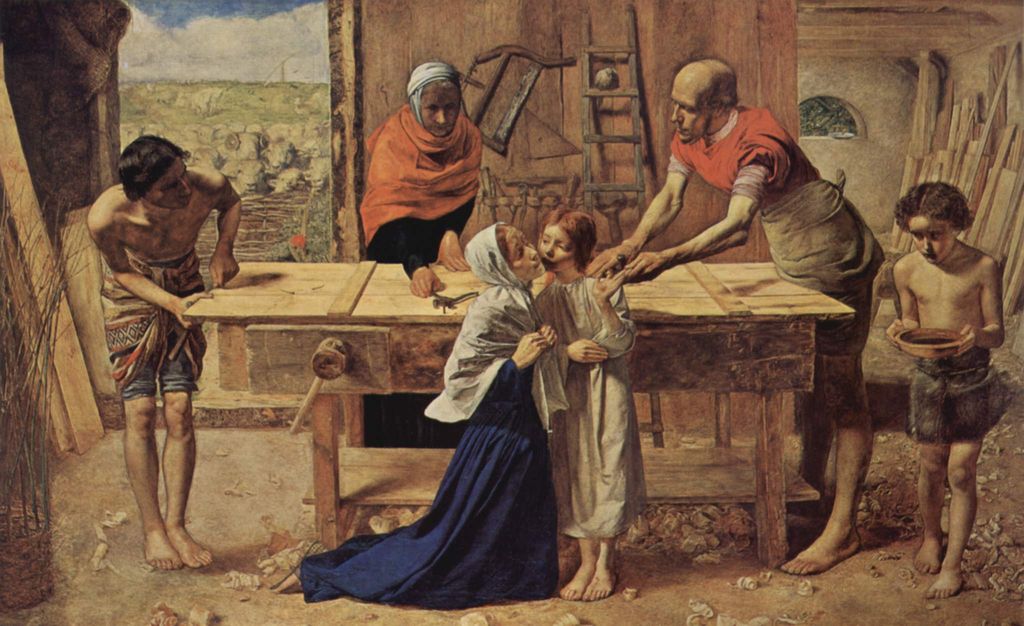
Christ in the House of His Parents, oil on canvas, Tate, N03584. From the archived 2005 Yorck Project reproduction. The carpenter’s shop becomes a point of disagreement about how sacred figures should look. Image source. Public domain.
How critics in Paris and Germany judged the work
The French critic Gustave Planche examined three paintings by Millais at the Paris Universal Exhibition in 1855. In his review for the Revue des Deux Mondes, he granted the simplicity of The Return of the Dove to the Ark and The Order of Release and dismissed their handling as overly dainty. In Ophelia, the colours troubled him and the outline of the floating body seemed insufficiently defined. Yet he wrote that the painting “nevertheless manages to move the viewer” (translated from the French). He thought the picture recovered something of the melancholy of Shakespeare’s character. Feeling moved was compatible with reservations about colour and drawing, and Planche gives both reactions room. The bookish humour of the young painter writing from Surrey and the French critic’s attention to the finished figure belong to different stages in the life of the same painting. [1] [6]
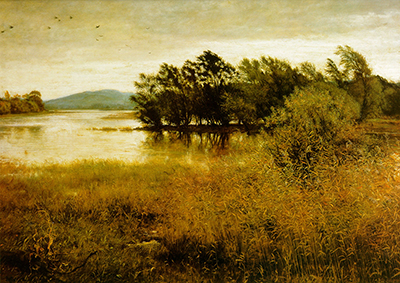
In February 1898, Otto von Schleinitz wrote in the German journal Kunstchronik about the Royal Academy’s memorial exhibition. He identified Christ in the House of His Parents as a particularly clear example of Millais’s Pre-Raphaelitism and credited A Huguenot and Ophelia with bringing him recognition. He also remarked on their extensive reproduction. He saw the Scottish landscape Chill October as one of the pictures that marked the arrival of a more independent manner. Schleinitz took a long view from the first student drawings to the final exhibits and used particular paintings to divide the career into periods. Millais’s 1851 letters let us see the garden wall and riverbank before either picture had made his reputation. Schleinitz’s article shows how far those paintings had travelled by the time a reviewer could use them to sum up the first part of a life’s work. [1] [8]
John Everett Millais artwork directory
Browse paintings and drawings covered in these articles, including related works held in public collections. Reproductive engravings and editions are discussed on the Prints page.
Prints and illustrated editions
- The Baby-House, 1872. Etching by Millais.
- The Good Shepherd, 1864. Wood engraving designed by Millais, engraved and printed by the Dalziel Brothers.
- Mariana, 1857. Wood engraving designed by Millais and cut by the Dalziel Brothers for the Moxon Tennyson.
- The Proscribed Royalist, 1858. Mixed-method engraving by William Henry Simmons after Millais.
| Name | Date | Medium |
|---|---|---|
| Pizarro Seizing the Inca of Peru | 1846 | Painting |
| The Young Men of Benjamin Seizing Their Brides | 1847 | Painting |
| Isabella | 1848–49 | Painting |
| Christ in the House of His Parents (‘The Carpenter’s Shop’) | 1849–50 | Painting |
| Ferdinand Lured by Ariel | 1849–50 (monogram dated 1849) | Painting |
| Study for Christ in the House of His Parents, Tate N04623 | c. 1849 | Drawing |
| Study for Christ in the House of His Parents, Tate N04792 | c. 1849 | Drawing |
| Study for Mariana in the Moated Grange | 1850 | Drawing |
| A Huguenot, on St Bartholomew’s Day, Refusing to Shield Himself from Danger by Wearing the Roman Catholic Badge | 1851–52 (exhibited 1852) | Painting |
| Mariana | 1851 | Painting |
| Ophelia | 1851–52 | Painting |
| The Bridesmaid | 1851 | Painting |
| The Return of the Dove to the Ark | 1851 | Painting |
| The Order of Release 1746 | 1852–53 | Painting |
| The Proscribed Royalist, 1651 | 1852–53 (exhibited 1853) | Painting |
| Portrait of John Ruskin | 1853–54 | Painting |
| The Blind Girl | 1854–56 | Painting |
| Autumn Leaves | 1855–56 (Manchester labels 1856) | Painting |
| A Dream of the Past: Sir Isumbras at the Ford | 1856–57, later revised | Painting |
| The Vale of Rest | 1858–59 | Painting |
| Study for The Black Brunswicker, Tate A00812 | c. 1860 | Drawing |
| Study for The Black Brunswicker, Tate A00813 | c. 1860 | Drawing |
| Study for The Black Brunswicker, Tate A00814 | c. 1860 | Drawing |
| The Black Brunswicker | 1860 | Painting |
| The Ransom | 1860–62 | Painting |
| My First Sermon | 1863 | Painting |
| My Second Sermon | 1864 | Painting |
| Joan of Arc | 1865 | Painting |
| Chill October | 1870 (exhibited 1871) | Painting |
| The Boyhood of Raleigh | 1870 | Painting |
| The Knight Errant | 1870 | Painting |
| Hearts are Trumps | 1872 | Painting |
| The North-West Passage | 1874 | Painting |
| Louise Jane Jopling | 1879 | Painting |
| William Ewart Gladstone, NPG 3637 | 1879 | Painting |
| Bubbles | 1886 | Painting |
| Portia | 1886 | Painting |
| Dew-Drenched Furze | 1889–90 | Painting |
| Ducklings | 1889 | Painting |
| Portrait of Sarah Hammond | 1891 | Painting |
Discussion
Look again at the images and ideas explored in John Everett Millais Quotes. These editorial prompts invite your observations.
Reader Insights
Which recorded response helped you see a feature you had overlooked in a picture?
How does your reading change when a remark comes from a contemporary letter or a recollection published years later?
Join the Conversation
Share a detail, comparison or question about John Everett Millais Quotes below.
References
- John Guille Millais, The Life and Letters of Sir John Everett Millais, vol. I (Methuen, 1899), pp. 38–39 (Edward Benest), 60–62 and 77–78 (Ophelia), 73–75 (22 November letter and A Huguenot). View source.
- George and Edward Dalziel, The Brothers Dalziel: A Record of Fifty Years’ Work (Methuen, 1901), ch. III, pp. 102–106 (John Everett and Effie Millais’s letters). View source.
- John Guille Millais, The Life and Letters of Sir John Everett Millais (1899), pp. 244–248, Archibald Stuart-Wortley’s reminiscences. View source.
- Charles Dickens, “Old Lamps for New Ones”, Household Words, no. 12 (15 June 1850), pp. 265–267. View source.
- John Ruskin, “The Pre-Raphaelite Artists”, letters in The Times, 13 and 30 May 1851, reprinted in The Works of John Ruskin, Library Edition, vol. XII (1904), pp. 320–326. View source.
- Gustave Planche, “Exposition des Beaux-Arts. L’École anglaise”, Revue des Deux Mondes, vol. 11 (1855), pp. 465–486, section beginning “Parmi les trois tableaux”. View source. (in French).
- The Metropolitan Museum of Art, The Good Shepherd (1864), proof, object 21.68.4(20). View source.
- Otto von Schleinitz, “Die Millais-Ausstellung in der Royal Academy in London”, Kunstchronik, new series, vol. 9, no. 16 (24 February 1898), pp. 258–259. View source. (in German).