 by Tom Gurney
Tom Gurney BSc (Hons) is an art history expert with over 20 years experience
Published on June 19, 2020 / Updated on November 25, 2026
Email: tomgurney1@gmail.com / Phone: +44 7429 011000
The Boyhood of Raleigh: Introduction
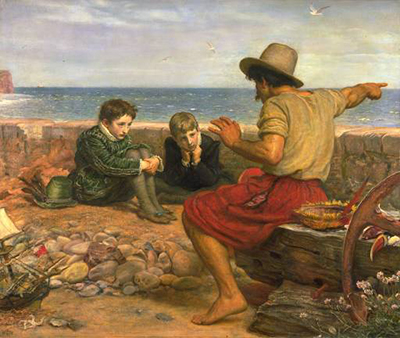
A barefoot sailor points towards the open sea in John Everett Millais’s The Boyhood of Raleigh. The boys at his feet keep their attention on him. A toy ship, partly hidden at the edge of the picture, suggests what they were doing before he began his story. Millais imagines Walter Raleigh as a child hearing about voyages he might one day make himself. The oil on canvas measures 120.6 × 142.2 cm. It was exhibited at the Royal Academy in 1870 and is now in the Tate collection, London, as N01691. [1] [2] [3]
At a Glance
- Date1870 [1][3]
- MediumOil on canvas [1]
- CollectionTate, N01691 [1]
- SubjectA sailor gestures out to sea as two boys listen [1][3]
This work across John Everett Millais’s career
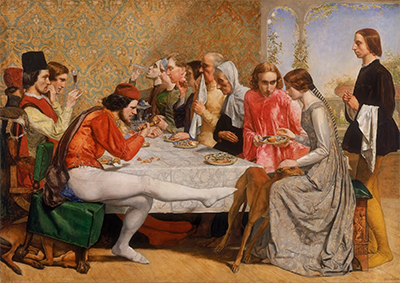
Isabella
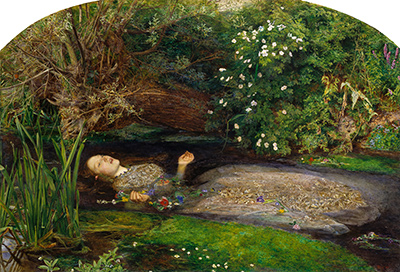
1848–49Ophelia
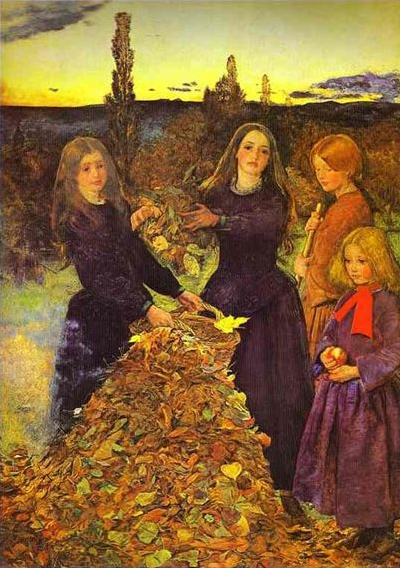
1851–52Autumn Leaves
1855–56Dew-Drenched Furze
1889–90Contents
- A story told with two hands
- Millais’s models and the Devon coast
- How the Victorians imagined Raleigh’s childhood
- The featherwork beside the sailor
- The painting’s audiences
- From Raleigh to The North-West Passage
A story told with two hands
The sailor has his back partly to us, and the wide brim of his hat hides much of his face. Millais makes his hands exceptionally expressive. His right arm almost reaches the far edge of the canvas. It crosses a band of blue water, and the finger carries the movement farther than the boy or the viewer can see. His left hand opens in the space between his face and the boys. That hand belongs to the conversation at their feet. The other gives the words a destination. The line of the pointing arm is so strong that it can take a moment to register how little of the sea occupies the picture. [1] [3]
The boy in the green doublet is Raleigh. He has drawn up his knees and clasped his hands around them. His companion, usually understood to be his brother, sits lower, with his face supported by his hands. The pale ruffs and carefully worked clothes of the boys stand out beside the sailor’s rolled sleeves and bare feet. There is a reversal of social authority in the arrangement. The finely dressed children sit on the ground, while the barefoot man has the seat, the experience and the power to hold their attention. We see enough of each child’s expression to imagine a different response. The posture of the green-clad boy tells us especially little about what he will do, until the title supplies his name. [1] [3] [4]
At the bottom left, the toy ship has come to rest among stones and pieces of seaweed. Its rigging and flag are small enough to miss at first. Across the painting lies the curved iron of a full-sized anchor. Those two objects bring play and seafaring into the same stretch of foreground. The toy suits a child who can already picture himself aboard a ship. The anchor has the weight and worn surface of something that has been used. A low wall runs behind the people, so that even as we follow the sailor’s arm towards the horizon, our eye stays close to the boys and the things they can touch. [1] [3]
Millais’s models and the Devon coast
The sailor is described as Genoese in the traditional reading of the picture. The man who posed for him was a professional model, according to Millais’s son John Guille Millais. The family memoir names the painter’s sons Everett and George as the two boys. It also places the painting of the background at Lady Rolle’s property on the Devon coast. The same book reproduces a sketch for the composition. In 1909 the Hungarian illustrated weekly Vasárnapi Újság named Angelo Colarossi as the model for the sailor. Art historian Scott Thomas Buckle also identifies Colarossi and found that he sat at the Royal Academy Schools between 1868 and 1870. Millais thus drew on both family and professional models to people his Elizabethan scene. [4] [5] [6] [7]
Historic England records that Millais stayed at the Octagon in Budleigh Salterton. The listed rubble wall opposite is a possible model for the one in the painting. The uncertainty matters because the wall has since acquired the name Raleigh’s Wall. Millais’s use of the Devon coast lends a particular feel to the foreground, from the low coping to the loose material of the beach. The association of a surviving wall with the picture comes from the painter’s visit centuries after Raleigh’s childhood. [5] [8]
How the Victorians imagined Raleigh’s childhood
In his essay England’s Forgotten Worthies, first published in 1852, the historian James Anthony Froude imagined Raleigh and his half-brothers playing by the water near Dartmouth. They might have climbed aboard ships to hear sailors describe lands across the Atlantic. Froude used this scene to make the adventures of the grown men seem to grow out of their games. Millais gives that idea a different setting and a much simpler cast. There are two children, one sailor and a toy ship. The story can be understood entirely through where people sit and how closely they listen. Froude’s essay makes a revealing parallel to the painting, whose meeting is an imagined episode in Raleigh’s life. [3] [5] [9]
The critic F. G. Stephens supplied the sailor’s story when he described the painting in 1870, in a passage later printed by Millais’s son. He imagined the man telling of his experiences in the Spanish Main and the boy forming a picture of El Dorado. Stephens likened the sailor to the part-pirate, part-hero figures familiar to boys from Charles Kingsley’s writing. The distant shore lies outside the frame, but Stephens’s account shows how easily one Victorian viewer could fill the open water with a familiar story. [5]
The adult Raleigh had a royal patent in 1584 and organised the expeditions that sought to establish English settlements on Roanoke Island. His account of the 1595 voyage to Guiana, published the following year, presented the region’s supposed riches as grounds for English intervention. In it he cast Elizabeth I as a protector against Spain while urging her to secure Guiana for herself. That mixture of rivalry, claimed protection and hoped-for wealth gave the voyage a purpose beyond travel. The intimate scene in Millais’s painting takes place before any of those choices and draws much of its drama from the fact that the audience already knows what the boy will become. [10] [11]
The literary scholar Christoph Bode argues that the painting makes a childhood conversation look like the beginning of an inevitable career. He reads a second implication in the same device. A Victorian viewer could see the young Raleigh’s future as the distant beginning of Britain’s own empire. Seen this way, the sailor’s finger points towards something an audience in 1870 might already regard as historical destiny. The painting makes that idea persuasive by working on a scale that feels familiar: two children listening, a man talking with his hands, and the things a child has been playing with left by the wall. [12]
The featherwork beside the sailor
The objects just behind the storyteller give the nineteenth-century context a physical presence. The Royal Academy’s memorial catalogue of 1898 described a feather-covered basket among the anchor and bright-plumaged birds. Research presented at Birkbeck identified the apparent basket as Indigenous featherwork made as a headdress. Edward Angelo Goodall, an artist attached to a British boundary survey of Guiana in the 1840s, collected Indigenous objects that Millais used in his work. The study identifies the same headdress in Pizarro Seizing the Inca of Peru, painted in 1846, where Millais used it for the Inca ruler’s crown. [3] [13]
The identification changes the role of a detail that could easily pass for part of the coastal still life. The headdress belongs to the history of an Indigenous maker and to a nineteenth-century survey and collecting expedition. In the picture it lies behind an Elizabethan storyteller, within reach of a man the boys look to for knowledge of distant places. This is a material connection to the colonial history through which the painting was made. The 1898 description shows how readily a viewer could attend to the brightness and texture of the feathers while overlooking what the object was. [3] [13]
The painting’s audiences
James Reiss lent The Boyhood of Raleigh to the Academy’s memorial exhibition in 1898. Amy, Lady Tate presented it to the collection in memory of Sir Henry Tate in 1900. A few years later the German critic Richard Muther wrote that one boy scarcely understood what he was hearing, while the other had begun to grasp his future calling. Stephens had given both boys a share in the excitement, even as he distinguished between their ways of listening. Their accounts show what changes when the viewer looks from the pointing finger back to the two separate faces. [1] [3] [5] [14]
The image also circulated far from the large canvas. A linen card at the National Maritime Museum, 72 by 60 millimetres, reproduces it as number eight in a series issued with Spinet cigarettes. A composition roomy enough for a broad sea and three clearly differentiated figures became a picture small enough to pass from hand to hand. Even at that scale the sailor’s arm and the tight group of listeners tell much of the story. [1] [15]
From Raleigh to The North-West Passage
The critic A. Lys Baldry read The Boyhood of Raleigh as a kind of prologue to Millais’s 1874 painting The North-West Passage. In the later work a young woman reads from an open book beside an old seafarer, with a chart on the table and the sea visible through a window. Raleigh listens to an experienced traveller in the open air. In the later work the older man listens indoors and the younger person supplies the words. Millais can put that sea behind a wall or across a room and still make an unseen voyage occupy the attention of everyone in the scene. [3] [16]
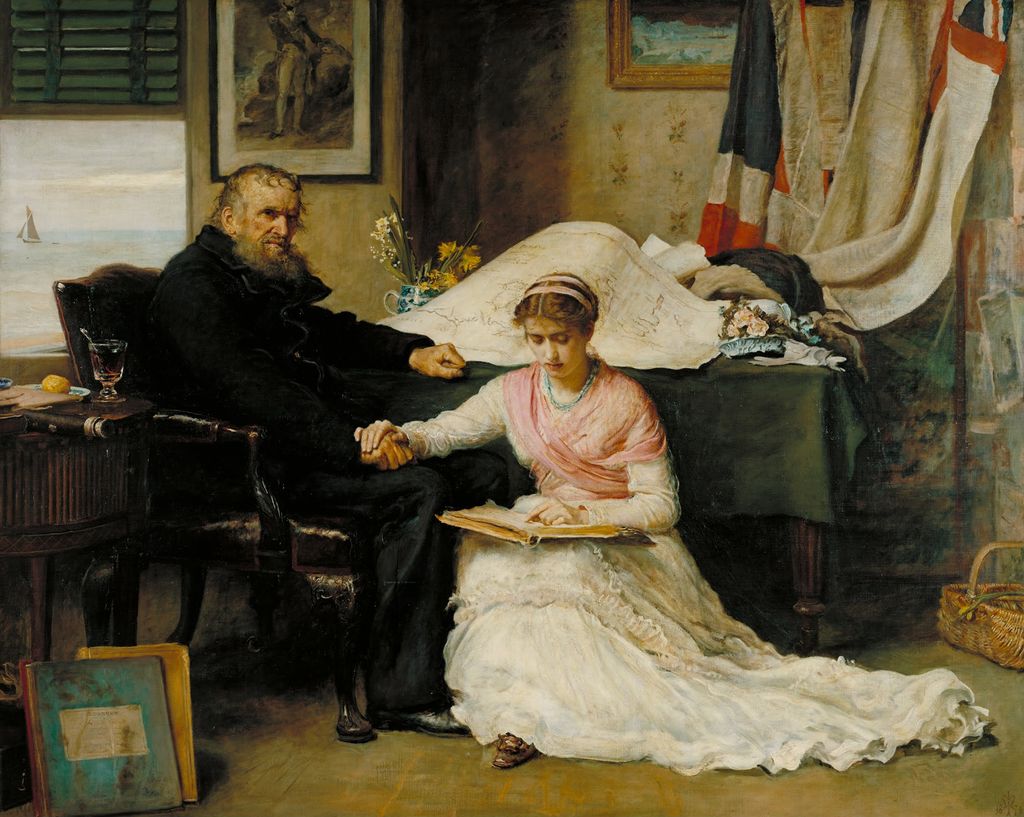
The North-West Passage, oil on canvas, Tate, N01509. Two later generations of viewers meet a story of sea travel at home through the seaman and the woman with a book. Image source. Public domain.
John Everett Millais artwork directory
Browse paintings and drawings covered in these articles, including related works held in public collections. Reproductive engravings and editions are discussed on the Prints page.
Prints and illustrated editions
- The Baby-House, 1872. Etching by Millais.
- The Good Shepherd, 1864. Wood engraving designed by Millais, engraved and printed by the Dalziel Brothers.
- Mariana, 1857. Wood engraving designed by Millais and cut by the Dalziel Brothers for the Moxon Tennyson.
- The Proscribed Royalist, 1858. Mixed-method engraving by William Henry Simmons after Millais.
| Name | Date | Medium |
|---|---|---|
| Pizarro Seizing the Inca of Peru | 1846 | Painting |
| The Young Men of Benjamin Seizing Their Brides | 1847 | Painting |
| Isabella | 1848–49 | Painting |
| Christ in the House of His Parents (‘The Carpenter’s Shop’) | 1849–50 | Painting |
| Ferdinand Lured by Ariel | 1849–50 (monogram dated 1849) | Painting |
| Study for Christ in the House of His Parents, Tate N04623 | c. 1849 | Drawing |
| Study for Christ in the House of His Parents, Tate N04792 | c. 1849 | Drawing |
| Study for Mariana in the Moated Grange | 1850 | Drawing |
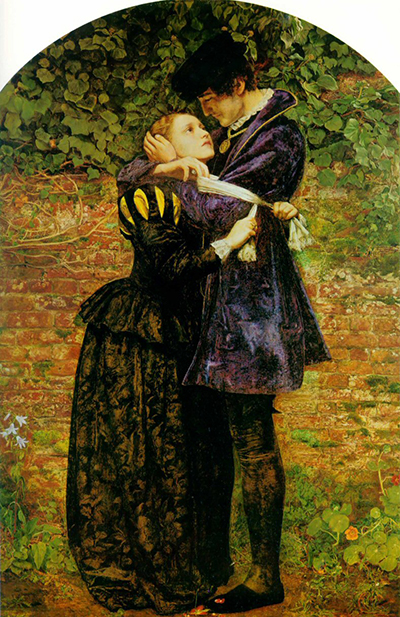
| A Huguenot, on St Bartholomew’s Day, Refusing to Shield Himself from Danger by Wearing the Roman Catholic Badge | 1851–52 (exhibited 1852) | Painting |
| Mariana | 1851 | Painting |
| Ophelia | 1851–52 | Painting |
| The Bridesmaid | 1851 | Painting |
| The Return of the Dove to the Ark | 1851 | Painting |
| The Order of Release 1746 | 1852–53 | Painting |
| The Proscribed Royalist, 1651 | 1852–53 (exhibited 1853) | Painting |
| Portrait of John Ruskin | 1853–54 | Painting |
| The Blind Girl | 1854–56 | Painting |
| Autumn Leaves | 1855–56 (Manchester labels 1856) | Painting |
| A Dream of the Past: Sir Isumbras at the Ford | 1856–57, later revised | Painting |
| The Vale of Rest | 1858–59 | Painting |
| Study for The Black Brunswicker, Tate A00812 | c. 1860 | Drawing |
| Study for The Black Brunswicker, Tate A00813 | c. 1860 | Drawing |
| Study for The Black Brunswicker, Tate A00814 | c. 1860 | Drawing |
| The Black Brunswicker | 1860 | Painting |
| The Ransom | 1860–62 | Painting |
| My First Sermon | 1863 | Painting |
| My Second Sermon | 1864 | Painting |
| Joan of Arc | 1865 | Painting |
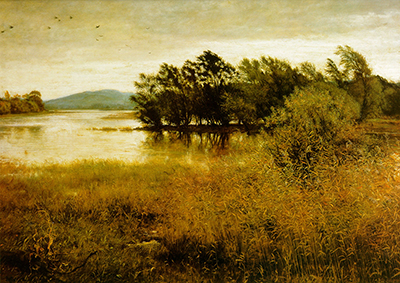
| Chill October | 1870 (exhibited 1871) | Painting |
| The Boyhood of Raleigh | 1870 | Painting |
| The Knight Errant | 1870 | Painting |
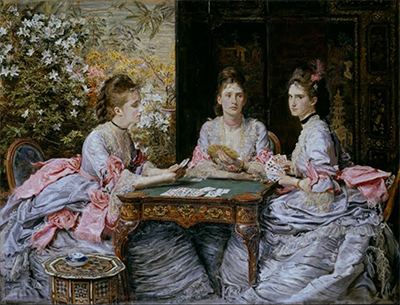
| Hearts are Trumps | 1872 | Painting |
| The North-West Passage | 1874 | Painting |
| Louise Jane Jopling | 1879 | Painting |
| William Ewart Gladstone, NPG 3637 | 1879 | Painting |
| Bubbles | 1886 | Painting |
| Portia | 1886 | Painting |
| Dew-Drenched Furze | 1889–90 | Painting |
| Ducklings | 1889 | Painting |
| Portrait of Sarah Hammond | 1891 | Painting |
Discussion
Look again at the images and ideas explored in The Boyhood of Raleigh. These editorial prompts invite your observations.
Reader Insights
Where does the sailor’s gesture send your eye, and what remains outside the canvas?
Compare how the two children listen. Which part of the painting makes their reactions feel distinct?
Join the Conversation
Share a detail, comparison or question about The Boyhood of Raleigh below.
References
- Tate, The Boyhood of Raleigh, N01691, Tate collection dataset. View source.
- Algernon Graves, The Royal Academy of Arts, vol. V, p. 246, catalogue entry no. 334 for 1870. View source.
- Royal Academy of Arts, Exhibition of Works by the Late Sir John Everett Millais, Winter Exhibition catalogue, 1898, p. 39, entries 126 and 129. View source.
- Historic Royal Palaces, Sir Walter Raleigh, caption and early-life section. View source.
- John Guille Millais, The Life and Letters of Sir John Everett Millais, 1899, pp. 221–222, including the sketch and F. G. Stephens’s account. View source.
- Vasárnapi Újság, “Híres modellek. A műtermek kulisszáiból”, vol. 56, no. 4, 24 January 1909. View source.
- Scott Thomas Buckle, “Is This the Face of Alessandro di Marco? The Forgotten Features of a Well-Known Italian Model”, The British Art Journal 13, no. 2, 2012, notes 11 and 39. View source.
- Historic England, Raleigh’s Wall (Wall Opposite No 5), National Heritage List entry 1333468. View source.
- James Anthony Froude, England’s Forgotten Worthies, first published in the Westminster Review, 1852, reprinted in Essays in Literature and History. View source.
- National Portrait Gallery, Sir Walter Ralegh (Raleigh), NPG 7, object commentary. View source.
- Folger Shakespeare Library, Elizabethan Court Day by Day, 1596, entry for 15 March, quoting Raleigh’s Discoverie of Guiana. View source.
- Christoph Bode, “Beyond/Around/Into One’s Own. Reiseliteratur als Paradigma von Welt-Erfahrung”, Poetica 26, nos. 1–2, 1994, pp. 70–73. View source.
- Birkbeck Centre for Museum Cultures, Trophies of Empire: Exotic Props in Two Paintings by John Everett Millais, research talk abstract, 18 November 2020. View source.
- Richard Muther, Geschichte der englischen Malerei, 1903, p. 193. View source.
- Royal Museums Greenwich, The Boyhood of Raleigh, linen cigarette card, National Maritime Museum, PEB5053. View source.
- A. Lys Baldry, Millais, Plate II, commentary on The Boyhood of Raleigh. View source.