 by Tom Gurney
Tom Gurney BSc (Hons) is an art history expert with over 20 years experience
Published on June 19, 2020 / Updated on November 25, 2026
Email: tomgurney1@gmail.com / Phone: +44 7429 011000
Portrait of John Ruskin: Introduction
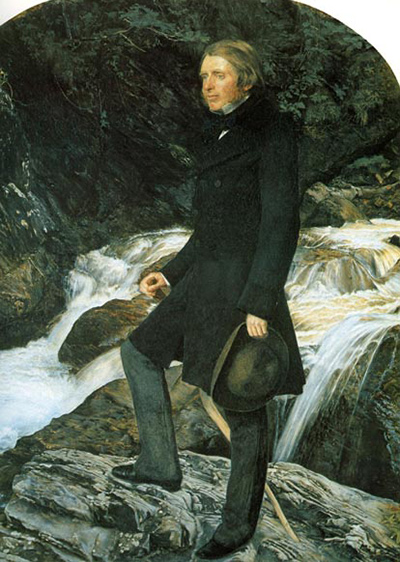
John Everett Millais painted the Victorian art critic John Ruskin standing on a shelf of rock beside a torrent in the Scottish Trossachs. Ruskin wears a dark frock coat, carries his hat and a walking stick, and looks away from the viewer. All around him, the stream breaks over rocks that occupy almost the entire picture. Millais began the oil in 1853, painted the figure in his London studio the following year and returned to Scotland to complete the landscape. The finished painting is in the Ashmolean Museum, Oxford. [1] [2]
What makes this portrait unusual is how much there is to see beyond the sitter. The rock directly under Ruskin’s shoes is as sharply described as the shoes themselves. The water carries the eye away from him, and the cliff crowds close enough for us to study its surface. Ruskin’s pose gives us a quiet point from which to take in all that movement and detail. In a letter to his father, he explained that he was to stand looking downstream, as he had often done for hours on his own. [3]
At a Glance
- Date1853–54 [1][2]
- MediumOil on canvas [1]
- CollectionAshmolean Museum, WA2013.67 [1]
- SitterJohn Ruskin, critic and writer, at Glenfinlas [1][2]
This work across John Everett Millais’s career
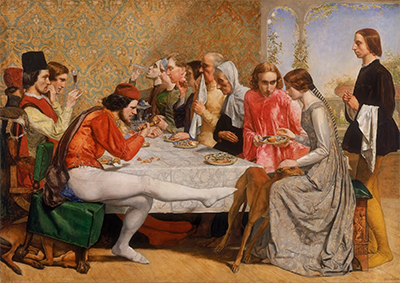
Isabella
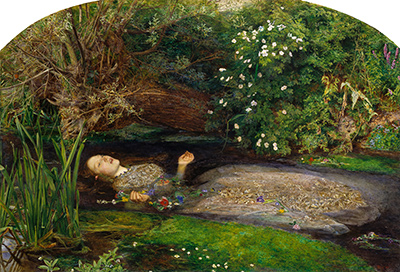
1848–49Ophelia
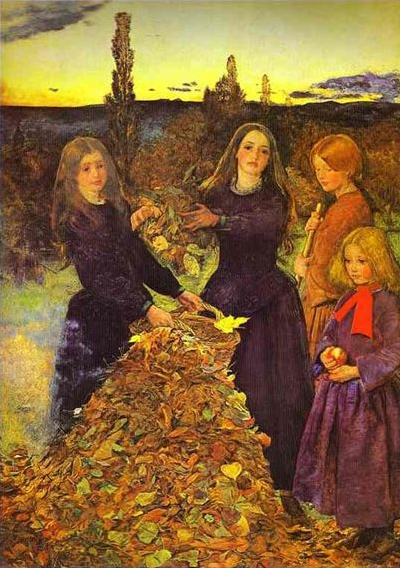
1851–52Autumn Leaves
1855–56Dew-Drenched Furze
1889–90Contents
- Why Millais painted Ruskin beside a torrent
- From Glen Finglas to the London studio
- What to look for in the ledge and water
- Ruskin’s own views of Glen Finglas
- The Acland family and the Ashmolean
Why Millais painted Ruskin beside a torrent
The commission came from Ruskin’s father, John James Ruskin, a wine merchant and a collector of contemporary watercolours. His son had taken up the cause of the Pre-Raphaelite Brotherhood in letters to The Times in May 1851, two years before the Scottish trip. In the first letter he argued that painters such as Millais and William Holman Hunt were trying to depict what they saw, or what they believed could actually have happened in a scene, with a degree of finish that challenged prevailing conventions. This was an argument for their way of working, and for judging their pictures by looking closely at what they had actually painted. [1] [4] [5]
Ruskin told his father on 6 July 1853 that Millais had chosen the spot near Brig o’ Turk. His letter names the ingredients of the setting before it says how he would stand. There would be worn rock, water foaming around it, weeds and moss, and a high bank of darker stone. He expected the rendering of the foam to be something new and put the planned picture beside J. M. W. Turner’s The Pass of St. Gotthard, near Faido in his imagination. Ruskin had commissioned Turner’s finished watercolour in 1843 after seeing the artist’s study of the Swiss site. The comparison gives some measure of his ambition for the portrait. The Scottish torrent was to repay the attention he already gave Turner’s Alpine water and rock. [3] [6]
Turner looked up a gorge where the river churns past the road at the base of a mountain. Millais brought his viewpoint much closer. A shelf of bare stone extends across the foreground, while the water appears in broken passages behind it and around the sitter. The edges cut off the continuing bank and stream, and there is scarcely any distance into which the eye can escape. Turner’s watercolour helps explain Ruskin’s excitement about the subject. The narrow field of view in Millais’s oil gives that subject its own scale and intimacy. [1] [6]
From Glen Finglas to the London studio
Millais began the canvas at Glen Finglas, also recorded as Glenfinlas, in July 1853. Ruskin’s Oxford friend Henry Acland was there at the start and, according to the Ashmolean, held the canvas for him. Working for any length of time beside the stream depended on the weather. In August Millais told his friend Thomas Combe that the waterfall was near enough for him to reach it easily in the morning. Writing to Mrs Combe in September, he described the group dining on the rocks while he painted and Ruskin drew, and said that midges could make it impossible to sit still even on a fine day. [1] [7]
By the end of October, the bulk of the background had been painted. Ruskin’s letter to Frederick Furnivall that month conveys how uncertain the outcome had seemed as the weather turned cold. He jokes about having pressed Millais to keep up the Pre-Raphaelite degree of finish and then describes the lichen patterns and the bubbles in the foam that he could already see in the canvas. One consists of marks that accumulate slowly on the rock. The other flickers in and out of sight as the water breaks. Millais spent part of the same season painting both closely enough for Ruskin to remark on them. [1] [3]
The figure was painted from life in the London studio in 1854. A separate Millais head study dated 17 January 1854, in the Morgan Library & Museum, records Ruskin with his face turned to the left. The canvas required another journey. The Ashmolean dates Millais’s return to Brig o’ Turk to June 1854 and says he spent about ten days finishing the landscape. The artist had to fit the figure painted in the studio onto the rock he had studied outdoors, making the shoes rest plausibly and bringing the face and clothes into the light of the glen. [1] [2] [8]
What to look for in the ledge and water
Begin at Ruskin’s feet. The ledge is broad enough for him to stand on, yet its face breaks into angular sections that make the edge feel precarious. Marks within the stone turn with its surface. The folds and edges of Ruskin’s dress give his body a similarly legible shape. Follow the hem of the coat down towards the stick and the outline of the trousers. The dark clothing cuts into the paler passages of rock and water, while the light on the sitter’s face and shirt collar picks him out against the darker bank. The force of the current is easiest to grasp where the whiteness bunches over a break in the rock and then thins downstream. [1] [2]
The Ruskin at Lancaster University identifies the rock as gneiss, a metamorphic rock with bands of differing mineral composition. Ruskin was interested in how those internal markings helped the eye understand the mass of a stone. In the fourth volume of Modern Painters he explains that a convincing contour can only do part of the work. The marks within the outline and the way they change as surfaces turn away from the viewer give the stone its weight. Look at how Millais uses a pale line along a broken edge or a streak crossing the face of an outcrop. The stripe reads at once as a mark on the surface and a clue to the shape of the whole rock. [9]
The lichen offered a different problem. Art historian Kate Flint draws attention to Ruskin’s letter of 11 October 1853, in which he likened the lichens in the painting to silver decoration on purple cloth. It was a comparison about colour and the way markings sit on a surface. The pale flecks and irregular patches in the oil can be read separately from the lines running through the stone. Ruskin’s later Study of Foreground Material of 1871, now at the Ashmolean, assembles examples of minute growth that a viewer might encounter on limestone. It shows how far he carried an interest already apparent in his response to Millais’s work. [10]
Ruskin’s own views of Glen Finglas
Ruskin made his own watercolour, Rocks and Torrent, Glenfinlas, in 1853. In that small section of the stream, the rock and current occupy the whole scene. This is a useful comparison with the portrait. In Millais’s oil, the ledge must bear a man’s weight and fit a landscape that continues beyond his body. In the watercolour, the meeting of stone and water supplies the composition. The two pictures ask us to judge the size and shape of the rocks in different ways. [1] [9]
Ruskin also made a separate Study of Gneiss Rock, Glenfinlas, now in the Ashmolean’s drawing collection. It uses lampblack, pen and ink, and bodycolour over graphite, with some areas scratched out. The museum identifies part of the same rock in the oil at the left edge and a smaller rock behind Ruskin’s right knee. Its curators place Ruskin’s viewpoint farther upstream and apparently nearer the edge of the water. Putting the study beside the oil makes it possible to follow a rock from one picture to the other while seeing the effect of a few steps along the bank. The Ashmolean also records Ruskin’s apparent reuse of the drawing in an 1871 lecture on light and shade, where an outline laid over the drawing helped distinguish the contour from what the full study tells us about the rock. [11]
Thomas Ogle’s albumen photograph of a river at Glen Finglas offers a third way of picturing this landscape. The Rijksmuseum dates the photograph from about 1853 to no later than 1863 and records it as a plate in an edition of Walter Scott’s The Lady of the Lake. Ogle’s river view belongs to the same place and period, with its own literary context. The close correspondence between Millais’s oil and Ruskin’s drawing is the firmer guide to the particular rocks in the portrait. [11] [12]
One later debate about Ruskin’s criticism helps bring the question of selection into focus. In the Russian journal Mir iskusstva around the turn of the twentieth century, an essay published under Sergei Diaghilev’s name took issue with what it saw as Ruskin’s demand that artists accept all of nature on equal terms. Its argument was that an artist must select what matters. A modern Russian anthology prints Millais’s portrait alongside the essay. Looking back at the painting, the choice of this ledge and the decision to let stone fill so much of the frame matter just as much as the fidelity with which Millais painted it. [13]
The Acland family and the Ashmolean
Effie Gray, then married to Ruskin, was part of the party at Brig o’ Turk. Her marriage to Ruskin was annulled in 1854, and she married Millais on 3 July 1855. Thomas Richmond had already painted her for John James Ruskin in 1851. That earlier oil, now at the National Portrait Gallery, presents her in an arched picture, wearing a gold and enamel bracelet. She wrote to her mother about how the painter had made her look, giving us her own response to sitting for a portrait within the same family circle. [5] [14] [15]
Ruskin gave the oil to Henry Acland in 1871. It continued to be shown on loan while in private hands, including at the Royal Academy’s Millais memorial exhibition in 1898 and at the National Portrait Gallery’s Millais: Portraits exhibition in 1999. It also had a quieter life in the Acland family. In the 1910s Henry’s daughter Sarah Angelina Acland, an early colour photographer and a former drawing pupil of Ruskin, made an Autochrome photograph of the painting hanging in her Oxford home. The photograph preserves evidence of how it was framed and hung. The oil and the glass colour plate later appeared in the Ashmolean’s Colour Revolution exhibition, allowing viewers to encounter Millais’s painting alongside Acland’s means of recording its colours. [1] [2] [16]
In 2013 the government accepted the portrait in lieu of inheritance tax. Arts Council England’s report records its permanent allocation to the Ashmolean under a condition of the offer. The same museum now holds Millais’s portrait and Ruskin’s study of the gneiss. Seen together, they show two artists working at the same stretch of water and making different choices about how much of the scene a picture needs. In the oil, Ruskin’s stillness makes the rush of the stream more palpable. In his drawing, the rock receives the scrutiny that Millais’s sitter appears to be giving the landscape. [1] [11] [17]
John Everett Millais artwork directory
Browse paintings and drawings covered in these articles, including related works held in public collections. Reproductive engravings and editions are discussed on the Prints page.
Prints and illustrated editions
- The Baby-House, 1872. Etching by Millais.
- The Good Shepherd, 1864. Wood engraving designed by Millais, engraved and printed by the Dalziel Brothers.
- Mariana, 1857. Wood engraving designed by Millais and cut by the Dalziel Brothers for the Moxon Tennyson.
- The Proscribed Royalist, 1858. Mixed-method engraving by William Henry Simmons after Millais.
| Name | Date | Medium |
|---|---|---|
| Pizarro Seizing the Inca of Peru | 1846 | Painting |
| The Young Men of Benjamin Seizing Their Brides | 1847 | Painting |
| Isabella | 1848–49 | Painting |
| Christ in the House of His Parents (‘The Carpenter’s Shop’) | 1849–50 | Painting |
| Ferdinand Lured by Ariel | 1849–50 (monogram dated 1849) | Painting |
| Study for Christ in the House of His Parents, Tate N04623 | c. 1849 | Drawing |
| Study for Christ in the House of His Parents, Tate N04792 | c. 1849 | Drawing |
| Study for Mariana in the Moated Grange | 1850 | Drawing |
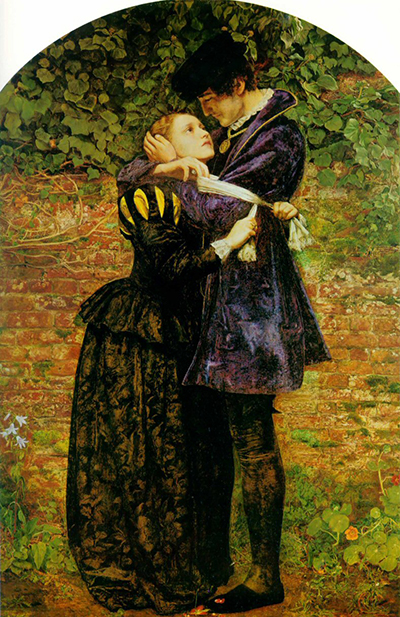
| A Huguenot, on St Bartholomew’s Day, Refusing to Shield Himself from Danger by Wearing the Roman Catholic Badge | 1851–52 (exhibited 1852) | Painting |
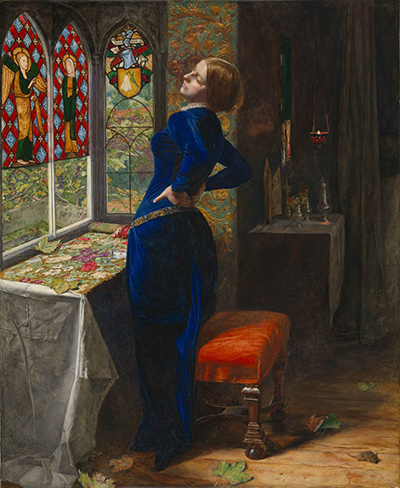
| Mariana | 1851 | Painting |
| Ophelia | 1851–52 | Painting |
| The Bridesmaid | 1851 | Painting |
| The Return of the Dove to the Ark | 1851 | Painting |
| The Order of Release 1746 | 1852–53 | Painting |
| The Proscribed Royalist, 1651 | 1852–53 (exhibited 1853) | Painting |
| Portrait of John Ruskin | 1853–54 | Painting |
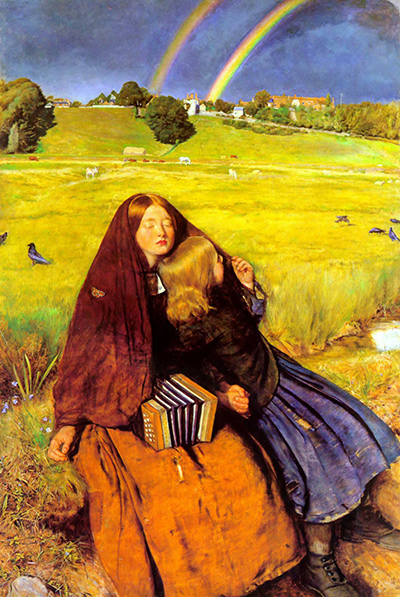
| The Blind Girl | 1854–56 | Painting |
| Autumn Leaves | 1855–56 (Manchester labels 1856) | Painting |
| A Dream of the Past: Sir Isumbras at the Ford | 1856–57, later revised | Painting |
| The Vale of Rest | 1858–59 | Painting |
| Study for The Black Brunswicker, Tate A00812 | c. 1860 | Drawing |
| Study for The Black Brunswicker, Tate A00813 | c. 1860 | Drawing |
| Study for The Black Brunswicker, Tate A00814 | c. 1860 | Drawing |
| The Black Brunswicker | 1860 | Painting |
| The Ransom | 1860–62 | Painting |
| My First Sermon | 1863 | Painting |
| My Second Sermon | 1864 | Painting |
| Joan of Arc | 1865 | Painting |
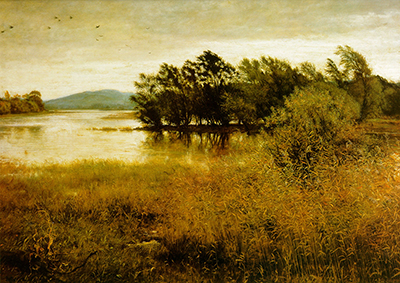
| Chill October | 1870 (exhibited 1871) | Painting |
| The Boyhood of Raleigh | 1870 | Painting |
| The Knight Errant | 1870 | Painting |
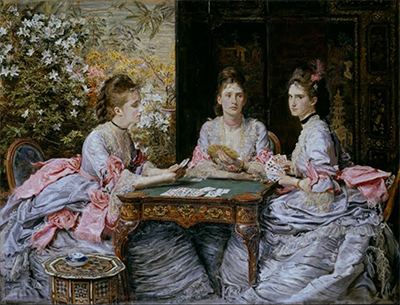
| Hearts are Trumps | 1872 | Painting |
| The North-West Passage | 1874 | Painting |
| Louise Jane Jopling | 1879 | Painting |
| William Ewart Gladstone, NPG 3637 | 1879 | Painting |
| Bubbles | 1886 | Painting |
| Portia | 1886 | Painting |
| Dew-Drenched Furze | 1889–90 | Painting |
| Ducklings | 1889 | Painting |
| Portrait of Sarah Hammond | 1891 | Painting |
Discussion
Look again at the images and ideas explored in Portrait of John Ruskin. These editorial prompts invite your observations.
Reader Insights
How does the rock next to the sitter change how you read his still pose?
Follow the painted water from the upper rocks to the foreground. Where does the motion first become clear?
Join the Conversation
Share a detail, comparison or question about Portrait of John Ruskin below.
References
- Ashmolean Museum, Portrait of John Ruskin by John Everett Millais, WA2013.67. View source.
- National Portrait Gallery, John Ruskin iconography, 1854 portrait and exhibition records. View source.
- John Ruskin, letters of 6 July and 16 October 1853, in the Cook and Wedderburn Library Edition, vol. XII, p. xxiv. View source.
- John Ruskin, letters to The Times, May 1851, in the Cook and Wedderburn Library Edition, vol. XII. View source.
- National Gallery, John Ruskin and the National Gallery. View source.
- The Morgan Library & Museum, J. M. W. Turner, The Pass of St. Gotthard, near Faido, 1843. View source.
- John Everett Millais, letters to Mr and Mrs Combe, August and September 1853, in J. G. Millais, The Life and Letters of Sir John Everett Millais, vol. I, pp. 108–112. View source.
- The Morgan Library & Museum, John Ruskin, age 35, print MA 11008 and the source drawing of 17 January 1854. View source.
- The Ruskin, Lancaster University, John Ruskin, Rocks and Torrent, Glenfinlas, 1853, 1996P1465. View source.
- Kate Flint, Ruskin and Lichen, Courtauld Books Online. View source.
- Ashmolean Museum, John Ruskin, Study of Gneiss Rock, Glenfinlas, WA.RS.REF.089. View source.
- Rijksmuseum, Thomas Ogle, Gezicht op een rivier in Glen Finglas, RP-F-2001-7-258-5. View source.
- Sergei Diaghilev, Сложные вопросы (Difficult Questions), section Поиски красоты (The Search for Beauty), in Manifesty modernizma, pp. 78–80. View source.
- National Portrait Gallery, John Everett Millais biography. View source.
- National Portrait Gallery, Thomas Richmond, Effie Gray (Lady Millais), 1851, NPG 5160. View source.
- Ashmolean Museum, How Victorian Women Shaped Colour Technologies, including Sarah Angelina Acland’s Autochrome. View source.
- Arts Council England, Acceptance in Lieu Report 2013, case 27, pp. 58–59. View source.