 by Tom Gurney
Tom Gurney BSc (Hons) is an art history expert with over 20 years experience
Published on June 19, 2020 / Updated on November 25, 2026
Email: tomgurney1@gmail.com / Phone: +44 7429 011000
Christ in the House of His Parents: Introduction
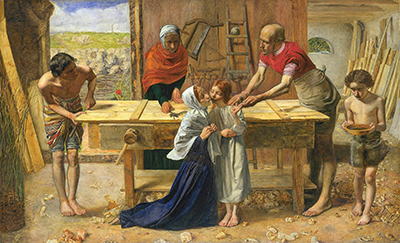
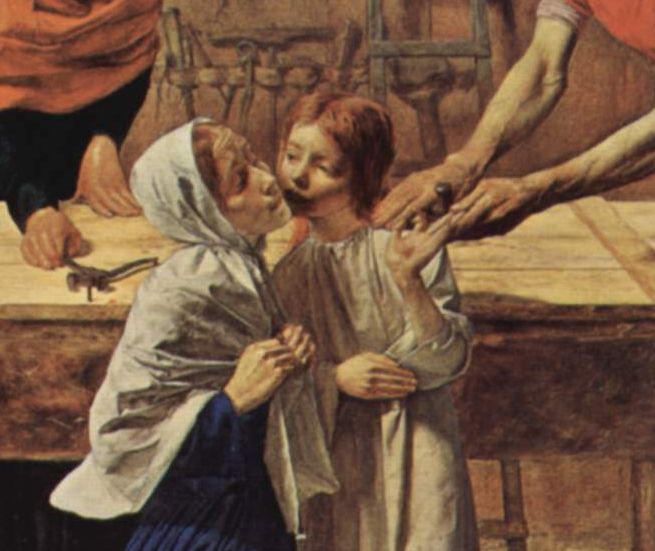
A boy has hurt his hand in a carpenter’s shop. He holds out his palm as his mother kneels beside him and his father bends over the workbench. Another boy approaches with a bowl of water. The injury is easy to miss amid the wood shavings, bare feet and exposed tools. Find the bright spot of blood on the palm, then look down to the boy’s foot. The two marks give the workshop accident a second meaning. In John Everett Millais’s Christ in the House of His Parents, an injury in childhood anticipates the wounds of the Crucifixion. [1]
Millais painted the canvas in 1849–50 and exhibited it at the Royal Academy in Trafalgar Square in 1850. The catalogue identified it as no. 518 and gave a verse from Zechariah in place of a title. The verse asks about the wounds in a man’s hands. He answers that he received them in the house of his friends. In the painting, the boy has been wounded in a place where he ought to be safe. Everything the others are doing now depends on noticing what has happened to him. [2] [3]
At a Glance
- Date1849–50 [1]
- MediumOil on canvas [1]
- CollectionTate, N03584 [1]
- First exhibitionRoyal Academy, 1850 [2][3]
This work across John Everett Millais’s career
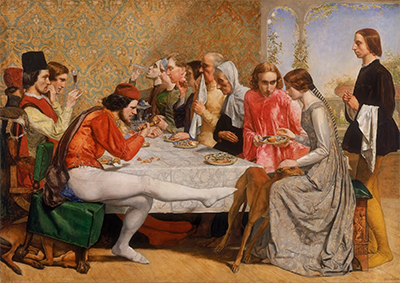
Isabella
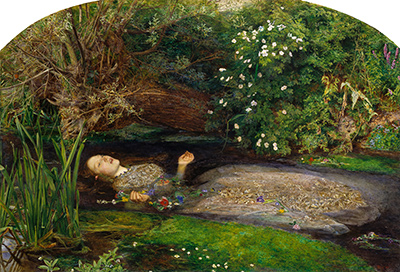
1848–49Ophelia
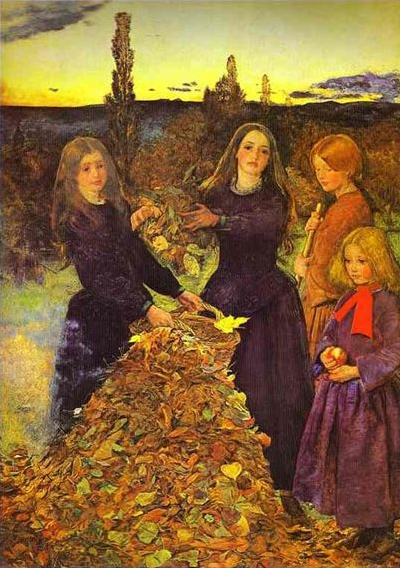
1851–52Autumn Leaves
1855–56Dew-Drenched Furze
1889–90Contents
- Around the workbench
- The workshop Millais knew
- From a cut palm to the Passion
- Why Dickens objected
- The Solomon replica and later images
- Annotated details
Around the workbench
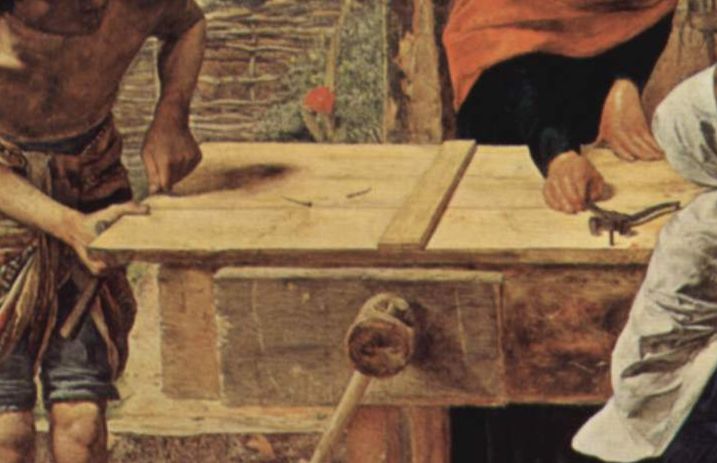
The bench takes up an extraordinary amount of space. Its thick front edge sets a horizontal across the scene, and the plank on top extends towards the boy with the bowl. Joseph and the older woman have to reach across it. Mary, kneeling in front, can bring her face down to her son’s height. The apprentice at the left turns his head towards the child while keeping a hand at the bench. The furniture tells us who can get close to the boy and who has to look on from the other side. [1]
Notice how much Millais leaves for the adults’ hands to do. Joseph’s long reach ends in the delicate grasp of a little wrist. His other hand goes down towards the board. The older woman, conventionally identified as Christ’s grandmother, Saint Anne, has pincers in her hand. She directs her attention to the board and the protruding nail on which he appears to have caught his hand. Mary clasps the boy’s other hand close to her body as he turns towards her cheek. It takes several people, each within reach of something different, to respond to a tiny wound. In that moment a room laid out for making things becomes a place for looking after someone. [1] [4]
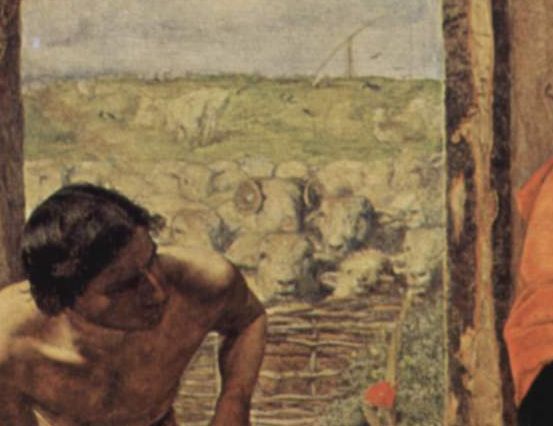
The pale curls scattered around their feet are especially legible against the floor. Some lie flat and others have sprung into loops. Their variety helps distinguish a room where people have been working from a clean interior furnished with a few symbolic props. Through the opening at the left, a row of sheep peer in over a barrier. The narrow view outside gives the crowded workroom a spot of daylight and introduces another group whose heads are turned towards the accident. No one in the room is attending to them. [1]
The workshop Millais knew
Tate traces the setting to a carpenter’s shop on Oxford Street. He used a room familiar from nineteenth-century London to imagine an incident in Christ’s childhood. Its surfaces have the specificity of objects handled repeatedly. Straight boards are stacked against a wall. The workbench holds timber at a height that makes sense for the men standing behind it, even when it prevents them from getting easily to a child on the other side. You can see the grain of the wood and the frayed-looking edges of the people’s clothes in the same light. [1]
In the biography published by the painter’s son, the carpenter himself is said to have modelled Joseph’s figure, with Millais’s father supplying the head. The same account recalls that Millais bought two woolly sheep’s heads from a butcher when he needed models for the flock. It is a striking example of how much he could build from a few observed things. Joseph is assembled from studies of two people, and the wall of animal faces beyond the opening from the heads of two sheep. [5]
Millais also drew on people close to him. Naoko Asano of the National Museum of Western Art in Tokyo identifies the painter’s father as the model for Joseph’s head and his sister-in-law Mary Hodgkinson as the model for the Virgin. Asano cites the recollection of Edward Benest, Millais’s cousin, who remembered the painter and his parents discussing the design before the work went onto the canvas. Emily Millais figures in that account as a participant in the discussion. Asano suggests that the protectiveness visible in the painting has a counterpart in the way Millais’s own parents attended to their son and his work. Joseph’s face offers a particularly direct connection between the two households. [6] [5]
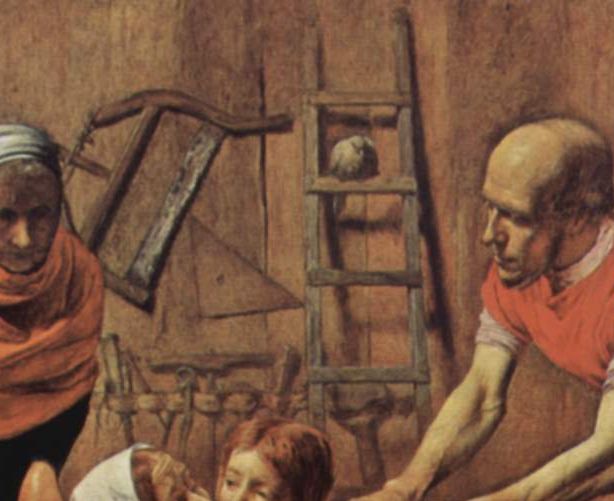
The drawings show how much had to be decided. Tate’s graphite study N04623, dated about 1849, already has the wide format and a gathering around the bench. John appears as an adult in the sketch, and Christ leans towards Mary in a more pronounced gesture of kissing her. George P. Landow points out that the dove is absent and that there is an open window to the left. In the oil, making John a child gives the scene another pair of bare feet and another figure at a different level from the working men. His position at the right takes the eye across the bench from the apprentice to the bowl. The dove high on the ladder invites the eye to travel up from the water. [7] [8]
Tate also has a separate study from about 1849, N04792. Its narrower sheet measures 19 × 28.9 cm and is catalogued as ink and watercolour on paper. The graphite drawing measures 19 × 33.7 cm. The different formats and media give us two distinct objects through which to approach the painting’s development. The changes visible between N04623 and the canvas establish how deliberately Millais arranged the line of sight from a child holding his mother to the people and objects around him. Benest remembered him working and reworking the poses of Mary and Christ and putting in the figure with the bowl late. On the finished canvas, the bow of Mary’s head keeps the contact between her face and his quiet. The bowl extends that small exchange out to the side of the picture. [7] [8] [5]
From a cut palm to the Passion
The Academy’s epigraph comes from the Hebrew Bible. In the catalogue it provides words for the boy’s gesture and invites a Christian reading of an imagined childhood incident. The raised palm and the blood at the foot call up later wounds. The nails and timber needed in the carpenter’s trade can suggest the means of the Crucifixion. This way of reading an earlier event as a sign of a later one is called typology. The child will still need his hand washed in the next few minutes. A viewer who follows the biblical allusion can picture the much greater harm he will suffer as an adult. [1] [2] [9]
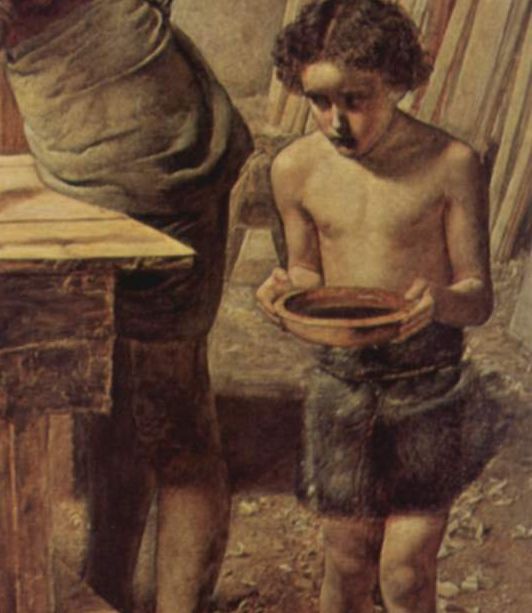
The boy with the water is generally understood to be the young John the Baptist. His vessel makes sense as an answer to the blood on the other boy’s hand. Paired with the dove above, it can also suggest Christ’s future baptism and the descent of the Holy Spirit. The sheep beyond the workshop can be read as a flock in the Christian sense. These associations have a different footing from the wound, which the choice of catalogue verse expressly brings to our attention. The animals, for example, remain onlookers in the painted scene even for a viewer who recognises the image of a congregation. [1] [2] [4]
Nicolas Poussin’s The Holy Family on the Steps of 1648 offers another way to bring Christ’s future into a childhood scene. In Poussin’s painting the infant John offers an apple, a reminder of the Fall, and Joseph sits to the side holding a compass. The compass gives Joseph his trade and the apple gives John’s gesture the weight of sacred history. In Millais the carpenter’s tools are in active use. It is their presence on a working bench, with a child now in pain in front of it, that gives them a second significance. [1] [10]
Marina Tsvetaeva and Anna Nikiforova put the palm, the drop at the foot and the carpenter’s implements at the centre of their reading. They compare the Pre-Raphaelites’ effort to make inherited Christian signs intelligible again with the earlier efforts of the German Nazarenes. The workshop shows one way to renew a familiar image. Almost any group of carpenters could have these materials to hand, yet the correspondence between the palm, the foot, the nails and the wood leads the viewer to a particular story. The religious reading depends on looking as carefully at hardware and skin as at the faces of the Holy Family. [9]
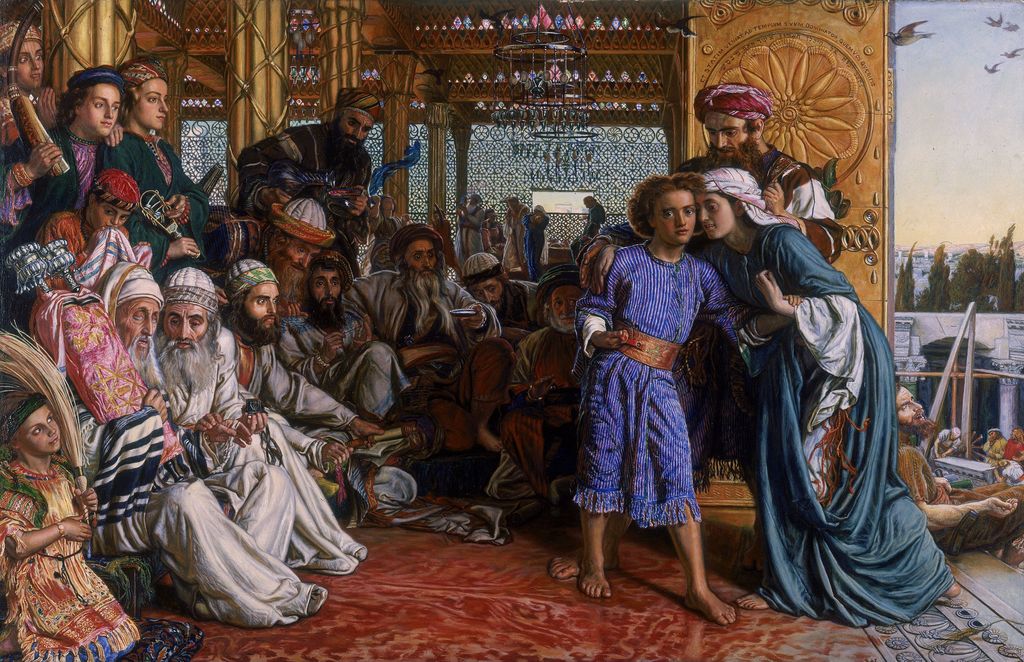
William Holman Hunt, The Finding of the Saviour in the Temple. This public encounter in the Temple offers a contrast with Millais’s family scene in a carpenter’s workshop. Birmingham Museums Trust. Image source. Public domain.
Why Dickens objected
Charles Dickens took up that relation between ordinary things and the sacred subject in the leading article of Household Words on 15 June 1850. In “Old Lamps for New Ones” he leads his readers through a satirical tour of the exhibition. He imagines that the “wry-necked, blubbering” boy acquired the injury while playing in a gutter. The men’s bodies put him in mind of hospital patients, and their feet of the London district of St Giles’s. In his telling, the workshop becomes recognisably contemporary even as he charges the painters of the Brotherhood with wanting to turn art backwards. Dickens describes the picture in detail and leaves the painter unnamed. [11] [12] [13]
The shavings were one detail Dickens thought skilfully done. To him, their precision sharpened the problem of what the painter had chosen to exercise his skill on. He wanted an art capable of conveying feeling and reverence, and treated the razor-sharp rendering of the floor as craftsmanship exercised at the expense of those qualities. David Wilson connects the mockery in the article to Dickens’s idea of progress. His imaginary societies dedicated to going back before modern perspective or science carry the principle of returning to earlier authorities to a comic extreme. Michael Slater’s notes for Dickens Journals Online also draw attention to a letter to Daniel Maclise in which Dickens gave his satire a religious and political urgency by talking about the danger of priestly influence. In later correspondence with Millais, Dickens could admire the artist’s progress and still say that his judgement of this picture stood. [12] [13] [14]
The Times review of 9 May had already objected to what it took for dirt, disease and poverty, reading the close attention to detail as an affront to the subject. The language matters because it tells us what the reviewer believed he could see in these bodies. Chikako Deguchi, writing in the research bulletin of Seinan Gakuin University Museum, tests that language against the picture. In one comparison she places the hands of Millais’s Mary and Anne alongside the hands in William Dyce’s Madonna and Child and Thomas Webster’s A Letter from the Colonies. The comparison draws out how clearly Millais specifies the forms of fingers and joints. The hands offer both evidence of the women’s circumstances and a means of showing what they do for the child. Deguchi argues that the rough skin, bare feet and worried family made the picture legible in terms of Victorian genre painting and its treatment of poverty. [15] [16]
The contemporary accounts give us individual reactions. John Ruskin recalled in a letter to The Times in May 1851 that his own first impression of the previous year’s Millais had nearly put him in agreement with a hostile critic. He nevertheless asked for a more searching look at the merits and shortcomings of the artists’ work than a general exhibition notice could allow. The distance between that initial discomfort and the willingness to look again gives some measure of what the picture asked of its earliest viewers. [17]
The Solomon replica and later images
The picture people saw in 1850 is the oil on canvas now in Tate’s collection. A second oil with the same composition came about through the work of Rebecca Solomon, an exhibiting painter who also worked as a copyist. She began the replica for a reproductive engraving by Ludwig Grüner. Sotheby’s recorded an inscription formerly visible on the back in which Millais credited Solomon with the copy and identified the heads and much of the background as his own work. The catalogue also cites a payment to Millais recorded in 1863 for reworking the copy. These records identify both painters’ contributions, although the catalogue found no clear division between their hands on the surface. The catalogue’s account of the commission places the publication of Grüner’s engraving in 1866. In 1921 the Art Fund appealed directly to its members to help buy the original for the national collection. [7] [4] [18]
The workshop had a further life as a subject in a different medium. Daniel Foliard compares the painting with Frank Mason Good’s 1875 photograph A Carpenter’s Shop, set in Nazareth. He traces Good’s staging to a William Holman Hunt engraving used as the frontispiece of the 1874 edition of Frederic Farrar’s The Life of Christ. Millais supplies Foliard with a parallel for the way ordinary work might prompt thoughts of Christ’s childhood and of the Passion. For Good, the setting in Nazareth was part of photography’s claim to show a place tied to scripture. In Millais, that claim is made differently. He builds a convincing space out of a London tradesman’s workshop, then uses the position of a hand, a few spots of red and the actions of a family to give the scene its biblical weight. [1] [19]
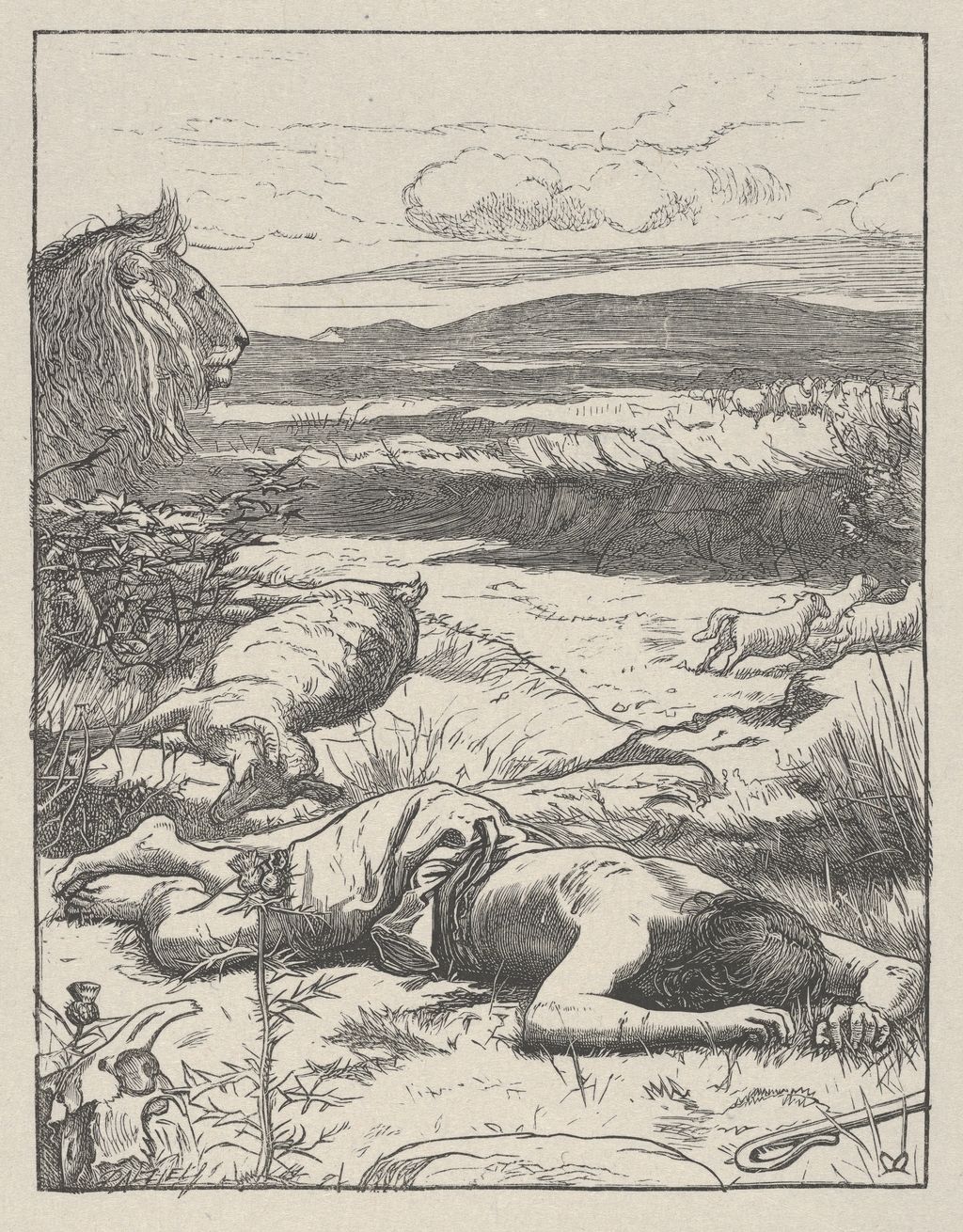
John Everett Millais, design, engraved and printed by the Dalziel Brothers. The Good Shepherd, 1864, wood-engraved proof. Metropolitan Museum of Art, Rogers Fund, 1921, 21.68.4(20). The proof supplies a separate example of Millais’s religious imagery moving between close observation and a biblical subject. Image source. CC0 / Public domain.
Annotated Details from Christ in the House of His Parents
The numbered points identify visible features discussed in this article. Return from each detail to the numbered overview. Christ in the House of His Parents, oil on canvas, Tate, N03584. From the archived 2005 Yorck Project reproduction. Image source. Public domain.
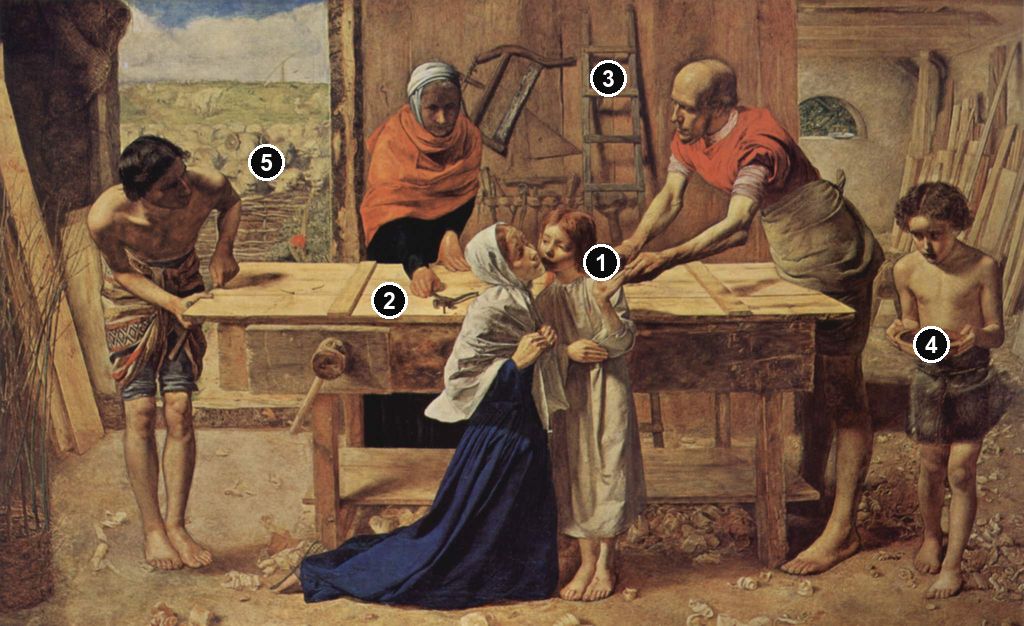
Details from CHRIST IN THE HOUSE OF HIS PARENTS
Follow the diagonal lines of attention and gesture from the workshop and its doorway towards the injured child.
The wounded palm
At the front of the bench, the child shows his hand. The family’s attention gathers around the injury, from Joseph’s reach to Mary’s close profile.
The bench and its tools
The thick edge and worn top of the bench form a strong horizontal. A tool and scattered shavings help make the scene a place of ordinary, skilled work.
The dove above the workbench
A small pale bird appears on the ladder among the workshop objects. Its position above the group allows a traditional emblem of the Holy Spirit to enter the scene without interrupting the family’s actions.
The boy with the bowl
The boy at the far right looks down at the bowl he carries. His path towards the family connects the injury to water and allows a reference to John the Baptist’s later role.
Sheep beyond the doorway
The opening at left carries light into the workshop. Beyond it, the clustered sheep give the distant field a shape of its own and support a familiar Christian association with a flock.
John Everett Millais artwork directory
Browse paintings and drawings covered in these articles, including related works held in public collections. Reproductive engravings and editions are discussed on the Prints page.
Prints and illustrated editions
- The Baby-House, 1872. Etching by Millais.
- The Good Shepherd, 1864. Wood engraving designed by Millais, engraved and printed by the Dalziel Brothers.
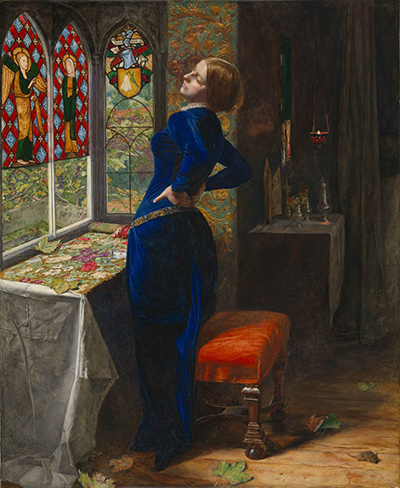
- Mariana, 1857. Wood engraving designed by Millais and cut by the Dalziel Brothers for the Moxon Tennyson.
- The Proscribed Royalist, 1858. Mixed-method engraving by William Henry Simmons after Millais.
| Name | Date | Medium |
|---|---|---|
| Pizarro Seizing the Inca of Peru | 1846 | Painting |
| The Young Men of Benjamin Seizing Their Brides | 1847 | Painting |
| Isabella | 1848–49 | Painting |
| Christ in the House of His Parents (‘The Carpenter’s Shop’) | 1849–50 | Painting |
| Ferdinand Lured by Ariel | 1849–50 (monogram dated 1849) | Painting |
| Study for Christ in the House of His Parents, Tate N04623 | c. 1849 | Drawing |
| Study for Christ in the House of His Parents, Tate N04792 | c. 1849 | Drawing |
| Study for Mariana in the Moated Grange | 1850 | Drawing |
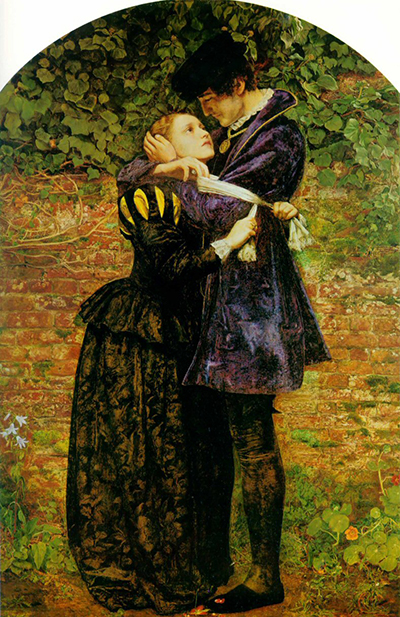
| A Huguenot, on St Bartholomew’s Day, Refusing to Shield Himself from Danger by Wearing the Roman Catholic Badge | 1851–52 (exhibited 1852) | Painting |
| Mariana | 1851 | Painting |
| Ophelia | 1851–52 | Painting |
| The Bridesmaid | 1851 | Painting |
| The Return of the Dove to the Ark | 1851 | Painting |
| The Order of Release 1746 | 1852–53 | Painting |
| The Proscribed Royalist, 1651 | 1852–53 (exhibited 1853) | Painting |
| Portrait of John Ruskin | 1853–54 | Painting |
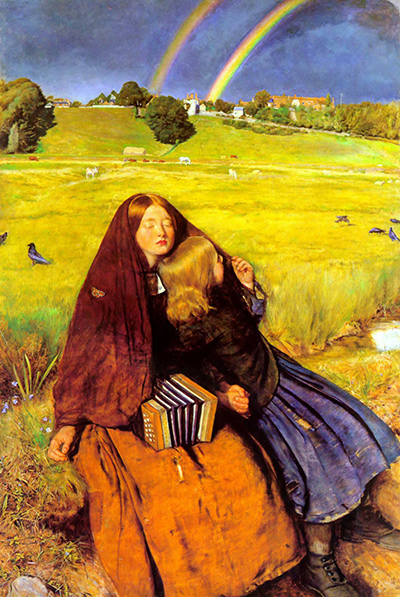
| The Blind Girl | 1854–56 | Painting |
| Autumn Leaves | 1855–56 (Manchester labels 1856) | Painting |
| A Dream of the Past: Sir Isumbras at the Ford | 1856–57, later revised | Painting |
| The Vale of Rest | 1858–59 | Painting |
| Study for The Black Brunswicker, Tate A00812 | c. 1860 | Drawing |
| Study for The Black Brunswicker, Tate A00813 | c. 1860 | Drawing |
| Study for The Black Brunswicker, Tate A00814 | c. 1860 | Drawing |
| The Black Brunswicker | 1860 | Painting |
| The Ransom | 1860–62 | Painting |
| My First Sermon | 1863 | Painting |
| My Second Sermon | 1864 | Painting |
| Joan of Arc | 1865 | Painting |
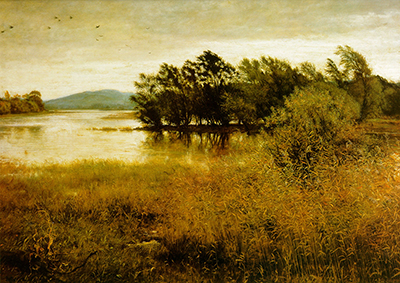
| Chill October | 1870 (exhibited 1871) | Painting |
| The Boyhood of Raleigh | 1870 | Painting |
| The Knight Errant | 1870 | Painting |
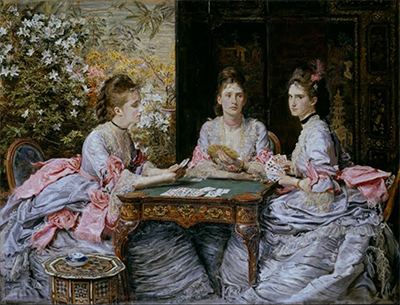
| Hearts are Trumps | 1872 | Painting |
| The North-West Passage | 1874 | Painting |
| Louise Jane Jopling | 1879 | Painting |
| William Ewart Gladstone, NPG 3637 | 1879 | Painting |
| Bubbles | 1886 | Painting |
| Portia | 1886 | Painting |
| Dew-Drenched Furze | 1889–90 | Painting |
| Ducklings | 1889 | Painting |
| Portrait of Sarah Hammond | 1891 | Painting |
Discussion
Look again at the images and ideas explored in Christ in the House of His Parents. These editorial prompts invite your observations.
Reader Insights
How does the workbench connect the child’s injured hand to the other people in the room?
Which everyday object has the strongest effect on how you read the biblical subject?
Join the Conversation
Share a detail, comparison or question about Christ in the House of His Parents below.
References
- Tate, Christ in the House of His Parents (The Carpenter’s Shop), N03584, collection image and interpretation. View source.
- Sarah Victoria Turner, “1850: Battles Old and New,” Royal Academy Summer Exhibition Chronicle, passage on the Zechariah 13:6 entry and link to the original catalogue. View source.
- Royal Academy of Arts, The Exhibition of the Royal Academy, 1850, no. 518, Vol82 canvas c23 transcription. View source.
- Sotheby’s, Christ in the House of His Parents, Millais and Rebecca Solomon, lot 73, 2008, description, provenance and catalogue note. View source.
- John Guille Millais, The Life and Letters of Sir John Everett Millais, 1899, vol. 1, pp. 76–78, Edward Benest’s recollections and the account of the workshop models. View source.
- Naoko Asano, “More than Models and Muses: The Women of John Everett Millais’ Domestic Circle and Their Contributions,” National Museum of Western Art Research Bulletin 25, pp. 5–6 and note 7. View source.
- Tate, public collection data, accession rows N03584, N04623 and N04792. View source.
- George P. Landow, “Original Drawing for ‘Christ in the House of His Parents’,” The Victorian Web, reproduction and close comparison of Tate N04623. View source.
- Marina Tsvetaeva and Anna Nikiforova, “The Role of the Pre-Raphaelite Brotherhood Religious Painting in the British Art Reforming,” Vestnik Russkoi khristianskoi gumanitarnoi akademii 23(1), 2022, p. 272. View source.
- Cleveland Museum of Art, Nicolas Poussin, The Holy Family on the Steps, 1648, 1981.18. View source.
- Charles Dickens, “Old Lamps for New Ones,” Household Words 1, no. 12, 15 June 1850, p. 265. View source.
- Charles Dickens, “Old Lamps for New Ones,” Household Words 1, no. 12, 15 June 1850, p. 266. View source.
- Dickens Journals Online, “Old Lamps for New Ones,” author index and Michael Slater’s notes on the letters to Maclise and Millais. View source.
- David Wilson, The Art of Faith in a World of Progress: From Transcendence to Immanence, University of St Andrews PhD thesis, vol. 1, pp. 175–177. View source.
- The Times, Royal Academy exhibition review, 9 May 1850, as transcribed in David Wilson, The Art of Faith in a World of Progress, vol. 1, p. 178. View source.
- Chikako Deguchi, “Genre-Painting Elements in J. E. Millais’s Christ in the House of His Parents,” Seinan Gakuin University Museum Research Bulletin 6, pp. 17–29, especially pp. 25–27 and fig. 19. View source.
- John Ruskin, letter to The Times, 13 May 1851, in E. T. Cook and Alexander Wedderburn, eds., The Works of John Ruskin, vol. 12, pp. 319–320. View source.
- Art Fund, Christ in the House of His Parents (The Carpenter’s Shop), 1921 acquisition appeal record. View source.
- Daniel Foliard, “La photographie de la Palestine au temps du collodion : une spécificité britannique ?” Revue d’histoire du XIXe siècle 45, 2012, pp. 164–166 and fig. 1. View source.