 by Tom Gurney
Tom Gurney BSc (Hons) is an art history expert with over 20 years experience
Published on June 19, 2020 / Updated on November 25, 2026
Email: tomgurney1@gmail.com / Phone: +44 7429 011000
The Bridesmaid by John Everett Millais: Introduction
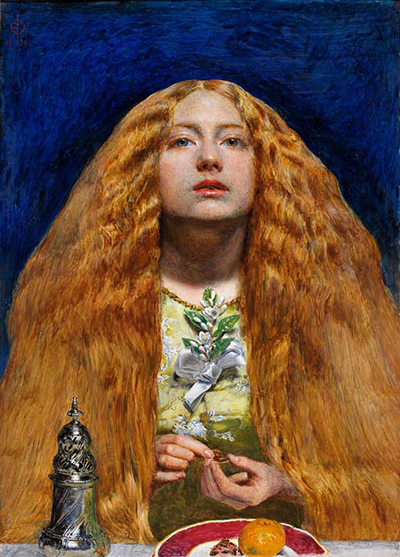
In John Everett Millais’s The Bridesmaid, a young woman holds a ring delicately between her fingertips. Her eyes are already raised, as though she expects to see something beyond the table. A plate at the bottom of the picture holds an orange and part of a wedding cake. The cake explains the tiny action at the centre of the panel. By passing a piece of it through the ring nine times, the bridesmaid hopes to see a vision of her future husband. Millais painted this early Pre-Raphaelite work in 1851. The oil on wood panel belongs to the Fitzwilliam Museum in Cambridge. [1] [2] [3]
At a Glance
- Date1851 [1]
- MediumOil on wood panel [1]
- CollectionFitzwilliam Museum, Cambridge [1]
- SubjectA bridesmaid performing a wedding-cake ritual associated with a future husband [1]
This work across John Everett Millais’s career
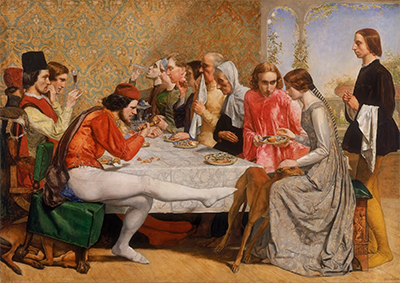
Isabella
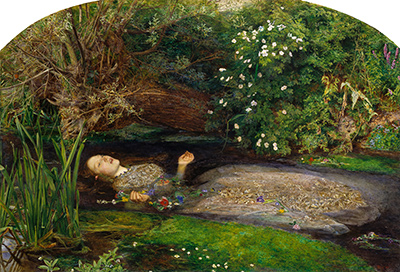
1848–49Ophelia
1851–52Autumn Leaves
1855–56Dew-Drenched Furze
1889–90Contents
- What the bridesmaid is doing
- A small panel that rewards close looking
- Orange blossom, desire and the caster
- Who sat for the painting?
- From Windus’s collection to the Fitzwilliam
What the bridesmaid is doing
Millais explained the action himself in a letter from Gower Street to Martha Combe in January 1851. He reported that he had finished a very small picture of a bridesmaid passing wedding cake through a ring nine times. The letter sets the little panel among larger projects already under way. In an earlier letter to Combe, he described buying velvets and silks for Mariana and The Woodman’s Daughter. His account of The Bridesmaid gives its scale and its principal action in a single sentence. Both matter in front of the painting, where the ring and the piece of cake take close attention to pick out. [2]
The custom gives a piece of food from someone else’s wedding a second purpose. The portion has to be small enough to pass through the ring, and the test depends on repeating the same movement. Millais can show only one instant of the sequence. He makes the prospect of a revelation legible through the direction of the woman’s gaze. Her fingers stay on the task below, but she is already watching for its outcome. The sleeves and sweeping hair make her figure seem still while the two hands work in a little space in front of her. [2] [4] [5]
The family’s published list of Millais’s paintings records All Hallows’ Eve as an alternative title. Carol Jacobi, discussing the panel alongside Millais’s other pictures of solitary figures, relates the ritual to St Agnes’s Eve and the search for a vision of a future lover. The letter to Combe specifies the action and its repetition and leaves the calendar open. Millais’s setting does much the same. We can see what the woman has brought to the table, while the dark blue behind her gives little indication of a particular room or hour. The glimpse of the future belongs entirely to the expectation on her face. [2] [5] [6] [3]
A small panel that rewards close looking
The panel is 27.9 centimetres high and 20.3 centimetres wide. Within that narrow space, the figure almost fills the picture. Her lifted face sits near the central axis, and the wavy hair falls over both shoulders until it meets the objects on the table. Look along the edges of her hair as it emerges from the blue. There are fine, bright strands on the outside and much broader bands of shadow within the mass. Jacobi describes veils of transparent oil colour in the hair, drawing attention to the way Millais gives it volume while letting its edges seem almost weightless. [1] [5] [3] [7]
The embroidery and ribbon offer another way to see what the confined format does. A blue-grey bow hangs in front of the pale green bodice. Its broad, soft folds make the harder outlines of the leaves and the small white flowers easier to see. Below it, the hands occupy about the width of the bodice between the curtains of hair. The fingers hold something narrow enough to disappear when the picture is reproduced small. Once you have found the ring, the gesture looks more deliberate and the upward tilt of the face begins to read as an action in its own right. [4] [5] [3]
At the lower left, the elaborate vessel rises from the table and breaks the balance of the figure. The red edge of the plate curves into the picture from below. Almost the whole table has been cut off, so the viewer has to infer its depth from these few objects and the angle of the dish. The 1902 Fitzwilliam catalogue called the object a glass vessel. Jacobi identifies it as a silver caster, probably an eighteenth-century implement of a type used for sugar, salt or spices. The sharp patterning on its body catches the light differently from the softer, more extended highlights of the hair. [5] [3]
Orange blossom, desire and the caster
Orange blossom would have made an immediate connection with wedding dress. Queen Victoria wore it at her marriage to Prince Albert in 1840, both in a wreath and as trimming. The Royal Collection preserves two brooches from the suite of orange-blossom jewellery that Albert gave her over several years. That well-documented fashion gives a context for the sprig pinned to the chest of Millais’s bridesmaid. The flower could evoke bridal virtue as well as fertility, associations that fit a young woman concerned with the prospect of her own marriage. [5] [8] [9]
The orange on the plate brings the plant into the picture a second way. In her study of floral language, Julie Ann Whyman reads the fruit and the cake together with the ring and the flowers. Each is a familiar material object, and together they can suggest sexual anticipation. Eriko Yamaguchi connects the orange here with the blood orange that Lorenzo offers Isabella in Millais’s earlier painting. She reads the fruit in relation to marriage in both pictures. In Isabella, the offer takes place at a crowded table, in front of the brothers who will prevent the union. At the bridesmaid’s table, the person she hopes to see is absent and the orange remains on the dish. [7] [9] [10]
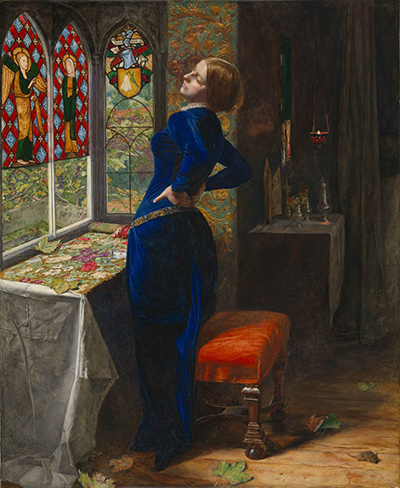
Jacobi also traces the caster through several of Millais’s pictures. In The Bridesmaid it makes sense on a table where food is served. In Mariana, a version of the object’s form appears as a censer at the back of the chamber. Jacobi brings out the suggestiveness of the vessel in both paintings, building on Tim Barringer’s reading of the caster as a sign of the man the bridesmaid hopes to see. The forms of the two pictures also give that comparison a practical basis. In each, the metal vessel interrupts an area of soft material, and a solitary woman directs her attention towards someone the viewer has no way of seeing. [3]
Writing about flowers and hair in Jorge Isaacs’s novel María, Rhi Johnson uses The Bridesmaid as a comparison. Johnson points to the flower and tightly tied ribbon as signs of modesty and sees a more intimate aspect in the figure’s flowing hair, parted lips and expectant stare. The comparison helps explain how the picture can be explicit about its wedding associations and still leave the viewer debating the woman’s feelings. Her ornament is in order. Her loose hair seems to be escaping the edges of her figure. [11]
Who sat for the painting?
William Michael Rossetti’s journal names Miss McDowall in its entry for 9 February 1851. He describes a small study from her on the subject of passing cake through a ring. The notes to the published journal identify her as a professional model and connect the study to the small oil The Bridesmaid. Millais’s son, John Guille Millais, gives another account in his 1899 biography. He says Mrs Nassau Senior sat for the head. The distinction between a study and the painted head leaves open the possibility of more than one sitting or model. The surviving accounts give no clear sequence for combining those claims. In the finished panel the woman’s identity is established by what she does and wears. The lifted chin and held ring tell us how completely she is occupied with the test. [2] [4]
From Windus’s collection to the Fitzwilliam
The Fitzwilliam traces the picture to the collector B. G. Windus by 1855. The painter Ford Madox Brown saw it in Windus’s collection in Tottenham that year. His diary describes the woman by the two features that caught his eye, the long hair and the wedding ring. He also saw Isabella and A Huguenot in the collection, alongside drawings by Turner and works by several other artists. The brief record is a glimpse of how a fellow painter encountered the little panel in a private house, among other works by the same young artist. [1] [4]
Christie’s offered the panel as lot 46 at Windus’s sale in July 1862, when it was bought in and stayed in the collection. At the February 1868 sale, the dealer Ernest Gambart bought it. The museum next records an anonymous Christie’s sale in February 1888 associated with J. M. Wright of Liverpool, with the picture bought by Shepperd. Thomas Richards Harding gave it to the Fitzwilliam the following year. The museum’s accession number is 499*, and its record locates Millais’s monogram and the date in the upper left of the panel. [1] [5]
Millais returned to the title in 1879 for a larger canvas. The 1898 Royal Academy memorial exhibition catalogue describes that figure turning away from the viewer, wearing a red hat and holding a bouquet. The earlier ring and cake belong to the 1851 Cambridge panel. [12]
The Fitzwilliam lent the painting to the Whitechapel Art Gallery for British Art Fifty Years Ago in 1905. The catalogue places it alongside other loans by Millais, including a replica of My First Sermon. In 1985 the panel was shown in The Pre-Raphaelites and Their Times, which travelled to Tokyo, Osaka and Yamanashi. Those exhibitions gave the work two different settings. The Whitechapel show looked back at recent British painting, while the Japanese exhibition placed it in the history of the group with which Millais began his career. Within either group of paintings its effect is still intimate. The face draws you in from a distance. The action only becomes clear when you come close enough to see what is between the fingers. [13] [14]
John Everett Millais artwork directory
Browse paintings and drawings covered in these articles, including related works held in public collections. Reproductive engravings and editions are discussed on the Prints page.
Prints and illustrated editions
- The Baby-House, 1872. Etching by Millais.
- The Good Shepherd, 1864. Wood engraving designed by Millais, engraved and printed by the Dalziel Brothers.
- Mariana, 1857. Wood engraving designed by Millais and cut by the Dalziel Brothers for the Moxon Tennyson.
- The Proscribed Royalist, 1858. Mixed-method engraving by William Henry Simmons after Millais.
| Name | Date | Medium |
|---|---|---|
| Pizarro Seizing the Inca of Peru | 1846 | Painting |
| The Young Men of Benjamin Seizing Their Brides | 1847 | Painting |
| Isabella | 1848–49 | Painting |
| Christ in the House of His Parents (‘The Carpenter’s Shop’) | 1849–50 | Painting |
| Ferdinand Lured by Ariel | 1849–50 (monogram dated 1849) | Painting |
| Study for Christ in the House of His Parents, Tate N04623 | c. 1849 | Drawing |
| Study for Christ in the House of His Parents, Tate N04792 | c. 1849 | Drawing |
| Study for Mariana in the Moated Grange | 1850 | Drawing |
| A Huguenot, on St Bartholomew’s Day, Refusing to Shield Himself from Danger by Wearing the Roman Catholic Badge | 1851–52 (exhibited 1852) | Painting |
| Mariana | 1851 | Painting |
| Ophelia | 1851–52 | Painting |
| The Bridesmaid | 1851 | Painting |
| The Return of the Dove to the Ark | 1851 | Painting |
| The Order of Release 1746 | 1852–53 | Painting |
| The Proscribed Royalist, 1651 | 1852–53 (exhibited 1853) | Painting |
| Portrait of John Ruskin | 1853–54 | Painting |
| The Blind Girl | 1854–56 | Painting |
| Autumn Leaves | 1855–56 (Manchester labels 1856) | Painting |
| A Dream of the Past: Sir Isumbras at the Ford | 1856–57, later revised | Painting |
| The Vale of Rest | 1858–59 | Painting |
| Study for The Black Brunswicker, Tate A00812 | c. 1860 | Drawing |
| Study for The Black Brunswicker, Tate A00813 | c. 1860 | Drawing |
| Study for The Black Brunswicker, Tate A00814 | c. 1860 | Drawing |
| The Black Brunswicker | 1860 | Painting |
| The Ransom | 1860–62 | Painting |
| My First Sermon | 1863 | Painting |
| My Second Sermon | 1864 | Painting |
| Joan of Arc | 1865 | Painting |
| Chill October | 1870 (exhibited 1871) | Painting |
| The Boyhood of Raleigh | 1870 | Painting |
| The Knight Errant | 1870 | Painting |
| Hearts are Trumps | 1872 | Painting |
| The North-West Passage | 1874 | Painting |
| Louise Jane Jopling | 1879 | Painting |
| William Ewart Gladstone, NPG 3637 | 1879 | Painting |
| Bubbles | 1886 | Painting |
| Portia | 1886 | Painting |
| Dew-Drenched Furze | 1889–90 | Painting |
| Ducklings | 1889 | Painting |
| Portrait of Sarah Hammond | 1891 | Painting |
Discussion
Look again at the images and ideas explored in The Bridesmaid by John Everett Millais. These editorial prompts invite your observations.
Reader Insights
What does the position of the hands let you see of the ritual?
Which surface takes the closest attention from you, the hair, the fabric or the objects in front of the sitter?
Join the Conversation
Share a detail, comparison or question about The Bridesmaid by John Everett Millais below.
References
- The Fitzwilliam Museum, The Bridesmaid, accession 499*. View source.
- John Guille Millais, The Life and Letters of Sir John Everett Millais, vol. I, pp. 93–96 and 150, including Millais’s January 1851 letter to Martha Combe. View source.
- Carol Jacobi, Sugar, Salt and Curdled Milk: Millais and the Synthetic Subject, Tate Papers 18, 2012, fig. 2 and discussion of the silver vessel. View source.
- William Michael Rossetti, ed., Præraphaelite Diaries and Letters (1900), Madox Brown’s diary, pp. 169–170, and the P.R.B. Journal, p. 295. View source.
- F. R. Earp and the Fitzwilliam Museum, A Descriptive Catalogue of the Pictures in the Fitzwilliam Museum (1902), pp. 133–134. View source.
- John Guille Millais, The Life and Letters of Sir John Everett Millais, chronological work list, 1851 entry for The Bridesmaid. View source.
- Eriko Yamaguchi, Primitivism in the Pre-Raphaelite Brotherhood, 2010, p. 131, dimensions and discussion of Isabella. View source.
- Royal Collection Trust, Pair of Brooches from the Orange Blossom Parure, RCIN 65306, with Queen Victoria’s 1840 wedding attire. View source.
- Julie Ann Whyman, Dante Gabriel Rossetti’s Language of Flowers, vol. I, 2019, pp. 146–148. View source.
- National Museums Liverpool, Isabella, Walker Art Gallery, WAG 1637. View source.
- Rhi Johnson, Mourning Weeds: Objects of Desire and Objects of Death in María by Jorge Isaacs, Decimonónica 14.1, 2017, pp. 24–26 and fig. 1. View source.
- Royal Academy of Arts, Exhibition of Works by the Late Sir John Everett Millais (1898), catalogue no. 69, the separate 1879 painting. View source.
- Whitechapel Art Gallery, British Art Fifty Years Ago (1905), catalogue nos. 378 and 381, p. 54. View source.
- The Fitzwilliam Museum, The Pre-Raphaelites and Their Times, 1985 exhibition record. View source.