 by Tom Gurney
Tom Gurney BSc (Hons) is an art history expert with over 20 years experience
Published on June 19, 2020 / Updated on November 25, 2026
Email: tomgurney1@gmail.com / Phone: +44 7429 011000
The North-West Passage: Introduction
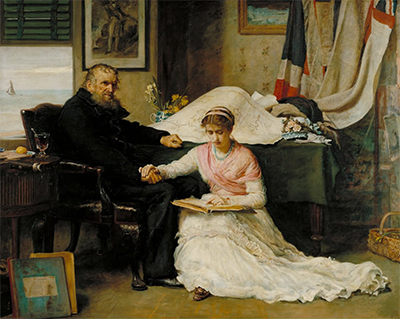
The sea in John Everett Millais’s The North-West Passage looks calm enough for a small sailing boat. It is visible through a window behind an elderly sailor, who stares ahead while a young woman follows a page with her finger. Between them is the touch of one hand over another. Behind the woman, an Arctic chart lies open across the table. Millais made this scene in 1874 on a canvas more than two metres wide. The size gives a private moment the gravity of public history. The voyage itself has to be imagined from the things these two people have gathered around them. [1] [2]
At a Glance
This work across John Everett Millais’s career
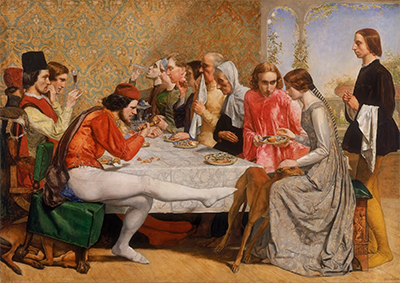
Isabella
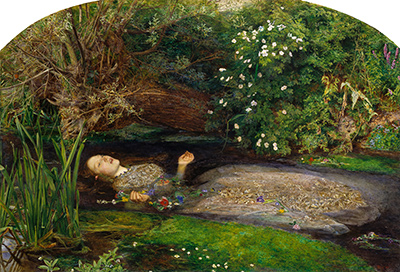
1848–49Ophelia
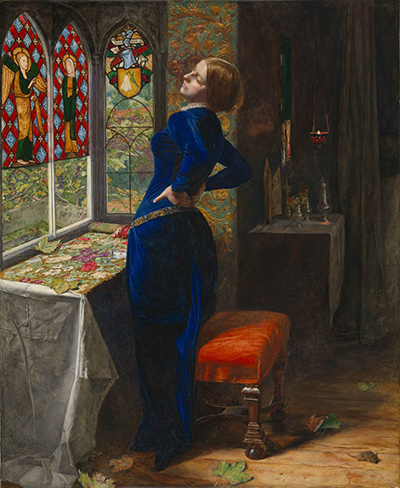
1851–52Autumn Leaves
1855–56Dew-Drenched Furze
1889–90Contents
- The book and the sailor
- The globe that disappeared
- What the chart records
- What England should do
- From the gallery to the print
- Annotated details
The book and the sailor
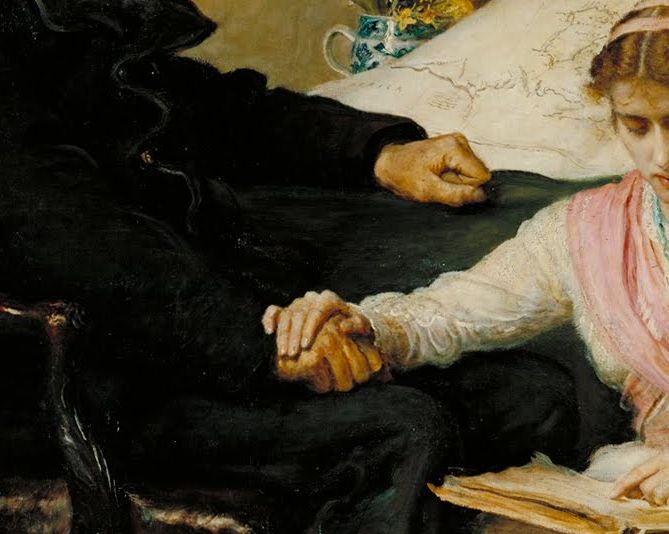
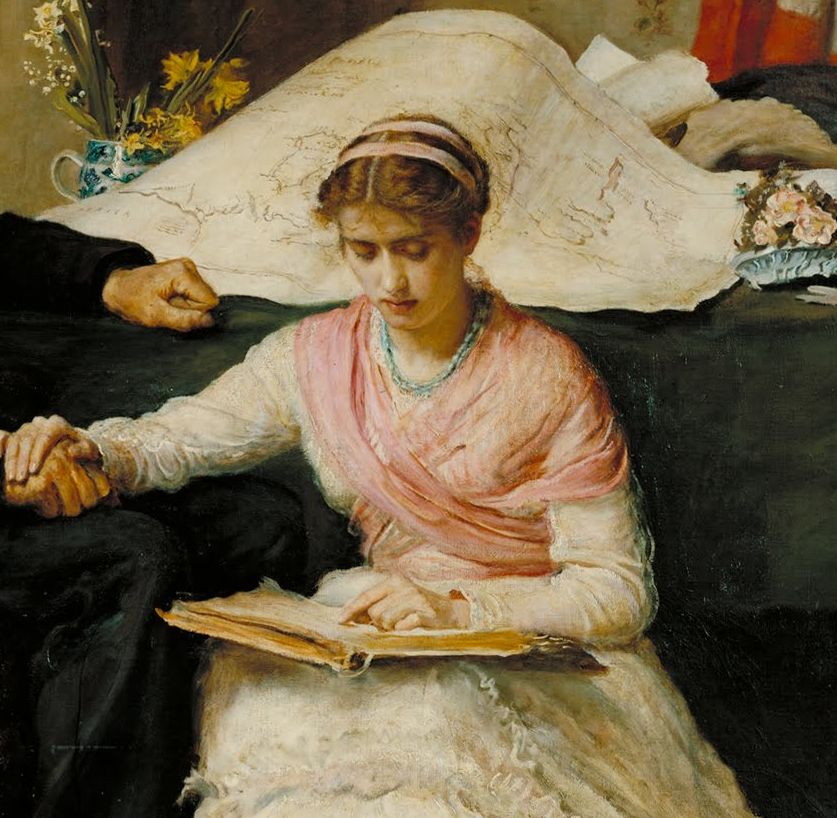
Look down from the woman’s face and her hands tell a small story of their own. Her left forefinger holds her place in the open book. Her right hand rests over the sailor’s closed hand on his knee. The catalogue for the 1886 Grosvenor Gallery exhibition understood her to be reading Arctic history aloud, a persuasive reading of the pose. Millais gives us no legible title for her book. A volume propped beside the furniture at the right is visibly marked “Logbook”. The distinction matters. We can recognise what kind of record a sailor might keep without knowing what the woman has found on the page. She might be following a line of text or drawing his attention to something she can see. [2] [3]
The sailor’s gaze travels beyond the objects in the room. His other hand presses heavily on the chart table, close to where the pale sheet catches the light. Beyond his head hangs a print identified as a portrait of Nelson, and another framed image shows a ship in the ice. Those two pictures supply a public history of naval distinction and danger. Beside them the real view through the window offers a much quieter sea. The small opening gives us daylight and room to breathe, while the dark jacket and the sailor’s fixed expression keep the foreground weighted. The young woman’s bright dress brings the eye back to the book. She occupies the lower position of the two figures, yet she may be choosing the passage that sets his thoughts in motion. [1] [2] [3]
Millais’s son John Guille described the woman as the sailor’s daughter, and identified Edward John Trelawny as the model for the old man. Trelawny had entered the Royal Navy in his teens and was known for writing about his friends Percy Bysshe Shelley and Lord Byron. The old mariner is a character played by this recognisable man. According to the family account, Effie Millais secured the sittings after Trelawny agreed to pose in exchange for her trying the Turkish baths he promoted. John Guille also recalled that his father added the glass of grog after the sittings because Trelawny, a teetotaller, had objected to it. The drink and the cut citrus beside it help set the scene, even as the sitter’s protest reminds us how easily an accessory can be taken for evidence about a person. The female model also sat for Stitch, Stitch, Stitch, according to the same family account. Art historian Mark A. Cheetham names her as Mrs Ellis. [2] [3] [4] [5]
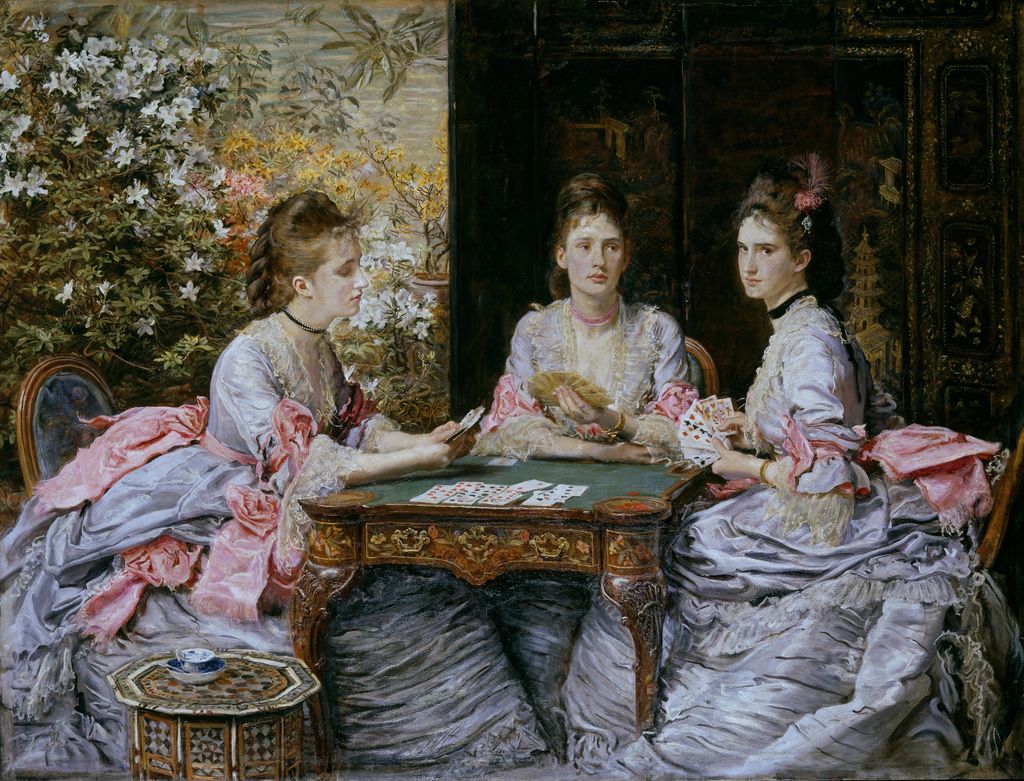
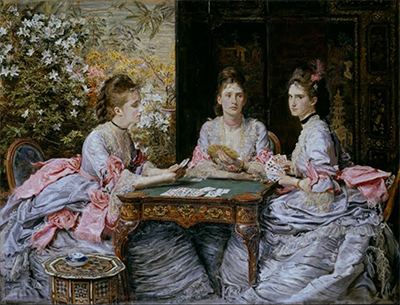
Hearts are Trumps, oil on canvas, Tate, N05770. The later Armstrong commission also gives a small shared activity much of the work of directing the viewer’s gaze. Image source. Public domain.
The globe that disappeared
An 1874 pencil study shows the sailor pointing at a globe. A note on the sheet, transcribed by Christie’s as “where the ship broke up”, gives the gesture a possible destination. In that version the mariner directs attention towards a disaster. In the finished painting the globe has gone and the reader directs attention with the smallest movement of her finger. Another study, now at the Huntington, shows how Millais also tried varying the old man’s expression. Cheetham observes that his eyes appear closed in the study. In the oil, the open eyes give him a distant and rather hard stare, while leaving the object of that stare to the imagination. [2] [6]
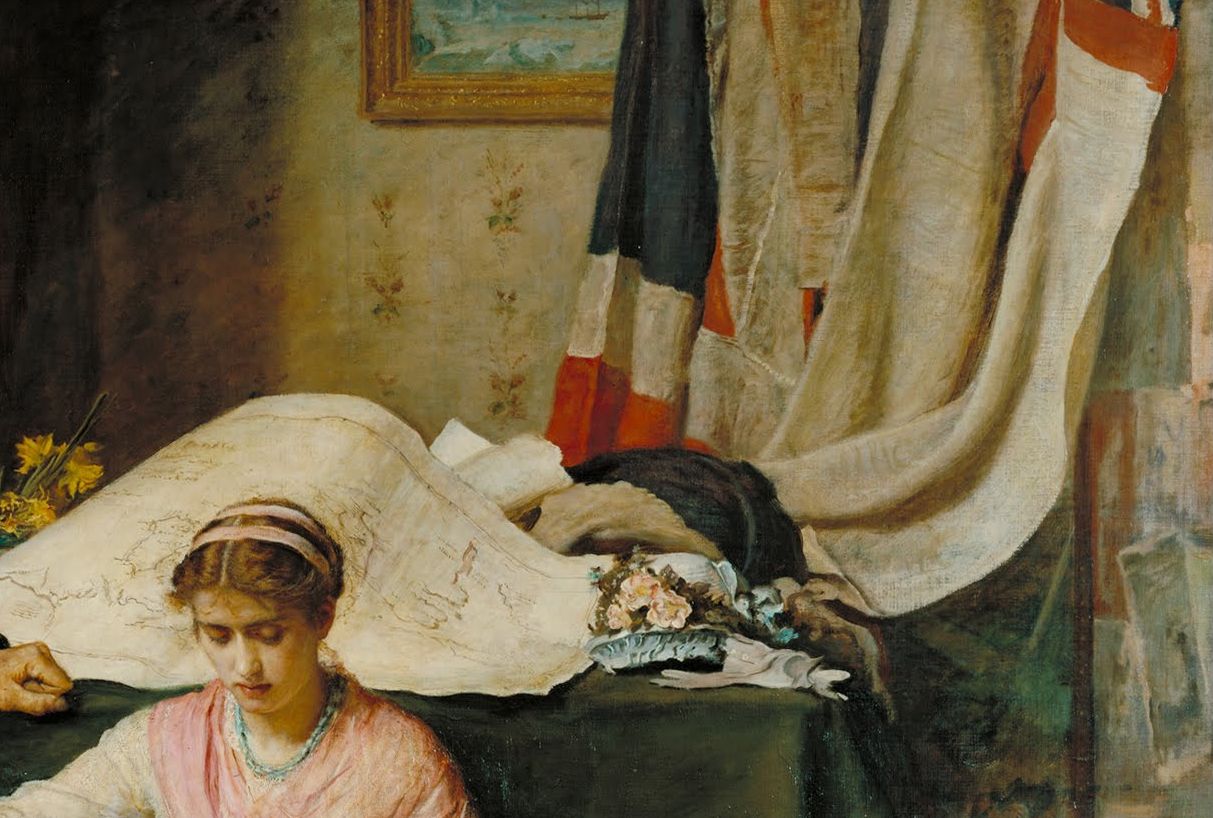
John Guille separately recalled that he and his sister Alice had posed as children turning a globe in an early version of the canvas. He remembered their group being cut away and the flag occupying the revised area. His story comes from a participant writing years later. The surviving studies establish that Millais tried different arrangements, and the final picture shows what those choices did to the story. With just two people, a lowered head and a steady outward gaze can hold much of the picture between them. The flags, meanwhile, give the right side of the room a stronger note of display. Frédéric Regard sees the Union Jack as a sign of the national story British audiences had made from successive Arctic voyages. It folds across the furniture of a household whose books and framed pictures already show how far that story had travelled. [1] [2] [4] [6] [7]
What the chart records
The Northwest Passage links the Atlantic and Pacific through the waterways of the Canadian Arctic. Sir John Franklin set out in 1845 with HMS Erebus and HMS Terror to chart the gap that remained in the British survey of the route. Both ships became trapped in ice off King William Island. Franklin died before his surviving men abandoned the vessels. The searches that followed generated new surveys and new accounts, as crews went out to look for the missing men and continued to trace routes through the archipelago. That is the history behind the chart in Millais’s room, where several decades of exploration can be unrolled across a table. [2] [8] [9]
Cheetham identifies the painted sheet with Robert McClure’s Arctic chart and reproduces part of a fold-out chart from the published account of McClure’s voyage. McClure entered from the Pacific in HMS Investigator in 1850. Ice blocked the ship, but a sledge journey established the connection from Prince of Wales Strait to waters already known to parties approaching from the Atlantic. His crew eventually abandoned Investigator in Mercy Bay and came out with men from Edward Belcher’s search expedition. An Admiralty chart in the National Maritime Museum records the tracks of Investigator and its sledge parties along with other searchers’ surveys. The difference between tracing a route and sailing its length is easy to lose in a title. Roald Amundsen’s Gjøa made the first through voyage by a single ship in 1903–06. [2] [9] [10] [11]
Parks Canada’s account of the Franklin search preserves evidence of a different kind of chartmaking. In 1869 the American searcher Charles Francis Hall learned about a wreck near Ugjulik, a sealing area off the Adelaide Peninsula. An Inuk named Inukpujijuk indicated the wreck’s position on Hall’s Admiralty chart and made a map of his own. Hall’s access to these accounts also relied on his interpreters Taqulittuq and Ipiivik. Inuit accounts of the ships and knowledge of the ice, coast and currents helped guide the searches that located Erebus in 2014 and Terror in 2016. These histories put the picture’s open chart in perspective. Reading Millais’s room takes us into a British household and its inheritance of naval records. Reading the history of the waters means attending to the people who lived, travelled and gathered evidence there. [12]
What England should do
When the Royal Academy showed the painting at its summer exhibition of 1874, its catalogue printed a motto beneath the title. “It might be done, and England should do it.” The wording leaves the task unspecified. The title and the old chart lead the eye back to the Northwest Passage, while the wish to accomplish something leads forward. Cheetham reads the motto in the light of preparations for George Nares’s Arctic expedition. Nares sailed in 1875 with Alert and Discovery in an attempt to reach the North Pole. After wintering in the Arctic, sledge parties set out the following spring, and Albert Markham’s party pushed north short of the Pole. Two quite different tasks could therefore occupy the imagination of someone looking from the old chart to the exhibition catalogue. [2] [13]
The Examiner in May 1874 placed the work on the south wall of the Academy’s great room, opposite William Powell Frith’s procession at Boulogne. Its reviewer contrasted Millais’s bold handling of paint with Frith’s smoother modelling. By December, Punch could turn Millais’s scene into topical satire by putting Prime Minister Benjamin Disraeli in the sailor’s chair and Britannia at his knee. The drink at his elbow was labelled “Popularity”. A composition with almost no action of its own had become recognisable enough to carry an argument about political motives. The difference between the two responses is telling. One reader saw an exhibition picture whose handling invited comparison with a rival’s. The cartoonist saw a pose, a chart and a drink that could be borrowed wholesale and still make sense. [2] [14]
John Guille Millais later remembered a crowd in front of the painting and understood its appeal as an expression of national feeling. Contemporary responses also show how quickly that feeling could change. As Cheetham notes, when Nares’s ships returned in 1876, the Royal Cornwall Gazette turned the Academy motto against the expedition by substituting a declaration of failure. With its clenched hand and troubled face, the painting had room for that mood too. [2] [4]
From the gallery to the print
The painting went to the Paris Exposition Universelle in 1878 and was shown at the Fine Art Society in 1881. In the same year an etching by Augustin Mongin was published. The National Portrait Gallery holds a colour lithograph after Millais by the Leighton Brothers, catalogued under Trelawny’s name. A print could put the sailor’s face before someone who had never stood in front of the large canvas. In 1886 John Ruskin judged from a colour print that the original must be a glorious painting. He added that England would do better to mind its affairs at home. The admiration and the objection were compatible. Millais’s depiction of the old man had travelled far enough to reach a viewer who could sympathise with the figure and question the policy invoked by the motto. [3] [4] [5] [15]
Sir Henry Tate presented the original in 1894. The National Trust preserves a separate, freely adapted oil version at A La Ronde in Devon, made after Millais and on a smaller scale. Both the copy and the prints show how readily this public exhibition picture could find a place of its own in other rooms. The chart and the flags give its story a particular place in British history. The hands give it a reason to hold the eye even after the political moment has passed. In the stillness between the two figures, the reader is close enough to reach the sailor and the things she brings to mind are an ocean away. [1] [2] [16]
Annotated Details from The North-West Passage
The numbered points identify visible features discussed in this article. Return from each detail to the numbered overview. The North-West Passage, oil on canvas, Tate, N01509. Image source. Public domain.
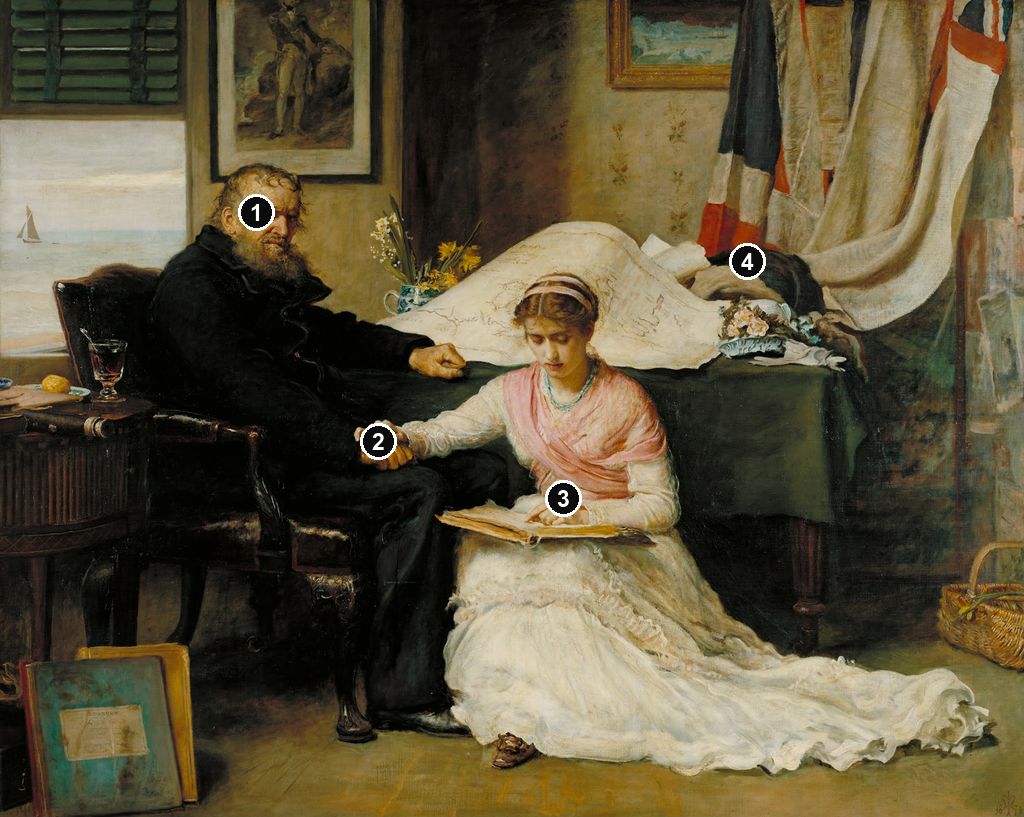
Details from THE NORTH-WEST PASSAGE
Compare the cropped details with the source images above. Notice how their colours, shapes and positions contribute to the larger compositions.
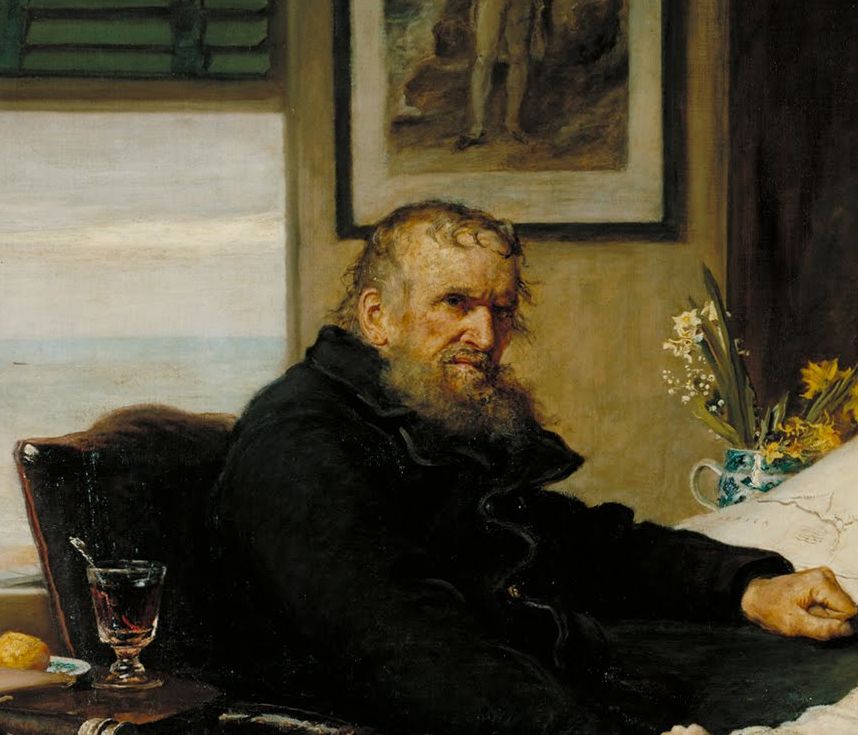
The seaman at the window
The old man turns away from the woman’s reading. The window opens behind him to water and a sail, close in the composition to his distant gaze.
The hands between the figures
Her hand reaches across the gap to meet his. His other hand rests high by the chart, joining the immediate gesture to the wider subject of the passage.
Open book and lowered eyes
The woman looks down at the book in her lap. Her posture makes the act of reading visible while the man looks out.
The chart and the draped flag
The chart rolls up across the table and a red, white and blue flag hangs behind it. Both bring the subject of navigation into the room.
John Everett Millais artwork directory
Browse paintings and drawings covered in these articles, including related works held in public collections. Reproductive engravings and editions are discussed on the Prints page.
Prints and illustrated editions
- The Baby-House, 1872. Etching by Millais.
- The Good Shepherd, 1864. Wood engraving designed by Millais, engraved and printed by the Dalziel Brothers.
- Mariana, 1857. Wood engraving designed by Millais and cut by the Dalziel Brothers for the Moxon Tennyson.
- The Proscribed Royalist, 1858. Mixed-method engraving by William Henry Simmons after Millais.
| Name | Date | Medium |
|---|---|---|
| Pizarro Seizing the Inca of Peru | 1846 | Painting |
| The Young Men of Benjamin Seizing Their Brides | 1847 | Painting |
| Isabella | 1848–49 | Painting |
| Christ in the House of His Parents (‘The Carpenter’s Shop’) | 1849–50 | Painting |
| Ferdinand Lured by Ariel | 1849–50 (monogram dated 1849) | Painting |
| Study for Christ in the House of His Parents, Tate N04623 | c. 1849 | Drawing |
| Study for Christ in the House of His Parents, Tate N04792 | c. 1849 | Drawing |
| Study for Mariana in the Moated Grange | 1850 | Drawing |
| A Huguenot, on St Bartholomew’s Day, Refusing to Shield Himself from Danger by Wearing the Roman Catholic Badge | 1851–52 (exhibited 1852) | Painting |
| Mariana | 1851 | Painting |
| Ophelia | 1851–52 | Painting |
| The Bridesmaid | 1851 | Painting |
| The Return of the Dove to the Ark | 1851 | Painting |
| The Order of Release 1746 | 1852–53 | Painting |
| The Proscribed Royalist, 1651 | 1852–53 (exhibited 1853) | Painting |
| Portrait of John Ruskin | 1853–54 | Painting |
| The Blind Girl | 1854–56 | Painting |
| Autumn Leaves | 1855–56 (Manchester labels 1856) | Painting |
| A Dream of the Past: Sir Isumbras at the Ford | 1856–57, later revised | Painting |
| The Vale of Rest | 1858–59 | Painting |
| Study for The Black Brunswicker, Tate A00812 | c. 1860 | Drawing |
| Study for The Black Brunswicker, Tate A00813 | c. 1860 | Drawing |
| Study for The Black Brunswicker, Tate A00814 | c. 1860 | Drawing |
| The Black Brunswicker | 1860 | Painting |
| The Ransom | 1860–62 | Painting |
| My First Sermon | 1863 | Painting |
| My Second Sermon | 1864 | Painting |
| Joan of Arc | 1865 | Painting |
| Chill October | 1870 (exhibited 1871) | Painting |
| The Boyhood of Raleigh | 1870 | Painting |
| The Knight Errant | 1870 | Painting |
| Hearts are Trumps | 1872 | Painting |
| The North-West Passage | 1874 | Painting |
| Louise Jane Jopling | 1879 | Painting |
| William Ewart Gladstone, NPG 3637 | 1879 | Painting |
| Bubbles | 1886 | Painting |
| Portia | 1886 | Painting |
| Dew-Drenched Furze | 1889–90 | Painting |
| Ducklings | 1889 | Painting |
| Portrait of Sarah Hammond | 1891 | Painting |
Discussion
Look again at the images and ideas explored in The North-West Passage. These editorial prompts invite your observations.
Reader Insights
How does the woman’s book change what you notice about the seaman’s gaze?
Which object in the room makes exploration feel most immediate to you?
Join the Conversation
Share a detail, comparison or question about The North-West Passage below.
References
- Tate, The North-West Passage, 1874, N01509, collection record reproduced by Google Arts & Culture. View source.
- Mark A. Cheetham, “Millais’s Metapicture: The North-West Passage as Distillate of Arctic Voyaging from the Anglosphere”, British Art Studies 19, 2021, especially figs. 1–5 and notes 5, 12–20 and 25–27. View source.
- Grosvenor Gallery, Exhibition of the Works of Sir John E. Millais, 1886, pp. 39–40, no. 60. View source.
- John Guille Millais, The Life and Letters of Sir John Everett Millais, 1899, chapter XII, pp. 239–242, and appendix on engraved works. View source.
- National Portrait Gallery, Edward John Trelawny, collection biography and Leighton Brothers chromolithograph, NPG D50114. View source.
- Christie’s, Studies for “North West Passage”, 1874, lot 201, catalogue inscriptions and commentary. View source.
- Frédéric Regard, “« Mad North-North-West » : le mythe du passage du Nord-Ouest, Angleterre (1576–1859)”, Atala 13, 2010, p. 20. View source.
- Royal Museums Greenwich, Sir John Franklin (1786–1847), National Maritime Museum, BHC2695, object commentary. View source.
- Library and Archives Canada, Robert McClure, Pathfinders and Passageways, archived exhibition entry. View source.
- Royal Museums Greenwich, Chart shewing the North West Passage discovered by Capt. R. Le M. McClure, Admiralty chart, National Maritime Museum, C.6. View source.
- Fram Museum, Gjøa-ekspedisjonen, 1903–1906. View source.
- Parks Canada, Le savoir traditionnel inuit, Wrecks of HMS Erebus and HMS Terror National Historic Site. View source.
- Royal Museums Greenwich, Captain Markham’s most northerly encampment, National Maritime Museum, BHC0640, object commentary. View source.
- The Examiner, “The Royal Academy Exhibition”, 23 May 1874, pp. 548–549. View source.
- John Ruskin, 1886 note on The North-West Passage, The Works of John Ruskin, Library Edition, vol. XIV, p. 496. View source.
- National Trust, The North-West Passage, A La Ronde, NT 1313532, collection record. View source.