 by Tom Gurney
Tom Gurney BSc (Hons) is an art history expert with over 20 years experience
Published on June 19, 2020 / Updated on November 25, 2026
Email: tomgurney1@gmail.com / Phone: +44 7429 011000
Mariana by John Everett Millais: Introduction
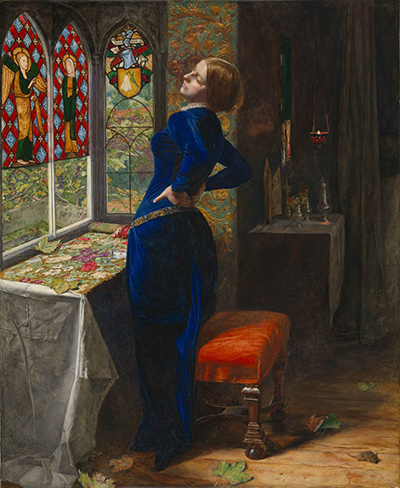
Mariana has just risen from her embroidery. She presses her hands into her lower back, arches her body and lifts her chin towards the stained glass. Her deep blue dress and the orange-red seat are among the brightest things in the room. Look down from them and the signs of a much slower change emerge. Leaves lie beside the unfinished needlework and across the floor. A mouse edges out into the room. The stretch will last a few seconds, but the rest of the picture suggests how long she has been there. Millais painted Mariana in oil on a mahogany panel in 1851. It belongs to Tate. [1]
At a Glance
- Date1851 [1]
- MediumOil on mahogany [1]
- CollectionTate, T07553 [1]
- Literary subjectTennyson’s poem based on Mariana from Measure for Measure [1][2][3]
This work across John Everett Millais’s career
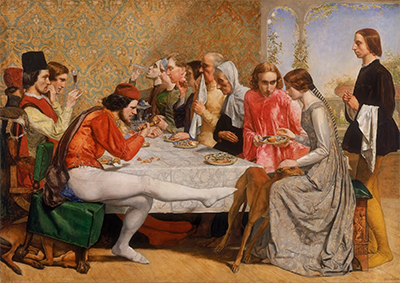
Isabella
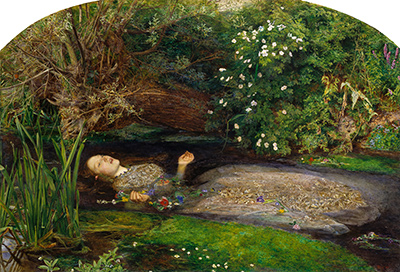
1848–49Ophelia
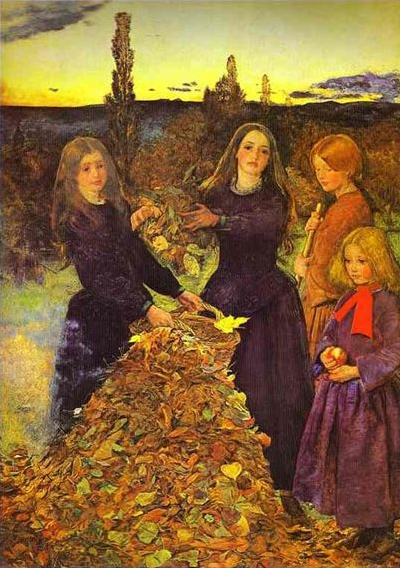
1851–52Autumn Leaves
1855–56Dew-Drenched Furze
1889–90Contents
- From Shakespeare’s plot to Tennyson’s waiting
- The stretch and the unfinished embroidery
- The Annunciation in the window
- The mirror Millais left out
- The Royal Academy exhibition of 1851
- The second Mariana
- Annotated details
From Shakespeare’s plot to Tennyson’s waiting
In Shakespeare’s Measure for Measure, Mariana was to marry Angelo, the man the Duke of Vienna leaves in charge of the city. The Duke tells Isabella that Mariana’s brother died at sea and her dowry was lost with him. Angelo broke off the engagement, casting doubts on Mariana’s reputation. When the Duke involves her in his plan against Angelo, she takes Isabella’s place at a secret meeting. In the final scene Mariana pleads for Angelo’s life after their marriage, and the Duke pardons him. Her decision to intervene is part of what brings the play to its close. [2] [3]
Tennyson borrows Mariana and the moated grange for his 1830 poem. He leaves the machinations in Vienna and the resolution out of the story. Angelo survives in the brief refrain “He cometh not!”, with his name left unspoken. The first thing the poem gives us is the condition of the place. Black moss covers the flower plots. A nail has come loose from the pear tree on the wall. The creaking hinges, the mouse and the sounds of a poplar become conspicuous in the absence of company. Morning, evening and night pass, and the refrain keeps returning. When the wording changes in the final stanza, the prospect of a visit feels more remote still. [4]
Millais drew on that sense of duration. The picture was shown at the Royal Academy in 1851 with lines from Tennyson’s refrain, which helped visitors place a solitary figure at her needlework within the story. The painted room gives the poem’s weariness a physical measure. A woman who has been bent over a frame long enough to stiffen her back stands up for relief. Around her, the leaves and the almost imperceptible mouse give the eye the kind of small, passing events to which the poem gives a great deal of attention. Anyone looking for the Duke or Angelo will find that Millais has given nearly the whole panel to the time Shakespeare’s action passes over. [1] [4]
The stretch and the unfinished embroidery
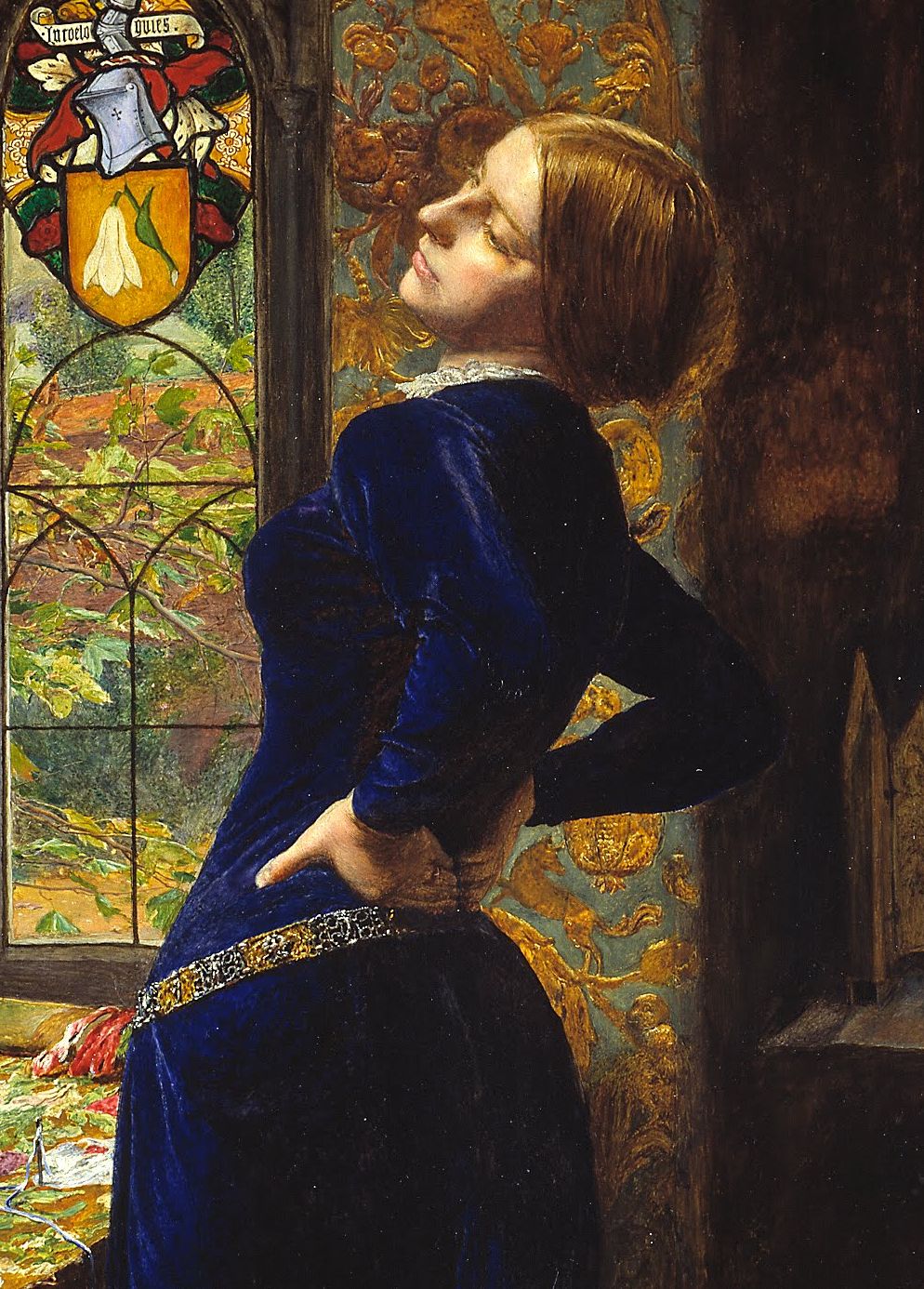
Follow the seam and folds of the blue dress upwards. The skirt hangs heavily near the ground, while the fitted bodice follows the backward curve of her torso. The elbows project, and the profile tilts up. The embroidery frame, window ledge and floorboards supply horizontal lines against which the arch of her back feels pronounced. The cushioned seat is close behind her. Together, the seat and frame make it easy to imagine the position she has just left. The force of the gesture comes partly from how ordinary its cause might be. [1]
Yoko Kanemitsu examined the 1850 drawing in the Victoria and Albert Museum and called attention to the way its lines convey both strain and release in the twisting body. The contours of the study make the mechanics particularly legible. In the oil, the curve becomes more emphatic through the fall of the blue fabric and the way it catches the light. Kanemitsu connects Millais’s concern with bodily expression to contemporary discussions of anatomy, including those of the surgeon and anatomist Charles Bell. Her comparison gives the viewer a reason to look closely at the specific kind of movement Millais worked out on paper. The turn of the body is as carefully considered as the medieval patterns around it. [1] [5]
The needle remains upright in the embroidery, a particularly small sign that Mariana has stopped partway through her work. Carol Jacobi singles out its placement in a white flower in the pattern and observes that the needle is even more prominent in the finished preparatory drawing. Her study compares the sharp point with an object in Millais’s The Bridesmaid, another painting of 1851. The young woman in that painting handles the wedding cake in a ritual intended to give her a vision of her future husband. Both pictures ask the eye to move from an absorbed figure to a minute object. The bridesmaid seeks a glimpse of a future marriage. Mariana’s work gives shape to the hours she spends waiting for a man she already knows. [6]
The part played by needlework also invited Rebeccah Swerdlow to compare Mariana to Penelope in Homer’s Odyssey. The comparison makes the difference between their circumstances easier to see. Penelope weaves and unpicks a shroud to postpone a decision about remarriage while Odysseus is away. She can use the progress of the work to influence the people around her. Mariana’s embroidery registers the passage of hours without giving her influence over Angelo’s return. The likeness is one of repeated work in the absence of a man, while the two stories give that work different stakes. [7]
The Annunciation in the window
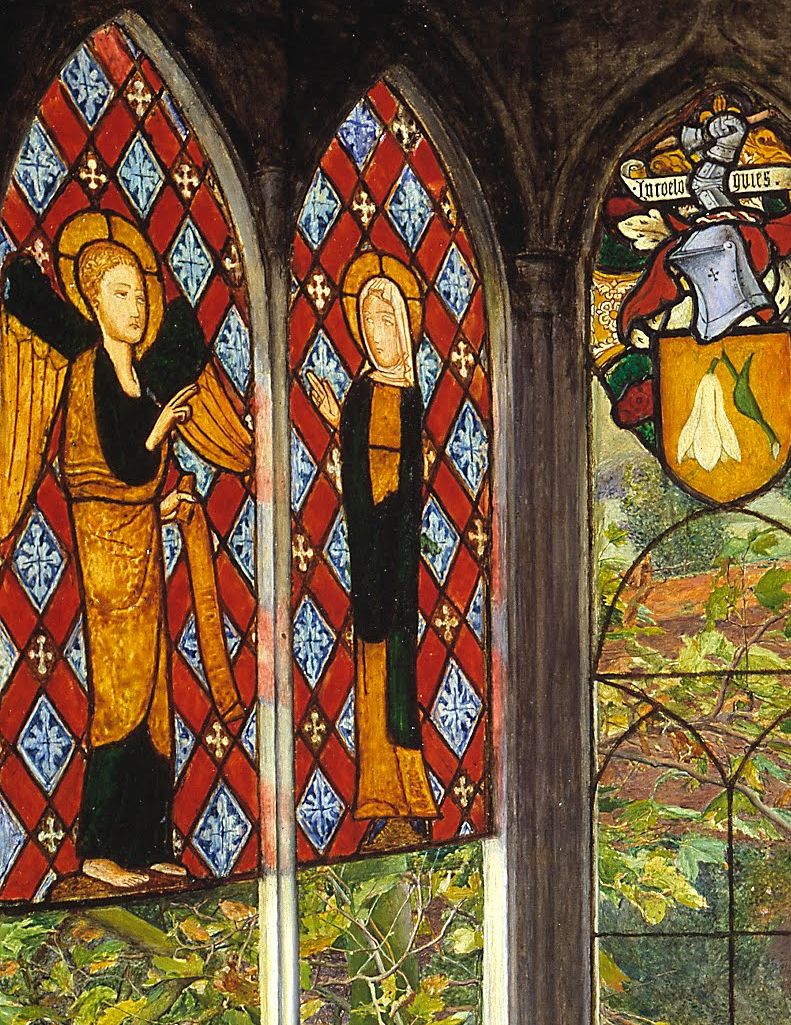
The large window is the brightest part of the chamber. Look across its lead lines and the figures resolve into the angel Gabriel and the Virgin Mary. Within the glass, a messenger has arrived to tell a woman that she will bear a child. The announcement gives the one woman a future she can scarcely have expected. The lines exhibited with the painting tell us that the other has spent day after day expecting a visit. Tennyson’s companion poem, Mariana in the South, also brings Mariana into contact with the Virgin through prayer. Jasmine M. Allen connects that religious imagery with the glass in Millais’s panel. [1] [8] [9]
Allen identifies the models for the two Annunciation panels in the medieval tracery of the east window at Merton College Chapel in Oxford. Her account, drawing on Tate’s 1984 exhibition catalogue, places Millais on scaffolding at the chapel to sketch the glass. She draws attention to the red and blue patches on the nearby grey stonework. The coloured glass affects what the room looks like even outside the limits of the window. At right, a little flame hangs in a shadowed part of the room, near devotional furnishings that the 1886 Grosvenor Gallery catalogue described as an oratory. The two light sources give very different impressions of space. Light from the window picks out the work in front of Mariana and the stone close to the glass. The lamp lets the eye discover an indistinct recess behind her. [8] [10]
Małgorzata Hołda reads the window as both a physical barrier and a focus for longing. The patterned panes take up much of the space Mariana faces, offering colour and figures while allowing only a limited sense of the grounds beyond. Some autumn leaves have found their way indoors, so the visible distance between Mariana and the outside world is slight. The distance between her and the person she wants to see remains immeasurable. A viewer following her gaze can see Gabriel and Mary with some clarity, yet has no better chance than Mariana of seeing anyone approach. [1] [11]
The mirror Millais left out
The National Gallery points to a round mirror sketched behind Mariana’s head in a preparatory drawing. It would have shown her loosened hair and given the viewer another view of the figure. In the painting Millais opened up the space behind her, leaving room for the distant furnishings and the small flame. That change lets the glance travel through the chamber after it has crossed the strip of blue dress. It also leaves the panel without a clear reflected view of Mariana herself. [9]
The gallery compares the design with Jan van Eyck’s Arnolfini Portrait. A convex mirror there shows the room from another angle, and small Passion scenes run around its edge. The gallery suggests that Millais may have found a precedent in those scenes for placing another story inside his picture, even after he dropped the mirror. In Mariana, the Annunciation has that structural role. The little figures in the glass matter to the woman standing before them just as the strong light and the tight divisions of the window matter to the way the room is painted. The comparison with Van Eyck helps explain why a small scene set well away from the centre can carry so much weight. [9]
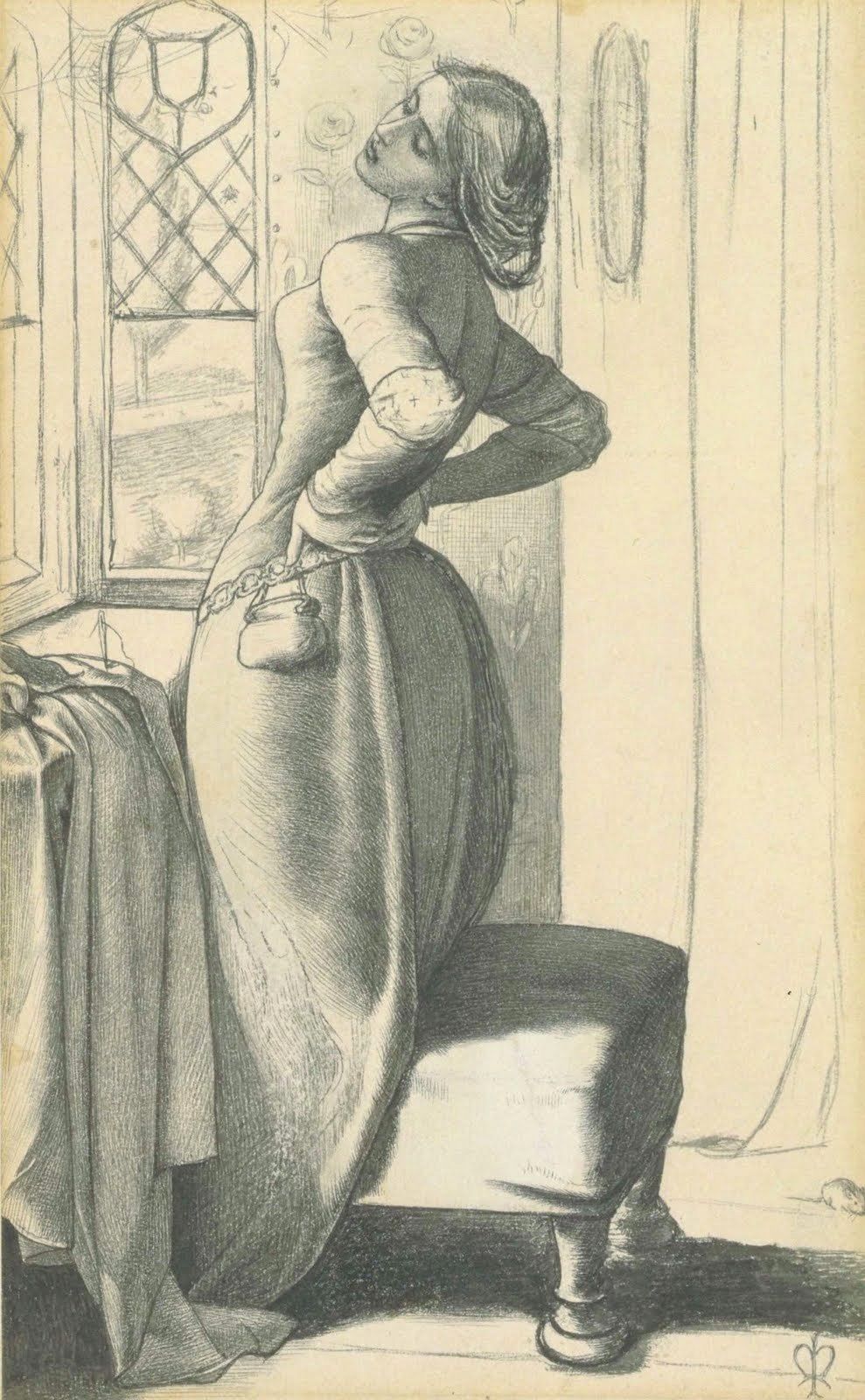
John Everett Millais, study for Mariana in the Moated Grange, 1850. Pen and ink with gouache, Victoria and Albert Museum, E.354-1931. The round mirror behind the figure is visible in the study and was omitted from the painted panel. Image source. Public domain.
The Royal Academy exhibition of 1851
Millais sent Mariana, The Return of the Dove to the Ark and The Woodman’s Daughter to the Royal Academy in 1851. In The Times, the reviewer discussed Millais alongside William Holman Hunt and Charles Allston Collins, treating their painstaking finish, unusual colour and references to old art as evidence of an affected style. John Ruskin answered in a letter published on 13 May. He insisted that the labour and attention in the pictures deserved serious consideration, even as he voiced suspicions about what he saw as the artists’ Roman Catholic and Tractarian tendencies. He singled out the woman in blue, declaring himself glad that she seemed tired of her painted window and what he called her “idolatrous toilet table”. He read the stretch as weariness with the furnishings that today may first catch the eye for their beauty. [10] [12] [13]
Punch picked on the pose itself. In its parody the backward stretch became an exaggerated figure resembling a saint in stained glass. The visual joke drew together two of the painting’s most distinctive choices, its sharply bent figure and its medieval glass. It also shows how easily a critic could treat a posture that begins with the physical demands of needlework as evidence of a painter’s taste for the grotesque. The same issue took aim at Collins’s Convent Thoughts, the painting whose meticulous study of water plants Ruskin had praised. [12] [13] [14]
By 1886 the Grosvenor Gallery exhibited the painting as Mariana of the Moated Grange. Its catalogue reprinted the Tennyson lines and described the blue dress against the red-orange seat, the unfinished embroidery catching the window light and the burning lamp in shadow. The emphasis falls on the interplay of colour, light and weariness that the earlier debate had made contentious. Tate records that the work was accepted in lieu of tax and allocated to the gallery in 1999. [1] [10]
Millais’s son John Guille revisited the painting in Life and Letters in 1899. He recounts how his father obtained a model for the mouse after it ran behind a portfolio in the studio. The story connects a fleeting detail of the poem to the kind of close observation that went into the picture. John Guille also disagreed with the critic M. H. Spielmann, who had found its colours too gay for the subject. John Guille appealed to Tennyson’s description of a late sunbeam crossing the chamber at the hour Mariana most hated. Strong colour, on his reading, belongs to a world that goes on glowing regardless of what Mariana feels. The dispute goes to the heart of the way Millais painted the room. The brightness that has kept it so memorable can also make the dreariness of her days harder to bear. [15]
The Italian exhibition Preraffaelliti. L’utopia della bellezza grouped the panel with paintings based on earlier literature and history at Palazzo Chiablese in Turin in 2014. Its checklist placed Mariana next to Holman Hunt’s Claudio and Isabella, which takes another part of Measure for Measure as its subject. Hunt brings two characters together at a point of decision. Millais, following Tennyson, gives his heroine an entire room to herself. The works make different kinds of pressure visible within the same Shakespearean story. [16]
The second Mariana
Millais returned to Tennyson’s poem for Edward Moxon’s illustrated Poems of 1857. He supplied the design for a wood engraving, and the Dalziel Brothers cut it. The National Gallery of Victoria holds an impression measuring just over nine centimetres high. The small size puts the image on the scale of a reader holding a book and encountering the figure alongside the words. The Fundación Juan March exhibition catalogue records the illustration on page seven of the Moxon volume, close to the beginning of the collection. [17] [18]
In the engraving Mariana sinks forward at the window, her face hidden in her arms. Beyond the window, a tall poplar stands out against the darker landscape. Small framed portraits hang over her where the earlier picture had given the Annunciation such prominence. Millais can suggest grief by hiding the face and letting the body give way. In the oil, he had stretched the figure upwards into the light, where even the position of her fingers helps describe an effort to ease the strain. The contrast suggests how many moments of a long wait lay within Tennyson’s poem. The book illustrator chose one in which the posture makes despair immediately apparent. The painter gave us one in which Mariana still has work waiting for her when she sits down. [1] [17] [19]
Annotated Details from Mariana
The numbered points identify visible features discussed in this article. Return from each detail to the numbered overview. Mariana, oil on mahogany, Tate, T07553.
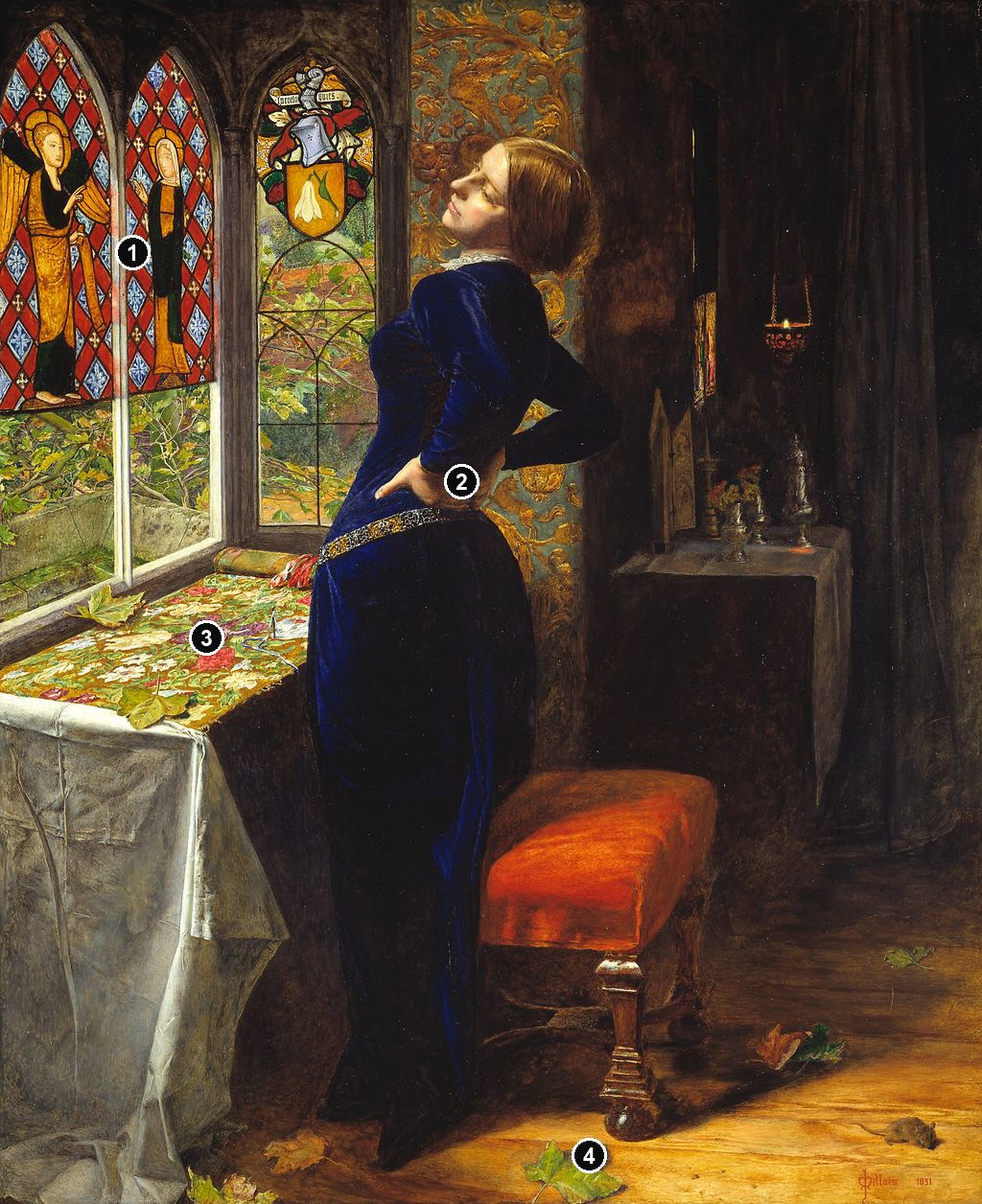
Details from MARIANA
Compare the workmanship of glass and cloth with the figure’s stretch and the autumn leaves scattered across the room.
The Annunciation windows
An angel and the Virgin occupy the two panes at upper left. The bright glass introduces another story about a message and a woman waiting, within the enclosure of Mariana’s room.
The stretch and hands
She arches back and presses her hands against her lower back. Her lifted face and the curve of her dress extend the movement, suggesting the stiffness of a body held at work for hours.
The unfinished embroidery
Worked flowers and coloured threads spread across the cloth. Its dense surface contrasts with the loose leaves elsewhere in the room and records how Mariana has occupied her time.
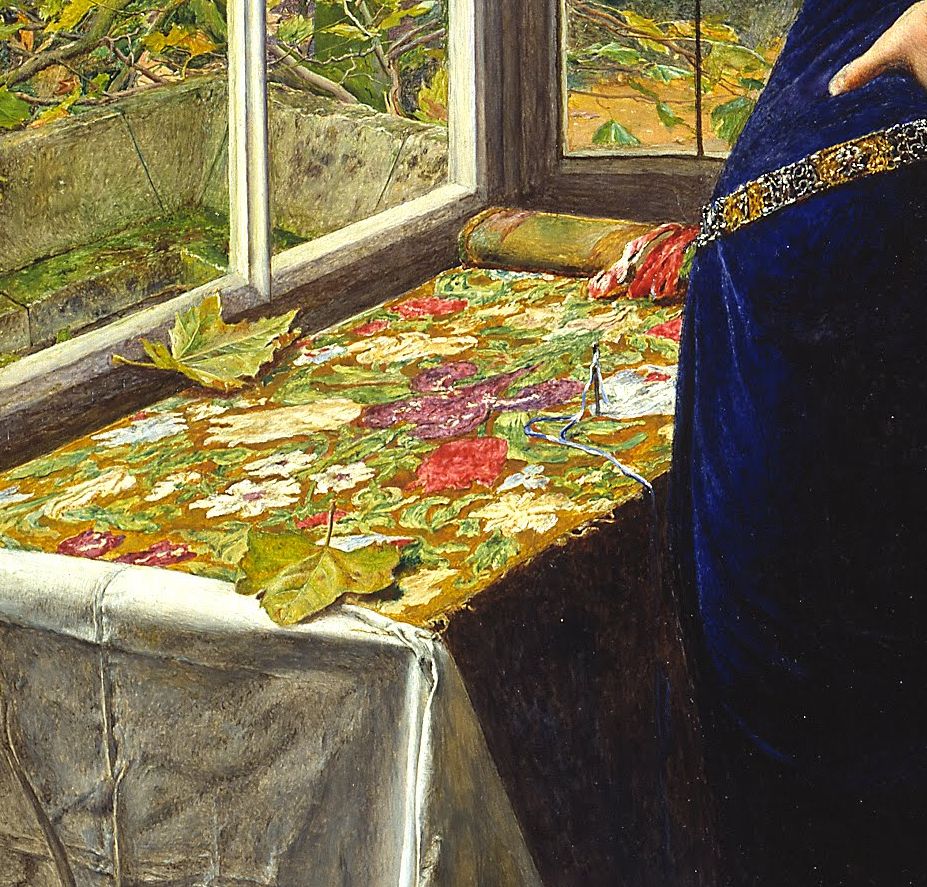
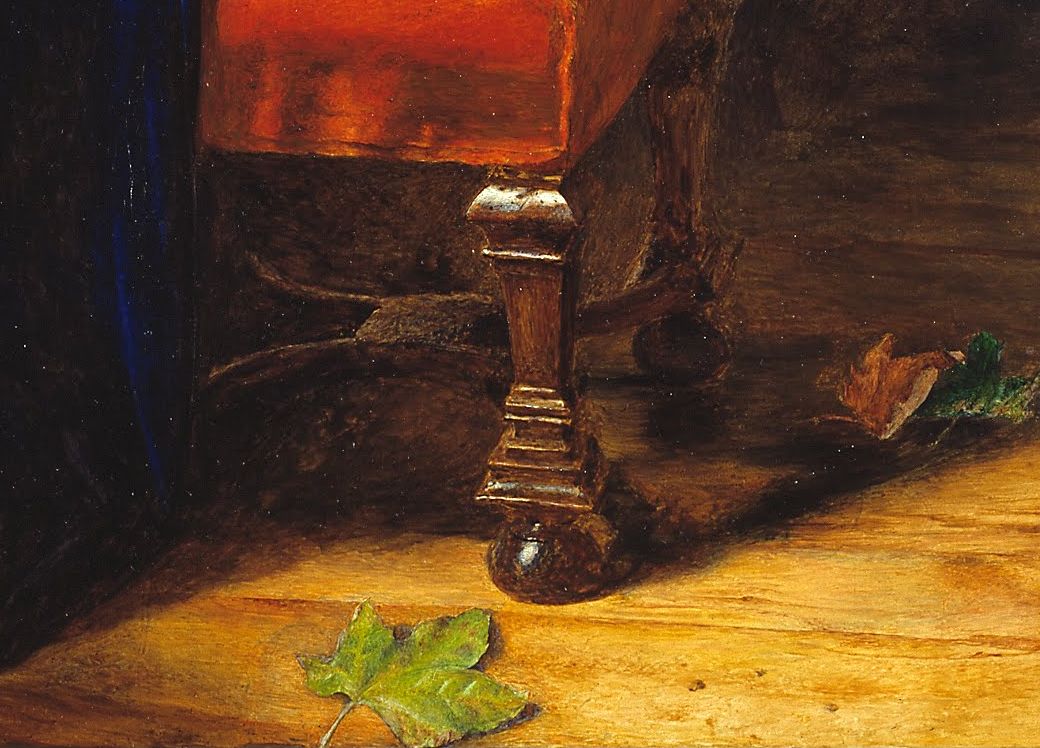
Leaves across the floor
Scattered leaves carry the autumn outside into the room. Their uneven distribution becomes clearer along the lit boards and below the stool.
John Everett Millais artwork directory
Browse paintings and drawings covered in these articles, including related works held in public collections. Reproductive engravings and editions are discussed on the Prints page.
Prints and illustrated editions
- The Baby-House, 1872. Etching by Millais.
- The Good Shepherd, 1864. Wood engraving designed by Millais, engraved and printed by the Dalziel Brothers.
- Mariana, 1857. Wood engraving designed by Millais and cut by the Dalziel Brothers for the Moxon Tennyson.
- The Proscribed Royalist, 1858. Mixed-method engraving by William Henry Simmons after Millais.
| Name | Date | Medium |
|---|---|---|
| Pizarro Seizing the Inca of Peru | 1846 | Painting |
| The Young Men of Benjamin Seizing Their Brides | 1847 | Painting |
| Isabella | 1848–49 | Painting |
| Christ in the House of His Parents (‘The Carpenter’s Shop’) | 1849–50 | Painting |
| Ferdinand Lured by Ariel | 1849–50 (monogram dated 1849) | Painting |
| Study for Christ in the House of His Parents, Tate N04623 | c. 1849 | Drawing |
| Study for Christ in the House of His Parents, Tate N04792 | c. 1849 | Drawing |
| Study for Mariana in the Moated Grange | 1850 | Drawing |
| A Huguenot, on St Bartholomew’s Day, Refusing to Shield Himself from Danger by Wearing the Roman Catholic Badge | 1851–52 (exhibited 1852) | Painting |
| Mariana | 1851 | Painting |
| Ophelia | 1851–52 | Painting |
| The Bridesmaid | 1851 | Painting |
| The Return of the Dove to the Ark | 1851 | Painting |
| The Order of Release 1746 | 1852–53 | Painting |
| The Proscribed Royalist, 1651 | 1852–53 (exhibited 1853) | Painting |
| Portrait of John Ruskin | 1853–54 | Painting |
| The Blind Girl | 1854–56 | Painting |
| Autumn Leaves | 1855–56 (Manchester labels 1856) | Painting |
| A Dream of the Past: Sir Isumbras at the Ford | 1856–57, later revised | Painting |
| The Vale of Rest | 1858–59 | Painting |
| Study for The Black Brunswicker, Tate A00812 | c. 1860 | Drawing |
| Study for The Black Brunswicker, Tate A00813 | c. 1860 | Drawing |
| Study for The Black Brunswicker, Tate A00814 | c. 1860 | Drawing |
| The Black Brunswicker | 1860 | Painting |
| The Ransom | 1860–62 | Painting |
| My First Sermon | 1863 | Painting |
| My Second Sermon | 1864 | Painting |
| Joan of Arc | 1865 | Painting |
| Chill October | 1870 (exhibited 1871) | Painting |
| The Boyhood of Raleigh | 1870 | Painting |
| The Knight Errant | 1870 | Painting |
| Hearts are Trumps | 1872 | Painting |
| The North-West Passage | 1874 | Painting |
| Louise Jane Jopling | 1879 | Painting |
| William Ewart Gladstone, NPG 3637 | 1879 | Painting |
| Bubbles | 1886 | Painting |
| Portia | 1886 | Painting |
| Dew-Drenched Furze | 1889–90 | Painting |
| Ducklings | 1889 | Painting |
| Portrait of Sarah Hammond | 1891 | Painting |
Discussion
Look again at the images and ideas explored in Mariana by John Everett Millais. These editorial prompts invite your observations.
Reader Insights
Which feature tells you most about the length of Mariana’s wait?
How does the open colour in the stained glass change the feeling of the enclosed room?
Join the Conversation
Share a detail, comparison or question about Mariana by John Everett Millais below.
References
- Tate Britain, John Everett Millais, Mariana, 1851, T07553, collection record and painting reproduction. View source.
- William Shakespeare, Measure for Measure, act 3, scene 1, Folger Shakespeare Library. View source.
- William Shakespeare, Measure for Measure, act 5, scene 1, Folger Shakespeare Library. View source.
- Alfred, Lord Tennyson, Mariana, University of Toronto, Representative Poetry Online. View source.
- Yoko Kanemitsu, Dialogue between Medicine and Art in the Nineteenth Century: Through J. E. Millais’s Three Paintings around 1851, Juntendo University, vol. 2, 2017, pp. 9–10 and fig. 8. View source.
- Carol Jacobi, Sugar, Salt and Curdled Milk: Millais and the Synthetic Subject, Tate Papers no. 18, 2012. View source.
- Rebeccah Swerdlow, Mariana Mirroring Penelope: A Case for Classical Influence in a Pre-Raphaelite Painting, The Journal of Pre-Raphaelite Studies vol. 26, 2017. View source.
- Jasmine M. Allen, Stained Glassworlds: Stained Glass at the International Exhibitions 1851–1900, University of York, pp. 35–36 and figs. 0.4–0.5. View source.
- National Gallery, Reflections: Behind the Inspiration, painting in detail, Mariana. View source.
- Grosvenor Gallery, Exhibition of the Works of Sir John E. Millais, Bart., R.A., 1886, cat. no. 79. View source.
- Małgorzata Hołda, The Hermeneutical Aesthetics of (Be)longing, Text Matters no. 14, 2024, section on Mariana. View source.
- The Royal Academy Summer Exhibition Chronicle, 1851: Ruskin to the Rescue, with contemporary reviews and references. View source.
- John Ruskin, letter to The Times, published 13 May 1851, reprinted in Arrows of the Chace, vol. I. View source.
- Punch, Punch among the Painters, vol. XX, 17 May 1851, p. 219, Mariana cartoon reproduced by The Victorian Web. View source.
- John Guille Millais, The Life and Letters of Sir John Everett Millais, vol. I, 1899, p. 54. View source.
- Mecenate 90, Preraffaelliti. L’utopia della bellezza, 2014, exhibition checklist, “La storia”. View source. (in Italian).
- National Gallery of Victoria, Mariana, 1857, wood engraving by the Dalziel Brothers from a design by Millais, accession 1280.45-3. View source.
- Fundación Juan March, Julia Margaret Cameron 1815–1879, exhibition catalogue, cat. no. 2.10a. View source.
- John Everett Millais and the Dalziel Brothers, Mariana from Alfred Tennyson’s Poems, Edward Moxon, 1857, page scan by George P. Landow. View source.