 by Tom Gurney
Tom Gurney BSc (Hons) is an art history expert with over 20 years experience
Published on June 19, 2020 / Updated on November 25, 2026
Email: tomgurney1@gmail.com / Phone: +44 7429 011000
A Huguenot: Introduction
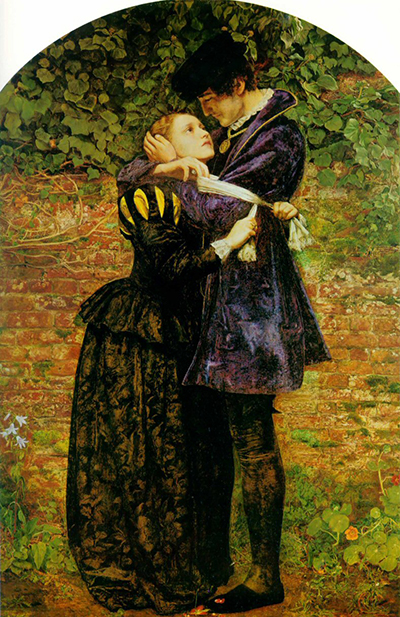
In John Everett Millais’s A Huguenot, a young woman tries to tie a strip of white cloth around her lover’s arm. He draws her close while pulling the cloth loose. The two stand against an ivy-covered garden wall, close enough that it takes a moment to work out whose fingers are holding the band. The work’s long title explains the disagreement. He is a French Protestant in danger during the Saint Bartholomew’s Day Massacre, and she hopes a sign associated with Catholics will save him. Millais painted the oil on canvas in 1851–52 and exhibited it in the West Room of the Royal Academy exhibition in 1852. [1] [2]
The Academy’s memorial exhibition of 1898 listed the picture as The Huguenot. The entry identifies T. H. Miller as the lender and records a signature and the date 1852. The principal oil is a privately held painting. The Rossetti Archive identifies it as the arched canvas, and the Bridgeman reproduction caption gives the Makins Collection credit. [1] [3] [4]
At a Glance
- Date1851–52 [1][3]
- MediumOil on canvas [1]
- First exhibitionRoyal Academy, 1852 [1][2]
- SubjectA young man refuses the protective white armband [1][2]
This work across John Everett Millais’s career
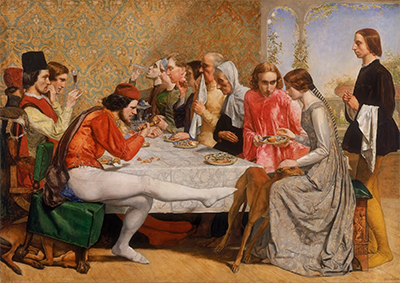
Isabella
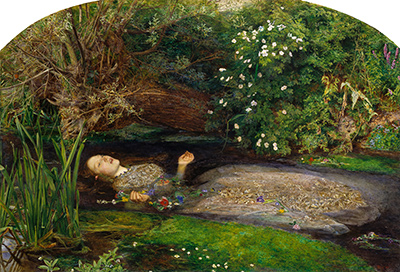
1848–49Ophelia
1851–52A Huguenot, on St Bartholomew’s Day, Refusing to Shield Himself from Danger by Wearing the Roman Catholic Badge (current article)
1851–52 (exhibited 1852) [1]Autumn Leaves
1855–56Dew-Drenched Furze
1889–90Contents
- The white band and the lovers’ hands
- The massacre of 1572 and Meyerbeer’s opera
- Painting a Surrey garden and dressing the figures
- From the Academy wall to prints and photographs
The white band and the lovers’ hands
At first the pose reads as an ordinary embrace. His head inclines towards hers and his fingers spread over her hair. Her upturned face is very close to his, but she is still working on the band. Follow the arm he has put around her shoulders and notice where it ends. The hand that reaches back to the cloth belongs to the man. The same gesture that cradles her also lets him undo her work. The action looks careful and deliberate, and their closeness holds even as their hands work against each other. [3]
The narrow canvas lets the spectator see almost the whole of both figures without giving much space to their surroundings. The yellow showing through the slashes of her dark sleeves draws the eye to her arms. His purple tunic and dark hose make a broad field against which the loose end of the band can be read. The hands and the bright cloth occupy a small area between their bodies. Without the title, one might recognise an argument in the gesture and still have no way to tell what is at stake. [1] [3]
The wall makes the meeting feel secluded. The leaves and patches of exposed brick run close behind the two figures, leaving little suggestion of a view beyond the garden. Their isolation is temporary. The title locates them in a wider emergency that they cannot see from their corner and that the painting keeps outside our field of view. In November 1851 Millais told Martha Combe how he wanted the scene to feel. “It will be very quiet, and but slightly suggest the horror of a massacre.” The garden wall was already painted when he wrote to her. [5]
The massacre of 1572 and Meyerbeer’s opera
The massacre began in Paris during the night of 23–24 August 1572. Protestant nobles had come to the capital for the marriage of Henri of Navarre and Marguerite de Valois. On 22 August the Protestant leader Gaspard de Coligny was wounded in an assassination attempt. He was killed two days later as the violence began, and attacks spread through Paris and to other towns. The Musée protestant describes white crosses worn by attackers as identification. Millais gave his couple a strip of cloth and left the soldiers and crowds out of view. [6] [7]
The 1852 exhibition catalogue directed readers to a specific nineteenth-century account of the events, Anne Marsh-Caldwell’s The Protestant Reformation in France. The passage, reprinted in the 1898 catalogue, describes Catholics being instructed to identify themselves by white linen on the arm and a white cross in the cap when a bell sounded. It was printed as an order attributed to the Duke of Guise. The historical writing supplied the Academy visitor with what the image withholds, including the sound of the bell and the public meaning of the white band. The strip laid against the man’s arm might allow others to take him for a Catholic. For the woman that possibility makes it worth tying, while the man’s quiet refusal makes his attachment to his faith visible. [2] [3] [8]
That decision was central to Millais’s description of the picture while he was making it. In his letter to Combe he describes a Catholic woman and a Protestant man about to part, and stresses the gentleness with which the man will stop her. A viewer in 1852 could learn the public reason for the refusal from the catalogue. In the painting the held head, the bent elbows and the slack end of the band convey the private cost of the choice. [2] [5]
Another nineteenth-century version of the massacre is Giacomo Meyerbeer’s Les Huguenots, the five-act opera with a libretto by Eugène Scribe and Émile Deschamps that premiered in Paris in 1836. Its lovers, the Protestant Raoul and the Catholic Valentine, face the consequences of sectarian violence. The opera has room for public and private drama, including scenes with a chorus and the extended duet for the lovers in Act IV. Millais concentrates that larger dramatic situation into a silent exchange. The opera offers a persuasive parallel and a possible source for the choice of subject. The exhibited title leaves the pair unnamed and refers the viewer to Marsh-Caldwell’s history. [2] [9] [10] [11]
The Swiss museum in Lausanne that holds François Dubois’s Massacre de la Saint-Barthélemy describes it as the work of a Protestant refugee in Geneva. Painted within years of the event, it shows violence at multiple points in a recognisable Paris. It makes a revealing comparison with Millais’s much later English picture. Dubois lets the viewer look across a city and piece together episodes from the massacre. Millais asks what two people can see of each other in one corner of it. [12]
Painting a Surrey garden and dressing the figures
The wall began with an observed place. Naoko Asano’s study of Millais’s household describes his work on the ivy and brick at Worcester Park Farm near Ewell, where he was working alongside William Holman Hunt. Millais’s letter to Combe treats the finished background as something he already has to build a story around. Asano also documents the work he delegated. His mother Emily researched historic costume at the British Museum and helped arrange what the figures would wear. Through Martha Combe he borrowed lace from another woman to use for the band. Marsh-Caldwell called for linen in her account of the order, while the studio supplied lace for Millais to paint. [5] [13]
Sotheby’s catalogue of a pencil and watercolour study identifies Anne Ryan as the model for the woman and Arthur Lempriere as the model for the Huguenot. It also notes that Millais painted Ryan’s hair lighter than it was. Here the two heads and the garden have the immediacy of things studied close up. They were assembled from models, clothes and a wall available to a painter in 1850s England. Those decisions make the imagined meeting specific, down to the way a cloth caught between two people would hang when one of them loosened it. [13] [14]
From the Academy wall to prints and photographs
The full title tells us what the man intends to do, but viewers disagreed about how much the painting had already decided. Art historian Jo Briggs traces the emphasis several 1852 reviewers put on the young man’s firmness. They understood the incident as a test of a Protestant man’s resolve and anticipated his death. Tom Taylor, by contrast, considered the moment open and thought the outcome a spectator imagined would depend on whose feelings they shared. Read in that light, the woman’s effort to secure the band also commands attention. She has found a practical way to protect someone and tries it in the narrow time the picture allows. [8]
The picture earned the Liverpool Academy’s prize for a work by a non-member in 1852. Paolo Giudici follows its passage from purchase by the dealer David Thomas White to the trade in reproductions published in London and marketed through Ernest Gambart in Paris and New York. Thomas Oldham Barlow made the engraving after Millais. A recorded impression published by White in 1857 uses mixed engraving methods. In monochrome the band, hands and faces still carry the action, even though the difference between the purple clothing and yellow sleeves is now a difference of tone. [15] [16]
A later format made the composition portable on a far smaller scale. The Rijksmuseum holds an albumen photograph mounted as a carte-de-visite, dated 1860–90. It bears the name and Amsterdam address of Andries Jager and the French title Le Huguenot. The photograph is only 85 millimetres tall before the mount is counted. In his 1898 German review of the London retrospective, O. von Schleinitz singled out A Huguenot and Ophelia as the works through which Millais gained recognition and remarked on how often both were reproduced. The albumen card gives a concrete sense of the variety of objects through which the image became familiar. [17] [18]
Millais also revisited the composition in his own media. The separate 1852 work Sotheby’s catalogued as Original Study for A Huguenot is pencil with watercolour wash, measuring 19 by 13 centimetres. The catalogue differentiates it from known replicas, including a reduced oil, and notes that a letter attached to the replica mentions other watercolours. Millais’s much later Mercy: St Bartholomew’s Day, 1572 returns to the massacre with a different group and a different dramatic situation. Éva Péteri compares the success of the earlier work with the far cooler reception of Mercy. The two scenes show how much of the earlier picture’s appeal rests on the concentrated exchange between its young couple, whose expressions can temper the severity of the historical subject without resolving their conflict. [11] [14]
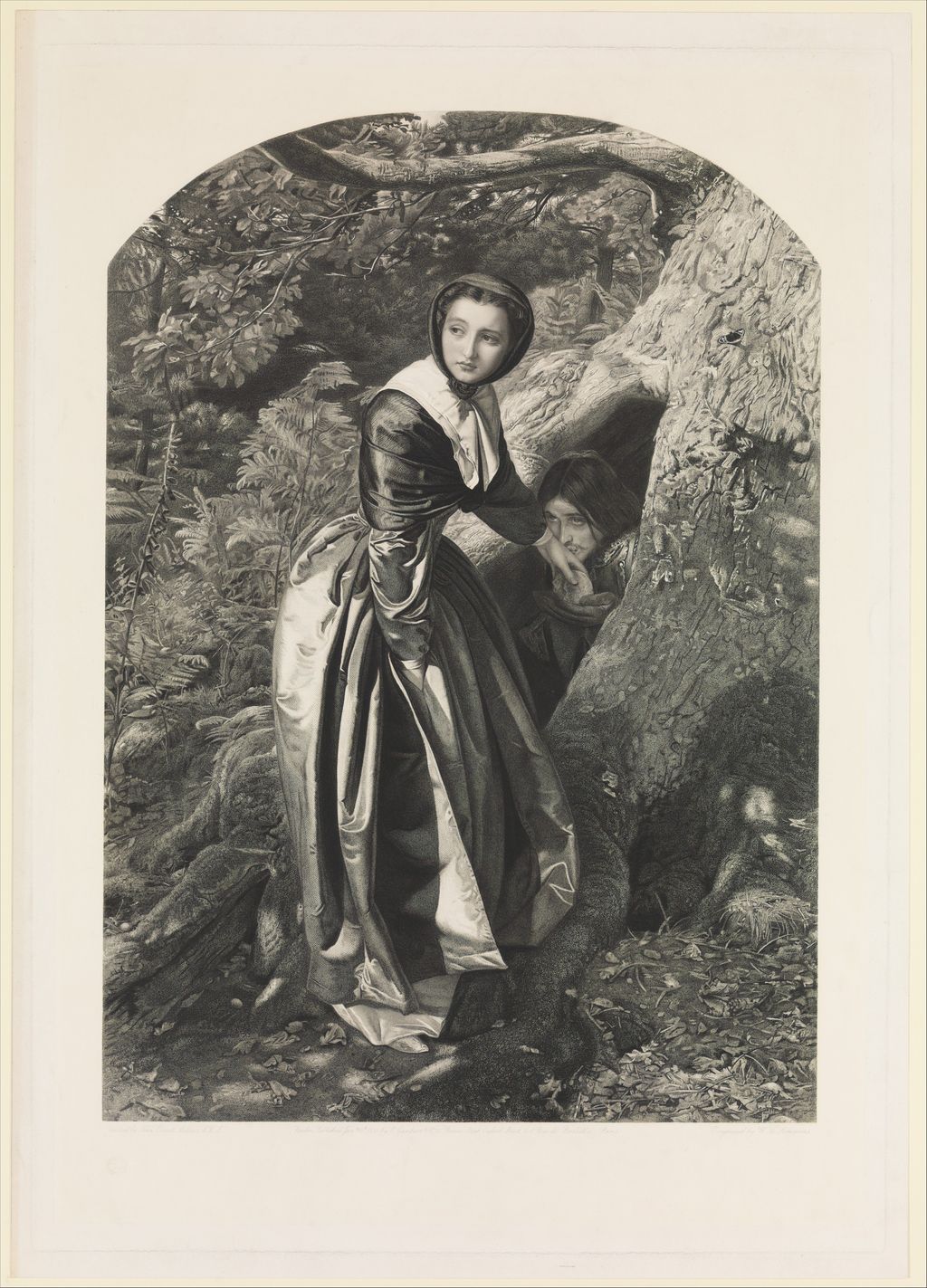
William Henry Simmons after John Everett Millais, The Proscribed Royalist, 1858. Mixed-method engraving on chine collé. Metropolitan Museum of Art, 49.40.209. Simmons’s engraving after another Millais history painting shows how tonal prints carried related subjects to viewers. Image source. CC0 / Public domain.
John Everett Millais artwork directory
Browse paintings and drawings covered in these articles, including related works held in public collections. Reproductive engravings and editions are discussed on the Prints page.
Prints and illustrated editions
- The Baby-House, 1872. Etching by Millais.
- The Good Shepherd, 1864. Wood engraving designed by Millais, engraved and printed by the Dalziel Brothers.
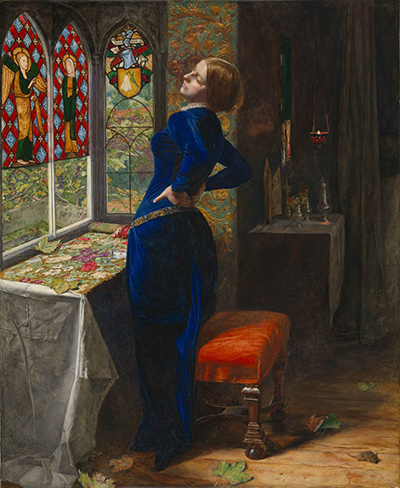
- Mariana, 1857. Wood engraving designed by Millais and cut by the Dalziel Brothers for the Moxon Tennyson.
- The Proscribed Royalist, 1858. Mixed-method engraving by William Henry Simmons after Millais.
| Name | Date | Medium |
|---|---|---|
| Pizarro Seizing the Inca of Peru | 1846 | Painting |
| The Young Men of Benjamin Seizing Their Brides | 1847 | Painting |
| Isabella | 1848–49 | Painting |
| Christ in the House of His Parents (‘The Carpenter’s Shop’) | 1849–50 | Painting |
| Ferdinand Lured by Ariel | 1849–50 (monogram dated 1849) | Painting |
| Study for Christ in the House of His Parents, Tate N04623 | c. 1849 | Drawing |
| Study for Christ in the House of His Parents, Tate N04792 | c. 1849 | Drawing |
| Study for Mariana in the Moated Grange | 1850 | Drawing |
| A Huguenot, on St Bartholomew’s Day, Refusing to Shield Himself from Danger by Wearing the Roman Catholic Badge | 1851–52 (exhibited 1852) | Painting |
| Mariana | 1851 | Painting |
| Ophelia | 1851–52 | Painting |
| The Bridesmaid | 1851 | Painting |
| The Return of the Dove to the Ark | 1851 | Painting |
| The Order of Release 1746 | 1852–53 | Painting |
| The Proscribed Royalist, 1651 | 1852–53 (exhibited 1853) | Painting |
| Portrait of John Ruskin | 1853–54 | Painting |
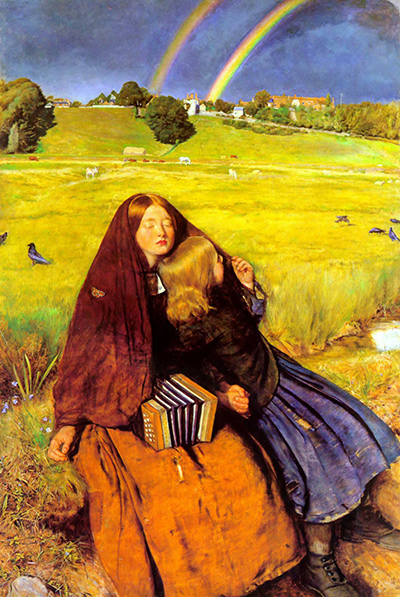
| The Blind Girl | 1854–56 | Painting |
| Autumn Leaves | 1855–56 (Manchester labels 1856) | Painting |
| A Dream of the Past: Sir Isumbras at the Ford | 1856–57, later revised | Painting |
| The Vale of Rest | 1858–59 | Painting |
| Study for The Black Brunswicker, Tate A00812 | c. 1860 | Drawing |
| Study for The Black Brunswicker, Tate A00813 | c. 1860 | Drawing |
| Study for The Black Brunswicker, Tate A00814 | c. 1860 | Drawing |
| The Black Brunswicker | 1860 | Painting |
| The Ransom | 1860–62 | Painting |
| My First Sermon | 1863 | Painting |
| My Second Sermon | 1864 | Painting |
| Joan of Arc | 1865 | Painting |
| Chill October | 1870 (exhibited 1871) | Painting |
| The Boyhood of Raleigh | 1870 | Painting |
| The Knight Errant | 1870 | Painting |
| Hearts are Trumps | 1872 | Painting |
| The North-West Passage | 1874 | Painting |
| Louise Jane Jopling | 1879 | Painting |
| William Ewart Gladstone, NPG 3637 | 1879 | Painting |
| Bubbles | 1886 | Painting |
| Portia | 1886 | Painting |
| Dew-Drenched Furze | 1889–90 | Painting |
| Ducklings | 1889 | Painting |
| Portrait of Sarah Hammond | 1891 | Painting |
Discussion
Look again at the images and ideas explored in A Huguenot. These editorial prompts invite your observations.
Reader Insights
What does each figure’s hand tell you about their decision concerning the white band?
Which detail makes the scene feel urgent before you know its historical setting?
Join the Conversation
Share a detail, comparison or question about A Huguenot below.
References
- Rossetti Archive, A Huguenot, object record and 1852 Royal Academy exhibition number. View source.
- Royal Academy, 1852 exhibition catalogue, West Room, p. 24, no. 478. View source.
- Royal Academy, Millais memorial exhibition catalogue, 1898, p. 24, no. 61. View source.
- Bridgeman Images, The Huguenot, 1851–52, Makins Collection caption. View source.
- John Guille Millais, The Life and Letters of Sir John Everett Millais, vol. I, pp. 134–135, letter to Martha Combe, 22 November 1851. View source.
- Archives nationales, La Saint-Barthélemy : une nuit de violence racontée par les archives. View source.
- Musée protestant, Quatrième guerre de Religion et la Saint-Barthélemy (1572–1573). View source.
- Jo Briggs, “‘The Old Feelings of Men in a New Garment’: John Everett Millais’s A Huguenot and Masculine Audiences in the Mid-Nineteenth Century,” Nineteenth-Century Art Worldwide 11, no. 3 (2012). View source.
- Bibliothèque nationale de France, Les Huguenots, record of the first Paris performance, 29 February 1836. View source.
- Ricordi, Les Huguenots, critical edition edited by Milan Pospíšil and Marta Ottlová, character list and account of Act IV. View source.
- Éva Péteri, “John Everett Millais’s Huguenot Pictures,” Hungarian Journal of English and American Studies 29, no. 2 (2023). View source.
- Musée cantonal des Beaux-Arts, Lausanne, François Dubois, Le Massacre de la Saint-Barthélemy. View source.
- Naoko Asano, “More than models and muses: The women of John Everett Millais’ domestic circle and their contributions,” National Museum of Western Art Research Bulletin 25, p. 7. View source.
- Sotheby’s, Original Study for A Huguenot, 2014, lot 9. View source.
- Paolo Giudici, Royal College of Art doctoral thesis, discussion of the sale, exhibition reception and print publication of A Huguenot. View source.
- Christie’s, The Huguenot, Thomas Oldham Barlow after John Everett Millais, 1857 impression, lot 4860800. View source.
- Rijksmuseum, Fotoreproductie van Een Hugenoot door John Everett Millais, RP-F-2003-27. View source.
- O. von Schleinitz, review of the Millais retrospective, Kunstchronik, 24 February 1898, pp. 258–259. View source. (in German).