


 by Tom Gurney
Tom Gurney BSc (Hons) is an art history expert with over 20 years experience
Published on June 19, 2020 / Updated on November 25, 2026
Email: tomgurney1@gmail.com / Phone: +44 7429 011000
John Everett Millais Paintings: Introduction
John Everett Millais painted the water closing over Shakespeare’s Ophelia and, nearly twenty years later, the wind passing through a stretch of reeds beside the Tay. In Ophelia, plants crowd the bank and frame the figure’s upturned hands. In Chill October, the long grass and the bend of the trees give the painting its movement. The two works share an attention to what water and vegetation do. They ask the viewer to spend that attention differently. [1] [2]
The paintings gathered here span the early Pre-Raphaelite experiments, scenes from literature and history, pictures of children, commissioned portraits and the late Scottish landscapes. Follow the links for individual paintings or browse the gallery for a wider selection. A useful way into Millais’s work is to compare pairs of pictures and see how the same problem changes with the subject. A hand might guide the eye towards an injury, reveal who holds power in a room, or show how close a child is to sleep.
John Everett Millais Paintings
TheHistoryOfArt’s short film shows paintings from different stages of Millais’s career.
TheHistoryOfArt. A selection of paintings by John Everett Millais. Watch on YouTube.
At a Glance
- Early literary workIsabella and Ophelia [1][3]
- Religious historyChrist in the House of His Parents and The Order of Release 1746 [4][5]
- Later workSociety portraits and Scottish landscapes [6][7]
Contents
- Early paintings and the use of detail
- Stories told through gestures and objects
- Twilight, attention and childhood
- Portraiture, scale and the painted surface
- The Scottish landscapes
- How exhibitions brought the paintings together
Browse Millais’s Paintings
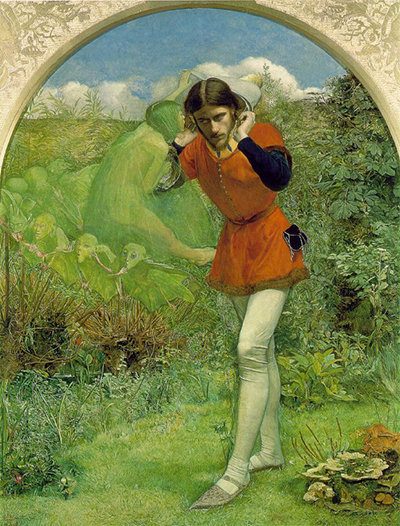
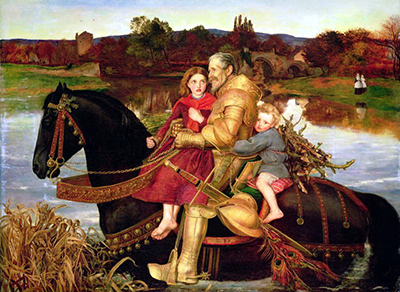
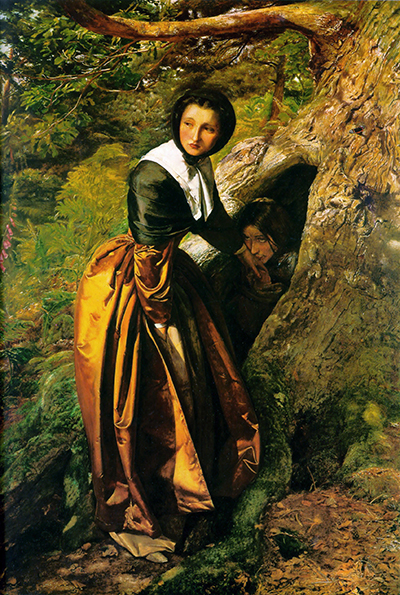
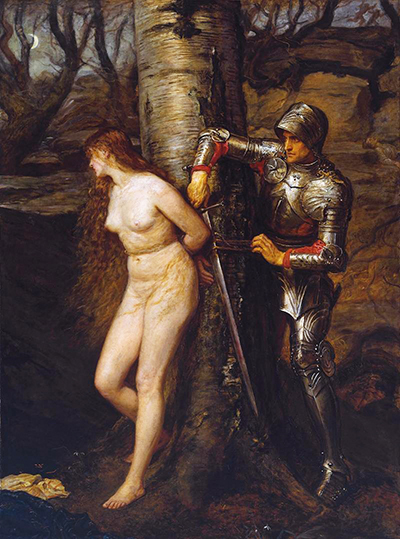
Early paintings and the use of detail
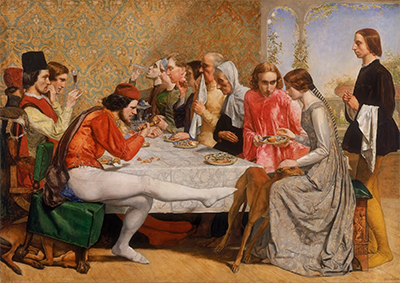
In Isabella, shown at the Royal Academy in 1849, Millais takes a story from Keats’s poem and concentrates it around a dinner table. Isabella and Lorenzo’s exchange at one end is quiet enough to overlook on a first pass. The brother’s extended leg on the other side is easier to spot. It cuts across the foreground towards Isabella’s dog, giving the threat to the lovers a physical direction. The long white cloth and the succession of faces carry the eye along the table. The spread of the meal may look orderly, yet almost every gesture interrupts that order. The shallow space and strong colour also draw on early Italian painting, as the Walker Art Gallery’s account explains. [3] [8]
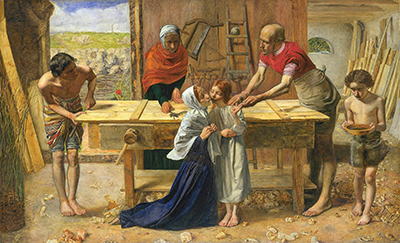
The bench in Christ in the House of His Parents does comparable work. The horizontal slab of wood holds a group together, and the gestures around the injured boy bring the smallest incident in the room to the centre. Shavings on the floor and tools on the wall insist on the ordinary use of the space. The 1850 Royal Academy catalogue supplied a verse from Zechariah about wounds in the hands in place of the painting’s familiar title. The verse made the hand a point of connection between an accident in a workshop and the Crucifixion. The Academy chronicle describes the mostly favourable response to Isabella and the press hostility that followed the carpenter’s shop. Sharply observed physical details had different consequences when the people depicted were the Holy Family. [4] [9]
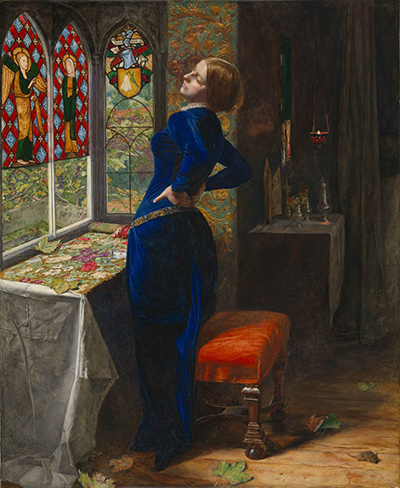
Mariana and Ophelia offer two ways to build a literary scene. Mariana’s blue dress and arched back make a figure of impatience in a room full of things that stay put. The National Gallery compares the painting with a preparatory drawing in which a round mirror sits behind Mariana’s head. The drawing brings a reflected detail into play. In the finished painting, the recession of the room, with the distant bed and the small flame at the right, gives the figure more space around her. The National Gallery reads both stages alongside Jan van Eyck’s Arnolfini Portrait. Borrowing from an older painting could involve trying out a compositional device and then finding another way to create depth. [10]
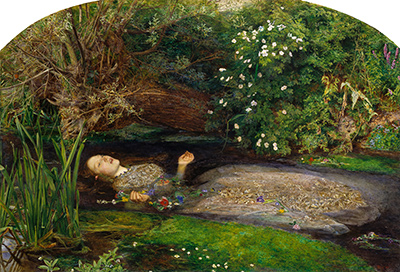
For Ophelia, Tate documents a division between work beside the Hogsmill in Surrey and the separate posing of Elizabeth Siddal in a bath. The bank’s many little edges belong to a study of a particular place. Siddal’s pose had to fit that world of intersecting stems, leaves and water. The open palms and the pale face emerge clearly, while stretches of the dress almost join the surface of the stream. The figure comes from a play, the vegetation from a local river and the pose from a studio arrangement. It takes all three to produce that moment of suspension, when some parts of Ophelia still appear buoyant and others are already going under. [1]
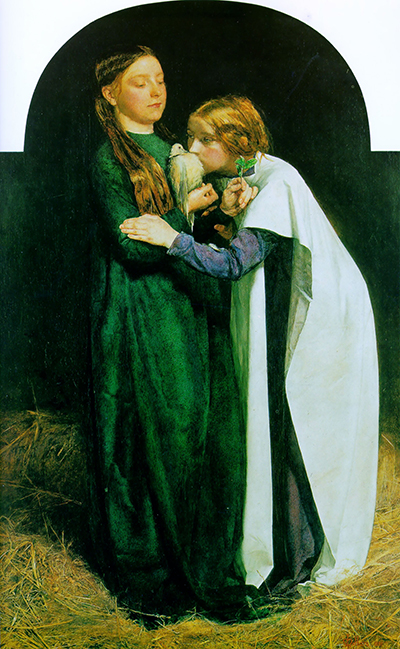
At the Paris exhibition of 1855, Gustave Planche dismissed the execution of The Return of the Dove to the Ark and The Order of Release. He found Ophelia moving and poetic even as he objected to its colour and the heroine’s indistinct outline. The feature that bothered him is easy to test with the picture in front of you. It is difficult to say exactly where the gown ends in places, and the uncertainty helps make the body seem to float. Planche wanted a more firmly bounded figure. His review catches the difference between admiring the effect of a picture and accepting the choices that produce it. [11]
Stories told through gestures and objects
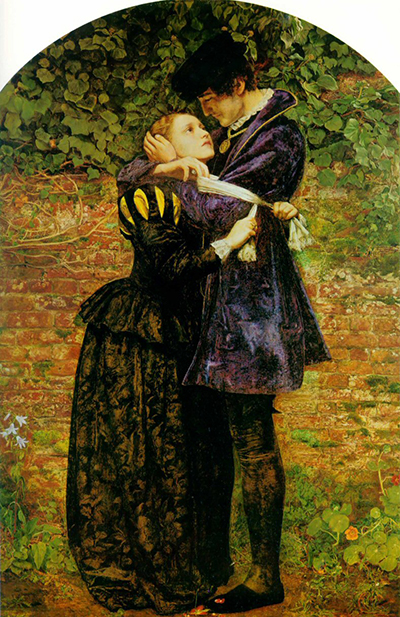
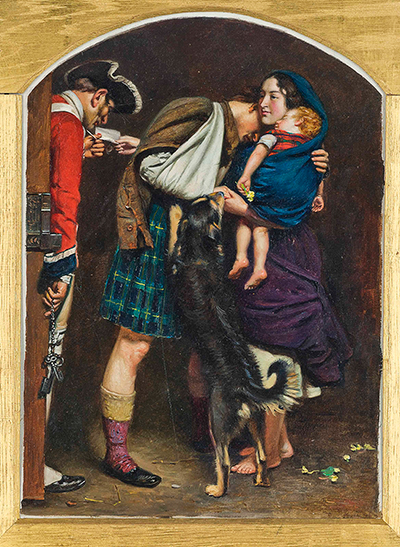
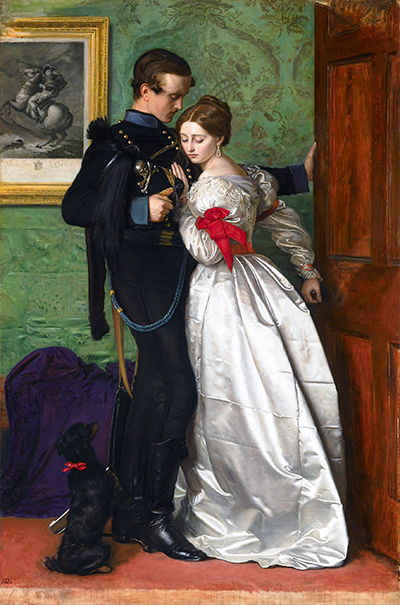
Millais often took public events into narrow spaces where one person’s decision could be read from a hand. In The Order of Release, a woman presents a paper to a gaoler while a wounded Jacobite leans against her. The small pale sheet commands attention even among the child, the dog and the folds of clothing. It has the authority to change what happens next, and she is the person who holds it. In A Huguenot, a woman tries to secure a white band around her lover’s arm, and he resists. One object opens a prison door. The other could permit passage through a hostile city at the cost of a public sign of allegiance. Look at the point where the hands meet in each painting and see how much of the story Millais leaves to that encounter. [5] [12]
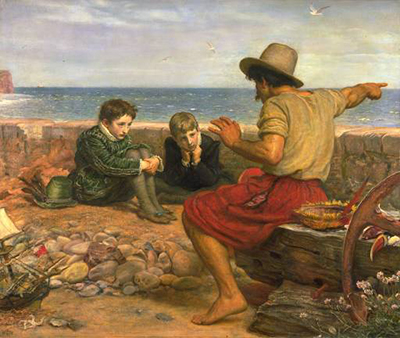
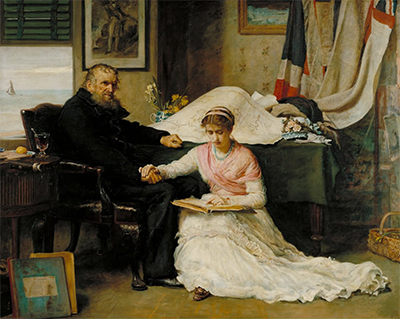
The North-West Passage (1874) also takes a public story indoors. The table separates a seated older man and a younger woman reading beside him from our own space, but the chart laid out on it is close enough to draw us in. The expedition belongs to the world beyond the room. We encounter its pull through the map, the act of reading and the different ways the two figures attend to what is being read. In The Boyhood of Raleigh, a sailor’s outstretched arm performs a similar task from a seat on the shore. Two boys listen while he points out to sea. The imagined childhood scene and the later picture of Arctic exploration both make an unseen place matter through the concentration of their listeners. [13] [14]
Twilight, attention and childhood
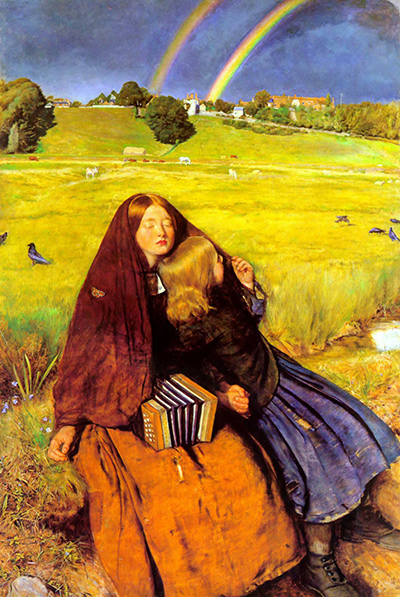
The Blind Girl and Autumn Leaves were both exhibited at the Royal Academy in 1856. [15] The two paintings place young people outdoors amid effects of light that will soon disappear. In The Blind Girl, the sighted companion turns towards the double rainbow. The older girl’s fingers meet the grass and she holds the younger girl’s hand. Graeme Douglas, writing from the perspective of disability and education, draws attention to the warmth, touch and sounds the scene suggests. The roadside setting, where the pair shelter together, has as much to do with their exchange as the brilliant sky behind them. [16] [17]
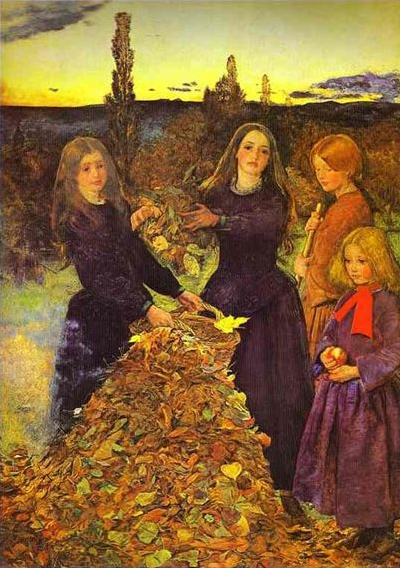
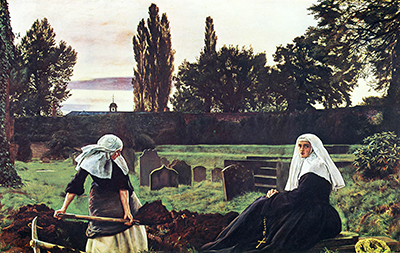
In Autumn Leaves, four girls gather at a pile of leaves in the failing light. Watching where the colour thins is a way of seeing the painting’s structure. Faces and hands are distinct enough to register separate attitudes, while dark clothing and the lower foreground merge as the sky clears towards the horizon. The smoke is easy to miss. It gives the work a duration, however brief, and makes it possible to imagine the smell and the gathering cold. The Vale of Rest uses a related light for a more disquieting task. One nun digs as another looks out of the picture. The open grave makes the fading of daylight feel more urgent. In the 2008 Bunkamura retrospective, curator Masao Miyazawa drew attention to The Vale of Rest as an example of Millais making the atmosphere and arrangement of the picture carry much of its meaning. [17] [18] [19]
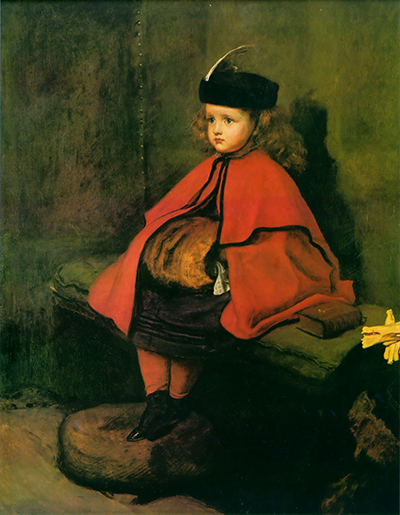
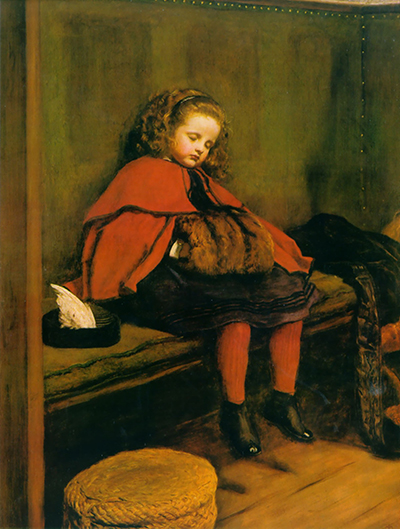
Scale and timing work differently in the church scenes My First Sermon and My Second Sermon, exhibited in successive years. The upright child with a steady gaze gives way to a body settling into sleep. Because the pew and the red clothing carry from one episode to the next, a shift of weight can do the work of a plot. The public first had a year to remember the attentive child before being shown the sequel. The Guildhall Art Gallery holds both canvases. [20] [21]
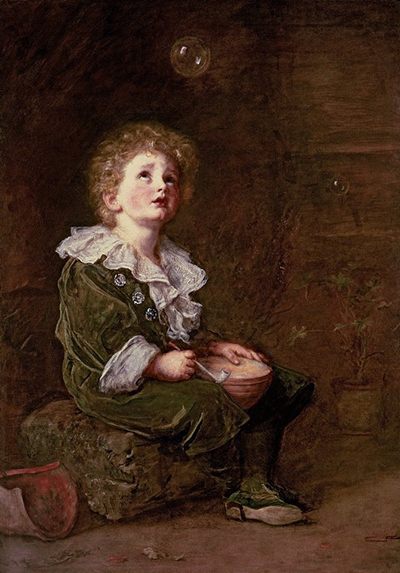
In Bubbles, originally titled A Child’s World, the distance from the boy’s face to the bubble is enough to hold an entire scene. His upward look keeps ours on an object so slight that the painting must give it weight through its position and the light on its rim. The sitter was Millais’s grandson, and the image also belongs to the tradition of the fancy picture, a genre in which an observed child could become the subject of a broadly recognisable scene. Here the pleasure depends on something that can vanish in an instant. William Ingram acquired the oil before it passed to Thomas Barratt of Pears. In the branded print the bubble acquired a commercial purpose, even though the boy’s pose, pipe and wondering expression could carry over intact. Surviving advertisements and the painting have separate histories. [22] [23] [24]
In Ducklings (1889), the light that picks out the child’s face and clothing also makes us search the darker foreground for the birds promised by the title. Tokyo’s National Museum of Western Art reads the girl’s untidy hair and worn shoes alongside the ducklings, and suggests a possible echo of Hans Christian Andersen’s The Ugly Duckling. The museum leaves the object in her hand unidentified. The little mysteries of the picture send attention back to the child’s circumstances, where Bubbles keeps returning the eye to the fragility of the object the boy is watching. [25]
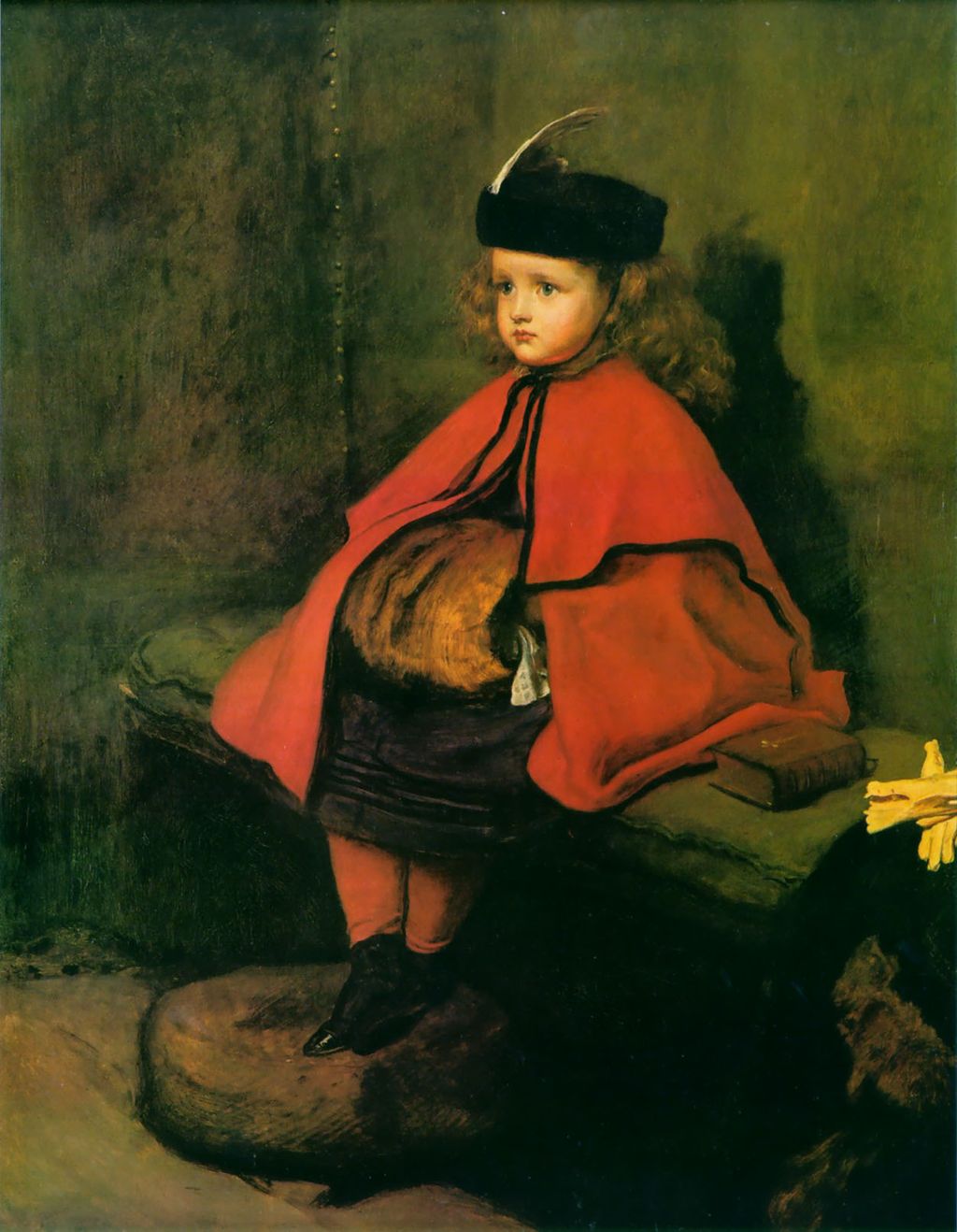
My First Sermon, oil on canvas, Guildhall Art Gallery, 701. Her fixed attention is a point of comparison with the sequel and with the children in other paintings. Image source. Public domain.
Portraiture, scale and the painted surface
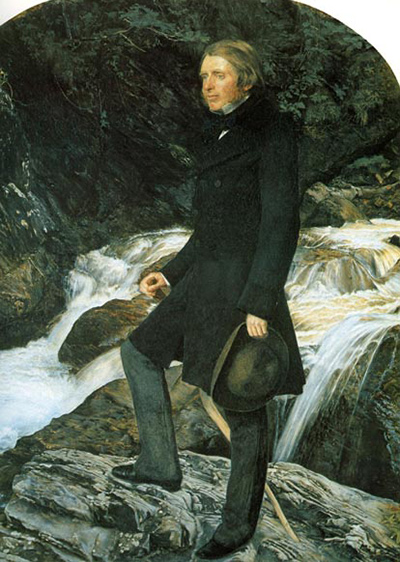
In the portrait of John Ruskin, the sitter stands on a rock ledge at Glenfinlas. Against the rush of the stream and the broken surfaces of the rocks, the upright figure and his dark coat act as points of stillness. The site and the sitter demanded separate sittings. The Ashmolean’s account describes how Millais worked on the setting in Scotland and painted Ruskin in London. A portrait could involve much the same act of assembly as Ophelia, although here the real person occupies a place to which he had a strong attachment. [26]
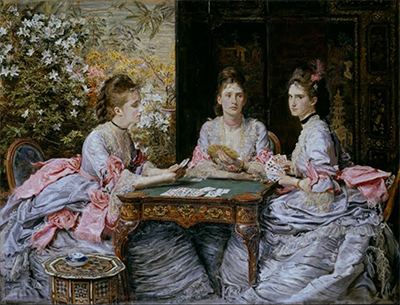
At just under 2.2 metres wide, Hearts are Trumps (1872) distributes an encounter among three sitters and a card table. The Armstrong sisters’ dresses share a colour scheme, while the women’s hands and eyes are free to direct attention differently. Mary’s outward look makes the open side of the table feel like a place someone might occupy. The kinship Tate identifies with Joshua Reynolds’s group portraiture lies partly in that combination of an imposing scale and a carefully arranged social moment. The game lets the sisters have something to do besides sit for their likenesses. [6]
Tate’s treatment of Hearts are Trumps supplies a reason to look carefully at the evidence of brushwork. Discoloured resin varnish had dulled differences in colour and made the space seem flatter. Conservators used paint samples and ultraviolet fluorescence to distinguish the layers before removing varnish, with special care around sensitive pigments. The newly legible brushwork and stronger separation of colours made the depth of the scene easier to see. In a painting of this scale, working broadly across a dress or a bank of flowers can give entirely adequate information at viewing distance. The effect changes as you come close enough to see where the stroke ends. [27]
Single sitters called for another kind of staging. The National Portrait Gallery’s 1879 portraits of William Ewart Gladstone and the painter Louise Jopling are similar in height. Gladstone’s dark clothing and quiet arrangement make details like his ring stand out. In Jopling’s portrait, the folds and accents of a fashionable outfit have a more conspicuous part in establishing the sitter’s presence. The National Portrait Gallery links the direct handling of the Jopling canvas to Millais’s familiarity with the sitter, a fellow professional, and compares the painting of her costume with work by Manet. That is a different point of reference from the Reynolds comparison for Hearts are Trumps, and it helps make clear how many models for a portrait Millais had at his disposal. [28] [29]
The Metropolitan Museum’s Portia (1886) makes that selective finish especially plain. The tightly described face and hair interrupt large passages of red across the robes. X-rays and visible traces of earlier brushwork show a figure in Greek dress under the finished image. Ellen Terry lent the costume she had worn as Portia, and the Met identifies Kate Dolan as the model. Lucy Oakley’s study reconstructs how the earlier design became a scene from The Merchant of Venice. Looking back to Mariana, there is again a gap between the first design and the finished Shakespearean subject. The change in Mariana is legible in a drawing, while the changes in Portia can be read in and beneath the painted surface. [10] [30] [31]
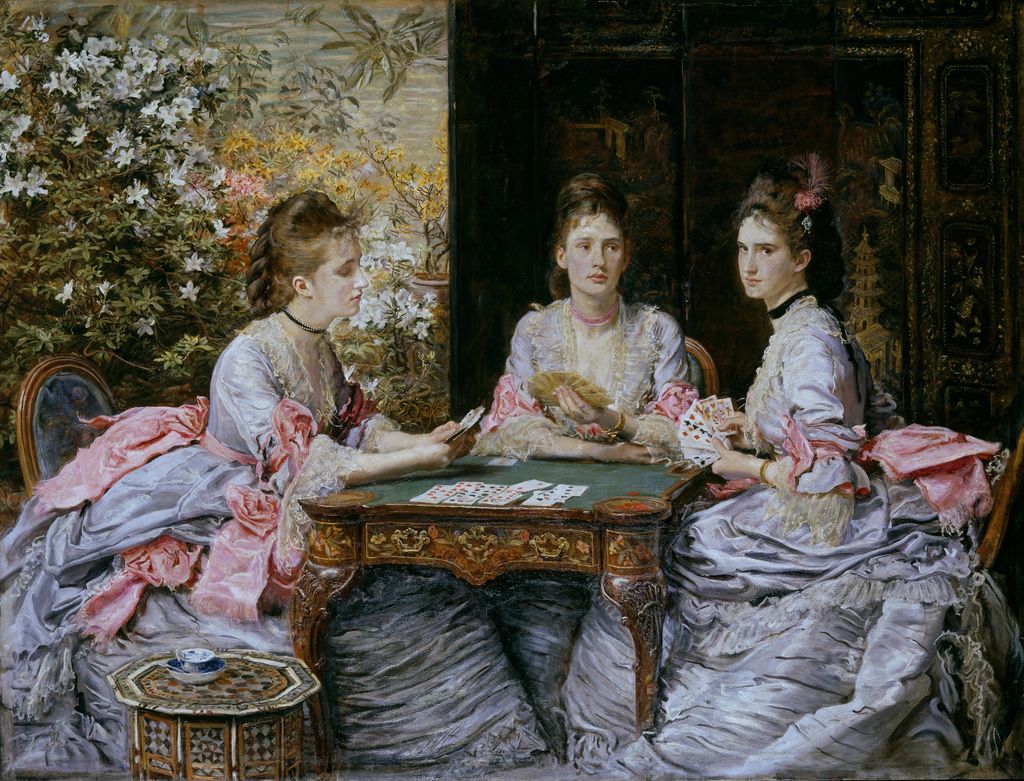
Hearts are Trumps, oil on canvas, Tate, N05770. Broad stretches of satin and a narrow table organise the three sitters. Image source. Public domain.
The Scottish landscapes
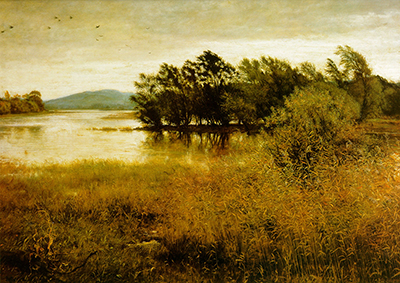
Chill October was painted in 1870 and shown at the Academy the following year. Millais worked outdoors by a backwater of the River Tay. For all the foreground grasses, the far bank and low sky have enough room to set a pace for the whole canvas. The line of trees tips with the wind and the water catches the grey overhead. The 1898 Royal Academy memorial catalogue includes a note by Millais about the site near Kinfauns, and the German critic O. von Schleinitz included the painting among works that, in his view, inaugurated Millais’s more independent manner. He also praised the technical accomplishment of Hearts are Trumps while complaining about its colour, a detail that takes on interest beside Tate’s later account of the effect of the discoloured varnish. [27] [32] A viewer working back from this picture can already find sustained observation of water and weather in the river of Ophelia, the stream beside Ruskin and the clearing sky of The Blind Girl. [2] [33] [32]
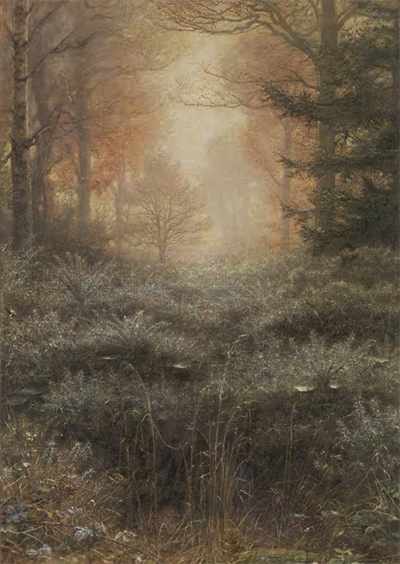
Dew-Drenched Furze brings the eye close to vegetation again. Painted on the Murthly estate in Perthshire around 1890, the picture lets light in through a clearing and sends it across a dense, textured mass of foliage. The eye has to find a way through bracken and gorse before it can travel into the painting. In Chill October, it is easier to take in the changing weather across a distance. In Dew-Drenched Furze, the effect depends on many small changes close together. There is even a literary echo. Tate connects the title loosely to Tennyson’s In Memoriam, a reminder that the poetry Millais drew on for his early figure pictures could still help name a sensation in the landscape. [7]
How exhibitions brought the paintings together
The Royal Academy’s memorial exhibition of 1898 shows how early the career was already being assessed across several genres. A century later, the retrospective that travelled from London to Amsterdam and Japan again invited viewers to see a much wider range than the handful of early works that most often represent Millais. Writing about that exhibition, Akira Ishizuka observed that the changes of the 1860s were substantial but did not proceed in one direction. Works that recall earlier habits appear among paintings with markedly different handling. The 2019 exhibition in Milan, which presented Ophelia among works by a wider circle of Pre-Raphaelites, offered another way to see the same artist: look for the shared interests in fidelity to nature and poetry that become especially visible in the early work. [19] [33] [34] [35] [36]
Try ending a first pass through the gallery with Dew-Drenched Furze and returning to the bank in Ophelia. What the young painter made of a bramble or a clump of grass matters in both works, even as the distance from which the scene feels coherent changes. For two indoor pictures, set the exchange of fruit in Isabella beside the hands at the card table in Hearts are Trumps. One group seems on the verge of disclosing a secret and the other catches three people allowing us into their circle. Millais finds both effects in the placement of hands, the direction of a look and the space a table leaves between us and the people on the other side.
John Everett Millais artwork directory
Browse paintings and drawings covered in these articles, including related works held in public collections. Reproductive engravings and editions are discussed on the Prints page.
Prints and illustrated editions
- The Baby-House, 1872. Etching by Millais.
- The Good Shepherd, 1864. Wood engraving designed by Millais, engraved and printed by the Dalziel Brothers.
- Mariana, 1857. Wood engraving designed by Millais and cut by the Dalziel Brothers for the Moxon Tennyson.
- The Proscribed Royalist, 1858. Mixed-method engraving by William Henry Simmons after Millais.
| Name | Date | Medium |
|---|---|---|
| Pizarro Seizing the Inca of Peru | 1846 | Painting |
| The Young Men of Benjamin Seizing Their Brides | 1847 | Painting |
| Isabella | 1848–49 | Painting |
| Christ in the House of His Parents (‘The Carpenter’s Shop’) | 1849–50 | Painting |
| Ferdinand Lured by Ariel | 1849–50 (monogram dated 1849) | Painting |
| Study for Christ in the House of His Parents, Tate N04623 | c. 1849 | Drawing |
| Study for Christ in the House of His Parents, Tate N04792 | c. 1849 | Drawing |
| Study for Mariana in the Moated Grange | 1850 | Drawing |
| A Huguenot, on St Bartholomew’s Day, Refusing to Shield Himself from Danger by Wearing the Roman Catholic Badge | 1851–52 (exhibited 1852) | Painting |
| Mariana | 1851 | Painting |
| Ophelia | 1851–52 | Painting |
| The Bridesmaid | 1851 | Painting |
| The Return of the Dove to the Ark | 1851 | Painting |
| The Order of Release 1746 | 1852–53 | Painting |
| The Proscribed Royalist, 1651 | 1852–53 (exhibited 1853) | Painting |
| Portrait of John Ruskin | 1853–54 | Painting |
| The Blind Girl | 1854–56 | Painting |
| Autumn Leaves | 1855–56 (Manchester labels 1856) | Painting |
| A Dream of the Past: Sir Isumbras at the Ford | 1856–57, later revised | Painting |
| The Vale of Rest | 1858–59 | Painting |
| Study for The Black Brunswicker, Tate A00812 | c. 1860 | Drawing |
| Study for The Black Brunswicker, Tate A00813 | c. 1860 | Drawing |
| Study for The Black Brunswicker, Tate A00814 | c. 1860 | Drawing |
| The Black Brunswicker | 1860 | Painting |
| The Ransom | 1860–62 | Painting |
| My First Sermon | 1863 | Painting |
| My Second Sermon | 1864 | Painting |
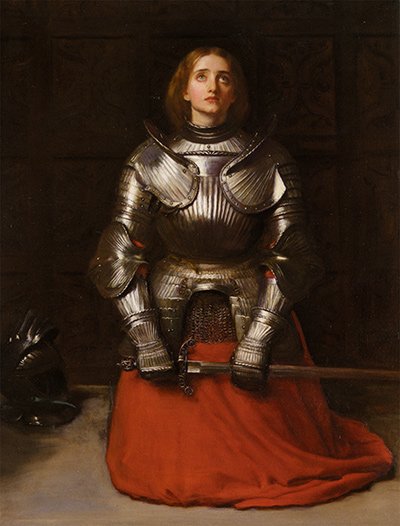
| Joan of Arc | 1865 | Painting |
| Chill October | 1870 (exhibited 1871) | Painting |
| The Boyhood of Raleigh | 1870 | Painting |
| The Knight Errant | 1870 | Painting |
| Hearts are Trumps | 1872 | Painting |
| The North-West Passage | 1874 | Painting |
| Louise Jane Jopling | 1879 | Painting |
| William Ewart Gladstone, NPG 3637 | 1879 | Painting |
| Bubbles | 1886 | Painting |
| Portia | 1886 | Painting |
| Dew-Drenched Furze | 1889–90 | Painting |
| Ducklings | 1889 | Painting |
| Portrait of Sarah Hammond | 1891 | Painting |
Discussion
Look again at the images and ideas explored in John Everett Millais Paintings. These editorial prompts invite your observations.
Reader Insights
Choose two paintings with a figure looking out of the canvas. How does each gaze change your position as a viewer?
Which comparison makes the difference between Millais’s early and late handling clearest? Look at a painted edge or one passage of fabric.
Join the Conversation
Share a detail, comparison or question about John Everett Millais Paintings below.
References
- Tate Britain, Ophelia, collection record. View source.
- Anne Helmreich, 1871: The Year of Modern Landscape, Royal Academy Summer Exhibition Chronicle. View source.
- Walker Art Gallery, Isabella, collection record. View source.
- Tate Britain, Christ in the House of His Parents, collection record. View source.
- Tate Britain, The Order of Release 1746, collection record. View source.
- Tate Britain, Hearts are Trumps, collection record. View source.
- Tate, Major Late Landscape by Millais, Dew-Drenched Furze, Donated to Tate. View source.
- Sarah Victoria Turner, 1849: The Arrival of the “PRB”, Royal Academy Summer Exhibition Chronicle. View source.
- Sarah Victoria Turner, 1850: Battles Old and New, Royal Academy Summer Exhibition Chronicle. View source.
- National Gallery, Reflections: Behind the Inspiration. Painting in Detail: Mariana. View source.
- Gustave Planche, Exposition des Beaux-Arts, Revue des Deux Mondes, 1855. View source. (in French).
- Rossetti Archive, A Huguenot, work record. View source.
- Tate Britain, The North-West Passage, collection record. View source.
- Tate, The Boyhood of Raleigh, collection image. View source.
- Royal Academy Summer Exhibition Chronicle, 1856: Critics at Odds. View source.
- Graeme Douglas, John Everett Millais’ The Blind Girl (1856), Midlands Art Papers. View source.
- Manchester Art Gallery, Autumn Leaves, collection record. View source.
- Tate Britain, The Vale of Rest, collection record. View source.
- Masao Miyazawa, John Everett Millais, Bunkamura exhibition introduction, 2008. View source. (in Japanese).
- Pamela Fletcher, 1859: Sequel Paintings, Royal Academy Summer Exhibition Chronicle. View source.
- City of London, Guildhall Art Gallery and Roman Amphitheatre. View source.
- Rossetti Archive, Bubbles, work record. View source.
- Paolo Giudici, Ophelia, Royal College of Art doctoral thesis. View source.
- History of Advertising Trust, Magazine Insert: Pears Soap. View source.
- National Museum of Western Art, Tokyo, あひるの子 (Ducklings), collection record. View source.
- Ashmolean Museum, A Portrait of John Ruskin. View source.
- Tate, John Everett Millais’s Hearts are Trumps 1872, conservation project. View source.
- National Portrait Gallery, William Ewart Gladstone, NPG 3637. View source.
- Carol Blackett-Ord, National Portrait Gallery, Louise Jane Jopling, extended record for NPG 6612. View source.
- Metropolitan Museum of Art, Portia, collection record. View source.
- Lucy Oakley, The Evolution of Sir John Everett Millais’s Portia, Metropolitan Museum Journal 16, pp. 181–193. View source.
- O. von Schleinitz, review of the Millais exhibition, Kunstchronik, 24 February 1898, pp. 258–259. View source. (in German).
- Royal Academy of Arts, Exhibition of Works by the Late Sir John Everett Millais, 1898, introduction and catalogue no. 108. View source.
- Akira Ishizuka, An Examination of Exhibitions and Publications Focusing on the Life and Art of John Everett Millais, pp. 13–14. View source. (in Japanese).
- Van Gogh Museum, Jaarverslag 2008, exhibitions. View source.
- Palazzo Reale Milano, Preraffaelliti: Amore e Desiderio, 2019 exhibition. View source.