 by Tom Gurney
Tom Gurney BSc (Hons) is an art history expert with over 20 years experience
Published on June 19, 2020 / Updated on November 25, 2026
Email: tomgurney1@gmail.com / Phone: +44 7429 011000
Ferdinand Lured by Ariel: Introduction
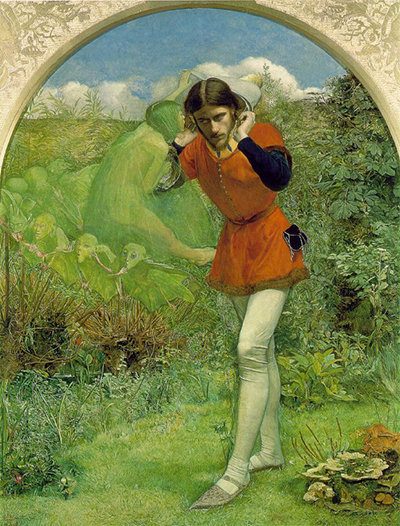
In John Everett Millais’s Ferdinand Lured by Ariel, a shipwrecked prince raises his hands to his ears as a green spirit lifts his hat. Ferdinand can hear a voice, yet his eyes give him no clue where it comes from. Millais lets us see the singer and the small winged creatures suspended around him. They are almost the colour of the grass and thickets, while Ferdinand’s orange-red tunic stands out across the clearing. Millais’s monogram and the date 1849 are at the lower left of the arched oil panel. The painting, dated 1849–50, measures 64.8 × 50.8 cm. [1] [2]
At a Glance
- Date1849–50 [1]
- MediumOil on panel, with an arched top [1]
- Dimensions64.8 × 50.8 cm [1]
- Ferdinand’s modelFrederic George Stephens [1][3][4]
- ExhibitedRoyal Academy, 1850 [5]
This work across John Everett Millais’s career
Isabella
1848–49Ferdinand Lured by Ariel (current article)
1849–50 (monogram dated 1849) [1]Ophelia
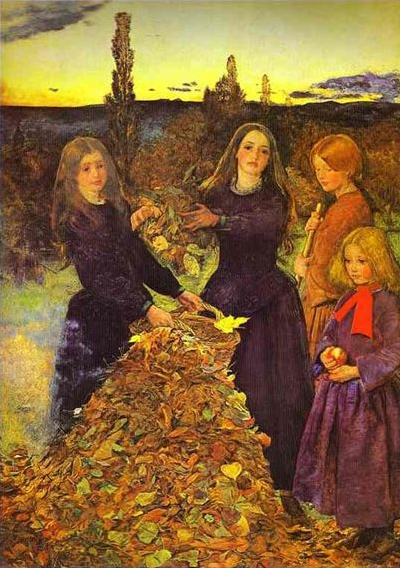
1851–52Autumn Leaves
1855–56Dew-Drenched Furze
1889–90Contents
- A prince who stands out and spirits who blend in
- The songs that lead Ferdinand into the clearing
- Painting outdoors at Shotover Park
- A real sitter, a costume plate and two studies
- Two very different Ferdinands at the 1850 Academy
- From Victorian exhibitions to the Met loan
A prince who stands out and spirits who blend in
Ferdinand fills most of the panel’s height. His head dips between his raised hands and his narrow white stockings cross below the broad flare of the tunic. The pointed shoe at the bottom appears to test the ground, and the bend at the waist carries that hesitant step into the upper body. A dark sleeve gives definition to the hand raised alongside his face. The costume holds the figure together in large blocks of colour even as the body twists in several directions. His gaze falls towards the grass, away from the company that crowds close to him.
Ariel’s movements are easiest to follow from the hat. The pale shape lifted behind Ferdinand’s head leads left to the spirit’s head and down along the curve of his body. A small, dark-edged, shell-like instrument nestles near their shoulders. Below it, Ariel’s arm stretches across the green of the clearing towards the side of the tunic. Farther left, small faces emerge in a row around the height of the prince’s hip. Their rounded eyes and pale flashes at the edges of their wings mark them out from the grass. One is easy to pass over as a patch of foliage until a face nearby gives the shape a scale. [1]
The arch leaves room for a short stretch of sky between the foliage and the rim. Most of the available space below it is packed with banks of leaves, tall stems, short grass and the crossing forms of the spirits. On the lower left, the fine rushes splinter the light into thin strokes, and shadows collect in the spiky roots. On the right, layers of foliage sit above a low cluster of shelf-like growths. The bright turf across the foreground makes Ferdinand’s feet easy to find and gives his step a clear direction. Looking close enough to see how the individual stems are painted also brings the quieter outlines of the spirits into focus.
The two figures share very little space between their heads. Yet the difference in the way they are painted makes the air at that point feel crowded for the viewer and empty for Ferdinand. His solid, closely fitted sleeve keeps its sharp outline against the surroundings. Ariel’s green profile and the bodies of his companions are absorbed, in places, into a whole range of greens that stretch through the glade. At the Grosvenor Gallery in 1886 the catalogue described their wings and shifting colours in terms of insects in motion. Its writer imagined them taking on the colours of neighbouring objects, an effect that the painting encourages as the light catches first a leaf, then a wing. [6]
The songs that lead Ferdinand into the clearing
In Act 1, scene 2 of The Tempest, the stage direction has Ariel enter invisible, playing and singing. Prospero has arranged the wreck and separated Ferdinand from his companions. Earlier, he has told Miranda that nobody was harmed. Ferdinand believes his father, Alonso, King of Naples, has drowned. Ariel knows what has become of the ship’s passengers, while the prince must make sense of a voice he can hear without seeing who sings. Millais preserves that difference between the spirit’s knowledge and Ferdinand’s bewilderment. [2]
Ariel’s first song calls its hearers to the yellow sands to dance and asks sprites to join the refrain. The directions scatter the sounds of barking dogs, and the song brings in the crow of a cock. Then Ferdinand asks whether the music comes from the air or the earth. He remembers grieving on a bank when the tune crept across the water and quietened both the waves and his distress. As he tells it, he went after the sound, then revises the thought and gives the music the power to draw him. It falls silent just long enough for him to notice, and starts up again. [2]
The second song begins ‘Full fathom five thy father lies’. It gives Alonso an imagined burial beneath the sea, changing his bones into coral and his eyes into pearls. A bell-like refrain marks the tolling of his knell. This time Ferdinand hears the sound above him. Soon afterwards he sees Miranda and takes her for a goddess associated with the music. The picture stops short of their meeting, while the prince’s bent head, unsettled stance and lifted hands can hold the uncertainty that the play distributes across both songs. [2]
Shakespeare’s cues give a painter scope to invent. The sprites invited to join the first refrain and the sea nymphs mentioned in the second supply suggestions, while the winged company in the clearing, the shell-like instrument and the shifting of the hat are Millais’s own visible arrangements. The hat is especially effective because its movement helps explain why Ferdinand has both hands up. One seems ready to steady it as the other cups his ear. Millais’s solution relies on where he places bodies and how clearly he lets us see them. Music can approach in a play before the hearer knows where to look. In the painting, we can follow the turn of the prince’s head and discover the source of the sound beside him. [1] [2] [6]
Painting outdoors at Shotover Park
Millais spent much of the summer of 1849 painting the background at Shotover Park near Oxford. The work was an early and sustained application of the Pre-Raphaelite practice of painting nature outdoors. In an undated letter to William Holman Hunt, associated with that summer’s work, Millais called his own landscape ‘ridiculously elaborate’. He said a single weed could take him a month if he gave it as much attention as it deserved. He aimed to give each blade of grass and leaf its own definition, and still saw a difference between his effort and the minuteness of nature. [1] [7]
That attention changes the kind of setting a story can have. Dividing the foreground into dozens of small overlapping shapes brings a piece of Oxfordshire close enough to study. The play’s yellow sands and the waters Ferdinand speaks of are somewhere beyond the clearing Millais gives us. The shaded tangle at the edge of a summer meadow becomes part of the fiction. It makes the viewer search through irregularities for a spirit the way one might have to search for an animal in thick grass. Millais can use that experience of looking closely without fixing a geographical location for Shakespeare’s island.
Stephens’s later account describes the use of a white ground for clear, bright colour. Outdoor work was one part of the process, and the head, costume and sprites each required decisions of a different kind. In the Pre-Raphaelite Brotherhood’s journal, William Michael Rossetti recorded Millais working on the beard of Ferdinand’s head in May 1849 and identified Stephens as the sitter. By 30 December he reported that Millais considered the work almost finished, with more to do on the background. John Guille Millais’s memoir also cites a December 1850 letter to James Wyatt as evidence that the artist went back to work on the background after the sale. The dates show how long the setting could remain open to adjustment. [3] [4]
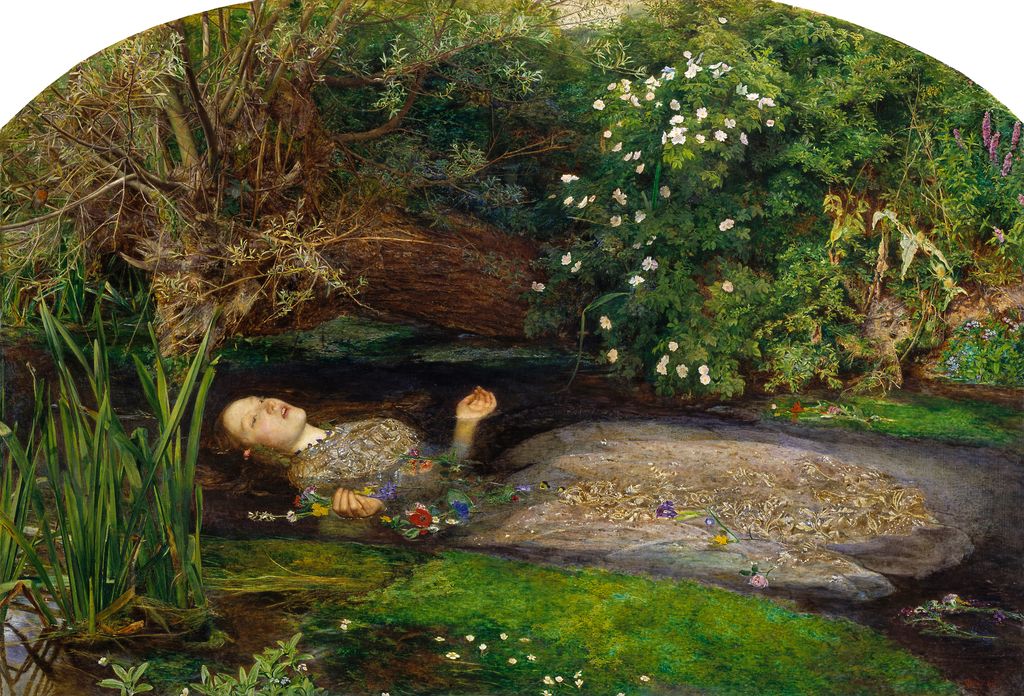
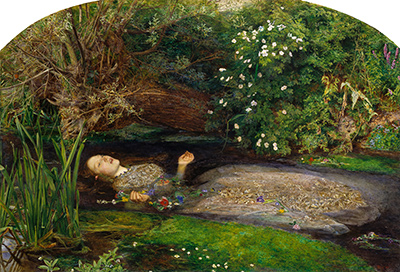
Ophelia, oil on canvas, Tate, N01506. For Ophelia, Millais again worked outdoors on the setting before completing the figure.
A real sitter, a costume plate and two studies
Frederic George Stephens recalled a careful drawing on paper followed by a less finished rendering of the head on the panel. In a subsequent long sitting in Gower Street he held the pose with the aid of a stick while Millais painted the face. The memoir preserves his testimony alongside evidence of the artist’s work at other times. The long sitting helps explain the concentration on one difficult area of the picture, where a tilted head and the strain of keeping still had to become the expression of someone listening intently. The journal’s May entry fixes work on the head before the summer at Shotover. Stephens’s recollections, written down much later, supply the details of the drawing and the sittings without fixing their exact dates. [3] [4]
A separate graphite study survives at the Yale Center for British Art. On a cream wove sheet measuring 17.5 × 13 cm, Millais worked out the way the head turns and how light falls across the features. The oil study at Sudley House, in Liverpool, gives a different view of the preparation. It establishes how Ariel and the accompanying spirits occupy the air near Ferdinand, and how the whole group sits in a landscape. National Museums Liverpool describes its handling as light and fluid beside the finished painting’s minute description. Together the two objects show Millais testing the relation of the figures to the glade on a small scale and giving the shape of a single, living face its own concentrated study. [8] [9]
Ferdinand’s costume and pose drew on Camille Bonnard’s Costumes historiques, a collection of historical fashion plates. The fitted tunic and pale hose bring a recognisable style of dress to a place whose time and geography remain loose. Naoko Asano has discussed four tracings of medieval figures after Bonnard in the Royal Academy collection. She reports Malcolm Warner’s attribution of the tracings to the painter’s father and raises the possibility that he helped gather costume material. The Grosvenor Gallery catalogue also reported that Millais used metal to represent the cloth of gold at Ferdinand’s neck, an account by a writer who knew the artist of a material used to catch the light at the throat. [1] [6] [10]
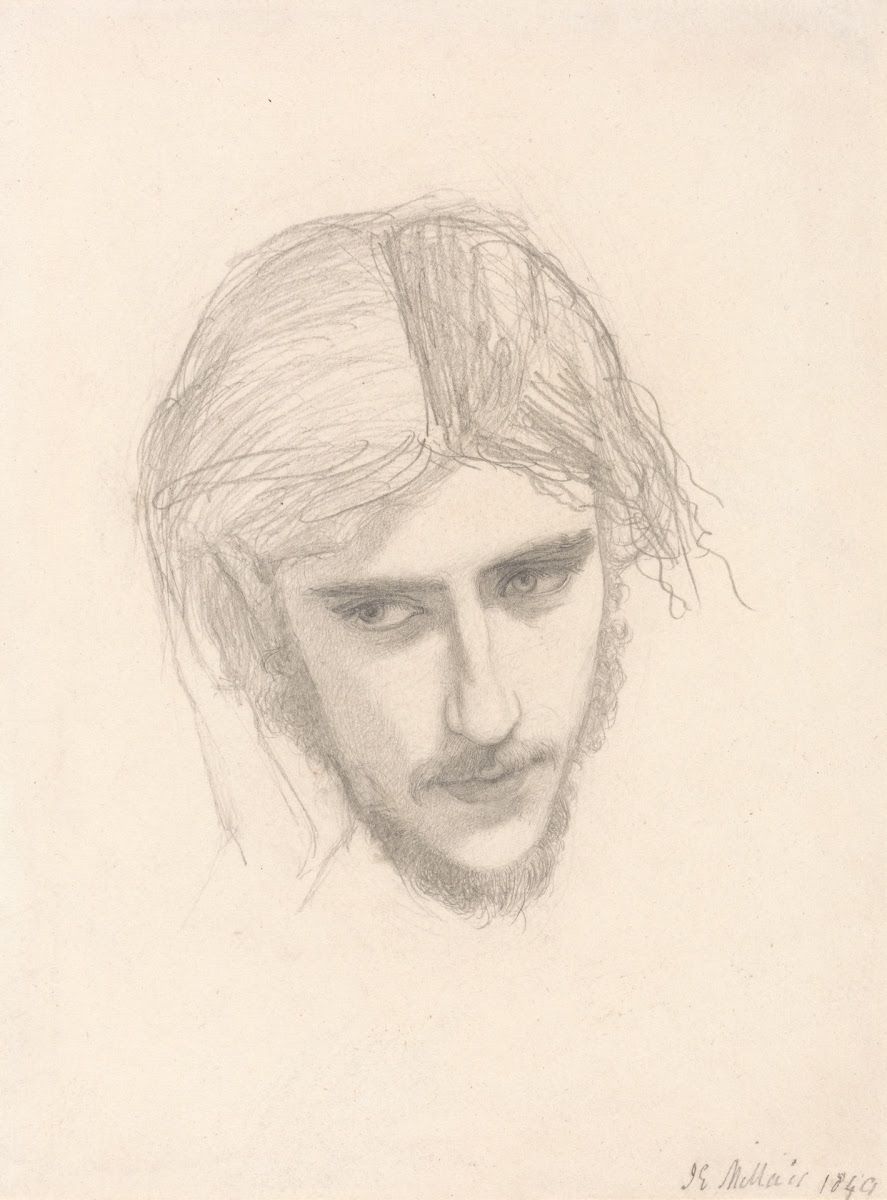
John Everett Millais, Study for the Head of Ferdinand, 1849. Graphite. Yale Center for British Art, B1980.25.2. Millais isolates the turn of the head and the direction of the eyes in this graphite study. Image source. CC0 / Public domain.
Two very different Ferdinands at the 1850 Academy
Millais exhibited the panel at the Royal Academy in 1850, as number 504, with a quotation beginning with Ferdinand’s question about the music. His other entries included Christ in the House of His Parents. The family memoir records that the Shakespeare painting was hung low in a corner and that the dealer who had commissioned it for £100 refused it. The Grosvenor Gallery catalogue also gives the commission and refusal. Richard Ellison bought the panel in 1850 for £150, an early instance of a collector responding to a picture whose appearance divided the critics. [1] [6] [4] [5]
The Athenaeum of 1 June held two opinions about it at once. It thought the Shakespeare picture better painted than the Holy Family, and judged its conception even less sensible. The review called it a scene built on a stage manager’s contrivances, and thought the effect failed. In July, Blackwood’s Edinburgh Magazine mocked Ariel as a ‘pea-green monster’ and remarked on the sprites’ turquoise eyes. Its review gives a particularly telling comparison. Frank Stone had chosen the same scene of The Tempest, showing Miranda’s first sight of Ferdinand, and his painting was also at the Academy that year. The critic much preferred Stone’s prince and still found his attitude a little too theatrical. The complaint had as much to do with the kind of prince and spirits a painter should imagine as with the devices used to evoke a performance. Stone had chosen the later moment when two people first see each other, a situation a viewer can read from their expressions and the direction of their eyes. Millais asked the same exhibition audience to make sense of one figure’s response to a presence he can hear alone. The Athenaeum and Blackwood’s each fastened on aspects of that demanding convention. [2] [11] [12]
From Victorian exhibitions to the Met loan
The 1897 Guildhall exhibition catalogue lists H. F. Makins as lender and describes the leaves and herbage shining after rain. The same bright green that troubled the early critics had become a quality a catalogue could dwell on. When Robert Ross sought the panel for the Carfax Gallery in 1911, he made the case that it could do something few other pictures could in a comparison of British and French art. Later exhibitions brought that distinctive mixture of observation and invention into different company. In 1998–99 it featured in a Victorian fairy painting exhibition at the Frick. In 2003, Shakespeare in Art showed it in Ferrara and London. The organisers in Ferrara singled out the precision of Millais’s handling and the force of his colours as the very qualities that gave his fantastical subject a physical presence. Their exhibition placed the work in a section on Victorian responses to Shakespeare, alongside treatments of his supernatural subjects by artists including Robert Huskisson and Joseph Noël Paton. Where those paintings often brought the fairy world to life by moonlight or firelight, the sky and ordinary daylight in Millais’s clearing make the spirits share the visible world of Ferdinand. [1] [13] [14]
Government records trace the painting from Ellison through James Wyatt Jr and Thomas Woolner, who sold it at Christie’s in 1875, and records Allen buying it there for £315. Allen was named as lender at the Grosvenor Gallery in 1886, and Makins lent it to the Guildhall in 1897. In the late Victorian catalogues, the panel could be both a picture in a named private collection and a work available for public viewing on a particular occasion. [6] [13] [15]
The 2019 UK export deferral set a matching price of £9.5 million. A private individual offered that sum and undertook to make it publicly accessible in a UK museum for at least 100 days a year over ten years. The owner declined the offer, and the permanent export licence was refused. A subsequent three-year temporary export licence was issued for exhibition at New York’s Metropolitan Museum of Art. [15] [16]
In August 2022 the Met described the panel as a loan from a private collection and announced that it would be shown alongside Millais’s The Escape of a Heretic, 1559, on loan from the Museo de Arte de Ponce. The UK reviewing committee’s report gave September 2023 as the scheduled date of return to Britain. The two records establish the terms of the loan and the Met’s announced pairing. The painting’s current location is unconfirmed. [16] [17]
John Everett Millais artwork directory
Browse paintings and drawings covered in these articles, including related works held in public collections. Reproductive engravings and editions are discussed on the Prints page.
Prints and illustrated editions
- The Baby-House, 1872. Etching by Millais.
- The Good Shepherd, 1864. Wood engraving designed by Millais, engraved and printed by the Dalziel Brothers.
- Mariana, 1857. Wood engraving designed by Millais and cut by the Dalziel Brothers for the Moxon Tennyson.
- The Proscribed Royalist, 1858. Mixed-method engraving by William Henry Simmons after Millais.
| Name | Date | Medium |
|---|---|---|
| Pizarro Seizing the Inca of Peru | 1846 | Painting |
| The Young Men of Benjamin Seizing Their Brides | 1847 | Painting |
| Isabella | 1848–49 | Painting |
| Christ in the House of His Parents (‘The Carpenter’s Shop’) | 1849–50 | Painting |
| Ferdinand Lured by Ariel | 1849–50 (monogram dated 1849) | Painting |
| Study for Christ in the House of His Parents, Tate N04623 | c. 1849 | Drawing |
| Study for Christ in the House of His Parents, Tate N04792 | c. 1849 | Drawing |
| Study for Mariana in the Moated Grange | 1850 | Drawing |
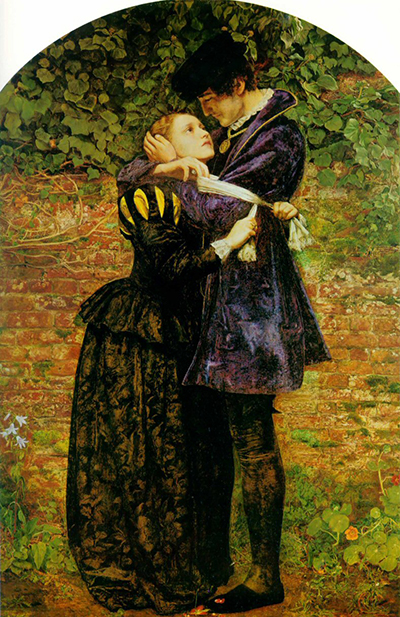
| A Huguenot, on St Bartholomew’s Day, Refusing to Shield Himself from Danger by Wearing the Roman Catholic Badge | 1851–52 (exhibited 1852) | Painting |
| Mariana | 1851 | Painting |
| Ophelia | 1851–52 | Painting |
| The Bridesmaid | 1851 | Painting |
| The Return of the Dove to the Ark | 1851 | Painting |
| The Order of Release 1746 | 1852–53 | Painting |
| The Proscribed Royalist, 1651 | 1852–53 (exhibited 1853) | Painting |
| Portrait of John Ruskin | 1853–54 | Painting |
| The Blind Girl | 1854–56 | Painting |
| Autumn Leaves | 1855–56 (Manchester labels 1856) | Painting |
| A Dream of the Past: Sir Isumbras at the Ford | 1856–57, later revised | Painting |
| The Vale of Rest | 1858–59 | Painting |
| Study for The Black Brunswicker, Tate A00812 | c. 1860 | Drawing |
| Study for The Black Brunswicker, Tate A00813 | c. 1860 | Drawing |
| Study for The Black Brunswicker, Tate A00814 | c. 1860 | Drawing |
| The Black Brunswicker | 1860 | Painting |
| The Ransom | 1860–62 | Painting |
| My First Sermon | 1863 | Painting |
| My Second Sermon | 1864 | Painting |
| Joan of Arc | 1865 | Painting |
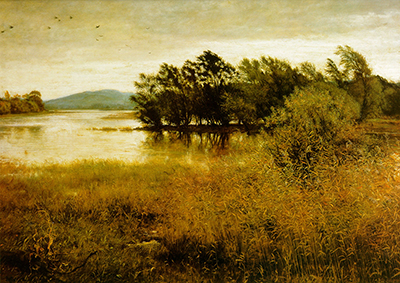
| Chill October | 1870 (exhibited 1871) | Painting |
| The Boyhood of Raleigh | 1870 | Painting |
| The Knight Errant | 1870 | Painting |
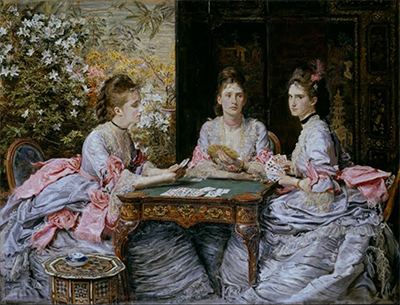
| Hearts are Trumps | 1872 | Painting |
| The North-West Passage | 1874 | Painting |
| Louise Jane Jopling | 1879 | Painting |
| William Ewart Gladstone, NPG 3637 | 1879 | Painting |
| Bubbles | 1886 | Painting |
| Portia | 1886 | Painting |
| Dew-Drenched Furze | 1889–90 | Painting |
| Ducklings | 1889 | Painting |
| Portrait of Sarah Hammond | 1891 | Painting |
Discussion
Look again at the images and ideas explored in Ferdinand Lured by Ariel. These editorial prompts invite your observations.
Reader Insights
How does the painted foliage help conceal Ariel and the other spirits?
What changes in Ferdinand’s expression or posture once you recognise who is making the sound?
Join the Conversation
Share a detail, comparison or question about Ferdinand Lured by Ariel below.
References
- Arts Council England, reviewing committee expert statement, object entry, exhibition history and Waverley criteria for Ferdinand Lured by Ariel, 2019. View source.
- William Shakespeare, The Tempest, Folger Shakespeare Library, Act 1, scene 2, especially through-line numbers 0099–0110 and 0523–0577. View source.
- William Michael Rossetti, Pre-Raphaelite Brotherhood journal, entries for 15 May and 30 December 1849, published in Præraphaelite Diaries and Letters (1900). View source.
- John Guille Millais, The Life and Letters of Sir John Everett Millais, vol. I (1899), pp. 82–87, dealer and exhibition account, December 1850 Wyatt letter and Frederic George Stephens’s recollections. View source.
- Algernon Graves, The Royal Academy of Arts, vol. V, p. 244, Royal Academy exhibition of 1850, entries 429, 504 and 518. View source.
- Grosvenor Gallery, Exhibition of the Works of Sir John E. Millais, Bt., R.A., London, 1886, cat. no. 78, pp. 47–48. View source.
- Christiana Payne, “Constable, Ruskin and the Pre-Raphaelites”, p. 7 and note xxiii, tracing Millais’s undated letter to Hunt to Leslie Parris, ed., The Pre-Raphaelites (Tate Gallery, 1984), p. 74. View source.
- Yale Center for British Art, Study for the Head of Ferdinand in “Ferdinand Lured by Ariel”, B1980.25.2, collection record and reproduction via Google Arts & Culture. View source.
- National Museums Liverpool, Ferdinand Lured by Ariel, Sudley House, WAG 273, collection entry and reproduction. View source.
- Naoko Asano, “More than models and muses: The women of John Everett Millais’ domestic circle and their contributions”, Journal of the National Museum of Western Art, no. 25 (2021), p. 21, note 10. View source.
- “Royal Academy,” The Athenaeum, no. 1179, 1 June 1850, p. 591. View source.
- “The Pictures of the Season,” Blackwood’s Edinburgh Magazine, vol. 68, no. 417, July 1850, p. 82. View source.
- A. G. Temple, Catalogue of the Loan Collection of Pictures by Painters of the British School, Guildhall, 1897, p. 71, cat. no. 131. View source.
- Palazzo dei Diamanti, Shakespeare nell’arte, Ferrara, 16 February to 15 June 2003, section VII on Shakespeare and Victorian art. View source. (in Italian).
- Department for Digital, Culture, Media & Sport, “Arts Minister stops export of Pre-Raphaelite work”, 16 August 2019, provenance and initial temporary export bar. View source.
- Reviewing Committee on the Export of Works of Art and Objects of Cultural Interest, annual report for 2018–19 and 2019–20, published July 2021, case 8, pp. 79–81. View source.
- Metropolitan Museum of Art and Museo de Arte de Ponce, announcement of the display of five Victorian loans, 31 August 2022, Gallery 808 and the Millais pairing. View source.