 by Tom Gurney
Tom Gurney BSc (Hons) is an art history expert with over 20 years experience
Published on June 19, 2020 / Updated on November 25, 2026
Email: tomgurney1@gmail.com / Phone: +44 7429 011000
A Dream of the Past: Sir Isumbras at the Ford: Introduction
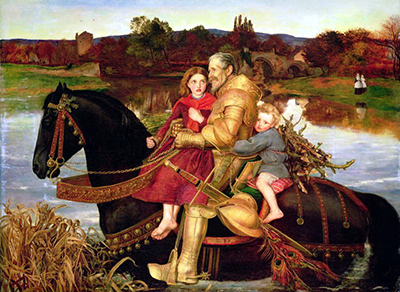
Two children ride a black horse through a river at dusk. Between them sits a grey-bearded knight in golden armour. His helmet hangs at his side, leaving the face exposed, and his arm keeps the girl in front of him steady. The boy behind him carries a bundle of sticks. John Everett Millais exhibited this large oil painting at the Royal Academy in 1857. The canvas now belongs to the Lady Lever Art Gallery in Port Sunlight. Millais returned to it several times, reshaping the horse and changing its equipment long after the first exhibition. [1] [2] [3]
At a Glance
- Date1856–57, exhibited in 1857 and later revised [1][2][3]
- MediumOil on canvas [1]
- CollectionLady Lever Art Gallery, LL3625 [1]
- SubjectAn ageing knight carries two woodcutters’ children across a ford [1][2]
This work across John Everett Millais’s career
Isabella
1848–49Ophelia
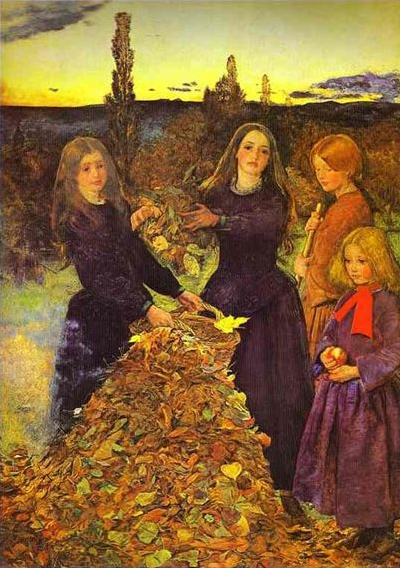
1851–52Autumn Leaves
1855–56A Dream of the Past: Sir Isumbras at the Ford (current article)
1856–57, later revised [1]Dew-Drenched Furze
1889–90Contents
- Three figures on one horse
- The romance and Tom Taylor’s verse
- From Perthshire to the exhibition wall
- A knight becomes a caricature
- The large canvas and its relatives
- Annotated details
Three figures on one horse
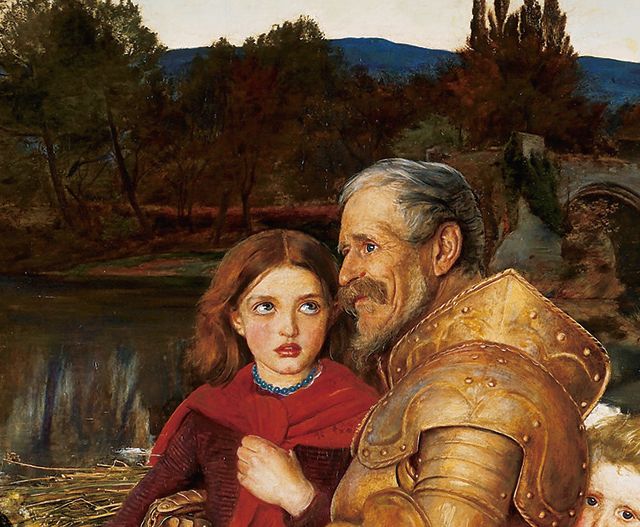
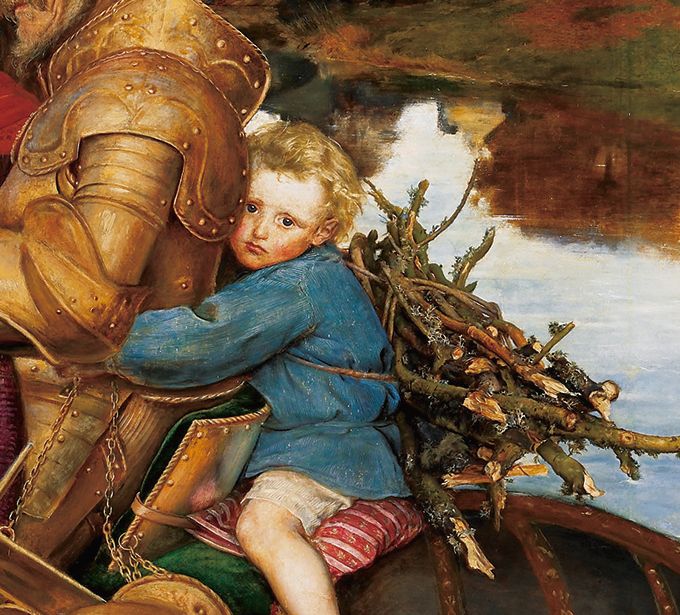
The knight’s head rises above the trees, where the last of the light draws out the shape of his hair and beard. His gaze goes ahead across the river. The girl turns her face up towards him, her hand among the strands of the horse’s mane. Behind them, the boy leans in close. The three heads describe a shallow arc, interrupted by the irregular ends of the wood the boy has gathered. Each rider has something different to attend to, although all depend on the same animal finding its footing. [1] [2]
The lowered viewpoint gives the horse much of its grandeur. Its body fills the foreground, and the far shore seems a long way below the riders’ faces. A broad band of golden armour sits between the pale faces above and the dark flank below. The saddlecloth introduces a brighter patch of colour against the animal’s coat. The clothes of the children and the sticks at the boy’s back belong to a world of ordinary work. The metal fittings and the knight’s armour come from a world of wealth and warfare. Millais presses the two together so closely that the armour is also something a child can hold on to. [1] [2] [4]
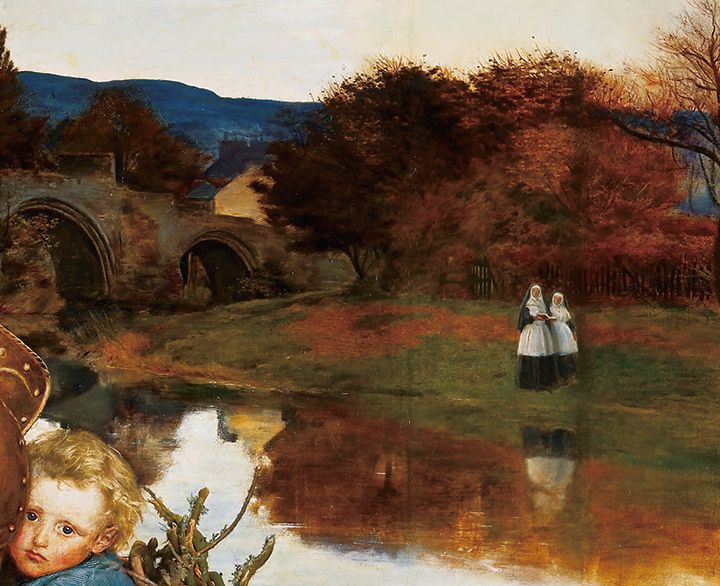
Across the water there are two small figures that the Royal Academy’s 1898 catalogue identified as nuns. One appears to hold a book, according to a later exhibition description. Their scale makes the crossing feel longer and gives the riders witnesses who can watch from dry land. The stone arch and buildings are harder to make out than the reflections in the foreground. Above them, a narrow band of warm sky is still visible beyond the trees. The fading light makes the effort to get the children over the river feel timely. It also offers a quieter parallel with the age of the knight, a reading the Grosvenor Gallery catalogue made explicit in 1886. [1] [2] [5] [6]
The romance and Tom Taylor’s verse
The name Sir Isumbras comes from an English verse romance dated by the University of York’s database to before 1320. In it, a prosperous knight forgets that he owes his good fortune to God. He loses his wealth, is separated from his wife and sons, and spends years in poverty before his family is restored to him. There is a river crossing in the poem. It is the moment at which wild animals carry away two of his sons. The Russian literary scholar Vadim Semyonov places those losses alongside the eventual return of all three sons as mounted knights, part of a wider pattern of episodes that answer one another. Millais chose an invented scene in which the knight carries two woodcutters’ children through the water to safety. [7] [8] [9]
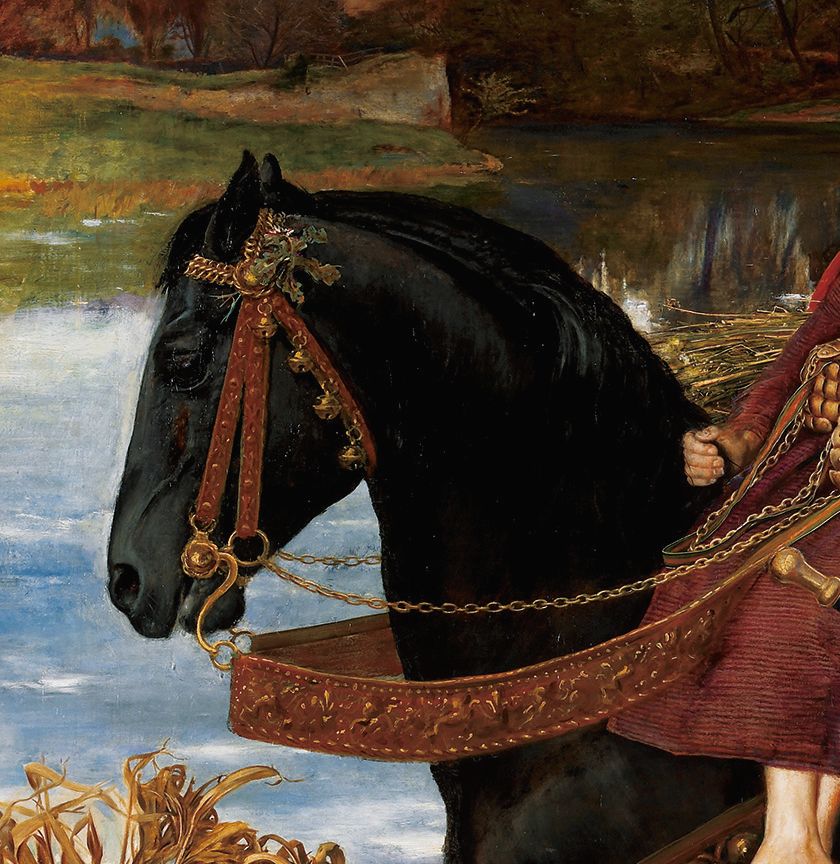
Visitors to the Academy had some help imagining the missing episode. The exhibition catalogue presented verses as if they came from the old romance. They were written for the occasion by the critic and playwright Tom Taylor. The lines make much of the horse’s wide back, unusual length and indifference to the river. Taylor even gives it two names, one used by the knight and another by the household and stable. That attention to what people call the horse helps the text sound like part of a much longer story. It also gives the big animal a reason to look extraordinary before the spectator has decided whether to believe in it. [2] [4] [9]
The historical romance continued to have a life of its own during the Victorian revival of medieval literature. In 1897 the Kelmscott Press published Syr Ysambrace, edited by F. S. Ellis after an edition based on the Lincoln Cathedral manuscript and illustrated by Edward Burne-Jones. Its use of manuscript evidence gives a sense of the different projects encompassed by that revival. The Kelmscott book brought an old text into print with new decoration. Millais and Taylor supplied an episode and a voice that the original story never had. [7] [10]
From Perthshire to the exhibition wall
Effie Millais remembered that her husband painted the old bridge and the Ochil Hills from beneath the newer bridge at Bridge of Earn in late October and early November 1856. The family account connects the tower he added with Elcho Castle. The scene therefore draws together buildings and terrain from separate places. Effie also recalled river plants standing in a tub in the studio so that he could paint them. Their firm, close silhouettes offer a point of comparison with the softer edges of the distant shore. [1] [3]
The horse proved harder to settle. According to Effie, Millais began with an animal he thought too small and replaced it with one that went to the other extreme. She remembered bringing food to the painter as he worked outside in winter, where the live model kept moving and the canvas had to be secured against the wind. Christie’s account connects the enlargement with a suggestion from the dealer Ernest Gambart. The family account puts the decision in Millais’s own terms. Both accounts help explain how a picture built from close observation could produce a horse that some visitors found almost impossible to believe. [3] [11]
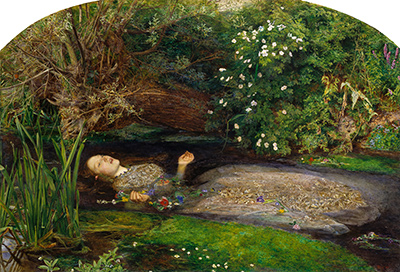
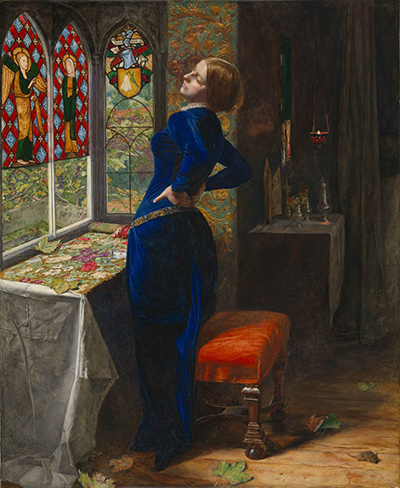
On 2 May 1857, The Leader called the picture the most striking work in its room and credited the force of the painting. Its reviewer also wondered if the horse belonged in a toy stable and if the knight might be made of paper. John Ruskin set the picture against Ophelia and Mariana, calling the change in Millais’s manner a “Catastrophe”. He thought the brightly coloured figures and the blue hills were lit as if they belonged to different hours. He also questioned the relative brightness of the water and sky and the isolated reflection of the crimson saddlecloth in the armour. For Ruskin these were failures of consistency, especially conspicuous beside details he admired, such as the plume and the cloth itself. [4] [12]
Yet Ruskin could see an affecting subject in a man using the strength acquired in warfare to protect children. He went further and imagined the knight as an angel of death carrying them across the river. George Meredith, writing in the Westminster Review that July, set Ruskin’s allegory aside and found the picture’s poetry in the head of the old man. The illustrator Walter Crane, recalling his childhood visit about fifty years later, remembered the work for its originality, force and convincing sense of romance. The horse, the light and the knight’s head mattered differently to each of these viewers. The reviews also concern a painted surface that was about to change. [4] [9] [13]
A knight becomes a caricature
Frederick Sandys’s A Nightmare, published on 4 May 1857, turned Millais into the knight and put him astride a braying donkey marked with Ruskin’s initials. Dante Gabriel Rossetti and William Holman Hunt replaced the children. In the print, the bundle of wood becomes painters’ brushes. On the far bank Sandys substituted Michelangelo, Titian and Raphael for the background figures. The joke enlarges a dispute over one picture into a quarrel about the Pre-Raphaelite Brotherhood’s relationship to earlier painting. The long mount and its crowded riders were distinctive enough that their outlines could carry the joke before anyone read the inscriptions. [6] [9] [14]
A German example shows the composition circulating in another form. In Theodor Fontane’s Der Stechlin, published in book form in 1899, a professor offers to lend Woldemar a print after Sir Isumbras. The professor has just untangled a confusion between the English Millais and the French painter Jean-François Millet. He admires Sir Isumbras and regrets that its maker did not persist with Pre-Raphaelitism. In London in 1857 the canvas had seemed to Ruskin a departure from the movement. In Fontane’s Berlin the picture itself represents something the artist left behind. [4] [15]
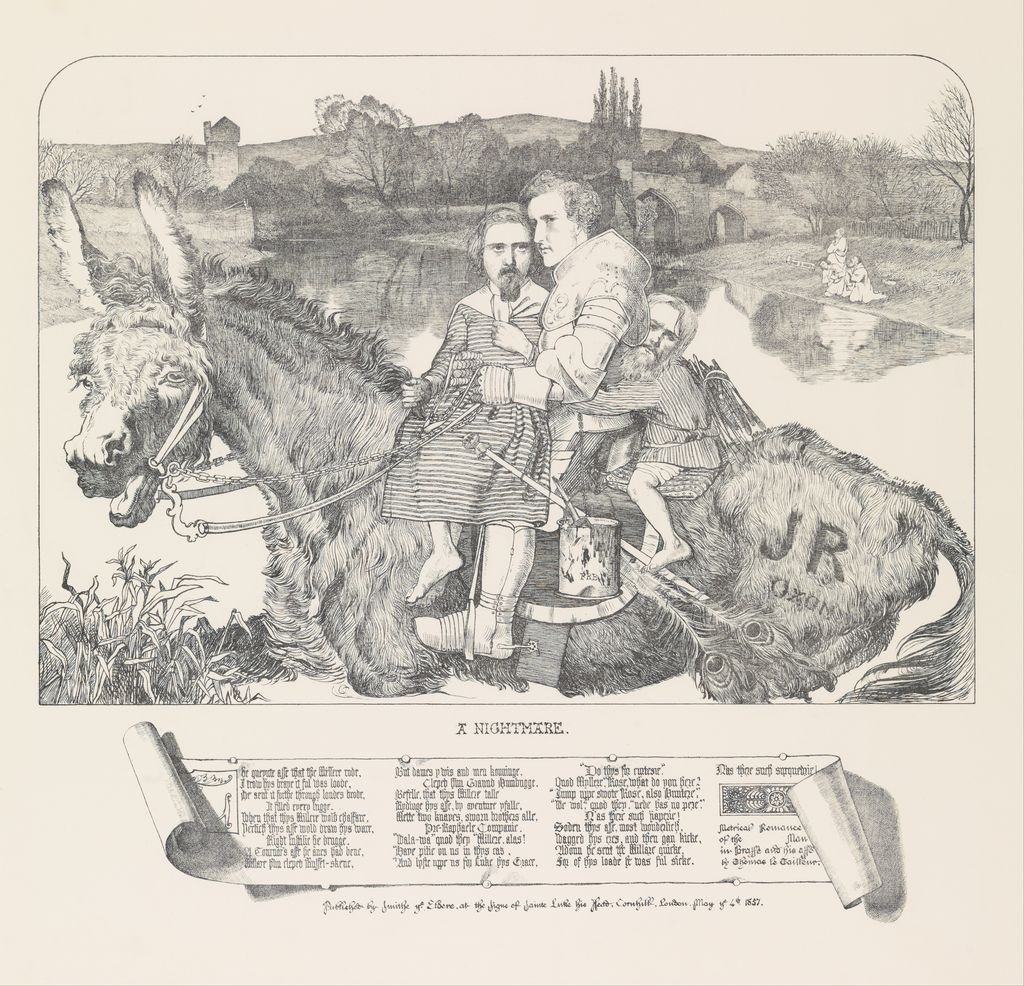
Frederick Sandys, A Nightmare, 1857. Zincotype parody of Millais’s Sir Isumbras at the Ford. Metropolitan Museum of Art, 22.19. The print keeps the shape of the crossing while replacing the riders and horse. Image source. CC0 / Public domain.
The large canvas and its relatives
Effie recalled that after the Academy closed, Millais took the unsold painting back to Scotland and replaced the horse. The family memoir reproduces a letter in which the novelist Charles Reade, who bought the painting the following year, writes that he cannot identify exactly what Millais changed but likes the result. John Graham lent the canvas to the Grosvenor Gallery in 1886. It passed to Robert Henry Benson, who lent it to the Royal Academy’s 1898 memorial exhibition. [2] [3] [4] [6] [11]
Benson’s account, recorded in the family biography and discussed by Christie’s, helps explain the broader bridle and decorated harness visible on the canvas today. Benson and his wife studied historic horse equipment and proposed changes to the animal’s outline and fittings. Millais also wanted another chance to break up the expanse of black. A small oil on panel catalogued by Christie’s shows a related arrangement with a thinner, brightly coloured rein. The auction catalogue reads the panel as preserving the composition before the late changes to the main canvas. It measures just 27.3 by 36.5 centimetres and has a separate history, including a sale in 1896 as The Good Knight. The family biography also reproduces a first sketch. The Royal Academy’s 1909 exhibition of George McCulloch’s collection included both the large canvas and a signed watercolour replica measuring just five and a half by seven inches. The catalogue describes them in separate entries. The small oil gives a basis for comparing the horse before and after the late alterations, while the sketch and watercolour show the design at other scales and in other media. [1] [11] [16] [17]
The work’s appearance in the McCulloch exhibition was another Academy outing in decidedly different company. The large canvas was listed next to Edward Burne-Jones’s Love Among the Ruins and Elizabeth Forbes’s Victor and Vanquished. McCulloch’s collection was dispersed after his death in the 1913 sale from which Lord Leverhulme acquired a number of works. Millais’s oil is now in the collection that bears Lever’s name. [1] [17] [18]
Millais returned to chivalric rescue in The Knight Errant, exhibited in 1870. There the armoured man has reached the person in danger and is cutting her free. At the ford, the help is already under way and the far bank is still some distance off. The rider’s arm around the girl and the boy’s grip behind him show how long a simple act can last when all three are waiting for the horse’s next step. [1] [2] [19]
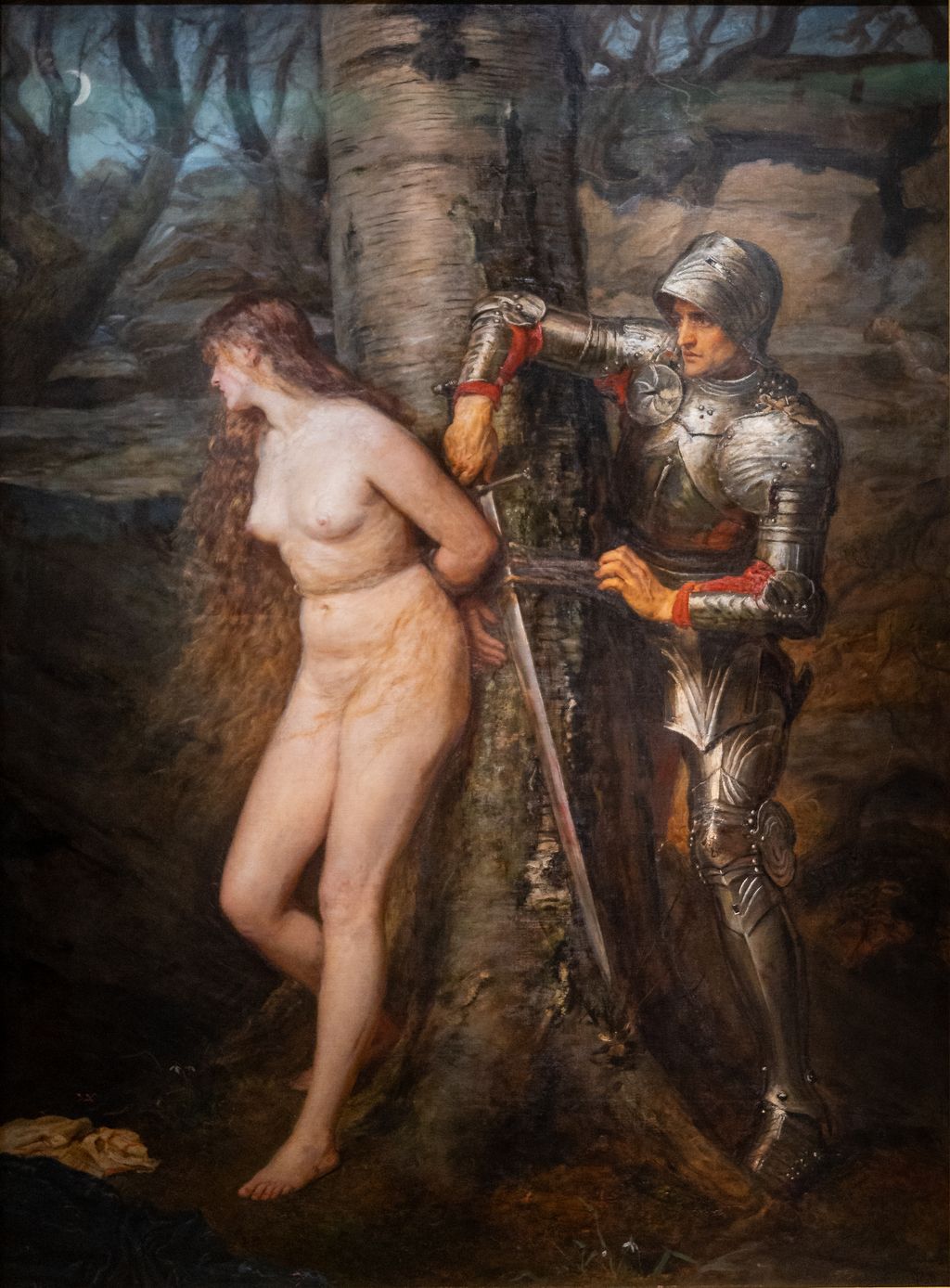
John Everett Millais, The Knight Errant, 1870, Tate N01508. Canvas-only crop from an exhibition photograph. Millais returned to chivalric aid with a more tightly enclosed landscape. Rainer Halama (Wuselig). Image source. CC BY-SA 4.0. Cropped to the painted canvas and resized. This derivative uses CC BY-SA 4.0.
Annotated Details from Sir Isumbras at the Ford
The numbered points identify visible features discussed in this article. Return from each detail to the numbered overview. A Dream of the Past: Sir Isumbras at the Ford, oil on canvas, Lady Lever Art Gallery, LL3625. Image source. Public domain.
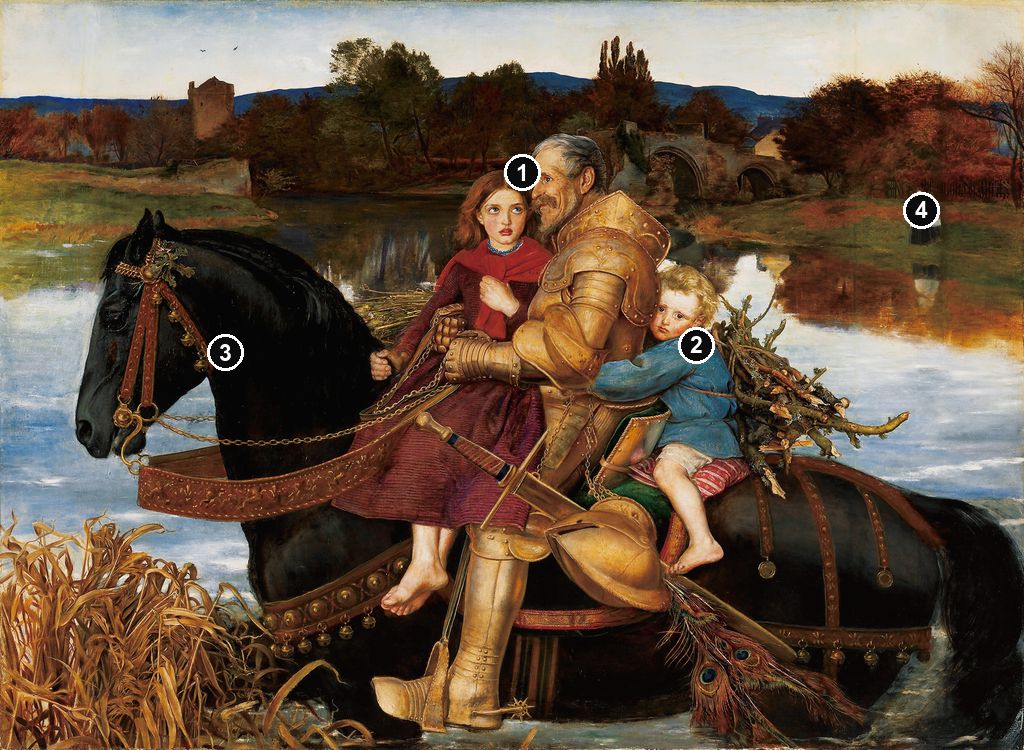
Details from SIR ISUMBRAS AT THE FORD
Compare the cropped details with the source images above. Notice how their colours, shapes and positions contribute to the larger compositions.
The faces of the knight and girl
The girl looks out while the knight faces across her. Their heads rise together above the horizontal line of the distant water.
The boy and his bundle
The boy holds fast to the knight. A bundle of uneven branches rises behind him and gives the foreground a line quite different from the finished surfaces of the armour.
The horse and harness
The horse’s dark head and neck reveal the lighter lines of the bridle and reins. Follow them towards the rider’s gauntlet.
Figures across the ford
Two tiny figures stand beyond the reflections. Their distance sets off the size of the mounted group and helps the eye follow the crossing to the far bank.
John Everett Millais artwork directory
Browse paintings and drawings covered in these articles, including related works held in public collections. Reproductive engravings and editions are discussed on the Prints page.
Prints and illustrated editions
- The Baby-House, 1872. Etching by Millais.
- The Good Shepherd, 1864. Wood engraving designed by Millais, engraved and printed by the Dalziel Brothers.
- Mariana, 1857. Wood engraving designed by Millais and cut by the Dalziel Brothers for the Moxon Tennyson.
- The Proscribed Royalist, 1858. Mixed-method engraving by William Henry Simmons after Millais.
| Name | Date | Medium |
|---|---|---|
| Pizarro Seizing the Inca of Peru | 1846 | Painting |
| The Young Men of Benjamin Seizing Their Brides | 1847 | Painting |
| Isabella | 1848–49 | Painting |
| Christ in the House of His Parents (‘The Carpenter’s Shop’) | 1849–50 | Painting |
| Ferdinand Lured by Ariel | 1849–50 (monogram dated 1849) | Painting |
| Study for Christ in the House of His Parents, Tate N04623 | c. 1849 | Drawing |
| Study for Christ in the House of His Parents, Tate N04792 | c. 1849 | Drawing |
| Study for Mariana in the Moated Grange | 1850 | Drawing |
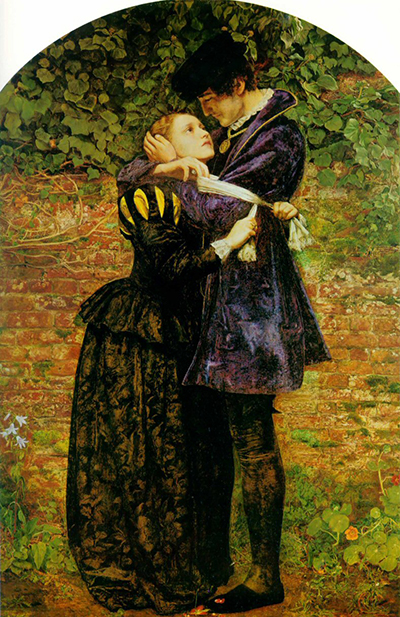
| A Huguenot, on St Bartholomew’s Day, Refusing to Shield Himself from Danger by Wearing the Roman Catholic Badge | 1851–52 (exhibited 1852) | Painting |
| Mariana | 1851 | Painting |
| Ophelia | 1851–52 | Painting |
| The Bridesmaid | 1851 | Painting |
| The Return of the Dove to the Ark | 1851 | Painting |
| The Order of Release 1746 | 1852–53 | Painting |
| The Proscribed Royalist, 1651 | 1852–53 (exhibited 1853) | Painting |
| Portrait of John Ruskin | 1853–54 | Painting |
| The Blind Girl | 1854–56 | Painting |
| Autumn Leaves | 1855–56 (Manchester labels 1856) | Painting |
| A Dream of the Past: Sir Isumbras at the Ford | 1856–57, later revised | Painting |
| The Vale of Rest | 1858–59 | Painting |
| Study for The Black Brunswicker, Tate A00812 | c. 1860 | Drawing |
| Study for The Black Brunswicker, Tate A00813 | c. 1860 | Drawing |
| Study for The Black Brunswicker, Tate A00814 | c. 1860 | Drawing |
| The Black Brunswicker | 1860 | Painting |
| The Ransom | 1860–62 | Painting |
| My First Sermon | 1863 | Painting |
| My Second Sermon | 1864 | Painting |
| Joan of Arc | 1865 | Painting |
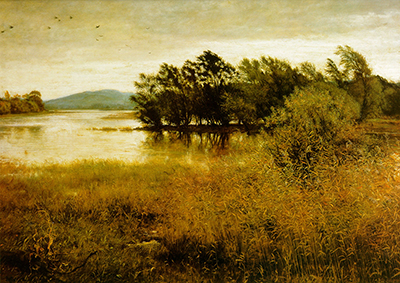
| Chill October | 1870 (exhibited 1871) | Painting |
| The Boyhood of Raleigh | 1870 | Painting |
| The Knight Errant | 1870 | Painting |
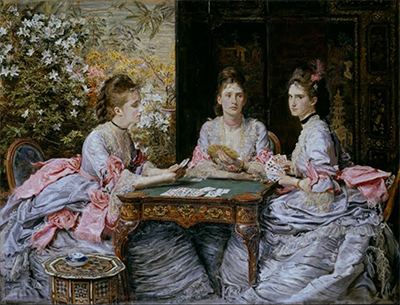
| Hearts are Trumps | 1872 | Painting |
| The North-West Passage | 1874 | Painting |
| Louise Jane Jopling | 1879 | Painting |
| William Ewart Gladstone, NPG 3637 | 1879 | Painting |
| Bubbles | 1886 | Painting |
| Portia | 1886 | Painting |
| Dew-Drenched Furze | 1889–90 | Painting |
| Ducklings | 1889 | Painting |
| Portrait of Sarah Hammond | 1891 | Painting |
Discussion
Look again at the images and ideas explored in A Dream of the Past: Sir Isumbras at the Ford. These editorial prompts invite your observations.
Reader Insights
Find the three faces on the horse, then the two figures on the far bank. How does the crossing change as your viewpoint moves?
What did Sandys recognise in Millais’s composition that could still work as a joke after he replaced the figures?
Join the Conversation
Share a detail, comparison or question about A Dream of the Past: Sir Isumbras at the Ford below.
References
- National Gallery of Australia, Love & Desire exhibition checklist, National Museums Liverpool loan LL3625. View source.
- Royal Academy of Arts, Exhibition of Works by the Late Sir John Everett Millais, 1898, no. 47, pp. 19–20. View source.
- John Guille Millais, The Life and Letters of Sir John Everett Millais, vol. I, pp. 158–161 and catalogue of watercolours. View source.
- John Ruskin, Academy Notes for 1857, Library Edition of the Works, vol. XIV, pp. 106–110. View source.
- A. G. Temple, Descriptive Catalogue of the Loan Collection of Pictures, Guildhall Art Gallery, 1894, no. 116. View source.
- Grosvenor Gallery, Exhibition of the Works of Sir John E. Millais, 1886, no. 124, pp. 77–79. View source.
- University of York, Database of Middle English Romance, Sir Isumbras. View source.
- Vadim Semyonov, ‘Poetics and Topics of the Medieval English Romance “Sir Isumbras” (14th Century)’, Philology and Culture, no. 1 (75), 2024, pp. 86–93. View source.
- Morna O’Neill, ‘1857: A “Catastrophe” at the Royal Academy’, The Royal Academy Summer Exhibition: A Chronicle, 1769–2018, including Walter Crane’s account in note 1. View source.
- Morgan Library & Museum, Kelmscott Press Syr Ysambrace, 1897, PML 9685. View source.
- Christie’s, A Dream of the Past: Sir Isumbras at the Ford, smaller oil on panel, lot 963208. View source.
- The Leader, Royal Academy review, 2 May 1857, p. 427. View source.
- George Meredith, Westminster Review, July 1857, p. 304, transcribed in Rebecca N. Mitchell, ‘George Meredith Among the Pre-Raphaelites’. View source.
- Metropolitan Museum of Art, Frederick Sandys, A Nightmare, 1857, object 641392. View source.
- Theodor Fontane, Der Stechlin, Berlin book edition, 1899, pp. 314–315. View source.
- John Guille Millais, The Life and Letters of Sir John Everett Millais, vol. I, illustrated edition, first sketch, p. 315, and Benson’s account, pp. 317–319. View source.
- Royal Academy of Arts, Exhibition of Modern Works in Painting and Sculpture Forming the Collection of the Late George McCulloch, 1909, nos. 10 and 310. View source.
- Amgueddfa Cymru – Museum Wales, A Welsh Puddler, record for George McCulloch, NMW A 18882. View source.
- National Gallery of British Art, Catalogue of the National Gallery of British Art (Tate Gallery), no. 1508, The Knight Errant. View source.