 by Tom Gurney
Tom Gurney BSc (Hons) is an art history expert with over 20 years experience
Published on June 19, 2020 / Updated on November 25, 2026
Email: tomgurney1@gmail.com / Phone: +44 7429 011000
Ophelia by John Everett Millais: Introduction
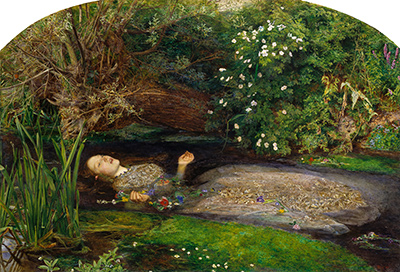
The willow leans over the stream from the left, its lower branches almost brushing the dark water. At its foot, a fan of long green leaves screens the margin of the stream. A face comes into view just past them. Ophelia is already in the water. Her head has tipped back, her lips are parted, and the skirt of her embroidered dress has opened out around her. John Everett Millais painted Ophelia in 1851–52. The oil on canvas measures 76.2 × 111.8 cm and was given to the nation by Henry Tate in 1894. It is in Tate’s collection. [1]
At a Glance
- Date1851–52 [1]
- MediumOil on canvas [1]
- Dimensions76.2 × 111.8 cm [1]
- CollectionTate, N01506 [1]
- SitterElizabeth Siddal [2][3]
This work across John Everett Millais’s career
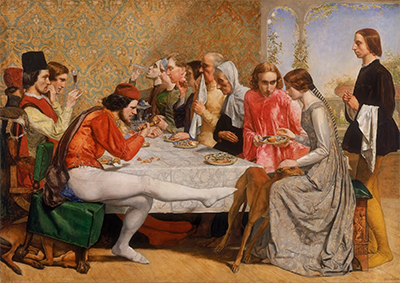
Isabella
1848–49Ophelia (current article)
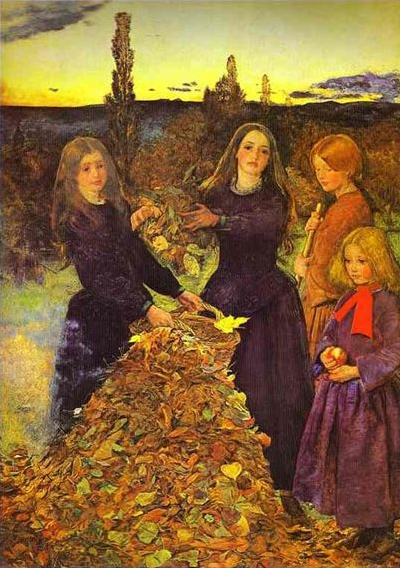
1851–52Autumn Leaves
1855–56Dew-Drenched Furze
1889–90Contents
- From the bank to the water
- The moment Gertrude describes
- Months at the Hogsmill
- The London sitting and Elizabeth Siddal
- The flowers on land and in the stream
- The white layers and the shifted willow
- London, Paris and the engraved image
- Ophelia in a Japanese novel and a Dutch exhibition
- Annotated details
From the bank to the water
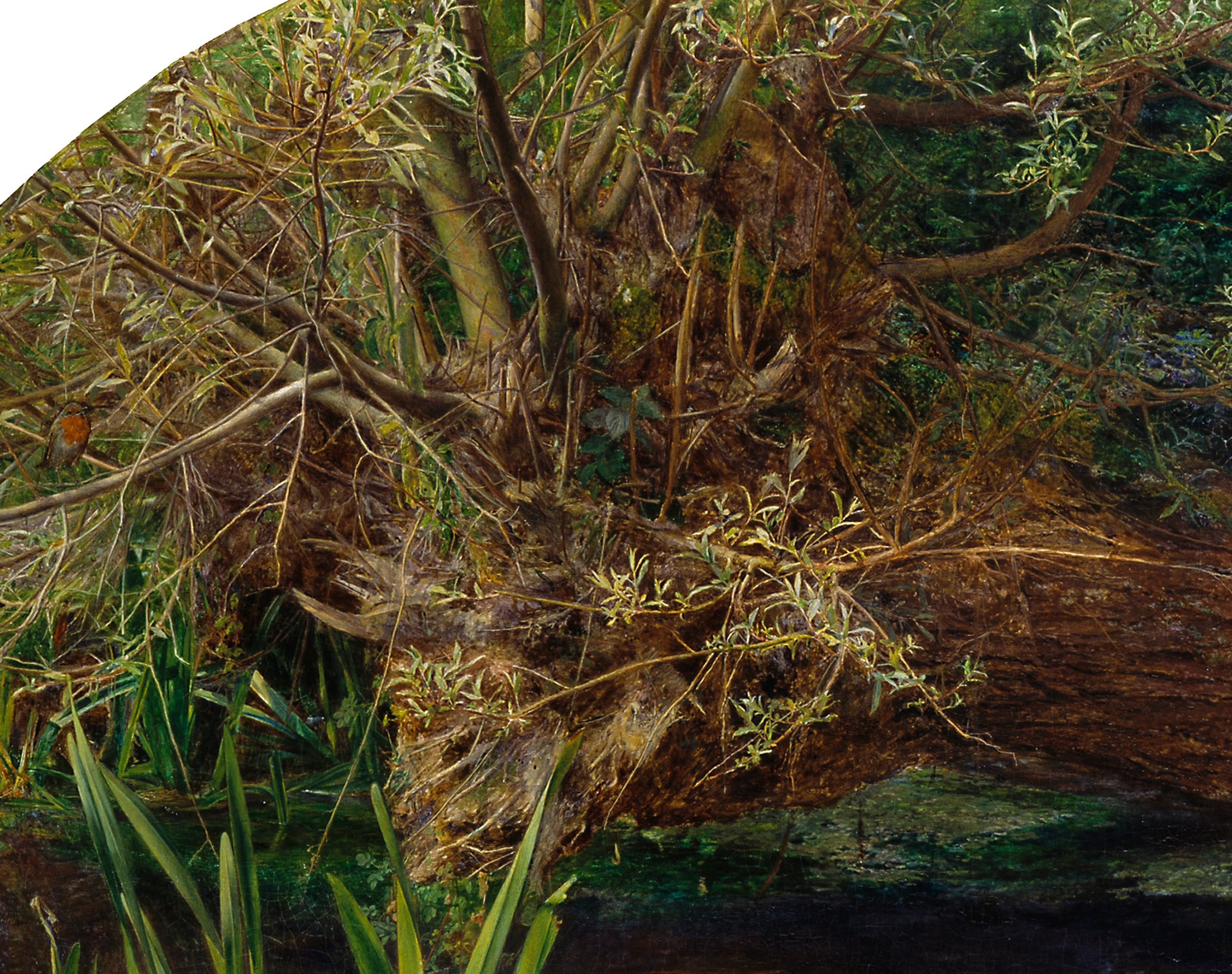
Begin at the trunk and follow its lean downwards. Thin shoots and dead twigs cross in front of the heavier wood, some pale enough to stand out against the darkness beneath. A small bird with an orange breast perches in the tangle at the far left. The leaning wood and the upright water plants lead towards the first opening around Ophelia’s head. [1]
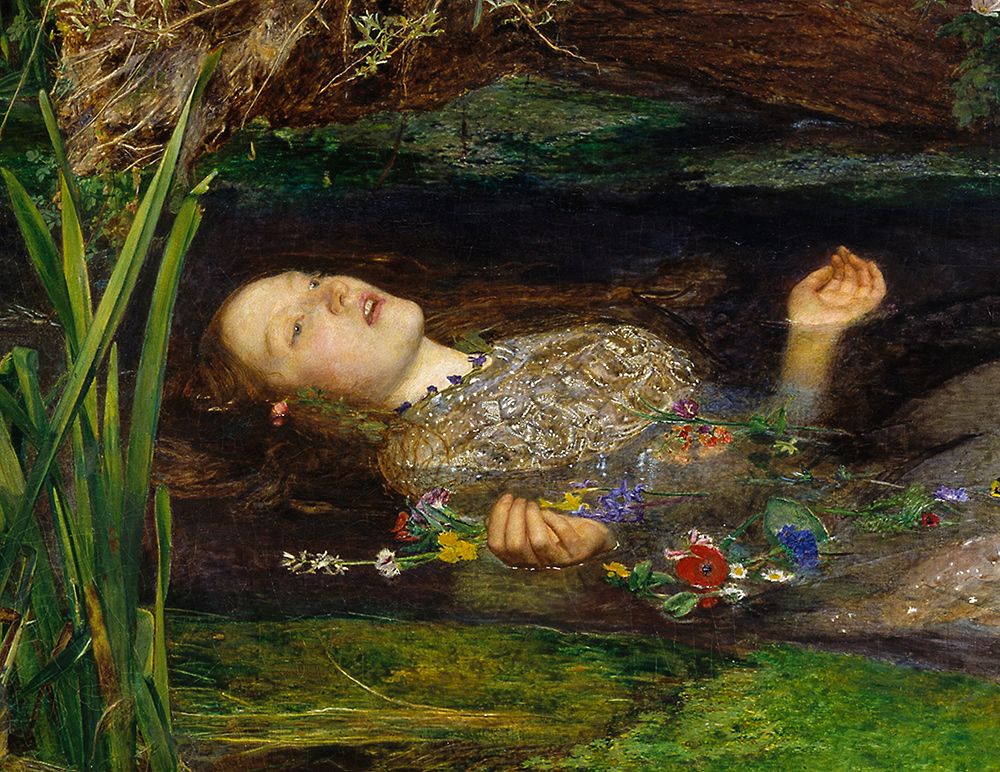
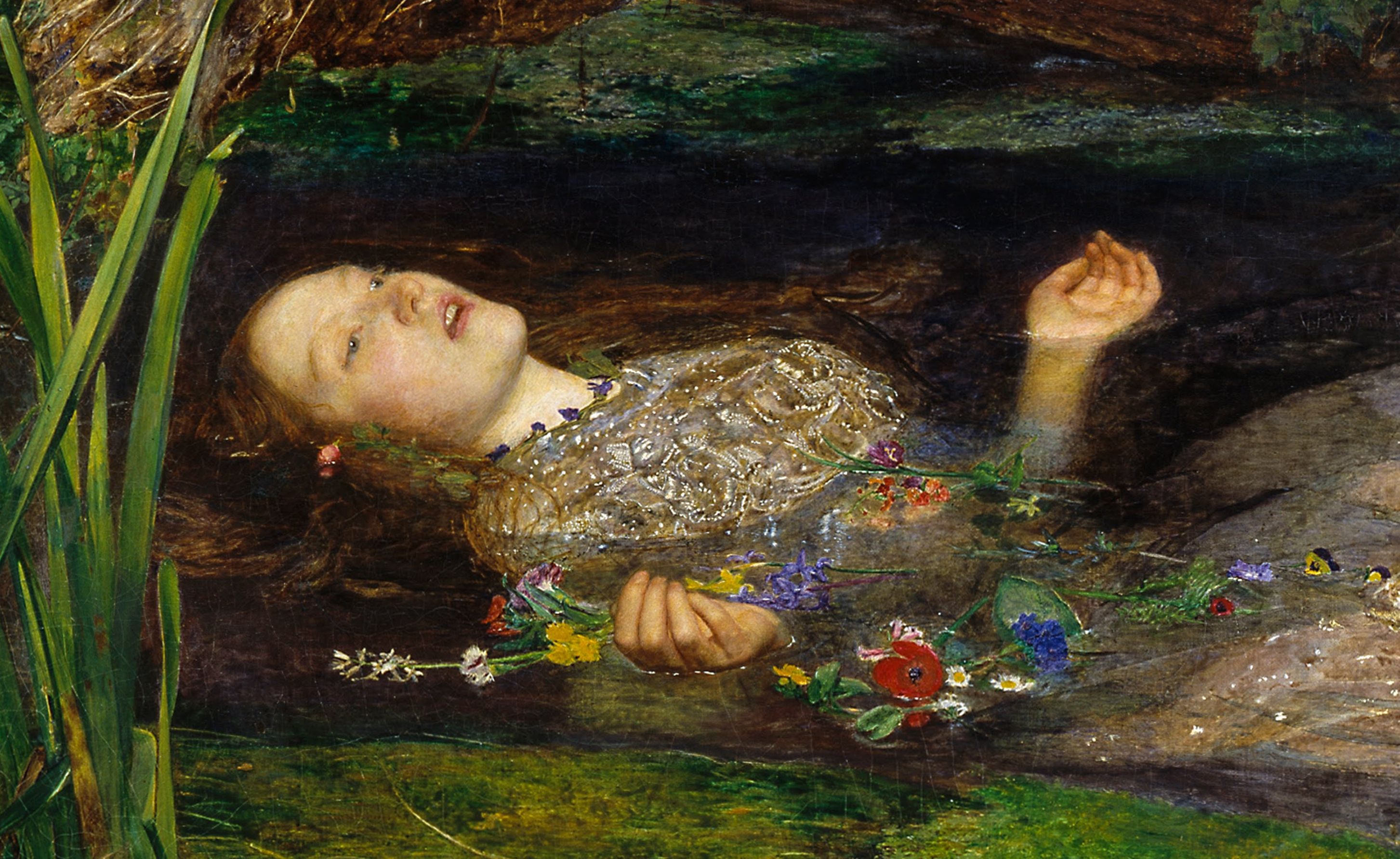
Her face and palms are among the lightest things in that strip of water. The hand farther from us rises towards the bank, its fingers curled slightly inwards. The nearer hand is close to the surface, surrounded by flowers with stems trailing between her arms and across the wet dress. Her eyes look upwards, past the bank and out of the picture. The opening of her mouth is scarcely wider than some of the petals beside her. [1]
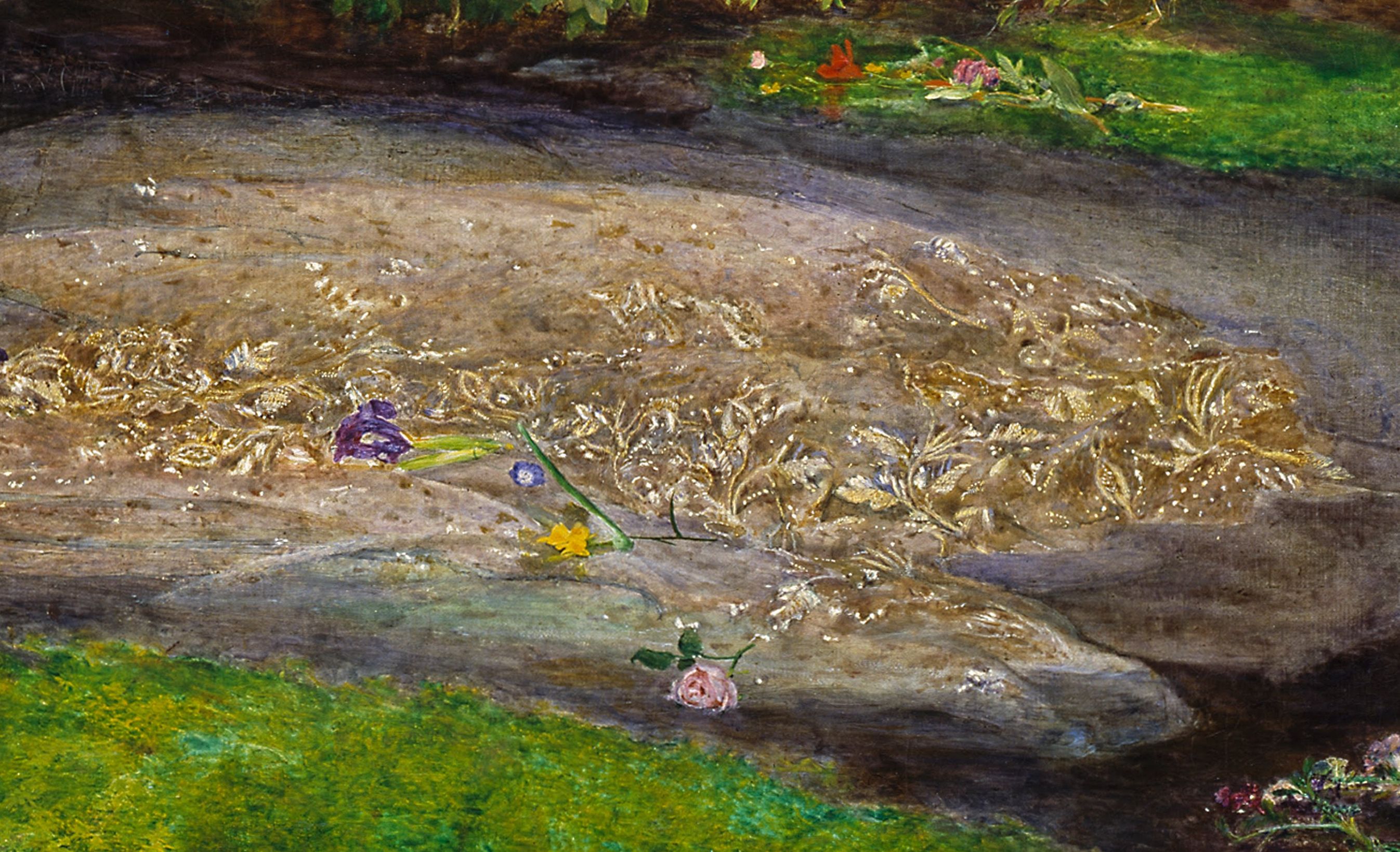
Across the right half of the picture, gold and silver tones separate strands of embroidery that are beginning to lose their outline under water. Where the dress is easiest to see, its pattern looks almost as sharp as foliage. At the lower edge the fabric becomes translucent. The skirt still spreads broadly enough to suggest buoyancy, even where the dark current seems to pass over it. [1]
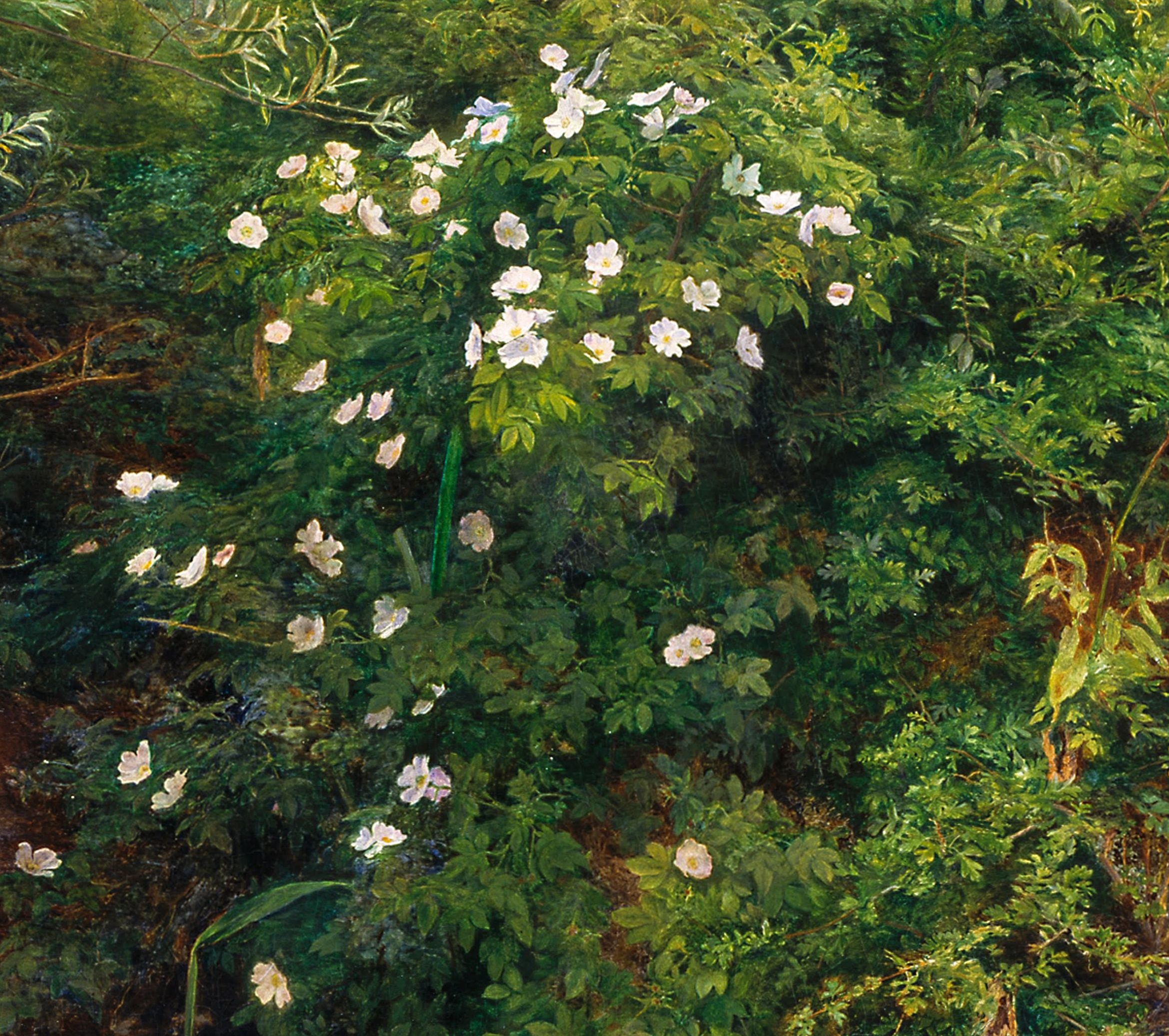
Depth comes from the way the water changes across a narrow space. The vivid green patches nearest us make it look shallow. Behind the raised hand, a relatively bare band of dark water runs under the far bank. Follow it to the right, where a spray of white blossoms reaches almost to the surface. Behind the spray there are further layers of leaves and branches, with barely a gap to look through. The open water beside Ophelia’s face feels all the more exposed for being surrounded by so much cover. [1]
The moment Gertrude describes
The drowning in Hamlet happens away from the stage. In Act IV, scene 7, Gertrude tells Laertes that his sister climbed out to hang her garlands on the boughs of a willow and a branch snapped. Ophelia and the flowers fell into the brook. Her clothes spread and supported her for a short time, during which she sang fragments of old songs. Gertrude then says the clothes grew heavy with water and pulled her under. Millais takes the brief middle interval. The branch has given way, and the dress is already filling, but her face remains clear of the water and the parted lips leave room to imagine the song. [4]
Gertrude suggests that Ophelia seemed unaware of her distress or as if she belonged to the element around her. The open hands could be part of the suspension she describes. There is no frantic reaching towards the trunk and no figure on the bank to interpret what is happening for us. The picture keeps the state of mind Gertrude describes open to interpretation. Laertes hears the story afterwards. In front of the canvas we can dwell in the interval his sister had before the clothes pulled her under. [1] [4]
In Act V, scene 1, the gravediggers debate whether she sought her death and therefore ought to be denied Christian burial. One tells the other that the coroner has permitted it, and the dialogue soon turns to the privilege of a gentlewoman who receives rites that might be refused to others. The priest later speaks of doubtful circumstances and of the limited rites allowed. The change of setting matters. At the grave, the question of intent shapes the way Ophelia is buried. Millais leaves that judgement with the characters who make it. [5]
Months at the Hogsmill
Millais painted the landscape outdoors beside the Hogsmill River near Ewell, Surrey, in 1851. William Holman Hunt was working nearby on the setting for The Hireling Shepherd. Both artists painted outdoors on the canvases they planned to exhibit. From summer into autumn they concentrated on their settings, leaving areas of white to receive figures later. That order gave Millais time to build the landscape to the finish he wanted while Ophelia still existed largely as a space within it. [2] [6]
In a letter to Mrs Combe, Millais treated the difficulties of the site as material for a running joke. He complained about Surrey flies, the prospect of a trespass complaint for damage to the hay, and the chance of being blown into the water. A pair of swans lingered precisely where he wished to work and disturbed the water plants within reach. A patch of water he had come back to paint could change while he was standing in front of it. The stillness we see is something he made over months. [6] [3]
You can see the benefit of prolonged looking at the left edge. The green blades rise at slightly different angles, overlap, and occasionally disappear in front of a leaf of similar colour. Farther up, dry growth and exposed bark interrupt the fresher leaves. When he brought the work back to London, he brought a dense body of observations that already set limits on the space available for the figure. The result joins a particular English river to a scene reported at the Danish court. Tate notes that plants which bloom at different times appear together here. The fine observation of individual specimens gives the conjunction the air of something Millais might have seen all at once. [1] [2] [6]
The London sitting and Elizabeth Siddal
The figure was painted indoors in Millais’s Gower Street studio. Elizabeth Siddal lay in a bath so that he could study the behaviour of cloth in water and see where it settled around her arms and shoulders. In one March 1852 letter, Millais tells Thomas Combe that he has just spent £4 on an old dress embroidered with silver flowers. In another, on 31 March, he says the skirt is still to be painted. It is the broadest part of the figure in the finished picture, and the material on which Shakespeare makes her life briefly depend. [2] [3]
The account of the bath cooling comes from the life of the artist written decades later by his son, John Guille Millais. He says that lamps beneath the bath went out while the painter was absorbed in his work, that Siddal fell ill, and that her father threatened an action for £50 in damages. According to the son, Millais paid the doctor’s bill and the matter was settled. The threatened sum and the eventual payment are separate details in the account. Holding the position long enough to paint such details made demands on Siddal as well as on the painter. [3]
In 1853 Siddal drew The Lady of Shalott, from Tennyson’s poem. She chose an interior at the moment the curse takes hold. The Lady sits at an upright loom with shuttles in her hands. Threads pull away from the frame and the mirror reflecting Lancelot has cracked. Through the opening beside it, there are boats on the river below. Glenda Irene Youde notes the precision of the loom and shuttles, which distinguish the work of weaving from embroidery, and the freedom with which Siddal arranges the mirror, window and other details. The water that will carry the Lady towards Camelot is still beyond the room. Siddal puts the work of the woman and the moment that work is interrupted in front of us. [7] [8]
The flowers on land and in the stream
The purple loosestrife stands almost upright at the right edge, while the white field roses spill diagonally towards the stream. Pink roses appear by Ophelia’s cheek and on the dress. The resemblance draws the eye from plants still rooted in the bank to loose flowers scattered across the water. The blue of the forget-me-nots offers a quieter connection. They appear low on the far bank below the loosestrife and again in the foreground. Those touches of blue help bring the near and far margins of the stream into the same view. [1] [2]
Shakespeare supplies more than one group of flowers. Gertrude names nettles, crowflowers, daisies and “long purples” when she describes the garlands in Act IV, scene 7. In Act IV, scene 5, Ophelia names pansies and daisies and says that the violets have withered since her father died. Laertes calls her the “rose of May” in the same scene. Tate reads the tall purple loosestrife as an allusion to the “long purples”, the flower it identifies in Shakespeare’s text as an orchid. [4] [2] [9]
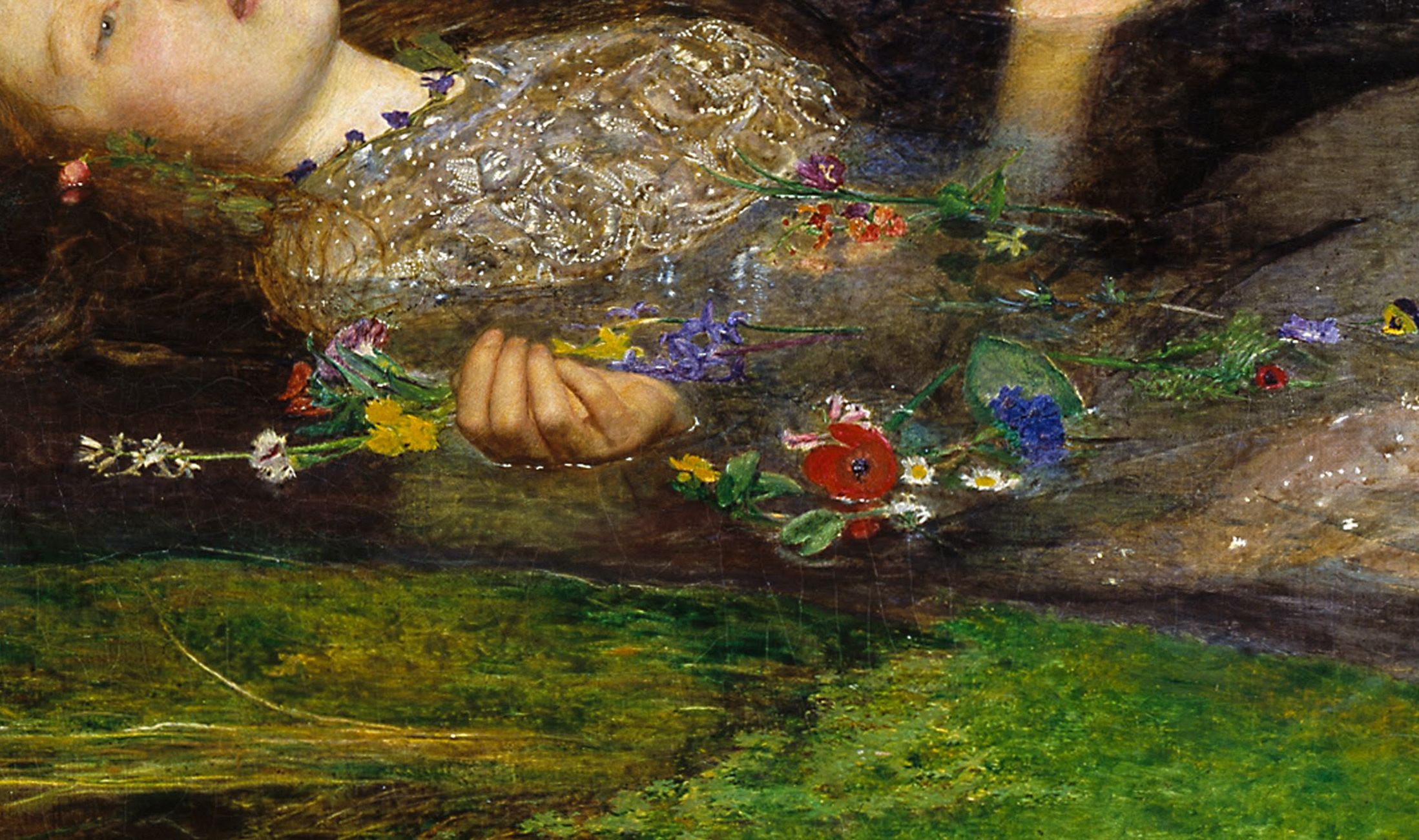
The flowers on Ophelia’s body bring the earlier scene closer. Tate identifies violets at the neck and pansies on the dress, and reads innocence in the nearby daisies. Tate’s collection text associates a poppy with death. Its longer account separately identifies the poppy-like pheasant’s eye near the pansies and connects it with sorrow. The flowers also have a direct effect on how we see the figure. A few red, yellow and blue petals remain distinct against the water where the submerged cloth begins to fade. [1] [2]
The white layers and the shifted willow
On 7 June 1851, before the summer’s work at Ewell, Millais bought a double canvas from the colourman Charles Roberson for fifteen shillings. The second canvas on the stretcher protected the back of the painting. It carried Roberson’s stencilled mark, documented when the canvas was removed for the 1967 lining. The mark led researchers to the supplier’s records. [2]
Under ultraviolet light, a microscopic cross-section from the painting shows lead white below a layer of zinc white. A pale base under the colour helps explain why small strokes can appear so luminous, even along the edge of a shaded bank. Tate raises the possibility that Millais laid down fresh white paint on the area he meant to complete that day and worked into it while it was wet. A sample can establish the order of the two white layers where it was taken. The precise extent of a daily wet-white routine across the canvas remains harder to establish. The palette offers another part of the explanation for the colour. Tate identifies greens made with chrome yellow and Prussian blue. Some of the painting’s most conspicuous greens are in the shallows near the viewer, where their brightness helps distinguish the water there from the shadow along the opposite bank. [1] [2]
Infrared examination can reveal drawing beneath paints that are more transparent to infrared than to visible light. In this case it revealed a slight shift in the willow. X-radiography showed a single composition with no major reworking, while light cast across the surface showed how smoothly Millais painted it. One of the few recorded adjustments concerned the trunk from which the eye first follows the angle down to Ophelia. [2]
London, Paris and the engraved image
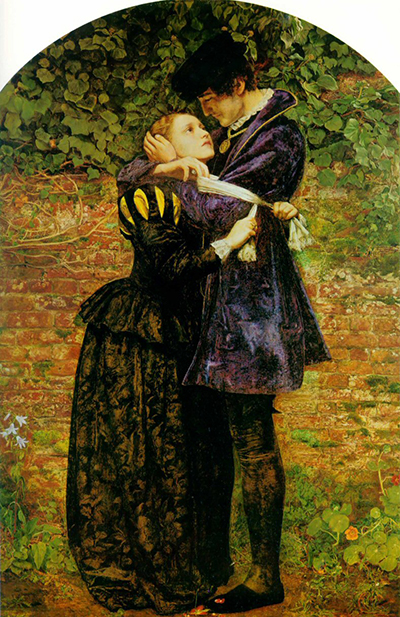
When the painting appeared at the Royal Academy in 1852, the force of its natural detail divided critics. The Morning Chronicle described a picture startling enough to make a viewer recoil, then sufficiently absorbing to draw that viewer back. Fraser’s Magazine found wilfulness in taking nature so much on its own terms. The colour of the larger Pre-Raphaelite group also made a difference in the crowded exhibition. As Elizabeth Prettejohn shows, praise in The Athenaeum for the force of Millais’s colour beside neighbouring paintings related specifically to A Huguenot, his other contribution. [2] [6]
After the Academy, Ophelia was exhibited in Birmingham in 1852 and at the Royal Scottish Academy in Edinburgh in 1853. It went to the Paris Exposition Universelle in 1855 with The Return of the Dove to the Ark and The Order of Release. In the Revue des Deux Mondes, Gustave Planche found the colours harsh and the outline of the floating figure too indefinite. He nevertheless thought the melancholy grace genuinely moving and felt it recalled Shakespeare. To Planche, a sharper contour would have given the heroine a more persuasive physical presence. The indistinct contour Planche objected to is easiest to see where the embroidered pattern begins to disappear into the current. [1] [2] [10]
Henry Farrer had already bought the painting from Millais in December 1851, before it appeared in the exhibition. James Stephenson’s print of 1866 gave the composition an audience beyond exhibitions. In the Metropolitan Museum’s proof, mezzotint, etching and stipple translate the painted contrasts into tones and marks. It is possible to distinguish the silverwork from the folds around it and the blossoms from the darkness behind, even when the green and pink have disappeared. The legibility of the submerged dress comes down to how gradually those marks give out. [2] [11]
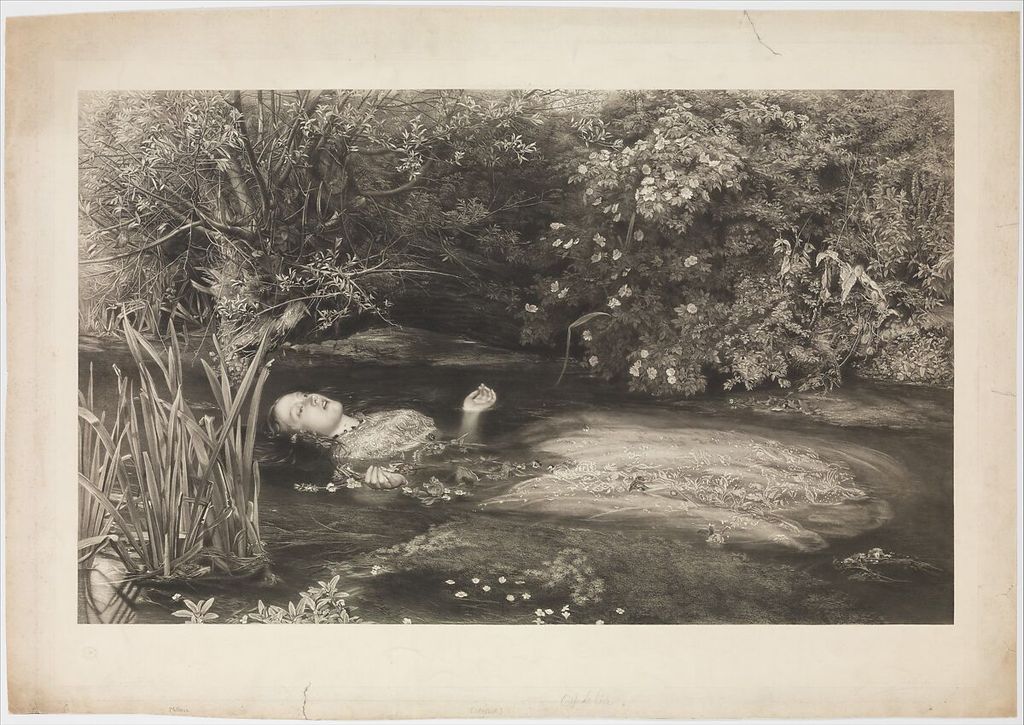
James Stephenson after John Everett Millais, Ophelia, 1866. Mezzotint, etching and stipple on chine collé, proof. The Metropolitan Museum of Art, 49.40.282. The engraved proof separates embroidery, leaves and water in tones instead of paint. Image source. CC0 / Public domain.
Ophelia in a Japanese novel and a Dutch exhibition
In Natsume Sōseki’s 1906 novel Kusamakura, a painter’s thoughts return to Millais’s Ophelia while he is staying at a hot spring. At one point the face of the painted figure comes into his mind as he tries to imagine the face of a bride. Nami eventually asks him to paint her floating in water. As Ann-Marie Dunbar shows, he can picture the arrangement but finds that her expressions keep moving between feelings he cannot fit to the image he has imagined. The novel makes the limits of the comparison part of its story. The English painting gives the fictional painter a pose to imagine, while Nami’s expression remains a problem for his own art. [12] [13]
In Amsterdam, the Van Gogh Museum showed the painting in its 2008 Millais retrospective and ran the contemporary photography display Me, Ophelia alongside it. The museum brought together work by artists including Rineke Dijkstra, Hellen van Meene and Inez van Lamsweerde & Vinoodh Matadin. It also ran a photography competition for secondary-school students who were invited to respond to Millais’s work. Visitors could walk from the painted figure to a photography display and compare what happens to a pose in another medium. The retrospective went on to the Kitakyushu Municipal Museum of Art and the Bunkamura Museum of Art in Tokyo later that year. [2] [14]
Annotated Details from Ophelia
The numbered points identify visible features discussed in this article. Return from each detail to the numbered overview. Ophelia, oil on canvas, Tate, N01506.
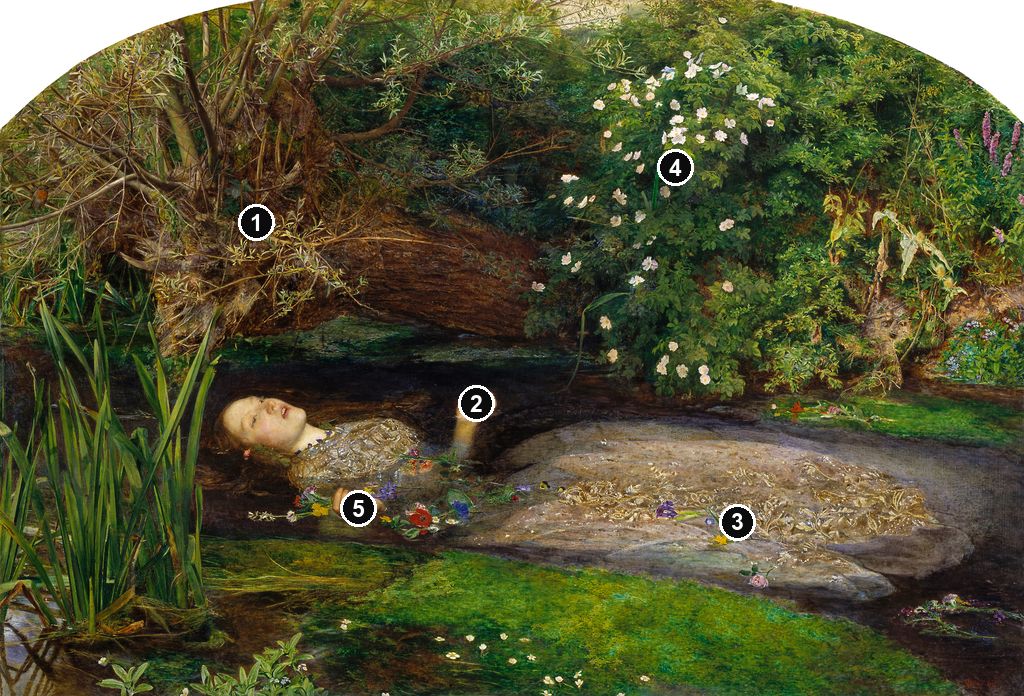
Details from OPHELIA
Follow the change from the tight detail of the bank to the broken edges of dress and flowers at the waterline.
The bank and overhanging willow
The leaning trunk crosses the upper bank, with fine branches descending towards the current. It makes the bank feel close above the figure.
The raised hand and waterline
The hand lifts out of the dark water beside the upturned face. The bank, head and hand lie in shallow horizontal bands, so slight changes in height make the figure’s position legible.
The dress meeting the river
Light catches the dress in a broken pattern. Further along, colour and texture soften into the water, making it hard to locate the boundary of the fabric.
White blossoms on the bank
The pale blossoms stand out against dense green foliage. They remain high above the coloured flowers caught around the figure.
Flowers beside the lower hand
Red, blue and yellow flowers mark the water beside her lower hand. Their separation makes the current visible around the fabric.
Films about Millais and the Pre-Raphaelites
Smarthistory discusses the Tate painting, its setting and the figure at the waterline. The other films explore related paintings and the wider movement.
Sir John Everett Millais, Ophelia
A discussion of the composition, the plants and the moment chosen from Hamlet.
Watch on YouTubeJohn Everett Millais artwork directory
Browse paintings and drawings covered in these articles, including related works held in public collections. Reproductive engravings and editions are discussed on the Prints page.
Prints and illustrated editions
- The Baby-House, 1872. Etching by Millais.
- The Good Shepherd, 1864. Wood engraving designed by Millais, engraved and printed by the Dalziel Brothers.
- Mariana, 1857. Wood engraving designed by Millais and cut by the Dalziel Brothers for the Moxon Tennyson.
- The Proscribed Royalist, 1858. Mixed-method engraving by William Henry Simmons after Millais.
| Name | Date | Medium |
|---|---|---|
| Pizarro Seizing the Inca of Peru | 1846 | Painting |
| The Young Men of Benjamin Seizing Their Brides | 1847 | Painting |
| Isabella | 1848–49 | Painting |
| Christ in the House of His Parents (‘The Carpenter’s Shop’) | 1849–50 | Painting |
| Ferdinand Lured by Ariel | 1849–50 (monogram dated 1849) | Painting |
| Study for Christ in the House of His Parents, Tate N04623 | c. 1849 | Drawing |
| Study for Christ in the House of His Parents, Tate N04792 | c. 1849 | Drawing |
| Study for Mariana in the Moated Grange | 1850 | Drawing |
| A Huguenot, on St Bartholomew’s Day, Refusing to Shield Himself from Danger by Wearing the Roman Catholic Badge | 1851–52 (exhibited 1852) | Painting |
| Mariana | 1851 | Painting |
| Ophelia | 1851–52 | Painting |
| The Bridesmaid | 1851 | Painting |
| The Return of the Dove to the Ark | 1851 | Painting |
| The Order of Release 1746 | 1852–53 | Painting |
| The Proscribed Royalist, 1651 | 1852–53 (exhibited 1853) | Painting |
| Portrait of John Ruskin | 1853–54 | Painting |
| The Blind Girl | 1854–56 | Painting |
| Autumn Leaves | 1855–56 (Manchester labels 1856) | Painting |
| A Dream of the Past: Sir Isumbras at the Ford | 1856–57, later revised | Painting |
| The Vale of Rest | 1858–59 | Painting |
| Study for The Black Brunswicker, Tate A00812 | c. 1860 | Drawing |
| Study for The Black Brunswicker, Tate A00813 | c. 1860 | Drawing |
| Study for The Black Brunswicker, Tate A00814 | c. 1860 | Drawing |
| The Black Brunswicker | 1860 | Painting |
| The Ransom | 1860–62 | Painting |
| My First Sermon | 1863 | Painting |
| My Second Sermon | 1864 | Painting |
| Joan of Arc | 1865 | Painting |
| Chill October | 1870 (exhibited 1871) | Painting |
| The Boyhood of Raleigh | 1870 | Painting |
| The Knight Errant | 1870 | Painting |
| Hearts are Trumps | 1872 | Painting |
| The North-West Passage | 1874 | Painting |
| Louise Jane Jopling | 1879 | Painting |
| William Ewart Gladstone, NPG 3637 | 1879 | Painting |
| Bubbles | 1886 | Painting |
| Portia | 1886 | Painting |
| Dew-Drenched Furze | 1889–90 | Painting |
| Ducklings | 1889 | Painting |
| Portrait of Sarah Hammond | 1891 | Painting |
Discussion
Look again at the images and ideas explored in Ophelia by John Everett Millais. These editorial prompts invite your observations.
Reader Insights
Where does the painted surface first tell you that the dress is sinking?
Which flowers are easy to pick out, and which disappear until you follow the edge of the water?
Join the Conversation
Share a detail, comparison or question about Ophelia by John Everett Millais below.
References
- Tate Britain, Ophelia, collection no. N01506, image and object details via Google Arts & Culture. View source.
- Tate, “The Story of Ophelia”, making, plant details, conservation, ownership and exhibition history. View source.
- John Guille Millais, The Life and Letters of Sir John Everett Millais, vol. I, Surrey letters, account of the sitting and Gower Street correspondence. View source.
- William Shakespeare, Hamlet, Act IV, scene 7, Folger Shakespeare Library. View source.
- William Shakespeare, Hamlet, Act V, scene 1, Folger Shakespeare Library. View source.
- Elizabeth Prettejohn, “1852 Pre-Raphaelite Plein-Air”, Royal Academy Chronicle. View source.
- The Maas Gallery, Elizabeth Siddal, The Lady of Shalott, 1853, drawing and exhibition history. View source.
- Glenda Irene Youde, Beyond Ophelia, University of York doctoral thesis, 2022, chapter 4 and analysis of The Lady of Shalott. View source.
- William Shakespeare, Hamlet, Act IV, scene 5, Folger Shakespeare Library. View source.
- Gustave Planche, “Exposition des Beaux-Arts. I. L’École anglaise”, Revue des Deux Mondes, 1855. View source. (in French).
- The Metropolitan Museum of Art, James Stephenson after John Everett Millais, Ophelia, 1866, object no. 49.40.282. View source.
- Natsume Sōseki, Kusamakura (草枕), 1906, Japanese text at Aozora Bunko. View source. (in Japanese).
- Ann-Marie Dunbar, “Three Leagues Away from a Human Colour”, Victorian Literature and Culture 46, no. 1, 2018. View source.
- Van Gogh Museum, Jaarverslag 2008, pp. 37–39 and Friday-evening programme. View source. (in Dutch).