 by Tom Gurney
Tom Gurney BSc (Hons) is an art history expert with over 20 years experience
Published on June 19, 2020 / Updated on November 25, 2026
Email: tomgurney1@gmail.com / Phone: +44 7429 011000
The Vale of Rest: Introduction
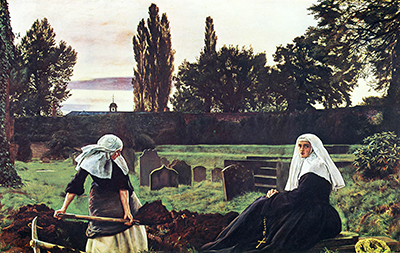
At the end of the day, a nun lifts a spadeful of earth from an open grave. Her companion sits on a stone and looks straight out of the picture. The sky is still bright enough to show the trees and chapel roof in silhouette, although the ground around the two women has already darkened. John Everett Millais began The Vale of Rest in Perth in 1858 and exhibited it at the Royal Academy in 1859. Tate holds the oil painting, which measures 102.9 × 172.7 cm, under accession number N01507. The face that meets our gaze today was repainted in 1862, according to the artist’s son. [1] [2] [3]
At a Glance
- Date1858–59, with the seated nun’s head repainted in 1862 [2][3]
- MediumOil on canvas [1][2]
- CollectionTate, N01507 [1][2]
- SubjectOne nun digs a grave at dusk while her seated companion looks out [1]
This work across John Everett Millais’s career
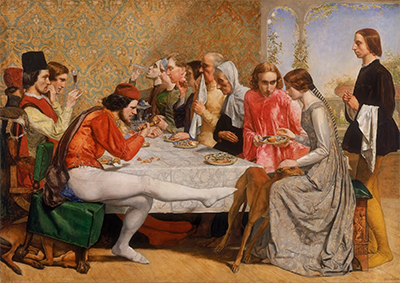
Isabella
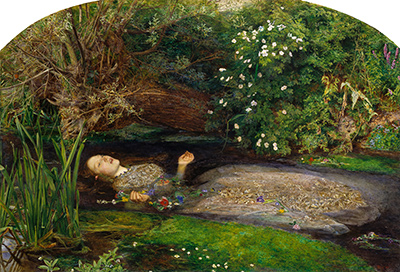
1848–49Ophelia
1851–52Autumn Leaves
1855–56Dew-Drenched Furze
1889–90Contents
- Two women at the grave
- How Millais built a graveyard from two places
- The title and the promise of rest
- Sisterhood, burial and the limits of the story
- At the Royal Academy and after
- Later ways of seeing the painting
- Annotated details
Two women at the grave
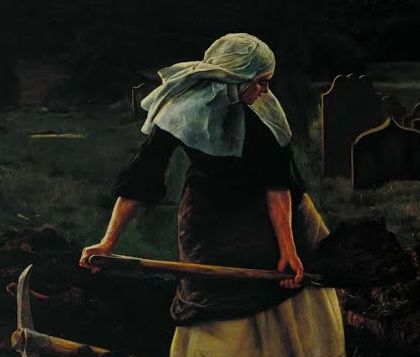
The digging nun works from inside the grave. Follow the line of her forearms to the spade and then out to the loaded blade. Her sleeves fall back from her wrists, and the strain of the movement shows in the twist of her upper body. The raised tool is angled across the top of the roughly cut bank, against the run of the wall behind it. The lower half of the woman is hidden by the ground she is working. This makes the grave’s depth something we understand from the way her body disappears as well as from the dark opening itself. Fresh earth lies in coarse lumps above the old turf. Millais sets an instant of exertion in a place that otherwise seems scarcely to move. [1] [4]
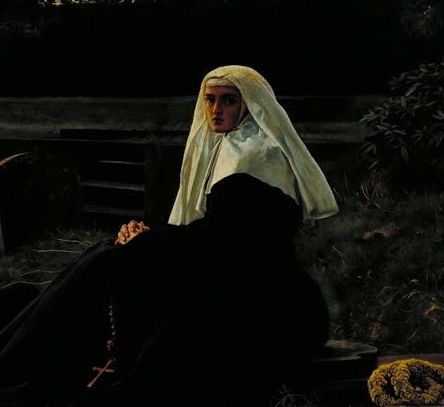
The sitter on the right is just as firmly placed. The 1898 memorial exhibition catalogue describes her seat as an overturned headstone. Her hands come together at her knee, and on the rosary there is a small skull-and-crossbones ornament. The eye takes in her white head covering and her face well before it can see what she is holding. At her feet and among the graves, the details of burial draw us back down after her gaze has caught ours. Tate identifies the wreaths, skull and open grave as signs of mortality. The skull brings death into the scale of something a person can hold. The spade brings it into the scale of work someone must do. [1] [4] [5]
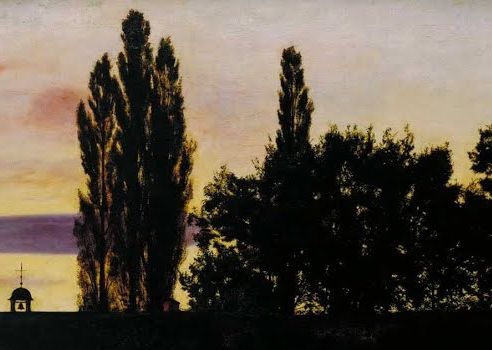
Look from the seated woman to the space between the poplars. There is a late glow beyond the wall, but the branches cut it into narrow intervals. The brightness promises distance without giving us a path into it. A later exhibition catalogue associated a long purple cloud with a Scottish belief that a coffin-shaped cloud foretold a death. The association is one historical way of reading the long band in the sky. The shape also matters to the composition because it hangs horizontally above the ground the spade keeps breaking. The cloud, the wall and the disturbed soil each mark a different distance from the viewer. [1] [6]
How Millais built a graveyard from two places
Effie Gray, whose account appears in their son’s Life and Letters, remembered that Millais wanted to paint nuns after their honeymoon in 1855. At Loch Awe they had talked about the remains of a monastery and imagined religious life there. The painting took shape three years later around her family’s home at Bowerswell. Effie recalled several fine sunsets late in October, work done quickly while the colours lasted, and adjustments made indoors that softened the purple and gold. The trees occupied him on successive afternoons as the leaves fell. Some parts of the picture therefore depend on a very brief interval of light, while others were built up across a change of season. [3] [4]
The terrace, shrubs and trees came from Bowerswell. The family account explains that Millais made a corner of the house serve as an ivy-covered chapel and used Kinnoull churchyard for the burial ground. Effie remembered the sexton digging a grave for him to work from and the wind threatening to bring the frame down. The scene joins the observations of someone sitting at a family doorstep with those of a painter who carried his work among graves in cold weather. The result has the detail of a place studied at length and the geography of an invented convent. [3] [4]
The digging nun’s stance took a different kind of work. John Guille Millais relates that his father painted and repainted her over seven weeks. In the family’s telling, Effie and her mother hid the canvas in a wine cellar to interrupt the effort. After some time away from it, he saw a way through the problem and returned to the figure. The story survives as a later recollection of the work in progress. The pose makes the difficulty easy to imagine. Both the woman’s weight and the balance of the earth on the blade have to make sense in an instant, with much of her body concealed behind the edge of the pit. [3] [4]
The title and the promise of rest
The entry for the 1859 Academy exhibition had the motto “Where the weary find repose”. The editors of Ruskin’s Academy Notes pointed to an echo of Job 3:17, which imagines the weary at rest in death. Tate traces the title to Felix Mendelssohn’s Ruhetal, the fifth of his six part-songs, Op. 59, a setting of a poem by Ludwig Uhland. The singer sees mountains of clouds rise in the last light and wonders whether the longed-for valley lies among them. The clouds are an occasion for longing. In the painting, the last light plays a similar part and falls on a place where a grave is still being prepared. [1] [7] [8] [9]
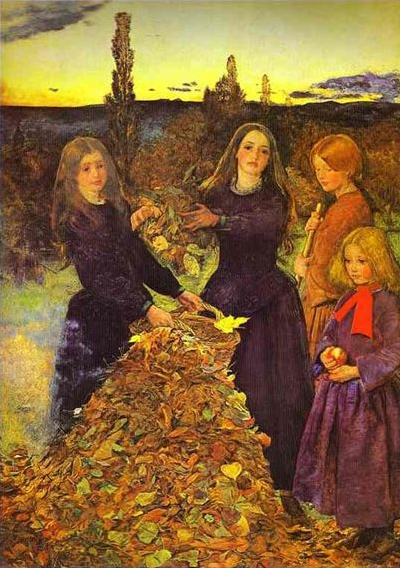
Adele Ernstrom compares that use of music with Millais’s earlier approach in Autumn Leaves. Both pictures ask the eye to adjust to dark foregrounds and to read an ordinary action in the short interval before night. The girls in Autumn Leaves gather leaves around a heap. The grave-digger has an equally legible task, but in The Vale of Rest Millais gave the Academy visitor words to carry into the picture. Ernstrom relates the shared mood of its colours to the way a musical key can unify a piece. The catalogue motto allows for the hope of rest. The picture makes the labour on which such rest depends impossible to miss. [1] [3] [9]
Sisterhood, burial and the limits of the story
Ayla Lepine places the painting in a Victorian fascination with religious sisterhoods. The revival of women’s communities in the Church of England made the public presence of women religious a live question alongside older Protestant attitudes to Catholic convents. In Charles Allston Collins’s Convent Thoughts, exhibited at the Academy in 1851, a solitary woman holds an illuminated book open and studies a passionflower. The objects direct her attention, and ours, towards the Passion. In Millais, the rosary can prompt a devotional reading, but there is also urgent physical work and a woman whose attention extends outside the frame. The two canvases offer different experiences of religious life within an enclosed garden. [10] [11]
Greg W. Spangler connects the reception of The Vale of Rest with suspicion of private burial at a time of burial reform, as well as with debate about the Oxford Movement. Those anxieties help explain how an enclosure and an open grave could make a Victorian audience uneasy. Ruskin even paused to say that he doubted nuns dug their own graves. The painting gives no funeral procession or mourners to explain what the women are doing, and no named deceased person to establish whose burial this is. Ariel Kline draws attention to the two figures’ different relations to the spectator. The worker’s action turns us towards dirt and effort, while the seated figure’s scrutiny makes it difficult to remain a detached observer. [4] [7] [12]
At the Royal Academy and after
Ruskin’s review of the painting, Academy no. 15, acknowledged that a first look might offend and insisted that the picture deserved the time it took to study it. He imagined an easier version, with prettier faces and a grave in more picturesque ground, and argued that such changes would make the scene sentimental. He found power in Millais’s approach while judging the handling crude by the painter’s earlier standards. His comments also reflect his own hostile view of convent life. He thought the picture’s troubling effect conveyed something real about that life, and his argument about the painting is inseparable from that opinion. [7]
Other critics asked for precisely the changes Ruskin thought would weaken the picture. The Economist wanted a more conventionally attractive face, and a wider opening onto the sunset to relieve the close wall and heavy ground. It also singled out the digging woman’s arm and the other woman’s face as passages of close observation in a painting otherwise notable for broad handling. The editors of Ruskin’s work record The Athenæum’s complaint about the face and its staring eyes. These comments refer to the 1859 exhibition state. In 1862, according to John Guille Millais, the painter brought the picture into his studio for a week and repainted the seated nun’s head from a model he calls Miss Lane. [3] [7] [13]
The Academy audience could also compare the graveyard with Millais’s Spring, now known as Spring (Apple Blossoms), shown in the same exhibition and now in the Lady Lever Art Gallery. The girls among the blossom in Spring occupy an enclosed space of their own. There, open flowers and youthful faces suggest the transience of a season in its fullness. The autumn graveyard brings decay and the prospect of burial to the foreground. In his review Ruskin moved straight from one painting to the other, treating both as tests of Millais’s change of manner. The pairing lets a viewer ask what he gained by making colour, season and the distribution of figures carry so much of the subject. [4] [7] [14]
Florence Claxton took the working nun out of the graveyard for her satire The Choice of Paris: An Idyll. When the Illustrated London News reproduced the satire in June 1860, its commentary expected readers to recognise the grave-digger and a reclining figure from Spring. A watercolour version in the National Trust collection likewise draws on both paintings. In Claxton’s crowded scene the recognisable poses become part of a joke about the Pre-Raphaelites. A figure that had taken Millais weeks to make convincing could now be identified out of her setting. [3] [15] [16]
The 1862 International Exhibition catalogue in London lists The Vale of Rest as no. 649, with B. G. Windus named as lender. Its listing establishes the painting’s whereabouts at the exhibition. The family account dates the head revision to the same year without establishing the sequence of the two events. Sir Henry Tate presented the canvas in 1894. It then appeared as no. 9 at the Royal Academy’s 1898 memorial exhibition, where the catalogue recorded its 1858 inscription and printed the old motto again. The illustrated catalogue of the National Gallery of British Art listed it as no. 1507, the counterpart of its present Tate number. [1] [3] [5] [17] [18]
Later ways of seeing the painting
For the 2008 Bunkamura retrospective, curator Masao Miyazawa discussed the two nuns in the evening light as part of Millais’s search for pictorial harmony. He compared that concern with the unity of colour and arrangement in the later Sisters, a portrait of Millais’s daughters. The comparison brings out what gives this graveyard its coherence even if the viewer never settles on a story. The low light cleaves the upper part of the picture from the ground, and the pale highlights on the habits and faces bring the sky’s remaining brightness back into the dark. The 2014 Turin exhibition Preraffaelliti. L’utopia della bellezza placed it in a section devoted to beauty, while the Museo Nacional de Arte in Mexico City included it in its 2015 survey of British landscape from Tate. Both contexts draw attention to features that the early reviews found difficult to reconcile with grave digging. [1] [19] [20] [21]
Russian art historian Sofia Zaust makes a different comparison, setting Millais’s nun beside the woman in Mikhail Nesterov’s 1913 Bride of Christ. Her study of Old Believer prayer dress draws attention to the pale fabric that frames each face in evening light. Looking back at Millais after that comparison, the seated figure’s white head covering can seem as important as the rosary. It gives her gaze a visibility the surrounding grass and grave markers have already lost. [1] [22]
The nun holding the rosary can appear almost motionless, but the shadow on the grass and the soil on the spade give the picture a sense of moments passing. The arms will lower, the earth will fall, and the band of light will narrow further. Millais keeps that short interval open long enough for us to take in the woman who looks back. The old motto makes a promise about the end of labour. The action and the gaze keep us in the brief time before it ends. [1] [4] [7]
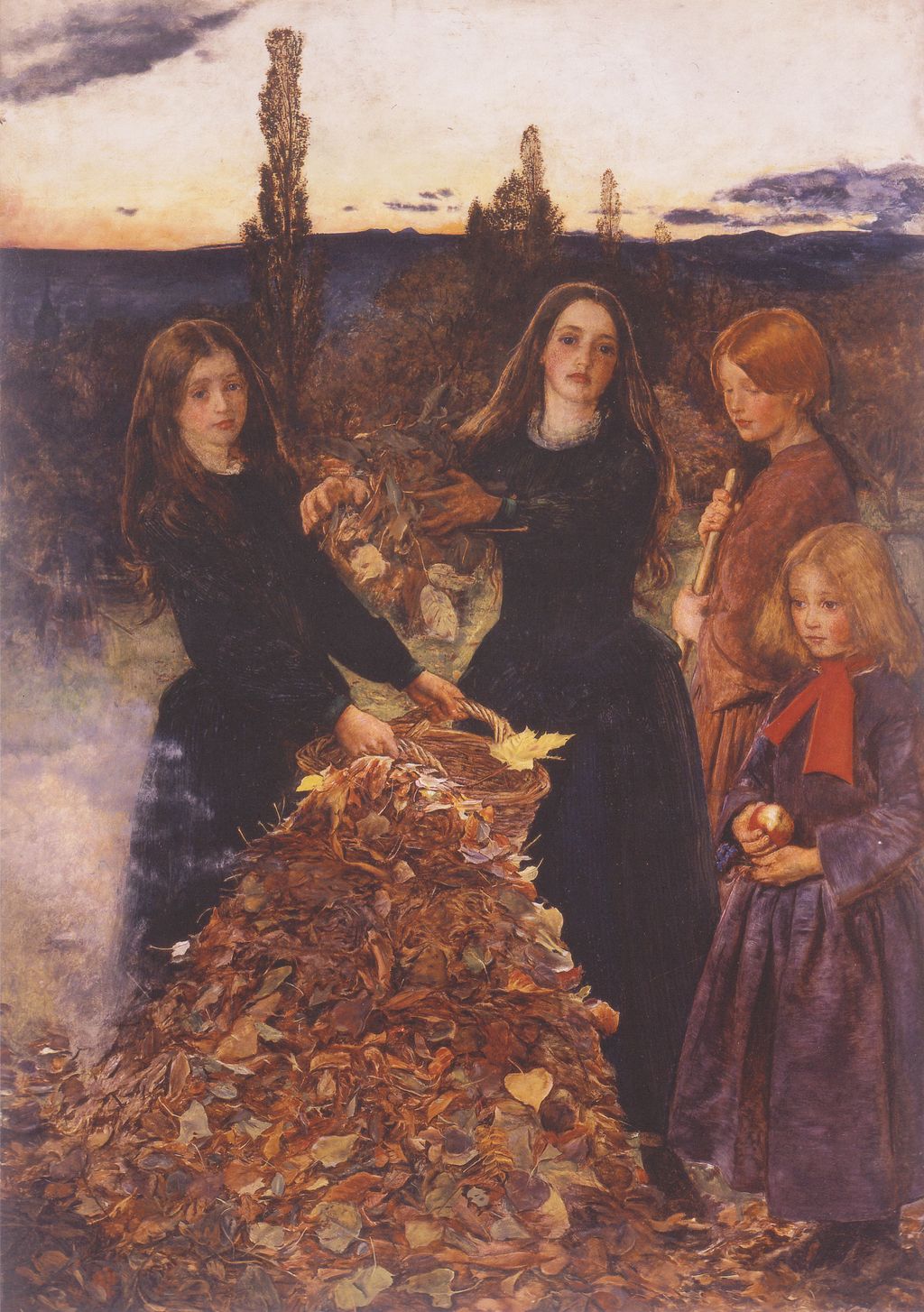
Autumn Leaves, oil on canvas, Manchester Art Gallery, 1892.4. From a scanned book reproduction. Set the graveyard against the earlier dusk and changing visibility of Autumn Leaves. Image source. Public domain.
Annotated Details from The Vale of Rest
The numbered points identify visible features discussed in this article. Return from each detail to the numbered overview. John Everett Millais, The Vale of Rest, 1858–59. Oil on canvas. Tate, N01507. Image source. Public domain.
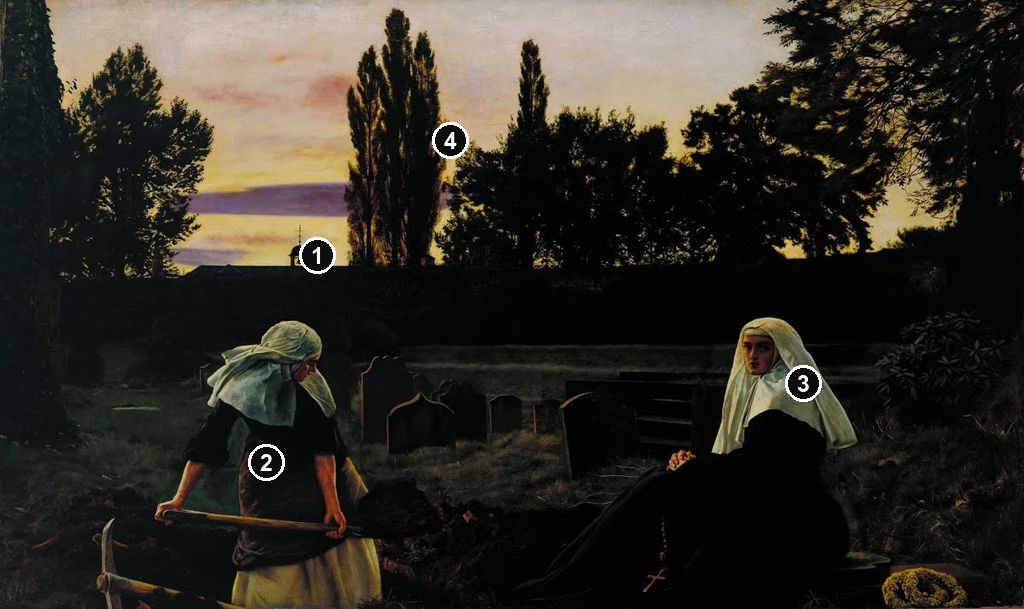
Details from THE VALE OF REST
Compare the cropped details with the source images above. Notice how their colours, shapes and positions contribute to the larger compositions.
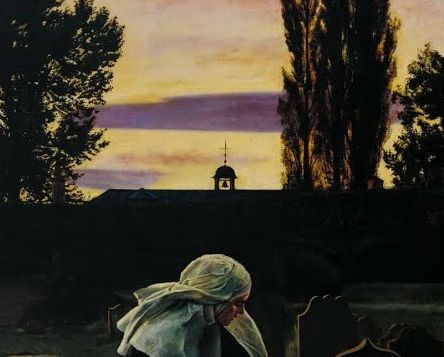
The bell above the wall
The small bell hangs in the brightest gap in the landscape. The high wall encloses the cemetery and leaves just this glimpse of a building.
The gravedigger at work
The figure bends towards the open earth. The long handle and her lowered arms show how much of the movement takes place below the viewer’s sightline.
The seated figure
The seated nun looks towards the viewer. Her lit wimple, dark clothing and rosary cross lead down to the near edge of the grave.
Light behind the poplars
Tall poplars stop the movement of the clouds and take their shape from the sky behind them. There is still colour above the wall when the lower garden has fallen into shadow.
John Everett Millais artwork directory
Browse paintings and drawings covered in these articles, including related works held in public collections. Reproductive engravings and editions are discussed on the Prints page.
Prints and illustrated editions
- The Baby-House, 1872. Etching by Millais.
- The Good Shepherd, 1864. Wood engraving designed by Millais, engraved and printed by the Dalziel Brothers.
- Mariana, 1857. Wood engraving designed by Millais and cut by the Dalziel Brothers for the Moxon Tennyson.
- The Proscribed Royalist, 1858. Mixed-method engraving by William Henry Simmons after Millais.
| Name | Date | Medium |
|---|---|---|
| Pizarro Seizing the Inca of Peru | 1846 | Painting |
| The Young Men of Benjamin Seizing Their Brides | 1847 | Painting |
| Isabella | 1848–49 | Painting |
| Christ in the House of His Parents (‘The Carpenter’s Shop’) | 1849–50 | Painting |
| Ferdinand Lured by Ariel | 1849–50 (monogram dated 1849) | Painting |
| Study for Christ in the House of His Parents, Tate N04623 | c. 1849 | Drawing |
| Study for Christ in the House of His Parents, Tate N04792 | c. 1849 | Drawing |
| Study for Mariana in the Moated Grange | 1850 | Drawing |
| A Huguenot, on St Bartholomew’s Day, Refusing to Shield Himself from Danger by Wearing the Roman Catholic Badge | 1851–52 (exhibited 1852) | Painting |
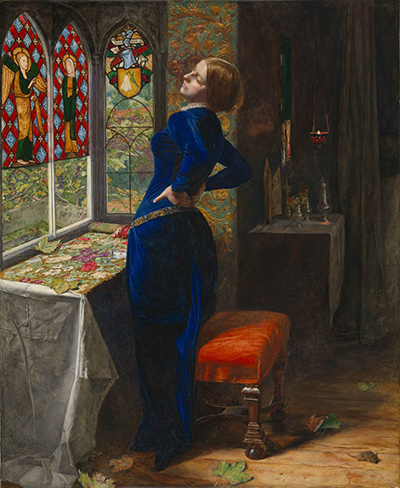
| Mariana | 1851 | Painting |
| Ophelia | 1851–52 | Painting |
| The Bridesmaid | 1851 | Painting |
| The Return of the Dove to the Ark | 1851 | Painting |
| The Order of Release 1746 | 1852–53 | Painting |
| The Proscribed Royalist, 1651 | 1852–53 (exhibited 1853) | Painting |
| Portrait of John Ruskin | 1853–54 | Painting |
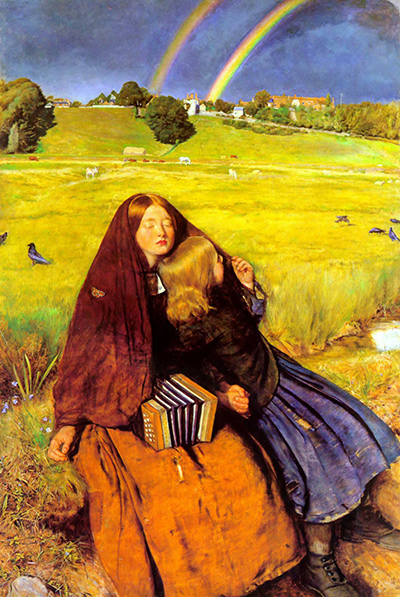
| The Blind Girl | 1854–56 | Painting |
| Autumn Leaves | 1855–56 (Manchester labels 1856) | Painting |
| A Dream of the Past: Sir Isumbras at the Ford | 1856–57, later revised | Painting |
| The Vale of Rest | 1858–59 | Painting |
| Study for The Black Brunswicker, Tate A00812 | c. 1860 | Drawing |
| Study for The Black Brunswicker, Tate A00813 | c. 1860 | Drawing |
| Study for The Black Brunswicker, Tate A00814 | c. 1860 | Drawing |
| The Black Brunswicker | 1860 | Painting |
| The Ransom | 1860–62 | Painting |
| My First Sermon | 1863 | Painting |
| My Second Sermon | 1864 | Painting |
| Joan of Arc | 1865 | Painting |
| Chill October | 1870 (exhibited 1871) | Painting |
| The Boyhood of Raleigh | 1870 | Painting |
| The Knight Errant | 1870 | Painting |
| Hearts are Trumps | 1872 | Painting |
| The North-West Passage | 1874 | Painting |
| Louise Jane Jopling | 1879 | Painting |
| William Ewart Gladstone, NPG 3637 | 1879 | Painting |
| Bubbles | 1886 | Painting |
| Portia | 1886 | Painting |
| Dew-Drenched Furze | 1889–90 | Painting |
| Ducklings | 1889 | Painting |
| Portrait of Sarah Hammond | 1891 | Painting |
Discussion
Look again at the images and ideas explored in The Vale of Rest. These editorial prompts invite your observations.
Reader Insights
Which nun catches your attention first, and how does the other figure pull it away?
Where does the remaining evening light change what you can see in the graveyard?
Join the Conversation
Share a detail, comparison or question about The Vale of Rest below.
References
- Tate Britain, The Vale of Rest, collection text and object record via Google Arts & Culture. View source.
- National Gallery of Australia, Love & Desire, checklist entry for Tate N01507. View source.
- John Guille Millais, The Life and Letters of Sir John Everett Millais, vol. I, pp. 164–168. View source.
- Ariel Kline, ‘Is the Painting a Grave? John Everett Millais and the Queer Refusals of Victorian Art’, British Art Studies, no. 24. View source.
- Royal Academy of Arts, Exhibition of Works by the Late Sir John Everett Millais, 1898, no. 9. View source.
- Grosvenor Gallery, Exhibition of the Works of Sir John E. Millais, 1886, entry no. 138 discussing the composition in connection with an ink drawing. View source.
- John Ruskin, Academy Notes for 1859, Library Edition of the Works, vol. XIV, pp. 212–215, with editorial notes. View source.
- Felix Mendelssohn Bartholdy, Ruhetal, Op. 59, no. 5, score from Sechs Lieder im Freien zu singen. View source.
- Adele Ernstrom, ‘Elizabeth Eastlake v. John Ruskin: The Content of Idea and the Claims of Art’, RACAR, vol. 37, no. 2, pp. 42–43. View source.
- Ayla Lepine, ‘Fabric of Devotion: William Quiller Orchardson’s The Story of a Life and Women Religious in Victorian Britain’, Yale MAVCOR. View source.
- Ashmolean Museum, Convent Thoughts by Charles Allston Collins, WA1894.10. View source.
- Greg W. Spangler, The Ambiguous Graveyard: Religious Sympathy and Erotic Desire in Sir John Everett Millais’s The Vale of Rest, University of Nebraska–Lincoln, thesis abstract. View source.
- The Economist, Royal Academy review, 28 May 1859. View source.
- National Museums Liverpool, Christopher Newall on Spring (Apple Blossoms), Lady Lever Art Gallery. View source.
- Illustrated London News, ‘The Choice of Paris: An Idyll’, commentary accompanying the engraving after Florence Claxton, 2 June 1860, p. 542. View source.
- National Trust, Florence Claxton, The Choice of Paris: An Idyll, watercolour version NT 1529624. View source.
- International Exhibition of 1862, Official Catalogue of the Fine Art Department, British Division, p. 37, nos. 649–650. View source.
- National Gallery of British Art, Illustrated Catalogue, no. 1507. View source.
- Masao Miyazawa, Bunkamura retrospective curatorial essay, ‘新たな美の探究’, 2008. View source. (in Japanese).
- Mecenate 90, Preraffaelliti. L’utopia della bellezza, Palazzo Chiablese, Turin, 2014 exhibition checklist, p. 9. View source. (in Italian).
- Museo Nacional de Arte and Tate, Landscapes of the Mind. Paisajismo británico. Colección Tate. 1690–2007, exhibition checklist, no. 56. View source.
- Sofia Zaust, study of Old Believer prayer dress in Mikhail Nesterov’s painted cycle, Heritage and Modern Times, 2021, fig. 4. View source. (in Russian).