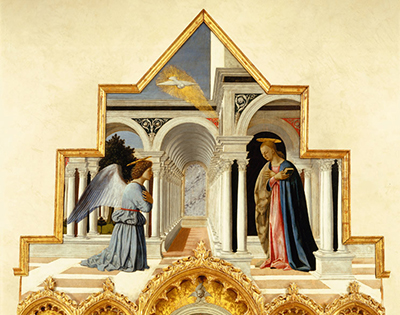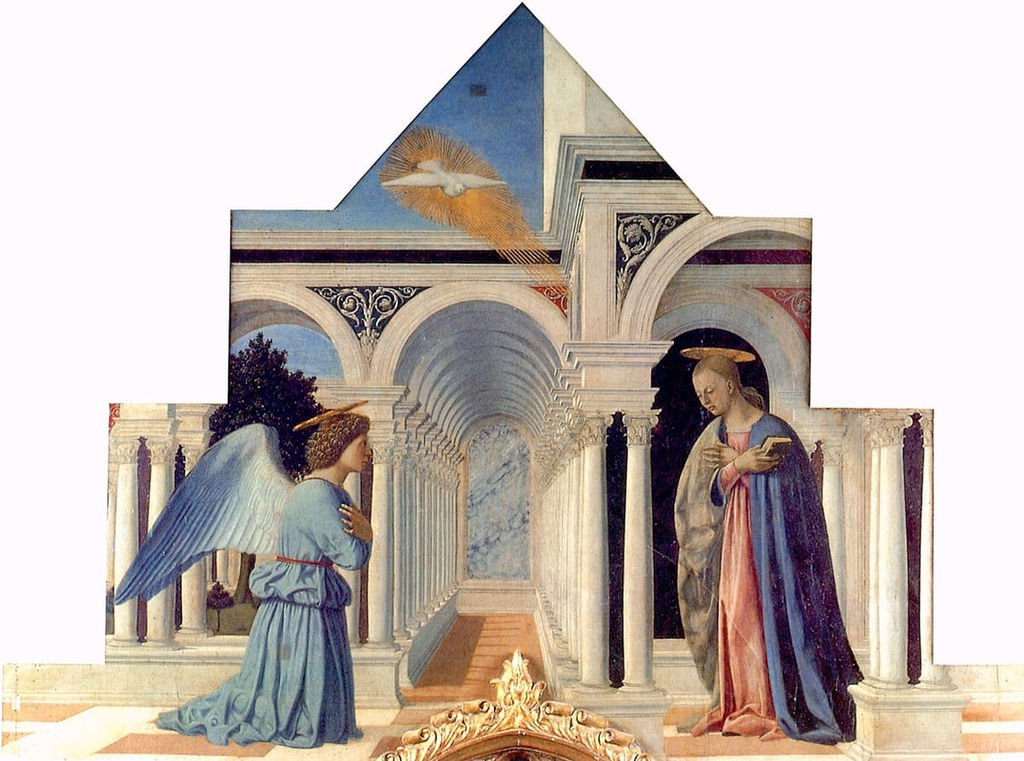
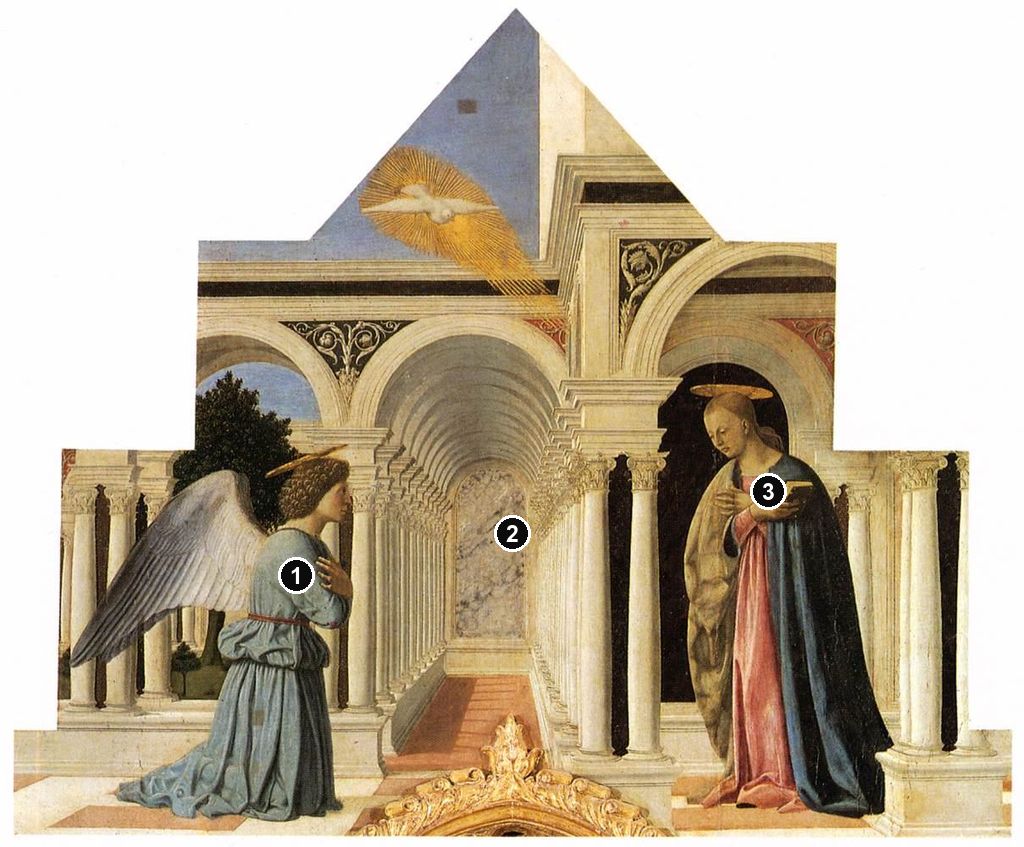
Piero della Francesca, Annunciation, crown of the Sant’Antonio Polyptych, Perugia. Image source. Public domain. Resized only; native appearance preserved.
 by Tom Gurney
Tom Gurney BSc (Hons) is an art history expert with over 20 years experience
Email: tomgurney1@gmail.com / Phone: +44 7429 011000
Annunciation (Perugia) by Piero della Francesca: Introduction
At the top of Piero della Francesca’s Sant’Antonio altarpiece, rows of pale arches recede between the angel Gabriel and the Virgin Mary. Gabriel kneels at the left. Mary stands beneath a portico at the right with her head tilted and a finger still in her book. High above them, the dove of the Holy Spirit sends fine rays towards her. The panel, now in the Galleria Nazionale dell’Umbria in Perugia, invites a viewer to follow two paths at once. Gabriel’s greeting crosses the foreground from left to right, while the architecture draws the eye straight into the distance. The apparent ease of that arrangement conceals a question. What could Gabriel see of Mary from where he kneels? [1] [2] [3]
At a Glance
- ArtistPiero della Francesca. [2]
- DateAbout 1468–1470 for the panel. The Galleria Nazionale dell’Umbria dates the whole altarpiece to about 1467–1469. [1] [2]
- PositionThe crowning panel, or cimasa, of the Sant’Antonio polyptych. [1] [2]
- MediumOil on wood in the national component record. The museum catalogues the full altarpiece as tempera and oil on wood. [1] [2]
- Original settingThe high altar of the external church of the Franciscan sisters’ Sant’Antonio monastery in Perugia. [1] [2]
- CollectionGalleria Nazionale dell’Umbria, Palazzo dei Priori, Perugia. Inventory 111. [1] [2]
This work across Piero della Francesca’s career
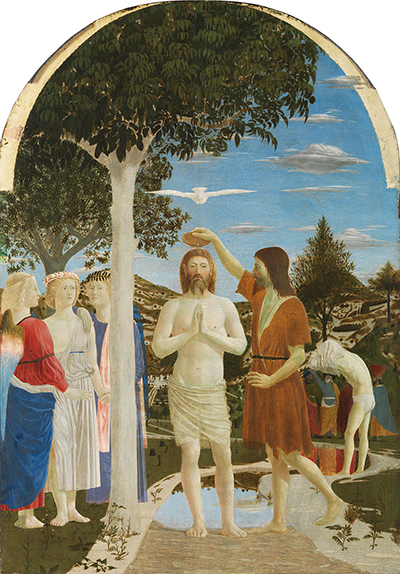
The Baptism of Christ
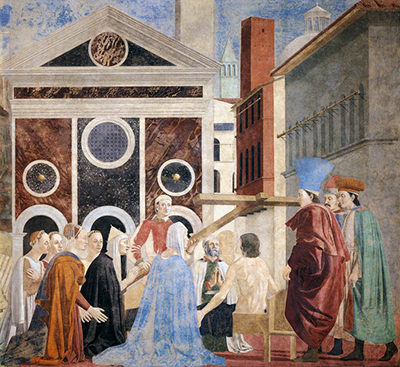
Probably about 1437–45The History of the True Cross
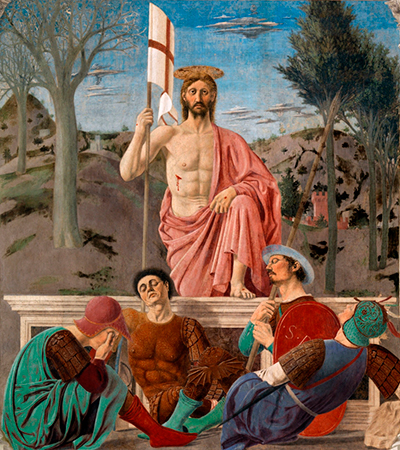
Mid-fifteenth centuryThe Resurrection
About 1458–68 (Opificio)The Flagellation of Christ
1459–60 (GNDM)Annunciation (Perugia) (current article)
About 1468–70 (national catalogue)The Montefeltro Altarpiece
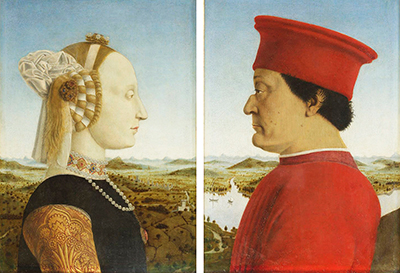
About 1472–74 (Brera)The Duke and Duchess of Urbino
About 1473–75 (Uffizi)The Nativity
Early 1480s (National Gallery)Contents
- Gabriel’s greeting and Mary’s reply
- How the corridor makes depth visible
- What can Gabriel see?
- Why the panel has a stepped outline
- The date and the other Annunciation
- Annotated details
Gabriel’s greeting and Mary’s reply
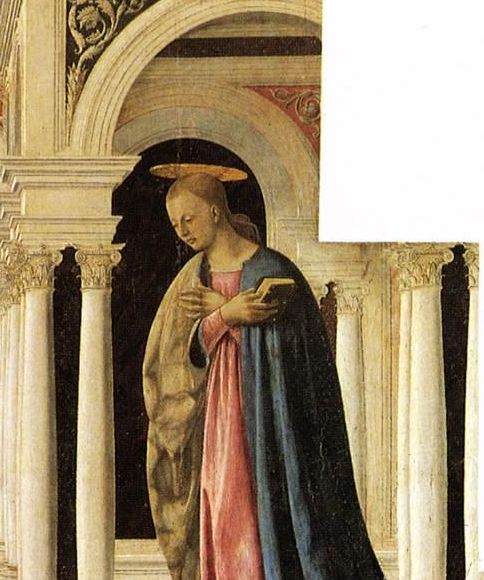
In Luke’s Gospel, Gabriel announces to Mary in Nazareth that she will bear a son named Jesus. She asks how this can happen, and Gabriel tells her that the Holy Spirit will come upon her. She accepts what she has been told. Piero compresses this exchange into the angle of two bodies and the repetition of a gesture. Gabriel folds his arms across his chest, and Mary answers with a similar movement. She lowers her eyes and inclines her head. The closeness of her hands to her body and the small opening of the book convey a pause in reading. Harriet Edquist, drawing on the sequence of Mary’s responses described in a fifteenth-century sermon by Roberto Caracciolo, identified her bearing with the moment of acceptance. [3] [4] [5]
Piero gives the two figures different kinds of shelter. Behind Gabriel, a tree rises into the open arch. The museum connects the tree with the hortus conclusus, the enclosed garden associated with Mary’s virginity. Mary stands under a roof, with a wall immediately behind her and columns at the front of her space. The dove occupies the summit of the panel, above the spring of the arches. Its diagonal rays introduce a third path for the eye, from above down towards Mary. You can distinguish this path from Gabriel’s position in the courtyard and from the route the pavement takes into depth. The three directions bring together the greeting, the coming of the Holy Spirit and the narrow place in which Mary receives them. [1] [3] [4] [6]
How the corridor makes depth visible
Start with the paving. The edges of the bands that run away from the front of the picture converge towards the centre of the corridor. The transverse divisions, which run across the floor, appear closer together the farther back they go. These are two effects of the same projection. The first establishes the direction into the picture. The second tells us how quickly equal intervals diminish to the eye. You can read the same progression higher up in the capitals and curved profiles of the arches. A near column cuts across parts of those behind it, so that overlap confirms the order already suggested by the decreasing scale. The eye can judge the distance through several cues even where a single feature is partly hidden. [1] [6] [7]
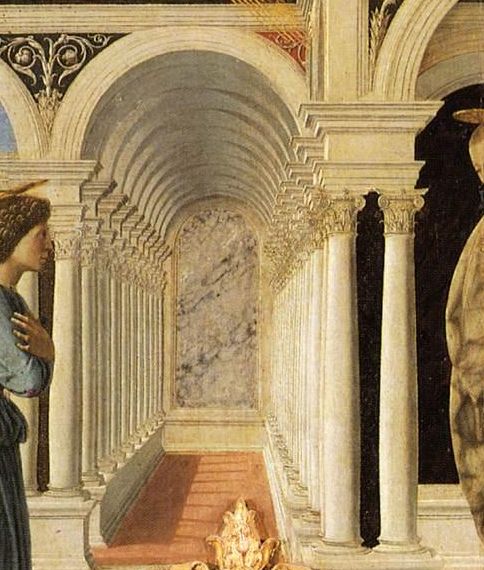
The paired columns leave a narrow opening down the middle of the portico. Its edges tighten rapidly towards a pale, varied surface at the far end. In his graphic analysis of the panel, Matteo Flavio Mancini points out that this surface can initially be taken for sky. Compare it with the open blue behind Gabriel. The centre has a mottled texture, like a panel of polished stone, and the arcade terminates there. The painting offers a long, seemingly walkable passage and a visible boundary to that passage. Its architecture also appears to continue sideways beyond the stepped outline. Near the edges of the picture we see portions of a larger building whose full extent the panel leaves to the imagination. [6] [8]
Light makes individual bays easier to distinguish. Koichi Toyama and Masato Naito draw attention to the carefully shaped shadows of the columns in the cloister and to the comparative lack of pronounced cast shadows from the two foreground figures. Gabriel and Mary are shaded, so their clothes and bodies have volume. Their footing has much less of the emphatic light-and-dark pattern that defines the passage. A viewer can follow that pattern into the distance and then return to the broad, comparatively quiet foreground where the exchange takes place. [9]
The museum relates the construction to De prospectiva pingendi, Piero’s treatise on perspective for painters. His work on mathematics and perspective helps explain how the painted pavement can be understood as a measurable surface. It also gives modern researchers a way to work backwards from the visible lines and test how the building might be laid out. Roberto de Rubertis did this through a computer-assisted reconstruction. He questioned the argument that the column involved in the awkward sightline could be explained as the consequence of an empirical workshop procedure using two distance points. Such points are geometrical aids for projecting distances on a level surface. A painter can use them to lay out a pavement whose edges, in the main direction of recession, still converge towards one central vanishing point. [1] [6] [7] [10]
Annotated Details from Annunciation (Perugia)
The numbered points identify visible features discussed in this article. Return from each detail to the numbered overview. Piero della Francesca, Annunciation, crowning panel of the Sant’Antonio Polyptych, Perugia. Image source. Public domain.
Details from ANNUNCIATION (PERUGIA)
Compare the cropped details with the source images above. Notice how their colours, shapes and positions contribute to the larger compositions.
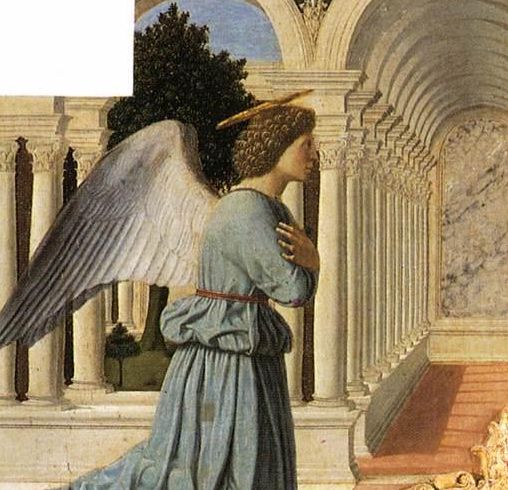
Gabriel at the entrance
Gabriel kneels where the side arches open to the left. His visible wing is sharply distinguished from the repeated pale shafts behind him.
The retreating arcade
Pairs of supports and the receding pavement draw the eye into the central passage. The patterned wall at the far end cuts off the view.
Mary under the arch
Mary turns her head down at the right. The shadowed door makes the light areas of her face and gown easier to discern.
What can Gabriel see?
Gabriel and Mary appear to face each other across an unobstructed foreground. Their feet are set along the same light band of paving. Imagine tracing that strip from the angel towards Mary and asking where it passes in relation to the column bases. Now look up at the adjoining arches. One of the supports implied by the architecture overlaps other parts of the portico from our viewpoint. Its position is easier to make out from the pavement and the arch it carries than from the outline of its shaft alone. When the Italian art historian Thomas Martone reconstructed the building from the painted evidence, he placed a column between the figures along their line of sight. From the front, the viewer can see both figures. Within the reconstructed courtyard, an ordinary line of sight from Gabriel’s position would encounter the support. [8] [11]
The distinction has two consequences. First, the converging lines down the corridor describe what the painting’s viewer sees. Gabriel looks across that direction, from within the space. An obstacle on his axis can belong to a consistent perspective from ours. Second, his greeting still reaches Mary. Her response is legible in her lowered head and folded arms, and the rays travel towards her from above. The painting gives us everything we need to recognise the exchange even as the layout complicates what an observer standing beside Gabriel might see. [3] [8] [11]
Daniel Arasse treated the difficulty as a way to picture the Incarnation, a mystery that has visible effects and exceeds what can be seen. In his reading, the hidden obstruction and the strangely distinct veining at the back of the colonnade both matter. The eye expects the texture to lose definition over such a long distance. Piero lets it register as a surface even as the intervening arches insist on depth. Harriet Edquist also read the architecture through the difficulty of giving the Incarnation a visible form. Her argument dwells on how ambiguity itself can work as a devotional metaphor. Petitot goes a step further. He suggests that the pillar can bar Mary’s ordinary vision even as Gabriel, understood as a spiritual being, can look through it. The same reconstructed plan can therefore support different readings of what the figures perceive. These interpretations begin with things a reader can test in the picture. The further claim that Piero intended a particular theological meaning belongs to the history of its interpretation. [5] [8] [11] [12]
Why the panel has a stepped outline
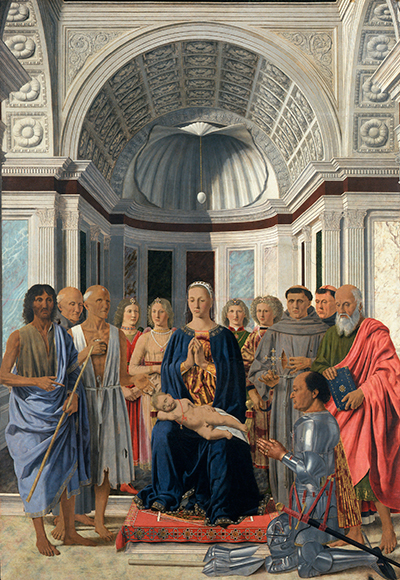
The Annunciation is the cimasa, the crowning compartment of the Polyptych of Perugia. The Franciscan Third Order sisters commissioned the altarpiece for the external church of their monastery of Sant’Antonio da Padova, near Porta Sant’Angelo. There, the stepped upper edge rose above the main tier with the enthroned Virgin and Child and standing saints. Read from top to bottom, Gabriel’s announcement is followed by the image of Mary with the child whose birth he has announced. The form makes another change conspicuous. The main tier gathers its figures against gold, while the summit opens onto sky and carries the eye into the depth of a building. Writing in the sixteenth century, Giorgio Vasari singled out this combination of Gabriel’s apparent descent from heaven and the beauty of the diminishing columns. His description already places both effects above the Virgin and Child in the church of the sisters of Sant’Antonio. [1] [2] [8] [13]
The differences in scale, light and setting fed a debate about whether the top was conceived separately. In his 1954 restoration report, Cesare Brandi distinguished the step-shaped edge of the original painted field from the later frame. He also reported that the upper board was narrower than the body of the altarpiece, with strips added on either side, and that the painted boundaries around the arches did not precisely follow their framed profiles. He took these details and the painting’s markedly different appearance as reasons to consider a separate conception possible. The national catalogue records evidence from a later restoration which favours a unified design. Lines snapped with a cord and marks made with a scratching tool were found across the boards and read as traces of a coordinated layout. Those findings address the assembly and preparation of the altarpiece. Within a unified structure Piero could vary his materials and method from one tier to the next. [2] [14]
Brandi’s report describes another attempt to reconcile the appearance of the two tiers. During an earlier treatment, a greyish tempera wash had been spread over the Annunciation, covering both old paint and filled losses to make the difference in tone less pronounced. Brandi’s team reduced and evened out the wash during cleaning. Their photographs show sample areas during treatment. This history helps explain why older observers, photographs and the surface visible today can give different impressions of the light in the arcade. [14]
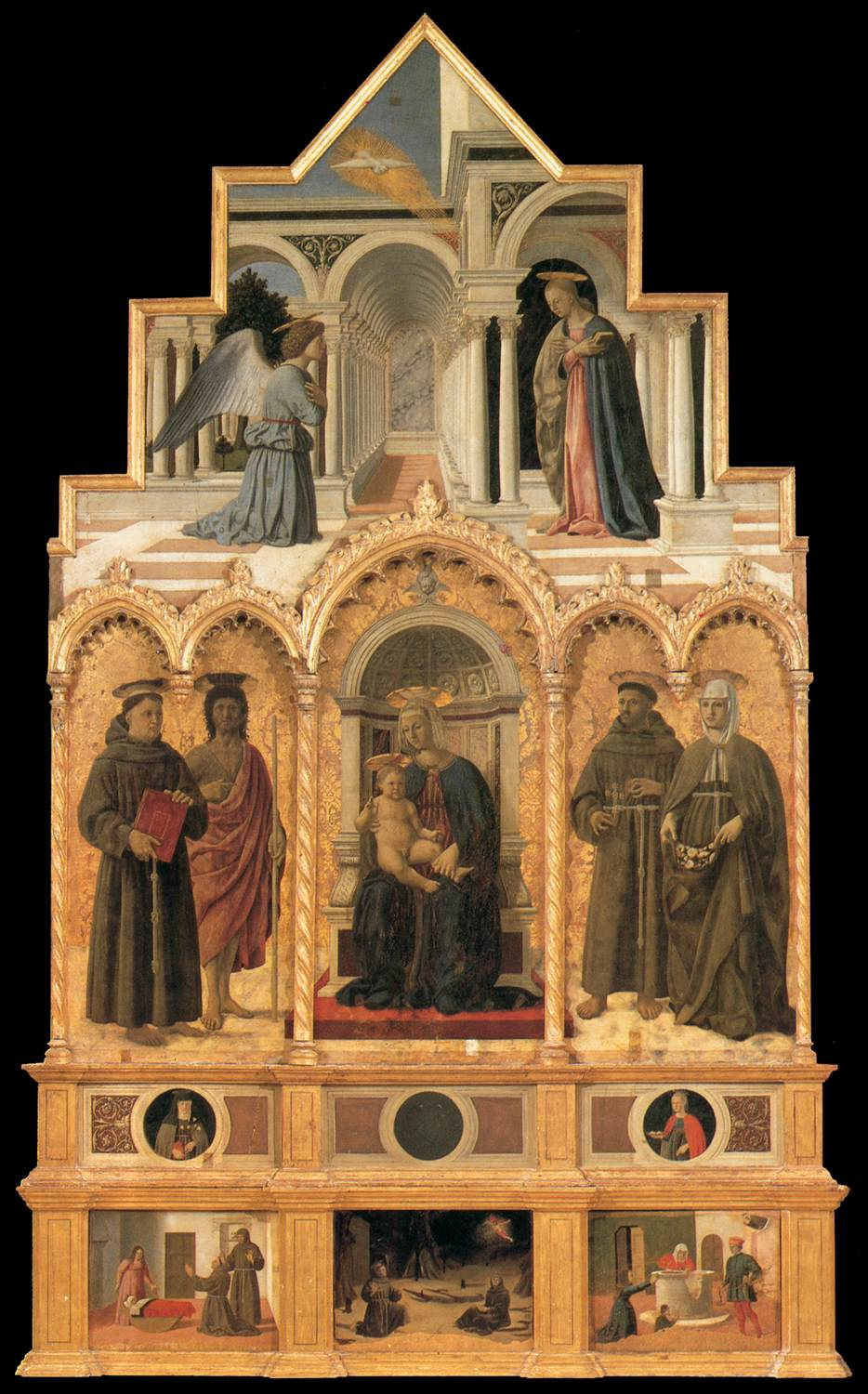
Sant’Antonio Polyptych in its current assembly, Galleria Nazionale dell’Umbria, Perugia. Image source. Public domain. Resized only; native appearance preserved.
The date and the other Annunciation
The Galleria Nazionale dell’Umbria dates the full altarpiece to about 1467–1469. Italy’s national catalogue dates the Annunciation compartment to about 1468–1470. A municipal grant in 1468 provides the documentary point of reference. According to the national catalogue, the city granted the sisters fifteen florins towards a panel that had already been made, which the historian Francesco Federico Mancini associated with Piero’s commission. The record concerns the commission and its funding. It gives no date for the painting of a particular figure, corridor or board. The same entry notes Vittoria Garibaldi’s earlier proposal of a date close to Piero’s 1459 stay in Rome, based in part on the treatment of reflective materials and glass in the main tier. That argument starts from affinities in the painting. The 1468 document supplies a different kind of evidence for the ensemble. [1] [2]
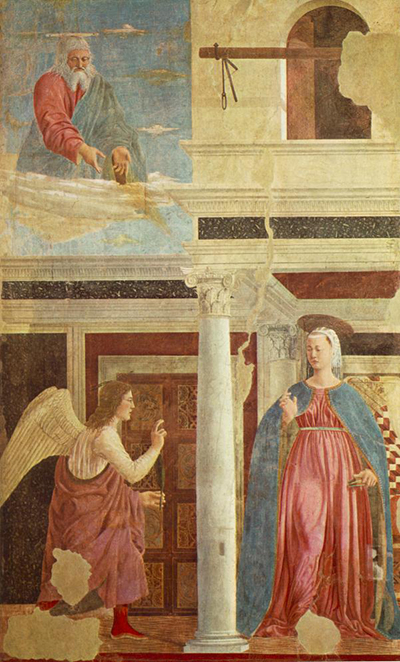
Piero had already painted an Annunciation in Arezzo as a fresco for the History of the True Cross cycle at San Francesco. There, the encounter occupies a tall field on the chapel wall, with God the Father above Gabriel and a prominent column dividing the foreground. At Perugia the scene spreads sideways on wood beneath a stepped edge, with the dove at the top and whole ranks of columns leading away from the exchange. There is also a precedent for the broad arrangement in Domenico Veneziano’s Annunciation for the St Lucy Altarpiece, now at the Fitzwilliam Museum. Domenico places the figures on either side of the central depth and ends it at a closed door. Piero takes the eye through a series of bays to a veined surface, and his forward supports make the lateral relation of the figures hard to reconstruct at a glance. [3] [5] [6] [11] [12] [15] [16]
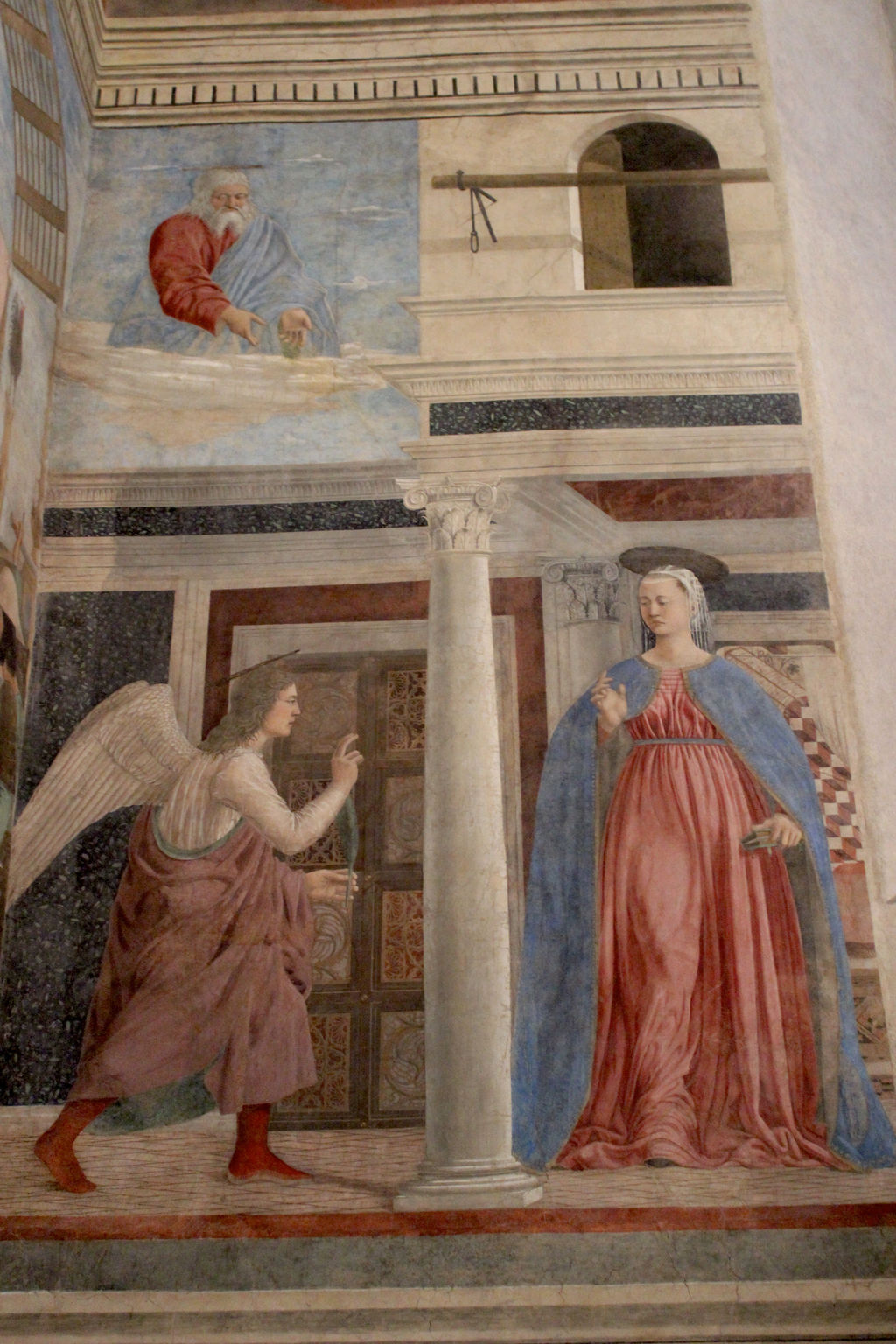
Piero della Francesca, Annunciation, Bacci Chapel, Arezzo. Miguel Hermoso Cuesta. Image source. CC BY-SA 4.0. Resized from the source. This reproduction uses CC BY-SA 4.0.
Browse the artworks
Compare Piero’s frescoes, panels and manuscript figures. The list includes ensembles and separately identifiable panels or scenes. Dates are approximate where the sources differ.
| Name | Date | Medium and source |
|---|---|---|
| The Baptism of Christ | Probably c. 1437–45 | Panel painting Catalogue. |
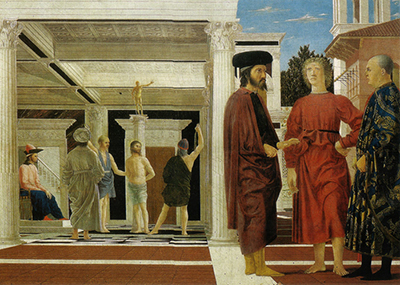
| The Flagellation of Christ | 1459–60 (GNDM) | Panel painting Catalogue. |
| The History of the True Cross | Mid-fifteenth century | Wall painting Catalogue. |
| Dream of Constantine | Mid-fifteenth century | Wall painting Catalogue. |
| The Duke and Duchess of Urbino | About 1473–75 (Uffizi) | Panel painting Catalogue. |
| The Resurrection | About 1458–68 (Opificio) | Wall painting Catalogue. |
| Brera Madonna | About 1472–74 | Panel painting Catalogue. |
| Annunciation at Arezzo | Mid-fifteenth century | Wall painting Catalogue. |
| Madonna del Parto | About 1450–65 (Monterchi) | Wall painting Catalogue. |
| Polyptych of the Misericordia | Commissioned 1445 | Panel painting Catalogue. |
| The Nativity | Early 1480s (National Gallery) | Panel painting Catalogue. |
| Madonna di Senigallia | About 1474–75 (GNDM) | Panel painting Catalogue. |
| Death of Adam | Mid-fifteenth century | Wall painting Catalogue. |
| Queen of Sheba | Mid-fifteenth century | Wall painting Catalogue. |
| Victory of Constantine | Mid-fifteenth century | Wall painting Catalogue. |
| Battle between Heraclius and Chosroes | Mid-fifteenth century | Wall painting Catalogue. |
| Saint Mary Magdalen | Wall painting Catalogue. | |
| The Augustinian Polyptych | 1454–69 | Panel painting Catalogue. |
| Polyptych of Perugia | About 1467–69 (GNU) | Panel painting Catalogue. |
| Perugia Annunciation | About 1468–70 (national catalogue) | Panel painting Catalogue. |
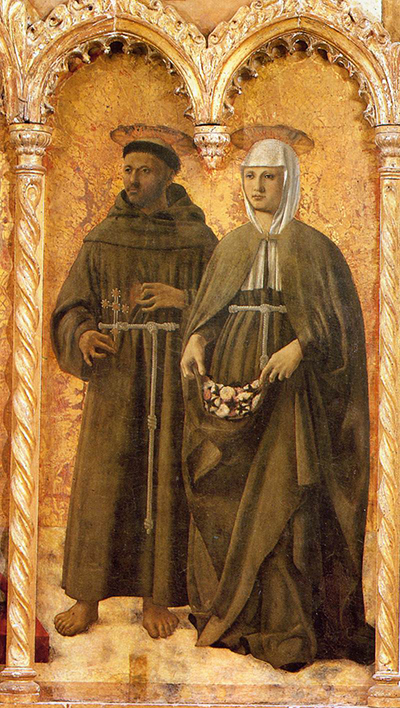
| St Francis and St Elizabeth | About 1467–69 (GNU) | Panel painting Catalogue. |
| Stigmatisation of St Francis | About 1468–70 (national catalogue) | Panel painting Catalogue. |
| An Augustinian Nun (Saint Monica) | 1454–69 | Panel painting Catalogue. |
| Augustinian Saint | 1454–69 | Panel painting Catalogue. |
| Saint Michael | 1454–69 | Panel painting Catalogue. |
| Saint Nicholas of Tolentino | 1454–69 | Panel painting Catalogue. |
| Saint John the Evangelist | 1454–69 | Panel painting Catalogue. |
| Virgin and Child Enthroned with Four Angels | About 1460–70 (Clark) | Panel painting Catalogue. |
| Portrait of Sigismondo Pandolfo Malatesta | About 1450–51, often proposed. Louvre catalogue range 1450–75. | Panel painting Catalogue. |
| Sigismondo before St Sigismund | 1451 | Wall painting Catalogue. |
| St Jerome and a Donor | 1460s (Accademia); about 1450 also proposed | Panel painting Catalogue. |
| St Jerome in Penitence | 1450, dated on the panel | Panel painting Catalogue. |
| Saint Julian | About 1455–60, often proposed | Wall painting Catalogue. |
| Saint Augustine | 1454–69 | Panel painting Catalogue. |
| Saint Apollonia | 1454–69 | Panel painting Catalogue. |
| Crucifixion from the Augustinian Polyptych | 1454–69 | Panel painting Catalogue. |
| Saint Louis of Toulouse | Wall painting Catalogue. | |
| Burial of the Wood | Mid-fifteenth century | Wall painting Catalogue. |
| Discovery and Proof of the True Cross | Mid-fifteenth century | Wall painting Catalogue. |
| Exaltation of the Cross | Mid-fifteenth century | Wall painting Catalogue. |
| Saint Anthony Raises a Child | About 1467–69 (GNU) | Panel painting Catalogue. |
| Saint Elizabeth Revives a Child | About 1467–69 (GNU) | Panel painting Catalogue. |
| Hercules | About 1470 | Wall painting Catalogue. |
| Portrait of a Boy (possibly Guidobaldo da Montefeltro) | Panel painting Catalogue. | |
| De prospectiva pingendi, Reggio Emilia witness (figures) | Manuscript diagrams Catalogue. | |
| The Interrogation of Judas | Mid-fifteenth century | Wall painting Catalogue. |
| Two prophets, Bacci Chapel | Mid-fifteenth century | Wall painting Catalogue. |
| Saint Clare of Assisi, upper predella | About 1467–69 (GNU) | Panel painting Catalogue. |
| Saint Agatha, upper predella | About 1467–69 (GNU) | Panel painting Catalogue. |
| Lost centre of the Augustinian Polyptych | 1454–69 | Lost panel or panels Catalogue. |
Frequently Asked Questions
Discussion
Look again at the images and ideas explored in Annunciation (Perugia) by Piero della Francesca. These editorial prompts invite your observations.
Reader Insights
Follow the pavement first, then the arches. Which gives you a clearer sense of how quickly the space recedes?
Look at Mary’s hand, the open book and Gabriel’s folded arms. Where in their conversation would you place this moment?
Compare the central arcade with the enthroned Virgin and saints below. Where does your eye settle in each tier, and what makes it stay there?
Join the Conversation
Share a detail, comparison or question about Annunciation (Perugia) by Piero della Francesca below.
References
- Galleria Nazionale dell’Umbria. Polittico di Sant’Antonio. Collection record for the altarpiece. View source.
- Ministero della Cultura, Catalogo generale dei Beni Culturali. Annunciazione, 1000016171-1. National record for the component. View source.
- Galleria Nazionale dell’Umbria. Piero della Francesca – Sala 13. Guide to the panel and tactile model. View source.
- Luke 1:26–38. New American Bible, Holy See. View source.
- Harriet Edquist. ‘Walking in the Way of Metaphors and Enigmatic Images’: Piero Della Francesca’s Perugia Annunication. Australian Journal of Art 6, no. 1 (1987), pp. 4–16. View source.
- Matteo Flavio Mancini. ‘Measuring the Infinite. Space and Perspective between Piero della Francesca and Andrea Pozzo’. Measure / Out of Measure. Transitions. FrancoAngeli, 2024, pp. 3221–3242. View source.
- Roberto de Rubertis. ‘Cronaca di una prospettiva “annunciata”’. XY Dimensioni del disegno, no. 20 (1994), pp. 3–10. Opening pages and reconstruction plate. View source.
- Giuseppe Longo and Sara Longo. Infini de Dieu et espace des hommes en peinture, conditions de possibilité pour la révolution scientifique. Section on the Perugia altarpiece and Martone’s reconstruction. View source.
- Koichi Toyama and Masato Naito. ‘A Comparative Survey on the Rendering of Shade and Shadow in Painting: Edo Period Japan and Italian Early Renaissance’. CARLS Series of Advanced Study of Logic and Sensibility 1, pp. 325–338, Keio University repository. View source.
- Piero della Francesca. De prospectiva pingendi. Edited by Chiara Gizzi. Edizioni Ca’ Foscari, 2016. View source.
- Jean Petitot. ‘La non généricité chez Piero della Francesca’. Section II, with diagrams from Thomas Martone’s reconstruction. View source.
- Neville Rowley. ‘Daniel Arasse en perspective: une apostille à L’Annonciation italienne’. Revista de História da Arte e Arqueologia 6. View source.
- Giorgio Vasari. ‘Piero della Francesca’. Le vite de’ più eccellenti pittori, scultori e architettori, 1568 edition. View source.
- Cesare Brandi. ‘Restauri a Piero della Francesca’. Bollettino d’Arte, fourth series, fasc. III (1954), section on the Sant’Antonio altarpiece. View source.
- Fondazione Federico Zeri, Università di Bologna. Piero della Francesca, Annunciazione (Arezzo). Record for the San Francesco fresco. View source.
- The Fitzwilliam Museum. Domenico Veneziano, The Annunciation. Collection record for the St Lucy predella panel. View source.