 by Tom Gurney
Tom Gurney BSc (Hons) is an art history expert with over 20 years experience
Published on June 19, 2020 / Updated on October 14, 2023
Email: tomgurney1@gmail.com / Phone: +44 7429 011000
The Resurrection by Piero della Francesca: Introduction
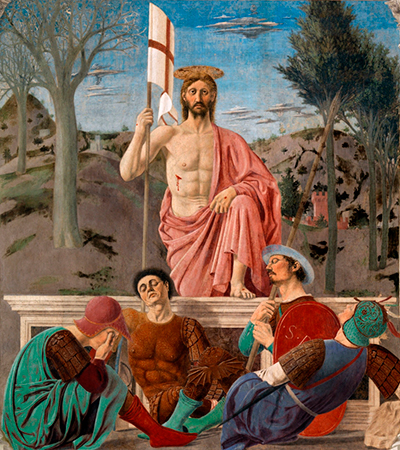
Christ stands in an open tomb with one bare foot planted on the rim. He holds a white banner marked with a red cross, gathers his rose-coloured robe at the knee and looks out of the picture. Four guards have fallen asleep at the foot of the tomb. Their elbows, helmets, shields and bent legs crowd the foreground. Above them, the risen Christ has room to stand and the hills recede on either side of him. The whole scene is quiet enough that the first sign of movement may be the simple fact that Christ’s weight is already on the foot that will carry him out. [1] [2]
Piero painted The Resurrection in the fifteenth century for the civic world of his native Sansepolcro. It is now in the Museo Civico in the Palazzo della Residenza, the former seat of the town’s magistrates. The museum dates it to about 1460. Conservation work completed in 2018 has given historians reasons to consider a date later in the 1460s, as well as evidence that the mural was moved with part of its original brick wall. The painting has stayed part of the town’s public life through changes in where and how people saw it. [1] [2] [3]
At a Glance
- ArtistPiero della Francesca. [1] [2]
- TitleThe Resurrection (La Resurrezione). [1] [2]
- DateAbout 1460 in the museum’s dating. The Opificio uses a working range of 1458–68. [1] [2] [4]
- MediumMural on brick and plaster, combining fresco and extensive work on dry plaster. [1]
- LocationMuseo Civico, Palazzo della Residenza, Sansepolcro, Tuscany. [1] [2] [3]
- ConservationThe recent treatment was completed in 2018. [1] [4]
This work across Piero della Francesca’s career
The Baptism of Christ
Probably about 1437–45The History of the True Cross
Mid-fifteenth centuryThe Resurrection (current article)
About 1458–68 (Opificio)The Flagellation of Christ
1459–60 (GNDM)The Montefeltro Altarpiece
About 1472–74 (Brera)The Duke and Duchess of Urbino
About 1473–75 (Uffizi)The Nativity
Early 1480s (National Gallery)Contents
- Christ, the tomb and the four guards
- What the trees and hills contribute
- A Resurrection for Sansepolcro
- The wall the painting travelled with
- How Piero put paint on the wall
- What changed in the 2015–18 restoration
- From Vasari to Huxley and the wartime recollection
- Annotated details
Christ, the tomb and the four guards
The tomb establishes the distance between the figures. Its long upper edge runs straight across the scene and makes a firm ledge for Christ’s foot. We can see a little of the stone’s upper surface, as we might if we looked towards a chest from nearby. The men sit well below that edge, with some shoulders and heads crossing it so that their bodies seem to occupy the space immediately in front of the tomb. Christ’s lower leg disappears behind it. The arrangement lets us see his body still partly enclosed even as his upper body is clear against the sky. [1] [2]
Follow the line of Christ’s raised leg, from the weight of the cloth at his knee down to the foot. His left hand draws the fabric over the leg without entirely hiding its shape. On the other side, his right hand grips the almost vertical staff. Look back up from the hand and the narrow flag takes the eye close to the top of the painting. The movement towards the viewer takes place inside that strong upright arrangement. The gaze seems steady partly because the body is held steady, and partly because the bends and tilts everywhere below it make the head’s position so conspicuous. [1] [2]
The soldiers fill the lower half with different ways a body can give way to sleep. At the left, a guard in a reddish cap leans into his hand, his cloak falling heavily around his bent back. Beside him a bareheaded man slumps with his eyes closed and his face partly turned towards us. A soldier under a broad pale-blue helmet tips his head back and clasps the shaft that crosses his torso. At the far right the nearest figure turns most of his back towards us, bringing his blue garment and the curved shape of the group into the foreground. The poses overlap so fully that individual limbs take a moment to untangle. The large red shield brings the eye back to the group whenever it begins to climb towards the banner. [1] [2]
A loose triangle grows out of those bodies. It is broadest where the men are seated and narrows through the rising edges of Christ’s arm and clothing to the head. Aldous Huxley picked out this triangular structure in 1925 and thought it made the act of rising visible through the arrangement of the figures. It is worth looking for the features that interrupt the triangle too. The banner is off-centre, the knee projects on the opposite side, and the foreground is packed more tightly on the right. The underlying geometry makes room for the awkwardness of sleeping bodies and the uneven effort of stepping up. [1] [2] [5]
The guards belong to the tradition of picturing the Christian Resurrection. In the Gospel of Matthew the authorities arrange for a guard and seal the stone. At dawn an angel rolls it away and the guards collapse in fear. Later they are paid to spread the claim that the disciples took the body while they slept. Piero gives us a different kind of access to the event. The stone chest and the upright figure make Christ’s emergence visible, and the soldiers give us a measure of how quietly that emergence takes place. The witnesses within the picture are unavailable. Christ’s gaze leaves the person looking at the mural to see what the guards have missed. [1] [2] [6]
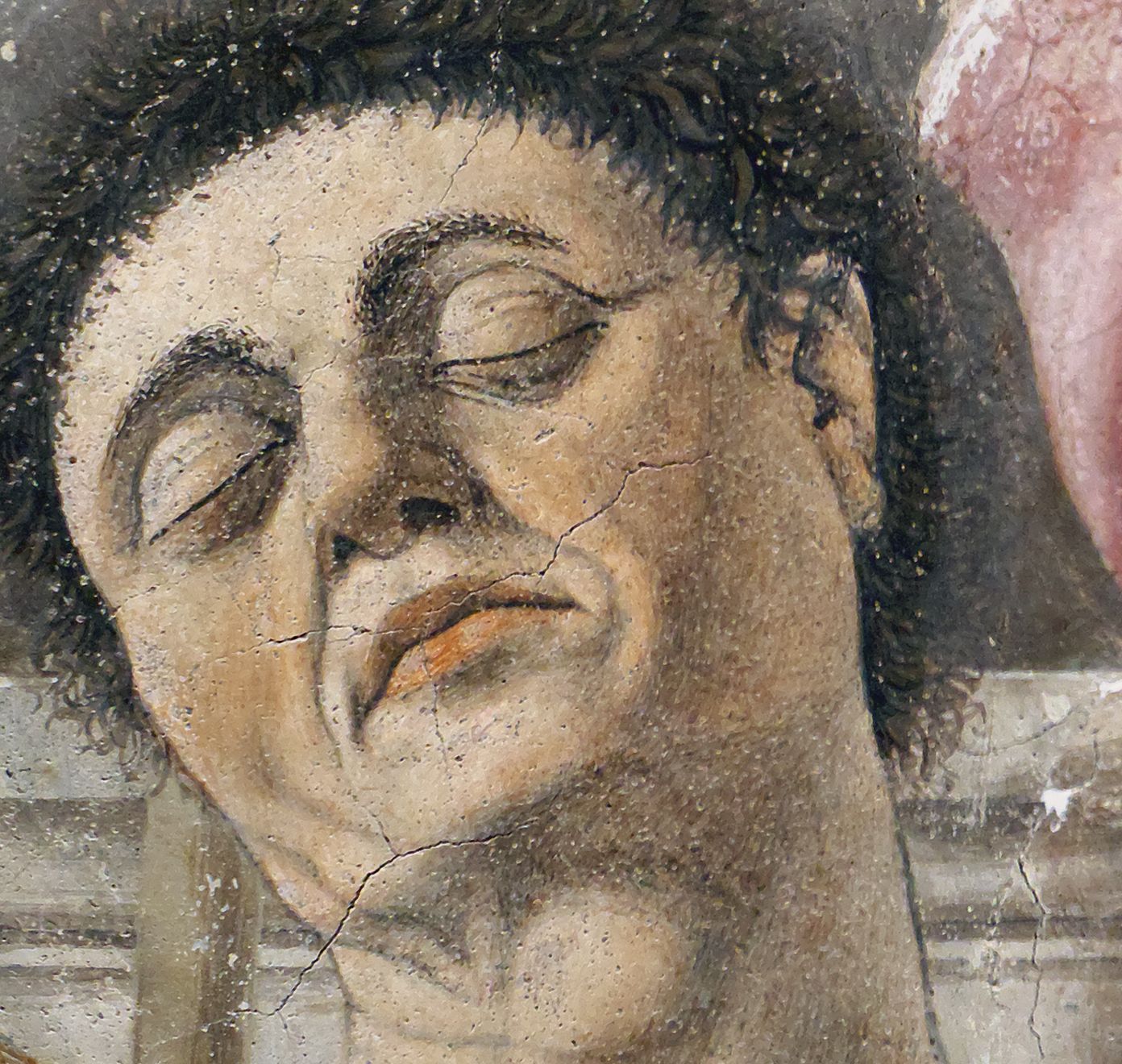
The bareheaded soldier has long been suggested as a self-portrait. The Opificio delle Pietre Dure notes features including the curls, the deep-set eyes and the dimpled chin that recur in other figures sometimes thought to portray the painter. Later representations of Piero took up those features. A resemblance to a later likeness can therefore lead straight back to the same tradition. The identification remains possible. The soldier’s clearly visible closed eyes draw attention to Christ’s steady gaze. [1] [2]
What the trees and hills contribute
At the left, the sky shows through a network of mostly bare branches. At the right, the trees make a dense, dark mass. The division falls on either side of Christ without looking like a division drawn down the middle. Between the trunks are pale slopes and small darker shapes that carry the scene into the distance. The hill line leaves enough sky around the head and banner to make them legible. Seen from the base of the tomb, the landscape is the first part of the picture in which the eye can travel very far. [1] [2]
The trees lend themselves to a reading in terms of death and renewed life. The difference between a bare crown and one that carries foliage makes change perceptible in the natural world around the tomb. It is an effect of the arrangement that survives even if we leave the narrower question of what every tree symbolises open. The two sides share the same pale terrain and sky. Their contrast gives a sense of renewal taking place in one landscape. [1] [2]
The technical examination makes this part of the mural especially interesting to look at. Piero once modelled parts of the hills with translucent copper-green paint. The Opificio reports that an earlier, aggressive cleaning removed many dry-applied finishes, including those gradations. Some stretches of background now show mainly their underlying paint. The landscape’s distance consequently depends more heavily on contour and the placement of one slope behind another than it once did. The trees still organise the scene, but a viewer should allow for a greater original variety of woodland and hillside detail than the surface preserves today. [1]
Annotated Details from The Resurrection
The numbered points identify visible features discussed in this article. Return from each detail to the numbered overview. A sleeping guard beneath the tomb rim, detail of The Resurrection, Sansepolcro. VlRan. Image source. CC BY-SA 4.0. The numbered overview and detail crops are adaptations under CC BY-SA 4.0.
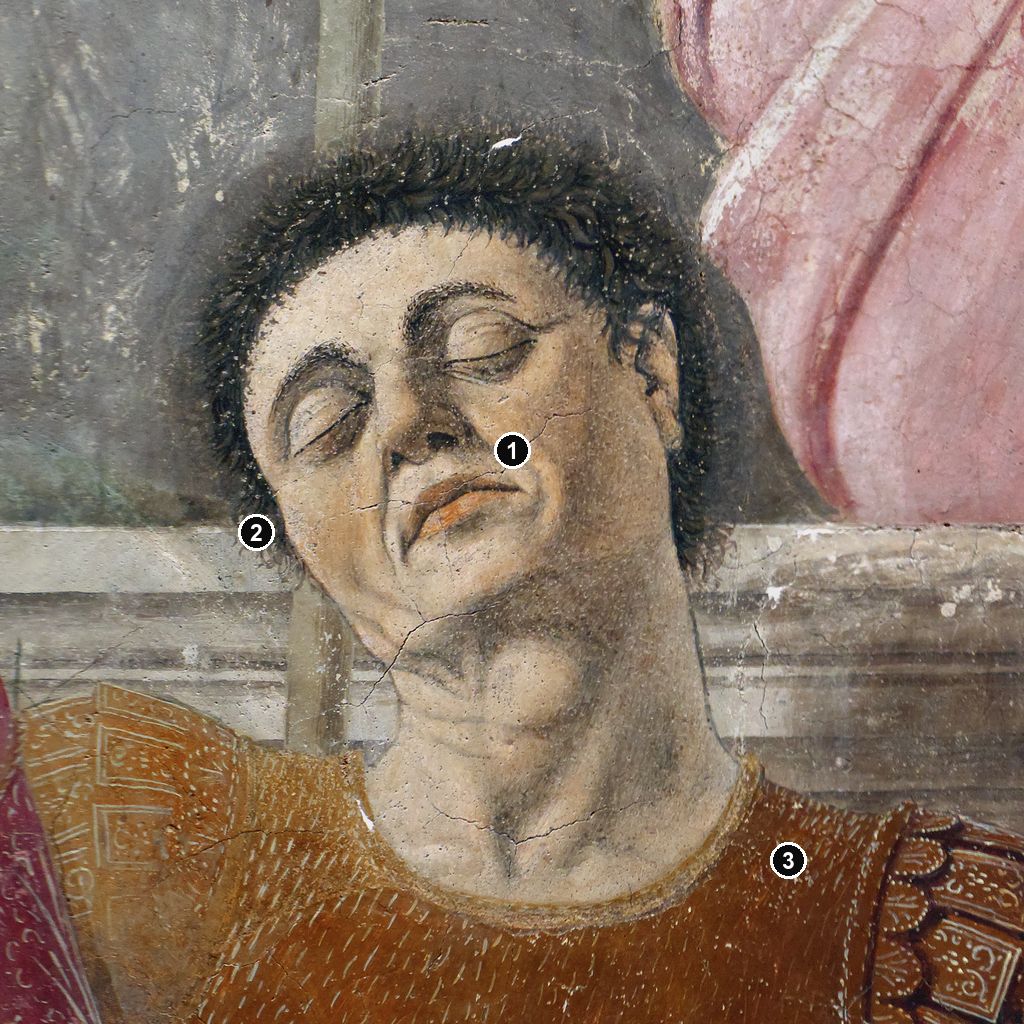
Details from THE RESURRECTION
Compare the cropped details with the source images above. Notice how their colours, shapes and positions contribute to the larger compositions.
The tilted head
The guard’s head tips back. The closed eyes and slack mouth fill an unusually large part of this detail.
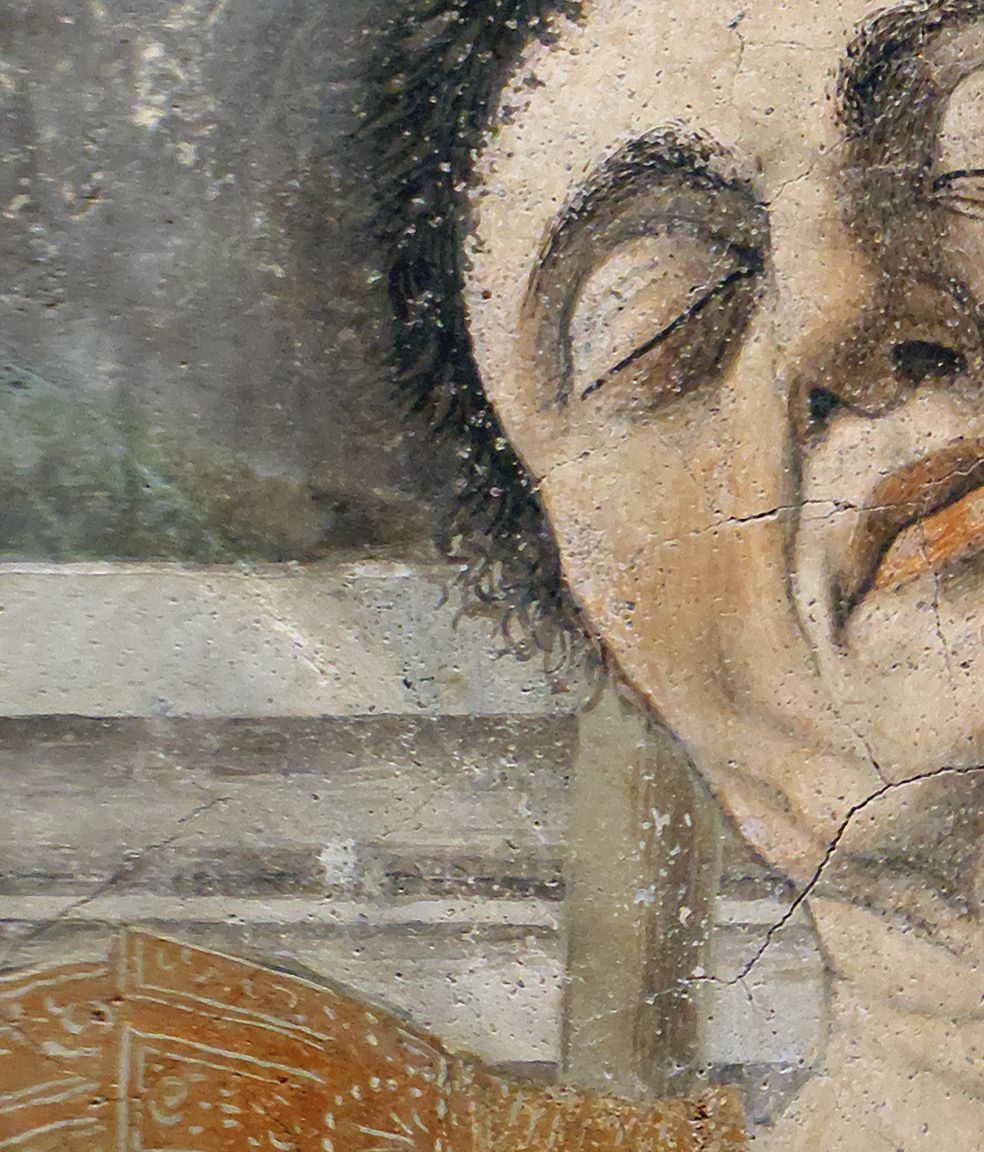
The edge of the tomb
The long horizontal line beyond the guard’s head is part of the tomb rim. It meets the softly rounded contours of his cheek and neck.
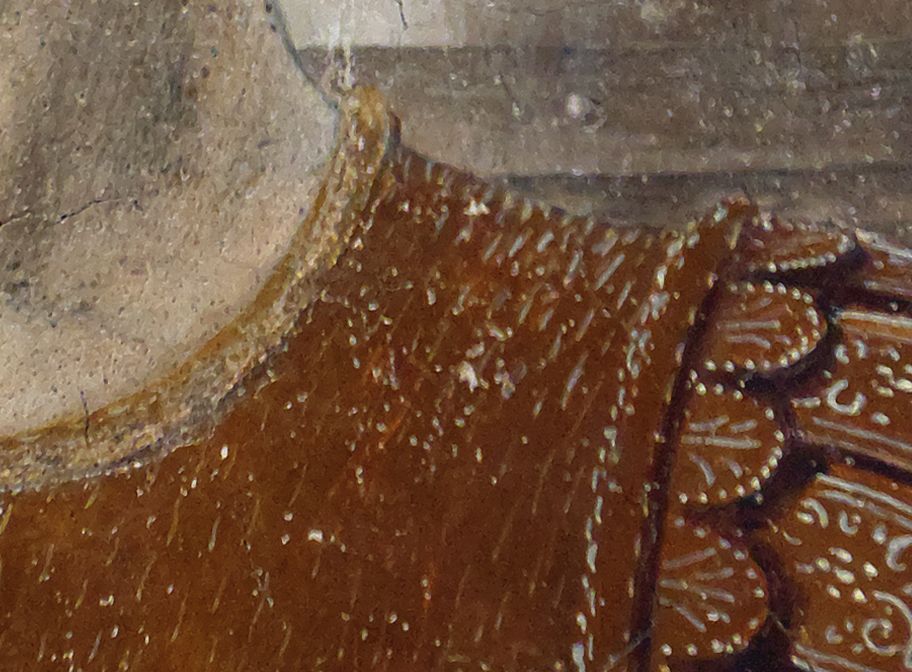
Patterned sleeve and seam
Fine pale strokes pick out the garment. Alongside them, broader cracks and breaks belong to the condition of the wall painting.
A Resurrection for Sansepolcro
Sansepolcro takes its name from the Holy Sepulchre in Jerusalem. The risen Christ became its civic emblem. The local museum guide points to an earlier panel associated with Niccolò di Segna, now in the cathedral, as evidence that the town pictured the risen Christ well before Piero’s mural. The stone tomb therefore carried a local association as well as its place in the Easter story. It was an image by which the community could recognise itself, in a building where it conducted its affairs. [2] [3]
In the town’s foundation legend, the pilgrims Arcano and Egidio returned from the Holy Land with relics and established a place of worship. Minako Uchijima connects the town hall mural with that tradition and with the earlier altar image, tracing a devotional subject from the abbey into a place of government. She also draws attention to the local office of standard-bearer of justice, revived in 1460. Christ’s grip on the staff and the authority of his frontal pose give her grounds to associate the sacred victory banner with the public responsibilities of the office. That reading depends on the local setting. A cross on a white flag would still have signified Christ’s victory over death elsewhere. [7] [8]
The Palazzo della Residenza grew out of a medieval civic complex. The offices housed there give the subject a different setting from a painting made for an altar. A ruler or citizen looking at the image might have recognised the emblem of Sansepolcro while also seeing the central event of the Christian promise of resurrection. Those uses could coexist. The exact commissioning circumstances are harder to recover. The restoration dossier considers a civic commission around 1468 in the context of hopes for greater autonomy from Florence. That proposal explains why a familiar emblem might have had a particular force at that moment, without fixing the date of the commission. [1] [2] [3]
The painting’s approximate date varies with the evidence a catalogue emphasises. The Museo Civico uses circa 1460, and the Opificio’s project title gives 1458–68. The latter’s historical discussion distinguishes earlier estimates around 1450–60 from the hypothesis of a work around 1468. Museo Galileo offers a narrower context for the commission, during Piero’s period of residence in Sansepolcro between 1459 and 1463. The disagreement concerns how to relate the mural to the painter’s activity and the town’s political and building history. There is no precisely dated commission on which to settle it. [1] [2] [9]
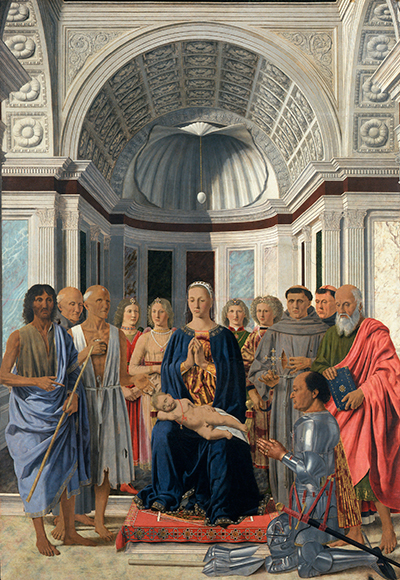
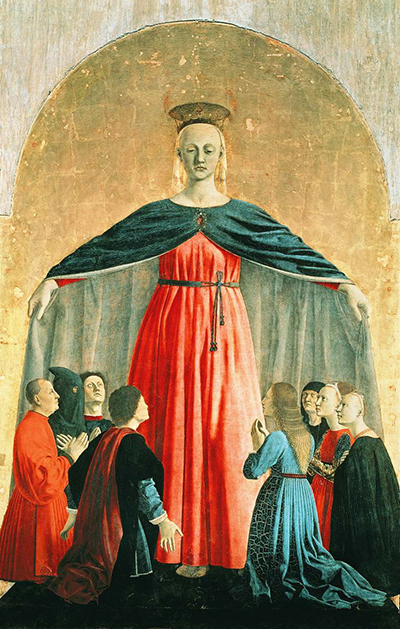
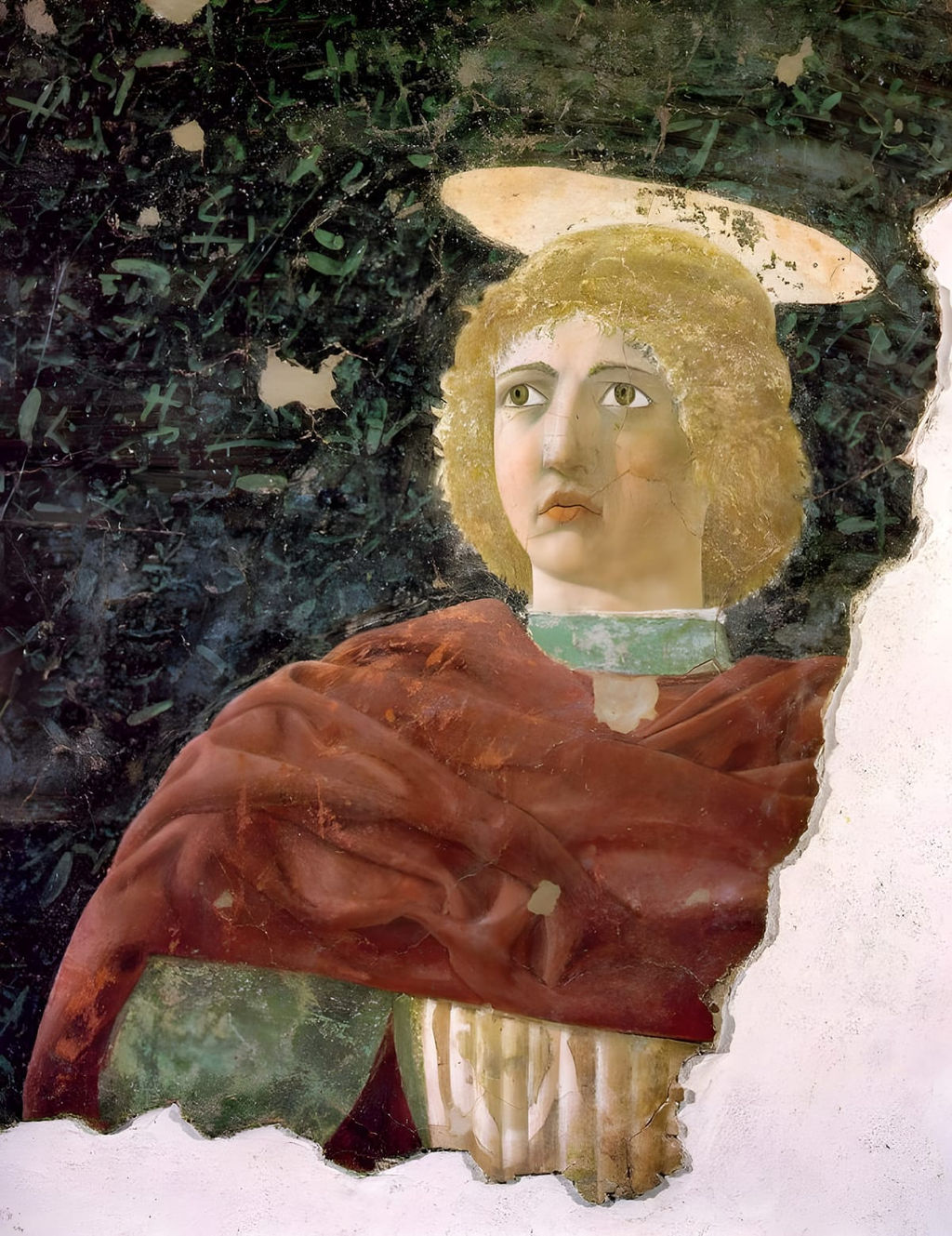
Look at the same museum’s Polyptych of the Misericordia and another kind of local religious patronage comes into view. The Virgin’s mantle shelters the smaller figures underneath her, while Christ stands above the soldiers and looks beyond them. Both compositions give a figure great authority through an upright, frontal pose, but their publics and supports differ. The Misericordia is a panel altarpiece associated with a confraternity. Piero’s Saint Julian, also in the Museo Civico, is a detached fragment of wall painting. The three works bring together different routes by which paintings made for particular Sansepolcro settings entered the civic collection. [3] [5] [10]
The wall the painting travelled with
The Resurrection is now on a wall that divides what was once a larger hall. Conservators wanted to know whether Piero had painted on that wall or whether the picture had been inserted during an earlier alteration. The Opificio registers the work as a mural moved a massello. In this kind of transfer, the painted plaster travels with the piece of masonry that supports it. Its investigation identified the original support as flat-laid brick, while the history of the building places the present divider in a later reorganisation of the palace. The setting is old, but the masonry directly under the painting and the wall that receives it belong to different parts of the story. [1]
The team proposed that the mural might originally have stood at the arengario, a raised structure by the palace façade from which the magistrates addressed people gathered outside. Museo Galileo’s account envisages a place of worship within the civic building before the move. The precise starting point is unresolved. A façade position would make a public gathering in the square part of the mural’s viewing history from the outset. A setting inside the complex would suggest a more restricted first encounter. The researchers could test what the wall was made of, but the original audience and its line of sight still have to be inferred. [1] [9]
There are also two kinds of frame to notice. The painted architecture at the sides gives the landscape and tomb the appearance of being seen through an opening. The outer part of the architectural surround has its own later history, with material added over several phases. The conservation report distinguishes it from the surviving original painting. Cyril Gerbron’s study draws attention to the stone surround, which is often omitted in reproductions, and reads the whole installation as a monument with features of an altar and a tomb. In a reproduction cropped to the scene, the verticals of the staff and tree trunks assume some of the work done by the painted framing. The distinction matters when comparing the mural’s dimensions across records. [1] [2] [8]
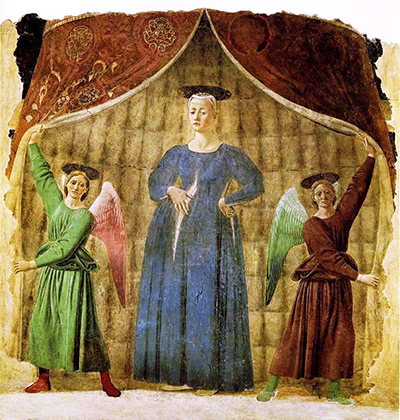
Monterchi’s Madonna del Parto offers a useful comparison. There, two painted angels pull apart the sides of a tent and make an intimate opening through which we see the pregnant Virgin. At Sansepolcro, the flanking architecture, the trees and the banner frame a figure coming forward. In both works the framing belongs to the act of looking. Each reserves its quietest space for the face a viewer will return to. [1] [11]
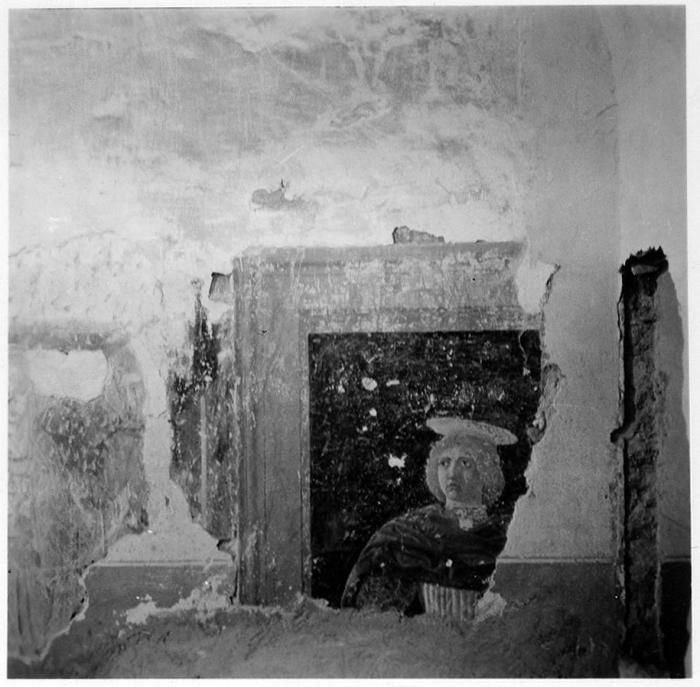
Historical photograph of the Saint Julian fresco fragment at its original site in Sansepolcro. Image source. Public domain. Resized only; native appearance preserved.
How Piero put paint on the wall
The mural is often called a fresco. In the strict sense fresco means applying colour while lime plaster is still wet, so the pigment is fixed as it sets. The Opificio found that Piero used true fresco for a relatively small part of this work and painted extensive areas a secco, on dry plaster. The team identified tempera and oil in the dry work and reported evidence of different binders across the surface. Some colours and effects relied on those dry layers. A coat of lime plaster gave Piero a wall to work on, but he treated the surface with a range of materials that let him vary how colour covered it and how light passed through the upper layers. [1]
The drawing and the arrangement of the plaster tell us about the work before its colours went on. The conservators identified spolvero, the transfer of a design by dusting pigment through tiny holes along a paper drawing. A snapped line helped lay out the grooves of the painted columns, and some details of the helmets and footwear retain signs of brush drawing. The fine-grained plaster was laid in planned sections. Museo Galileo reports eighteen plaster sections, or giornate. The count describes how the plaster was laid, while the drawing and the later dry painting belonged to a longer process. [1] [9]
There is a small material clue above Christ’s face. The Opificio reports both gold leaf and gilded tin in the halo. The precise sequence of its making remains uncertain. Compared with the way light appears on a painted helmet through modelling, the halo could catch actual light from the room. The face, its surrounding sky and the surface above it would therefore change together as a viewer moved, and their appearance would depend on where the mural was lit. [1]
What changed in the 2015–18 restoration
By the time the Opificio and the regional heritage authority began the treatment, the problems went well beyond a darkened surface. Sulphation had affected the plaster and its paint, and parts of the paint and plaster were losing their hold. Earlier interventions had left layers of material that had darkened with age. The team found three superimposed fixing layers, one tinted brown. Old repairs could change the colour a viewer saw, and earlier cleaning had already taken away some vulnerable original material. The conservators had to establish how to lift later coatings while protecting the thin dry-applied paint underneath. [1] [4]
Imaging at several wavelengths and laboratory analysis helped the conservators distinguish materials and trace damage. A structural team from the University of Florence also mapped the cracks and surveyed the masonry. They distinguished the thinner wall containing the painted brick section from the thicker partition behind it. This helped explain why the mural’s condition had to be assessed alongside the behaviour of the hall walls, especially in a building that had weathered earthquakes. [1] [12]
Cleaning proceeded gradually. The restorers consolidated vulnerable material and reduced the visual interruption of losses with restrained colour work. They restricted that reintegration to areas where original paint was already missing. Their conclusion that the surviving painted surface was original allows for the loss of some of Piero’s finishes and for the separate history of the outer surround. [1]
The Resurrection could still be seen while treatment was in progress. The project’s designers planned a freestanding scaffold with folding platforms so that conservators could work close to the wall and a full view could be made available. The museum records completion in 2018. Visitors could compare the emerging colours with passages where the older coatings still remained and see why cleaning had to proceed area by area. [1] [4] [13]
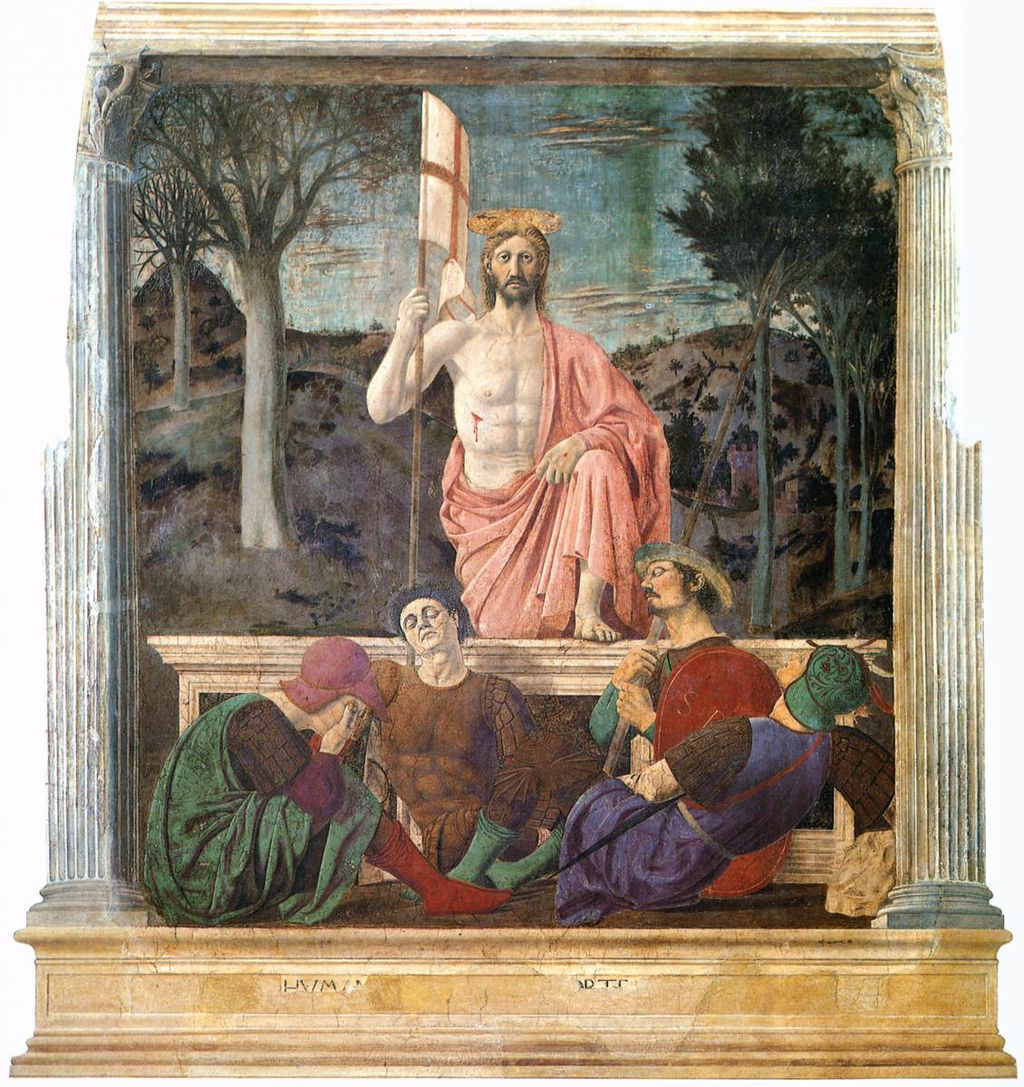
Piero della Francesca, The Resurrection, Museo Civico, Sansepolcro. Image source. Public domain. Resized only; native appearance preserved.
From Vasari to Huxley and the wartime recollection
Giorgio Vasari already singled out the Resurrection in his sixteenth-century life of Piero. He named the Palazzo dei Conservatori and reported the especially high regard in which the painting was held among Piero’s works. That is early testimony to where a visitor could encounter it and how highly it was valued. Vasari gives no precise account of the wall on which it was first painted. [1] [14]
Huxley made the difficulty of getting to Sansepolcro part of his 1925 essay “The Best Picture”. He recalls crossing an Apennine pass in early spring, from bare trees and withered grass on one slope to primroses on the other. The memory gives the reader a way into the mural’s own pairing of bare branches and greener trees. His description of the painting itself turns to the solidity of Christ and to the broad arrangement of the guards. When he calls it “the greatest picture in the world”, he immediately jokes about the absurdity of ranking works of art. The title gave readers a phrase to remember, and the essay gave them a way of looking. [5]
The essay also reached travellers who never read it in full. Luciano Cheles found that the 1930 edition of the Baedeker guide to Rome and Central Italy cited Huxley in drawing readers’ attention to Sansepolcro. Huxley had made fun of guidebook stars and wondered whether accessibility affected an artist’s reputation. Within a few years, a guidebook was using his own judgement to make the case for the journey. [5] [15]
The wartime story is known through a later recollection by British artillery officer Anthony Clarke. In his account of events in 1944, he recalled that the name Sansepolcro had been familiar before he remembered the essay he had read as a young man. He said shells had already been fired and that, after hearing the Germans had withdrawn and recalling Piero’s mural, he held further fire. He later went into town and saw the painting intact behind partial sandbag protection. Clarke gave his account years after the event. In it the news of the withdrawal and the recognition of the town’s name both shape his decision. How much damage continued firing would have done remains a matter of conjecture. [16]
The painting Huxley described and the wall Clarke remembered entered those stories at very different moments. We can still begin where both accounts ended, in front of a figure whose eyes meet ours while the men below him sleep. The date of its first commission and the path from its first wall are problems for historians. The ledge, the raised foot and the sleeping guards are there to see, and a second look at what is left of the hills gives some idea of how much more the fifteenth-century wall once held. [1] [2] [5] [16]
Browse the artworks
Compare Piero’s frescoes, panels and manuscript figures. The list includes ensembles and separately identifiable panels or scenes. Dates are approximate where the sources differ.
| Name | Date | Medium and source |
|---|---|---|
| The Baptism of Christ | Probably c. 1437–45 | Panel painting Catalogue. |
| The Flagellation of Christ | 1459–60 (GNDM) | Panel painting Catalogue. |
| The History of the True Cross | Mid-fifteenth century | Wall painting Catalogue. |
| Dream of Constantine | Mid-fifteenth century | Wall painting Catalogue. |
| The Duke and Duchess of Urbino | About 1473–75 (Uffizi) | Panel painting Catalogue. |
| The Resurrection | About 1458–68 (Opificio) | Wall painting Catalogue. |
| Brera Madonna | About 1472–74 | Panel painting Catalogue. |
| Annunciation at Arezzo | Mid-fifteenth century | Wall painting Catalogue. |
| Madonna del Parto | About 1450–65 (Monterchi) | Wall painting Catalogue. |
| Polyptych of the Misericordia | Commissioned 1445 | Panel painting Catalogue. |
| The Nativity | Early 1480s (National Gallery) | Panel painting Catalogue. |
| Madonna di Senigallia | About 1474–75 (GNDM) | Panel painting Catalogue. |
| Death of Adam | Mid-fifteenth century | Wall painting Catalogue. |
| Queen of Sheba | Mid-fifteenth century | Wall painting Catalogue. |
| Victory of Constantine | Mid-fifteenth century | Wall painting Catalogue. |
| Battle between Heraclius and Chosroes | Mid-fifteenth century | Wall painting Catalogue. |
| Saint Mary Magdalen | Wall painting Catalogue. | |
| The Augustinian Polyptych | 1454–69 | Panel painting Catalogue. |
| Polyptych of Perugia | About 1467–69 (GNU) | Panel painting Catalogue. |
| Perugia Annunciation | About 1468–70 (national catalogue) | Panel painting Catalogue. |
| St Francis and St Elizabeth | About 1467–69 (GNU) | Panel painting Catalogue. |
| Stigmatisation of St Francis | About 1468–70 (national catalogue) | Panel painting Catalogue. |
| An Augustinian Nun (Saint Monica) | 1454–69 | Panel painting Catalogue. |
| Augustinian Saint | 1454–69 | Panel painting Catalogue. |
| Saint Michael | 1454–69 | Panel painting Catalogue. |
| Saint Nicholas of Tolentino | 1454–69 | Panel painting Catalogue. |
| Saint John the Evangelist | 1454–69 | Panel painting Catalogue. |
| Virgin and Child Enthroned with Four Angels | About 1460–70 (Clark) | Panel painting Catalogue. |
| Portrait of Sigismondo Pandolfo Malatesta | About 1450–51, often proposed. Louvre catalogue range 1450–75. | Panel painting Catalogue. |
| Sigismondo before St Sigismund | 1451 | Wall painting Catalogue. |
| St Jerome and a Donor | 1460s (Accademia); about 1450 also proposed | Panel painting Catalogue. |
| St Jerome in Penitence | 1450, dated on the panel | Panel painting Catalogue. |
| Saint Julian | About 1455–60, often proposed | Wall painting Catalogue. |
| Saint Augustine | 1454–69 | Panel painting Catalogue. |
| Saint Apollonia | 1454–69 | Panel painting Catalogue. |
| Crucifixion from the Augustinian Polyptych | 1454–69 | Panel painting Catalogue. |
| Saint Louis of Toulouse | Wall painting Catalogue. | |
| Burial of the Wood | Mid-fifteenth century | Wall painting Catalogue. |
| Discovery and Proof of the True Cross | Mid-fifteenth century | Wall painting Catalogue. |
| Exaltation of the Cross | Mid-fifteenth century | Wall painting Catalogue. |
| Saint Anthony Raises a Child | About 1467–69 (GNU) | Panel painting Catalogue. |
| Saint Elizabeth Revives a Child | About 1467–69 (GNU) | Panel painting Catalogue. |
| Hercules | About 1470 | Wall painting Catalogue. |
| Portrait of a Boy (possibly Guidobaldo da Montefeltro) | Panel painting Catalogue. | |
| De prospectiva pingendi, Reggio Emilia witness (figures) | Manuscript diagrams Catalogue. | |
| The Interrogation of Judas | Mid-fifteenth century | Wall painting Catalogue. |
| Two prophets, Bacci Chapel | Mid-fifteenth century | Wall painting Catalogue. |
| Saint Clare of Assisi, upper predella | About 1467–69 (GNU) | Panel painting Catalogue. |
| Saint Agatha, upper predella | About 1467–69 (GNU) | Panel painting Catalogue. |
| Lost centre of the Augustinian Polyptych | 1454–69 | Lost panel or panels Catalogue. |
Frequently Asked Questions
Piero painted some passages in fresco and extensive areas on dry plaster. “Mural” covers the whole work more accurately, although “fresco” remains a familiar name for it. [1]
Anthony Clarke later recalled withholding further fire after news of a German withdrawal and remembering Huxley’s essay about the painting. He found the mural intact. His recollection supplies the episode, while the claim that his decision certainly saved the mural goes beyond what can be verified. [16]
Discussion
Look again at the images and ideas explored in The Resurrection by Piero della Francesca. These editorial prompts invite your observations.
Reader Insights
Where do your eyes go after they meet Christ’s gaze, and which shape or colour draws them there?
How would looking from a public square change your reading of the figure compared with seeing it inside a council hall?
What do you notice about the sleeping soldiers when you follow the long horizontal rim of the tomb instead of looking first at Christ?
Join the Conversation
Share a detail, comparison or question about The Resurrection by Piero della Francesca below.
References
- Opificio delle Pietre Dure, “Piero della Francesca, La Resurrezione, 1458–1468, Museo Civico, Sansepolcro (Arezzo)”, conservation dossier GR 13385, covering the 2015–18 project, diagnostics, mounting and painting technique, condition, treatment and photographs. View source.
- Museo Civico di Sansepolcro, museum history and collection gallery, and EmozionArti Sansepolcro, “Resurrezione”, gallery entry for Sala 4, with an object image and civic iconographic context. View source 1. View source 2.
- Regione Toscana, “Museo Civico Piero della Francesca”, regional museum record, updated 13 February 2023. View source.
- Museo Civico di Sansepolcro, “Restauri”, entry for completion of La Resurrezione in 2018. View source.
- Aldous Huxley, “The Best Picture,” in Along the Road: Notes and Essays of a Tourist (1925), part III, “Works of Art.” View source.
- Gospel according to Matthew, 27:62–66 and 28:1–15, New American Bible, Revised Edition, USCCB. View source 1. View source 2.
- Minako Uchijima (内島美奈子), “ピエロ・デッラ・フランチェスカ作《キリストの復活》に関する一考察 ―市庁舎の装飾壁画としての機能―” (“Piero della Francesca’s Resurrection as a Town Hall Mural”), Seinan Gakuin University Museum Research Bulletin 3, especially pp. 41–43 and 47–48, on civic decoration, the local foundation legend and the office of standard-bearer. View source.
- Cyril Gerbron, “The Stone and the Dream: On Piero della Francesca’s Resurrection”, Studies in Iconography 38 (2017), pp. 142–173, on the Holy Sepulchre, civic identity, the tomb and architectural framing. Open text. View source 1. View source 2.
- Museo Galileo, Piero della Francesca. Il disegno tra arte e scienza, section VI, “Resurrezione”, exhibition object entry with the proposed commission window, setting and plaster sections. View source.
- Ministero della Cultura, “Museo Civico di Sansepolcro,” Catalogo Generale dei Beni Culturali, museum history and holdings including the Misericordia. View source.
- Musei Civici Madonna del Parto, Monterchi, “L’Opera”, holding institution and artwork record. View source.
- Anna Livia Ciuffreda, Massimo Coli and Michelangelo Micheloni, “Structural Analysis and Evaluation of Interventions for the Protection of the Resurrection of Christ by Piero della Francesca Mural Painting at Sansepolcro”, International Conference on Cultural Heritage and New Technologies, Vienna, 2019, especially “Cognitive framework.” View source.
- Pietro Capone, Vito Getuli and Paola Ilaria Mariotti, “Il progetto per il cantiere di restauro della Resurrezione di Piero della Francesca”, OPD Restauro 27 (2015), pp. 266–275, with the design documented in the University of Florence repository’s conservation-site case study, “Restauro della pittura murale della Resurrezione.” View source 1. View source 2.
- Giorgio Vasari, “Piero della Francesca,” Le vite de’ più eccellenti pittori, scultori e architettori, Italian text of the life, passage on the Palazzo dei Conservatori. View source.
- Luciano Cheles, “The Italian Renaissance in American Gothic: Grant Wood and Piero della Francesca”, American Art 30, no. 1 (Spring 2016), pp. 106–124, discussion of Huxley’s reception and Baedeker. Author’s full-text copy. View source 1. View source 2.
- Nick Havely, “From Sansepolcro to La Verna,” in Apennine Crossings: Travellers on the Edge of Tuscany (Oxford University Press, 2024), pp. 14–15, reproducing Clarke’s later account. Chapter preview with the quoted recollection. View source 1. View source 2.
Related Paintings
Saint Julian
Piero della Francesca, Saint Julian, detached fresco in the Museo Civico, Sansepolcro. Image source. Public domain. Resized only; native appearance preserved.