 by Tom Gurney
Tom Gurney BSc (Hons) is an art history expert with over 20 years experience
Published on June 19, 2020 / Updated on October 14, 2023
Email: tomgurney1@gmail.com / Phone: +44 7429 011000
Saint John the Evangelist: Introduction
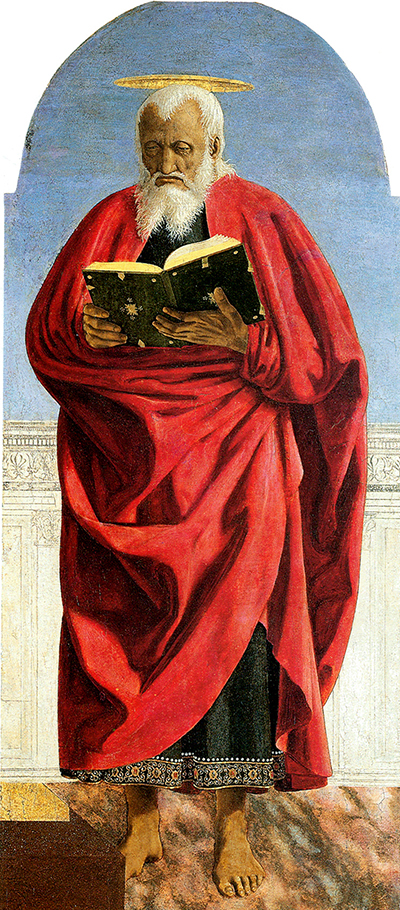
Saint John bends his head over a book so large that it takes both hands to hold it open. His white beard almost touches the pages. A heavy red mantle fills much of the panel, but some of Piero della Francesca’s most delicate painting is at ground level, where a strip of jewels catches the light just above John’s bare feet. Beside those feet is a second detail that is easy to miss. A step enters the composition from the lower left, then stops at the edge of the panel. It belonged to the space John once shared with a scene that has since been lost. [1] [2] [3]
Now in the Frick Collection in New York, the panel was one of four standing saints in the principal tier of Piero’s Augustinian Polyptych. The work was commissioned in 1454 for the high altar of Sant’Agostino in Piero’s home town of Borgo San Sepolcro, now Sansepolcro. A payment in 1469 suggests that the altarpiece was finished by then. Those dates bracket the commission and its completion. The Frick dates John’s panel to the same span. [1] [3] [4]
Piero della Francesca, Saint John the Evangelist, The Frick Collection, New York. Image source. Public domain. Resized only; native appearance preserved.
At a Glance
- ArtistPiero della Francesca. [1]
- Date1454–69, the documented span of the Augustinian commission. [1] [4]
- MediumOil and tempera with traces of gold on poplar panel in the Frick’s exhibition entry. The 2024 Milan checklist describes it as oil on panel. [1] [3]
- Dimensions134 × 62.2 cm. [1] [3]
- CollectionThe Frick Collection, New York, inventory 36.1.138. [1] [5]
- Original positionImmediately to the spectator’s right of the lost central panel of the Augustinian Polyptych. [3] [6]
This work across Piero della Francesca’s career
The Baptism of Christ
Probably about 1437–45The History of the True Cross
Mid-fifteenth centurySaint John the Evangelist (current article)
1454–69, Augustinian commissionThe Resurrection
About 1458–68 (Opificio)The Flagellation of Christ
1459–60 (GNDM)The Montefeltro Altarpiece
About 1472–74 (Brera)The Duke and Duchess of Urbino
About 1473–75 (Uffizi)The Nativity
Early 1480s (National Gallery)Contents
- An old man reading
- The jewellery at his feet
- What survives at the lower left
- From a church altar to the Frick
- Two saints called John
- Annotated details
An old man reading
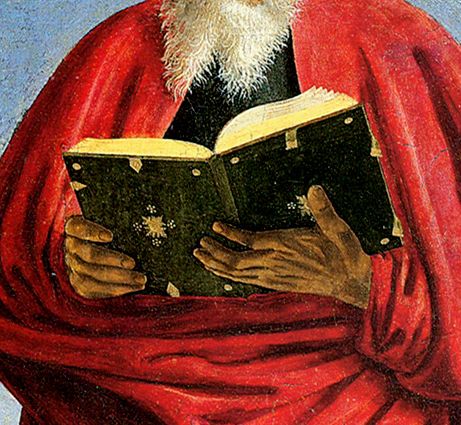
The book sits just below the middle of John’s chest. Its open leaves make a double slope, one half falling gently away while the other rises towards his shoulder. We see the dark outer covers, pale edges of the pages and small fittings on the binding. The text faces John. His hands spread across the covers and steady the volume while he reads. Piero has placed the book where its weight can be felt in the turn of a wrist and the pressure of the fingers. Even the mantle seems to respond to the act of reading. Its broad folds gather just below the hands before falling diagonally towards the floor. [1] [2]
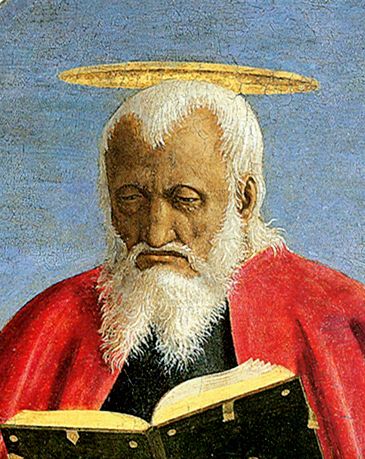
John’s lowered brow deepens the shadow around his eyes. Against the blue sky, the short white hair and pointed beard stand out, and the thin oval of the halo follows the angle of the viewer’s upward gaze. The face and hands tell us about age through particulars such as the lines of the forehead and the pronounced joints of the fingers. A slight inclination of the head is enough to draw attention away from the grandeur of the costume and towards what the saint is doing. His feet stay planted and his eyes stay on the page. This is how Piero gives a stationary figure an action that can hold our attention. [1] [2]
The Frick suggests that John could be contemplating his Gospel or the Book of Revelation, both traditionally associated with the Evangelist. The view Piero gives of the volume leaves its contents open to interpretation. The Frick also connects John’s inclusion to the names of the family behind the commission, pointing to the saint as patron of the donors’ father and of Giovanna, the wife of Simone whose wishes the commission was intended to fulfil. The book fits that identification, though a book held by a saint is a fairly common attribute. The garment supplies a more particular clue. [1] [4]
The jewellery at his feet
The red mantle nearly conceals a dark green garment. At its lower edge, a narrow decorated band stays close to the horizontal even as the mantle above it falls in deep, irregular folds. Piero picks out light on pearls and on stones the Frick identifies as rubies and aquamarines. The museum reads this as a possible reference to the legend in which John turns pebbles into precious stones. Seen this way, the border carries a piece of the saint’s story without adding a separate episode to the picture. The jewels are the small, sharply defined elements in a passage that also includes the softness of cloth and the weight of bare feet on stone. [1] [2]
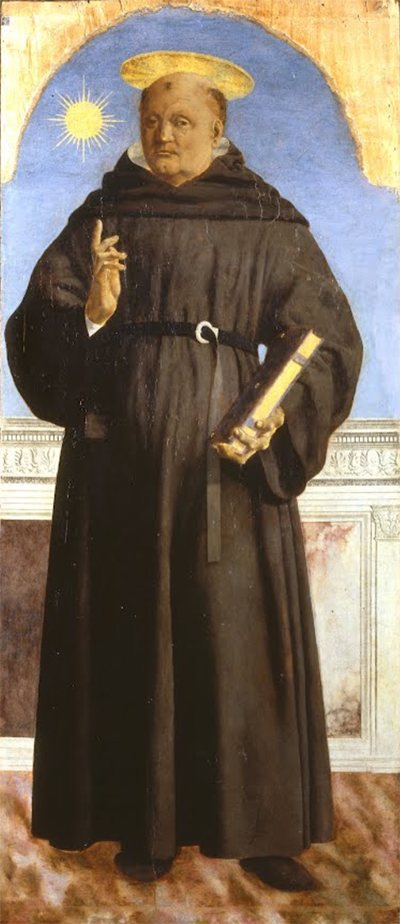
The comparison with neighbouring figures helps explain how sharply those details register. Immediately to John’s right, the Saint Nicholas of Tolentino panel gives another full-length saint a book, but Nicholas wears the black hooded habit and belt of the Augustinian friars. His star and the habits known to the men who worshipped in the church help identify him. Across the lost centre, Saint Michael is a young soldier in gleaming armour, holding the severed head of the creature he has defeated. Piero makes room in the same company for the reflective old apostle, a friar in the dress of his order and an armed angel. Fabric, metal and the way each figure uses his hands allow the saints to differ even where the sky and architecture bring them together. [1] [2] [6] [7]
Annotated Details from Saint John the Evangelist
The numbered points identify visible features discussed in this article. Return from each detail to the numbered overview. Piero della Francesca, Saint John the Evangelist, The Frick Collection, New York. Image source. Public domain.
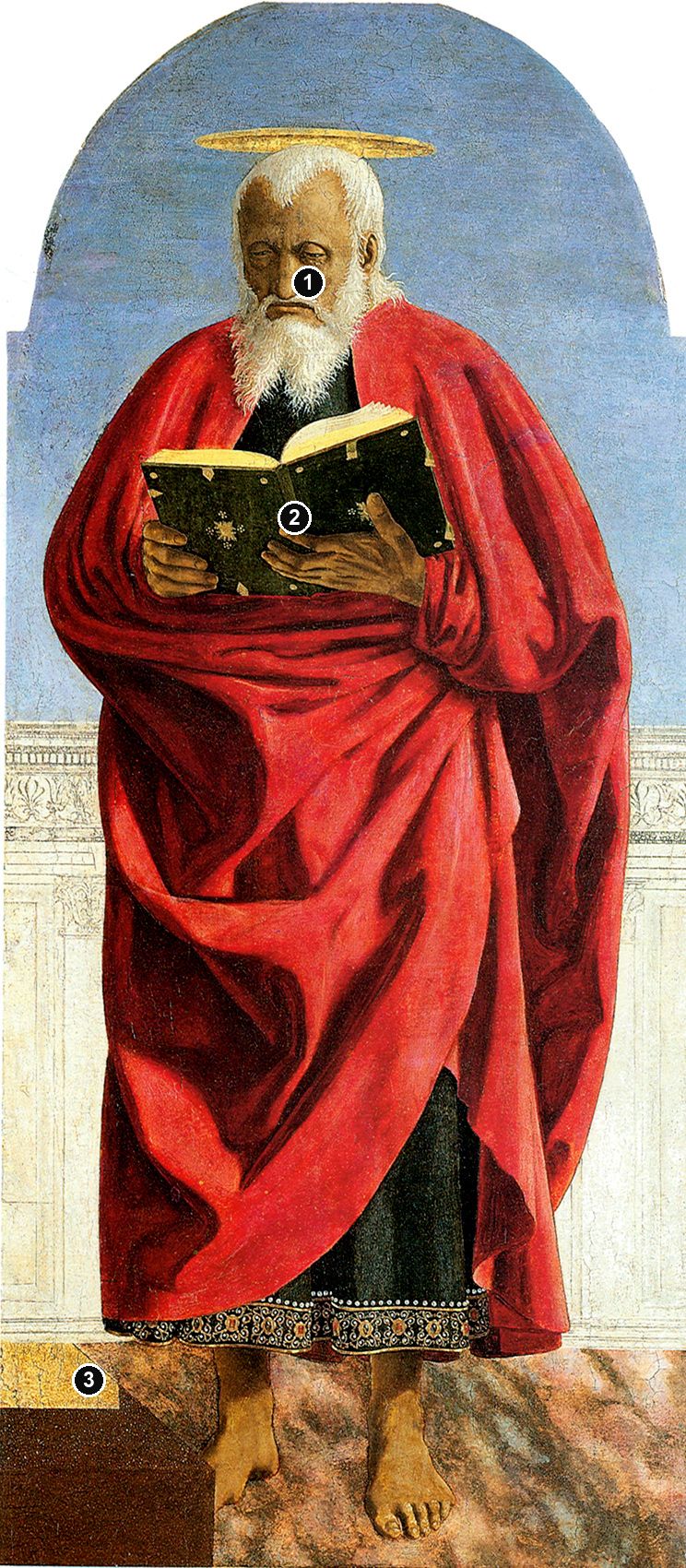
Details from SAINT JOHN THE EVANGELIST
Compare the cropped details with the source images above. Notice how their colours, shapes and positions contribute to the larger compositions.
John’s face and gold halo
The gold ellipse is foreshortened above the head. The saint’s lowered eyes carry the viewer towards his book.
The open jewelled book
Piero shows the gold edges of the opened pages as well as the jewels of the dark binding. John steadies the book with both hands.
The interrupted yellow step
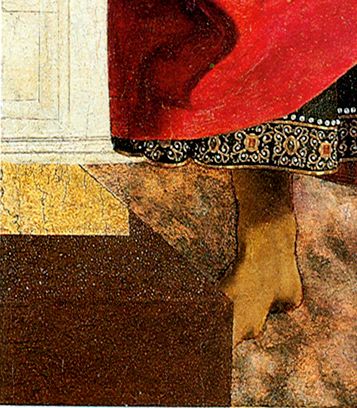
A yellow edge enters at the left and stops at John’s feet. This surviving fragment helped scholars identify the side of the lost centre that John originally stood beside.
What survives at the lower left
In the Frick panel, the painted balustrade runs behind the figure and the mottled pavement extends under his feet. At the lower left, a rectilinear piece of a step breaks into that pavement. Its top and darker face are abruptly truncated by the left edge, the edge that faced the missing centre when John stood on the spectator’s right. Michael was on the other side of the opening. His lower right corner preserves related architecture and part of a rich garment. Looking at the two panels together shows why the isolated step in John matters. Each panel takes in a small portion of the same central space from its own side. The present edge cuts off the painted form, so its surviving width gives only a partial indication of the original architecture. The Frick also records that the poplar support was thinned and reinforced with a wooden cradle on the back. That treatment concerns the thickness of the support. The interrupted step concerns the extent of the painted scene. [2] [3] [6] [8]
Microscopic examination added a different kind of evidence. The team that prepared the Museo Poldi Pezzoli’s 2024 exhibition reported minute remains of pink and blue angel wings along the inner boundaries of the two panels. The curators concluded that the wings extended into the saints’ compartments from the centre and were erased when the pictures became independent works. The golden disc above John’s head belongs to his figure. The wing evidence concerns the separate, partly erased elements at the margins. The porphyry steps and the fragment of crimson brocaded velvet lined with ermine, read together with the wings, led the Milan curators to propose a Coronation of the Virgin, in which Mary kneels to receive the crown from Christ. [3]
The surviving edges establish the relationship between the side panels and the centre more securely than they establish the subject. A stepped structure and a brocaded garment had also supported an interpretation as a Virgin and Child Enthroned, still given in the National Gallery’s entry for Michael. In 2013, Nathaniel Silver, James R. Banker and Machtelt Israëls questioned whether an 1825 inventory listing a Madonna and Child in the former Augustinian church described Piero’s missing centre at all. The inventory also listed saints that earlier documents placed in private hands. The 2024 study thus brought physical evidence to a debate that had depended in part on how to read later descriptions. The wings indicate figures extending from the middle, and the steps and rich textile help explain the proposal for a ceremonial scene. The central painting itself remains missing. An earlier Coronation by Filippo Lippi, now in the Uffizi, shows how the subject could be arranged around a kneeling Mary and a throne attended by angels. In Lippi’s version God the Father holds the crown. The Milan proposal has Christ crowning Mary. The comparison helps explain what kind of scene the researchers had in mind and why the wing tips and steps matter together. [3] [6] [9] [10]
The Milan research also bears on how these panels were made. The 1454 contract called for the reuse of an existing wooden structure. The curators found evidence that old preparatory layers were retained under parts of the smaller paintings and reported that Piero cleared the older preparation from the larger panels. Their study found oil to be the principal binding medium in samples from the polyptych. For the viewer, some of the clearest results of this technique are in the way thin layers of colour let the light appear to penetrate a surface, as it does in the gems, while opaque highlights sit on top. This gives a material context for the Frick’s description of the panel as oil and tempera and for the Milan checklist’s shorter description of oil on panel. [1] [3] [8]
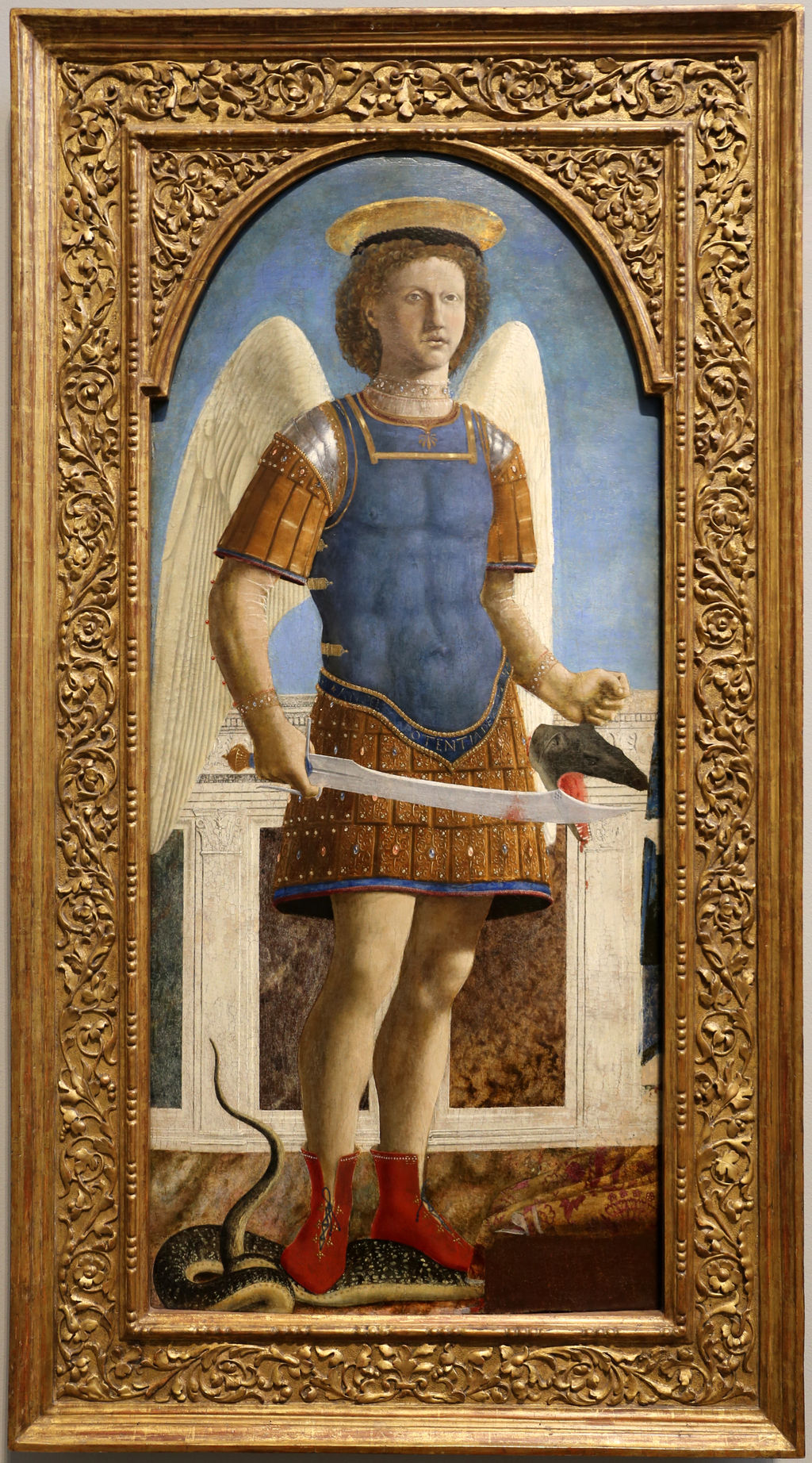
Piero della Francesca, Saint Michael, National Gallery, London. Sailko. Image source. CC BY 3.0. Resized from the source. This reproduction uses CC BY 3.0.
From a church altar to the Frick
The church’s change of occupants in the mid-sixteenth century provides the setting for the altarpiece’s dispersal. Its exact dismantling date is uncertain. By 1624, John and Augustine were recorded in a private collection in Sansepolcro. Later in the seventeenth century, Giovanni Cinelli Calvoli described four saints from the high altar in the house of Luca and Francesco Ducci. The large panels had been detached by the time of that description, but their shared local ownership helped preserve knowledge of where they came from. [6] [9] [5]
By 1936 the panel had turned up in Vienna, where the New York dealers Knoedler and Company found it. The Frick bought it from them for $400,000. The museum describes it as the first painting by Piero acquired by a public institution in the United States, and credits Helen Clay Frick with pressing for the purchase. A news report from the year of the sale called the figure Saint Andrew, illustrating how differently the painting could be read without its original setting. A few years later, Millard Meiss took the newly accessible painting as additional evidence for linking the dispersed saints to the documented 1454 commission. [11] [12] [13]
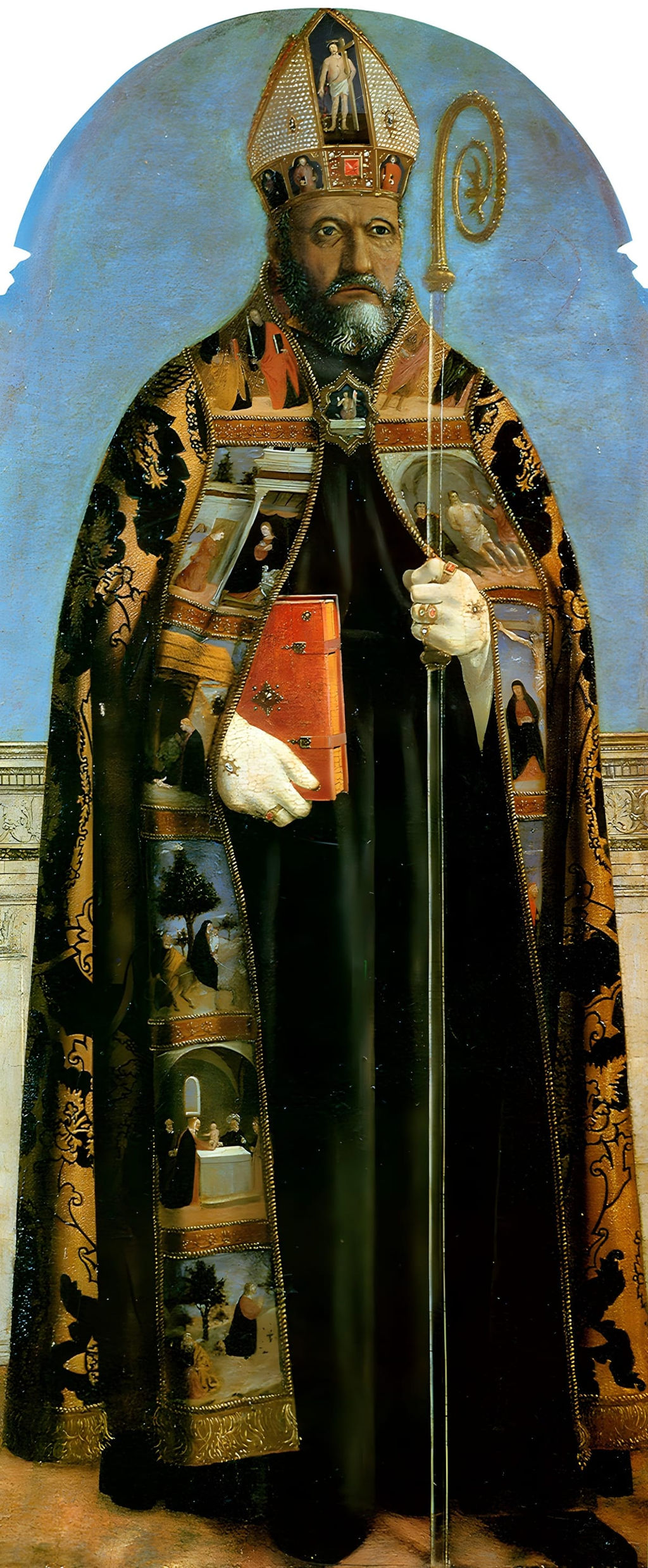
At the Frick’s 2013 exhibition, the standing Evangelist was shown with other survivors from the commission, including Saint Augustine from Lisbon. In 2024 the Poldi Pezzoli in Milan gathered all eight known surviving panels from five museums. The exhibition kept the panels in their later frames and showed them in relation to each other, with the centre still absent. Seeing the red figure as one member of a group makes its scale intelligible. Looking closely at the book, its binding and the narrow rim of jewellery brings back the qualities that made the panel so arresting in isolation. [2] [3] [14]
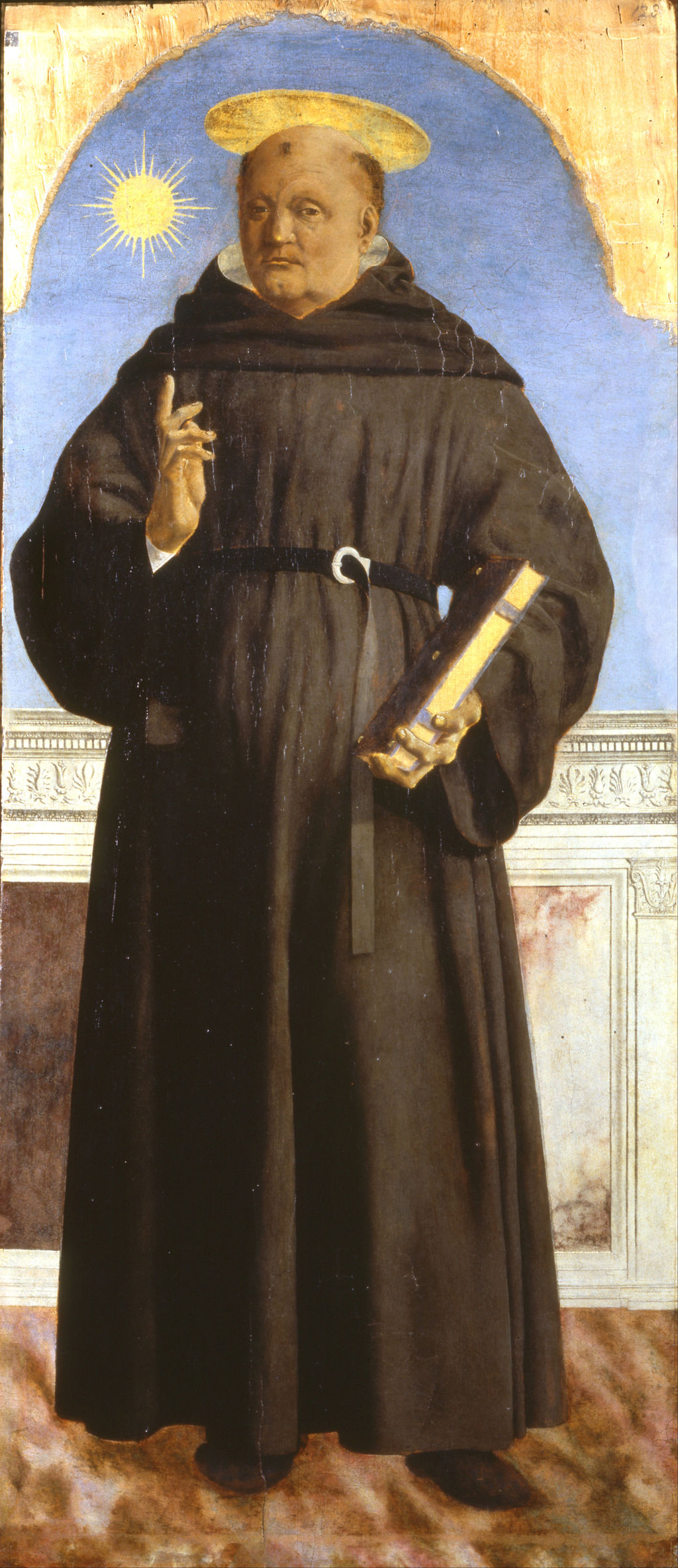
Piero della Francesca, Saint Nicholas of Tolentino, Museo Poldi Pezzoli, Milan. Image source. Public domain. Resized only; native appearance preserved.
Two saints called John
In the Frick’s small Crucifixion from the same polyptych, the museum identifies the young mourner on the right as John the Evangelist. He clasps his hands as he approaches the cross. The principal-tier panel gives this same saint a white beard and an open book. The difference in age serves the two subjects. A youthful disciple participates in a moment of grief, while the aged apostle quietly attends to a sacred text. [1] [15]
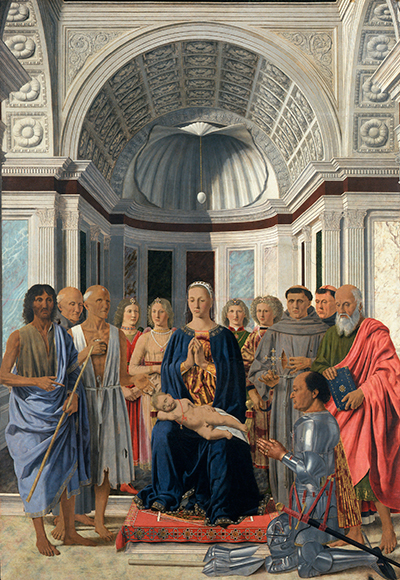
John the Baptist is a different saint. Piero painted both Johns in the Misericordia Polyptych for a separate commission in Sansepolcro. Piero also included the Baptist in the Sant’Antonio Polyptych now in Perugia. The Montefeltro Altarpiece at Brera makes the distinction easy to see within one painting. On the far left the Baptist points towards the Christ Child, while on the far right the aged Evangelist in a red mantle carries a book and looks towards Christ. In the Frick panel, the pages are open and John’s attention has turned to them. [16] [17] [18] [19]
Browse the artworks
Compare Piero’s frescoes, panels and manuscript figures. The list includes ensembles and separately identifiable panels or scenes. Dates are approximate where the sources differ.
| Name | Date | Medium and source |
|---|---|---|
| The Baptism of Christ | Probably c. 1437–45 | Panel painting Catalogue. |
| The Flagellation of Christ | 1459–60 (GNDM) | Panel painting Catalogue. |
| The History of the True Cross | Mid-fifteenth century | Wall painting Catalogue. |
| Dream of Constantine | Mid-fifteenth century | Wall painting Catalogue. |
| The Duke and Duchess of Urbino | About 1473–75 (Uffizi) | Panel painting Catalogue. |
| The Resurrection | About 1458–68 (Opificio) | Wall painting Catalogue. |
| Brera Madonna | About 1472–74 | Panel painting Catalogue. |
| Annunciation at Arezzo | Mid-fifteenth century | Wall painting Catalogue. |
| Madonna del Parto | About 1450–65 (Monterchi) | Wall painting Catalogue. |
| Polyptych of the Misericordia | Commissioned 1445 | Panel painting Catalogue. |
| The Nativity | Early 1480s (National Gallery) | Panel painting Catalogue. |
| Madonna di Senigallia | About 1474–75 (GNDM) | Panel painting Catalogue. |
| Death of Adam | Mid-fifteenth century | Wall painting Catalogue. |
| Queen of Sheba | Mid-fifteenth century | Wall painting Catalogue. |
| Victory of Constantine | Mid-fifteenth century | Wall painting Catalogue. |
| Battle between Heraclius and Chosroes | Mid-fifteenth century | Wall painting Catalogue. |
| Saint Mary Magdalen | Wall painting Catalogue. | |
| The Augustinian Polyptych | 1454–69 | Panel painting Catalogue. |
| Polyptych of Perugia | About 1467–69 (GNU) | Panel painting Catalogue. |
| Perugia Annunciation | About 1468–70 (national catalogue) | Panel painting Catalogue. |
| St Francis and St Elizabeth | About 1467–69 (GNU) | Panel painting Catalogue. |
| Stigmatisation of St Francis | About 1468–70 (national catalogue) | Panel painting Catalogue. |
| An Augustinian Nun (Saint Monica) | 1454–69 | Panel painting Catalogue. |
| Augustinian Saint | 1454–69 | Panel painting Catalogue. |
| Saint Michael | 1454–69 | Panel painting Catalogue. |
| Saint Nicholas of Tolentino | 1454–69 | Panel painting Catalogue. |
| Saint John the Evangelist | 1454–69 | Panel painting Catalogue. |
| Virgin and Child Enthroned with Four Angels | About 1460–70 (Clark) | Panel painting Catalogue. |
| Portrait of Sigismondo Pandolfo Malatesta | About 1450–51, often proposed. Louvre catalogue range 1450–75. | Panel painting Catalogue. |
| Sigismondo before St Sigismund | 1451 | Wall painting Catalogue. |
| St Jerome and a Donor | 1460s (Accademia); about 1450 also proposed | Panel painting Catalogue. |
| St Jerome in Penitence | 1450, dated on the panel | Panel painting Catalogue. |
| Saint Julian | About 1455–60, often proposed | Wall painting Catalogue. |
| Saint Augustine | 1454–69 | Panel painting Catalogue. |
| Saint Apollonia | 1454–69 | Panel painting Catalogue. |
| Crucifixion from the Augustinian Polyptych | 1454–69 | Panel painting Catalogue. |
| Saint Louis of Toulouse | Wall painting Catalogue. | |
| Burial of the Wood | Mid-fifteenth century | Wall painting Catalogue. |
| Discovery and Proof of the True Cross | Mid-fifteenth century | Wall painting Catalogue. |
| Exaltation of the Cross | Mid-fifteenth century | Wall painting Catalogue. |
| Saint Anthony Raises a Child | About 1467–69 (GNU) | Panel painting Catalogue. |
| Saint Elizabeth Revives a Child | About 1467–69 (GNU) | Panel painting Catalogue. |
| Hercules | About 1470 | Wall painting Catalogue. |
| Portrait of a Boy (possibly Guidobaldo da Montefeltro) | Panel painting Catalogue. | |
| De prospectiva pingendi, Reggio Emilia witness (figures) | Manuscript diagrams Catalogue. | |
| The Interrogation of Judas | Mid-fifteenth century | Wall painting Catalogue. |
| Two prophets, Bacci Chapel | Mid-fifteenth century | Wall painting Catalogue. |
| Saint Clare of Assisi, upper predella | About 1467–69 (GNU) | Panel painting Catalogue. |
| Saint Agatha, upper predella | About 1467–69 (GNU) | Panel painting Catalogue. |
| Lost centre of the Augustinian Polyptych | 1454–69 | Lost panel or panels Catalogue. |
Frequently Asked Questions
The Frick associates the pearled and jewelled hem with a miracle from the Evangelist’s legend, in which he transformed pebbles into gems. [1]
Discussion
Look again at the images and ideas explored in Saint John the Evangelist. These editorial prompts invite your observations.
Reader Insights
Where do you look first when you see the whole panel, and how does the bright band beneath the red mantle draw your eye back down?
Compare the hands of John, Nicholas and Michael. How does the way each saint handles an object shape your sense of his role?
Start at John’s lower-left corner and Michael’s lower-right corner. Which details would you carry across the gap, and how much of the central scene could you infer from them?
Join the Conversation
Share a detail, comparison or question about Saint John the Evangelist below.
References
- The Frick Collection, Saint John the Evangelist, exhibition object entry. View source.
- Museo Poldi Pezzoli, Piero della Francesca. The Augustinian Polyptych Reunited, exhibition page with full-panel and detail photographs. View source.
- Museo Poldi Pezzoli, Il polittico agostiniano riunito, 2024 exhibition dossier, especially pp. 9, 11–12 and 18–19. View source.
- The Frick Collection, St. John the Evangelist, collection text hosted by Google Arts & Culture. View source.
- National Gallery of Art, Saint Apollonia, provenance note 4 on the Ducci collection and the large panels. View source.
- The National Gallery, Saint Michael, NG769, collection entry. View source.
- Museo Poldi Pezzoli, San Nicola da Tolentino, collection entry. View source.
- The Frick Collection, Piero della Francesca in America, exhibition image checklist with support and treatment details. View source.
- Nathaniel Silver, James R. Banker and Machtelt Israëls, “The Lost Piero”, 2013, on evidence for dispersal and the disputed inventory. View source.
- Gallerie degli Uffizi, Filippo Lippi’s Coronation of the Virgin, collection entry. View source.
- The Frick Collection, Piero della Francesca in America, 2013 exhibition release, p. 2. View source.
- Greymouth Evening Star, “Art Treasure for New York”, 16 April 1936, p. 3. View source.
- Millard Meiss, “A Documented Altarpiece by Piero Della Francesca”, The Art Bulletin 23, no. 1 (1941), pp. 53–68, opening extract. View source.
- The Frick Collection, Piero della Francesca in America, 2013 exhibition overview. View source.
- The Frick Collection, The Crucifixion, exhibition object entry. View source.
- Italian Ministry of Culture, Madonna della misericordia e santi, storie della Passione di Cristo, national catalogue and component list. View source.
- Galleria Nazionale dell’Umbria, Polittico di Sant’Antonio, collection entry. View source.
- Pinacoteca di Brera, Madonna col Bambino e santi, angeli e Federico da Montefeltro, collection entry. View source.
- Pinacoteca di Brera, La Pala Montefeltro, DescriVedendo visual description. View source.
Related Paintings
The Augustinian Polyptych
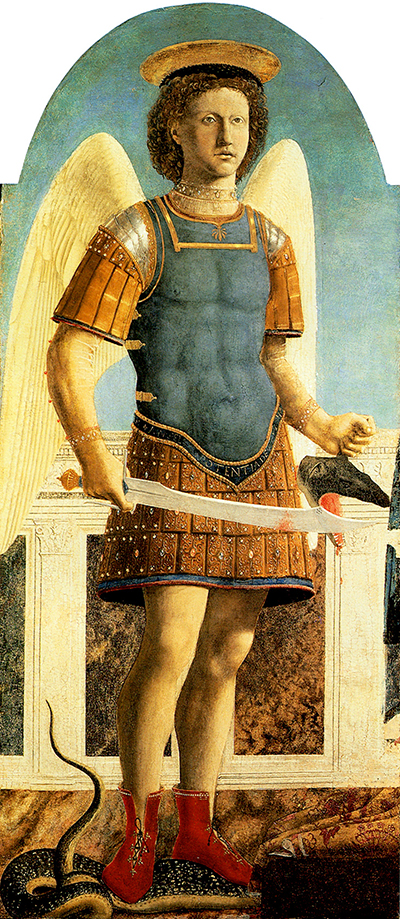
Piero della Francesca, Saint Augustine, surviving panel from the Augustinian Polyptych, Lisbon. Image source. Public domain. Resized only; native appearance preserved.