 by Tom Gurney
Tom Gurney BSc (Hons) is an art history expert with over 20 years experience
Published on June 19, 2020 / Updated on October 14, 2023
Email: tomgurney1@gmail.com / Phone: +44 7429 011000
The History of the True Cross: Introduction
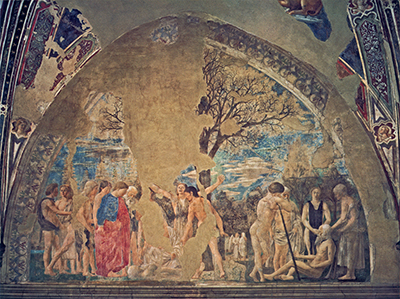
High on the right wall of the Bacci Chapel in Arezzo, Seth brings back a shoot that will grow from his father Adam’s grave. Directly across the chapel, the timber has become a cross. It rises into the sky over a crowd kneeling to receive it in Jerusalem. The painted episodes stand at the same height, across a single room, yet the story between them spans the age of the first humans, the Crucifixion and the reigns of two Roman emperors. Piero della Francesca’s History of the True Cross, also called the Legend of the True Cross, places the beginning and end where they can be seen together. To follow everything that happens in between, you have to look down, turn, and look up again. [1] [2]
The paintings occupy the walls of the main chapel of the Franciscan Basilica of San Francesco. The cross changes from living wood to building material, buried timber, military sign and relic. The Crucifixion gives each of those changes its meaning, yet it has no scene to itself in the wall cycle. The basilica’s medieval painted Crucifix, a separate work now associated with the high altar, supplies a powerful counterpart to what happens on the walls. A viewer can look from the painted body of Christ on the wooden Crucifix to the bare, upright Cross received by the people of Jerusalem. [1] [2] [3]
At a Glance
- ArtistPiero della Francesca and workshop, following Bicci di Lorenzo’s earlier chapel campaign. [2] [4] [5]
- LocationBacci Chapel, the main chapel of the Basilica of San Francesco, Arezzo. [3]
- DateAbout 1452–66 is the conventional bracket for Piero’s campaign. A December 1466 document refers to the work as completed. [4] [6]
- SubjectThe medieval legend of the wood of Christ’s Cross, from Adam’s burial to its return to Jerusalem under Heraclius. [1] [7] [8]
- ArrangementThree registers, with corresponding scenes on facing walls and smaller episodes and prophets around the back window. [1] [2] [9]
- ConservationThe major campaign of investigation and treatment began in 1985 and ended in 2000. [10]
This work across Piero della Francesca’s career
The Baptism of Christ
Probably about 1437–45The History of the True Cross (current article)
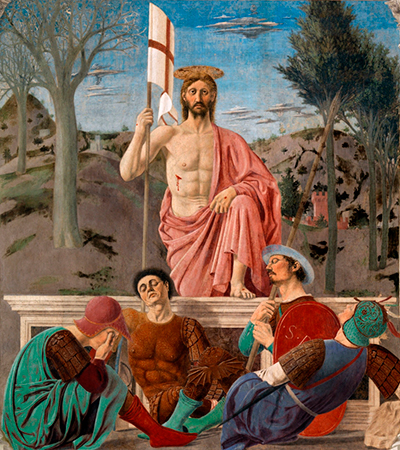
Mid-fifteenth centuryThe Resurrection
About 1458–68 (Opificio)The Flagellation of Christ
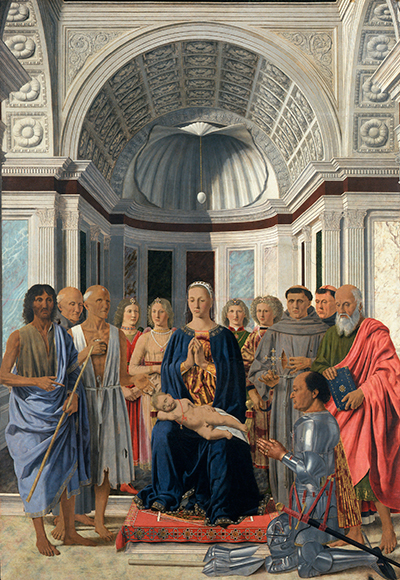
1459–60 (GNDM)The Montefeltro Altarpiece
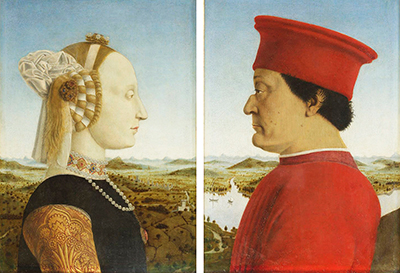
About 1472–74 (Brera)The Duke and Duchess of Urbino
About 1473–75 (Uffizi)The Nativity
Early 1480s (National Gallery)Contents
- The Bacci family and the two painting campaigns
- The walls and the order of the story
- Where the story comes from
- From Adam’s grave to Constantine’s victory
- Helena’s search, the Persian war and the return
- The prophets, fragments and proposed portraits
- The conservation of a painted room
- Seeing the paintings in Arezzo
- Annotated details
The Bacci family and the two painting campaigns
The commission began with the Bacci family’s obligations as patrons of the chapel. Baccio di Maso Bacci, an Arezzo merchant, made arrangements for its decoration in wills of 1411 and 1416. After his death in 1417, responsibility passed to his sons Tommaso, Girolamo and Francesco. Progress was slow. In the 1440s the friars pressed the family to act, and the Bacci raised money by selling property, including a vineyard. In 1447 they commissioned the Florentine painter Bicci di Lorenzo. The gap between the wills and the commission explains why the name of a single donor tells only part of the story. The paintings were the outcome of commitments made and acted on across generations. [2] [4]
Bicci’s work is best understood by looking above and around the painted legend. His campaign accounts for the four Evangelists in the vault and the Last Judgement over the entrance arch, as well as two of the Fathers of the Church on its underside. He died in 1452, leaving Piero to continue the decoration within an architectural and pictorial setting already partly established. Below the Evangelists, Piero’s three tiers of wall paintings have a different task. Bicci’s subjects place the chapel within the history and authority of the Church. The painted legend uses particular people, places and objects to tell a story about redemption. Both campaigns can be read in a single visit. [2] [4]
The firm chronological evidence leaves considerable room for debate. Bicci’s death in 1452 is the conventional starting point for dating Piero’s work. A contract of 20 December 1466 for a different Arezzo commission, a banner for the Confraternity of the Annunciation, refers to the San Francesco frescoes as completed. The surviving record gives neither the terms of Piero’s chapel commission nor the exact date of completion. Some scholars favour an earlier and shorter campaign, while others allow for work before and after Piero’s documented activity in Rome in 1459. The broad bracket of about 1452–66 accommodates these possibilities and leaves the length and timing of the painting campaign open. [2] [4] [6]
The Franciscan setting helps explain the choice of legend. The friars had a strong devotional interest in the Cross, and the subject already occupied the main chapel of another Franciscan church, Santa Croce in Florence. There Agnolo Gaddi had painted the legend in the late fourteenth century. Florence provides a precedent for covering a chancel with this story and asking the viewer to look across the space from wall to wall. In Arezzo, the story comes back up to the highest tier for its conclusion. The similarities show what Piero inherited as a painter of a Franciscan chapel. The difference in how the story ends shows how much room there was to reshape that inheritance. The friars’ role in choosing the subject is plausible, but the surviving documentation leaves the detailed authorship of the Arezzo programme open. [2] [4] [6] [11]
The workshop’s contribution is especially relevant to two narrow scenes beside the window. Giovanni di Piamonte is traditionally credited with executing the Burial of the Holy Wood and the Torture of Judas within Piero’s design. Art historians have also discussed his hand in parts of the arch decoration. These judgements distinguish composition from the act of painting. A design can tie an episode closely to its neighbours even where the handling of figures and drapery points to another painter. Giovanni’s independently signed altarpiece of 1456 in Città di Castello gives scholars work to compare, though the signed panel cannot by itself date the completion of the Arezzo murals or establish a complete roster of the workshop. [1] [2] [5]
The walls and the order of the story
The directions below assume you are looking towards the altar and the window at the back of the chapel. The wall bands, or registers, give a stable way to locate a fresco even when modern titles vary. Six large scenes fill the two side walls. The window leaves room for four narrower scenes and two prophet figures on the wall behind the altar. [1] [2] [9]
| Register | Left wall | Back wall, left of window | Back wall, right of window | Right wall |
|---|---|---|---|---|
| Upper | Exaltation of the Cross | Prophet | Prophet | Death and Burial of Adam |
| Middle | Finding and Recognition of the True Cross | Torture of Judas | Burial of the Holy Wood | Adoration of the Wood and Meeting of Solomon and the Queen of Sheba |
| Lower | Battle of Heraclius and Chosroes | Annunciation | Dream of Constantine | Victory of Constantine over Maxentius |
One way to follow the timber is to start at the top right, then move down one tier to Sheba and towards the window to see the wood hidden. After the Crucifixion, which the wood’s fate requires the viewer to supply, the story resumes in the lower scene of Constantine in his tent. His victory is on the neighbouring right wall. The search for the relic takes your eyes to the middle register across the chapel, first to Judas beside the window and then to Helena on the left wall. On that wall, look down for the battle that recovers the Cross and up to the lunette for its return to Jerusalem. The Annunciation belongs before the Crucifixion in sacred time. Its architectural partner is the Dream on the opposite side of the window, and it can be read as part of that pair. [1] [2] [9]
The facing walls also make sense when you take them one tier at a time. Above, Adam’s burial and Heraclius’s return put the wood’s origins opposite its public veneration. In the middle, two royal women recognise its significance centuries apart, and each fresco places action outdoors alongside action framed by architecture. Below, two victories involving the Cross occupy the widest fields. The two armies do almost opposite things. One recoils before Constantine’s small sign, while Heraclius’s victory unfolds as close combat. Lavin’s study of the chapel makes the distinction between tracing the narrative and comparing these groups explicit. The first way of looking tells you what happened to the wood. The second reveals that the same kind of action can recur with different outcomes or through different kinds of power. [1] [2] [9]
You can make the same comparison around the window. At the lowest level, two angels deliver messages to recipients in sharply different settings. Above them, people labour to conceal a timber on one side and extract the man who will help disclose its whereabouts on the other. The repeated gestures of lifting and lowering make the connection visible from across the chapel. Piero’s architecture also helps mark the nature of each event. An open landscape gives the burial of Adam a long span, whereas the sides of Constantine’s tent concentrate attention on a single sleeper. When the wood finally stands upright in the Exaltation, it can command an expanse of relatively empty sky. The change in scale matters as much as the repetition of the object. [1] [2] [9]
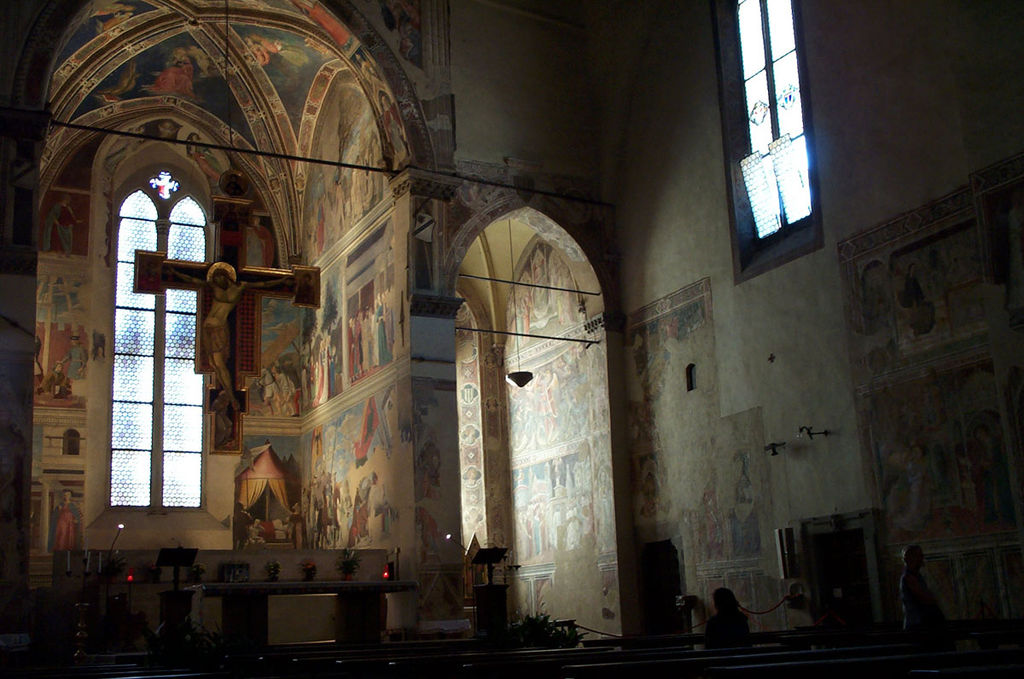
An oblique view of the Bacci Chapel with its window, suspended crucifix and right wall. louis-garden. Image source. CC BY-SA 2.5. Resized from the source. This reproduction uses CC BY-SA 2.5.
Annotated Details from The History of the True Cross
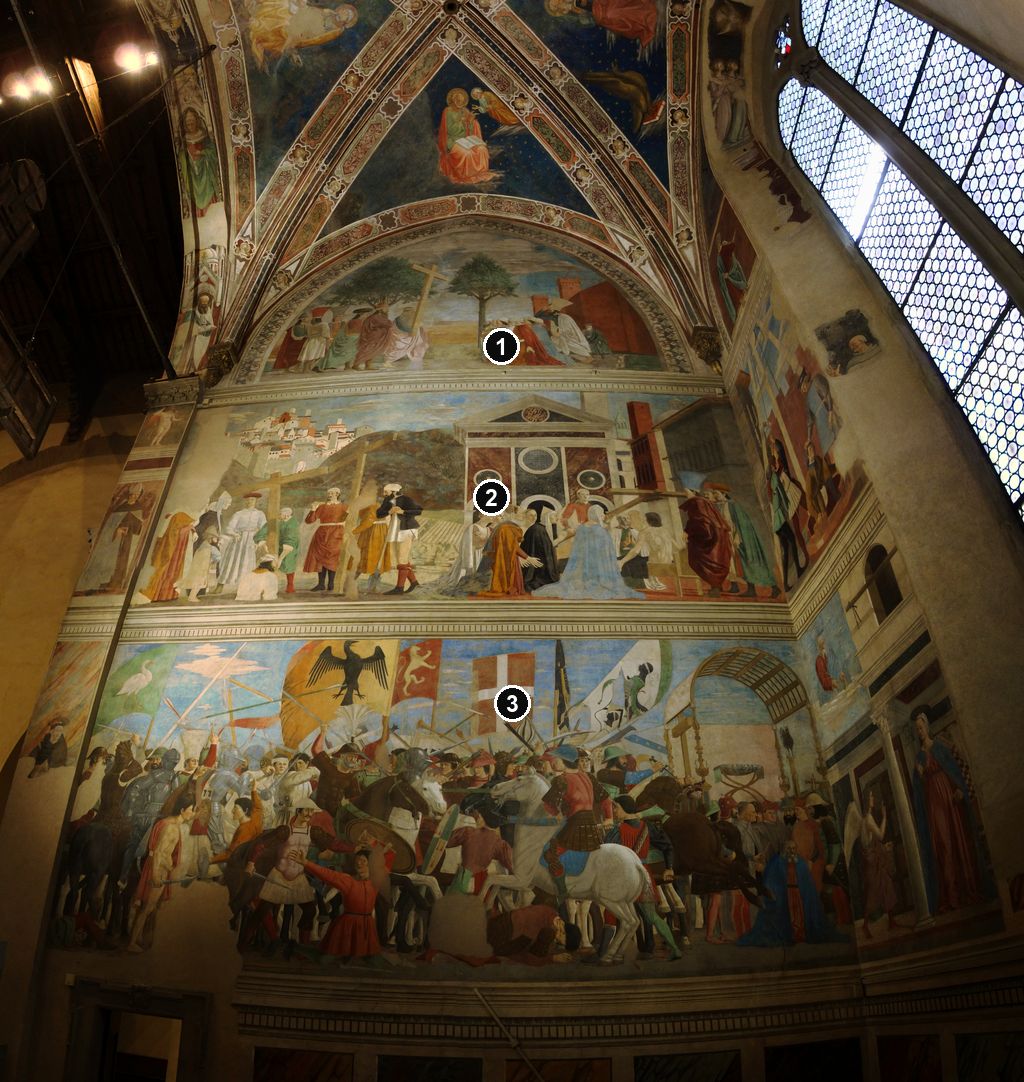
The numbered points identify visible features discussed in this article. Return from each detail to the numbered overview. Each caption identifies the work shown.
Left wall of the Bacci Chapel
Left wall of the Bacci Chapel in San Francesco, Arezzo, as seen from the nave facing the altar. Spike. Image source. CC BY-SA 4.0. The numbered overview and detail crops are adaptations under CC BY-SA 4.0.
Right wall of the Bacci Chapel
Right wall of the Bacci Chapel in San Francesco, Arezzo, as seen from the nave facing the altar. Spike. Image source. CC BY-SA 4.0. The numbered overview and detail crops are adaptations under CC BY-SA 4.0.
Details from THE HISTORY OF THE TRUE CROSS
Compare the cropped details with the source images above. Notice how their colours, shapes and positions contribute to the larger compositions.
Left wall of the Bacci Chapel
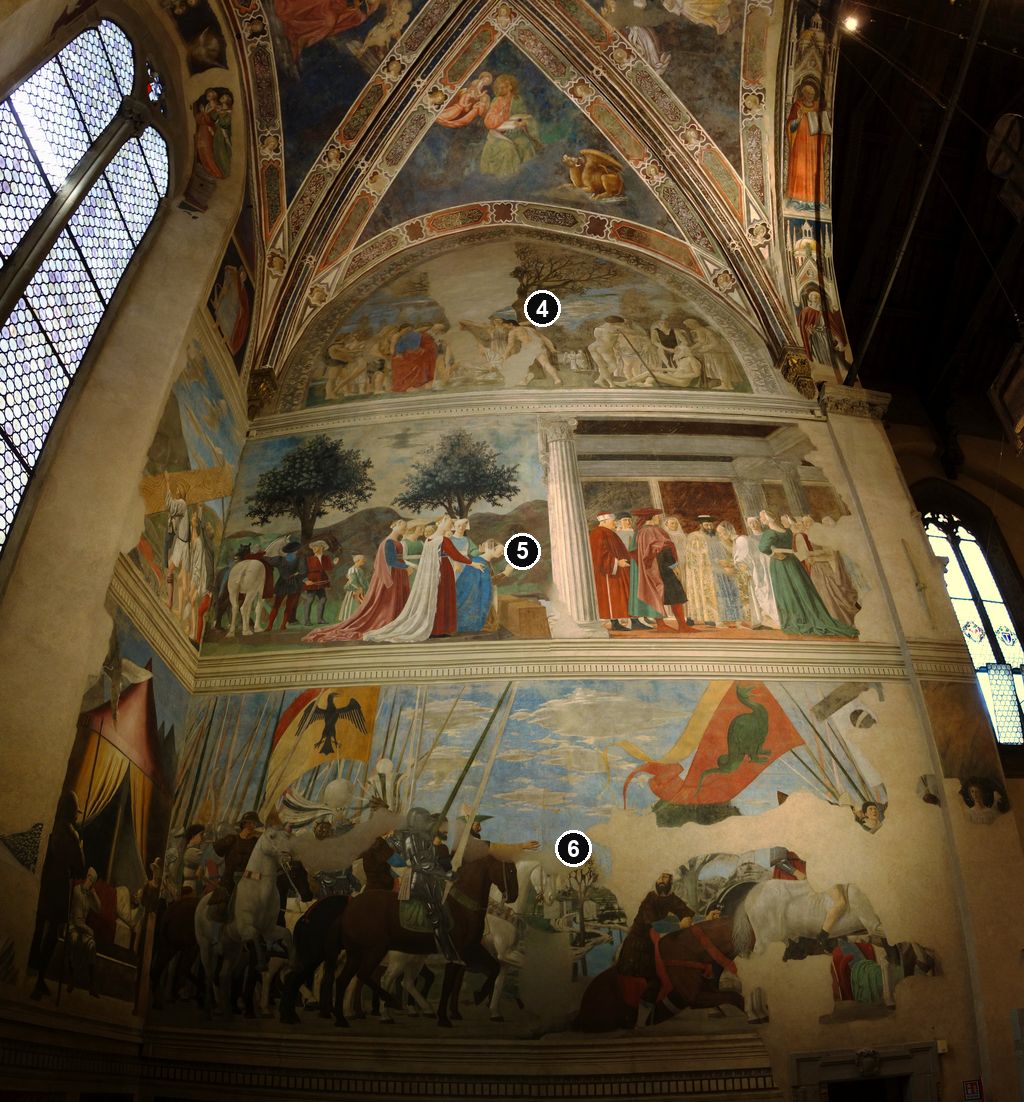
The procession in the lunette
The procession in the Exaltation spreads in a shallow arc at the top of this wall, under the painted vault.
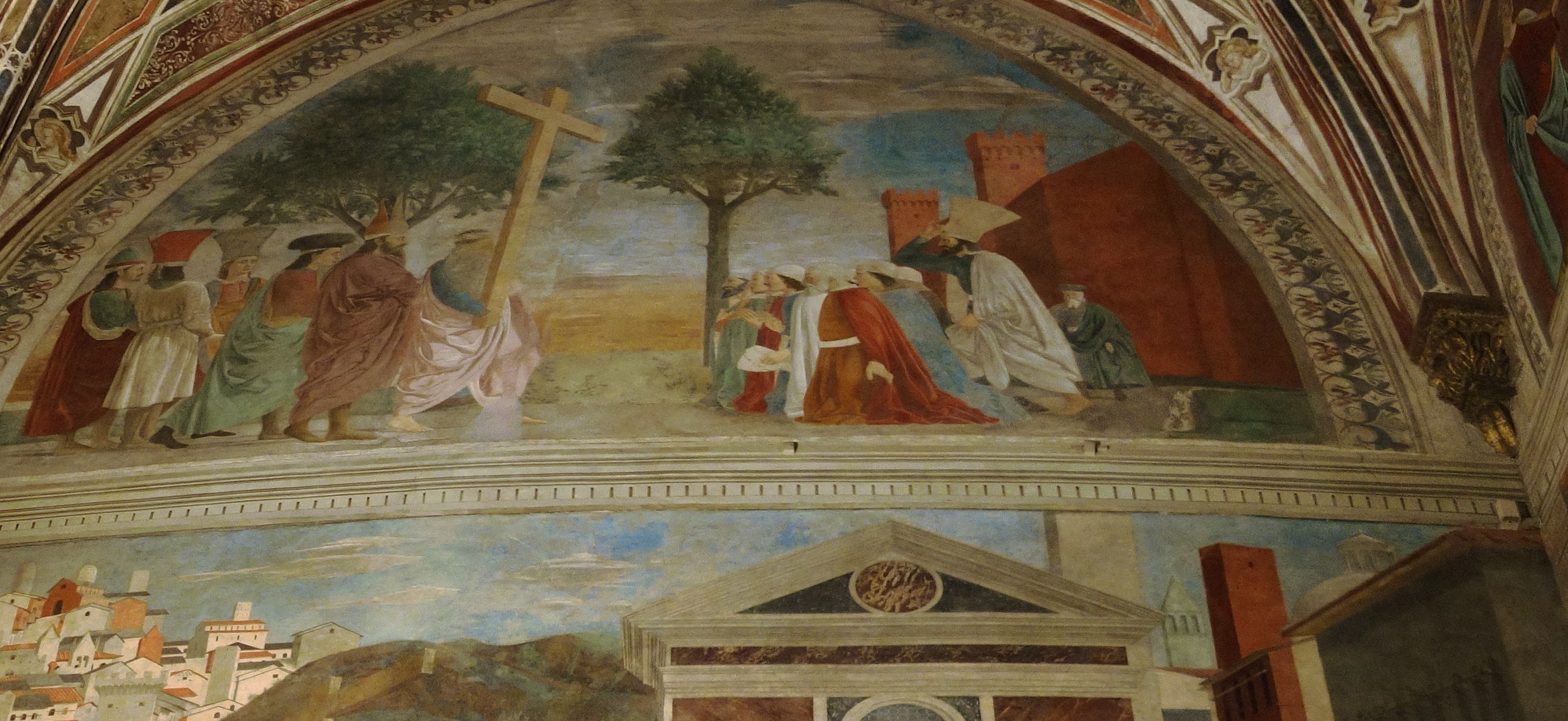
Two settings at the middle level
Figures gather outdoors at one side of the continuous narrative. The darker arches on the other side make the architecture as legible as the group in front.
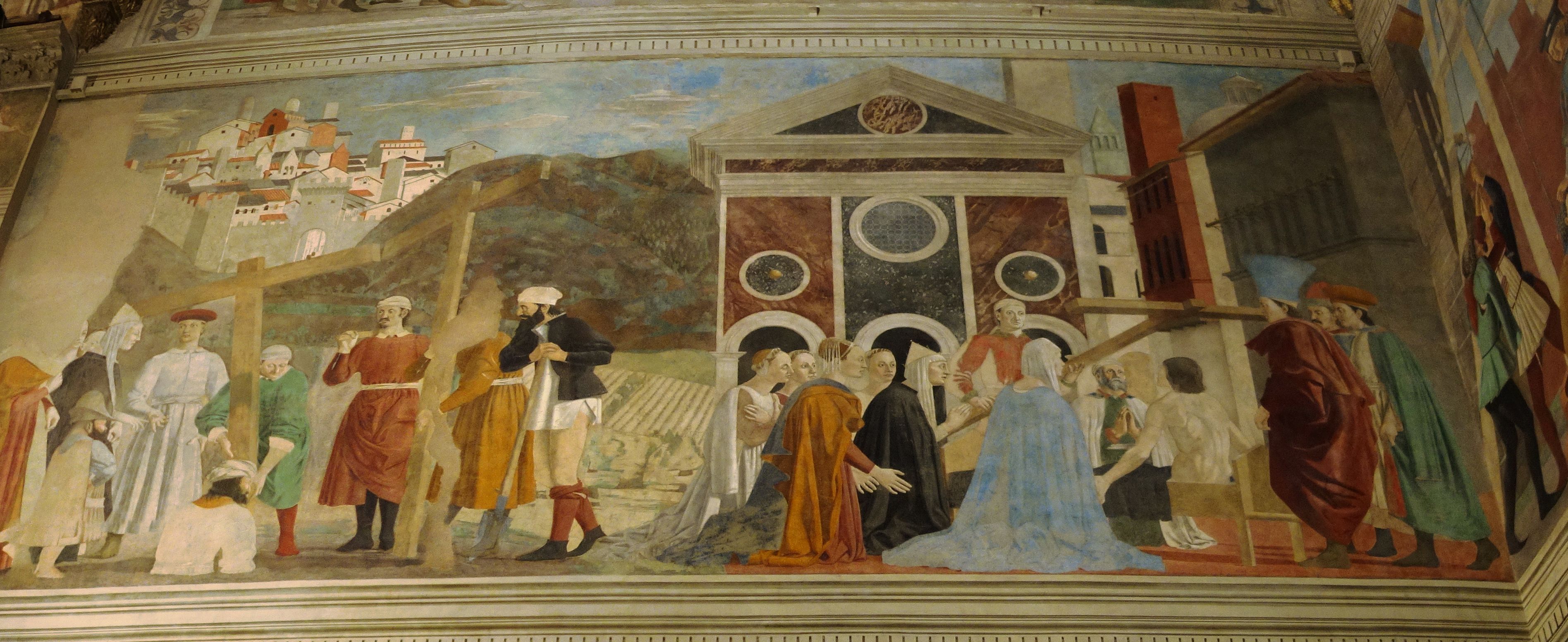
The standards in the battle
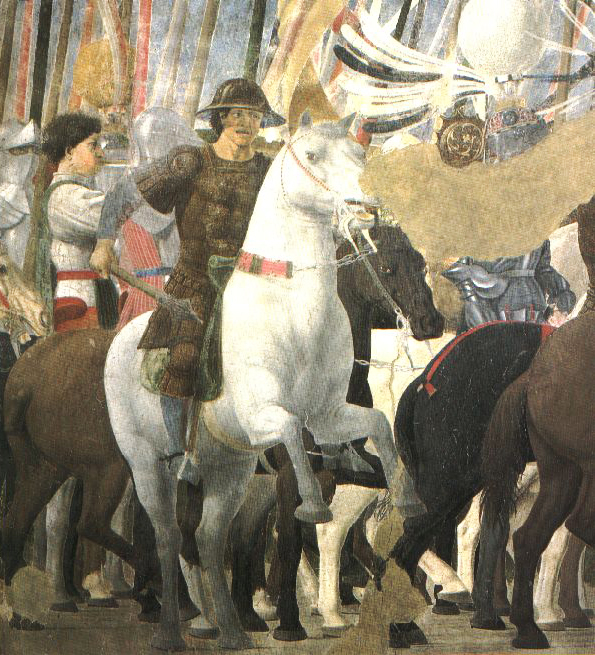
Above the fighting, heraldic devices and the red and white crosses mark distinct standards against the sky.
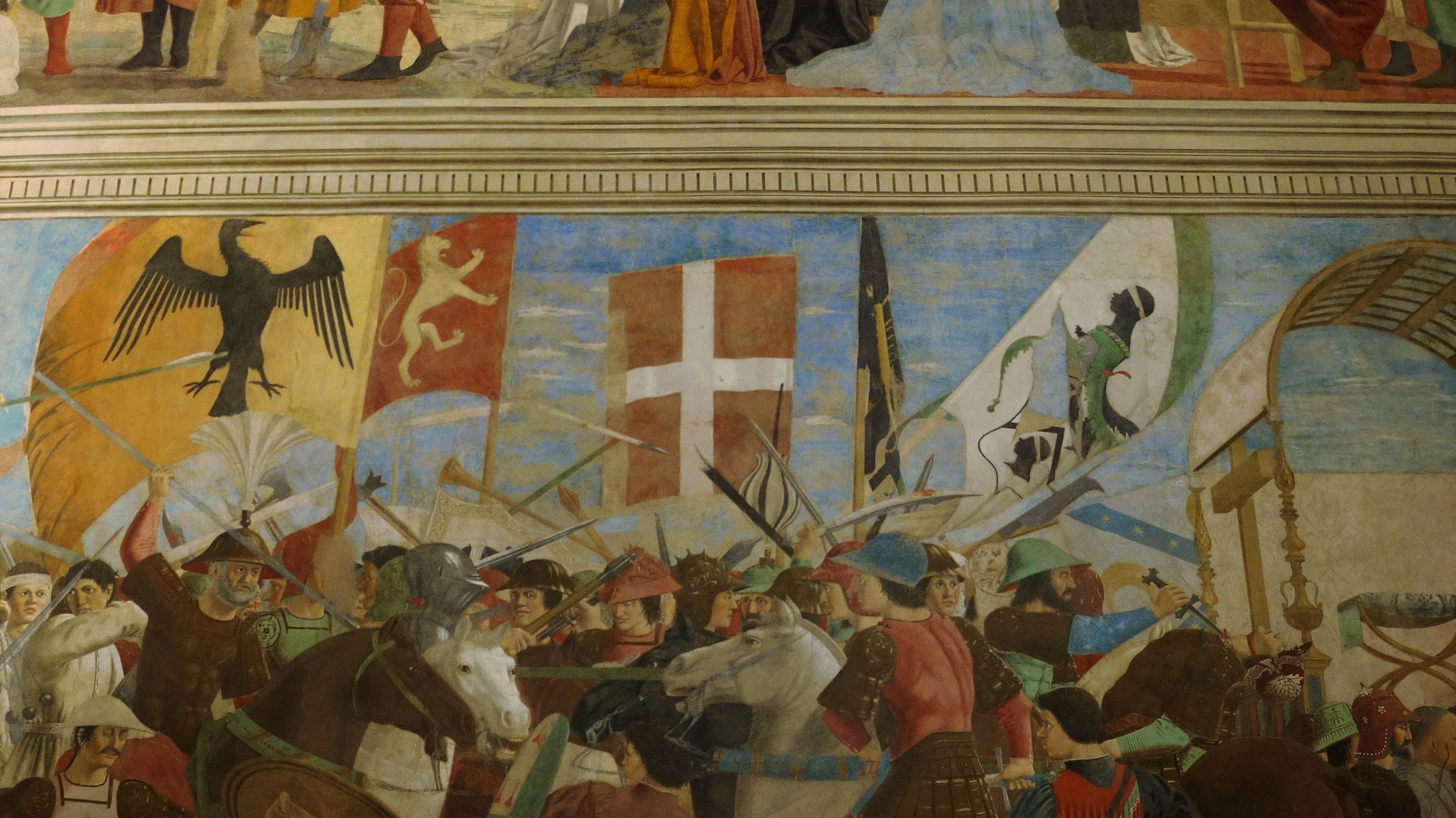
Right wall of the Bacci Chapel
The painted lunette
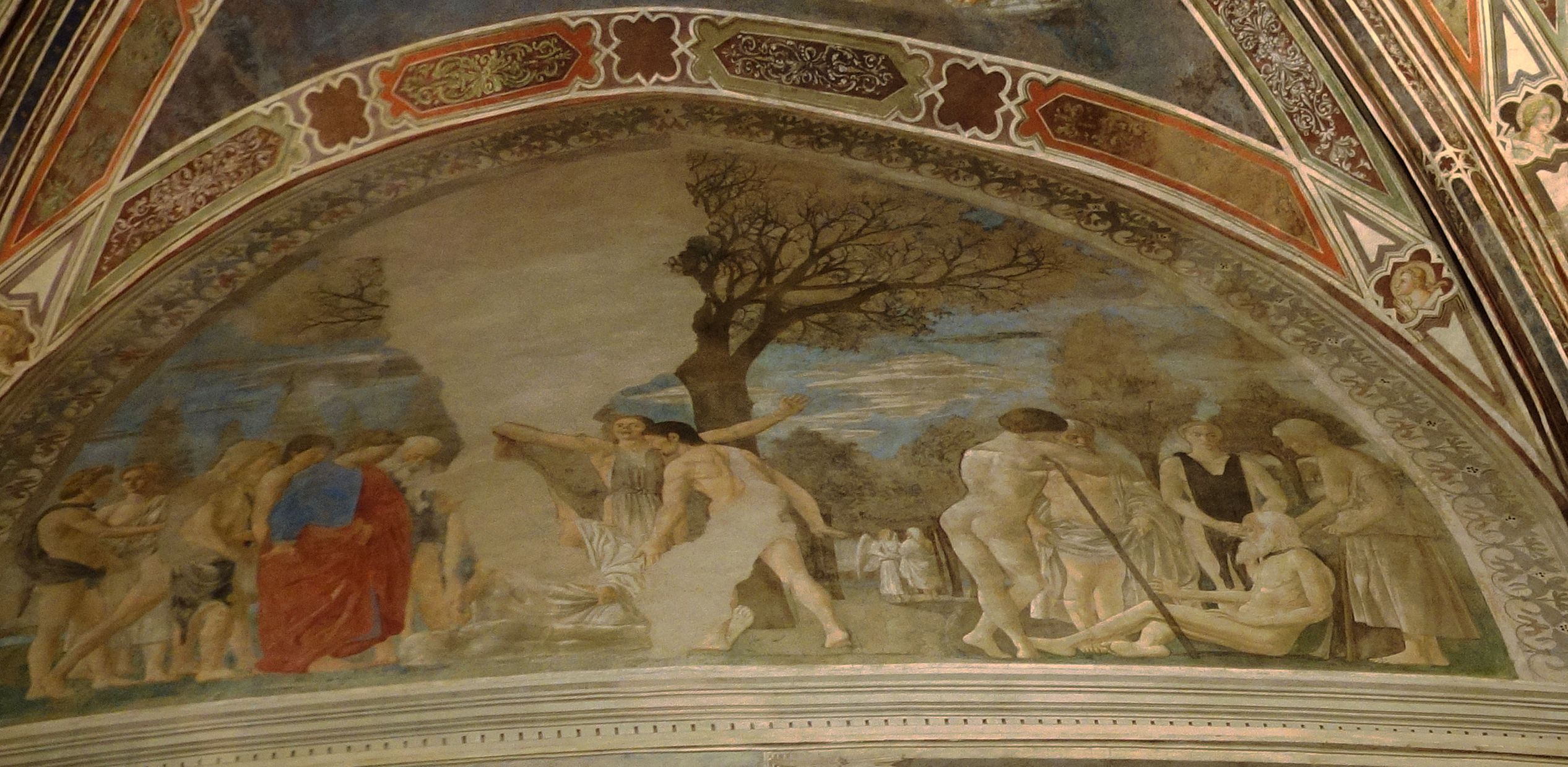
The Death of Adam is spread across a shallow arc. The tree occupies the middle and separates groups within the lunette.
Two visits in a single tier
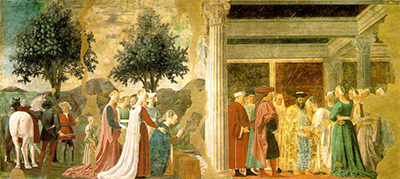
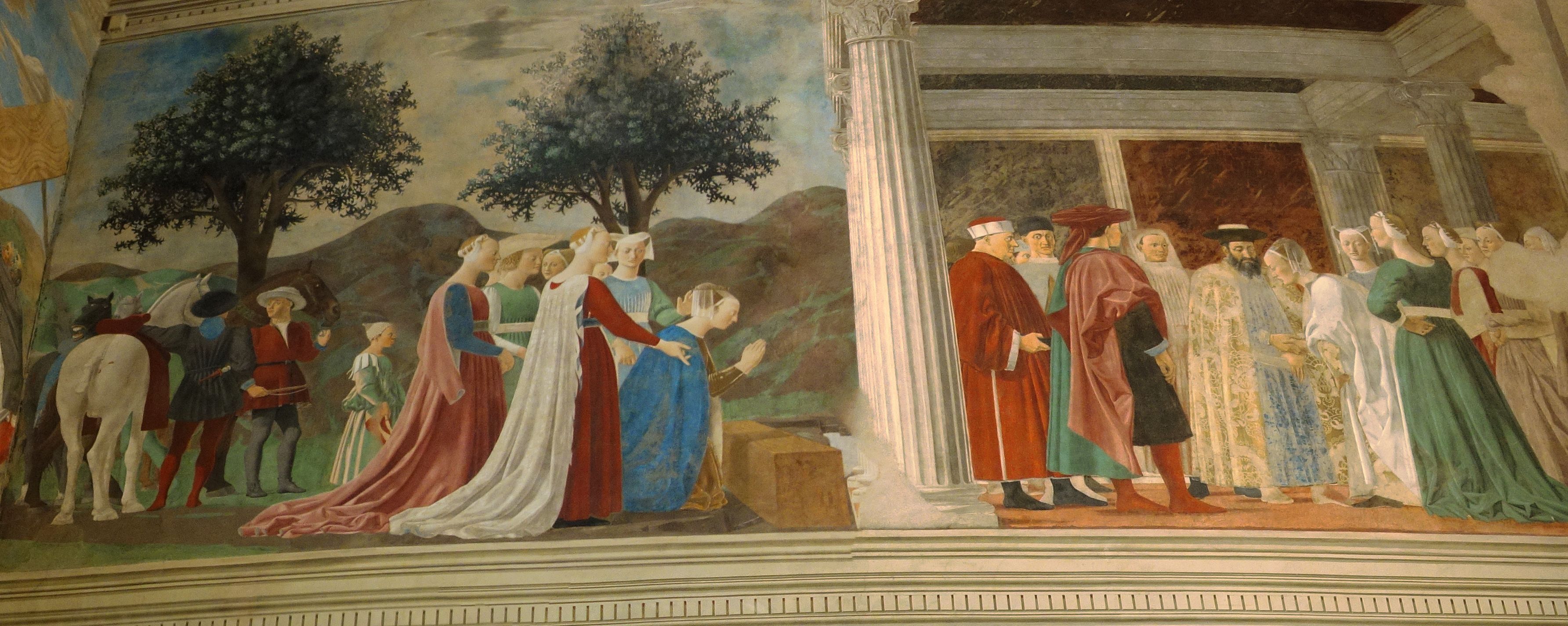
Trees stand behind a kneeling queen and her retinue on the left. Pale columns mark the encounter between the queen and Solomon on the right.
Horsemen below
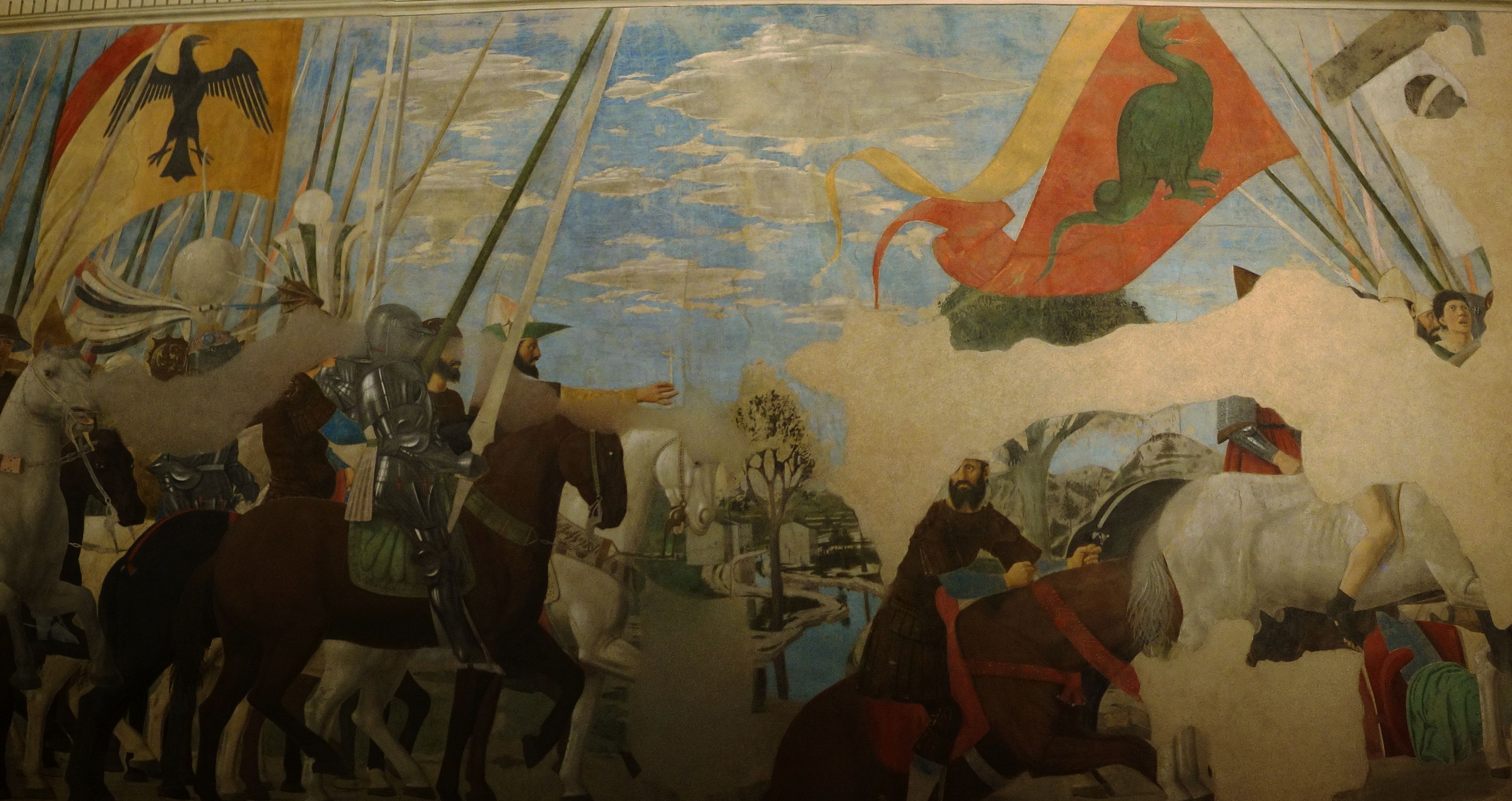
Seen from below, the lower register stretches groups of riders and pennants across the wall. The diagonal lines of the weapons are legible even at a distance.
Where the story comes from
Jacobus de Voragine, a thirteenth-century Dominican also known as Jacopo da Varazze or Jacopo da Varagine, gathered stories of saints and explanations of feast days in the Golden Legend. Two chapters are particularly relevant to Arezzo, the Invention of the Holy Cross and the Exaltation of the Holy Cross. “Invention” here means finding, in the sense of the Latin inventio. The first chapter gathers accounts of the ancient wood and Helena’s discovery. The second concerns its recovery and elevation after the Persian capture of Jerusalem. The collection explicitly reports alternatives. It can tell a story one way and then report what other chronicles say about the same incident. [1] [7] [8]
The main elements of the Christian legend have different relationships to scripture. Genesis gives Adam a son named Seth and records Adam’s death. The story of Seth’s errand and the planting of the future Cross comes from later tradition. The Queen of Sheba visits Solomon in the First Book of Kings, where she questions him and sees his wisdom and wealth. Her recognition of the timber belongs to the legend. Luke supplies the meeting of Gabriel and Mary, and the Gospel of John narrates Jesus’s Crucifixion with two others. The wood’s origins, the later excavation and the miracle that singles it out as Christ’s Cross belong to accounts that grew around those biblical events. [7] [12]
This distinction matters because the painted sequence has the shape of a history, with rulers and armies placed in named settings. Piero also used the dress and architecture of his own world. Within the frescoes those familiar forms bring a remote story close. They can help interpret what the painter and his audience brought to a subject, while the medieval texts help explain which details they inherited and which they adapted. Several episodes change emphasis between text and wall. The person who takes charge of testing the Cross and the kind of combat attributed to Heraclius are two examples. [1] [9] [7] [8]
From Adam’s grave to Constantine’s victory
Death and Burial of Adam
The Death of Adam begins on the right of its lunette, where the aged Adam sends Seth to seek relief. The small meeting of Seth and the angel in the distance supplies the intervening event. At the left, Adam has died and the burial connects him to the shoot from which the sacred wood will grow. Versions of the legend differ over the token Seth receives and how it is placed at the burial. Piero makes the sequence recognisable by giving successive events separate groups within the same landscape. Stand back far enough to see the far-off meeting and the two larger gatherings together. The tree and the spaces between the groups matter to the story as much as any single figure. [1] [2] [7]
Adoration of the Wood and Meeting with Solomon
Below Adam, the Queen of Sheba encounters the timber when it is serving as a bridge. She kneels because she foresees its purpose, then appears again in a palace to tell Solomon what it will become. The change from landscape to columns and inlaid surfaces helps the eye find the join between the two moments. This is the first of two large fields featuring a royal woman who recognises the wood’s role. Sheba looks forward to what it will become. Helena, across the chapel, establishes which piece of timber it has become. The medieval prophecy includes hostility towards Jews, which belongs to the Christian sources for the picture and their historical setting. [1] [2] [7]
Burial of the Holy Wood
Three men shift a heavy beam beside the chapel window. In the legend Solomon orders the timber hidden after hearing the queen’s prophecy. The action in the fresco, still in progress, accounts for alternative titles such as Carrying of the Wood or Lifting of the Wood. It is the same field as the scene captioned Burial of the Holy Wood by Arezzo’s museum guide. Piero gives Solomon’s decision the physical weight of the beam. It tilts across the upright field, and the three figures register its weight through their shoulders, arms and bent bodies. [1] [5] [9] [7]
The chapter in the Golden Legend goes on to tell how the hidden timber reappears and becomes the instrument of Christ’s death. Piero leaves that interval between the concealment and the lower-wall scenes from the age of Constantine. This gap changes what a viewer has to identify. In the scenes before Christ, the object can look like any old piece of wood. When it next becomes visible as a sign, its shape alone can carry the weight of the missing event. [1] [2] [7]
Dream of Constantine
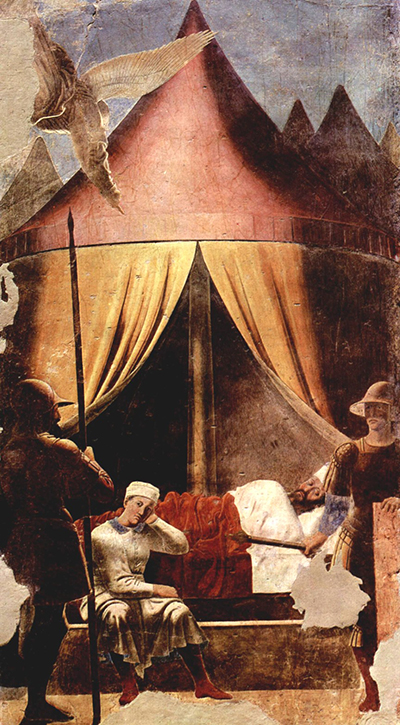
In the Dream of Constantine, the emperor sleeps in a military tent while a descending angel brings the sign under which he will win. A seated attendant and two guards help make the camp tangible. The strong light on a tent opening and the bed draws attention to a message given privately, even though the battle which follows will turn it into a public sign. The lighting of the scene has often led to its description as a nocturne. The museum guide describes its setting as dawn. Both descriptions direct attention to Piero’s use of an illuminated enclosure against the dim camp. [1] [4] [9]
Ancient traditions about Constantine’s vision differ. Lactantius describes a dream and a sign marked on the soldiers’ shields. Eusebius puts a light-bearing sign above the sun and recounts a subsequent dream. The angel in Piero’s tent is the artist’s rendering of a story with a long life in Christian tradition. The sequence in Arezzo brings it into a visual relationship with Gabriel’s appearance to Mary across the window. In each image one person receives news whose fulfilment lies beyond the painted moment. [1] [2] [9] [13]
Victory of Constantine
On the lower right wall, in the scene traditionally known as the Victory of Constantine at the Battle of the Milvian Bridge, the sign has left the privacy of the tent. Constantine advances with a small cross as the opposing troops retreat. The traditional identification is the defeat of Maxentius outside Rome in 312. Another proposed reading is Constantine’s rout of enemies near the Danube, also discussed in the Golden Legend. The fresco’s surviving features give little topographical precision, and losses affect the retreating group. The opposed direction of the riders, the prominence of the small cross and the connection with the Dream survive that uncertainty. [1] [6] [9] [7]
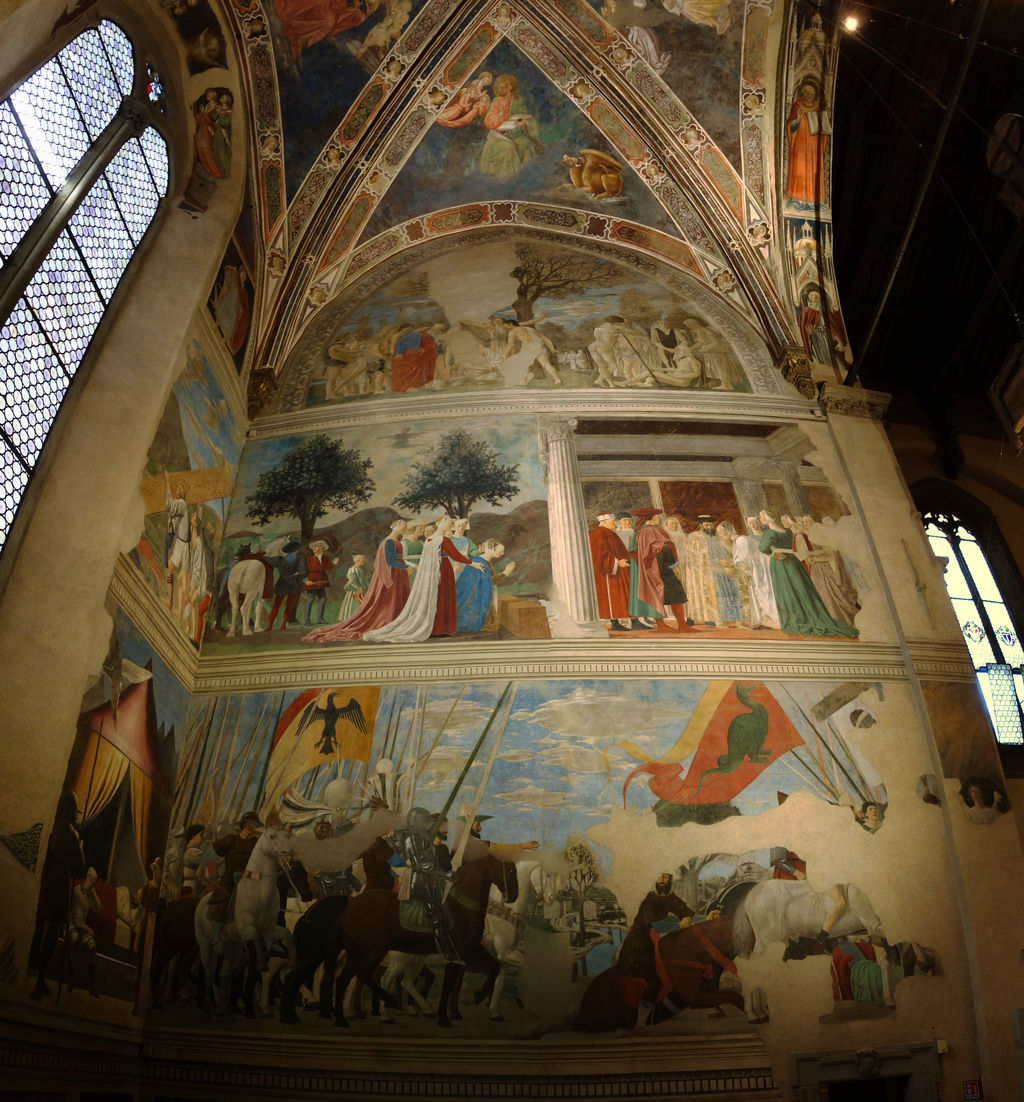
Right wall of the Bacci Chapel in San Francesco, Arezzo, as seen from the nave facing the altar. Spike. Image source. CC BY-SA 4.0. Resized from the source. This reproduction uses CC BY-SA 4.0.
Helena’s search, the Persian war and the return
Torture of Judas
The action moves to the left of the window, where a man is being hauled from a well. The Golden Legend names him Judas, a Jewish man in Jerusalem who knows where the crosses are buried. He lives centuries after Judas Iscariot. In the medieval account Helena has him imprisoned and starved until he agrees to reveal the place. The story goes on to make him a convert known as Cyriacus. The painted episode isolates the coercion. A wooden lifting frame sets the terms of the encounter, with the workers standing above ground and the captive suspended under their control. [1] [5] [7]
The legend uses the torture and subsequent conversion to affirm Christian possession of the relic. That is a good reason to name the anti-Jewish logic of the story plainly. Piero’s chapel makes it particularly visible by giving the coercion its own field. Seen next to Helena’s discovery, the torture shows whose testimony has made the discovery possible and what she does to obtain it. The two scenes work together even though their sizes and the people’s positions in them show sharply different kinds of authority. [1] [2] [7]
Finding and Recognition of the True Cross
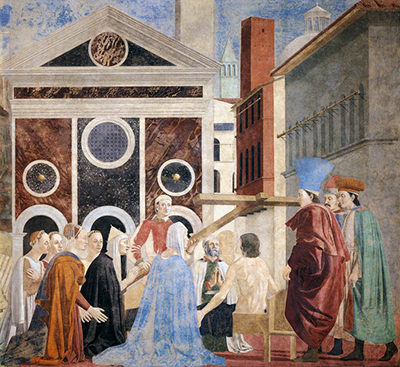
On the middle stretch of the left wall, the search and its conclusion take place side by side. Helena, dressed in dark clothes and crowned, watches the excavation near Jerusalem. The picture moves from the ground being opened on the left to a recognisable townscape on the right, where the Cross restores a young man to life. Three crosses had been found in the legend because Christ was crucified between two others. The test supplies what excavation alone cannot establish. Even at a distance, the repeated lines of the timber help differentiate the discovery of several candidates from the power assigned to one of them. [1] [3] [7] [12]
The Golden Legend places Judas at the centre of the testing in its account of the young man’s revival and also gives a different tradition involving a sick woman. At Arezzo Helena and her attendants make up the principal retinue. Her dark figure carries attention from one event to the other, much as the repeated figure of Sheba does in the field across the chapel. The contrast is that Sheba initially stops before a wooden object with no visible likeness to a cross. Helena has crosses before her, but has to see what one of them can do. [1] [2] [7]
Battle of Heraclius and Chosroes
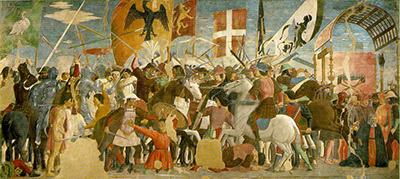
The relic is lost to the Persians in the medieval story and recovered by the emperor Heraclius. In the Battle between Heraclius and Chosroes, horses, arms and banners crowd the lower left wall. At the far right the defeated ruler is shown awaiting execution near his throne. The field brings armed confrontation and judgement within one setting. The Golden Legend offers different versions of the Persian war and the king’s death, including a single combat between Heraclius and Chosroes’s son. The painted mass battle and its appended execution make a particularly clear visual counterpart to Constantine’s victory on the other wall. [1] [2] [8]
The surviving historical accounts place the seizure of the relic during the Sasanian capture of Jerusalem in 614. The Persian ruler, Khosrow II, was overthrown and killed in 628 after a revolt within his own court, and his death opened the way for peace. The fresco gives the recovering emperor a direct role in the defeated king’s fate. The contrast between the accounts helps explain how the medieval legend turns a long war and its aftermath into a decisive victory over a single ruler. [8] [14] [15]
Exaltation of the Cross
The episode high on the left wall presents the return to Jerusalem as a reception of the recovered Cross. The great timber rises from the group around Heraclius, across open sky from the people kneeling to meet him. The medieval text goes into more detail. It tells of a gate shutting miraculously when the emperor approaches in all his finery, and opening after he gives up the trappings of rank and bears the Cross humbly. In the fresco the act the eye can most readily make out is the crowd kneeling before the great upright object. This is the furthest point in the wood’s journey. Its counterpart across the space shows where that wood first grew. [1] [2] [8]
Annunciation
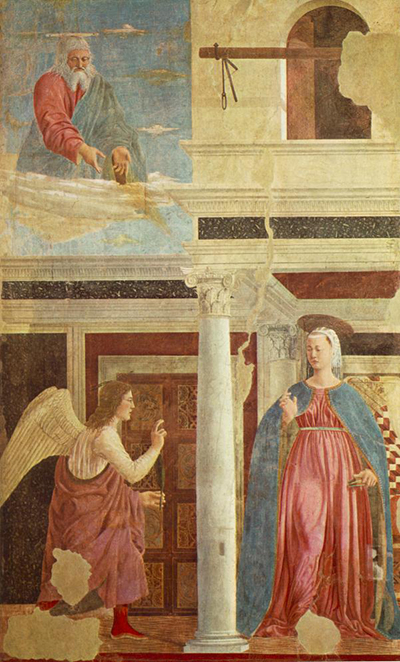
The chapel’s Annunciation occupies the bottom left of the window wall. Gabriel faces Mary in a setting of columns and coloured stone. Mary holds a book, and the museum guide reads the palm Gabriel brings as a sign of victory. Luke provides the encounter and the promise that Mary will bear Jesus. The palm and the architecture belong to the painted interpretation. The episode has a place in the ensemble because the Incarnation makes possible the death to which the rest of the legend refers. Its pairing with the Dream lets the viewer compare two kinds of revelation, one received awake and the other asleep. [1] [2] [12]
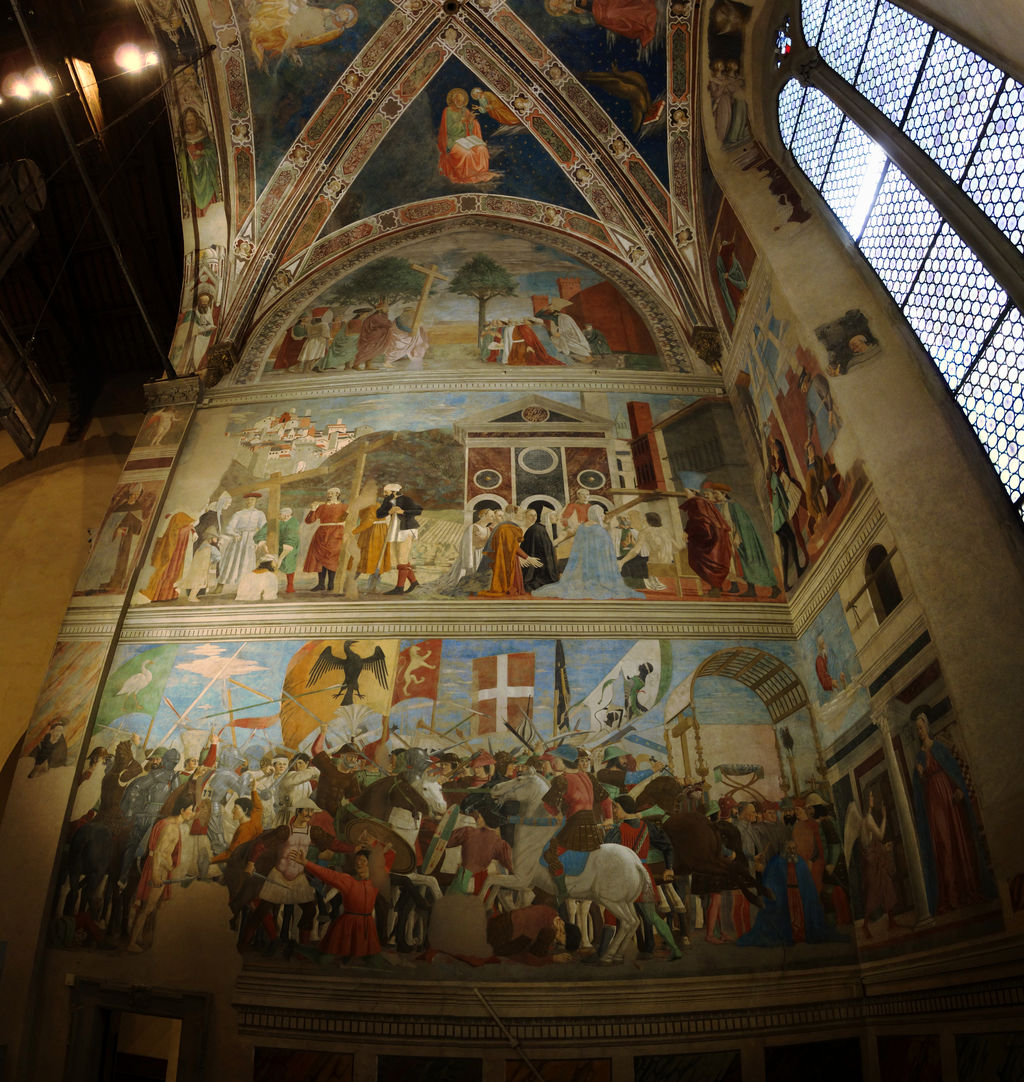
Left wall of the Bacci Chapel in San Francesco, Arezzo, as seen from the nave facing the altar. Spike. Image source. CC BY-SA 4.0. Resized from the source. This reproduction uses CC BY-SA 4.0.
The prophets, fragments and proposed portraits
The two standing figures above the smaller scenes are generally read as prophets. Their placement relates prophecy to the story unfolding beside and below them, but individual names remain open. Jeremiah and Ezekiel are familiar modern titles. Other readings have proposed Daniel and Isaiah, or Daniel and David. The programme can be understood without settling on a name for either figure. The painted figures direct attention towards events understood, in Christian tradition, as the fulfilment of older scriptures. [2] [4] [6] [9]
The edges preserve further evidence of the chapel’s decoration. Around the entrance the surviving fragments have been identified as saints including Louis of Toulouse and Peter Martyr, a painted angel, and a figure interpreted as a blind Cupid. A figure of Bernardino of Siena survives in the window reveal. The arch also preserves the Fathers of the Church, including two usually identified as Augustine and Ambrose from the later campaign. These details belong to the chapel’s broader programme. Some are fragmentary enough that their names, their original companions and the division of work merit the same care given to the prophets. [4] [6] [5]
A different kind of identification concerns the victorious Constantine. Scholars have compared his profile with Pisanello’s medal of the Byzantine emperor John VIII Palaiologos. Carlo Ginzburg and others explored whether this likeness could connect the fresco to fifteenth-century hopes of uniting the Eastern and Western churches or launching a crusade after the fall of Constantinople in 1453. A recognisable profile is evidence of a visual relationship. The exact politics of its use, the commissioners’ intentions, and the identity of a possible adviser such as Cardinal Bessarion remain matters of interpretation. The figure’s role as Constantine belongs to the painted narrative even if a contemporary face supplied his features. [6] [9]
The conservation of a painted room
Fresco painting binds pigment to a plaster surface as the plaster sets. At Arezzo the painting also used other techniques. The Tuscan museum authority describes a mixed practice that included fresco with tempera and oil work. Over time, moisture in the masonry helped cause sulphation, which clouded and damaged the surfaces. The long project of investigation and treatment described by Marisa Dalai Emiliani, begun in 1985 and concluded in 2000, therefore involved the building and its environment as well as the painted layer. Structural consolidation and work on the conditions around the paintings went alongside treatment of plaster and paint. Anna Maria Maetzke directed the campaign to its close. [10] [16]
The scope is easier to grasp by looking at how the conservators kept records. Stefano Casciu, Giuseppe Centauro and Massimo Chimenti describe a system built on measured photographic surveys of the walls. It allowed conservators to place older photographs, ultraviolet survey images and maps of treatments at their actual positions on the painted surface. The maps could be used singly or superimposed. This helped staff compare records of deterioration in a painted passage with records of masonry condition or earlier repairs. It also allowed them to assemble photographs taken after cleaning into a wall-wide view from before the visual treatment of losses. A view of that stage makes sense only if the different records can be put in the right spatial and chronological relationship. [17]
The restoration also changed what historians could study. Dalai Emiliani returned to the way Piero constructed pictorial space, using the restored ensemble and the evidence gathered during treatment. This kind of study depends on distinctions that a reproduction can flatten. One photograph may show an area before cleaning, another after cleaning, and a third after the reintegration of losses. Close photographs record surface detail, while a wider view shows what a figure or building does at the height and distance for which Piero designed it. In a cycle where looking across the room is fundamental, access to both kinds of image offers different ways to test an interpretation. [2] [10] [17]
The digital model produced by Lavin and her collaborators took that distinction seriously. It put photographs into a virtual chapel with enough context for the viewer to follow the narrative and inspect the relationships across the registers. Photographs taken from the scaffold record details unavailable from a normal viewing position. The model also lets a viewer recover the place of each detail in the room. In that way it answers a question that arises whenever a scene is reproduced on its own. How much of the picture’s meaning comes from what Piero placed just beyond the edge of the photograph? [2]
Continued care has taken different forms. The regional museum authority and its lighting partner presented new illumination in 2019, using controllable LED fittings. This changed how the surfaces could be seen. A separate 2024 maintenance programme reviewed the condition of plaster and paint and removed accumulated dust and particulates, following an earlier maintenance campaign in 2016. Its wider work programme also addressed the painted Crucifix and the glazed window, including plans for exterior protective glazing. The conservation of the wall paintings thus depends on their material surroundings. The measured photographs, the installed lighting and the work on the building each tell a different part of that history. [16] [18]
Seeing the paintings in Arezzo
Begin by locating Adam and the Exaltation high on opposing walls, then compare the women in the middle tier and the battles below. Once the three pairs are clear, follow the wood from Sheba’s bridge to the burial beside the window, then to the cross-sign in the Dream. When you reach the left wall, look from the workers hauling Judas up to the workers digging under Helena’s gaze. Those shifts of attention help retain the chapel’s scale and its alternating heights while following the plot. The frescoes remain in San Francesco, where the Tuscan museum authority publishes information for visitors. Piero’s Saint Mary Magdalen is in Arezzo Cathedral. The guide to where to see Piero’s work places both sites within a wider itinerary. [1] [2] [3] [19]
Browse the artworks
Compare Piero’s frescoes, panels and manuscript figures. The list includes ensembles and separately identifiable panels or scenes. Dates are approximate where the sources differ.
| Name | Date | Medium and source |
|---|---|---|
| The Baptism of Christ | Probably c. 1437–45 | Panel painting Catalogue. |
| The Flagellation of Christ | 1459–60 (GNDM) | Panel painting Catalogue. |
| The History of the True Cross | Mid-fifteenth century | Wall painting Catalogue. |
| Dream of Constantine | Mid-fifteenth century | Wall painting Catalogue. |
| The Duke and Duchess of Urbino | About 1473–75 (Uffizi) | Panel painting Catalogue. |
| The Resurrection | About 1458–68 (Opificio) | Wall painting Catalogue. |
| Brera Madonna | About 1472–74 | Panel painting Catalogue. |
| Annunciation at Arezzo | Mid-fifteenth century | Wall painting Catalogue. |
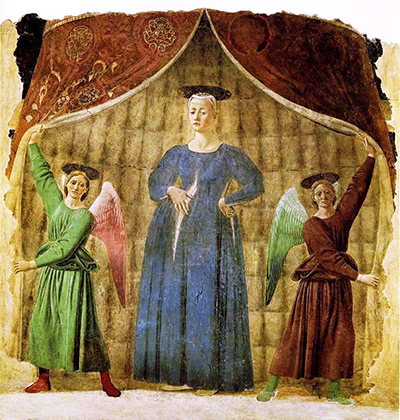
| Madonna del Parto | About 1450–65 (Monterchi) | Wall painting Catalogue. |
| Polyptych of the Misericordia | Commissioned 1445 | Panel painting Catalogue. |
| The Nativity | Early 1480s (National Gallery) | Panel painting Catalogue. |
| Madonna di Senigallia | About 1474–75 (GNDM) | Panel painting Catalogue. |
| Death of Adam | Mid-fifteenth century | Wall painting Catalogue. |
| Queen of Sheba | Mid-fifteenth century | Wall painting Catalogue. |
| Victory of Constantine | Mid-fifteenth century | Wall painting Catalogue. |
| Battle between Heraclius and Chosroes | Mid-fifteenth century | Wall painting Catalogue. |
| Saint Mary Magdalen | Wall painting Catalogue. | |
| The Augustinian Polyptych | 1454–69 | Panel painting Catalogue. |
| Polyptych of Perugia | About 1467–69 (GNU) | Panel painting Catalogue. |
| Perugia Annunciation | About 1468–70 (national catalogue) | Panel painting Catalogue. |
| St Francis and St Elizabeth | About 1467–69 (GNU) | Panel painting Catalogue. |
| Stigmatisation of St Francis | About 1468–70 (national catalogue) | Panel painting Catalogue. |
| An Augustinian Nun (Saint Monica) | 1454–69 | Panel painting Catalogue. |
| Augustinian Saint | 1454–69 | Panel painting Catalogue. |
| Saint Michael | 1454–69 | Panel painting Catalogue. |
| Saint Nicholas of Tolentino | 1454–69 | Panel painting Catalogue. |
| Saint John the Evangelist | 1454–69 | Panel painting Catalogue. |
| Virgin and Child Enthroned with Four Angels | About 1460–70 (Clark) | Panel painting Catalogue. |
| Portrait of Sigismondo Pandolfo Malatesta | About 1450–51, often proposed. Louvre catalogue range 1450–75. | Panel painting Catalogue. |
| Sigismondo before St Sigismund | 1451 | Wall painting Catalogue. |
| St Jerome and a Donor | 1460s (Accademia); about 1450 also proposed | Panel painting Catalogue. |
| St Jerome in Penitence | 1450, dated on the panel | Panel painting Catalogue. |
| Saint Julian | About 1455–60, often proposed | Wall painting Catalogue. |
| Saint Augustine | 1454–69 | Panel painting Catalogue. |
| Saint Apollonia | 1454–69 | Panel painting Catalogue. |
| Crucifixion from the Augustinian Polyptych | 1454–69 | Panel painting Catalogue. |
| Saint Louis of Toulouse | Wall painting Catalogue. | |
| Burial of the Wood | Mid-fifteenth century | Wall painting Catalogue. |
| Discovery and Proof of the True Cross | Mid-fifteenth century | Wall painting Catalogue. |
| Exaltation of the Cross | Mid-fifteenth century | Wall painting Catalogue. |
| Saint Anthony Raises a Child | About 1467–69 (GNU) | Panel painting Catalogue. |
| Saint Elizabeth Revives a Child | About 1467–69 (GNU) | Panel painting Catalogue. |
| Hercules | About 1470 | Wall painting Catalogue. |
| Portrait of a Boy (possibly Guidobaldo da Montefeltro) | Panel painting Catalogue. | |
| De prospectiva pingendi, Reggio Emilia witness (figures) | Manuscript diagrams Catalogue. | |
| The Interrogation of Judas | Mid-fifteenth century | Wall painting Catalogue. |
| Two prophets, Bacci Chapel | Mid-fifteenth century | Wall painting Catalogue. |
| Saint Clare of Assisi, upper predella | About 1467–69 (GNU) | Panel painting Catalogue. |
| Saint Agatha, upper predella | About 1467–69 (GNU) | Panel painting Catalogue. |
| Lost centre of the Augustinian Polyptych | 1454–69 | Lost panel or panels Catalogue. |
Frequently Asked Questions
Discussion
Look again at the images and ideas explored in The History of the True Cross. These editorial prompts invite your observations.
Reader Insights
Compare the right and left lunettes. How do the tree in Adam’s story and the upright Cross in the Exaltation change the way people gather underneath them?
Look at the scenes involving Sheba and Helena from the same distance. What can you learn about the wood from the women’s gestures before you can make out the smaller details?
Follow the workmen around the window and into Helena’s scene. What changes when the story of a relic is told through lifting, digging and carrying?
Join the Conversation
Share a detail, comparison or question about The History of the True Cross below.
References
- Musei di Arezzo. Frescoes by Piero della Francesca. Basilica of St. Francis. Illustrated guide and chapel plan. See also the Italian edition. View source 1. View source 2.
- Marilyn Aronberg Lavin, Kirk D. Alexander, Franco Tecchia and Marcello Carrozzino. “Piero Della Francesca On-line: Story of the True Cross, San Francesco, Arezzo (Italy)”. Museums and the Web 2009, especially figures 2–3. View source.
- Direzione regionale Musei nazionali Toscana. “Basilica di San Francesco”. See also Musei di Arezzo’s basilica and frescoes entry. View source 1. View source 2.
- Ronald W. Lightbown. “Franceschi, Piero”. Dizionario Biografico degli Italiani, vol. 49. Istituto della Enciclopedia Italiana, 1997. See the section on San Francesco. View source.
- Frank Dabell. “Giovanni da Piamonte”. Dizionario Biografico degli Italiani, vol. 56. Istituto della Enciclopedia Italiana, 2001. View source.
- Chiara Giulia Morandi. L’immagine eroica del principe al tempo dei conflitti con la Mezzaluna ottomana (XV–XVI sec.). Persistenze cavalleresche e rinascite dell’antico. Doctoral thesis, Università di Bologna, 2019, especially pp. 90–95. View source.
- Jacobus de Voragine. “The Invention of the Holy Cross.” The Golden Legend, vol. III. Translated by William Caxton, Temple Classics edition edited by F. S. Ellis, Fordham University Internet History Sourcebooks Project. View source.
- Jacobus de Voragine. “The Exaltation of the Holy Cross.” The Golden Legend, vol. V. Translated by William Caxton, Temple Classics edition edited by F. S. Ellis, Fordham University Internet History Sourcebooks Project. View source.
- Monica Centanni and Alessandra Pedersoli. “Costantino XI Paleologo vs Maometto II. Nota sulla cronologia della Battaglia di Costantino contro Massenzio di Piero della Francesca in San Francesco ad Arezzo”. La Rivista di Engramma 52 (2006), pp. 7–24. View source.
- Marisa Dalai Emiliani. “Nuovi indizi del metodo prospettico di Piero della Francesca nel cantiere di San Francesco ad Arezzo alla luce dei recenti restauri”. In L’artiste et l’oeuvre à l’épreuve de la perspective, pp. 287–301. École française de Rome, 2006. View source.
- Opera di Santa Croce. “Chancel Chapel”. Institutional account of Agnolo Gaddi’s fresco cycle and its arrangement. View source.
- The New American Bible, Revised Edition. Genesis 5, 1 Kings 10, Luke 1:26–38 and John 19:16–18. US Conference of Catholic Bishops. View source 1. View source 2. View source 3. View source 4.
- Eusebius of Caesarea. Life of Constantine, book I, chapters 28–29. Catholic Library. View source.
- Strategius of Mar Saba. The Capture of Jerusalem by the Persians in 614 CE. Institute for the Study of Ancient Cultures, University of Chicago. Modern English translations and scholarly introduction. View source.
- James Howard-Johnston. “Ḵosrow II”. Encyclopaedia Iranica. See the sections on the Roman war and Khosrow’s fall. View source.
- Direzione regionale Musei nazionali Toscana. “Arezzo – Basilica di San Francesco. Light is back. Piero della Francesca rinnova la sua luce”. Project announcement, 2019. View source.
- Stefano Casciu, Giuseppe A. Centauro and Massimo Chimenti. “The Archival Documentation System: The Computerized Heart of the Restored ‘History of the True Cross’ by Piero della Francesca.” In Werner Schmid, ed., GraDoc. Graphic Documentation Systems in Mural Painting Conservation. ICCROM, 2000, especially printed pp. 212–215, figs. 4–6. View source.
- Ministero della Cultura, Direzione generale Musei. “Ad Arezzo visite al cantiere di manutenzione della ‘Leggenda della Vera Croce’ di Piero della Francesca”. 2024 maintenance notice. View source.
- Ministero della Cultura, Catalogo generale dei Beni Culturali. “Santa Maria Maddalena”. Arezzo Cathedral, catalogue record 0900219689. View source.