 by Tom Gurney
Tom Gurney BSc (Hons) is an art history expert with over 20 years experience
Published on June 19, 2020 / Updated on October 14, 2023
Email: tomgurney1@gmail.com / Phone: +44 7429 011000
An Augustinian Nun (Saint Monica): Introduction
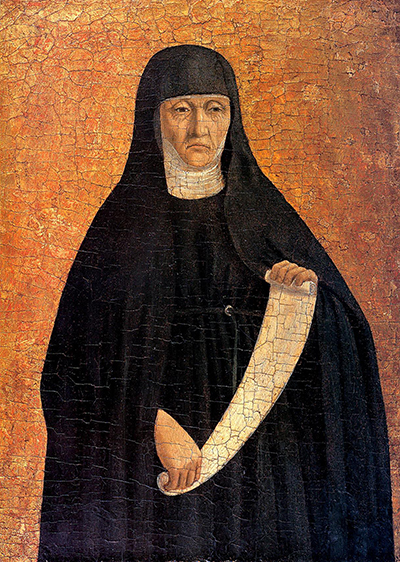
A woman in a black habit unrolls a white scroll against a field of gold. Her head turns towards the right of the panel, and the sheet curves back towards the body. The Frick Collection calls her Saint Monica, the mother of Saint Augustine, and identifies the scroll as the Augustinian rule. At less than forty centimetres high, the panel belonged to the elaborate high altarpiece that Piero della Francesca undertook for the Augustinians of Borgo San Sepolcro, now Sansepolcro. The church setting helps explain why the painter gave a woman from late antiquity the appearance of an Augustinian nun. [1] [2]
At a Glance
- TitleAn Augustinian Nun (Saint Monica), also published as Saint Monica. [1] [3]
- ArtistThe Frick’s collection record lists Piero della Francesca. The 2021 Madison guide allows for execution by his workshop. [4] [3]
- Date1454–69, the span of the altarpiece commission. [1] [2]
- Medium and sizeTempera on panel, 38.7 × 27.9 cm, in the current collection record. The Frick’s exhibition entry describes oil and tempera with gold on poplar. [1] [3]
- CollectionThe Frick Collection, New York, purchased in 1950, accession 1950.1.158. [3]
- Original settingA small saint panel from the high altarpiece of Sant’Agostino in Borgo San Sepolcro. Its precise location in the frame is reconstructed. [2] [5] [6] [7]
This work across Piero della Francesca’s career
The Baptism of Christ
Probably about 1437–45The History of the True Cross
Mid-fifteenth centuryAn Augustinian Nun (Saint Monica) (current article)
1454–69, Augustinian PolyptychThe Resurrection
About 1458–68 (Opificio)The Flagellation of Christ
1459–60 (GNDM)The Montefeltro Altarpiece
About 1472–74 (Brera)The Duke and Duchess of Urbino
About 1473–75 (Uffizi)The Nativity
Early 1480s (National Gallery)Contents
- The black habit and the white scroll
- Why the Augustinians pictured Monica as a nun
- A small figure in the structure of the altarpiece
- What examination of the panels can tell us
- How firmly is the painting attributed to Piero?
- Annotated details
The black habit and the white scroll
The face is framed by the long edge of the cowl, which makes the downward turn of the eye and the outline of the nose especially easy to follow. The heavy fabric narrows at the waist, where a leather belt is fastened with a metal buckle. The buckle is a tiny point of light within a broad area of black. From the waist, the folds pull the eye back up to the open scroll. Its pale surface catches the light across a much wider area, with the darker edge of the curl giving the sheet a thickness of its own. [1]
Two hands are involved in displaying the rule. One steadies the upper part of the scroll while the other supports the hanging portion. The resulting curve carries the action across the narrow panel. Her attention seems directed towards the scroll and beyond the edge of the picture at once. That effect matters in a work that once had neighbours on a gilded structure. A visitor looking at the small panel alone can follow the exchange between her face and hands, and imagine how the turn of her head might have led the eye elsewhere on the altar. [1] [2]
The Frick understands the scroll as the order’s code of conduct. The white expanse makes that object identifiable at a glance even where individual words cannot be made out. The dress makes the same point in another way. The cowl establishes the silhouette, and the belt gives the fabric the shape of an actual habit worn by a member of a religious community. A modern viewer might assume that the plain costume is simply a mark of humility. Here the particulars of dress, alongside the rule, also establish an institutional identity. [1]
Why the Augustinians pictured Monica as a nun
In Book IX of his Confessions, Augustine recalls talking with his mother at a window in Ostia as they waited to return to Africa. Their conversation turns to the nature of eternal life. He then describes her illness and death, and her request that he remember her at the altar. The episode brings together a son’s memory of his mother and the public setting in which he asks readers to remember her. That request gives the painted figure a particular resonance on a high altarpiece, even though the picture depicts a standing saint with a scroll and the book recounts a conversation at a window. [1] [8]
Monica lived centuries before the medieval Augustinian order. The order traces its way of living in community to Augustine in North Africa. Its institutional history dates from the thirteenth century, when the papacy brought Tuscan hermits and, later, other religious communities together under a single rule. Her clothing belongs to the visual language of the fifteenth-century church that commissioned the picture. The Frick’s exhibition label explains that Augustinian churches were already required to have an image of Monica by the time of this commission. Her place in this setting rested partly on her role in Augustine’s conversion. The scroll gives her an active place within the community’s image of itself. She holds out the rule that members of the order followed in their own lives, bringing the devotion associated with Augustine’s mother into the setting in which the friars prayed. [1] [8] [9]
That context gives the name Monica considerable force. The habit identifies the woman as Augustinian, and the importance of Monica to this particular order makes her a persuasive choice. The Frick’s 2013 press image list still printed the name with a question mark. In an account of small paintings that once belonged to the Franceschi Marini family in Sansepolcro, the National Gallery of Art in Washington also records earlier descriptions that identify the nun in general terms or call her by a different name. The title preserves an interpretation of the image that emerged through the study of the ensemble and its patrons. [5] [10]
Annotated Details from An Augustinian Nun (Saint Monica)
The numbered points identify visible features discussed in this article. Return from each detail to the numbered overview. An Augustinian Nun (Saint Monica), from the Augustinian Polyptych, The Frick Collection. Image source. Public domain.
.jpg)
Details from AN AUGUSTINIAN NUN (SAINT MONICA)
Compare the cropped details with the source images above. Notice how their colours, shapes and positions contribute to the larger compositions.
The face and wimple
A pale piece of cloth closely frames the face below the chin. Its short folds interrupt the dark habit and nearby plain strip of gold.
 Detail 01 the-face-and-wimple.jpg)
The upper hand
The fingertips bend over the pale scroll. It drops immediately away from the hand and crosses the front of the black habit.
 Detail 02 the-upper-hand.jpg)
The lower curve of the scroll
The scroll curves up beneath the lower hand. The damage and networks of cracks remain visible across the light paper and dark garment.
 Detail 03 the-lower-curve-of-the-scroll.jpg)
A small figure in the structure of the altarpiece
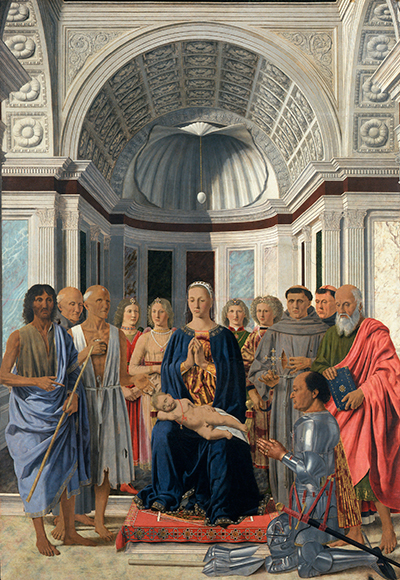
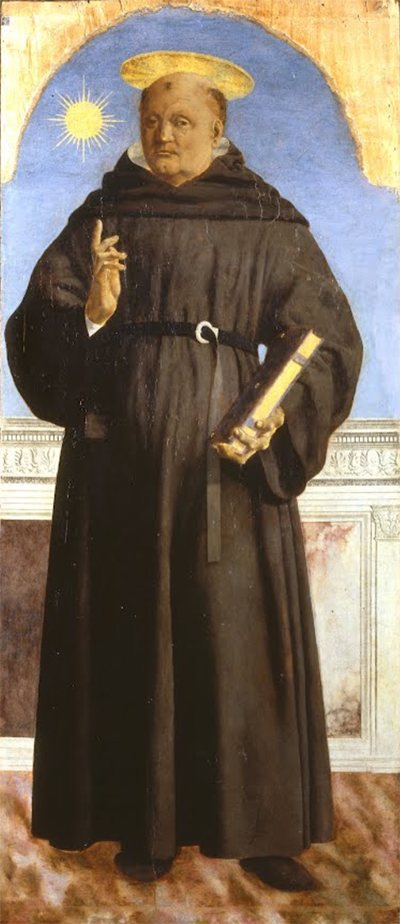
Piero received the commission in 1454, and the altarpiece was essentially complete in 1469. The large standing saints included Saint John the Evangelist, whose panel shares the Frick collection with Monica. John occupies a principal panel about 1.34 metres high. The nun measures 38.7 by 27.9 centimetres. Her compressed half-length, dark clothing and broad scroll are suited to a much smaller field. John stands before a balustrade against a blue sky, a setting that continued across the principal panels. The gold behind Monica shares the character of the gilded carpentry and of the other surviving small saints. [1] [2] [5] [10] [11]
The closest comparison in New York is the Augustinian Saint, a friar often identified as Saint Leonard. Both half-length figures wear black habits against gold, and both hold an object in front of the body. The friar has a closed red book, while Monica’s scroll is unfurled. The paintings invite comparison as counterparts within the same commission. Their exact positions in the original frame are more difficult to recover. They had travelled together by the time they were recorded in the Liechtenstein Gallery in Vienna in 1911, and the Frick bought both in 1950. Shared ownership establishes an episode in their later history. The reconstruction of their original positions depends on the panels and their relationship to the altarpiece. [5] [10] [4]
The small panels have been described as parts of the predella, the horizontal base below the main paintings. The Fondazione Federico Zeri still catalogues Monica as a predella compartment. Technical work by Roberto Bellucci, Marco Ciatti and Cecilia Frosinini for the Opificio delle Pietre Dure made the structural question more precise. They found that the three small gilded saint panels, Monica, the friar and Saint Apollonia, were individually made, with wood grain running along the length of each support. The traces of canvas and the arrangement of the attachment nails showed close similarities. In their analysis, this construction argued against placing them within the continuous horizontal boarding typical of a predella. Separate positions in the frame’s carpentry can explain why the panels are so alike in scale and construction. The gold-ground Crucifixion has a different format and is understood as a narrative scene from the base. [4] [6] [12]
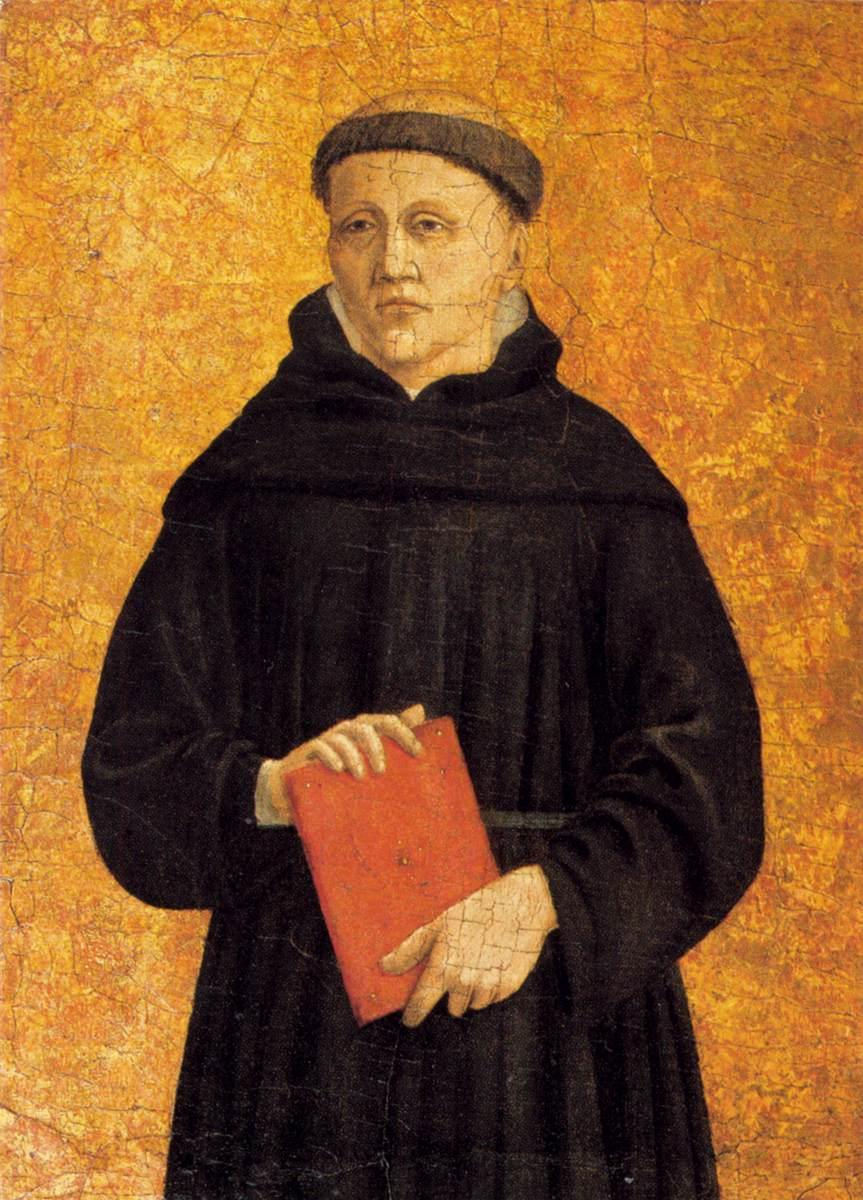
An Augustinian Saint, possibly Saint Leonard, The Frick Collection, New York. Image source. Public domain. Resized only; native appearance preserved.
What examination of the panels can tell us
In 2024 the Museo Poldi Pezzoli brought all eight known survivors together in Milan. The exhibition’s technical findings reported that a new gesso ground had been laid over an existing preparation on elements of the predella and pilasters. A ground is the layer that prepares the wood to receive paint or gilding. The superimposed layers accord with the contract’s provision for reusing an existing structure. Researchers linked that construction with the conservation history of the smaller panels. On the reverse of the nun’s panel, the earlier Opificio team had also found traces of the original working of the wooden support. For an object cut off from its setting, the back and edges can preserve evidence that the gilded face alone cannot supply. [6] [7] [13]
The same 2024 project found remnants of angel wings and a rich garment in the principal panels adjoining the gap at the centre. Those and other fragments led the curators to propose a Coronation of the Virgin for the missing central scene. Their account of the Augustinian Polyptych explains how the large saints shared the space around that image. With Monica and the friar, the most telling physical evidence concerns how their small supports fitted into a wooden structure. A pilaster placement is accordingly a reconstruction of their role. A precise slot on a particular side or level remains a proposal. [2] [6] [7] [13]
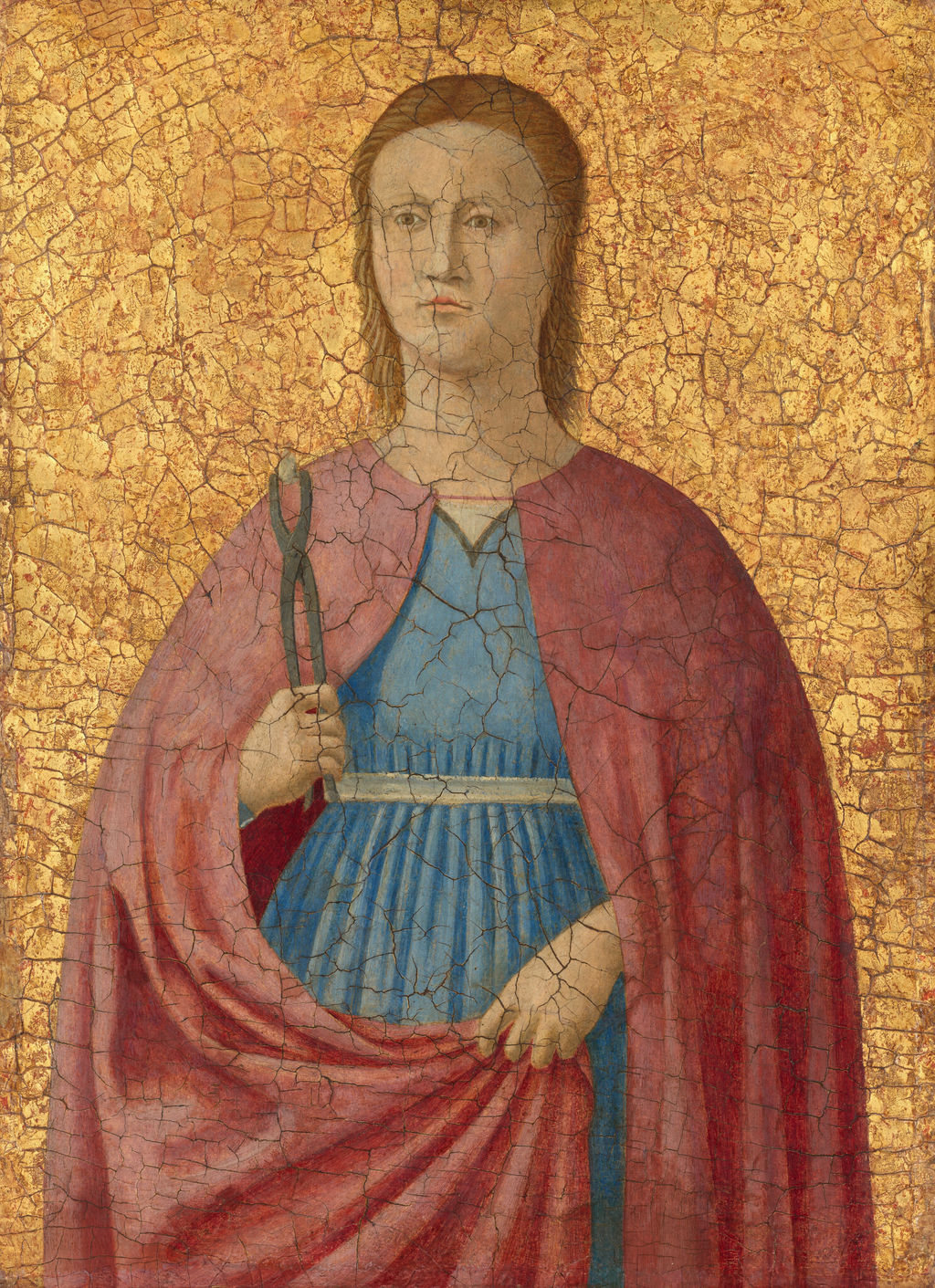
Piero della Francesca, Saint Apollonia, National Gallery of Art, Washington. Image source. Public domain. Resized only; native appearance preserved.
How firmly is the painting attributed to Piero?
The Frick’s current collection record names Piero della Francesca as the artist. Its 2021 Frick Madison guide published the more cautious formulation “or workshop” for Saint Monica. In the very same guide, the friar appears under Piero’s name with a question mark beside Saint Leonard. These are two different judgements. The Madison entry allows for workshop execution of the nun, and the friar’s question mark concerns the man represented. The 2013 image list attributed both works to Piero and expressed doubt about the identifications in their titles. [5] [4] [3]
The 2024 Milan exhibition presented the nun as part of Piero’s commission. The common materials and construction help explain her place within that ensemble. They establish the conditions in which the panel was made more securely than they establish who carried out each stage of the painting. A viewer can recognise the relevance of the large altarpiece to its small component while keeping the Frick’s published workshop qualification in view. [4] [6] [7] [13] [3]
Browse the artworks
Compare Piero’s frescoes, panels and manuscript figures. The list includes ensembles and separately identifiable panels or scenes. Dates are approximate where the sources differ.
| Name | Date | Medium and source |
|---|---|---|
| The Baptism of Christ | Probably c. 1437–45 | Panel painting Catalogue. |
| The Flagellation of Christ | 1459–60 (GNDM) | Panel painting Catalogue. |
| The History of the True Cross | Mid-fifteenth century | Wall painting Catalogue. |
| Dream of Constantine | Mid-fifteenth century | Wall painting Catalogue. |
| The Duke and Duchess of Urbino | About 1473–75 (Uffizi) | Panel painting Catalogue. |
| The Resurrection | About 1458–68 (Opificio) | Wall painting Catalogue. |
| Brera Madonna | About 1472–74 | Panel painting Catalogue. |
| Annunciation at Arezzo | Mid-fifteenth century | Wall painting Catalogue. |
| Madonna del Parto | About 1450–65 (Monterchi) | Wall painting Catalogue. |
| Polyptych of the Misericordia | Commissioned 1445 | Panel painting Catalogue. |
| The Nativity | Early 1480s (National Gallery) | Panel painting Catalogue. |
| Madonna di Senigallia | About 1474–75 (GNDM) | Panel painting Catalogue. |
| Death of Adam | Mid-fifteenth century | Wall painting Catalogue. |
| Queen of Sheba | Mid-fifteenth century | Wall painting Catalogue. |
| Victory of Constantine | Mid-fifteenth century | Wall painting Catalogue. |
| Battle between Heraclius and Chosroes | Mid-fifteenth century | Wall painting Catalogue. |
| Saint Mary Magdalen | Wall painting Catalogue. | |
| The Augustinian Polyptych | 1454–69 | Panel painting Catalogue. |
| Polyptych of Perugia | About 1467–69 (GNU) | Panel painting Catalogue. |
| Perugia Annunciation | About 1468–70 (national catalogue) | Panel painting Catalogue. |
| St Francis and St Elizabeth | About 1467–69 (GNU) | Panel painting Catalogue. |
| Stigmatisation of St Francis | About 1468–70 (national catalogue) | Panel painting Catalogue. |
| An Augustinian Nun (Saint Monica) | 1454–69 | Panel painting Catalogue. |
| Augustinian Saint | 1454–69 | Panel painting Catalogue. |
| Saint Michael | 1454–69 | Panel painting Catalogue. |
| Saint Nicholas of Tolentino | 1454–69 | Panel painting Catalogue. |
| Saint John the Evangelist | 1454–69 | Panel painting Catalogue. |
| Virgin and Child Enthroned with Four Angels | About 1460–70 (Clark) | Panel painting Catalogue. |
| Portrait of Sigismondo Pandolfo Malatesta | About 1450–51, often proposed. Louvre catalogue range 1450–75. | Panel painting Catalogue. |
| Sigismondo before St Sigismund | 1451 | Wall painting Catalogue. |
| St Jerome and a Donor | 1460s (Accademia); about 1450 also proposed | Panel painting Catalogue. |
| St Jerome in Penitence | 1450, dated on the panel | Panel painting Catalogue. |
| Saint Julian | About 1455–60, often proposed | Wall painting Catalogue. |
| Saint Augustine | 1454–69 | Panel painting Catalogue. |
| Saint Apollonia | 1454–69 | Panel painting Catalogue. |
| Crucifixion from the Augustinian Polyptych | 1454–69 | Panel painting Catalogue. |
| Saint Louis of Toulouse | Wall painting Catalogue. | |
| Burial of the Wood | Mid-fifteenth century | Wall painting Catalogue. |
| Discovery and Proof of the True Cross | Mid-fifteenth century | Wall painting Catalogue. |
| Exaltation of the Cross | Mid-fifteenth century | Wall painting Catalogue. |
| Saint Anthony Raises a Child | About 1467–69 (GNU) | Panel painting Catalogue. |
| Saint Elizabeth Revives a Child | About 1467–69 (GNU) | Panel painting Catalogue. |
| Hercules | About 1470 | Wall painting Catalogue. |
| Portrait of a Boy (possibly Guidobaldo da Montefeltro) | Panel painting Catalogue. | |
| De prospectiva pingendi, Reggio Emilia witness (figures) | Manuscript diagrams Catalogue. | |
| The Interrogation of Judas | Mid-fifteenth century | Wall painting Catalogue. |
| Two prophets, Bacci Chapel | Mid-fifteenth century | Wall painting Catalogue. |
| Saint Clare of Assisi, upper predella | About 1467–69 (GNU) | Panel painting Catalogue. |
| Saint Agatha, upper predella | About 1467–69 (GNU) | Panel painting Catalogue. |
| Lost centre of the Augustinian Polyptych | 1454–69 | Lost panel or panels Catalogue. |
Frequently Asked Questions
The Augustinian habit and the scroll establish a connection with the order. The church’s dedication and the order’s established devotion to Augustine’s mother make Monica a persuasive identification. The Frick uses that name on its exhibition label, while its 2013 press image list retains a question mark. [1] [5]
The Frick identifies the scroll as the Augustinian rule, the code that governed the community’s life. Its broad white surface makes the document prominent within the narrow picture. [1]
Discussion
Look again at the images and ideas explored in An Augustinian Nun (Saint Monica). These editorial prompts invite your observations.
Reader Insights
Follow the pale edge of the scroll down to the hand that supports it. Where does your eye go next, and how does the buckle help bring your attention back to the figure?
Compare the nun’s unfurled scroll with the friar’s closed red book. How does the way each figure holds a text change the relationship between the two small paintings?
Imagine the small gold panel fitted into its frame below or beside the larger saints. Which features of the nun would still be visible from across the church?
Join the Conversation
Share a detail, comparison or question about An Augustinian Nun (Saint Monica) below.
References
- The Frick Collection, Saint Monica, exhibition object entry. View source.
- Museo Poldi Pezzoli, Piero della Francesca. The Augustinian Polyptych Reunited, 2024 exhibition. View source.
- The Frick Collection, An Augustinian Nun (St. Monica), current collection record, accession 1950.1.158. View source.
- The Frick Collection, Frick Madison: A Guide to Works of Art on Exhibition, 2021, pp. 41–42. View source.
- The Frick Collection, Piero della Francesca in America, 2013 press image list, entries 6–9. View source.
- Roberto Bellucci, Marco Ciatti and Cecilia Frosinini, Analisi tecniche, technical study of the Augustinian Polyptych, republished by Bellucci in 2025, pp. 339–40. View source.
- Museo Poldi Pezzoli and Fondazione Bracco, 2024 exhibition dossier, object list, pp. 9–11, and Machtelt Brüggen Israëls, findings, pp. 19–20. View source.
- Augustine of Hippo, Confessions, Book IX, chapters 10–13, translated by J. G. Pilkington. View source.
- Order of Saint Augustine, History of the Order. View source.
- National Gallery of Art, Washington, Saint Apollonia, provenance notes 1 and 5–7. View source.
- The Frick Collection, Saint John the Evangelist, exhibition object entry. View source.
- Fondazione Federico Zeri, University of Bologna, Santa Monica, archival catalogue entry 19120. View source.
- Fondazione Bracco, 2024 exhibition and diagnostic research project. View source.
Related Paintings
The Augustinian Polyptych
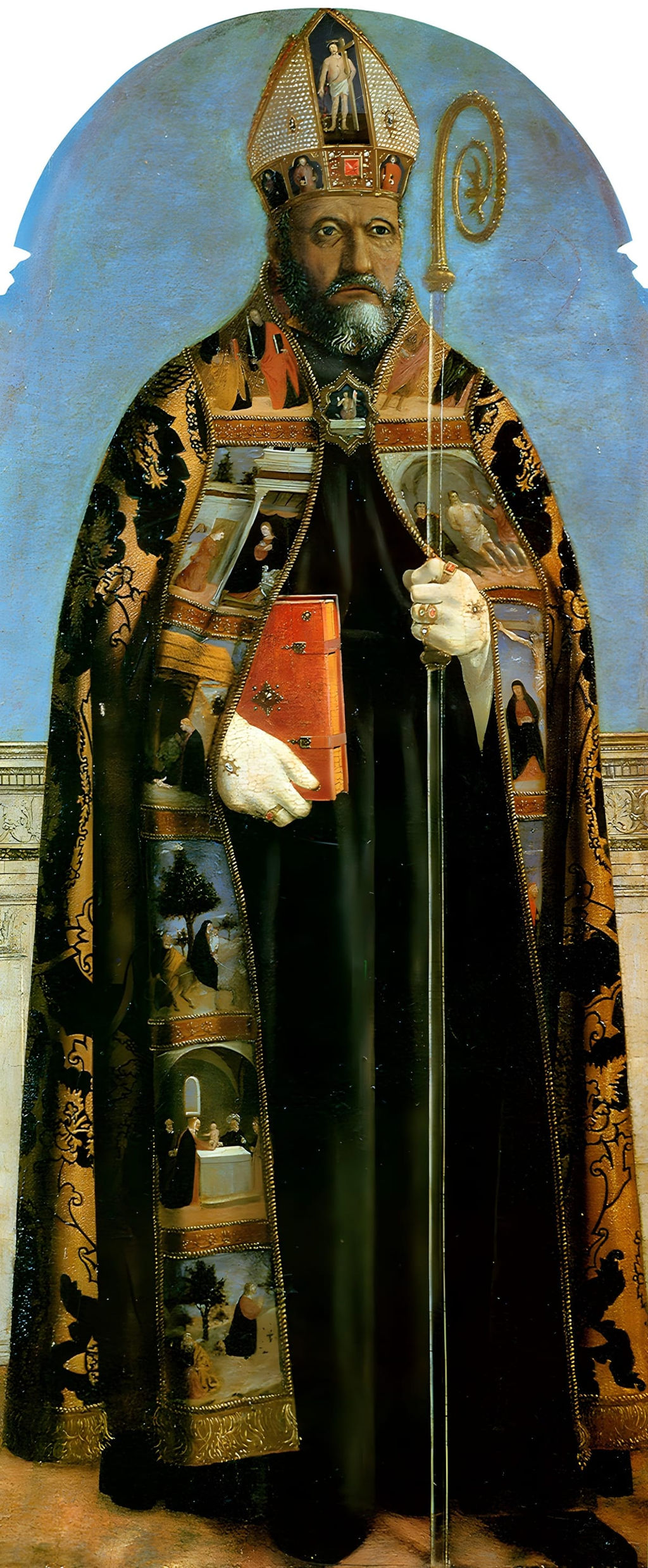
Piero della Francesca, Saint Augustine, surviving panel from the Augustinian Polyptych, Lisbon. Image source. Public domain. Resized only; native appearance preserved.