


 by Tom Gurney
Tom Gurney BSc (Hons) is an art history expert with over 20 years experience
Published on June 19, 2020 / Updated on October 14, 2023
Email: tomgurney1@gmail.com / Phone: +44 7429 011000
Paintings by Piero della Francesca: Introduction
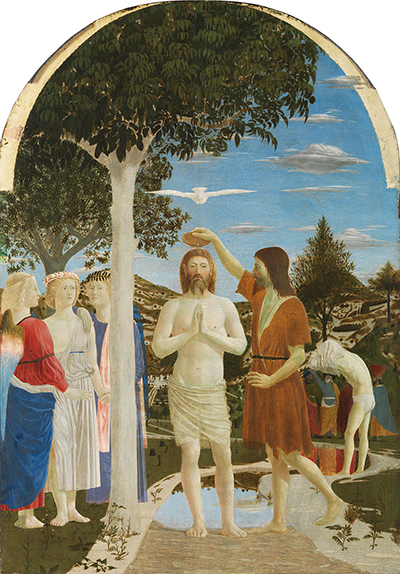
In London, Piero della Francesca’s Baptism of Christ appears to be a self-contained painting. A dove, a bowl of water and a pair of praying hands draw the eye down its centre, while a shallow river leads it back into the hills. In Sansepolcro, two standing saints and a row of small narrative scenes survive from the altarpiece that once surrounded it. Piero painted the Baptism. Matteo di Giovanni painted those other panels. The distribution of the pieces between two collections can obscure one of the most interesting things about them: a churchgoer would once have seen both painters’ work together. [1] [2]
The surviving paintings range from walls designed to be read across an entire chapel to small panels meant to reward a single viewer’s attention. There are altarpieces still recognisable as multi-storey structures, saints whose neighbours now live thousands of miles away, and court portraits with another image painted on the back. A good way in is to ask what sort of object you’re looking at and where it originally belonged. The answer changes how you read its scale, its composition and even the apparent completeness of its subject.
At a Glance
- Church fresco cycleThe History of the True Cross occupies three levels of the Bacci Chapel in Arezzo. [3]
- Civic wall paintingThe Resurrection survives in Sansepolcro’s former centre of government, now the Museo Civico. [4]
- Dispersed altarpieceEight panels from the Augustinian Polyptych were reunited at the Poldi Pezzoli in 2024. [5]
- Panel techniquesThe National Gallery catalogues the Baptism as egg tempera and the Nativity as oil, both on wood. [1] [6]
- Two-sided portraitsThe Urbino portraits have painted triumphs on the reverse. [7]
Contents
- Wall paintings and their settings
- Altarpieces and their surviving parts
- Single panels for altars and close viewing
- Portraits of rulers
- Provenance, condition and attribution
- Prints and reproductions
Piero della Francesca paintings catalogue
Wall paintings and their settings
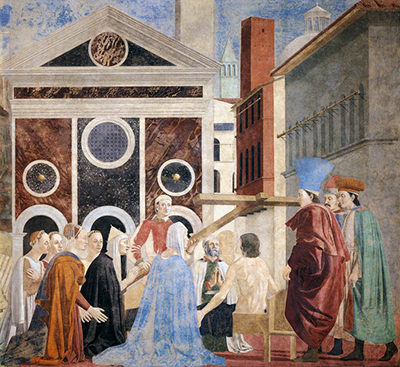
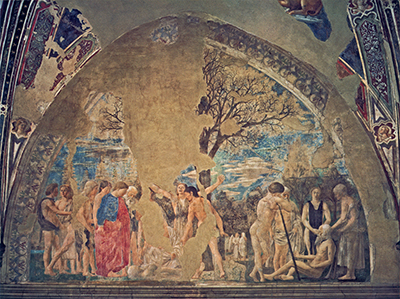
Start with the History of the True Cross in the Bacci Chapel of San Francesco, Arezzo. Episodes from the Christian legend of the wood of the Cross occupy three levels across the chapel walls. The story begins with the Death of Adam, but its episodes run out of sequence on the walls. Take in their positions before trying to follow the action. Scenes high in the chapel have to work within curved fields, and scenes facing one another can enter into dialogue even when they are centuries apart in the story. [3]
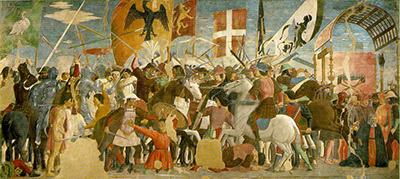
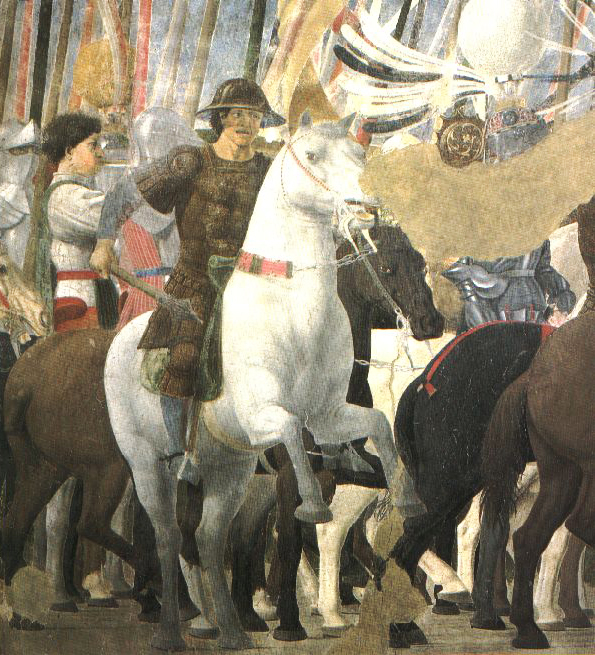
Look across from the Victory of Constantine to the Battle between Heraclius and Chosroes. In the first, a small cross extended in front of the advancing ruler tells you where to look amid the horses and retreating troops. In the second, the crowd thickens into overlapping bodies, weapons and flags. The shift between the two registers in a glance across the chapel. A detail photograph can make the small cross readily legible. A wider view shows how much empty or open space Piero gives it in relation to the packed fighting opposite. [3]
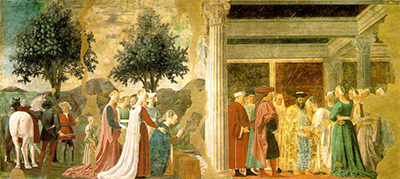
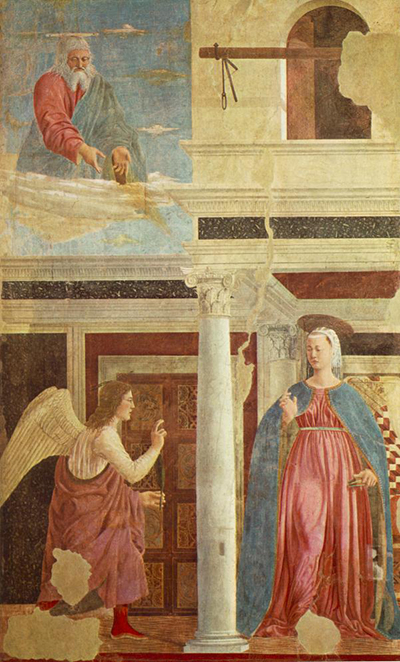
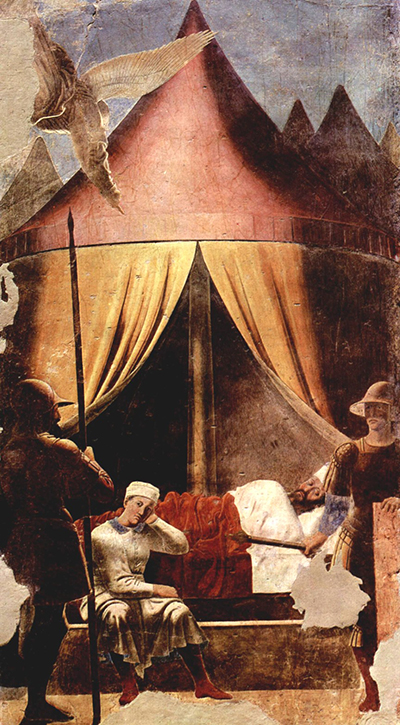
The cycle varies its pace within single paintings too. In the Queen of Sheba fresco, the queen kneels before the sacred timber on one side and meets Solomon inside a building on the other. Her bow and the movement of the women behind her prepare the eye for the more formal greeting across the architectural division. The Dream of Constantine concentrates the action in a tent lit by an angel. Follow the light across the tent opening and down to the guard. It gives a visible direction to an event that takes place while the emperor sleeps. The Arezzo Annunciation can likewise be read as a single encounter, but in the chapel it brings the Incarnation into a programme about the history and meaning of the Cross. [3]
The appearance of these walls owes something to conservation. The Arezzo team built an archive linking photographs, graphic records and written observations as the work proceeded. Such records help distinguish a break in the surviving surface from a painted contour, and allow what is visible today to be compared with an earlier state. A photograph dated before treatment can be especially useful when the feature under discussion is a damaged face or a patch of colour that reads differently in older books. [8]
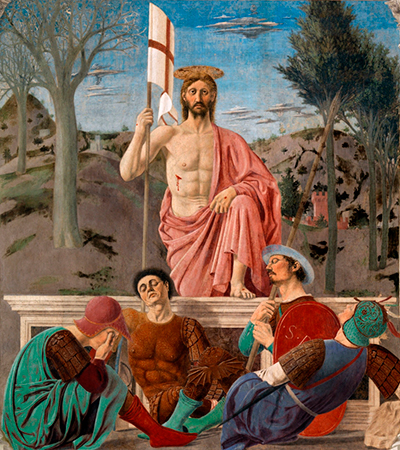
In Sansepolcro the Resurrection was painted for the city’s governing building, now part of the Museo Civico. The composition brings Christ’s upright body into relation with a group of sleeping soldiers at the foot of his tomb. Start low, among the bent legs, slumped heads and crooked elbows, then follow the edge of the tomb up to the forward-facing figure. The disorder below makes his stillness and direct gaze more striking. In a municipal building the image also had a local resonance. The Holy Sepulchre belongs to the town’s name and civic identity. The Opificio delle Pietre Dure concluded that the painting was moved with its original block of masonry. The team proposed a raised platform on the building’s façade as its first setting, which remains uncertain. [4]
Piero worked partly on wet plaster and applied much of the colour to the wall once the plaster was dry. The conservators of the Resurrection found traces of several ageing fixatives and evidence of damage from earlier cleaning. Their report attributes some of the background’s present flatness to the loss of finishing layers applied to dry plaster. The structure of the composition survives, and the hills still run behind Christ, but some of the changes of colour that once gave those hills depth have gone. That is a useful qualification when comparing the fresco’s landscape with the clear recession of the river in the Baptism. The works have reached us in very different states. [1] [4]
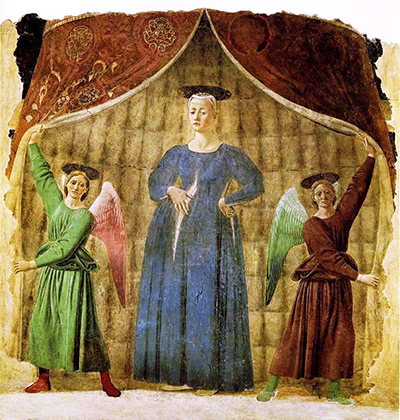
Two other wall paintings make the difference between location and support particularly clear. The Madonna del Parto was painted at Santa Maria a Momentana near Monterchi. Two angels draw back the flaps of a patterned canopy to reveal the pregnant Virgin. The symmetry of their poses steadies the image around the very human weight of Mary’s body and the opening of her dress. In 1911 the fresco was detached for its protection, exposing an older Madonna and Child beneath. Piero’s painting is now in Monterchi’s civic museum, where you can see the canopy and its flanking figures at close range. The surviving painted plaster and its original church setting have separate histories. [9]
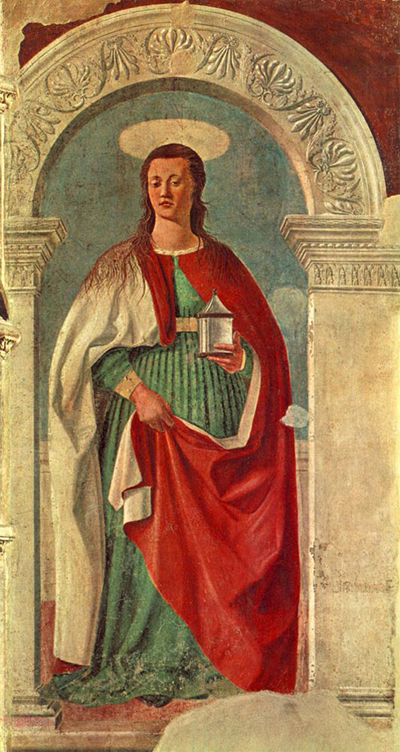
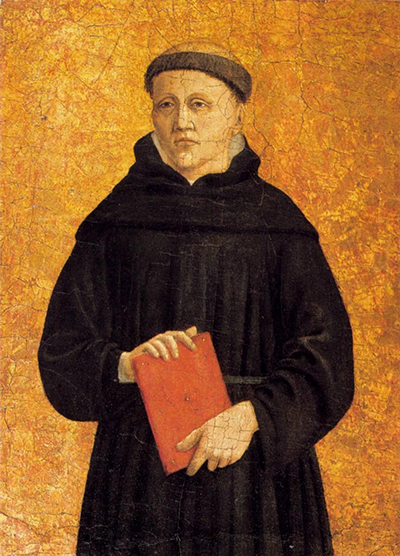
You can make a comparable distinction within Arezzo itself. The solitary Saint Mary Magdalen in the cathedral holds her ointment jar and meets our gaze from a painted architectural surround. Her height and stillness give a single saint the presence of a figure occupying a niche. The surviving Saint Julian in the Museo Civico at Sansepolcro is a detached fragment. Its strong face and costume can be examined in their own right, while the missing surroundings limit what can be said about its relationship to other figures. The Magdalene’s painted surround still shows how Piero placed a standing saint in relation to the architecture. [10] [11]
Piero also used wall painting to decorate a home. In Hercules, a youthful hero in a lion skin extends a club at so steep an angle that you can almost judge where someone stood beneath him. The Gardner Museum places the painting high in a room in the artist’s family house in Sansepolcro. It was taken off the wall in the nineteenth century and acquired by Isabella Stewart Gardner in 1903. Compared with the Madonna del Parto, the Boston work was made to be seen from below in a domestic setting, and its non-Christian subject shows how much adaptation was possible within the medium. [9] [12] [13]
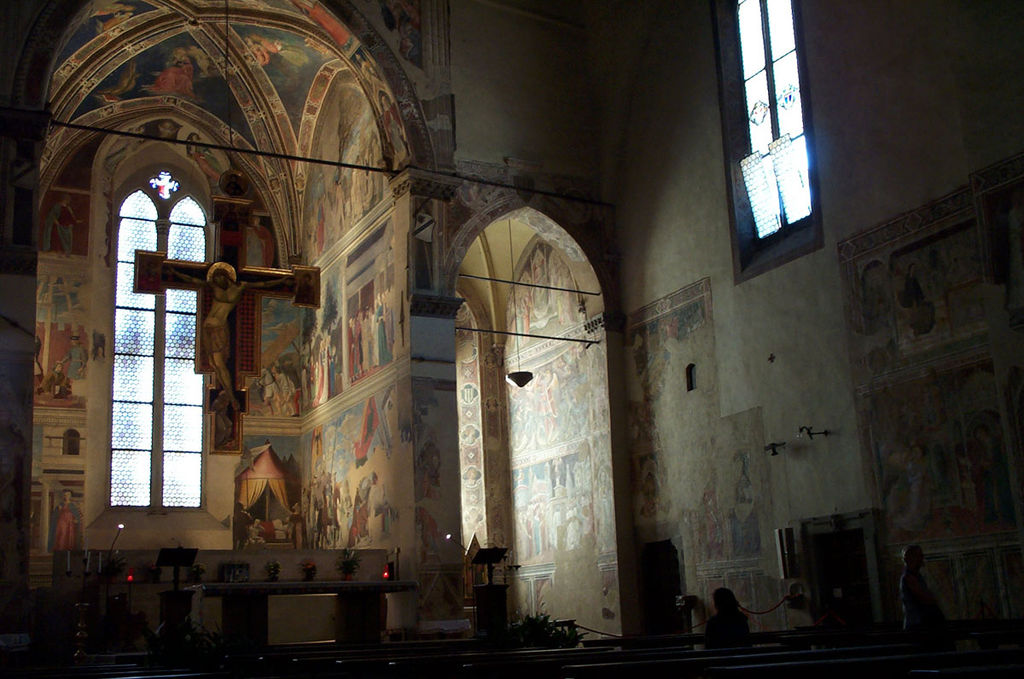
An oblique view of the Bacci Chapel with its window, suspended crucifix and right wall. louis-garden. Image source. CC BY-SA 2.5. Resized from the source. This reproduction uses CC BY-SA 2.5.
Altarpieces and their surviving parts
A multi-panel altarpiece, or polyptych, could combine several tiers of paintings with gilded framing that established the hierarchy of images. The main figures might be visible from some distance, while the smaller scenes below them demanded a closer look. When a panel comes loose from that structure and enters a collection, its varnished surface and new frame can make it feel complete. Locate it within the ensemble and you recover part of the artist’s original task.
Return to The Baptism of Christ. The shallow pools, pale tree trunk and receding hills surround a tightly ordered event. Christ’s almost vertical body holds the centre while John arcs forward to pour water. The original destination was the church of San Giovanni Battista in Val d’Afra at Sansepolcro. The Museo Civico records the commission for Antonio d’Anghiari’s wooden framing in 1433 and identifies the later Matteo di Giovanni panels as the saints Peter and Paul and the predella, the lower band of an altarpiece. Looking between the church ensemble and the London panel, you can imagine the open sky and distant hills enclosed by framing and flanked by gilded backgrounds. That combination makes the landscape look more exceptional than it does on a museum wall of other landscapes. [1] [2]
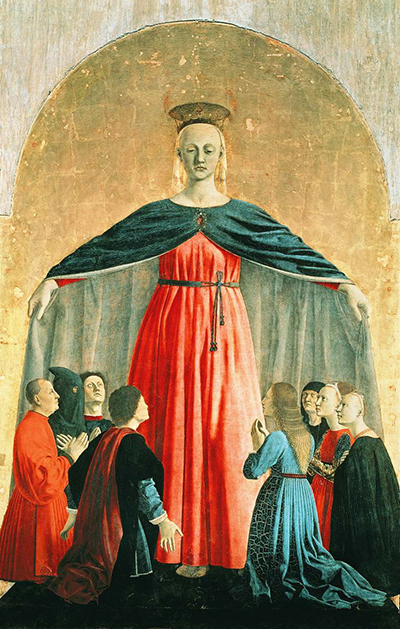
The gold in the Polyptych of the Misericordia does a different job. The Confraternity of the Misericordia commissioned the altarpiece for its oratory in Sansepolcro in 1445. Its centre shows the Virgin spreading her mantle over kneeling worshippers. Her scale marks her authority, and her cloak gives those small figures an inhabitable space. Follow its edge down towards the kneelers. Their heads turn and overlap under the fabric while Mary’s great silhouette keeps the group legible across a room. [14]
Stand back from the central image and the cross in the tier above, with the scenes of Christ’s Passion below, gives the ensemble a strong vertical structure. The saints beside Mary are part of that reading too. Their upright silhouettes supply a measured rhythm around her widening cloak. A reproduction of the central Madonna preserves a compelling devotional image, while a photograph of the assembled altarpiece explains how the confraternity’s commission joined the sheltering Virgin to a broader account of salvation. [14]
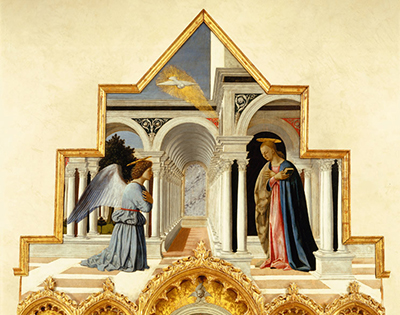
In Perugia the Polyptych of Sant’Antonio offers another way to study the hierarchy of an altarpiece. The Galleria Nazionale dell’Umbria records that the Franciscan women of Sant’Antonio commissioned it for the outer church of their monastery. The work was designed for a tight presbytery. Across its four levels, two predella registers sit below the principal figures, with an Annunciation in the crowning panel. The gallery records a change made after the monastery adopted permanent enclosure in 1572. The centre of the upper predella was removed and replaced with a metal grille through which the nuns could attend Mass from the enclosed choir. The removed panel is lost. An alteration to the building’s use thus became an alteration to the painted object itself. [15]
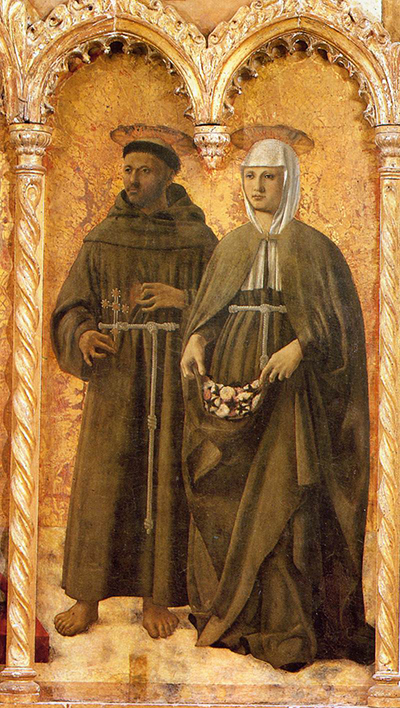
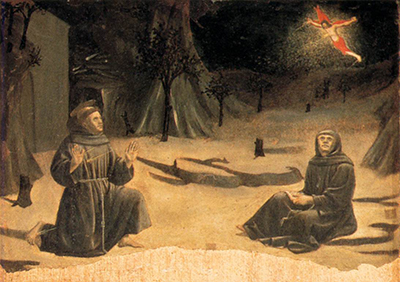
When you look from the lower register upwards, the change in scale is substantial. The Stigmatisation of St Francis places a small figure in a dark landscape, one of three miracle scenes along the base. In the main tier, St Francis and St Elizabeth stand on the same scale as their companions, so their presence registers even from farther back. Raise your eye again to the Annunciation. The gap between Gabriel and Mary is filled by a colonnade whose repeated arches draw you inward, though no human figure occupies its far end. Set alongside the Arezzo Annunciation, this version shows Piero adapting the same encounter to the space above an altar and to the particular shape of its panel. [3] [15]
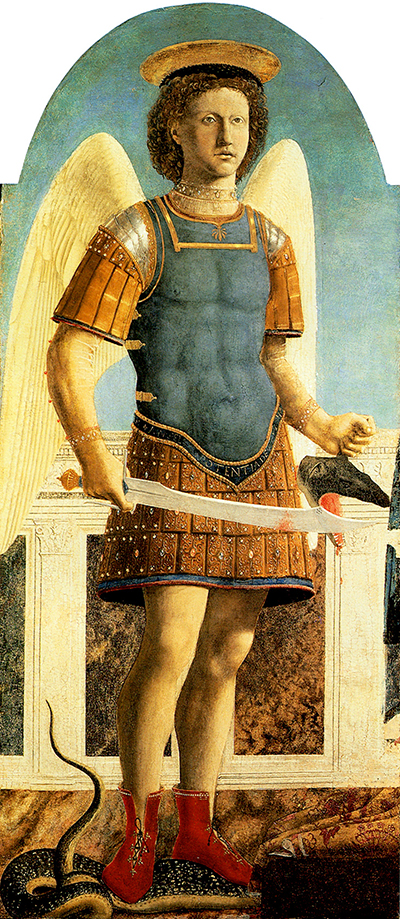
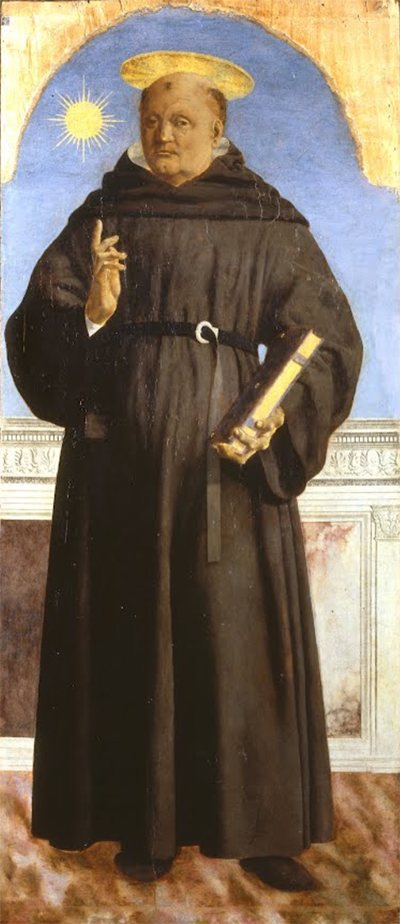
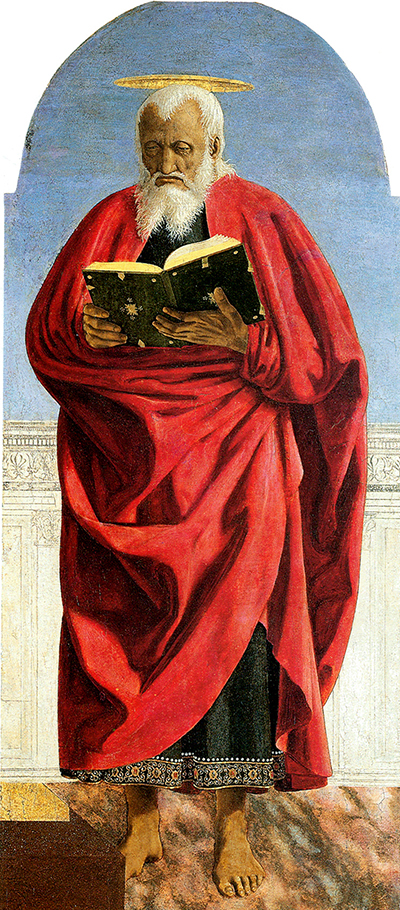
The Augustinian Polyptych survives in a much more dispersed state. It was commissioned in 1454 for the Augustinian high altar in Sansepolcro and completed in 1469. It was subsequently dismantled, although sources differ about when. Eight known panels survive in five museums. The four large saints are shared between Lisbon, London, New York and Milan. The Frick Collection also holds three small panels, and the National Gallery of Art in Washington holds Saint Apollonia. Washington’s catalogue now credits the panel to Piero. In 2004 the gallery recorded a change from his workshop to a qualified attribution to Piero himself. The small panel carries both a history of association with the altarpiece and a separate history of assessment of its authorship. [16] [17] The Frick showed six of these panels together in 2013, and the Poldi Pezzoli in Milan brought together all eight in 2024. The centre and much of the lower ensemble remain missing. [5] [18] [19]
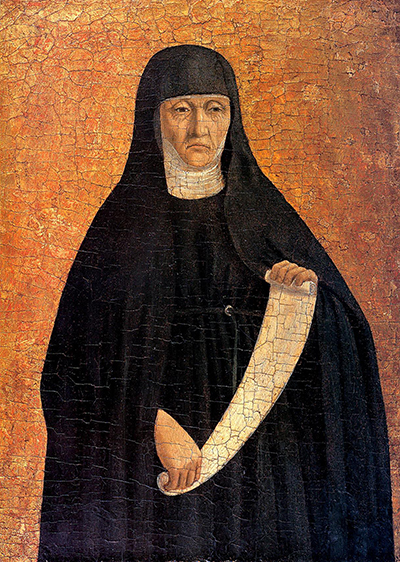
Bring the large saints together in photographs and you can follow the low marble barrier behind them. It helps put Saint Michael, with his brilliant armour, in the same elevated space as the sombre Saint Nicholas of Tolentino. A large book spreads across the hands of Saint John the Evangelist on the other side of the missing centre. In the considerably smaller panels, Saint Monica unrolls a scroll giving the order’s rule, and the Augustinian Saint, sometimes identified as Saint Leonard, holds a book close to his body. The parallel poses and measured changes of scale suggest how much an altarpiece could ask of a viewer at different distances. [5] [18] [19] [20]
Examine Michael’s lower right edge. A scrap of sumptuous fabric and part of a step were legible to catalogue authors who read them as fragments of a throne and the Virgin’s robe. The Poldi Pezzoli exhibition team reported tiny traces of coloured wings crossing the edges of Michael and John, and interpreted these alongside surviving fragments of costume and steps as evidence for a Coronation of the Virgin. The National Gallery’s catalogue records the older identification of the central subject as a Virgin and Child. Both interpretations concern the same missing centre. The visible remains are evidence that its composition continued across the separate boards, and the wings give the newer reconstruction something testable to explain. [18] [21]
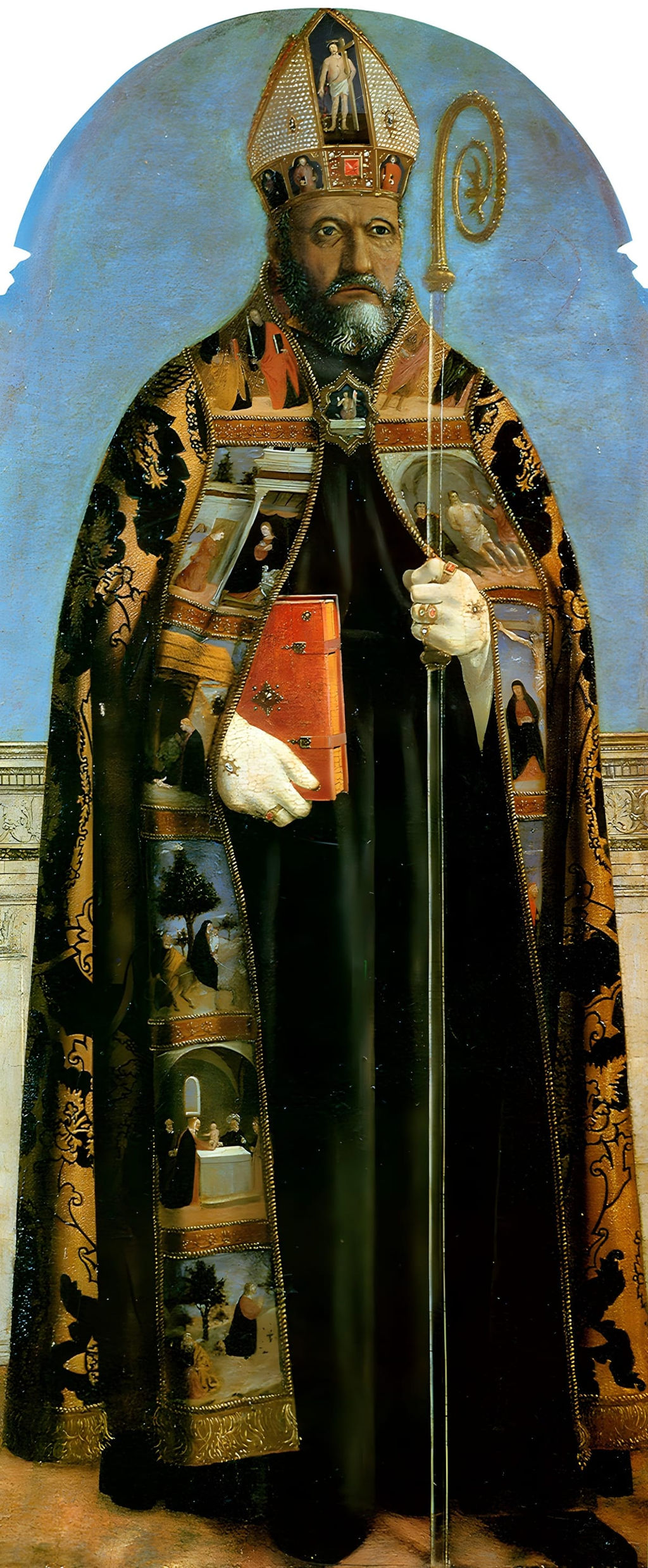
Piero della Francesca, Saint Augustine, surviving panel from the Augustinian Polyptych, Lisbon. Image source. Public domain. Resized only; native appearance preserved.
Single panels for altars and close viewing
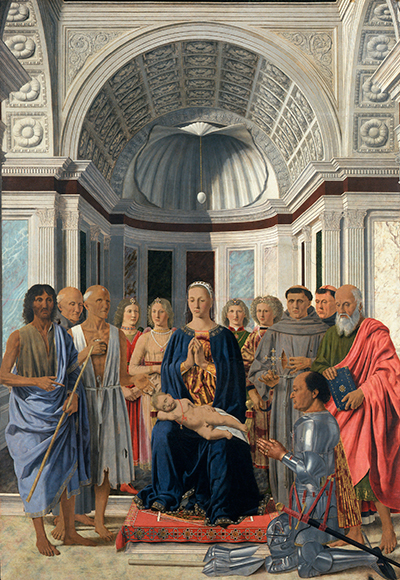
The Brera Madonna shows what Piero could achieve within one large field. The Virgin and Child, saints and angels share a space with the kneeling Federico da Montefeltro. Follow the diminishing coffers into the apse, then down to the hanging egg, Mary’s joined hands and the sleeping Child. Federico’s polished armour and his low position on the right give him physical weight in the room while keeping the Virgin at its centre. The same painting rewards a distant view of the architectural order and a close view of the tiny glints on metal, jewels and cloth. [22]
The panel came to Brera from San Bernardino outside Urbino in 1811. Whether it was first intended for that church remains uncertain. Brera also records that the painted support has been reduced. The surviving frame of the image presses around the figures and clips the architectural space that would once have given them more room. What now looks like a remarkably tight congregation of saints was originally set in a more expansive building. [22]
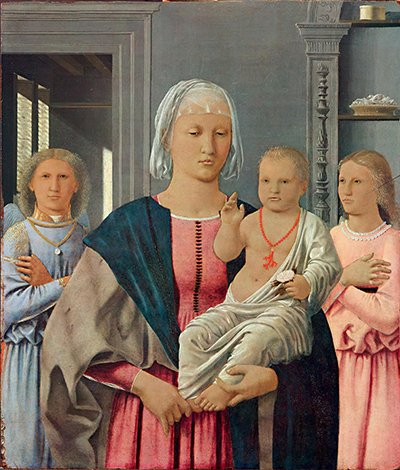
Put it beside the Madonna di Senigallia, now in the Galleria Nazionale delle Marche in Urbino. Here the figures fill a much smaller interior. Light enters from the left through a window in the room behind the Virgin, where a bright patch picks out the wall, then picks up the fabric and faces nearer to us. Notice the small coral ornament against the Child’s skin. The reduced scale makes it possible to register that detail and the window light in one glance. The documented provenance leads back to Santa Maria delle Grazie in Senigallia. A Montefeltro marriage gift is a hypothesis about an earlier stage of the painting’s life. [23]
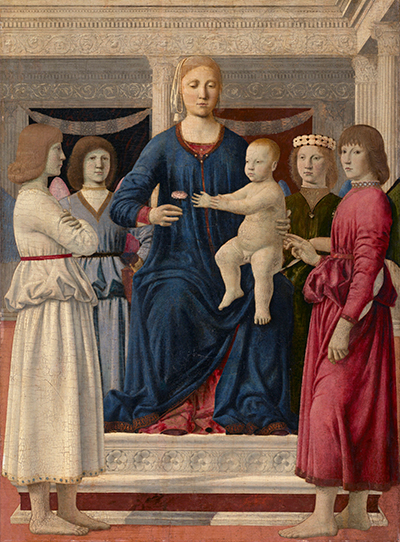
In the Clark Art Institute’s Virgin and Child Enthroned with Four Angels, the angelic attendants stand much closer to the throne than the saints stand to the Virgin at Brera. Look at their differing turns and at the small movement that gives the centre its focus: the Child reaches towards the rose. The scale of the gesture makes especially good sense in a painting that can be approached closely. Even where a small devotional picture’s original room or patron remains uncertain, the size of the object and the scale of its painted gestures are evidence for how it might have been seen. [24]
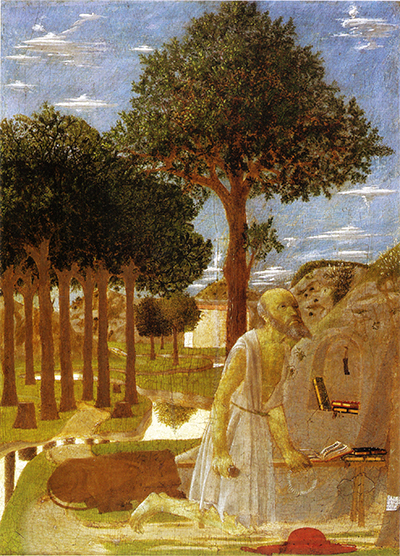
The two Jerome panels make an especially useful pair. In Berlin’s St Jerome in Penitence, the saint’s red hat lies in the foreground, separated from the man who sits among the trees. The painting retains its original frame and bears Piero’s name and the date 1450 on a painted slip attached to a tree. Its size and subject support the Berlin gallery’s reading of it as a picture for private devotion. That is stronger evidence for a general kind of use than for a particular owner. The gallery treats Gerolamo Ferretti as a possible patron, and points to a later painting for the Ferretti chapel, now in Turin, that adapts Piero’s composition to a different shape. [25]
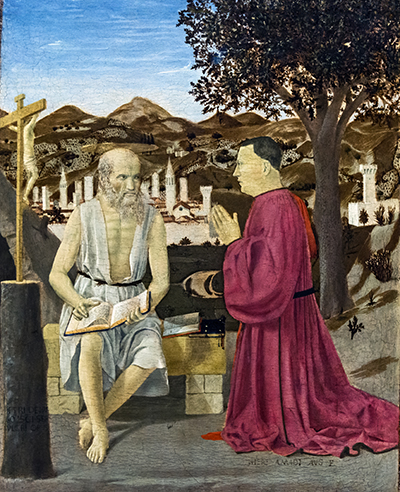
In the Venetian St Jerome and a Donor, an inscription identifies the kneeling man as Girolamo Amadi. Jerome has looked up from his reading. A bench and a tree define the space around the two figures, and the distance between their faces becomes the space of their exchange. The Berlin picture asks what a holy life looks like in solitude. The Venetian panel makes the viewer witness an encounter between a named worshipper and the saint. The towers in the distance and the low line of the bench enclose that exchange on a small patch of ground. [25] [26]
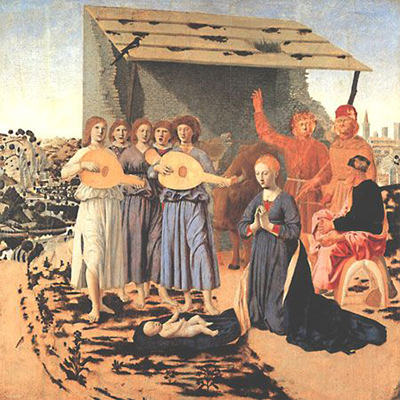
The almost square Nativity has room for a line of singers, a rough stable, and a landscape opening on either side. Seen next to the Baptism, the deep blue of Mary’s mantle and the more saturated passages of colour are a good introduction to the possibilities of Piero’s late oil technique. The London catalogue identifies the Baptism as egg tempera on poplar and the Nativity as oil on probably the same kind of wood. Earlier still, the Perugia gallery records both tempera and oil in the Sant’Antonio ensemble. Piero’s career gives ample opportunity to compare the handling of paint on wood without assuming that support and medium are the same thing. [1] [15] [6]
The National Gallery places the Nativity in the Piero family’s palace in Sansepolcro, where it originally hung in the principal bedchamber. It also records that overcleaning once made passages look unfinished. Conservation completed in 2022 brought out elements such as the light falling on the stable wall. Look there after studying the group of angels. The light on that rough wall is as important to the scene as the more obvious glints of light on skin and clothing. [6]
London’s three paintings can be read as a short tour through the career. The pale landscape of the early Baptism, the taller and narrower Saint Michael painted for the Augustinians, and the late Nativity show Piero working at different scales and for different settings. The National Gallery uses this group as the starting point for its monographic exhibition announced for 2027–28. These paintings belong to the gallery’s collection, while the announcement’s other works include loans. [27]
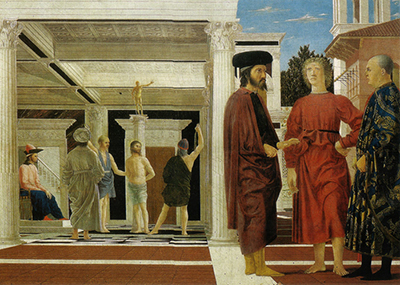
One single panel resists classification by function. In Urbino’s Flagellation of Christ, Christ is whipped in the back of a colonnade, while three men stand outside in the right foreground. The pavement carries our eye back towards the smaller biblical figures. The upright columns and foreground men pull it back to the front again. Piero’s signature sits on a step beneath Pilate’s seat. Earlier records place the panel in the cathedral sacristy, but the Galleria Nazionale delle Marche treats the original destination, patron and purpose as unresolved. The painter’s identity is secure. The connection between the two groups remains open to interpretation. [28]
Portraits of rulers
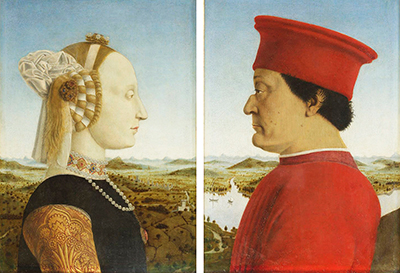
From the front, the Duke and Duchess of Urbino are two profiles against what reads as one expanse of landscape. Battista Sforza’s pale forehead and ornaments and Federico’s darkened complexion and vivid red clothing contrast sharply, while the horizon and the comparable angle of their faces bind the pair. Each board measures 47 by 33 centimetres. The details of hair, fabric and fortifications are easy to enlarge on a screen, but the painted faces take up a surprisingly large part of each modest panel. [7]
Turn to the reverse of each board and the sitters ride on triumphal cars, accompanied by personifications of virtues and Latin inscriptions. The portraits ask for attention to likeness and bearing, while the reverses praise the qualities of rule and character that the couple were to embody. The Uffizi points to the painted backs as evidence that the two boards originally formed a diptych. To see the whole surviving object, look for all four painted faces. [7]
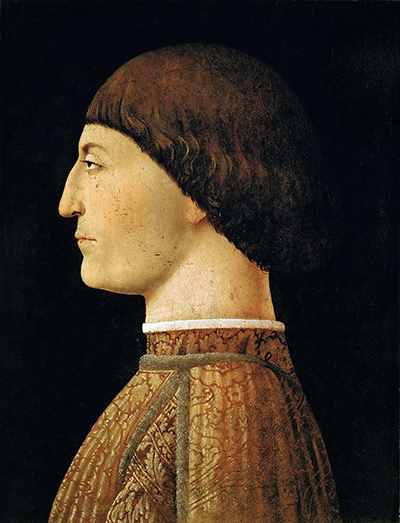
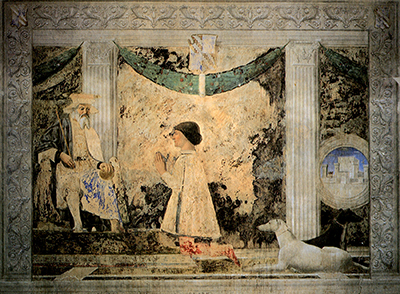
The Louvre’s Portrait of Sigismondo Pandolfo Malatesta also uses the strict profile. The sitter’s hair, nose and brocaded clothing stand out against a dark field. In Piero’s dated 1451 fresco of Sigismondo before Saint Sigismund at Rimini, the same ruler’s profile has a different purpose. He is shown on his knees, facing his patron saint within a painted architectural setting. Compare the direction of his gaze and the space it has to cross. The panel makes the contour and bearing of an individual its subject. The mural places that individual within a visible relationship of prayer and patronage. The Louvre suggests a connection between the panel and the planning of the fresco. It dates the portrait more broadly than the fixed date of the mural. [29] [30]
Provenance, condition and attribution
Piero’s surviving corpus reflects what later generations moved, valued or allowed to disappear. In Florence, documents record him working with Domenico Veneziano in 1439 on the now-lost fresco cycle at Sant’Egidio. Here the documentary evidence establishes activity even though there is no surviving surface to examine in place. The Augustinian altarpiece shows a different kind of loss. The boards that have been traced are still available for close study, and their edges give clues to what lay between them. Between those examples lies the Resurrection. Its main image remains legible but one account of its original depth depends on conservation evidence for the layers that have disappeared. [4] [5] [21] [31]
A catalogue can answer different questions with different degrees of confidence. A dated inscription such as the one on Berlin’s Jerome is evidence about authorship and chronology. An early inventory entry, such as the record of the Flagellation in Urbino Cathedral, tells us where a painting was kept at a later date. A connection inferred from style or original function needs to be weighed on its own terms. When paintings are broken up, even a secure attribution to Piero may leave the limits of his personal participation or the position of a board within a structure open to discussion. [5] [18] [25] [28]
Title alone can be misleading. Matteo’s saints in the Baptism altarpiece and Piero’s central panel belong to a single historical furnishing with different makers. A later adaptation such as Nicola di Maestro Antonio’s Jerome in Turin belongs to the history of Piero’s influence. Piero’s painted signature in Berlin and Amadi’s name in Venice each support a different claim. In making sense of an image search or an old book caption, it helps to identify the institution and the object first, then ask whether the record is describing the artist, the commission, the picture’s later travels or the source of a reproduction. [1] [2] [25] [26]
The museum records and the guide to where to see Piero’s paintings can help you follow those distinctions from one collection to another. If you want to see how some of his spaces were worked out on paper, the guide to his drawings offers a different starting point from the painted works.
Prints and reproductions
A modern print reproduces a particular photograph of a particular surface. Begin by matching the title and institution to the work you want, then look at the shape of the advertised image against the museum’s full view. A print of the Baptism may show the painted panel with its arched top or include the rectangular surround of the current frame. A detail of the Dream of Constantine can concentrate on the tent, while a view of the chapel locates the scene amid the surrounding walls. Both kinds of image have uses. Choose the one that preserves the relationship you want to be able to see. [1] [3]
Check the size of the printed image within any border or mount. Reproductions presented at the same height can make an intimate picture look as large as an altarpiece. A modest print of the Urbino portraits can give a convincing account of the two profiles, and a paired image or book plate can show the reverses beside them. For the Augustinian panels, a reproduction of the 2024 display or a clearly labelled reconstruction gives the standing saints a common scale and makes the missing space visible. If you want to examine a particular edge, garment or brushstroke, look for a separate detail view from the custodian. [5] [21] [7]
For colour and condition, compare the preview with a recent image from the institution. Subtle gradients matter in the Madonna di Senigallia and pale tones matter in the Baptism. Heavy contrast can swallow the grey passage between light and shadow. An older plate of the Nativity or the Resurrection may also reproduce the state before conservation. The most informative images identify the work, collection and, where it matters to the comparison, the date or treatment state of the photograph. The National Gallery’s reproduction of its own Baptism of Christ is one example of a print that can be matched to a named object and collection reference. [1] [4] [23] [6] [32]
Browse the artworks
Compare Piero’s frescoes, panels and manuscript figures. The list includes ensembles and separately identifiable panels or scenes. Dates are approximate where the sources differ.
| Name | Date | Medium and source |
|---|---|---|
| The Baptism of Christ | Probably c. 1437–45 | Panel painting Catalogue. |
| The Flagellation of Christ | 1459–60 (GNDM) | Panel painting Catalogue. |
| The History of the True Cross | Mid-fifteenth century | Wall painting Catalogue. |
| Dream of Constantine | Mid-fifteenth century | Wall painting Catalogue. |
| The Duke and Duchess of Urbino | About 1473–75 (Uffizi) | Panel painting Catalogue. |
| The Resurrection | About 1458–68 (Opificio) | Wall painting Catalogue. |
| Brera Madonna | About 1472–74 | Panel painting Catalogue. |
| Annunciation at Arezzo | Mid-fifteenth century | Wall painting Catalogue. |
| Madonna del Parto | About 1450–65 (Monterchi) | Wall painting Catalogue. |
| Polyptych of the Misericordia | Commissioned 1445 | Panel painting Catalogue. |
| The Nativity | Early 1480s (National Gallery) | Panel painting Catalogue. |
| Madonna di Senigallia | About 1474–75 (GNDM) | Panel painting Catalogue. |
| Death of Adam | Mid-fifteenth century | Wall painting Catalogue. |
| Queen of Sheba | Mid-fifteenth century | Wall painting Catalogue. |
| Victory of Constantine | Mid-fifteenth century | Wall painting Catalogue. |
| Battle between Heraclius and Chosroes | Mid-fifteenth century | Wall painting Catalogue. |
| Saint Mary Magdalen | Wall painting Catalogue. | |
| The Augustinian Polyptych | 1454–69 | Panel painting Catalogue. |
| Polyptych of Perugia | About 1467–69 (GNU) | Panel painting Catalogue. |
| Perugia Annunciation | About 1468–70 (national catalogue) | Panel painting Catalogue. |
| St Francis and St Elizabeth | About 1467–69 (GNU) | Panel painting Catalogue. |
| Stigmatisation of St Francis | About 1468–70 (national catalogue) | Panel painting Catalogue. |
| An Augustinian Nun (Saint Monica) | 1454–69 | Panel painting Catalogue. |
| Augustinian Saint | 1454–69 | Panel painting Catalogue. |
| Saint Michael | 1454–69 | Panel painting Catalogue. |
| Saint Nicholas of Tolentino | 1454–69 | Panel painting Catalogue. |
| Saint John the Evangelist | 1454–69 | Panel painting Catalogue. |
| Virgin and Child Enthroned with Four Angels | About 1460–70 (Clark) | Panel painting Catalogue. |
| Portrait of Sigismondo Pandolfo Malatesta | About 1450–51, often proposed. Louvre catalogue range 1450–75. | Panel painting Catalogue. |
| Sigismondo before St Sigismund | 1451 | Wall painting Catalogue. |
| St Jerome and a Donor | 1460s (Accademia); about 1450 also proposed | Panel painting Catalogue. |
| St Jerome in Penitence | 1450, dated on the panel | Panel painting Catalogue. |
| Saint Julian | About 1455–60, often proposed | Wall painting Catalogue. |
| Saint Augustine | 1454–69 | Panel painting Catalogue. |
| Saint Apollonia | 1454–69 | Panel painting Catalogue. |
| Crucifixion from the Augustinian Polyptych | 1454–69 | Panel painting Catalogue. |
| Saint Louis of Toulouse | Wall painting Catalogue. | |
| Burial of the Wood | Mid-fifteenth century | Wall painting Catalogue. |
| Discovery and Proof of the True Cross | Mid-fifteenth century | Wall painting Catalogue. |
| Exaltation of the Cross | Mid-fifteenth century | Wall painting Catalogue. |
| Saint Anthony Raises a Child | About 1467–69 (GNU) | Panel painting Catalogue. |
| Saint Elizabeth Revives a Child | About 1467–69 (GNU) | Panel painting Catalogue. |
| Hercules | About 1470 | Wall painting Catalogue. |
| Portrait of a Boy (possibly Guidobaldo da Montefeltro) | Panel painting Catalogue. | |
| De prospectiva pingendi, Reggio Emilia witness (figures) | Manuscript diagrams Catalogue. | |
| The Interrogation of Judas | Mid-fifteenth century | Wall painting Catalogue. |
| Two prophets, Bacci Chapel | Mid-fifteenth century | Wall painting Catalogue. |
| Saint Clare of Assisi, upper predella | About 1467–69 (GNU) | Panel painting Catalogue. |
| Saint Agatha, upper predella | About 1467–69 (GNU) | Panel painting Catalogue. |
| Lost centre of the Augustinian Polyptych | 1454–69 | Lost panel or panels Catalogue. |
Frequently Asked Questions
Altarpieces could be taken apart and their component paintings kept, acquired or sold individually. The Augustinian Polyptych was dismantled after it left its original high altar. The panels subsequently entered separate collections, and its central painting remains missing. [5]
Discussion
Look again at the images and ideas explored in Paintings by Piero della Francesca. These editorial prompts invite your observations.
Reader Insights
Compare the Virgin’s mantle in the Misericordia with the canopy in the Madonna del Parto. What tells you where the sheltered space begins in each painting?
Looking at the Uffizi’s photographs of both sides of the diptych, which detail on a portrait face changes meaning for you after you see the corresponding triumph?
Compare one True Cross episode as a detail and in a view of its chapel wall. Which gesture reads most clearly at each distance?
Join the Conversation
Share a detail, comparison or question about Paintings by Piero della Francesca below.
References
- National Gallery, London. The Baptism of Christ, NG665. Collection record, visual and technical account, and provenance. View source.
- Museo Civico di Sansepolcro. Pala dei Santi Pietro e Paolo. Museum interpretive record of the surviving Baptism ensemble and its commissions. View source.
- Museums of Arezzo. Frescoes by Piero della Francesca, Basilica of San Francesco. Site record with a chapel guide, source of the legend and arrangement of the cycle. View source.
- Opificio delle Pietre Dure. Piero della Francesca, La Resurrezione, 1458–1468, Museo Civico, Sansepolcro (Arezzo). Conservation case record with technical examination and treatment history. View source.
- Museo Poldi Pezzoli. Piero della Francesca: The Augustinian Polyptych reunited, 20 March–24 June 2024. Exhibition record identifying the eight panels and five lenders. View source.
- National Gallery, London. The Nativity, NG908. Object record with technique, family setting, condition and recent conservation. View source.
- Daniela Parenti, Gallerie degli Uffizi. The Duke and Duchess of Urbino Federico da Montefeltro and Battista Sforza, inv. 1890 nos. 1615 and 3342. Collection record and photographs of both sides. View source.
- Stefano Casciu, Giuseppe A. Centauro and Massimo Chimenti. The Archival Documentation System: The Computerized Heart of the Restored History of the True Cross. In Werner Schmid, ed., GRADOC: Graphic Documentation Systems in Mural Painting Conservation, ICCROM, 2000, p. 208 onwards. Project team’s account of the conservation archive. View source.
- Regione Toscana, Visit Tuscany. Madonna del Parto Civic Museums. Site history, detachment and conservation. View source.
- Ministero della Cultura, Catalogo generale dei Beni Culturali. Santa Maria Maddalena. National object record for the Arezzo cathedral wall painting. View source.
- Ministero della Cultura, Art Bonus. Opere d’arte del Museo civico “Piero della Francesca” di Sansepolcro. Sansepolcro collection survey and record of the detached frescoes. View source.
- Isabella Stewart Gardner Museum. Hercules. Collection record describing the wall painting, extraction and acquisition. View source.
- Isabella Stewart Gardner Museum. Early Italian Room, East Wall. Gallery guide to the original high placement and foreshortened club. View source.
- Museo Civico di Sansepolcro. Polittico della Madonna della Misericordia. Museum interpretive record of the confraternal commission and iconography. View source.
- Galleria Nazionale dell’Umbria. Polittico di Sant’Antonio, inv. 111–114. Object record with register arrangement, medium, commission and alterations. View source.
- National Gallery of Art, Washington. Saint Apollonia, 1952.5.19. Collection record with historic bibliography and Augustinian provenance. View source.
- National Gallery of Art, Washington. Annual Report 2004, Changes of Attribution, pp. 60–61. Official record of the attribution change for Saint Apollonia. View source.
- National Gallery, London. Saint Michael, NG769. Collection record discussing the evidence for the early reconstruction and the panel’s role in the altarpiece. View source.
- The Frick Collection. Piero della Francesca in America, 2013. Exhibition record identifying the six Augustinian panels displayed together. View source.
- The Frick Collection. Saint Monica. Exhibition object record identifying the text of the scroll and the order’s habit. View source.
- Museo Poldi Pezzoli. Piero della Francesca: Il polittico agostiniano riunito, exhibition dossier, 2024, pp. 19–20. Surviving edge fragments and the proposed Coronation of the Virgin. View source.
- Pinacoteca di Brera. Madonna and Child with Saints, Angels and Federico da Montefeltro, inv. 180. Collection record with original destination and reduction of the panel discussed. View source.
- Galleria Nazionale delle Marche. Madonna col Bambino benedicente e due angeli (Madonna di Senigallia). Catalogue entry describing the interior, provenance and marriage-gift hypothesis. View source.
- The Frick Collection. Virgin and Child Enthroned with Four Angels. Entry for the Clark Art Institute painting in Piero della Francesca in America, 2013. View source.
- Staatliche Museen zu Berlin, Gemäldegalerie. Der heilige Hieronymus, cat. 1904. Collection record, with text by Stephan Weppelmann, documenting the frame, inscription, possible patron and later Turin adaptation. View source.
- Gallerie dell’Accademia di Venezia. San Girolamo e un devoto. Collection record identifying Amadi and describing the composition. View source.
- National Gallery, London. The National Gallery stages largest ever exhibition of Italian Renaissance painter Piero della Francesca. Exhibition announcement with the three London collection paintings distinguished from loans. View source.
- Galleria Nazionale delle Marche. Flagellazione. Collection record with inscription, provenance and disputed interpretations. View source.
- Musée du Louvre. Portrait de Sigismond Malatesta, seigneur de Rimini, RF 1978 1. Catalogue entry with the proposed connection to the Rimini fresco. View source.
- Tempio Malatestiano, Rimini. The Malatesta Temple. Custodian’s account of the 1451 fresco and its location within the building. View source.
- Museo Civico di Sansepolcro. Biografie, entry for Piero della Francesca. Museum biography recording the documented work at Sant’Egidio with Domenico Veneziano. View source.
- National Gallery Shop, London. The Baptism of Christ Print, NG665. Museum reproduction example keyed to the collection object. View source.