 by Tom Gurney
Tom Gurney BSc (Hons) is an art history expert with over 20 years experience
Published on June 19, 2020 / Updated on October 14, 2023
Email: tomgurney1@gmail.com / Phone: +44 7429 011000
Piero della Francesca’s Drawings and Diagrams: Introduction
Piero della Francesca’s drawings survive in books he wrote, corrected or copied. In one manuscript of his treatise on perspective, an unsuccessful diagram sits on the same page as its replacement. In another, part of a word has been moved out of the way of a figure. These marks show an artist making decisions on paper. No independent drawing or cartoon for one of his paintings is securely identified, but some of the paintings themselves preserve lines and marks from their preparation. The manuscripts and the painted surfaces give us two kinds of evidence for how he drew. [1] [2]
At a Glance
- Entirely autograph manuscriptPiero wrote and illustrated Parma, Biblioteca Palatina, MS Parmense 1576. [1]
- A visible correctionReggio Emilia, Biblioteca Panizzi, MS Regg. A 41/2, folio 4r preserves both versions of the drawing for proposition I.7. [1]
- Other autograph graphicsPiero’s figures survive in the illustrated Latin manuscript in Milan and in Bordeaux MS 616, among other witnesses. [3]
- Transfer evidenceInfrared examination of the Misericordia polyptych shows pouncing dots and a line joining them. [4]
Contents
- Reading the page in Parma
- Two attempts at the same drawing
- When the same figure appears in several books
- A copy in Florence and a comparison in New York
- Drawings once attributed to Piero
- Tracing the design of a painting
Reading the page in Parma
The Biblioteca Palatina in Parma keeps a manuscript of De prospectiva pingendi, shelfmark Parmense 1576, in which Piero wrote the text and drew the figures himself. On folios 13r and 43r, he wrote the last part of a word between lines where it would otherwise run into the drawing. On folios 35r and 38r, the writing goes around circles already on the page. On folio 52r, the letters become smaller near the figures. Someone reading the treatise aloud could pass over all these details. For a reader following the argument on paper, the placement of the writing helps show which figure it belongs to. [1]
On folios 33r and 54r, some construction lines actually pass across the text. The editor Chiara Gizzi takes those crossings to suggest that the writing was there first on those pages. Space may have been allowed for the illustrations in advance, with Piero alternating between writing and drawing as he worked. The physical evidence is local to each page. A line going across a word helps establish the order of those two marks. It leaves open how much text or drawing Piero had already completed on the facing page or elsewhere in the book. [1]
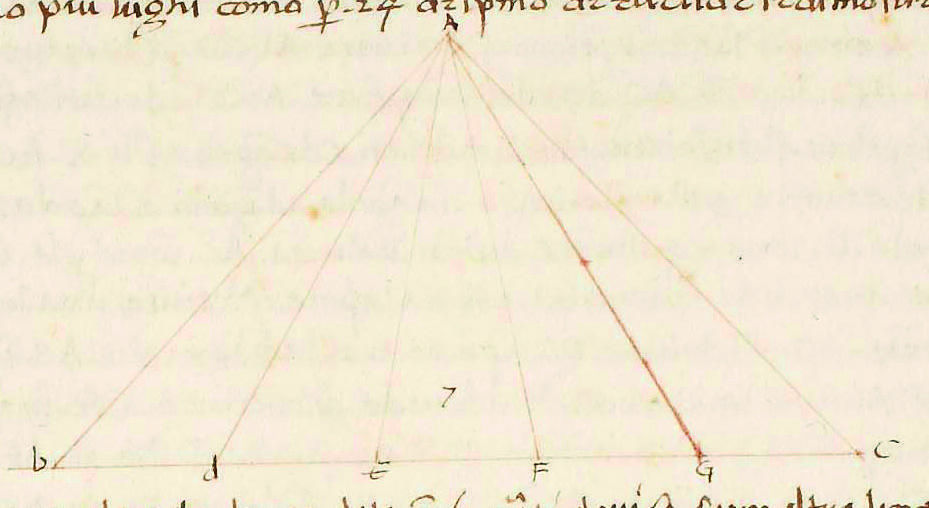
Diagram for Book I, proposition 7, fol. 4r of the Parma manuscript of De prospectiva pingendi. Piero della Francesca, MS Parm. 1576, Biblioteca Palatina, Parma. Chiara Gizzi (ed.), De prospectiva pingendi, Edizioni Ca’ Foscari, 2016, Book I, proposition 7, fol. 4r, fig. 8. Image source. CC BY 4.0. Resized from the source. This reproduction uses CC BY 4.0.
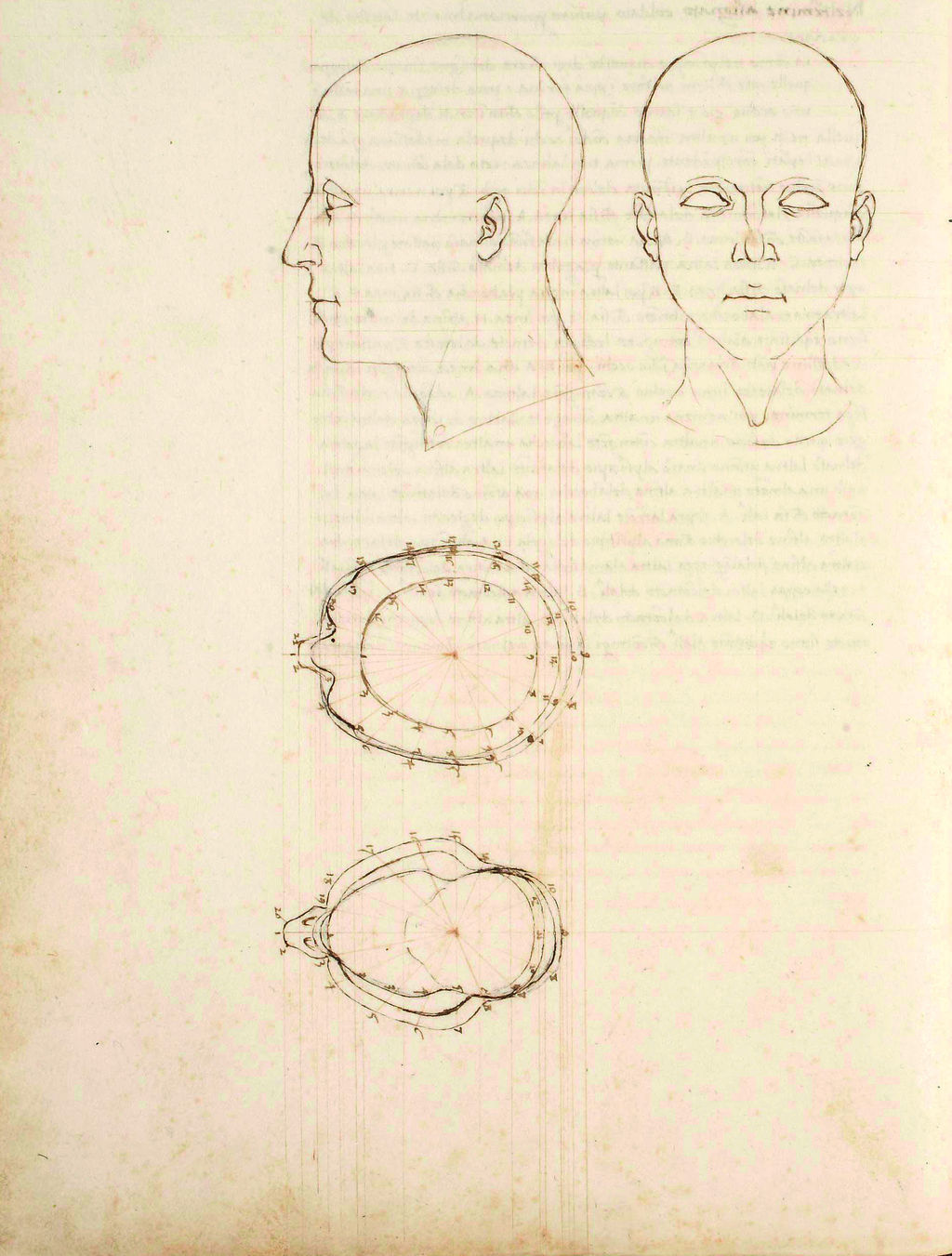
Studies of the head in profile, front and horizontal section, fol. 59v of the Parma manuscript. Piero della Francesca, MS Parm. 1576, Biblioteca Palatina, Parma. Chiara Gizzi (ed.), De prospectiva pingendi, Edizioni Ca’ Foscari, 2016, Book III, proposition 8a, fol. 59v, fig. 65. Image source. CC BY 4.0. Resized from the source. This reproduction uses CC BY 4.0.
Two attempts at the same drawing
Open the Reggio Emilia copy to folio 4r. At the bottom of the page is Piero’s first diagram for proposition I.7. Just above it, the written text limits how far the lines can extend. Piero gives the drawing another try in the outer margin, where he can set point A farther away. This is where the lines used to divide the segment BC into equal parts come together. He marks the abandoned version Vacat, directing the reader to disregard it. The corrected figure takes advantage of the wider space beside the text, and the two versions let us see what he changed. [1]
The manuscript, now at the Biblioteca Panizzi, Regg. A 41/2, also preserves distinctions between different sorts of marks. Gizzi describes lighter brown ink for construction lines and darker brown ink for contours and the visible edges of solid objects. Compare the well with steps and the cube on folio 26. In the well the lighter ink tends towards red ochre, while the lighter marks of the cube look more faded. Both figures make it possible to follow the structure of the object separately from the auxiliary lines used to establish it. The darker ink Piero used can resemble the ink of the copyist who wrote most of the text. Non-invasive X-ray fluorescence testing on the Reggio manuscript helped distinguish inks that look similar, which makes a useful check on what can be judged by eye. [1]
The Reggio illustrations are in Piero’s hand, as are his interventions in the written text. Two facing pages, folios 66v and 67r, are entirely autograph. A reader turning the leaves therefore passes from a copyist’s writing to passages written by the painter himself and back again. The manuscript also received notes by the scholar Giambattista Venturi centuries later. Two fragments of an earlier binding, now stored separately, also carry later pen drawings. Identifying what Piero drew involves looking at the position, ink and function of a mark as well as the book it came from. [1]
When the same figure appears in several books
Seven manuscripts of the perspective treatise survive. Three are in the Italian vernacular and four are in Latin. The illustrated Latin manuscript in Milan’s Biblioteca Ambrosiana, S.P. 6 bis, and Bordeaux’s MS 616 preserve figures and corrections by Piero alongside copied text. Milan’s second manuscript, D 200 inf., is a later vernacular copy whose spaces for figures were left blank. The London manuscript descends from the Bordeaux copy and served in turn as the model for the Paris manuscript. A resemblance between figures in two witnesses may therefore reflect the way one manuscript was copied from another. The shelfmark matters as much as the title when looking up a reproduced drawing. [1] [3]
The 2016 and 2017 National Edition of De prospectiva pingendi includes separate volumes for the drawings in its vernacular and Latin sets. Laura Carlevaris illustrates the editorial method with folio 72v of Bordeaux MS 616, a figure for drawing a column capital in perspective. She shows the manuscript image with two modern versions by Jessica Romor. The diplomatic version follows the appearance of the drawn marks, including differences in the weight of lines. The critical version tests how the construction works by reading the image alongside Piero’s instructions. Viewed together, the three versions allow a reader to see where interpretation enters. A cleaner set of lines may make a procedure easier to follow, while the manuscript records what Piero’s pen actually left on the page. [5]
The drawings also change character within the book. A simple plane figure can fit alongside a short passage of text. In Book III, a head seen at an angle requires a sequence of views. The outline of the nose or chin must be carried from one drawing to another as the viewpoint changes. The construction lines and reference points tell the reader where to find the corresponding features in each view. As the angle alters, parts of the face move closer together in the image or disappear behind the contour. The drawing makes those changes easier to follow than a description of the completed head could. Piero’s words on painting describe the problem, while the sequence of images lets a reader follow individual points as they move. [3] [4]
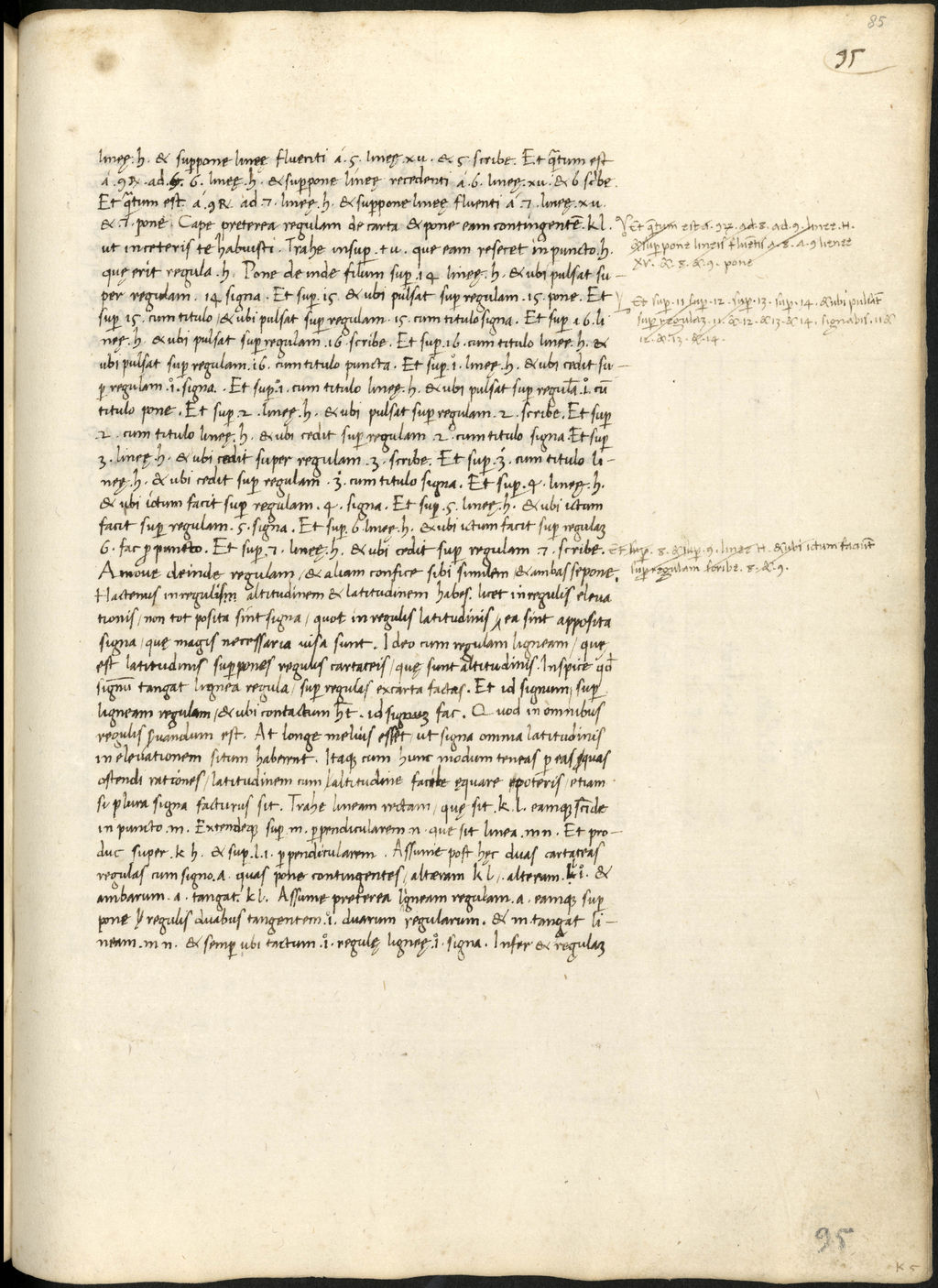
Bordeaux, Bibliothèque municipale, MS 616, folio 95 recto, from the Latin transmission of De prospectiva pingendi. Image source. Public domain. Resized only; native appearance preserved.
A copy in Florence and a comparison in New York
The Biblioteca Riccardiana in Florence holds Piero’s illustrated copy of a Latin translation of Archimedes, Ricc. 106. The library identifies his hand through James Banker’s comparison with manuscripts such as the Trattato d’abaco in the Biblioteca Medicea Laurenziana. It records about two hundred figures, many clustered in the margins, including drawings of spirals. In this case Piero was drawing while working through a different author’s arguments. Comparative study of the Riccardiana and a Vatican manuscript by Paolo d’Alessandro, Carlo Maccagni and Pier Daniele Napolitani found that the text follows the Vatican copy more straightforwardly than the figures do. Corrections made in the two books helped the researchers establish a likely period of production before 1468. The drawings have a history of their own within a copied text. This manuscript sits alongside Piero’s own mathematical writings as evidence of what he studied with a pen in hand. [6] [7]
A detached sheet in the Metropolitan Museum of Art shows how another painter used a closely related drawing procedure. The Met catalogues Head of a Man in Profile, object 1975.1.420, as Luca Signorelli’s work of the 1490s. A stylus cut horizontal guides across the head, and letters around the ear mark locations that can be used to establish points in a different view. Pricked holes follow the contour, allowing the outline to be copied. Taken together, the horizontal lines, letters and holes explain why the sheet has so many marks irrelevant to the appearance of the sitter. They make the profile available for further drawing. The Met links the procedure to Piero’s instructions for foreshortening a head, so Signorelli’s sheet provides a securely identified comparison. [8]
Drawings once attributed to Piero
The fortunes of Mars Seated in Rotterdam show how a convincing attribution can acquire authority over time. At the 1929 Russell sale, the sheet was offered as Piero’s work on the strength of an attribution by the collector Charles Alexander Loeser. The art historian Bernard Berenson continued to accept it in 1961. Museum Boijmans Van Beuningen now lists the sheet, I 280 recto, as anonymous and places it in the circle of Andrea Mantegna. In the museum’s catalogue, Rosie Razzall explains that the grey wash beneath the drawing and the scratchy handling of the pen have led scholars to look towards northern Italy around 1500. The outline was pricked for transfer, a physical fact that remains the same under each proposed attribution. [9]
Loeser also associated Piero with A Man Seated on a Throne, now in the Metropolitan Museum of Art, object 1975.1.397. The enthroned figure holds a sceptre. The museum compares the tight framing and the signs of authority to the emperor on fifteenth-century tarot cards and lists the drawing as the work of a follower. The two objects illustrate different outcomes of reassessment. The Rotterdam drawing has been assigned to a different artistic circle, while the Met retains a relationship to Piero in its catalogue. Neither is counted among his autograph manuscript drawings. [9] [10]
Tracing the design of a painting
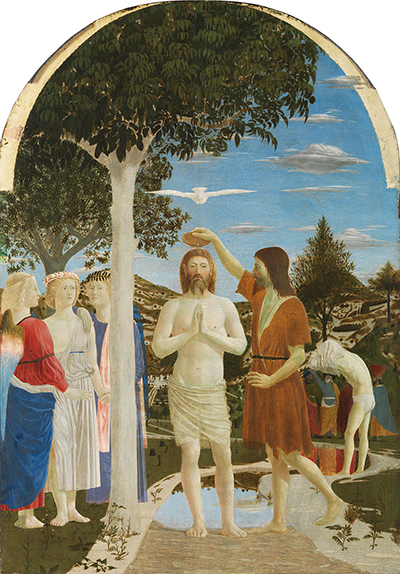
The distinction between drawing and design is especially useful in The Baptism of Christ. Look from the dove down to Christ’s clasped hands. The Baptist stretches an arm into this vertical alignment with the bowl, while the river draws the eye into the hills on the other side of his body. The walnut tree creates a second upright, giving the three angels their own space on the left. These relationships are visible in the finished composition. They help explain how the picture was organised, while the evidence of what Piero drew before painting has to come from a surviving object or the panel itself. [2] [11]
In the Annunciation at Perugia, the edges of the architecture are much easier to follow into depth. The Galleria Nazionale dell’Umbria identifies a central vanishing point in the upper panel of the Sant’Antonio polyptych. The columns overlap in an increasingly narrow band as the arcade recedes, leaving the angel and Mary with open space on either side. Here the architecture makes the gap between two figures part of the story. A drawing of a capital in the treatise shows how to construct a single architectural form. The painting shows what the placement of those forms can do across a whole panel. [5] [12]
To see marks from the act of preparing a painting, look at the infrared image of a kneeling devotee in the Misericordia polyptych at Sansepolcro. Conservators Roberto Bellucci and Cecilia Frosinini identified a chain of dots joined by a line. They interpret the dots as transfer marks made by pouncing. Powder was passed through tiny holes in a pricked paper design to leave a dotted outline on the prepared panel. The connecting line lets us distinguish a further act of drawing on the panel from the transfer itself. The image records the use of a cartoon even though the sheet used for this figure is unavailable for inspection. [4]
The same panel preserves a change to the base on which the Virgin stands. Bellucci and Frosinini traced the short diagonals of that base to the centre of the panel and measured a difference of roughly 18 centimetres between the vanishing point in the preliminary design and the one in the painting. They report that the change affected an already painted surface. They suggest the lower point may have adjusted the effect for the actual height of the panel on its altar. The change is measurable, whereas the intended viewing conditions are an interpretation of it. [4]
Bellucci and Frosinini also compare the underdrawing in the Virgin’s head and that of one of the devotees with the head diagrams in Book III. These are comparisons of working methods. A diagram for turning or tilting a head helps explain how a painter might keep the proportions consistent when adapting a design. A contour transferred to a panel establishes what was laid down for that particular figure. The two kinds of evidence meet where a specific detail, such as the placement of a feature or a repeated contour, can be compared across the book and the technical image. [4]
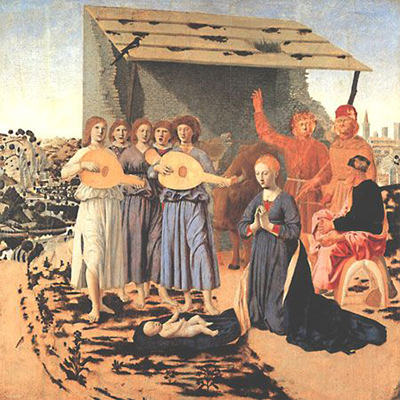
Underdrawing can even guide conservation today. In the National Gallery’s treatment of The Nativity, conservators used the precise underlying lines of the shepherds to guide thin glazes over areas where paint had been abraded. Their pale forms now recede beside the more prominent angels. A drawing that was originally meant to be covered helped the restorers judge where shapes belonged, while the finished scene still depended on the subtle differences in colour and tone that Piero applied over those lines. [13]
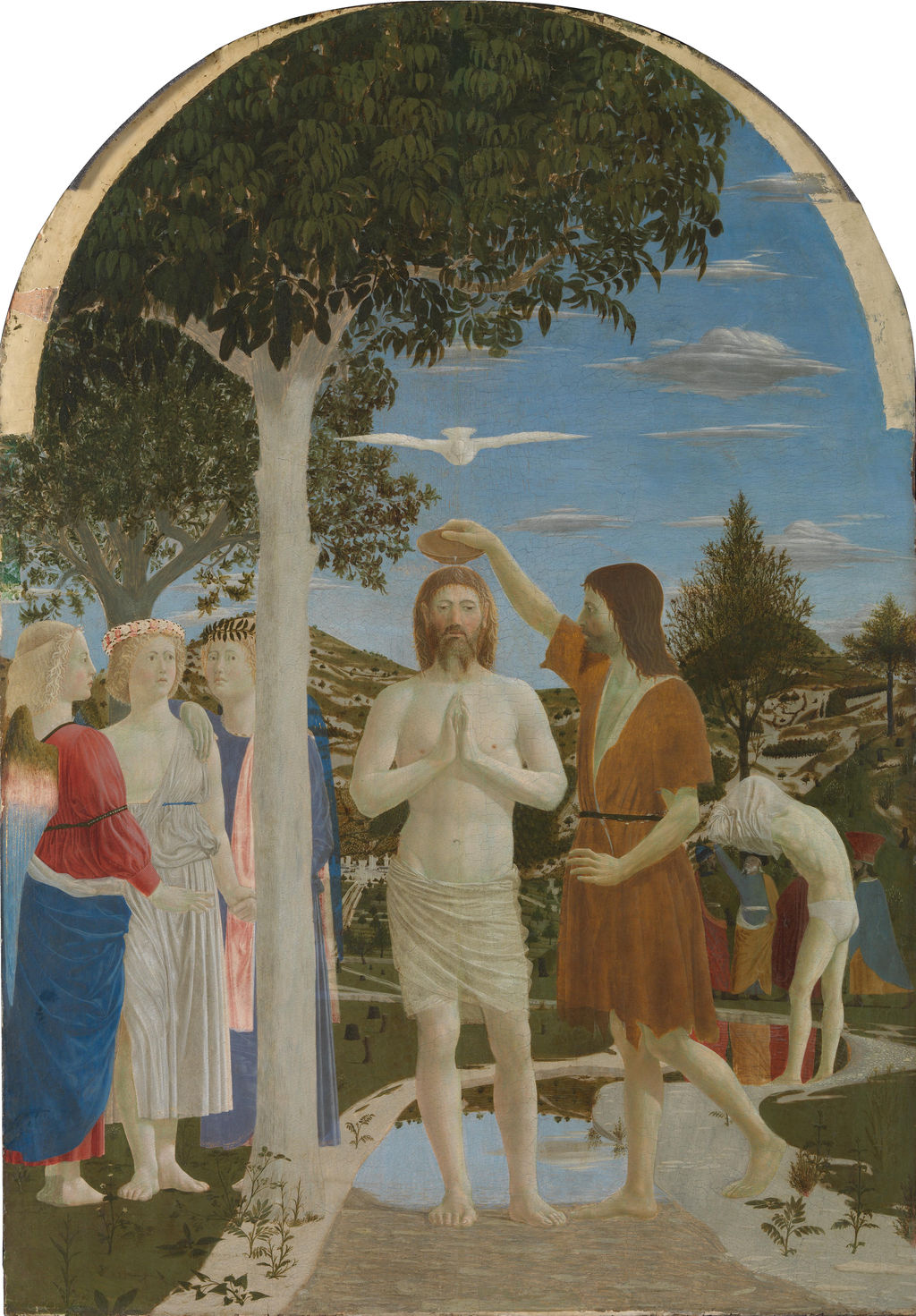
Piero della Francesca, The Baptism of Christ, National Gallery, London. Image source. Public domain. Resized only; native appearance preserved.
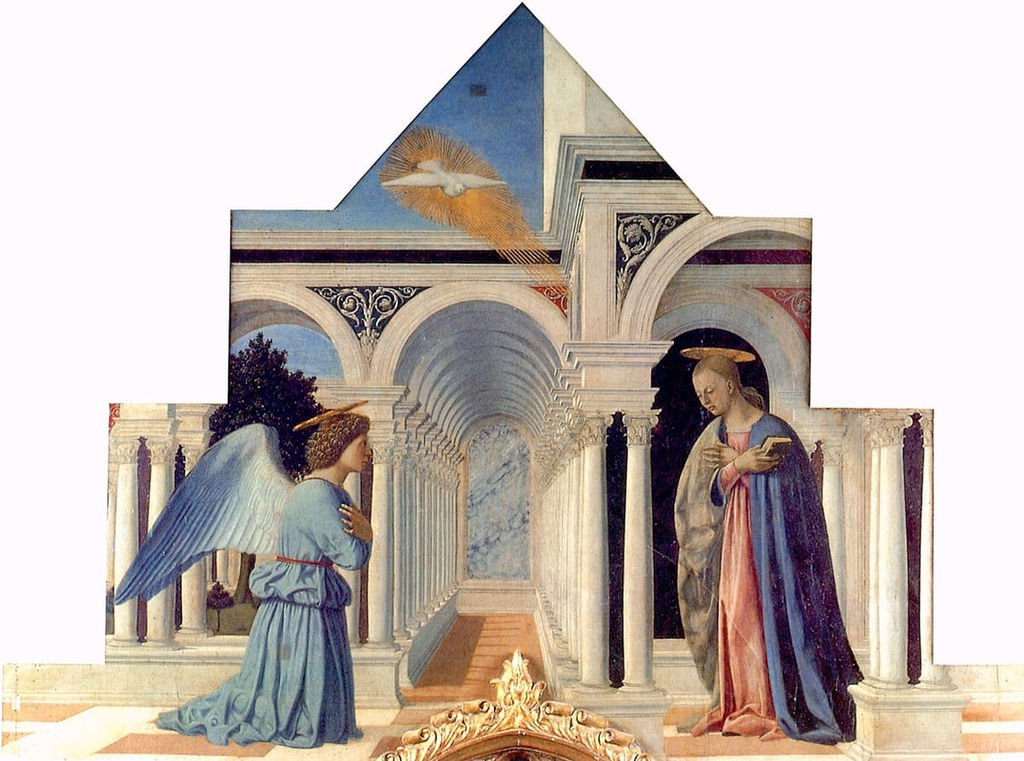
Piero della Francesca, Annunciation, crown of the Sant’Antonio Polyptych, Perugia. Image source. Public domain. Resized only; native appearance preserved.
Browse the artworks
Compare Piero’s frescoes, panels and manuscript figures. The list includes ensembles and separately identifiable panels or scenes. Dates are approximate where the sources differ.
| Name | Date | Medium and source |
|---|---|---|
| The Baptism of Christ | Probably c. 1437–45 | Panel painting Catalogue. |
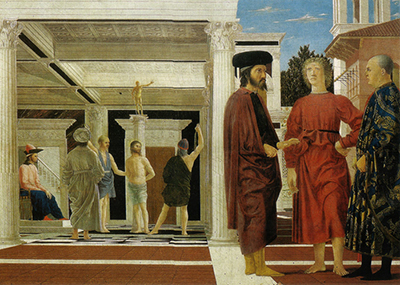
| The Flagellation of Christ | 1459–60 (GNDM) | Panel painting Catalogue. |
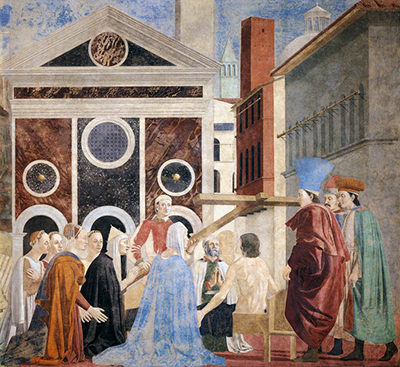
| The History of the True Cross | Mid-fifteenth century | Wall painting Catalogue. |
| Dream of Constantine | Mid-fifteenth century | Wall painting Catalogue. |
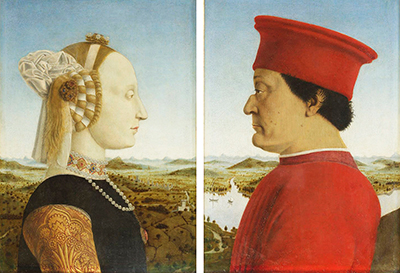
| The Duke and Duchess of Urbino | About 1473–75 (Uffizi) | Panel painting Catalogue. |
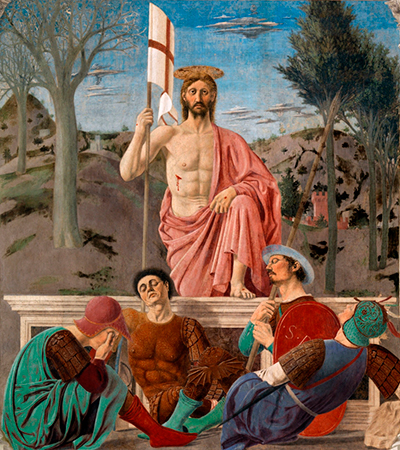
| The Resurrection | About 1458–68 (Opificio) | Wall painting Catalogue. |
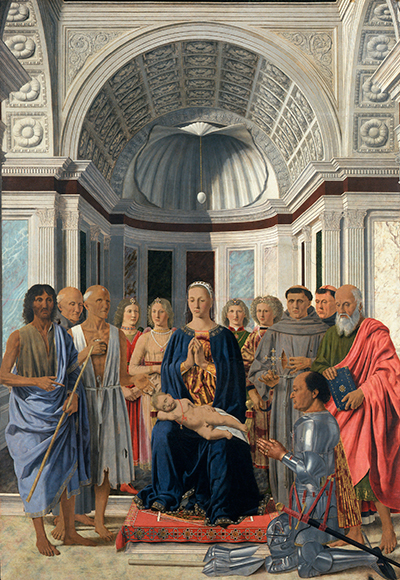
| Brera Madonna | About 1472–74 | Panel painting Catalogue. |
| Annunciation at Arezzo | Mid-fifteenth century | Wall painting Catalogue. |
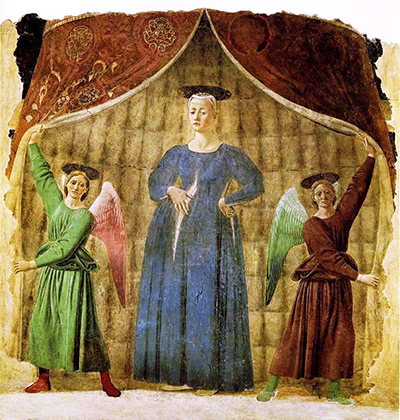
| Madonna del Parto | About 1450–65 (Monterchi) | Wall painting Catalogue. |
| Polyptych of the Misericordia | Commissioned 1445 | Panel painting Catalogue. |
| The Nativity | Early 1480s (National Gallery) | Panel painting Catalogue. |
| Madonna di Senigallia | About 1474–75 (GNDM) | Panel painting Catalogue. |
| Death of Adam | Mid-fifteenth century | Wall painting Catalogue. |
| Queen of Sheba | Mid-fifteenth century | Wall painting Catalogue. |
| Victory of Constantine | Mid-fifteenth century | Wall painting Catalogue. |
| Battle between Heraclius and Chosroes | Mid-fifteenth century | Wall painting Catalogue. |
| Saint Mary Magdalen | Wall painting Catalogue. | |
| The Augustinian Polyptych | 1454–69 | Panel painting Catalogue. |
| Polyptych of Perugia | About 1467–69 (GNU) | Panel painting Catalogue. |
| Perugia Annunciation | About 1468–70 (national catalogue) | Panel painting Catalogue. |
| St Francis and St Elizabeth | About 1467–69 (GNU) | Panel painting Catalogue. |
| Stigmatisation of St Francis | About 1468–70 (national catalogue) | Panel painting Catalogue. |
| An Augustinian Nun (Saint Monica) | 1454–69 | Panel painting Catalogue. |
| Augustinian Saint | 1454–69 | Panel painting Catalogue. |
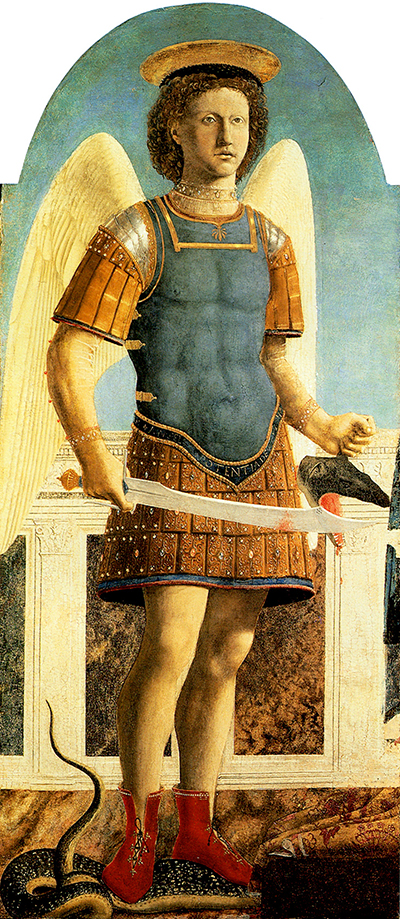
| Saint Michael | 1454–69 | Panel painting Catalogue. |
| Saint Nicholas of Tolentino | 1454–69 | Panel painting Catalogue. |
| Saint John the Evangelist | 1454–69 | Panel painting Catalogue. |
| Virgin and Child Enthroned with Four Angels | About 1460–70 (Clark) | Panel painting Catalogue. |
| Portrait of Sigismondo Pandolfo Malatesta | About 1450–51, often proposed. Louvre catalogue range 1450–75. | Panel painting Catalogue. |
| Sigismondo before St Sigismund | 1451 | Wall painting Catalogue. |
| St Jerome and a Donor | 1460s (Accademia); about 1450 also proposed | Panel painting Catalogue. |
| St Jerome in Penitence | 1450, dated on the panel | Panel painting Catalogue. |
| Saint Julian | About 1455–60, often proposed | Wall painting Catalogue. |
| Saint Augustine | 1454–69 | Panel painting Catalogue. |
| Saint Apollonia | 1454–69 | Panel painting Catalogue. |
| Crucifixion from the Augustinian Polyptych | 1454–69 | Panel painting Catalogue. |
| Saint Louis of Toulouse | Wall painting Catalogue. | |
| Burial of the Wood | Mid-fifteenth century | Wall painting Catalogue. |
| Discovery and Proof of the True Cross | Mid-fifteenth century | Wall painting Catalogue. |
| Exaltation of the Cross | Mid-fifteenth century | Wall painting Catalogue. |
| Saint Anthony Raises a Child | About 1467–69 (GNU) | Panel painting Catalogue. |
| Saint Elizabeth Revives a Child | About 1467–69 (GNU) | Panel painting Catalogue. |
| Hercules | About 1470 | Wall painting Catalogue. |
| Portrait of a Boy (possibly Guidobaldo da Montefeltro) | Panel painting Catalogue. | |
| De prospectiva pingendi, Reggio Emilia witness (figures) | Manuscript diagrams Catalogue. | |
| The Interrogation of Judas | Mid-fifteenth century | Wall painting Catalogue. |
| Two prophets, Bacci Chapel | Mid-fifteenth century | Wall painting Catalogue. |
| Saint Clare of Assisi, upper predella | About 1467–69 (GNU) | Panel painting Catalogue. |
| Saint Agatha, upper predella | About 1467–69 (GNU) | Panel painting Catalogue. |
| Lost centre of the Augustinian Polyptych | 1454–69 | Lost panel or panels Catalogue. |
Frequently Asked Questions
It identifies work in the author’s own hand. In the Parma perspective manuscript, that includes the writing and the illustrations. In Reggio, Piero drew the illustrations and made corrections and additions, while a copyist wrote most of the main text. [1]
Infrared reflectography can reveal some kinds of drawn marks under paint. In the Misericordia polyptych, the pounced dots and the drawn line linking them point to successive stages of preparation on the panel. The marks provide evidence of transfer from a cartoon. [4]
Discussion
Look again at the images and ideas explored in Piero della Francesca’s Drawings and Diagrams. These editorial prompts invite your observations.
Reader Insights
Look at the two versions of the diagram on the Reggio manuscript’s folio 4r. How does the extra space in the outer margin change the way you follow the lines?
Compare the outlines and guide marks in Signorelli’s head. Which marks would help you carry the position of the ear into a second view?
Follow the vertical alignment in The Baptism of Christ and then the receding columns of the Perugia Annunciation. Where does each design direct your attention first?
Join the Conversation
Share a detail, comparison or question about Piero della Francesca’s Drawings and Diagrams below.
References
- Chiara Gizzi, ed. De prospectiva pingendi. Edizioni Ca’ Foscari, 2016. Chapter 2, “Testimoni manoscritti ed edizioni a stampa”, pp. 23–32. See also comparative facsimiles for proposition I.7, Museo Galileo. View source 1. View source 2.
- James R. Banker. “Piero della Francesca: A Life of Design and Proportion”, keynote abstract in Piero della Francesca and Disegno. The Courtauld. View source.
- Museo Galileo. Piero della Francesca. La seduzione della prospettiva, section I.1. View source.
- Roberto Bellucci and Cecilia Frosinini. “La pianificazione dell’opera e il disegno preparatorio nel Polittico della Misericordia”, in Ripensando Piero della Francesca. Il Polittico della Misericordia di Sansepolcro, pp. 189–202, figs. 1, 7–8. Edifir, 2010. View source.
- Laura Carlevaris. “The National Edition of De Prospectiva Pingendi: a Philological Approach to the Drawings in the Treatise”. diségno, 3, 2018, figs. 1–3. View source.
- Biblioteca Riccardiana. “Piero della Francesca’s Archimedes”, Ricc. 106. View source.
- Paolo d’Alessandro, Carlo Maccagni and Pier Daniele Napolitani. “Piero della Francesca, Francesco dal Borgo e la traduzione di Archimede: la datazione del Riccardiano 106”. 2019. University of Roma Tre research record. View source.
- The Metropolitan Museum of Art. Luca Signorelli, Head of a Man in Profile, 1975.1.420. View source.
- Rosie Razzall. “Zittende Mars”, I 280 recto. Museum Boijmans Van Beuningen, catalogue of Italian drawings 1400–1600. View source.
- The Metropolitan Museum of Art. Follower of Piero della Francesca, A Man Seated on a Throne, 1975.1.397. View source.
- The National Gallery, London. Piero della Francesca, The Baptism of Christ, NG665. View source.
- Galleria Nazionale dell’Umbria. “Piero della Francesca – Room 13”, Polittico di Sant’Antonio and the Annunciation. View source.
- The National Gallery, London. Report on the restoration of Piero della Francesca’s Nativity. 2022. View source.