 by Tom Gurney
Tom Gurney BSc (Hons) is an art history expert with over 20 years experience
Published on June 19, 2020 / Updated on October 14, 2023
Email: tomgurney1@gmail.com / Phone: +44 7429 011000
Portrait of Sigismondo Pandolfo Malatesta: Introduction
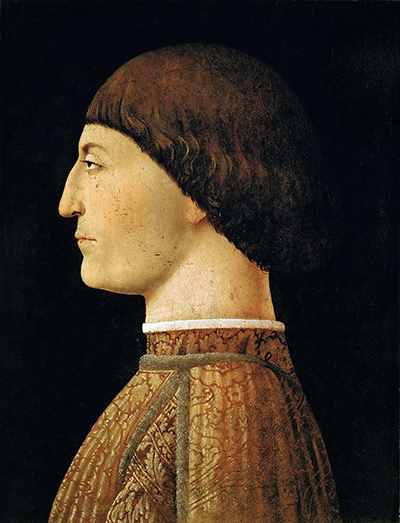
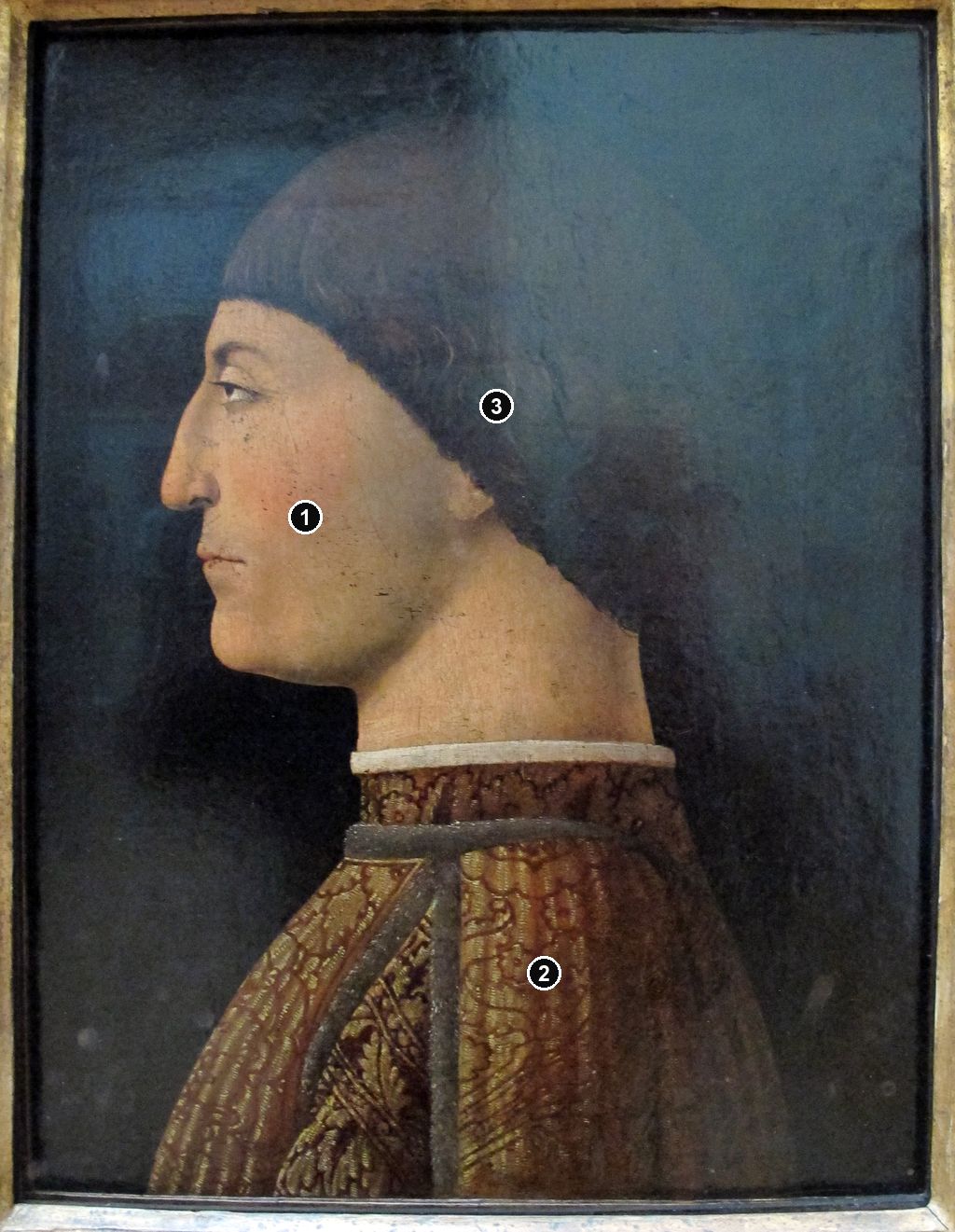
A pale forehead, a long nose and a closed mouth stand out against near-black in Piero della Francesca's portrait of Sigismondo Pandolfo Malatesta. The sitter faces left, his head upright above a stiff collar and a red and gold garment. Sigismondo was the lord of Rimini and a military commander. His dress here belongs to the court, while the profile has the clarity of the likenesses that circulated on his medals. The Louvre holds the small poplar panel, usually dated around 1450–51. [1] [2] [3]
At a Glance
- ArtistPiero della Francesca [1]
- SitterSigismondo Pandolfo Malatesta (1417–1468), lord of Rimini [1]
- DateAbout 1450–51, within the Louvre's catalogue range of 1450–75 [1] [2] [4]
- MediumOil on poplar in the Louvre catalogue, with tempera also recorded in the French national inventory [1] [2]
- Dimensions44.9 × 34 cm, unframed, in the Louvre catalogue [1]
- CollectionMusée du Louvre, Paris, inventory RF 1978 1 [1]
This work across Piero della Francesca’s career
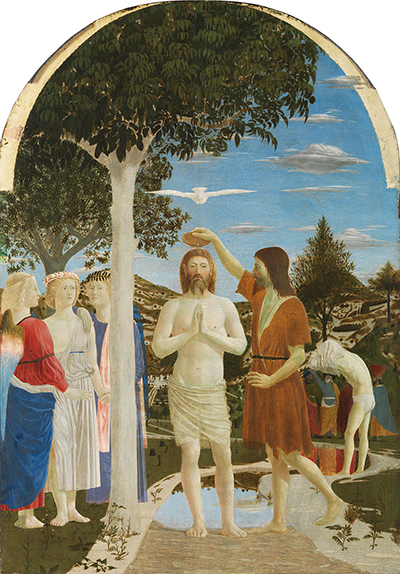
The Baptism of Christ
Probably about 1437–45Portrait of Sigismondo Pandolfo Malatesta (current article)
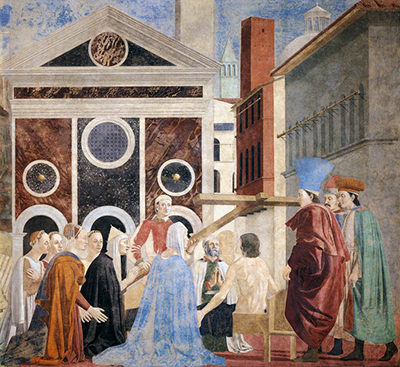
About 1450–51, often proposedThe History of the True Cross
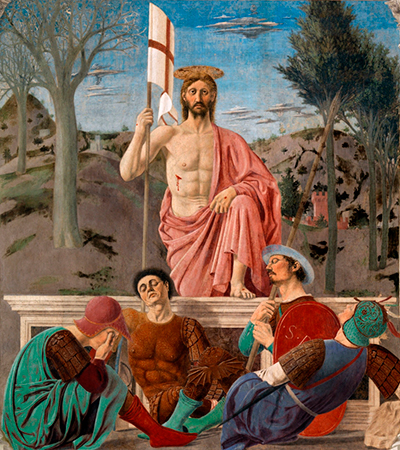
Mid-fifteenth centuryThe Resurrection
About 1458–68 (Opificio)The Flagellation of Christ
1459–60 (GNDM)The Montefeltro Altarpiece
About 1472–74 (Brera)The Duke and Duchess of Urbino
About 1473–75 (Uffizi)The Nativity
Early 1480s (National Gallery)Contents
- The face against the dark
- A court portrait in the age of the medal
- The same profile at prayer
- Rediscovery and the Louvre acquisition
- Annotated details
The face against the dark
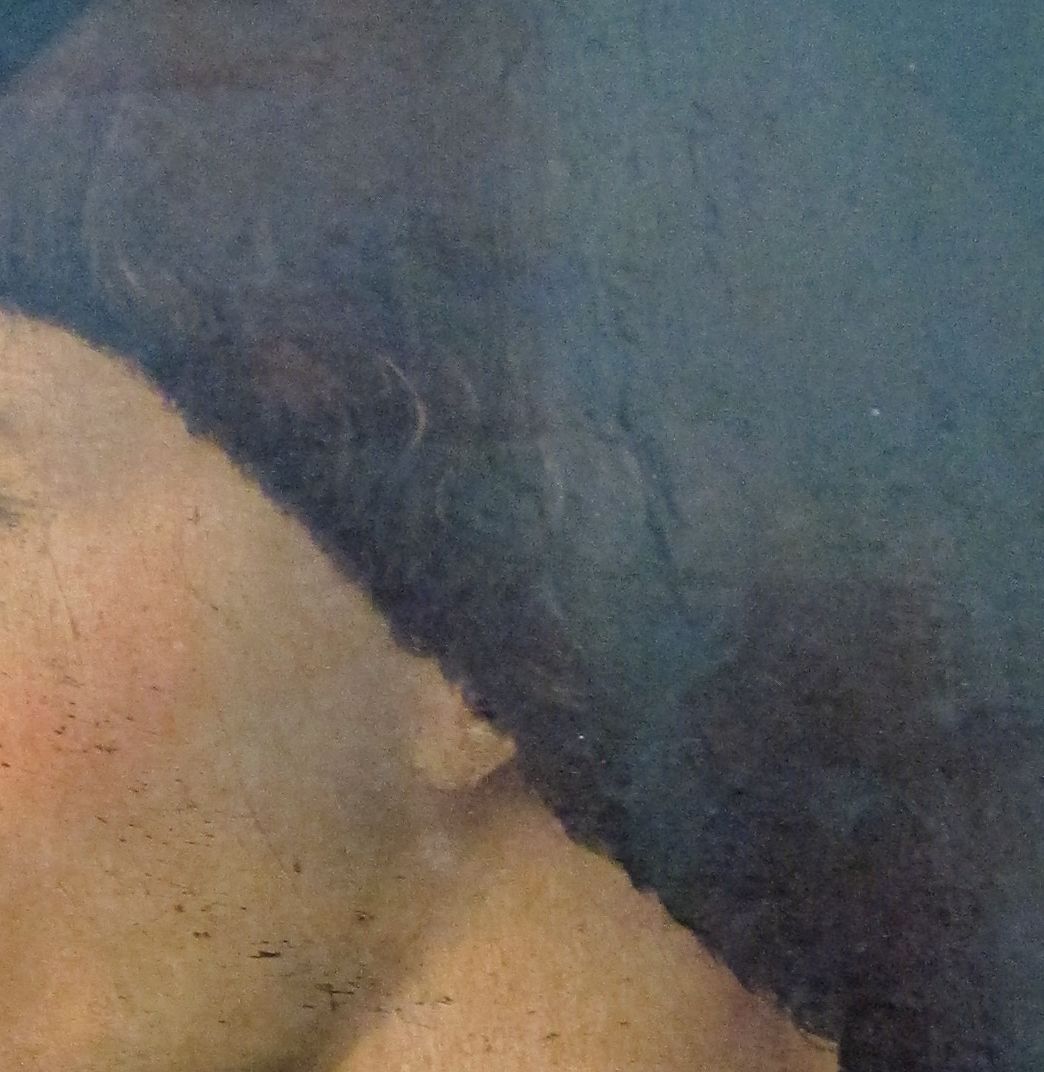
The most sharply defined line in the portrait runs down the front of the face. The forehead gives way to the brow and the long descent of the nose. The mouth draws inward, then the chin projects into the dark again. There is space between this contour and the left edge, enough for the eye to register the line and the direction of Sigismondo's gaze. The hair makes a softer edge. Along the crown it almost merges with the background, and the fall behind the neck is easiest to see by following the lit skin to where it ends. [1]
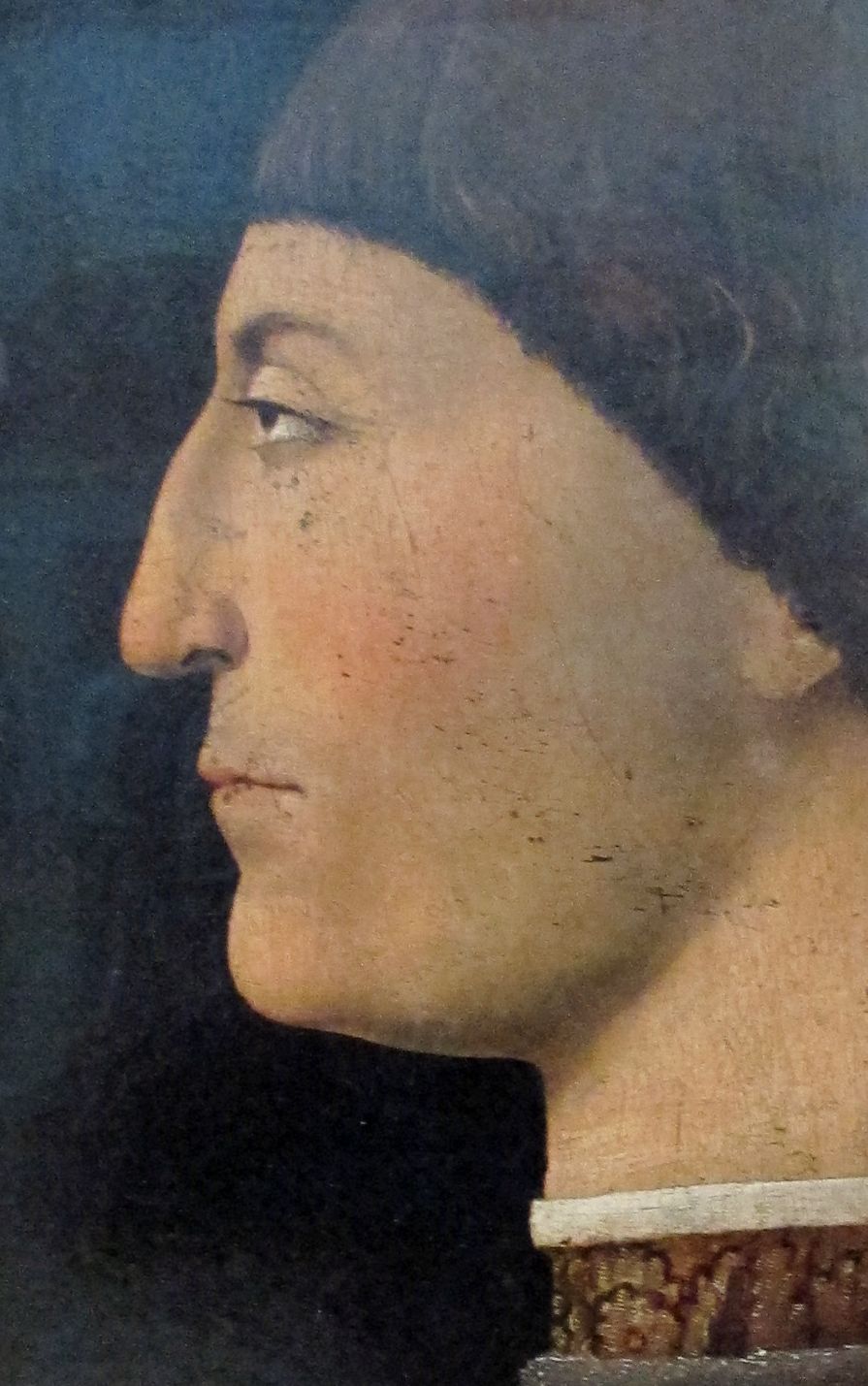
Inside that profile, Piero creates a sense of weight through small shifts of colour. The cheek warms near the centre. The skin cools and darkens along the jaw, where the head turns away from the light. A narrow patch of white at the eye gives the fixed silhouette a point of attention. The image can look severe at first glance. Up close, much of that impression comes from the upright posture, the tight line of the mouth and the amount of dark space in front of the face. [1]
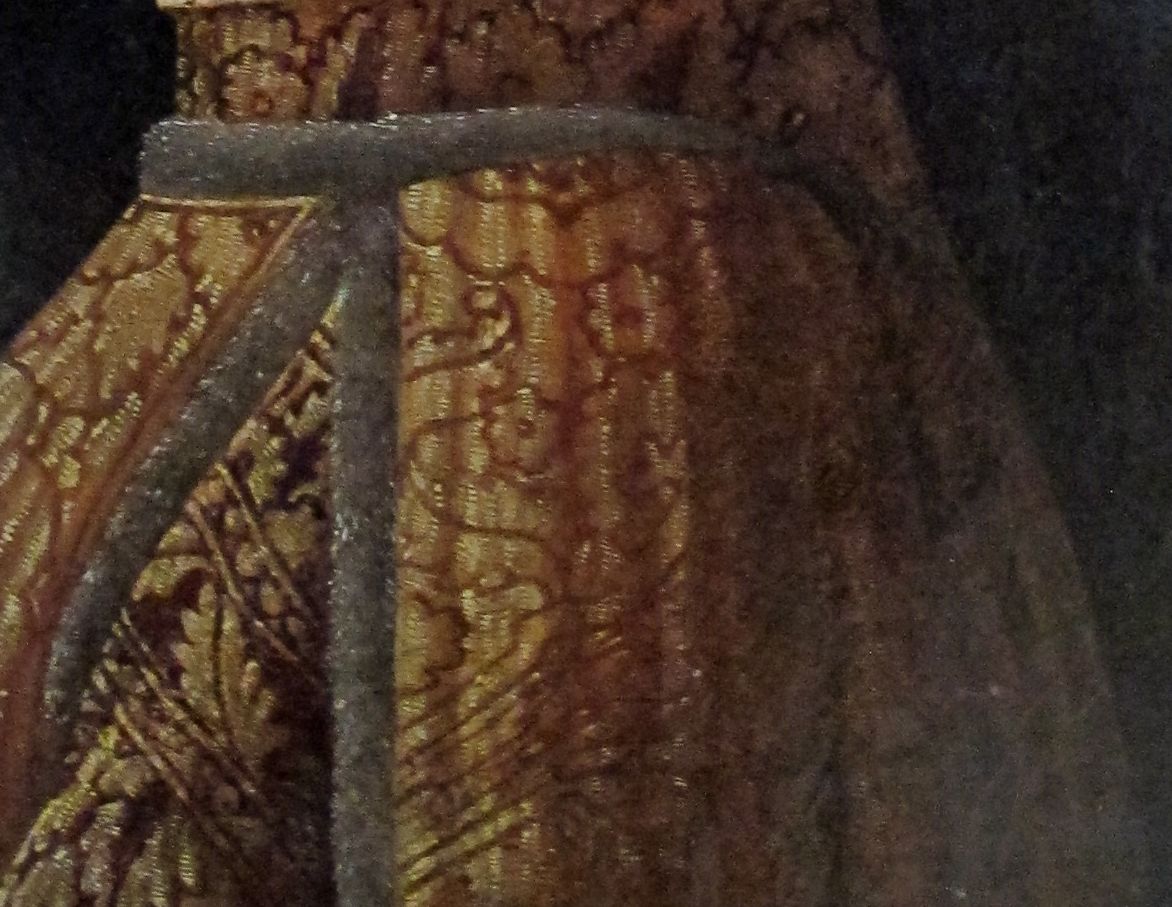
Below the jaw, the collar and shoulder create a second set of shapes. The pale rim of the collar separates warm flesh from patterned cloth. Dark bands follow the collar and divide the garment, and the gold-toned motifs turn or disappear as the fabric rolls away from the light. The pattern describes the curve of the torso as well as the costliness of the garment. At a distance the brow, nose and chin do most of the work of identification. At close range the painting asks the eye to distinguish the skin, the hair, the strip of linen and the heavy fabric, each reflecting light differently. [1] [2]
The Louvre catalogues the work as oil on poplar and records the panel at 44.9 by 34 centimetres. The French national inventory specifies both oil and tempera. Carlo Bertelli draws attention to the transparency and fine gradations of the flesh, comparing Piero's effects with those of Flemish painters. That comparison helps explain why the panel feels so different from a cast relief even where the contour looks medal-like. The warmth in the cheek and the shadow under the jaw give an impression of a face turning in light, while the black field leaves the boundaries of the room to the imagination. [1] [2] [5]
The light also keeps the garment from competing with the face. Its most intricate detail sits low on the panel. The broad, relatively unbroken cheek is further up and has the strongest contrast with its surroundings. The eye can move from the glints on the cloth to the fine line of the mouth without having to cross any furniture, window or painted inscription. The luminous skin and the dense ornament both demand close looking, but they do so at different points in the figure. [1] [5]
A court portrait in the age of the medal
Sigismondo ruled Rimini from 1432 until his death in 1468. A condottiere, or military captain, he also brought artists and scholars to his court. In 1447 work began on funerary chapels for him and Isotta degli Atti at the Franciscan church of San Francesco. The project grew into a remodelling of the church under Leon Battista Alberti. The Tempio Malatestiano remained unfinished at Sigismondo's death, but its architecture, paintings and sculpture preserve much of the language in which his court represented him. [3]
Cast portrait medals borrowed the profile and surrounding inscription familiar from ancient coins. The format gave a contemporary likeness the authority of an antique ruler's image, and the reverse allowed the artist to attach a second image to the sitter's name. Pisanello's medal of Sigismondo, dated 1445 by the National Gallery of Art in Washington, identifies him on the obverse as lord of Rimini and captain-general of the Roman Church. Turn the medal over and he appears on horseback before a fortress. One face gives a likeness and a title, the other a scene of command. [6] [7]
Pisanello's medal shows Sigismondo facing right. The Louvre panel faces left, and a left-facing profile also appears on medals of the same ruler by Matteo de' Pasti, who worked on the Tempio. The reverse can help identify which medal is under discussion. A small Hamburg example combines a laureate, armoured profile with an elevation of Alberti's projected church. Another medal in Washington pairs Sigismondo's likeness with the castle of Rimini. These are different designs with distinct catalogue dates. An inscribed date may commemorate the building or event depicted. The catalogue date of a particular cast can be later. [6] [8] [9] [10]
Medals could move between courts as gifts. Some were also deposited at building sites to preserve a patron's name and likeness for the future. The Walters Art Museum holds an excavated bronze cast from Matteo's design with Fortitude on the reverse and the date 1446 beneath her. Its mottled surface comes from burial. As a portable multiple, the medal could put the same profile into several hands or places. The roughly forty-five-centimetre painted panel works at a different scale. Its finer transitions of light reward a viewer who stands before it and looks for a while. [7] [10] [11]
Pisanello's painting of Leonello d'Este in Bergamo offers a second kind of comparison. Machtelt Brüggen Israëls relates Piero's handling of Sigismondo's features and hair as simple shapes to Pisanello's painted portrait and places the dark background in a tradition that also includes Jan van Eyck. Piero could draw on a language shared by panel painters and medallists. In the Louvre portrait, the name and titles carried by a medal's rim are absent from the painted field. Recognition rests on the arrangement of the head, the brow and nose, the shape of the hair and the court dress. [6] [12] [13]
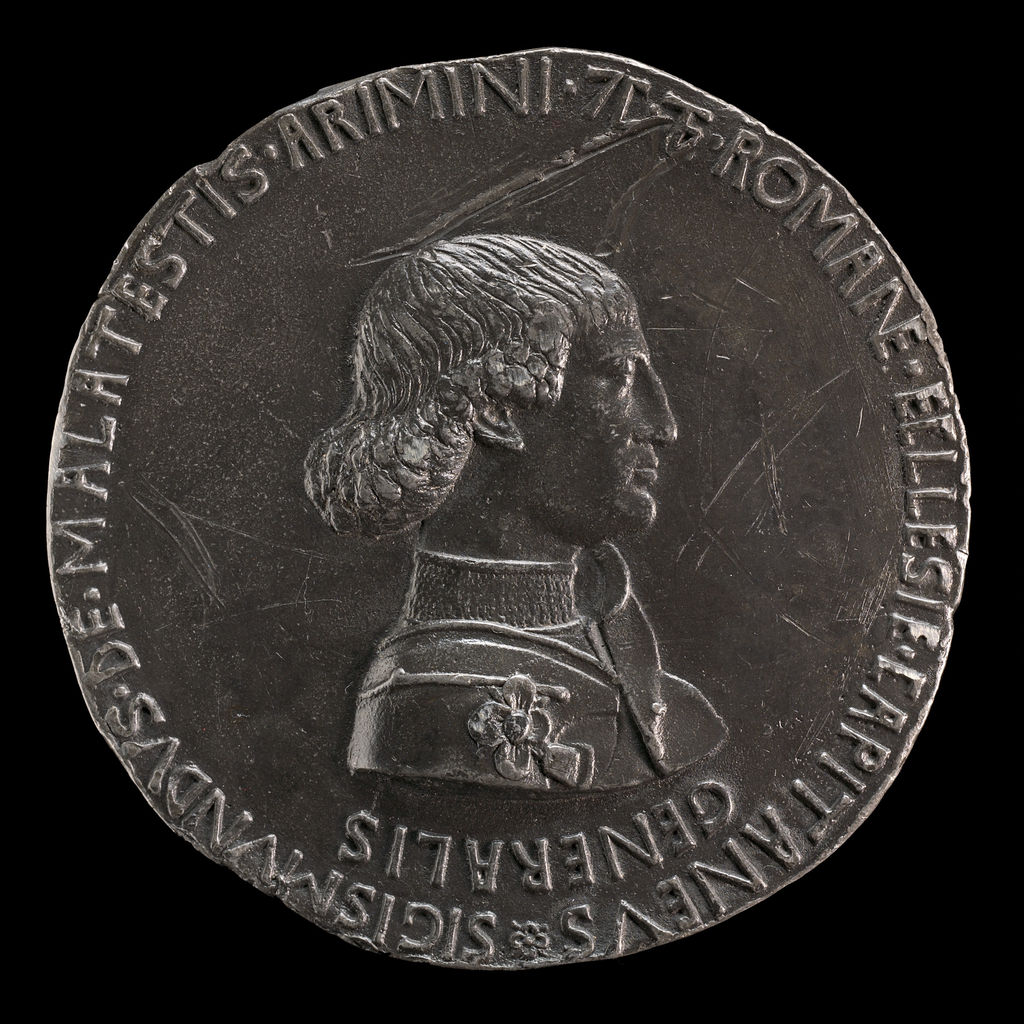
Pisanello, obverse of a medal of Sigismondo Pandolfo Malatesta, 1445. National Gallery of Art, Washington. National Gallery of Art, Washington, Samuel H. Kress Collection. Image source. Public domain. Resized only; native appearance preserved.
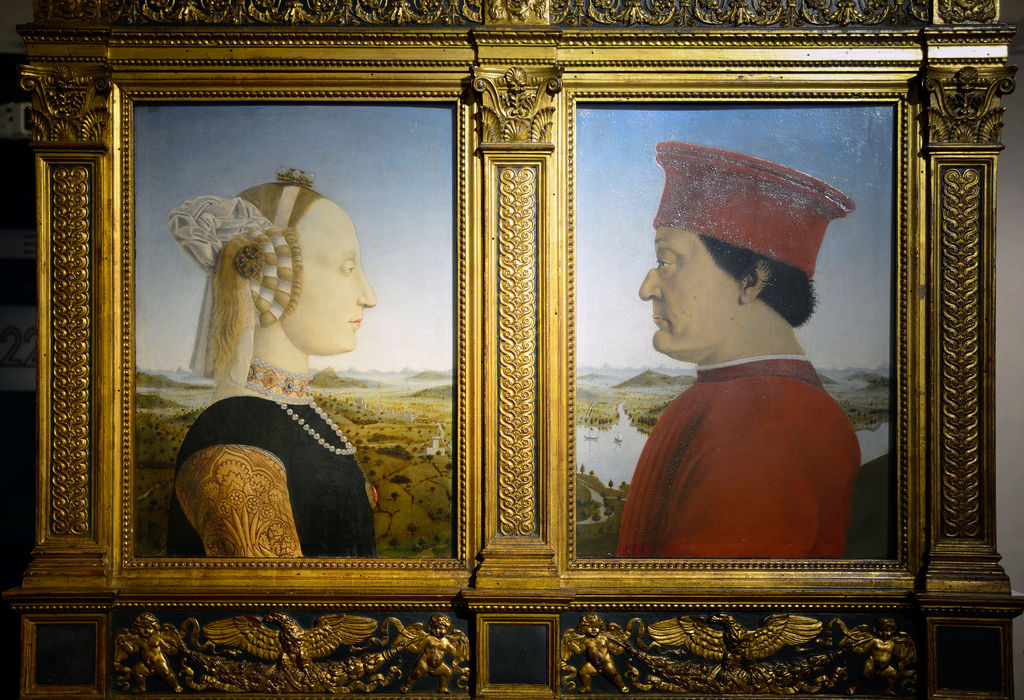
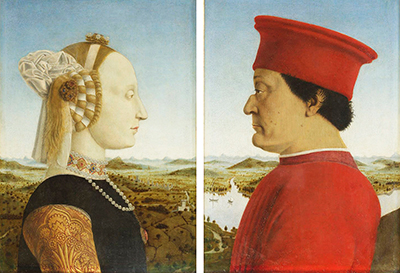
Battista Sforza and Federico da Montefeltro, the portrait faces of Piero’s Urbino diptych, Uffizi. Livioandronico2013. Image source. CC BY-SA 4.0. Resized from the source. This reproduction uses CC BY-SA 4.0.
Annotated Details from Portrait of Sigismondo Pandolfo Malatesta
The numbered points identify visible features discussed in this article. Return from each detail to the numbered overview. Piero della Francesca, portrait of Sigismondo Pandolfo Malatesta, Musée du Louvre. Sailko. Image source. CC BY 3.0. The numbered overview and detail crops are adaptations under CC BY 3.0.
Details from PORTRAIT OF SIGISMONDO PANDOLFO MALATESTA
Compare the cropped details with the source images above. Notice how their colours, shapes and positions contribute to the larger compositions.
The silhouette
The sitter’s nose, lips and chin extend slightly beyond the line of the darker hair. Light along the face clarifies each change in direction.
The patterned garment
Foliate shapes break up the fabric into narrow bands. The plain line of the collar separates it from the smooth, lighter neck.
Hair against the ground
The hair and surrounding field are close in value. The lighter face and the more visible contour at the crown let the head emerge against that dark surface.
The same profile at prayer
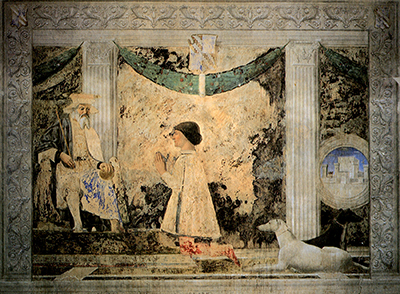
At the Tempio Malatestiano, Piero's signed fresco conventionally dated 1451 shows Sigismondo Pandolfo Malatesta praying before Saint Sigismund. The left-facing head, rounded cap of hair and high collar make the comparison immediate. In the fresco, the sitter's eye has a destination. His body is shown kneeling in a formal architectural space before his name saint, the Burgundian king, and his folded hands establish his role as donor. The panel isolates the head and upper body. The upright pose and elaborate clothing can carry the likeness on their own. [1] [5] [14] [15]
The Louvre proposes that the panel was an early conception for the mural. Bertelli describes the panel as taking up the face seen in the fresco. The close relationship is easier to establish than the order in which the images were made. The fresco also has its own preparatory evidence. A sinopia, a drawing beneath the plaster carrying the finished composition, came to light in 1943. It documents planning for the wall painting, while the Louvre's assessment of the panel speaks to the relationship between the two likenesses. The sources leave open what Piero used to carry the profile from one version to another. [1] [5] [14]
The contrast is particularly evident in the clothing. Marilyn Aronberg Lavin describes the kneeling ruler's garment as a high-collared damask coat suitable for court. Piero shows enough of it in the fresco to place the costly textile within a formal encounter. In the cropped panel, the corresponding passage becomes a large expanse of pattern beneath the face. The same courtly vocabulary serves two pictures at very different scales, one organised around an act of devotion and the other around the likeness itself. [1] [14]
The mural is an important early marker in Piero della Francesca's career. The later portraits of the Duke and Duchess of Urbino show what else he could do with the profile. In the Uffizi panels, Federico da Montefeltro and Battista Sforza face each other across two panels joined by a continuous horizon. Behind Malatesta there is no distant view to fix his position in a wider world. The sweep of the shoulder and the gap before the nose are the principal measures of space. Seen together, the panels show how much a court portrait's setting can change while the strict side view remains. [1] [5] [16]
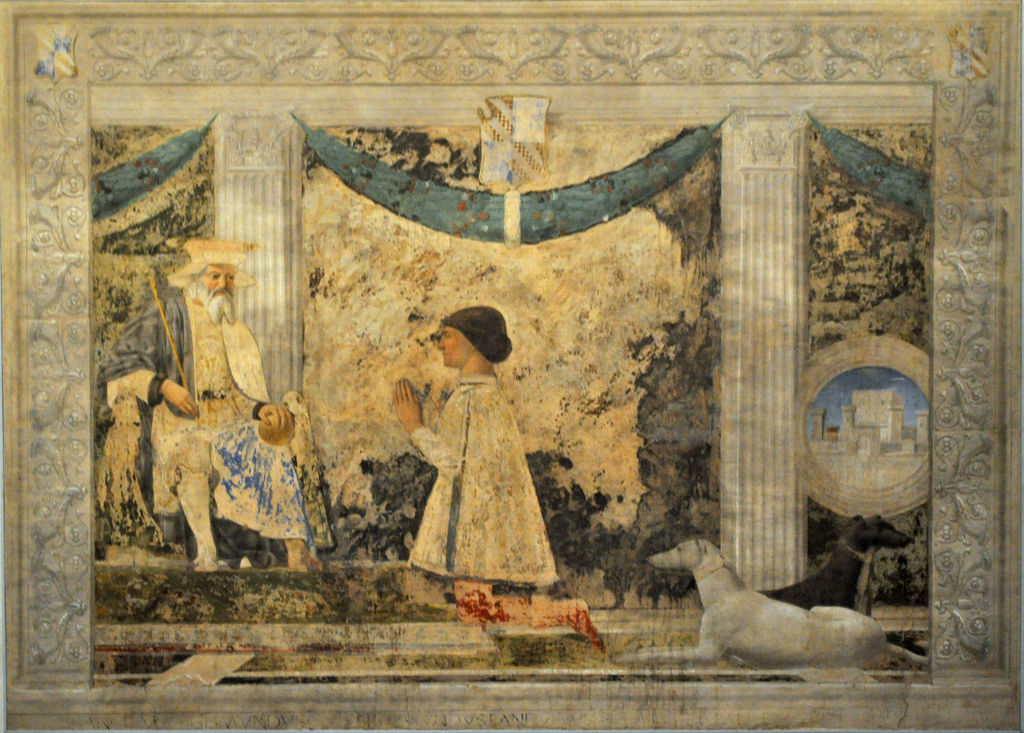
Sigismondo Pandolfo Malatesta before Saint Sigismund, Tempio Malatestiano, Rimini. Henry Townsend. Image source. Public domain. Resized only; native appearance preserved.
Rediscovery and the Louvre acquisition
The Louvre traces the modern ownership record to Paul Delaroff, who acquired the painting in Saint Petersburg in 1889. The museum cites a letter from the connoisseur Giovanni Morelli to Jean Paul Richter from that year. The panel subsequently belonged to Paolo D'Ancona in Milan and passed to Alessandro Contini Bonacossi around 1930. Roberto Longhi praised it in the second edition of his monograph on Piero. By 1977 the painting had reappeared with the New York dealer Stanley Moss, from whom the Louvre bought it the following year. [1] [4] [17]
The acquisition revived a dispute about authorship. In 1971 the art historian Eugenio Battisti had treated the work as a nineteenth-century copy from the wall painting in Rimini. Neville Rowley's archival study of the acquisition describes two kinds of evidence that mattered to the Louvre. Analysis identified oil alongside tempera, a combination consistent with Piero's practice. Federico Zeri supplied a 1928 photograph that showed how the portrait looked before Mauro Pelliccioli had repainted parts of it. The photograph gave curators a way to assess the appearance of the panel before that intervention. [2] [4] [17]
After the purchase, conservators removed Pelliccioli's overpaint. Rowley records that they left some losses exposed and filled losses in the hair and background with neutral colour. Looking closely at the panel now involves seeing the surviving paint and the effects of the decision to let some damage remain visible. Michel Laclotte put the evidence for Piero's authorship before readers in a study published in 1978. The Louvre now catalogues the work under Piero's name, and its exhibition history records later showings in Arezzo, at the Prado in Madrid and at the Hermitage in Saint Petersburg. The last brought the portrait back to the city where its modern ownership is first documented in the Louvre record. [1] [17]
Browse the artworks
Compare Piero’s frescoes, panels and manuscript figures. The list includes ensembles and separately identifiable panels or scenes. Dates are approximate where the sources differ.
| Name | Date | Medium and source |
|---|---|---|
| The Baptism of Christ | Probably c. 1437–45 | Panel painting Catalogue. |
| The Flagellation of Christ | 1459–60 (GNDM) | Panel painting Catalogue. |
| The History of the True Cross | Mid-fifteenth century | Wall painting Catalogue. |
| Dream of Constantine | Mid-fifteenth century | Wall painting Catalogue. |
| The Duke and Duchess of Urbino | About 1473–75 (Uffizi) | Panel painting Catalogue. |
| The Resurrection | About 1458–68 (Opificio) | Wall painting Catalogue. |
| Brera Madonna | About 1472–74 | Panel painting Catalogue. |
| Annunciation at Arezzo | Mid-fifteenth century | Wall painting Catalogue. |
| Madonna del Parto | About 1450–65 (Monterchi) | Wall painting Catalogue. |
| Polyptych of the Misericordia | Commissioned 1445 | Panel painting Catalogue. |
| The Nativity | Early 1480s (National Gallery) | Panel painting Catalogue. |
| Madonna di Senigallia | About 1474–75 (GNDM) | Panel painting Catalogue. |
| Death of Adam | Mid-fifteenth century | Wall painting Catalogue. |
| Queen of Sheba | Mid-fifteenth century | Wall painting Catalogue. |
| Victory of Constantine | Mid-fifteenth century | Wall painting Catalogue. |
| Battle between Heraclius and Chosroes | Mid-fifteenth century | Wall painting Catalogue. |
| Saint Mary Magdalen | Wall painting Catalogue. | |
| The Augustinian Polyptych | 1454–69 | Panel painting Catalogue. |
| Polyptych of Perugia | About 1467–69 (GNU) | Panel painting Catalogue. |
| Perugia Annunciation | About 1468–70 (national catalogue) | Panel painting Catalogue. |
| St Francis and St Elizabeth | About 1467–69 (GNU) | Panel painting Catalogue. |
| Stigmatisation of St Francis | About 1468–70 (national catalogue) | Panel painting Catalogue. |
| An Augustinian Nun (Saint Monica) | 1454–69 | Panel painting Catalogue. |
| Augustinian Saint | 1454–69 | Panel painting Catalogue. |
| Saint Michael | 1454–69 | Panel painting Catalogue. |
| Saint Nicholas of Tolentino | 1454–69 | Panel painting Catalogue. |
| Saint John the Evangelist | 1454–69 | Panel painting Catalogue. |
| Virgin and Child Enthroned with Four Angels | About 1460–70 (Clark) | Panel painting Catalogue. |
| Portrait of Sigismondo Pandolfo Malatesta | About 1450–51, often proposed. Louvre catalogue range 1450–75. | Panel painting Catalogue. |
| Sigismondo before St Sigismund | 1451 | Wall painting Catalogue. |
| St Jerome and a Donor | 1460s (Accademia); about 1450 also proposed | Panel painting Catalogue. |
| St Jerome in Penitence | 1450, dated on the panel | Panel painting Catalogue. |
| Saint Julian | About 1455–60, often proposed | Wall painting Catalogue. |
| Saint Augustine | 1454–69 | Panel painting Catalogue. |
| Saint Apollonia | 1454–69 | Panel painting Catalogue. |
| Crucifixion from the Augustinian Polyptych | 1454–69 | Panel painting Catalogue. |
| Saint Louis of Toulouse | Wall painting Catalogue. | |
| Burial of the Wood | Mid-fifteenth century | Wall painting Catalogue. |
| Discovery and Proof of the True Cross | Mid-fifteenth century | Wall painting Catalogue. |
| Exaltation of the Cross | Mid-fifteenth century | Wall painting Catalogue. |
| Saint Anthony Raises a Child | About 1467–69 (GNU) | Panel painting Catalogue. |
| Saint Elizabeth Revives a Child | About 1467–69 (GNU) | Panel painting Catalogue. |
| Hercules | About 1470 | Wall painting Catalogue. |
| Portrait of a Boy (possibly Guidobaldo da Montefeltro) | Panel painting Catalogue. | |
| De prospectiva pingendi, Reggio Emilia witness (figures) | Manuscript diagrams Catalogue. | |
| The Interrogation of Judas | Mid-fifteenth century | Wall painting Catalogue. |
| Two prophets, Bacci Chapel | Mid-fifteenth century | Wall painting Catalogue. |
| Saint Clare of Assisi, upper predella | About 1467–69 (GNU) | Panel painting Catalogue. |
| Saint Agatha, upper predella | About 1467–69 (GNU) | Panel painting Catalogue. |
| Lost centre of the Augustinian Polyptych | 1454–69 | Lost panel or panels Catalogue. |
Frequently Asked Questions
Medals by Pisanello and Matteo de' Pasti establish how familiar the profile was in Sigismondo's court. Their variations in clothing, headgear and direction help explain the range of models available. The panel's exact source and the sequence connecting the panel and fresco remain open. [1] [5] [6] [8] [9] [12]
The Louvre catalogue assigns it to 1450–75, while the French national inventory gives about 1451 and the Fondazione Zeri places it around 1450–51. The close likeness to the figure in the Rimini fresco helps explain the narrower estimate. It supplies a plausible period for the panel, while the date conventionally assigned to the wall painting comes from its own inscription history. [1] [2] [14] [4]
Discussion
Look again at the images and ideas explored in Portrait of Sigismondo Pandolfo Malatesta. These editorial prompts invite your observations.
Reader Insights
Follow the edge of the portrait from the forehead to the collar. Where does Piero use a sharp boundary, and where does he let neighbouring tones blend?
Set the painted profile beside a medal with its inscription. How much can you learn about Sigismondo's rank from each face of the medal and from the painted garment?
Consider the space in front of Sigismondo's eye. How does it change his expression when the person he faces is visible in the fresco?
Join the Conversation
Share a detail, comparison or question about Portrait of Sigismondo Pandolfo Malatesta below.
References
- Musée du Louvre, Portrait de Sigismond Malatesta, seigneur de Rimini (1417–1468), Department of Paintings collection record RF 1978 1. View source.
- Ministère de la Culture, Portrait de Sigismond Malatesta (1417–1468), Joconde, notice 000PE026951. View source.
- Comune di Rimini, Tempio Malatestiano, municipal record of the building and its patronage. View source.
- Fondazione Federico Zeri, Ritratto di Sigismondo Pandolfo Malatesta, Fototeca Zeri, see dating and previous locations. View source.
- Carlo Bertelli, “Piero della Francesca”, I classici della pittura, Treccani. See “Rimini” and “Il dittico”. View source.
- National Gallery of Art, Washington, Sigismondo Pandolfo Malatesta, 1417–1468, Lord of Rimini 1432 [obverse], Pisanello, 1445, 1957.14.605.a, and the associated charger reverse. View source 1. View source 2.
- The Frick Collection, The Pursuit of Immortality: Italy, exhibition account of Italian cast portrait medals. View source.
- Hamburger Kunsthalle, Sigismondo Pandolfo Malatesta and the Tempio Malatestiano, Matteo de' Pasti, M-1260. View source.
- National Gallery of Art, Washington, Sigismondo Pandolfo Malatesta, 1417–1468, Lord of Rimini and Fano [obverse], Matteo de' Pasti, about 1454–60, 1957.14.654.a, with associated castle reverse. View source.
- Lisha Deming Glinsman, “Renaissance Portrait Medals by Matteo de' Pasti: A Study of Their Casting Materials”, Conservation Research 1996/1997, National Gallery of Art, Washington, 1997. See the discussion of medal variants and their chronology. View source.
- Walters Art Museum, Portrait Medal of Sigismundo Malatesta, Matteo de' Pasti, 1446, bronze, collection record 59.716. See the Fortitude reverse and provenance. View source.
- Machtelt Brüggen Israëls, “A Sartorial Portrait of Ottaviano Ubaldini della Carda by Piero della Francesca”, The Burlington Magazine, vol. 165, no. 1444, 2023, pp. 720–37, via the University of Amsterdam repository. See the comparison of the Louvre portrait with Pisanello's Leonello. View source.
- Accademia Carrara, Vista da vicino: Ritratto di Leonello d'Este, museum guide to Pisanello's portrait. View source.
- Marilyn Aronberg Lavin, “Sigismondo Pandolfo Malatesta’s Surprising Duality: Images and Words”, Predella, no. 47, 2020. See fig. 4 for the sinopia, fig. 9 for the Louvre panel, and note 18 for the difficulty of reading the last digit of the fresco date. View source.
- Treccani, “Pièro della Francesca”, account of the signed fresco at the Tempio Malatestiano. View source.
- Daniela Parenti, The Duke and Duchess of Urbino Federico da Montefeltro and Battista Sforza, Uffizi Galleries collection record. View source.
- Neville Rowley, “Michel Laclotte 1978: frammenti di un'attività museale”, Predella, no. 57, 2025, pp. 34–35 and notes 24–33. For Laclotte's contemporary account, see “Le portrait de Sigismond Malatesta par Piero della Francesca”, La Revue du Louvre et des musées de France, no. 4, 1978, pp. 255–66, indexed in the Louvre bibliography. View source 1. View source 2.