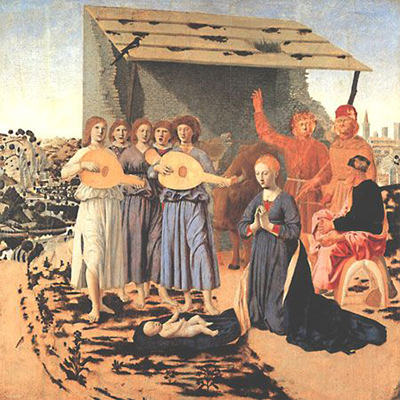
 by Tom Gurney
Tom Gurney BSc (Hons) is an art history expert with over 20 years experience
Published on June 19, 2020 / Updated on October 14, 2023
Email: tomgurney1@gmail.com / Phone: +44 7429 011000
Madonna di Senigallia: Introduction
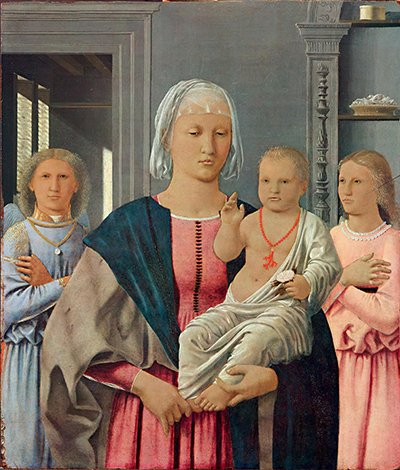
In Piero della Francesca’s Madonna di Senigallia, the Christ Child raises his right hand to bless the viewer. At the left, beyond an angel and through a doorway, sunlight pours through a window and falls across the wall of an adjoining room. The blessing takes place almost at arm’s length, while the sunlit wall draws the eye deeper into the picture. Piero painted this encounter on a walnut panel only about 61 centimetres high. It takes its familiar name from the church of Santa Maria delle Grazie in Senigallia and belongs to the collection of the Galleria Nazionale delle Marche in Urbino. [1] [2] [3]
At a Glance
- ArtistPiero della Francesca.
- Full subjectThe Madonna and blessing Christ Child with two angels.
- DateAround 1474–75 in the Galleria’s detailed catalogue, with other estimates proposed. [1] [2] [4]
- Medium and supportTempera and oil on walnut panel. [2] [3]
- Dimensions61 × 53 cm as catalogued by the Galleria Nazionale delle Marche. [2]
- CollectionGalleria Nazionale delle Marche, Palazzo Ducale, Urbino. Inventory D 58. [1] [2]
- Documented earlier locationSanta Maria delle Grazie, Senigallia. The panel entered the Urbino gallery in 1917. [1] [2] [5]
This work across Piero della Francesca’s career
The Baptism of Christ
Probably about 1437–45The History of the True Cross
Mid-fifteenth centuryThe Resurrection
About 1458–68 (Opificio)The Flagellation of Christ
1459–60 (GNDM)The Montefeltro Altarpiece
About 1472–74 (Brera)The Duke and Duchess of Urbino
About 1473–75 (Uffizi)Madonna di Senigallia (current article)
About 1474–75 (GNDM)The Nativity
Early 1480s (National Gallery)Contents
- The figures at the threshold
- The window and the way light moves
- Coral, linen and the angels’ ornaments
- Urbino and Netherlandish painting
- How closely can the painting be dated?
- From Senigallia to the gallery
- What the restorers found
- Annotated details
The figures at the threshold
Mary holds the Child high against her left side, her face inclined and her eyes lowered. One angel stands beside the doorway and the other beside the recessed shelves. The figures leave very little empty space between them. The angel at the left is partly concealed by Mary’s mantle, and the Child overlaps the angel on the right. These overlaps tell us where the figures stand even though the picture cuts them off without showing where their feet meet the floor. The upright bodies and narrow intervals give the group the steadiness of a much larger composition. [1] [2]
Two gestures are especially clear. The Child faces outward, raising his hand into an open patch of blue against Mary’s mantle. The angel on the right brings a hand across the chest, the fingers resting against folds that run diagonally across the body. The crossed arms of the angels suggest homage, while the Child addresses the viewer. Mary touches his foot, a gesture that Keith Christiansen reads as an act of respect. He relates the group’s solemnity to earlier icons of the Virgin and Child. Piero gives the figures no haloes, so the blessing and the formal gestures of its witnesses tell us how to understand the encounter. [2] [6]
The setting is spare, though carefully furnished. A pilaster ornamented with a candelabrum frames the shelves, which hold a cylindrical box and a wicker basket with folded cloth. The woven rim and the cloth caught against it are small enough to discover after taking in the figures. The museum relates the restrained architectural forms to Federico da Montefeltro’s palace. The resemblance suggests the kind of refined interior Piero knew at Urbino, while the shelves, linens and doorway make it possible to imagine the room being used. Christiansen connects the linen and box with traditions about Mary’s work in the Temple and suggests that the adjoining room evokes her bedchamber. Both proposals build on the care with which Piero painted familiar household things. [1] [2] [7] [6]
The window and the way light moves
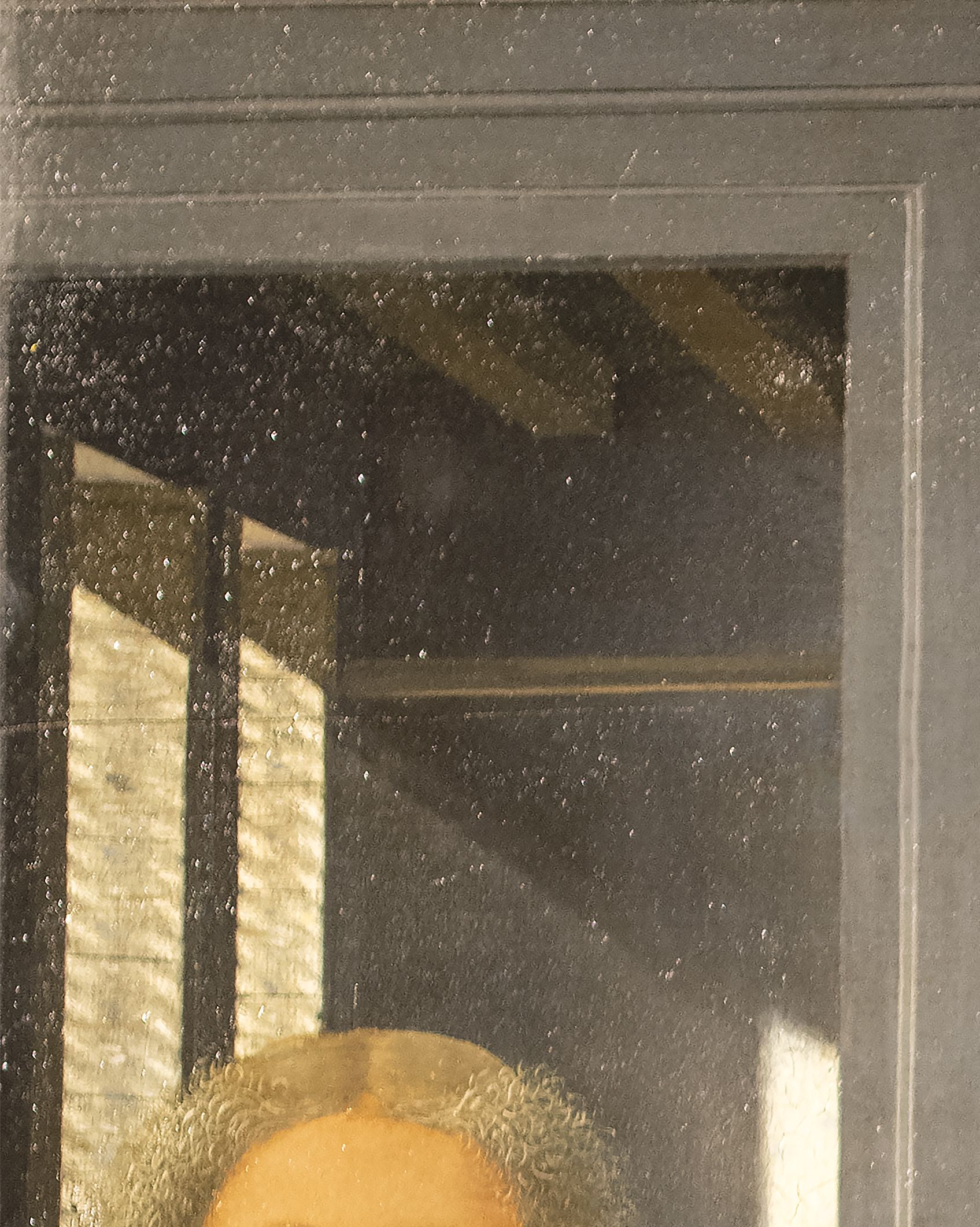
Start with the side room if you want to see how Piero gives this crowded picture depth. Its wall is visible through a narrow opening behind the angel on the left. The window, farther back again, supplies an oblique beam whose marks on the wall let us judge the distance between the opening and the surface it illuminates. The bright geometry of those marks gives the small patch of wall its own shape. Against the adjoining room’s shadow, fine specks suggest dust hanging in the beam. Christiansen traces the perspective from the recessed windows and the ceiling beams to a vanishing point on Mary’s right cheek. Piero sets the doorway and shelves off-centre, leaving bare wall behind the two central heads. The lines that establish the depth of the room lead back to the figures that take up most of the surface. [1] [2] [6]
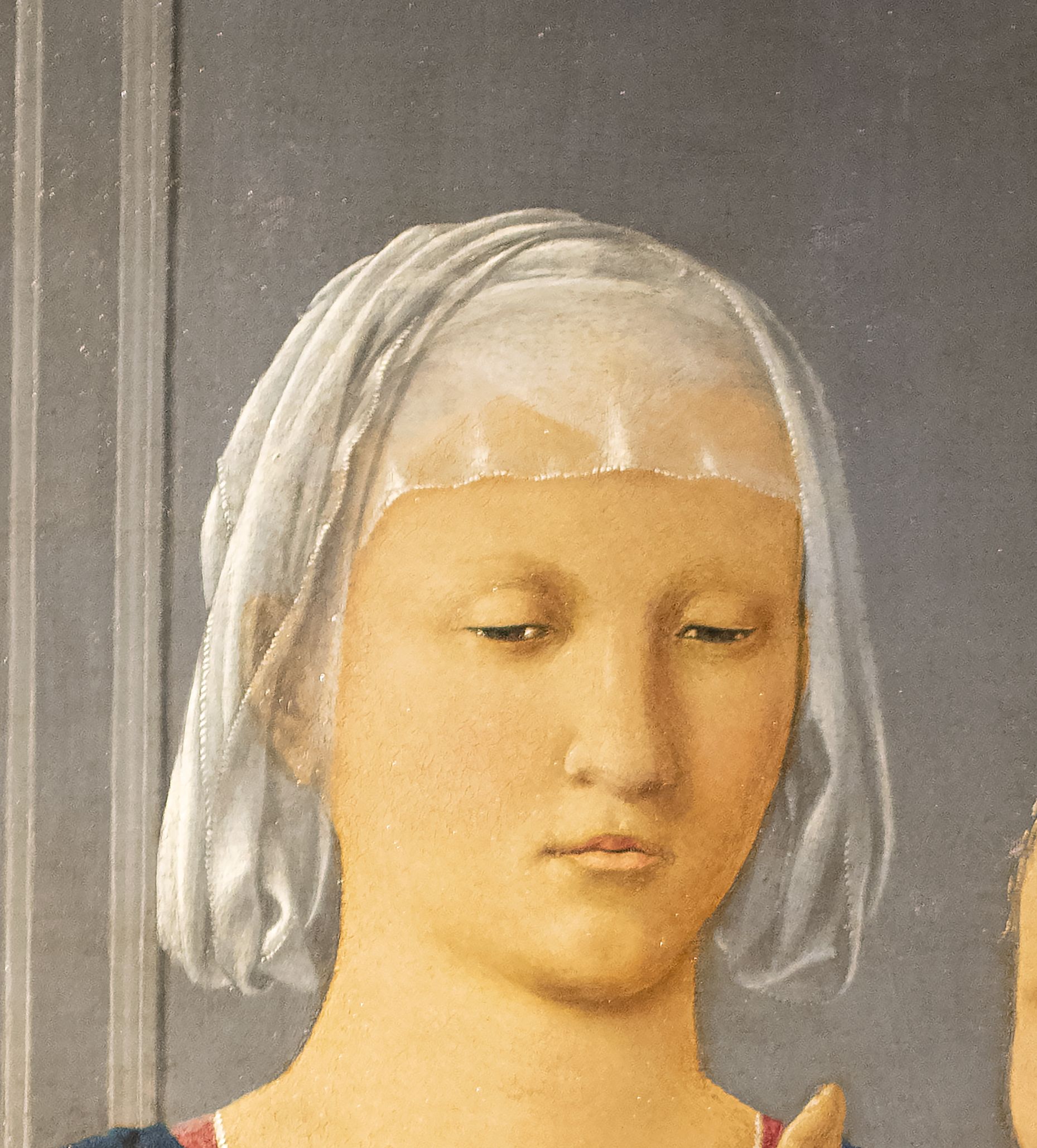
Across the foreground, the illumination is broader and softer. The cheeks, brows and the Child’s shoulder have gradual transitions from light to shadow, while the edges of the jewels catch small, abrupt points of brightness. Piero makes the same kind of distinctions with fabric. The veil across Mary’s forehead is so fine that the dark hairline shows through, and light catches its narrow folds. The mantle has heavier folds and a broad turned-back edge. The painted veil allows light through, while the weight of the mantle reads through the way its lit and shaded surfaces turn. [1] [2]
The museum also connects the beam through the window glass with a traditional image of Mary’s virginity. In that reading, light can pass through glass while leaving it intact, just as Christian theology held that Mary conceived Christ while remaining a virgin. Piero gives that idea a convincing physical setting. The light strikes a wall and makes the air seem visible before the eye travels back to the mother and Child. An observer can follow that passage through the room and still read the beam as part of the painting’s devotional language. [1] [8]
Annotated Details from Madonna di Senigallia
The numbered points identify visible features discussed in this article. Return from each detail to the numbered overview. Piero della Francesca, Madonna di Senigallia, Galleria Nazionale delle Marche. Orlando Paride. Image source. CC BY-SA 4.0. The numbered overview and detail crops are adaptations under CC BY-SA 4.0.
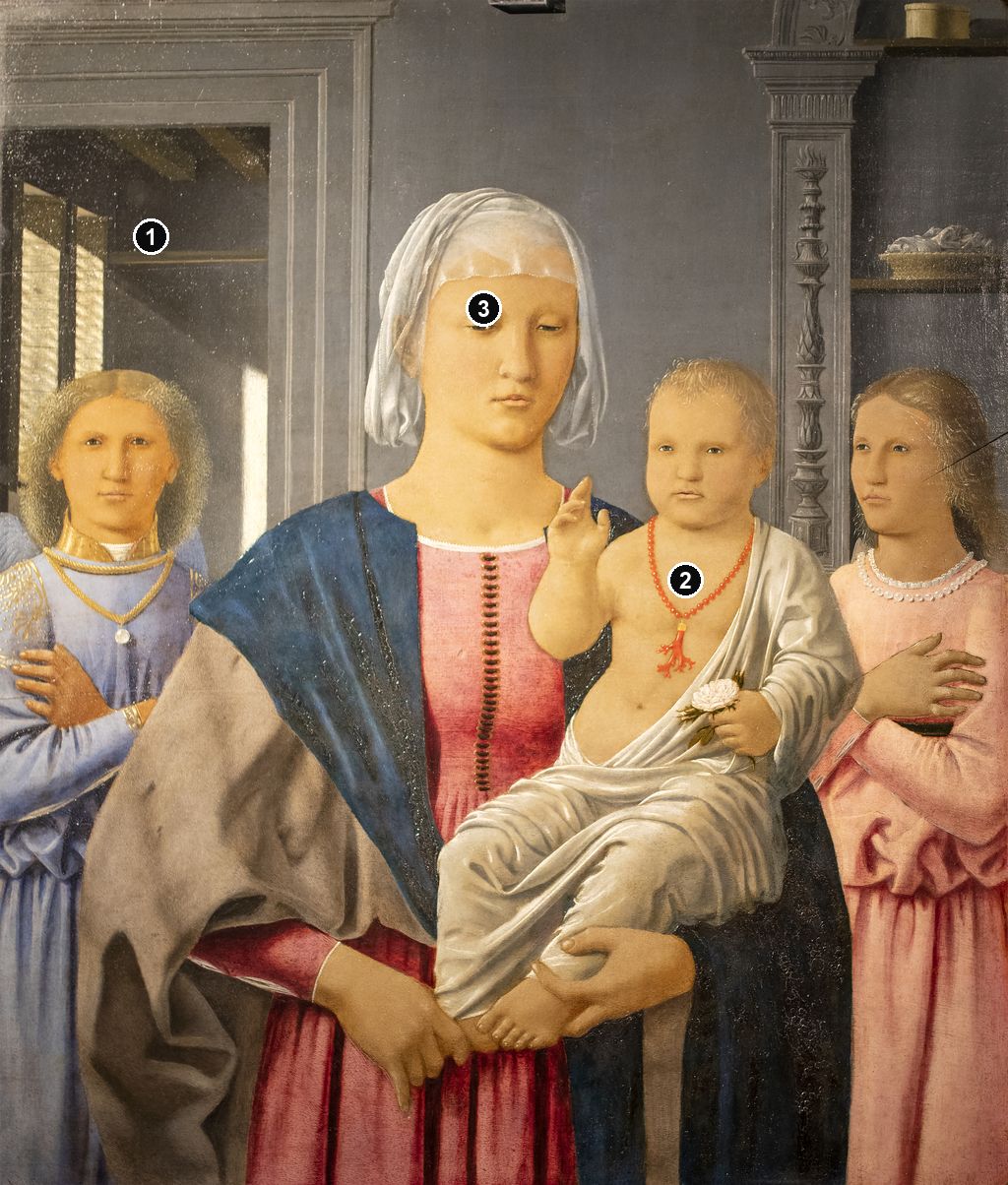
Details from MADONNA DI SENIGALLIA
Compare the cropped details with the source images above. Notice how their colours, shapes and positions contribute to the larger compositions.
Window and sunlight
Light breaks into separate bands on the panelling beside the deep window opening. Their contrast holds even in the dim upper room.
The red coral
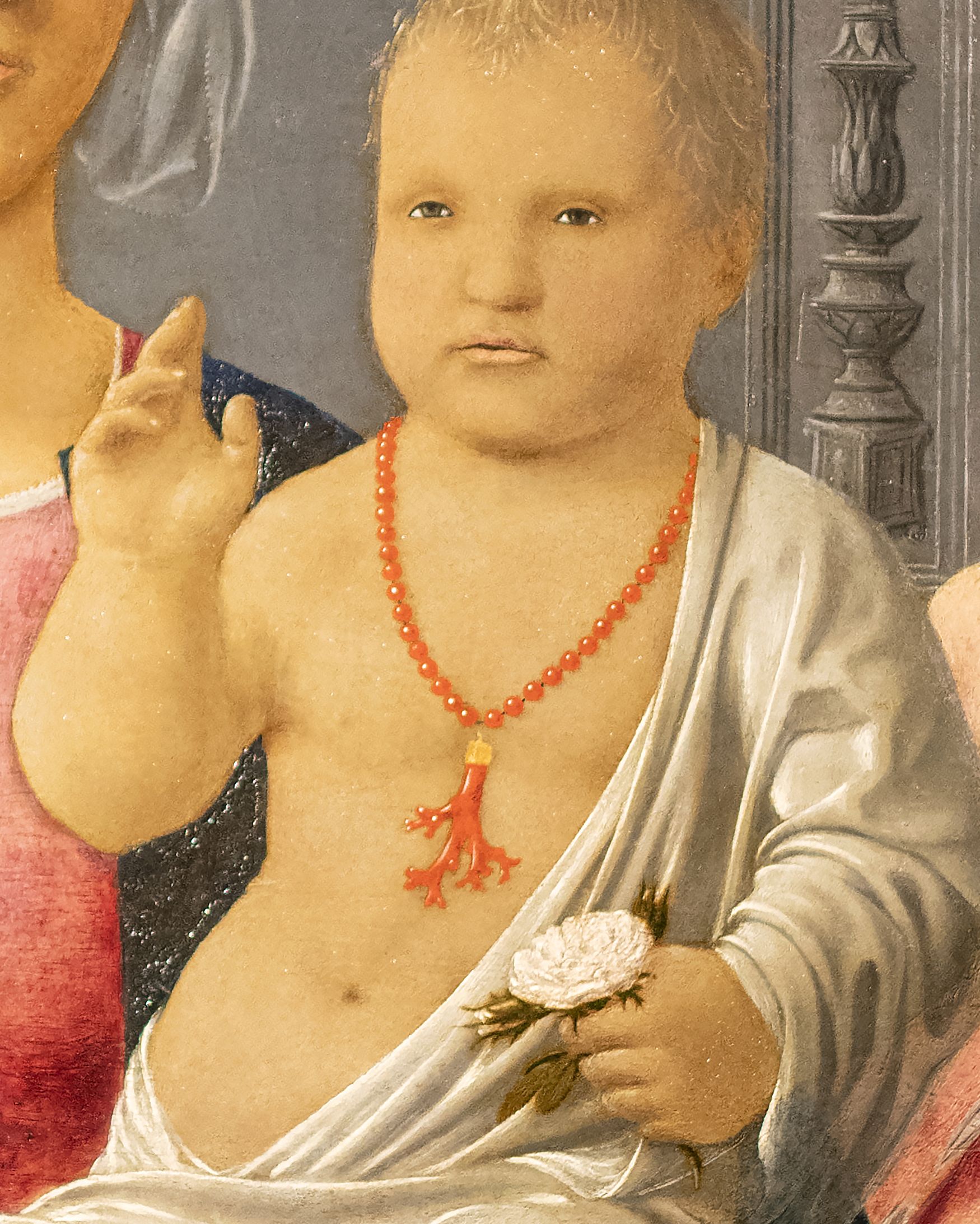
A small branch of coral hangs below the child’s neck. Its colour echoes the Virgin’s dress, while the child’s sleeve and cloth carry the light into folds.
The white veil
The edge of Mary’s veil shows faint folds and turns. Its light fabric separates the face and hair from the dark wall.
Coral, linen and the angels’ ornaments
The Child holds a white rose low in his left hand. Across his chest is a string of red beads with a branching coral pendant. The red stands out sharply between his pale skin and the white cloth around his body. Red coral was worn by children as a protective amulet, a practice that the Galleria Nazionale delle Marche singles out in its catalogue. Spanish researchers Francisco Javier Gutiérrez Núñez and Valeriano Sánchez Ramos place Piero’s pendant in a wider history of protective coral jewellery and its representation in paintings of the Virgin and Child. The branching shape retains the appearance of a piece of coral even as the red invites thoughts of blood. Here both associations are relevant, since the museum also reads the white wrap as an echo of Christ’s future shroud. [2] [9]
The rose has prompted several readings. The Italian culture ministry’s exhibition dossier records suggestions ranging from purity and resurrection to the rosary and the thorns of the Passion. Those possibilities depend on what a viewer brings to the flower. Piero has made it an intelligible thing for a child to hold, with pale petals and a short stem, and set it close to a cloth that can be read in light of Christ’s death. The small objects prompt reflection at the scale of a hand or a fold of fabric. [2] [8]
The angels’ dress rewards a slower look. The figure at the left wears blue with gold-coloured trim and a pale pendant. The right-hand angel wears rose pink and a string of pale beads, each picked out with a rounded highlight. The pink folds gather at the waist below the crossed hands. Across Mary’s bodice, dark stitches or lacing pull the edges together in a vertical line. The fabric of the Child’s wrap has a looser arrangement of folds, which turn over his shoulder and run across his knees towards his bare feet. The museum identifies one angel’s pendant as rock crystal and interprets its transparency in relation to divine light. It also reads the dark ermine-tail marks on the turned-back lining of Mary’s blue mantle as signs of royalty. At a distance, the colours of the garments distinguish the figures. Up close, the folded cloth, fur lining and jewels take on their own textures. [2] [6]
Urbino and Netherlandish painting
The basket, the reflected light and the sheen of the jewellery help explain why the panel is often discussed alongside fifteenth-century Netherlandish painting. In Jan van Eyck’s Arnolfini Portrait, for example, light from a side window puts different kinds of lustre on amber beads and a brass chandelier. Piero similarly lets light tell us what each object is made of. He gives a large share of his panel to the four closely grouped bodies, placing the most descriptive passages of light and furnishing at their edges. The comparison shows what Piero could do with a shared concern for visible things. It leaves open which northern paintings he had seen when he made this one. [1] [7] [10]
Christiansen points to a closer devotional parallel in Van Eyck’s Madonna in the Church in Berlin, where sunlight entering high windows picks out parts of a dim Gothic interior. Both paintings use patches of light to evoke a sacred presence in a place the eye can explore. Van Eyck sets his disproportionately tall Virgin beneath a soaring vault. Piero’s window looks onto a smaller room within a home, and there is room beside the doorway for an angel to seem to stand guard. Christiansen treats the Berlin panel as a parallel and identifies the Urbino circle as a plausible route for Piero’s familiarity with other works by Van Eyck. Ottaviano Ubaldini, a relative and adviser of Federico, owned paintings by him. [6] [11]
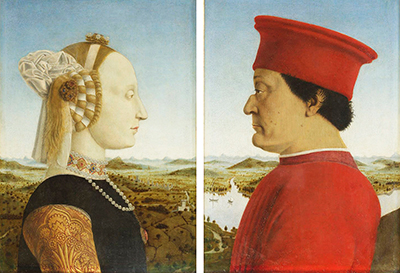
In its account of Piero’s Duke and Duchess of Urbino, the Uffizi likewise draws attention to the combination of attention to detail associated with Flemish painting and spatial organisation learnt in Florence. In the diptych the landscape joins two panels across the gap between them. In the Madonna di Senigallia, the incident beyond the doorway makes depth legible within a confined room. The comparison also helps explain why the proposed court connection is plausible. Piero’s work for the Montefeltro circle is visible in the portraits. A specific commission for the devotional panel requires its own evidence. [1] [12]
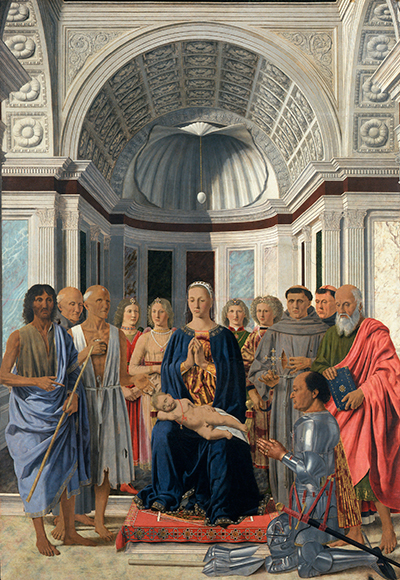
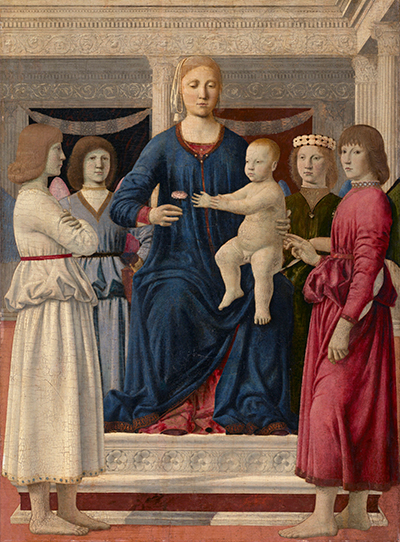
The Brera Madonna offers an especially telling comparison. There Piero places the Virgin within an imposing architectural setting and includes Federico, recognisable in armour, kneeling in prayer. In the Senigallia panel the cropped figures gather in a furnished interior, and the Child’s hand addresses the viewer directly. Piero’s smaller Virgin and Child Enthroned with Four Angels at the Clark Art Institute provides another comparison. Its throne gives the enthroned Virgin a formal centre and its four angels build a larger retinue around her. In the Senigallia panel, two angels and an ordinary doorway suffice to organise the scene. [2] [13] [14]
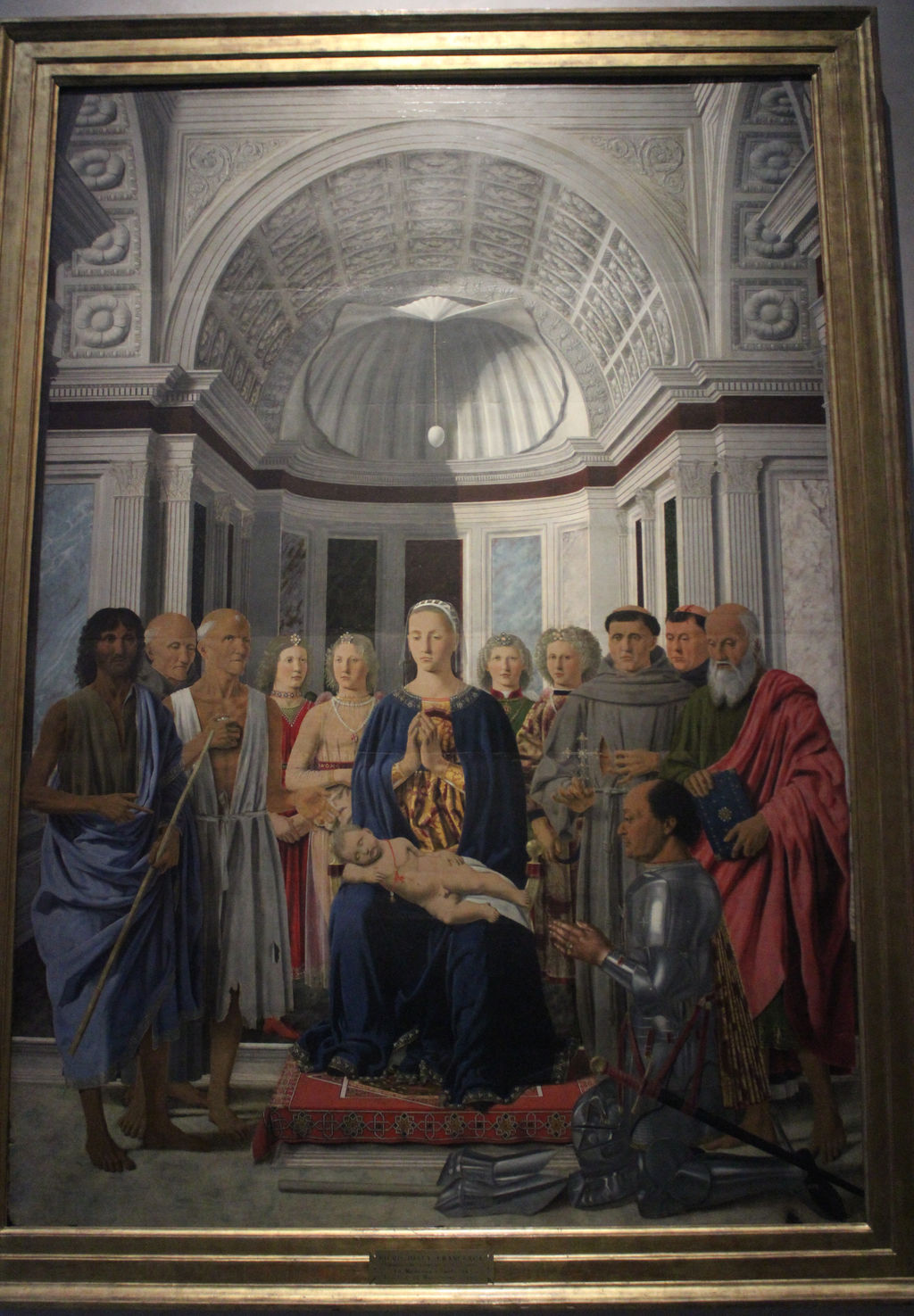
Piero della Francesca, Montefeltro Altarpiece, Pinacoteca di Brera, Milan. Miguel Hermoso Cuesta. Image source. CC BY-SA 4.0. Resized from the source. This reproduction uses CC BY-SA 4.0.
How closely can the painting be dated?
The Galleria Nazionale delle Marche catalogues the painting around 1474–75. Its separate account for visitors discusses two dates, 1474 and 1478, in connection with the marriage of Federico’s daughter Giovanna da Montefeltro and Giovanni della Rovere, lord of Senigallia. The first was the formal marriage arrangement and the second the wedding itself. According to a longstanding hypothesis, Federico gave the picture to his daughter on the occasion of her marriage. The panel’s scale suits private devotion, and the association with the della Rovere church gives the proposal a geographical basis. The gallery also notes that some scholars have read the two angels as a masculine and a feminine type in support of a nuptial interpretation. Those features can sustain the hypothesis, but the occasion and patron remain uncertain. [1] [2] [7]
The Metropolitan Museum of Art gave a wider, earlier estimate, about 1464–74, with a question mark, in the catalogue and press material for its 2014 exhibition. Christiansen proposes that Mary’s head may have been traced from the same preparatory drawing as the Virgin’s in the Brera altarpiece, with the design reversed. He also notes that by the early 1470s Federico was turning to other painters with Netherlandish training. In his reading those clues favour a date no later than 1474. A drawing could be reused, and a gift could be made some time after a picture was painted. The earlier estimate and the museum’s later dating show how different kinds of evidence lead to different conclusions. The church itself was begun in 1491, according to the Galleria, at Giovanni’s initiative in thanksgiving for the birth of Francesco Maria. If the panel had already been painted for the couple, it would have reached that altar later. Its known church setting and its proposed first setting therefore belong to different moments in the painting’s history. [1] [2] [4] [6]
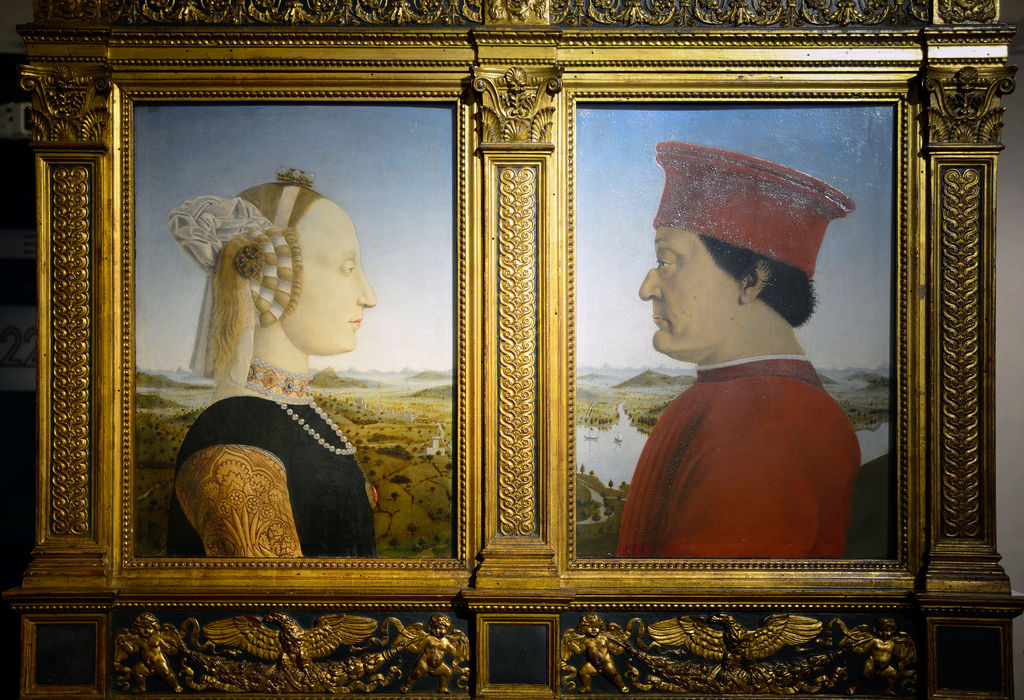
Battista Sforza and Federico da Montefeltro, the portrait faces of Piero’s Urbino diptych, Uffizi. Livioandronico2013. Image source. CC BY-SA 4.0. Resized from the source. This reproduction uses CC BY-SA 4.0.
From Senigallia to the gallery
The museum records that the work was rediscovered at Santa Maria delle Grazie in 1822. Later archival records place it in the sacristy when the town sought to move it and a Perugino altarpiece into public custody in 1871. Municipal and church authorities disputed who had the right to keep them. While that dispute was unresolved, Piero’s painting was stolen in October 1873. It was found about a month later at the railway station in Rome, without its gilded frame, and temporarily kept at the town hall. In 1877 the panel was returned to the church. It entered the Galleria Nazionale delle Marche in 1917. The sequence explains why the title still names the earlier home of a painting now associated so closely with Urbino. [2] [5]
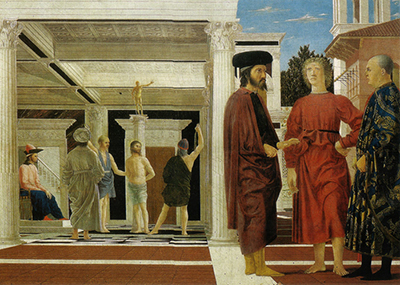
The panel was stolen again in February 1975, this time from the gallery in Urbino. Piero’s Flagellation of Christ and Raphael’s La Muta disappeared in the same theft. The Carabinieri traced the works to Switzerland, and all three were recovered in March 1976 with the help of the Swiss police. In 2014 the panel travelled to New York for the Met’s Piero della Francesca: Personal Encounters. The curators brought it together with two paintings of Saint Jerome and an earlier Madonna and Child. Side by side, the four paintings offered a way to see how Piero adapted the scale and address of his pictures for private devotion. [4] [15] [16]
What the restorers found
The illumination we see today has a conservation history of its own. In his 1954 account, Cesare Brandi noted that earlier critics had suspected wide areas of repainting, especially in the faces. During the Istituto Centrale del Restauro’s treatment, ultraviolet fluorescence and radiography helped the team judge where the later paint lay. A surprising patch of overpaint was on the Child’s white wrap. An X-ray left room for doubt about what survived beneath it, so the team examined a tiny sample in cross-section. This showed that part of Piero’s original paint remained and gave them grounds to remove the covering paint. [3]
Brandi identified two larger problems. The walnut support was badly bowed, and a later varnish had become patchy and cloudy. His report shows the extent of the bow in a photograph taken edge-on. The team straightened the wood, removed old retouching and filler from places where paint had contracted along the mantle, and carefully took off altered varnish while retaining an older patina. Comparing Brandi’s published photographs before and after the treatment makes it easier to distinguish the scale of these changes from the very limited areas that needed filling once the overpaint came away. [3]
The preparation between the walnut and the paint was so thin that Brandi reported it was hard to see without a microscope. He counted this among the affinities with Netherlandish practice. He also proposed that linseed oil could help account for the way colour had contracted, while acknowledging how difficult it was to confirm a specific oil from a tiny sample. The Galleria’s detailed catalogue describes tempera and oil on panel, a useful distinction from the shorter description of oil on panel on its public page. The Istituto returned to the painting for further conservation in late 2010 and early 2011. The succession of treatments matters because a cloudy varnish changes the relationship between the bright window, the deeper shadows and the almost transparent veil, precisely the relationships on which the picture depends. [1] [2] [3] [17]
Browse the artworks
Compare Piero’s frescoes, panels and manuscript figures. The list includes ensembles and separately identifiable panels or scenes. Dates are approximate where the sources differ.
| Name | Date | Medium and source |
|---|---|---|
| The Baptism of Christ | Probably c. 1437–45 | Panel painting Catalogue. |
| The Flagellation of Christ | 1459–60 (GNDM) | Panel painting Catalogue. |
| The History of the True Cross | Mid-fifteenth century | Wall painting Catalogue. |
| Dream of Constantine | Mid-fifteenth century | Wall painting Catalogue. |
| The Duke and Duchess of Urbino | About 1473–75 (Uffizi) | Panel painting Catalogue. |
| The Resurrection | About 1458–68 (Opificio) | Wall painting Catalogue. |
| Brera Madonna | About 1472–74 | Panel painting Catalogue. |
| Annunciation at Arezzo | Mid-fifteenth century | Wall painting Catalogue. |
| Madonna del Parto | About 1450–65 (Monterchi) | Wall painting Catalogue. |
| Polyptych of the Misericordia | Commissioned 1445 | Panel painting Catalogue. |
| The Nativity | Early 1480s (National Gallery) | Panel painting Catalogue. |
| Madonna di Senigallia | About 1474–75 (GNDM) | Panel painting Catalogue. |
| Death of Adam | Mid-fifteenth century | Wall painting Catalogue. |
| Queen of Sheba | Mid-fifteenth century | Wall painting Catalogue. |
| Victory of Constantine | Mid-fifteenth century | Wall painting Catalogue. |
| Battle between Heraclius and Chosroes | Mid-fifteenth century | Wall painting Catalogue. |
| Saint Mary Magdalen | Wall painting Catalogue. | |
| The Augustinian Polyptych | 1454–69 | Panel painting Catalogue. |
| Polyptych of Perugia | About 1467–69 (GNU) | Panel painting Catalogue. |
| Perugia Annunciation | About 1468–70 (national catalogue) | Panel painting Catalogue. |
| St Francis and St Elizabeth | About 1467–69 (GNU) | Panel painting Catalogue. |
| Stigmatisation of St Francis | About 1468–70 (national catalogue) | Panel painting Catalogue. |
| An Augustinian Nun (Saint Monica) | 1454–69 | Panel painting Catalogue. |
| Augustinian Saint | 1454–69 | Panel painting Catalogue. |
| Saint Michael | 1454–69 | Panel painting Catalogue. |
| Saint Nicholas of Tolentino | 1454–69 | Panel painting Catalogue. |
| Saint John the Evangelist | 1454–69 | Panel painting Catalogue. |
| Virgin and Child Enthroned with Four Angels | About 1460–70 (Clark) | Panel painting Catalogue. |
| Portrait of Sigismondo Pandolfo Malatesta | About 1450–51, often proposed. Louvre catalogue range 1450–75. | Panel painting Catalogue. |
| Sigismondo before St Sigismund | 1451 | Wall painting Catalogue. |
| St Jerome and a Donor | 1460s (Accademia); about 1450 also proposed | Panel painting Catalogue. |
| St Jerome in Penitence | 1450, dated on the panel | Panel painting Catalogue. |
| Saint Julian | About 1455–60, often proposed | Wall painting Catalogue. |
| Saint Augustine | 1454–69 | Panel painting Catalogue. |
| Saint Apollonia | 1454–69 | Panel painting Catalogue. |
| Crucifixion from the Augustinian Polyptych | 1454–69 | Panel painting Catalogue. |
| Saint Louis of Toulouse | Wall painting Catalogue. | |
| Burial of the Wood | Mid-fifteenth century | Wall painting Catalogue. |
| Discovery and Proof of the True Cross | Mid-fifteenth century | Wall painting Catalogue. |
| Exaltation of the Cross | Mid-fifteenth century | Wall painting Catalogue. |
| Saint Anthony Raises a Child | About 1467–69 (GNU) | Panel painting Catalogue. |
| Saint Elizabeth Revives a Child | About 1467–69 (GNU) | Panel painting Catalogue. |
| Hercules | About 1470 | Wall painting Catalogue. |
| Portrait of a Boy (possibly Guidobaldo da Montefeltro) | Panel painting Catalogue. | |
| De prospectiva pingendi, Reggio Emilia witness (figures) | Manuscript diagrams Catalogue. | |
| The Interrogation of Judas | Mid-fifteenth century | Wall painting Catalogue. |
| Two prophets, Bacci Chapel | Mid-fifteenth century | Wall painting Catalogue. |
| Saint Clare of Assisi, upper predella | About 1467–69 (GNU) | Panel painting Catalogue. |
| Saint Agatha, upper predella | About 1467–69 (GNU) | Panel painting Catalogue. |
| Lost centre of the Augustinian Polyptych | 1454–69 | Lost panel or panels Catalogue. |
Frequently Asked Questions
Possibly. The traditional proposal is that Federico da Montefeltro gave it to his daughter Giovanna when she married Giovanni della Rovere. The panel’s association with the couple’s church and its suitability for close devotional viewing support the proposal. The original commission remains uncertain. [1] [2] [7]
Discussion
Look again at the images and ideas explored in Madonna di Senigallia. These editorial prompts invite your observations.
Reader Insights
Follow the furthest line of the light in the adjoining room, then look at Mary’s cheek. How does the change in the way Piero paints light alter your sense of the distance between them?
Look first at the Child’s blessing hand and then at the angel’s hand on the right. What kind of response does each gesture invite from the person standing in front of the panel?
Which details make the room feel suitable for private devotion, and which seem equally at home on a church altar?
Join the Conversation
Share a detail, comparison or question about Madonna di Senigallia below.
References
- Galleria Nazionale delle Marche. Madonna col Bambino benedicente e due angeli (Madonna di Senigallia). Collection overview. View source.
- Galleria Nazionale delle Marche. Madonna con Bambino e angeli. Catalogue record 6100, inventory D 58. View source.
- Cesare Brandi. Restauri a Piero della Francesca. Bollettino d’Arte, 1954. Senigallia discussion and figures 18–24, pp. 248–253. View source.
- Metropolitan Museum of Art. Piero della Francesca’s Devotional Paintings Brought Together for the First Time in New Exhibition. Exhibition press release. View source.
- Antonella Gioli. Monumenti e oggetti d’arte nel Regno d’Italia. Archival study, Il patrimonio artistico nelle chiese mantenute al culto, pp. 175–177. View source.
- Keith Christiansen. Piero della Francesca: Personal Encounters. Metropolitan Museum of Art, 2013, pp. 45–57, especially catalogue entry 4 and figs. 34–38. View source.
- Ministero della Cultura. Madonna di Senigallia, Madonna con Bambino e angeli. National catalogue record 1100264111. View source.
- Ministero della Cultura / Galleria Nazionale delle Marche. Piero della Francesca, Madonna col Bambino e due angeli (Madonna di Senigallia). Exhibition dossier. View source.
- Francisco Javier Gutiérrez Núñez and Valeriano Sánchez Ramos. El árbol del jardín del mar y su devoción mariana. El caso de la Virgen del Coral de Sevilla. 2016, especially pp. 320–322 and plates 6–7. View source.
- National Gallery, London. The Arnolfini Portrait. Collection record and audio description transcript. View source.
- Gemäldegalerie, Staatliche Museen zu Berlin. Die Madonna in der Kirche. Collection record 525C. View source.
- Daniela Parenti, Uffizi Galleries. The Duke and Duchess of Urbino Federico da Montefeltro and Battista Sforza. Collection record. View source.
- Pinacoteca di Brera. The Montefeltro Altarpiece by Piero della Francesca. Museum guide, entry 06. View source.
- Clark Art Institute. Virgin and Child Enthroned with Four Angels. Work reproduced in the Clark library’s image resource guide. View source.
- Comando Carabinieri Tutela Patrimonio Culturale. Exhibition guide, Urbino theft and recovery. p. 128. View source.
- Metropolitan Museum of Art. Piero della Francesca: Personal Encounters. Exhibition overview, 14 January–30 March 2014. View source.
- Istituto Centrale per il Restauro. Al MET di New York quattro opere di Piero della Francesca. Conservation dates and exhibition context. View source.