 by Tom Gurney
Tom Gurney BSc (Hons) is an art history expert with over 20 years experience
Published on June 19, 2020 / Updated on October 14, 2023
Email: tomgurney1@gmail.com / Phone: +44 7429 011000
Brera Madonna by Piero della Francesca: Introduction
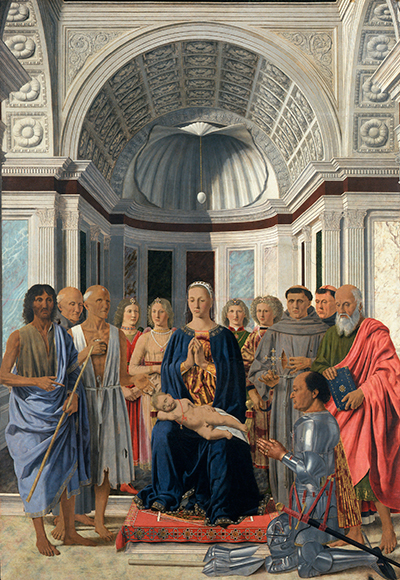
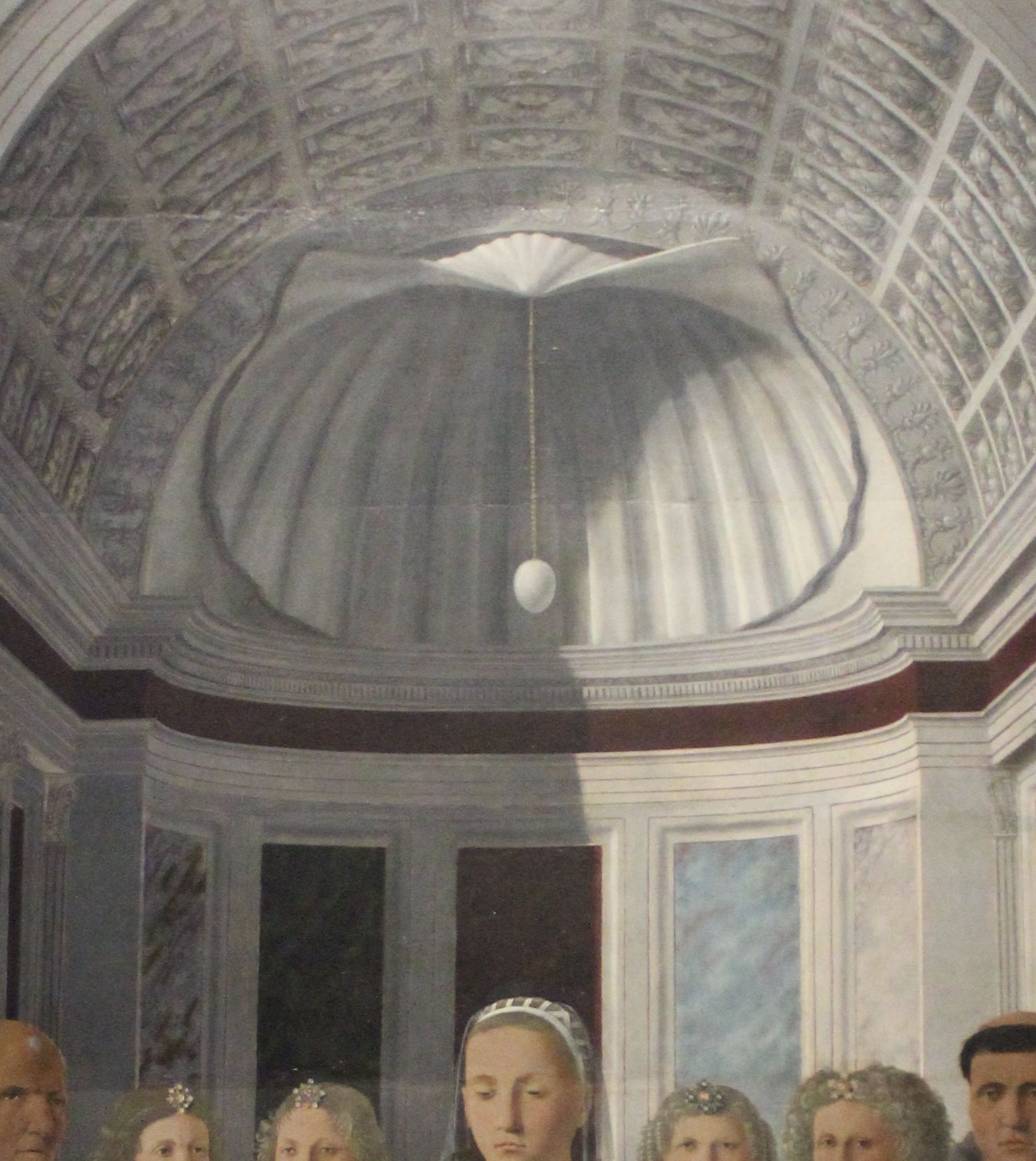
A pale egg hangs on a chain in the upper half of Piero della Francesca’s Brera Madonna. Farther down the panel, the Virgin lowers her eyes towards the sleeping child stretched across her lap. On the pavement below lies a soldier’s helmet. It belongs to Federico da Montefeltro, the ruler of Urbino, who kneels in armour at the right of the painting. The egg, the child and the helmet lead the eye through a picture in which a ruler’s public image, the vulnerability of an infant and the prospect of death come into the same space. [1] [2]
The Pinacoteca di Brera in Milan catalogues the altarpiece as Madonna and Child with Saints, Angels and Federico da Montefeltro and dates it to about 1472–1474. It is also called the Montefeltro Altarpiece and the San Bernardino Altarpiece, after the patron and the church from which it came to the museum. The surviving panel measures 251 × 172 cm. That height gives the architecture a presence that can be hard to gauge from a small reproduction. The figures fill the lower part of the picture, leaving much of the panel to the pale vault and its shifting shadows. [1]
At a Glance
- ArtistPiero della Francesca. [1]
- DateAbout 1472–1474, following Brera’s catalogue. [1]
- Also calledMontefeltro Altarpiece and San Bernardino Altarpiece. [1] [2]
- Surviving size and support251 × 172 cm, painted on wood. Brera’s collection record lists tempera, while its detailed guide describes tempera and oil. [1] [2]
- SubjectThe Virgin and sleeping Christ with six saints, four angels and the kneeling Federico da Montefeltro. [1] [2]
- CollectionPinacoteca di Brera, Milan, inventory 180. [1]
- Documented provenanceFrom San Bernardino in Urbino to Brera in 1811. [3] [4]
This work across Piero della Francesca’s career
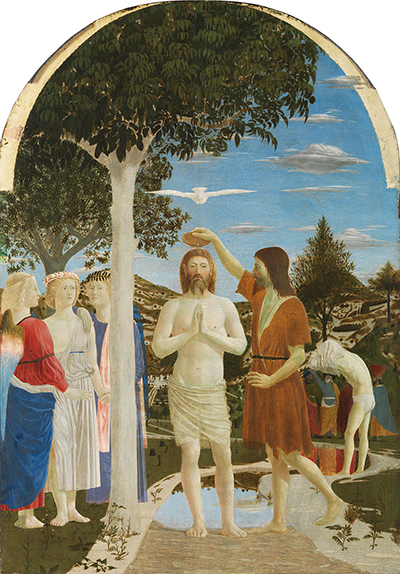
The Baptism of Christ
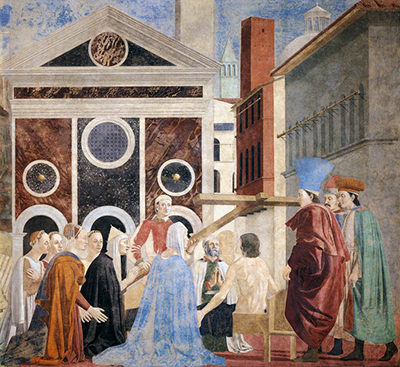
Probably about 1437–45The History of the True Cross
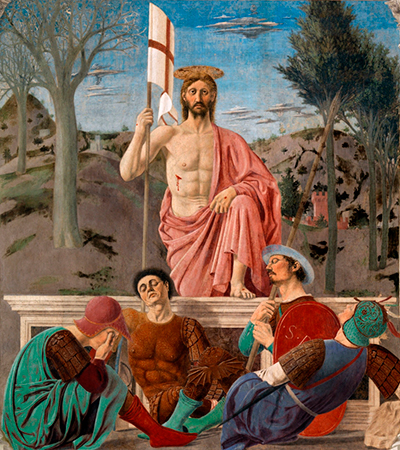
Mid-fifteenth centuryThe Resurrection
About 1458–68 (Opificio)The Flagellation of Christ
1459–60 (GNDM)The Montefeltro Altarpiece (current article)
About 1472–74 (Brera)The Duke and Duchess of Urbino
About 1473–75 (Uffizi)The Nativity
Early 1480s (National Gallery)Contents
- The Virgin, the child and the six saints
- The kneeling Duke of Urbino
- What the painted church does
- Light on stone, fabric and steel
- What does the egg mean?
- Changes to the panel and the duke’s hands
- From Urbino to Milan
- Annotated details
The Virgin, the child and the six saints
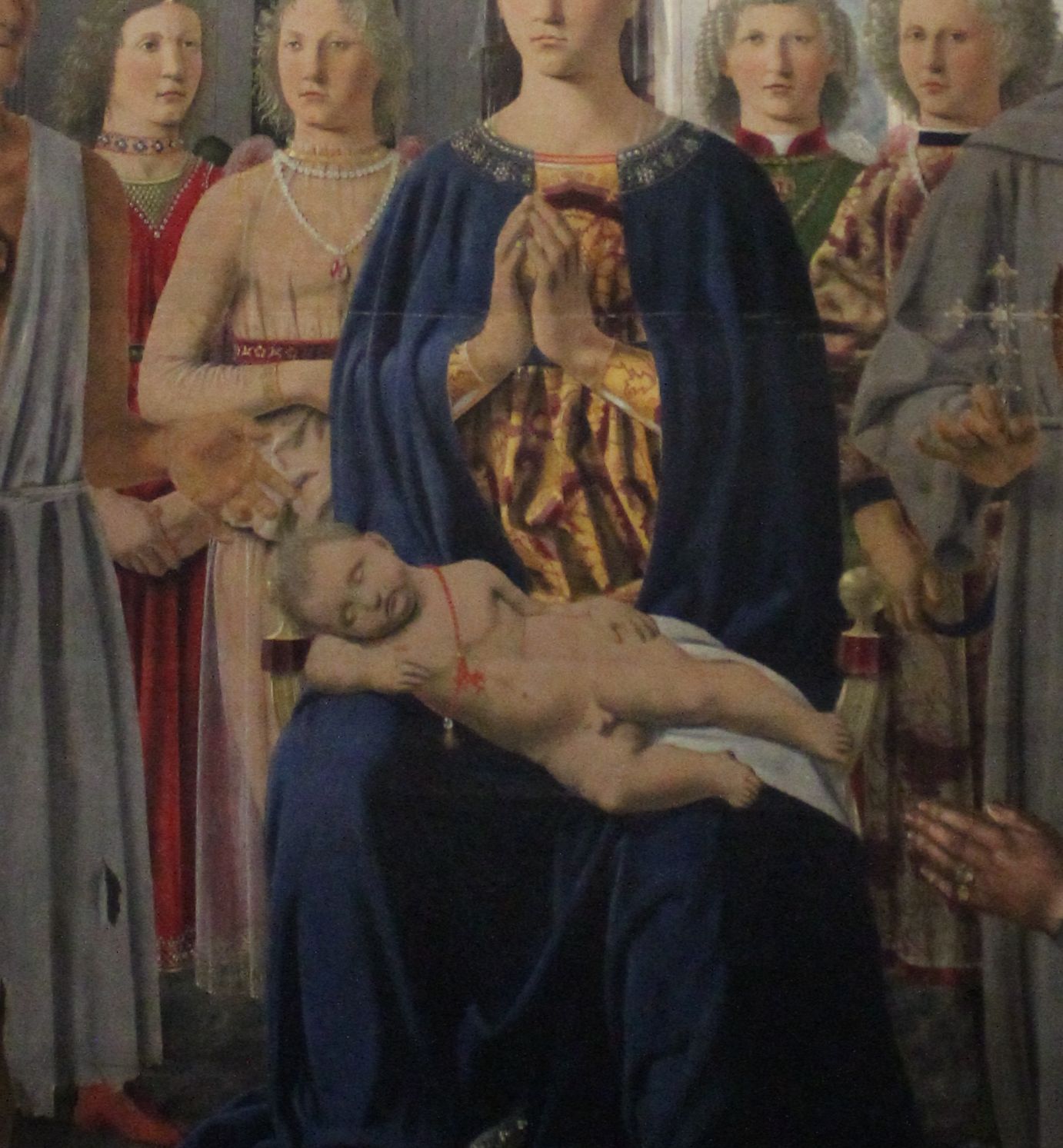
Mary sits very slightly above the others. Parts of her throne and its carpeted step are visible around the broad sweep of her dark blue mantle. At her chest, the fingers meet in prayer. The child sleeps with his head resting on his own bent arm. His body follows a shallow diagonal across the lap and almost the entire length of it faces out towards the picture’s viewer. A small red coral necklace marks the child’s bare skin. The lowered face, upright hands and loose limbs make up three different kinds of stillness within the central group. [1] [2]
The coral is easy to pass over. Brera’s audio guide connects its blood-red colour and the sleeping pose with the Passion, Christ’s suffering and death. The pose can carry that association because the weight of the child’s body is so apparent. It also looks like ordinary sleep. At the centre of a public altarpiece a mother holds a child in a moment familiar to anyone who has watched an infant fall asleep. The prospect of the adult Christ’s death gives that moment a second register, particularly in a work later displayed at a burial church. [1] [3]
This kind of altarpiece is called a sacra conversazione, or sacred conversation. Mary, Christ and saints share a continuous painted space. People from different centuries can thus appear together in an assembly of devotion. The word ‘conversation’ names the form of the gathering. The glances make it feel solemn and quiet. Some of the saints look towards the child, one looks out, and others seem absorbed in thought. Piero gives the gathering enough room for a viewer to read a gesture or an object before returning to the group as a whole. [1] [2]
At the viewer’s left, John the Baptist holds a staff and points towards the child. His gaze reaches out from the painting while his hand sends attention back inside it. Nearer Mary, the elderly Jerome holds a stone to strike his bare chest in penance and indicates the child with his other hand. Between and behind them is Bernardino of Siena, recognisable by his lean face and sparse hair. The layered arrangement matters. From a distance it looks like a regular sequence of heads, while close up the overlaps show which two saints stand forward and which one is farther back. [1] [2] [5]
On the right, Francis of Assisi opens his habit to reveal the wound in his side and holds a small cross that Brera identifies as rock crystal. Behind him and the outer figure stands Peter Martyr, with a long wound on his head. The older man with the white beard, red mantle and richly bound book is John the Evangelist. The cross, wound and book offer different ways of recognising the saints. Francis and Peter make suffering visible on their bodies. The Evangelist’s book invites a connection with his Gospel’s account of the Word taking human flesh, a subject given physical form in the sleeping child. [1] [2] [5]
Four angels stand in two pairs behind Mary. Look for the folded wings among the shoulders, just beyond brilliant fabrics and jewellery. Forehead ornaments pick up flecks of light, while strands of pearls follow the curve of the neck. The feathered wings draw little attention beside the clothes, which can make the angels look at first like attendants at a court. Piero has placed them close enough to the saints for the eye to move between the worn grey of Jerome’s clothing and the bright, densely patterned fabric at an angel’s chest. [1] [2]
Francis and Bernardino connect the assembly with the Franciscan order, which is relevant to the sites proposed for the altarpiece. Piero brought some of the same saints together in the Polyptych of Perugia, made for a community of Poor Clares. There, the Virgin and saints occupy a gold-ground main tier divided by a shaped framework, and Francis’s reception of the stigmata is a small narrative below. At Brera, the wound is displayed by a standing figure, and his place in the assembly is marked by the bodies around him. The two pictures ask the viewer to read an altar in different ways. [1] [2] [6]
The kneeling Duke of Urbino
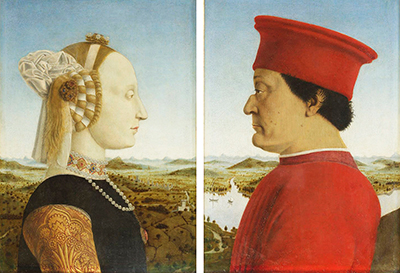
Federico is the closest figure to us. The turn of his body exposes his left profile, the side also shown in Piero’s portraits of the Duke and Duchess of Urbino. Brera and the Uffizi associate this choice with the injury he suffered in a tournament, which damaged the other side of his face. The familiar contour of the nose does much of the work of recognition. In the diptych that profile meets Battista Sforza’s across the join between two panels. In the altarpiece its direction is towards Christ, and a fuller view of the body shows how the ruler carries himself when kneeling. [2] [7]
The resemblance between the profiles goes deeper than the finished paint. Roberto Bellucci and Cecilia Frosinini compared infrared images of the preparatory drawing in the two pictures. After rescaling one head, they observed close correspondences in the design. They considered ways in which Piero might have transferred or altered a common drawing. This evidence opens a window onto his working practice, while leaving the chronological priority of the two portraits unresolved. A familiar face could be adapted for formats with different proportions, settings and uses. [8]
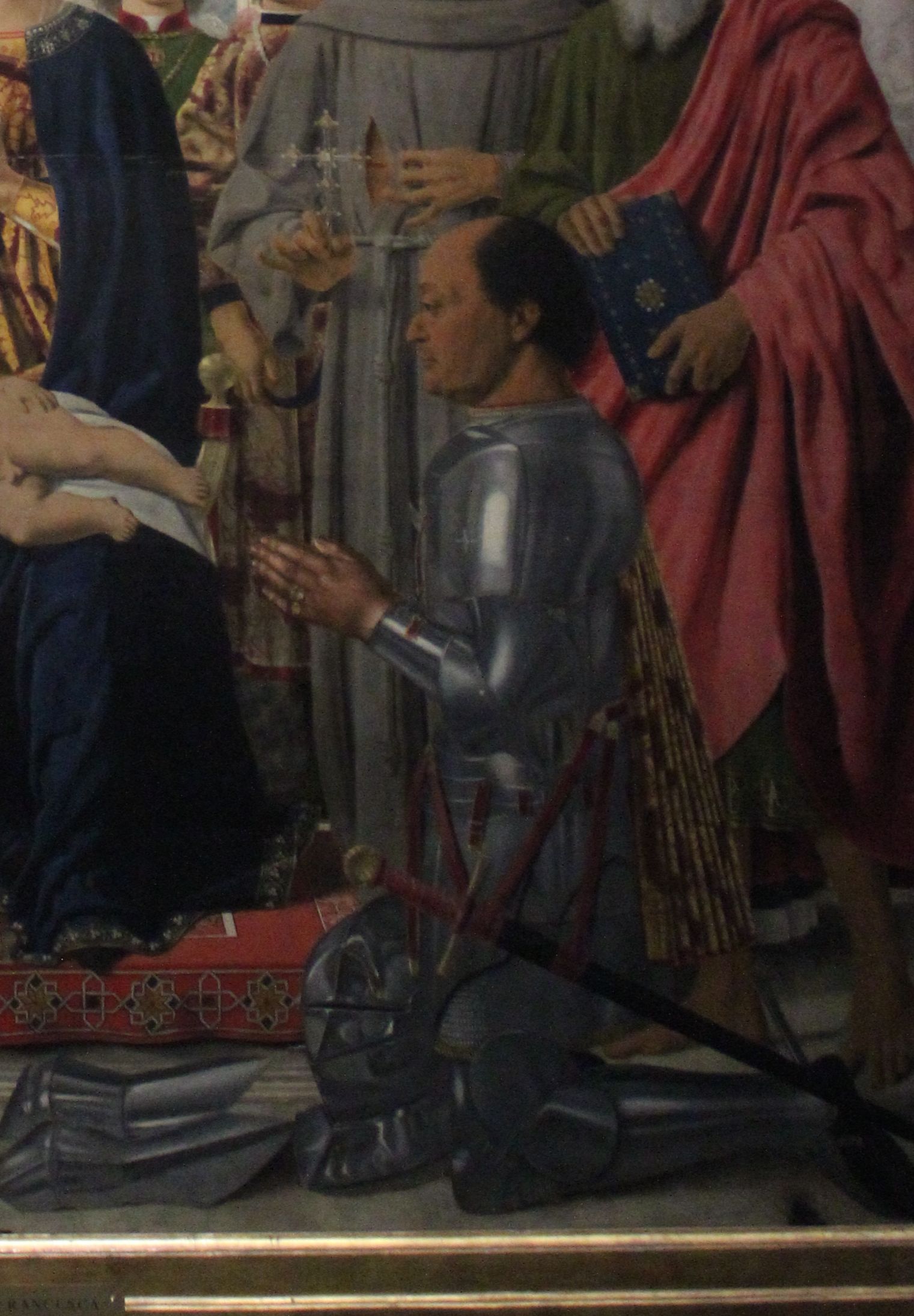
A sword hangs at Federico’s side. His helmet, gauntlets and command baton lie in front of him. The helmet’s marked visor and the polished armour reward a closer look, but the simple arrangement of the objects already conveys a change of activity. The hands have been freed for prayer, the head is uncovered, and the baton is within reach on the ground. Mary’s hands form another pair above them. Her position on the centre line and his position near the edge give different emphasis to the same act. The donor is conspicuous through his armour, his place in the foreground and the contrast between his profile and the frontal arrangement of the saints. [1] [2]
Brera dates the painting to the years around a change in the family’s fortunes. Federico’s heir Guidobaldo was born in 1472 and Battista died that July. The museum considers a commission after these events likely and reads the picture as an appeal to the Virgin’s protection of Federico’s house. That interpretation helps explain why birth, grief and political continuity can all matter here. Suggestions that John the Baptist recalls Battista through her name or that Mary’s face evokes her are readings of the image. The woman Piero identifies and portrays on the other panel of the diptych has no equally explicit portrait in the altarpiece. [1] [2] [7] [4]
The military costume has also been linked to Federico’s conquest of Volterra on Florence’s behalf in 1472. Brera’s audio guide presents it as one possible topical association. Armour and a baton already communicate Federico’s profession as a military commander, so the image alone leaves the connection to a particular campaign open. The missing insignia of the Order of the Garter, which Federico received in 1474, likewise help explain the museum’s dating. The dating argument depends on an expectation that he would have been shown wearing the distinction after receiving it. The date matters to the interpretation. In a 2023 study Machtelt Brüggen Israëls dates the panel to about 1469–1471 and suggests that Federico’s brother Ottaviano Ubaldini della Carda may have had a hand in arranging the commission. If that earlier date is right, the birth and bereavement of 1472 could have shaped how people later saw the picture, while the reason it was first commissioned would remain open. [2] [3] [4] [9]
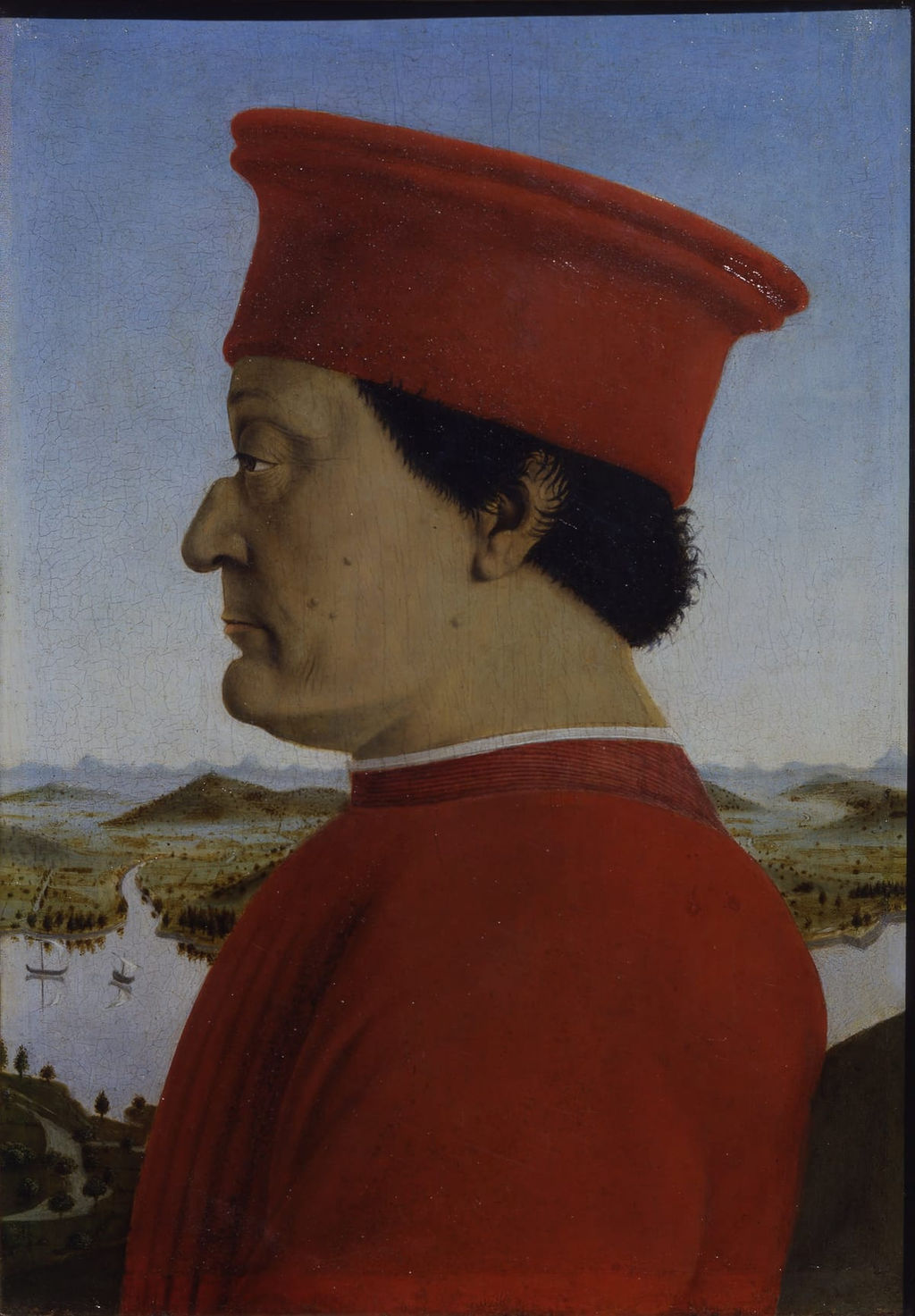
Federico da Montefeltro, portrait face of Piero’s Urbino diptych, Uffizi. Image source. Public domain. Resized only; native appearance preserved.
Annotated Details from Brera Madonna
The numbered points identify visible features discussed in this article. Return from each detail to the numbered overview. Piero della Francesca, Montefeltro Altarpiece, Pinacoteca di Brera, Milan. Miguel Hermoso Cuesta. Image source. CC BY-SA 4.0. The numbered overview and detail crops are adaptations under CC BY-SA 4.0.
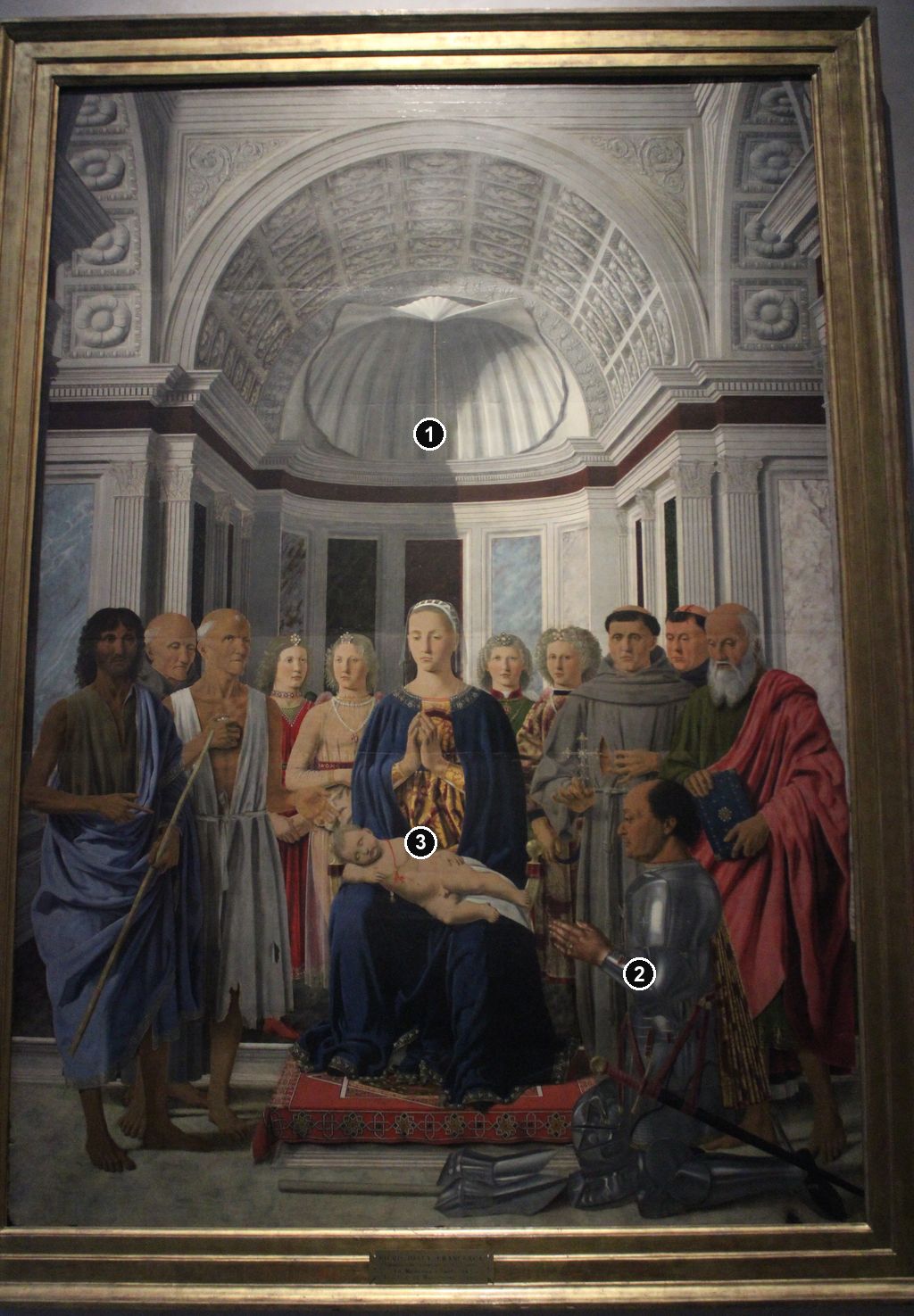
Details from BRERA MADONNA
Compare the cropped details with the source images above. Notice how their colours, shapes and positions contribute to the larger compositions.
Egg under the shell
A small white egg hangs below the upper shell in the depth of the apse. The coffers above recede towards it.
The kneeling duke
Federico kneels beside the group in armour. The surfaces of the metal hold narrow bands of reflected light alongside the folds and textures of the other garments.
Christ in Mary’s lap
The sleeping child rests across Mary’s knees. The red thread and pale body sit low within the vertical sweep of the Virgin’s figure.
What the painted church does
Follow the rows of square recesses in the ceiling. Each recess, called a coffer, contains a small flower. The coffers diminish in size towards the back and their visible sides change as the ceiling turns. A straight moulding below them continues the recession; closer to the floor, slivers of veined marble and the bases of architectural supports show through gaps between the saints. The distant shell occupies the curve at the back. Together these cues allow the viewer to judge depth even though most of the floor is concealed by cloth, bodies and armour. [1] [2]
The group stands in front of the apse. The egg is suspended in the space behind it. On the panel, egg and Virgin line up so closely that they seem to occupy the same vertical plane. The receding architecture shows the chain fixed well behind her. Trace an edge of the vault down towards the assembly and the lines of recession take the eye towards Mary’s face. The central axis also aligns her with the shell and egg. The first relationship describes how space recedes. The second allows distant features to be read together across the surface. [1] [2] [3]
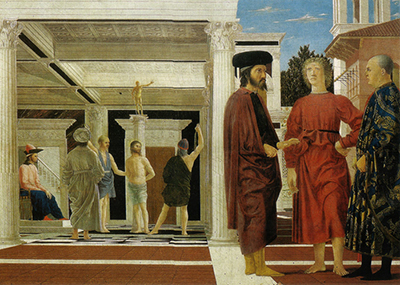
The picture invites comparison with Piero’s small Flagellation of Christ in Urbino. In that work patterned paving makes the interval between foreground figures and the punishment of Christ unusually legible. In the Brera altarpiece, figures fill much of the near zone. The ceiling and stretches of wall carry more of the design, while the pavement reveals itself in small openings. Piero can make a tiny panel feel extensive or a very large panel feel closely inhabited. His treatise on perspective, De prospectiva pingendi, describes procedures for representing forms seen in depth. The altarpiece shows what is at stake when such procedures serve a picture made to be looked at from a church floor. [1] [2] [10] [11]
One explanation for the architecture’s scale lies in the panel’s physical history. Brera says the surviving picture has been reduced and understands the original design as opening out around the figures beneath a dome and a large lantern, the raised structure that can admit light at a dome’s crown. The regional catalogue identifies reductions at the sides and lower edge. The existing picture therefore gives a close view of a space originally conceived as more expansive. The shell and vault survive, but any drawing that supplies the whole building also supplies parts for which the paint has been lost. [1] [4]
The play between large figures and receding architecture has also been placed in the context of Netherlandish painting. In a 2024 conference abstract, Takumi Etō reconsidered the relation between Piero and Joos van Gent, also known as Justus of Ghent, who worked in Urbino. Etō draws attention to how these painters reconcile commanding figures with buildings seen in depth and compares the shell-topped architectural forms in works associated with Joos. Such a comparison gives concrete substance to the idea of artistic exchange at Urbino. It leaves room for local architecture and different routes by which Netherlandish pictorial ideas could have reached Piero. [12]
Light on stone, fabric and steel
The strongest light appears to enter high from the left. On Federico’s shoulder, a small arched shape is visible in the polished metal. Brera reads it as the reflection of a window outside the painted view and its audio guide also suggests a possible small round opening. The window shape puts an imagined light source into the space in front of the apse and gives the armour its hard sheen. One small painted reflection makes the spectator think beyond the edges of the panel. [2] [3]
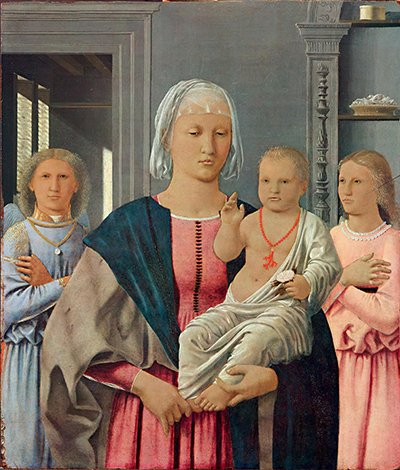
The highlights change as the eye crosses the surface. Metal gives a sharp reflection, the egg takes a smooth gradation, and carved stone casts shadows that repeat from coffer to coffer. At the centre, Mary’s dark mantle drapes heavily across the throne and the pale trim near the child’s skin reads as soft. Near the angels’ faces, points of white give small pearls a substance distinct from the bright woven cloth. In the Madonna di Senigallia, a shaft of light enters a modest room and seems to reveal dust in the air. At Brera the light reveals the depth of a public architectural space. In both pictures it also tells us what individual things are made of. [1] [2] [13]
The carpet at Mary’s feet is a case in point. Most of it disappears beneath the throne group. Enough remains for the pattern to be followed. The regional catalogue reports that L. E. Brancati used a digital reconstruction to study its design and related the central medallion to the type called ‘large-pattern Holbein’. Proposed geographical origins vary. The label is a classification used for a pattern, while the particular rug Piero may have used has yet to be matched to a surviving object. The fragment shows how closely an apparently minor feature was observed and how much of the evidence is concealed within the composition. [4]
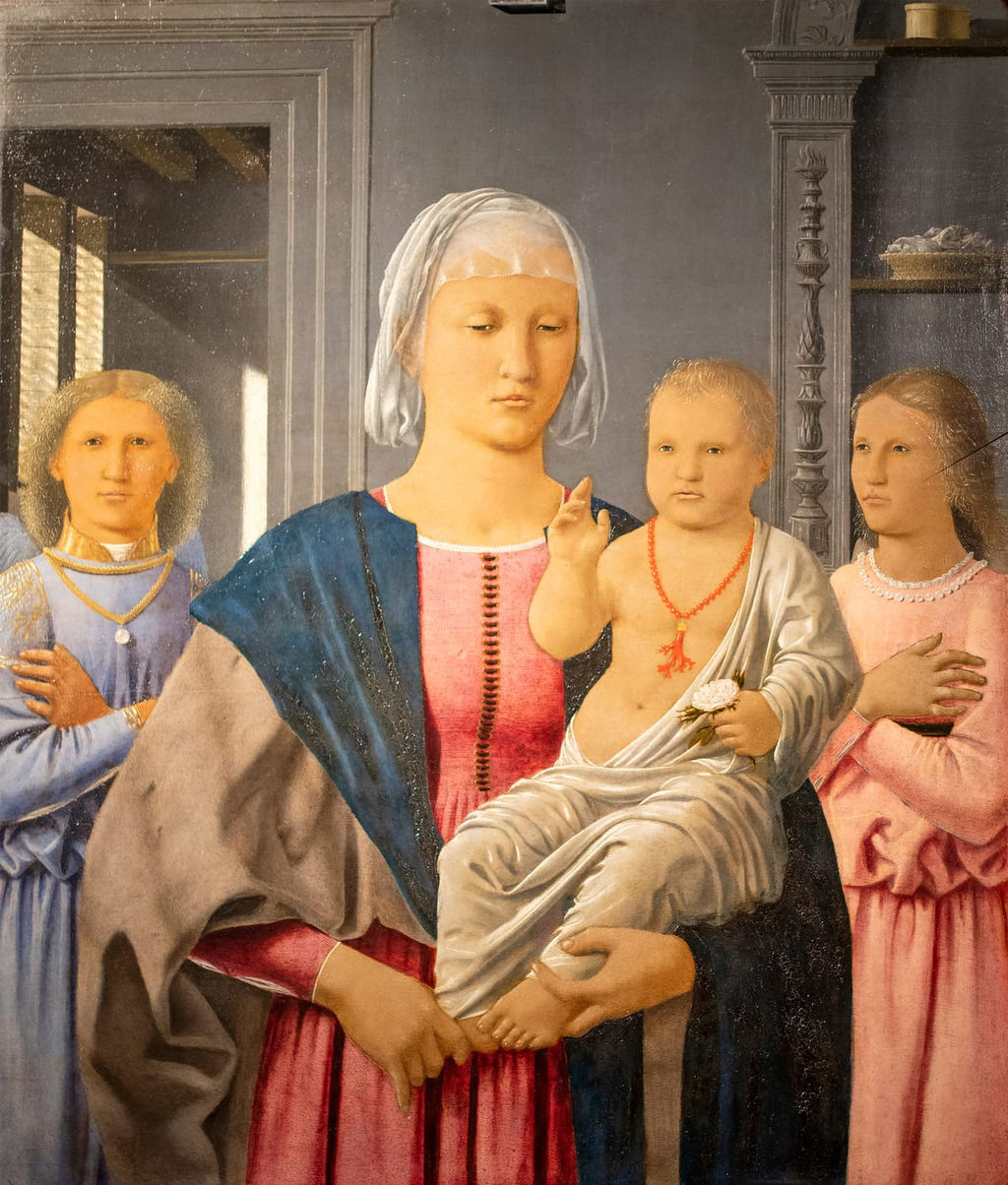
Piero della Francesca, Madonna of Senigallia, Galleria Nazionale delle Marche, Urbino. Image source. Public domain. Resized only; native appearance preserved.
What does the egg mean?
The most familiar explanation takes the object for an ostrich egg and links it to Mary’s miraculous motherhood. Brera relates that reading to an old belief that the sun nurtured ostrich eggs abandoned in the desert. The museum also reports a Montefeltro heraldic association. Its audio guide connects the egg with the hope of Resurrection and, in a dynastic reading, with Guidobaldo’s birth. The egg’s place above Mary, the sleeping child and the presence of the kneeling patron each give a different emphasis to the same shape. Several could have been available to a viewer, even if the patron’s preferred emphasis is lost. [1] [2] [3]
There is an equally important question of what people were accustomed to seeing hung in a church. Isa Ragusa pointed to a fresco in San Francesco at Lodi, where a suspended egg appears in a scene with the Virgin, child, saints and a donor. Sebastian Bock surveyed a broader range of examples and the writings of the medieval liturgist William Durandus. The uses Durandus gives include showing an unusual object that draws people’s attention in a church and offering a reminder to keep one’s attention fixed on God. Bock questions the assumption that real eggs hung in Western churches generally signified virginity or resurrection. The comparison suggests that Piero’s object could look plausible as a church furnishing and carry devotional weight at the same time. [14] [15]
The object’s resemblance to a pearl has also attracted attention. The shell makes that association unusually vivid. In her study of shell motifs, Yulia Zvezdina relates the pale oval to Mary’s head covering and to the pearls the angels wear. She treats it as an ostrich egg that looks like a very large pearl, making the visual association part of a reading of the Incarnation. The French-language study by Massimo Leone also finds a visual link between the shell’s curve and the child it seems to enclose when the viewer reads their shapes together. Bock reviews proposals that identify the object literally as a pearl or connect it with the egg of Leda, alongside the more familiar identification. Piero paints a small chain drawn taut by an object with a clearly modelled surface. That specificity makes the object seem materially present even as its isolation and placement encourage symbolic readings. [15] [16] [17]
Changes to the panel and the duke’s hands
Technical examination during the 1980–1981 restoration documented several kinds of change. Radiographs recorded adjustments to the angels’ heads and traces of a jewel once planned or painted at Mary’s cap and subsequently eliminated. Areas with visible ground or only a thin first stage of paint led the regional catalogue to describe the work as incompletely finished. Study of the support from 1992 to 1994 also found striking similarities in the joinery of this panel, the portraits of famous men from Federico’s study, and Joos van Gent’s Communion of the Apostles. The similarities suggest work by a common panel-making shop. The physical manufacture of a large support was itself part of the network that made court projects possible. [4]
Federico’s joined hands were repainted. Bellucci and Frosinini report that samples from the hands contain two distinct layers of flesh paint with varnish between them. The lower layer resembled paint sampled from one of the saints. By comparing a radiograph, an infrared image and the visible paint, they recovered traces of an earlier, slightly broader contour. The painter of the new hands appears to have used some of the earlier flesh paint to suggest the partly obscured hand. The prayer gesture we see incorporates material from both campaigns. [8] [4]
Bellucci and Frosinini argue for Pedro Berruguete on the basis of comparisons with the portraits from Federico’s study and with hands in an altarpiece in Burgos. Brera’s descriptive guide names Berruguete, while its collection entry for another work attributed to him phrases his contribution as a possibility. The regional record favours him and also mentions Joos van Gent. The motive for repainting and the precise date remain uncertain. The regional catalogue regards the picture as Piero’s work apart from limited retouching. [2] [8] [4] [18]
From Urbino to Milan
The altarpiece was removed from the high altar of San Bernardino. The regional catalogue traces its presence there to at least the early eighteenth century. The same record dates its acquisition in the Napoleonic suppression to 1811, a year also given by Brera. The inventory and early Brera catalogues called it the work of Fra Carnevale. In 1864 Giovanni Battista Cavalcaselle attributed it to Piero della Francesca. The name by which it is now best known joins an attribution recovered in the nineteenth century to the city in which the panel was then housed. [1] [3] [4]
Whether San Bernardino was always intended is harder to establish. The church was built as a mausoleum for Federico and his successors, with construction beginning after his death in 1482. The project could already have been envisaged when the picture was made. The earlier church of San Donato, absorbed into the nearby Franciscan complex, is another proposed original site. Federico’s remains were first laid there before their transfer to San Bernardino, so an earlier association with San Donato would be compatible with the altarpiece’s later documented location. The regional catalogue also records proposals involving San Francesco, where Battista’s funeral was celebrated, and a projected ducal burial setting at the palace. Each depends on a reconstruction of circumstances for which the earliest installation evidence remains missing. [1] [4] [19]
The alternatives affect how a historical viewer might have understood the picture. At a family tomb, the reclining child and the wounds of Francis and Peter Martyr would have put the hope of salvation beside the fact of burial. At a Franciscan altar closely tied to the family, the saints of the order and Federico’s public prayer would have been prominent. The painting also makes sense independently of a reconstruction of the first altar. The child is the focus of the surrounding gestures, and the patron is close enough to join in prayer while the gathering remains larger than his personal story. [1] [2] [4]
Even a museum has to decide how a painting with such a strong sense of architecture should meet the space around it. Vittorio Gregotti recalled placing the Brera panel relatively low and planning lateral daylight with a small overhead opening, echoing what he understood as the two directions of light in the picture. His account describes a museum design of the 1980s. It gives a sense of how the painting can shape the room in which it hangs, just as its own painted room shapes what we notice about the people within it. [20]
Watch a close reading of the Montefeltro Altarpiece
Smarthistory examines how the patron, saintly figures and painted setting work together.
Piero della Francesca, Madonna and Child with Saints, Angels, and Federico da Montefeltro
An object-led reading of the scale, painted architecture and kneeling patron of the Montefeltro Altarpiece.
Watch on YouTubeBrowse the artworks
Compare Piero’s frescoes, panels and manuscript figures. The list includes ensembles and separately identifiable panels or scenes. Dates are approximate where the sources differ.
| Name | Date | Medium and source |
|---|---|---|
| The Baptism of Christ | Probably c. 1437–45 | Panel painting Catalogue. |
| The Flagellation of Christ | 1459–60 (GNDM) | Panel painting Catalogue. |
| The History of the True Cross | Mid-fifteenth century | Wall painting Catalogue. |
| Dream of Constantine | Mid-fifteenth century | Wall painting Catalogue. |
| The Duke and Duchess of Urbino | About 1473–75 (Uffizi) | Panel painting Catalogue. |
| The Resurrection | About 1458–68 (Opificio) | Wall painting Catalogue. |
| Brera Madonna | About 1472–74 | Panel painting Catalogue. |
| Annunciation at Arezzo | Mid-fifteenth century | Wall painting Catalogue. |
| Madonna del Parto | About 1450–65 (Monterchi) | Wall painting Catalogue. |
| Polyptych of the Misericordia | Commissioned 1445 | Panel painting Catalogue. |
| The Nativity | Early 1480s (National Gallery) | Panel painting Catalogue. |
| Madonna di Senigallia | About 1474–75 (GNDM) | Panel painting Catalogue. |
| Death of Adam | Mid-fifteenth century | Wall painting Catalogue. |
| Queen of Sheba | Mid-fifteenth century | Wall painting Catalogue. |
| Victory of Constantine | Mid-fifteenth century | Wall painting Catalogue. |
| Battle between Heraclius and Chosroes | Mid-fifteenth century | Wall painting Catalogue. |
| Saint Mary Magdalen | Wall painting Catalogue. | |
| The Augustinian Polyptych | 1454–69 | Panel painting Catalogue. |
| Polyptych of Perugia | About 1467–69 (GNU) | Panel painting Catalogue. |
| Perugia Annunciation | About 1468–70 (national catalogue) | Panel painting Catalogue. |
| St Francis and St Elizabeth | About 1467–69 (GNU) | Panel painting Catalogue. |
| Stigmatisation of St Francis | About 1468–70 (national catalogue) | Panel painting Catalogue. |
| An Augustinian Nun (Saint Monica) | 1454–69 | Panel painting Catalogue. |
| Augustinian Saint | 1454–69 | Panel painting Catalogue. |
| Saint Michael | 1454–69 | Panel painting Catalogue. |
| Saint Nicholas of Tolentino | 1454–69 | Panel painting Catalogue. |
| Saint John the Evangelist | 1454–69 | Panel painting Catalogue. |
| Virgin and Child Enthroned with Four Angels | About 1460–70 (Clark) | Panel painting Catalogue. |
| Portrait of Sigismondo Pandolfo Malatesta | About 1450–51, often proposed. Louvre catalogue range 1450–75. | Panel painting Catalogue. |
| Sigismondo before St Sigismund | 1451 | Wall painting Catalogue. |
| St Jerome and a Donor | 1460s (Accademia); about 1450 also proposed | Panel painting Catalogue. |
| St Jerome in Penitence | 1450, dated on the panel | Panel painting Catalogue. |
| Saint Julian | About 1455–60, often proposed | Wall painting Catalogue. |
| Saint Augustine | 1454–69 | Panel painting Catalogue. |
| Saint Apollonia | 1454–69 | Panel painting Catalogue. |
| Crucifixion from the Augustinian Polyptych | 1454–69 | Panel painting Catalogue. |
| Saint Louis of Toulouse | Wall painting Catalogue. | |
| Burial of the Wood | Mid-fifteenth century | Wall painting Catalogue. |
| Discovery and Proof of the True Cross | Mid-fifteenth century | Wall painting Catalogue. |
| Exaltation of the Cross | Mid-fifteenth century | Wall painting Catalogue. |
| Saint Anthony Raises a Child | About 1467–69 (GNU) | Panel painting Catalogue. |
| Saint Elizabeth Revives a Child | About 1467–69 (GNU) | Panel painting Catalogue. |
| Hercules | About 1470 | Wall painting Catalogue. |
| Portrait of a Boy (possibly Guidobaldo da Montefeltro) | Panel painting Catalogue. | |
| De prospectiva pingendi, Reggio Emilia witness (figures) | Manuscript diagrams Catalogue. | |
| The Interrogation of Judas | Mid-fifteenth century | Wall painting Catalogue. |
| Two prophets, Bacci Chapel | Mid-fifteenth century | Wall painting Catalogue. |
| Saint Clare of Assisi, upper predella | About 1467–69 (GNU) | Panel painting Catalogue. |
| Saint Agatha, upper predella | About 1467–69 (GNU) | Panel painting Catalogue. |
| Lost centre of the Augustinian Polyptych | 1454–69 | Lost panel or panels Catalogue. |
Frequently Asked Questions
Discussion
Look again at the images and ideas explored in Brera Madonna by Piero della Francesca. These editorial prompts invite your observations.
Reader Insights
Follow the edges of the ceiling from the front of the picture to the shell. How does that change your sense of the distance between the egg and Mary?
Compare Mary’s folded hands with Federico’s. How do the armour, the direction of his gaze and his place at the edge change the effect of the same gesture?
How does each detail affect your reading of the child’s sleep? Consider the coral necklace, the wounds shown by the saints and the way his body rests on Mary’s lap.
Join the Conversation
Share a detail, comparison or question about Brera Madonna by Piero della Francesca below.
References
- Pinacoteca di Brera. Madonna and Child with Saints, Angels and Federico da Montefeltro (San Bernardino Altarpiece). Collection entry, inventory 180. View source.
- Pinacoteca di Brera, DescriVedendo and Associazione Nazionale Subvedenti. La Pala di Montefeltro di Piero della Francesca. Italian visual description and historical commentary. View source.
- Pinacoteca di Brera. 10 Masterpieces for You, no. 06, The Montefeltro Altarpiece by Piero della Francesca. View source.
- Lombardia Beni Culturali, Sistema Informativo Regionale dei Beni Culturali. Pala Montefeltro. Pala di San Bernardino. Full entry RL480-00071, especially the historical and conservation sections. View source.
- Fondazione Federico Zeri, Università di Bologna. Catalogue record for the Montefeltro Altarpiece. View source.
- Galleria Nazionale dell’Umbria. Polittico di Sant’Antonio. View source.
- Gallerie degli Uffizi. The Duke and Duchess of Urbino Federico da Montefeltro and Battista Sforza. View source.
- Roberto Bellucci and Cecilia Frosinini. Ipotesi sul metodo di restituzione dei disegni preparatori di Piero della Francesca: il caso dei ritratti di Federico da Montefeltro. In La Pala di San Bernardino di Piero della Francesca. Nuovi studi oltre il restauro, 1997, pp. 167–187. View source.
- Machtelt Brüggen Israëls. ‘A Sartorial Portrait of Ottaviano Ubaldini della Carda by Piero della Francesca’. The Burlington Magazine, 165, 2023, pp. 720–737. View source.
- Galleria Nazionale delle Marche. Flagellazione. View source.
- Jeryldene M. Wood. Introduction to The Cambridge Companion to Piero della Francesca. Cambridge University Press, 2002. View source.
- Takumi Etō. Reconsidering the influence of Netherlandish painting on Piero della Francesca’s Brera Altarpiece. Japan Art History Society, conference abstract, 2024, in Japanese. View source.
- Galleria Nazionale delle Marche. Madonna col Bambino benedicente e due angeli (Madonna di Senigallia). View source.
- Isa Ragusa. ‘The Egg Reopened’. The Art Bulletin, 53, 1971, pp. 435–443. View source.
- Sebastian Bock. The “Egg” of the Pala Montefeltro by Piero della Francesca and Its Symbolic Meaning. Heidelberg University repository, 2002. View source.
- Yulia N. Zvezdina. Renaissance sculptural motifs in the Kremlin’s Archangel Cathedral and in Italian painting. Moscow Kremlin Museums, in Russian, text pp. 11–13. View source.
- Massimo Leone. Sémiotique de l’âme, vol. III. 2012, in French, especially pp. 74–79. View source.
- Pinacoteca di Brera. Cristo nel sepolcro fra due angeli. Catalogue entry discussing Berruguete and the repainting of Federico’s hands. View source.
- Ministero della Cultura, Art Bonus. Chiesa San Bernardino. Institutional record for the ducal mausoleum. View source.
- Vittorio Gregotti. ‘La Pala Montefeltro nella luce di Brera’. Il Sole 24 Ore, archived by the Università di Udine. View source.