 by Tom Gurney
Tom Gurney BSc (Hons) is an art history expert with over 20 years experience
Published on June 19, 2020 / Updated on October 14, 2023
Email: tomgurney1@gmail.com / Phone: +44 7429 011000
Death and Burial of Adam by Piero della Francesca: Introduction
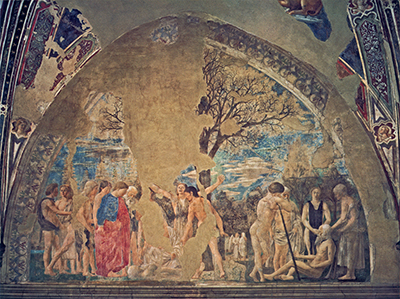
An old man sits low on the ground at the right of Piero della Francesca’s Death and Burial of Adam. By the time the eye reaches the group on the left, the man lies dead and his son Seth has returned from the gates of Paradise. Between the two groups stands a tall tree. It gives the burial a setting and anticipates the future of the small piece of living wood associated with Adam’s grave. High on the right wall of the Bacci Chapel in Arezzo, this fresco opens Piero’s Legend of the True Cross with the legendary origins of the timber on which Christ would be crucified. [1] [2]
At a Glance
- ArtistPiero della Francesca
- TitlesDeath of Adam, Death and Burial of Adam, Morte di Adamo and Sepoltura d’Adamo
- DateMid-fifteenth century [3] [4] [5]
- MediumWall painting in fresco with details applied to dry plaster [6] [7]
- LocationUpper right lunette facing the altar from the nave, Bacci Chapel, Basilica of San Francesco, Arezzo, Italy [1] [3] [6]
- SubjectAdam sends Seth for the oil of mercy. Seth meets Michael and returns for Adam’s burial. [1] [2]
This work across Piero della Francesca’s career
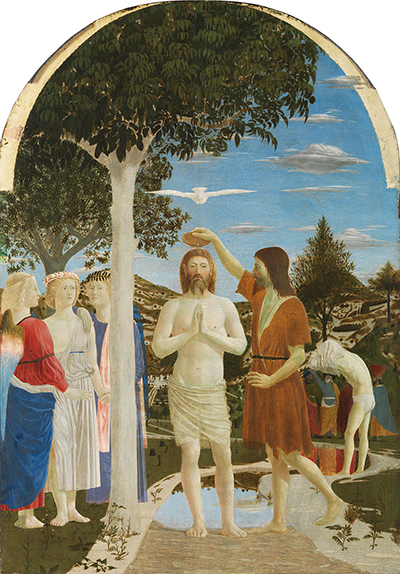
The Baptism of Christ
Probably about 1437–45The History of the True Cross
Mid-fifteenth centuryDeath and Burial of Adam (current article)
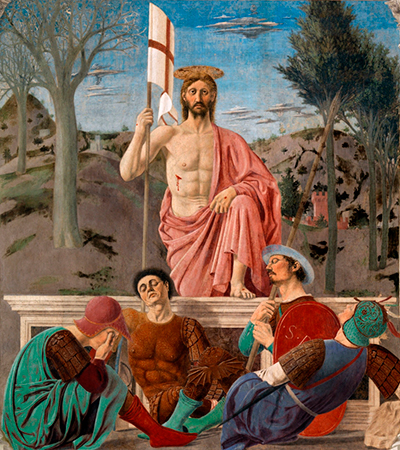
Mid-fifteenth centuryThe Resurrection
About 1458–68 (Opificio)The Flagellation of Christ
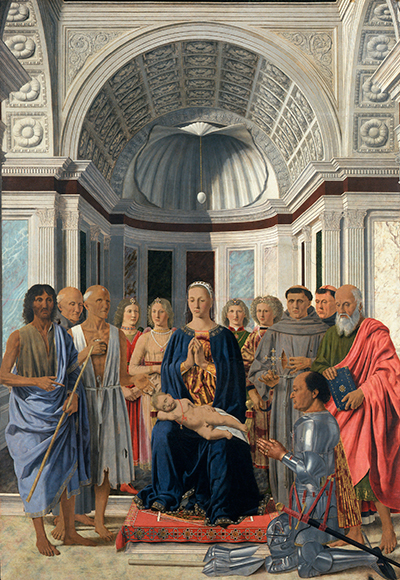
1459–60 (GNDM)The Montefeltro Altarpiece
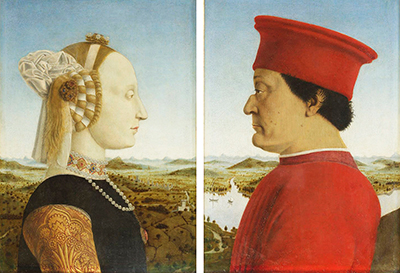
About 1472–74 (Brera)The Duke and Duchess of Urbino
About 1473–75 (Uffizi)The Nativity
Early 1480s (National Gallery)Contents
- The upper right lunette in the Bacci Chapel
- Three moments in one landscape
- What did Seth bring back?
- From the living tree to the sacred wood
- How much of the fresco survives?
- Annotated details
The upper right lunette in the Bacci Chapel
From the nave of the Basilica of San Francesco, face the high altar and look up to the top of the chapel’s right-hand wall. The fresco fills the lunette, the broad field beneath the arch. That high, lateral position makes the original view oblique. Seen from below, the large bodies, the central trunk and the mourner with outstretched arms provide points of orientation. Seth’s encounter with the angel is easier to pick out in a close view, where the difference in scale between the foreground groups and the pair in the distance becomes clear. Arezzo’s guide identifies the painting as the first narrative episode. Italy’s national heritage catalogue records N. Perazzo’s 1917 photographic negative of the same upper-right scene under the title Sepoltura d’Adamo, or Burial of Adam. Both English titles refer to the same wall painting. [1] [3]
Piero’s work belongs to a chapel decoration begun by Bicci di Lorenzo’s workshop. The national catalogue frames the True Cross cycle between 1452 and 1466, and the Tuscan regional museum directorate gives a narrower dating of about 1452–55. Katsuhiko Hayashi has questioned whether Bicci’s death in 1452 can be treated as a firm starting point for Piero’s work and has argued for early execution of parts of the cycle. The mid-fifteenth century dates the lunette with more confidence than an individual year. Its position at the beginning of the story tells us where to start reading the subject. The order in which the walls were painted is a separate question. [3] [4] [5]
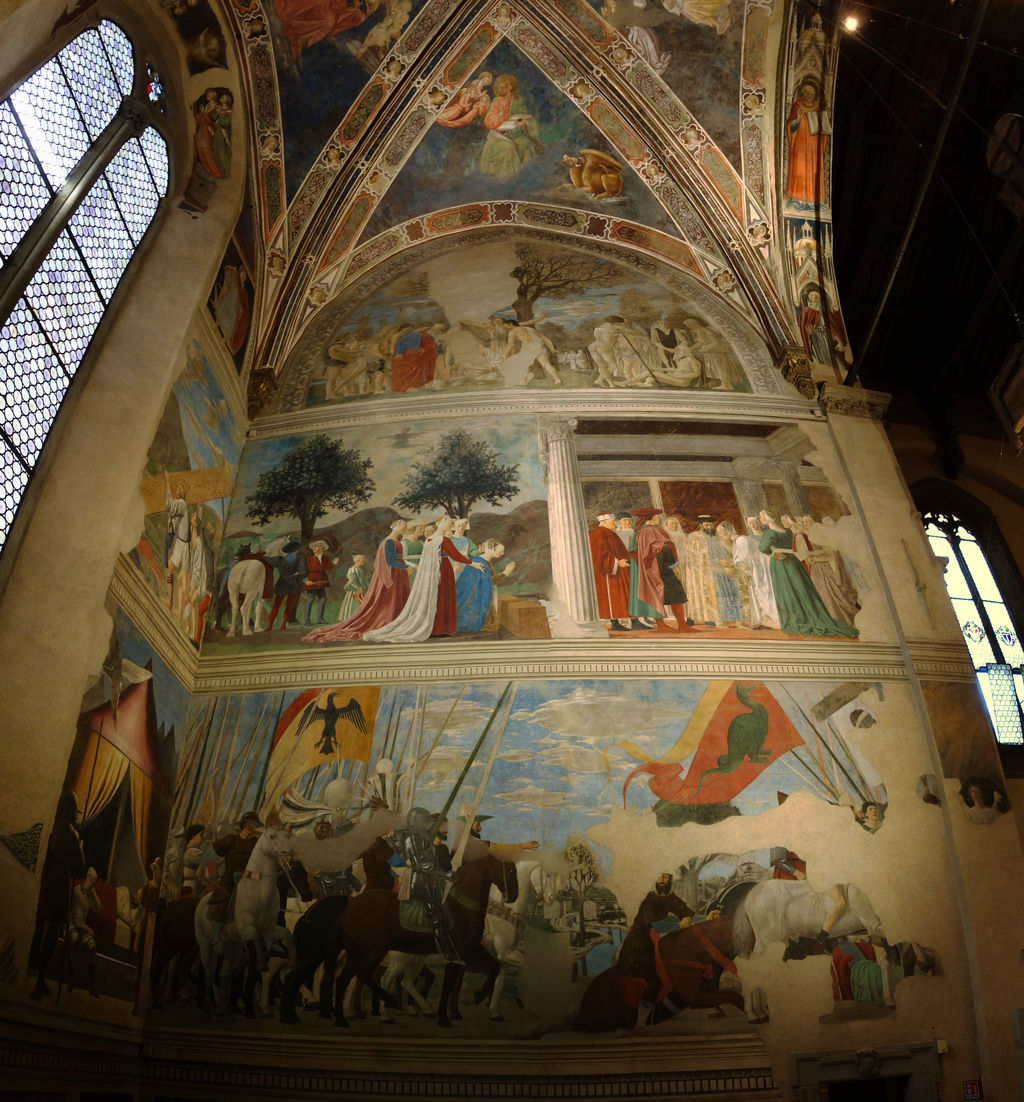
Right wall of the Bacci Chapel in San Francesco, Arezzo, as seen from the nave facing the altar. Spike. Image source. CC BY-SA 4.0. Resized from the source. This reproduction uses CC BY-SA 4.0.
Three moments in one landscape
Begin at the lower right. Adam, old and bearded, is surrounded by members of his family. His weakness is evident in the difference between his low, seated body and the figures who rise around him. He sends Seth to seek the oil of mercy, a remedy he hopes will relieve him. The first exchange is between father and son, close enough for the viewer to follow their gestures. A second exchange takes place farther away. In that small group Seth meets the Archangel Michael, who refuses the oil. Piero uses the landscape to accommodate the distance Seth travels. The eye moves from large figures near the lower edge to the much smaller pair farther into the scene. [1] [2] [6]
On the left, near the foot of the tree, the family gathers again. Adam’s body lies foreshortened on the ground, its low diagonal surrounded by standing and bending figures. The broad gesture of a mourner extending both arms makes the family’s grief easy to locate even before the eye finds Adam among the damaged passages. Seth is understood to have returned and to be attending to his father’s burial. The crossing of time is fundamental to the composition. Adam appears once alive and once dead, while Seth appears at the departure, in conversation with Michael and again at the burial. [1] [6] [8]
Art historians call this way of telling a story continuous narrative. Each appearance marks a different moment, and the shared ground keeps the events in relation. A comparable device appears in Masaccio’s Tribute Money, where Peter recurs within the landscape as the tax story unfolds. At Arezzo, the curve of the lunette leaves greater height towards its centre, where the trunk rises into the arch, and the main groups spread across the broad foreground. The tree separates the gathering around the living man from the gathering around the corpse. Since it belongs to the same landscape as both, it also helps one episode flow into the next. [6] [8]
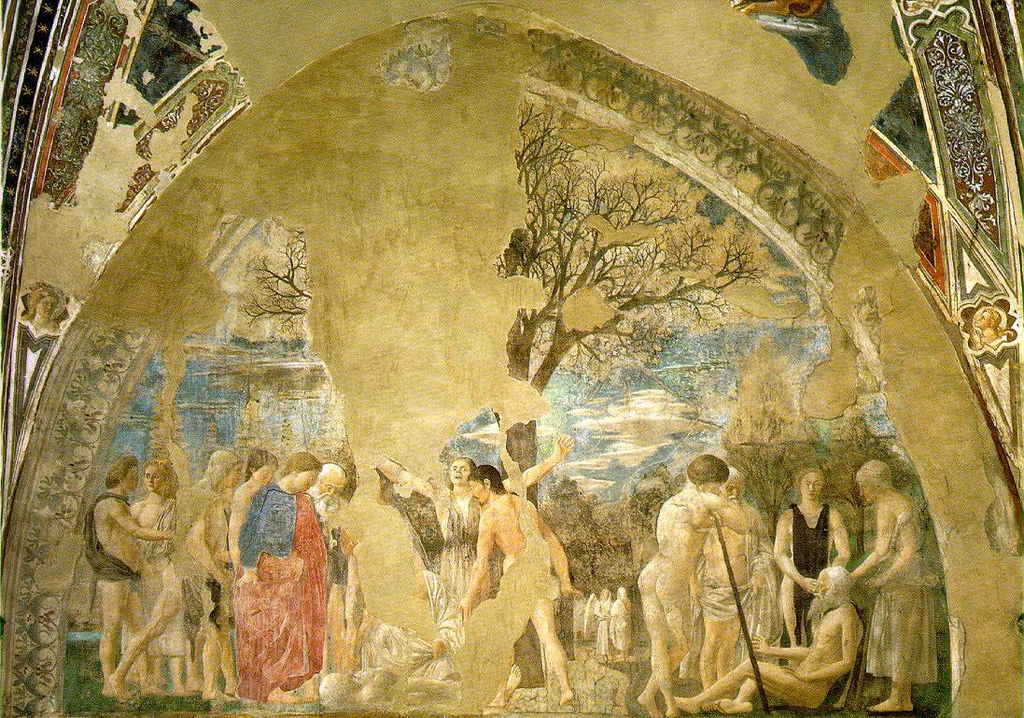
Death of Adam, right lunette of the Bacci Chapel viewed from the nave. Image source. Public domain. Resized only; native appearance preserved.
Annotated Details from Death and Burial of Adam
The numbered points identify visible features discussed in this article. Return from each detail to the numbered overview. Detail of the Death of Adam, Bacci Chapel, with foreground figures and the distant encounter. Image source. Public domain.
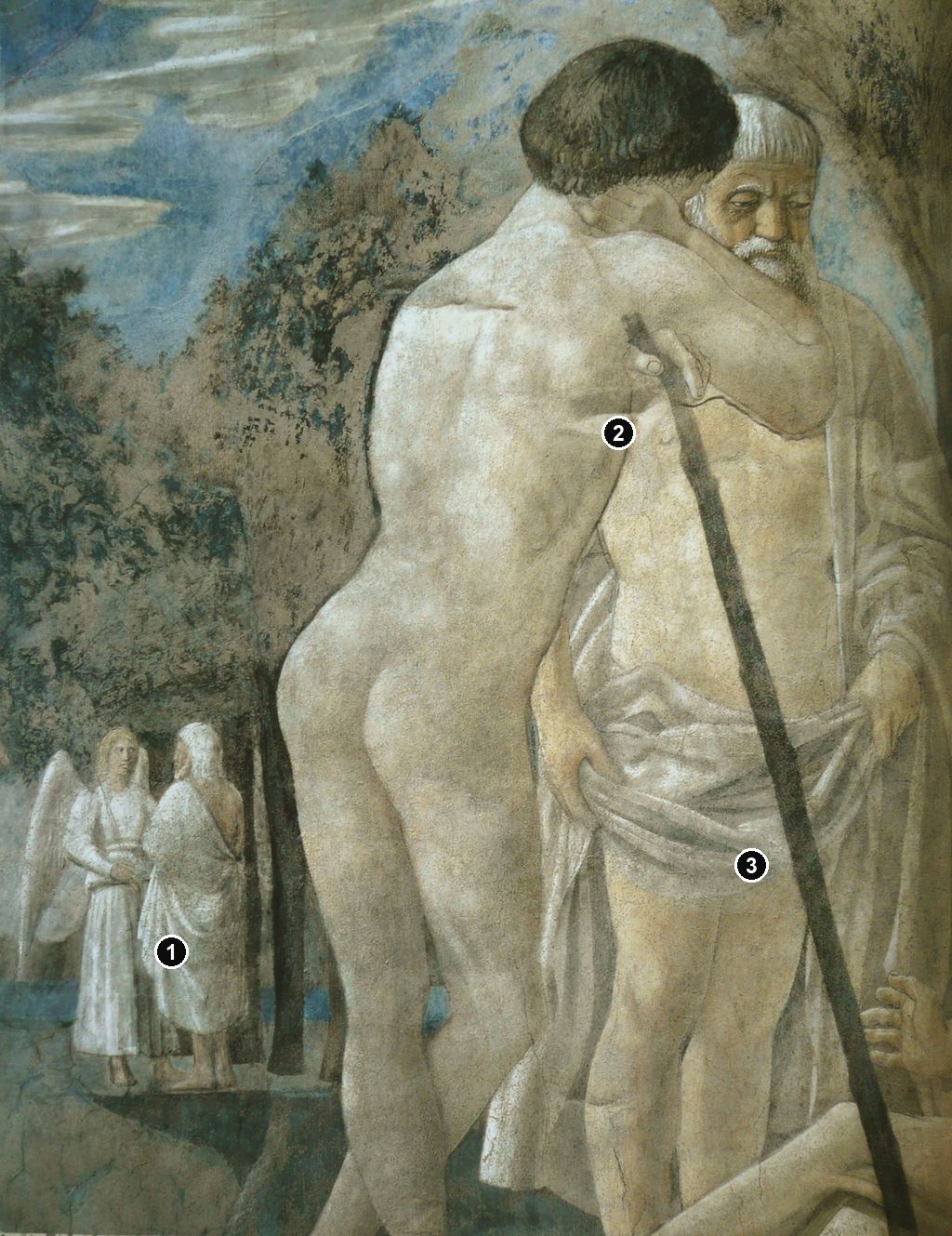
Details from DEATH AND BURIAL OF ADAM
Compare the cropped details with the source images above. Notice how their colours, shapes and positions contribute to the larger compositions.
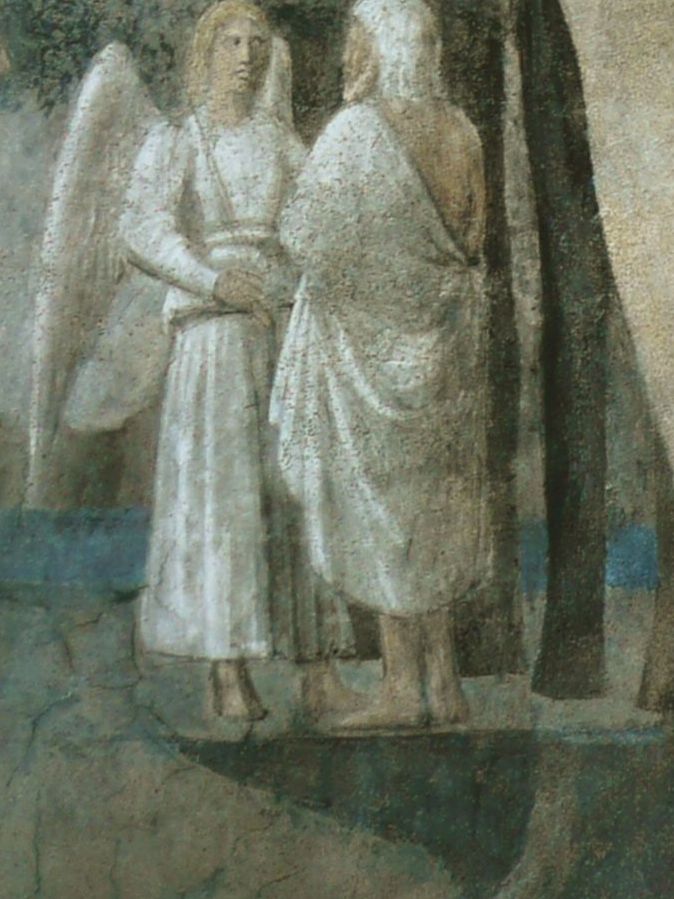
The distant meeting
Two small upright figures can be picked out in the landscape behind the larger group. Their scale lets the meeting occupy a separate moment in the same field.
The old man and the standing youth
The two foreground bodies overlap. The young man’s turn makes his back a broad surface of light beside the older man’s face and pale hair.
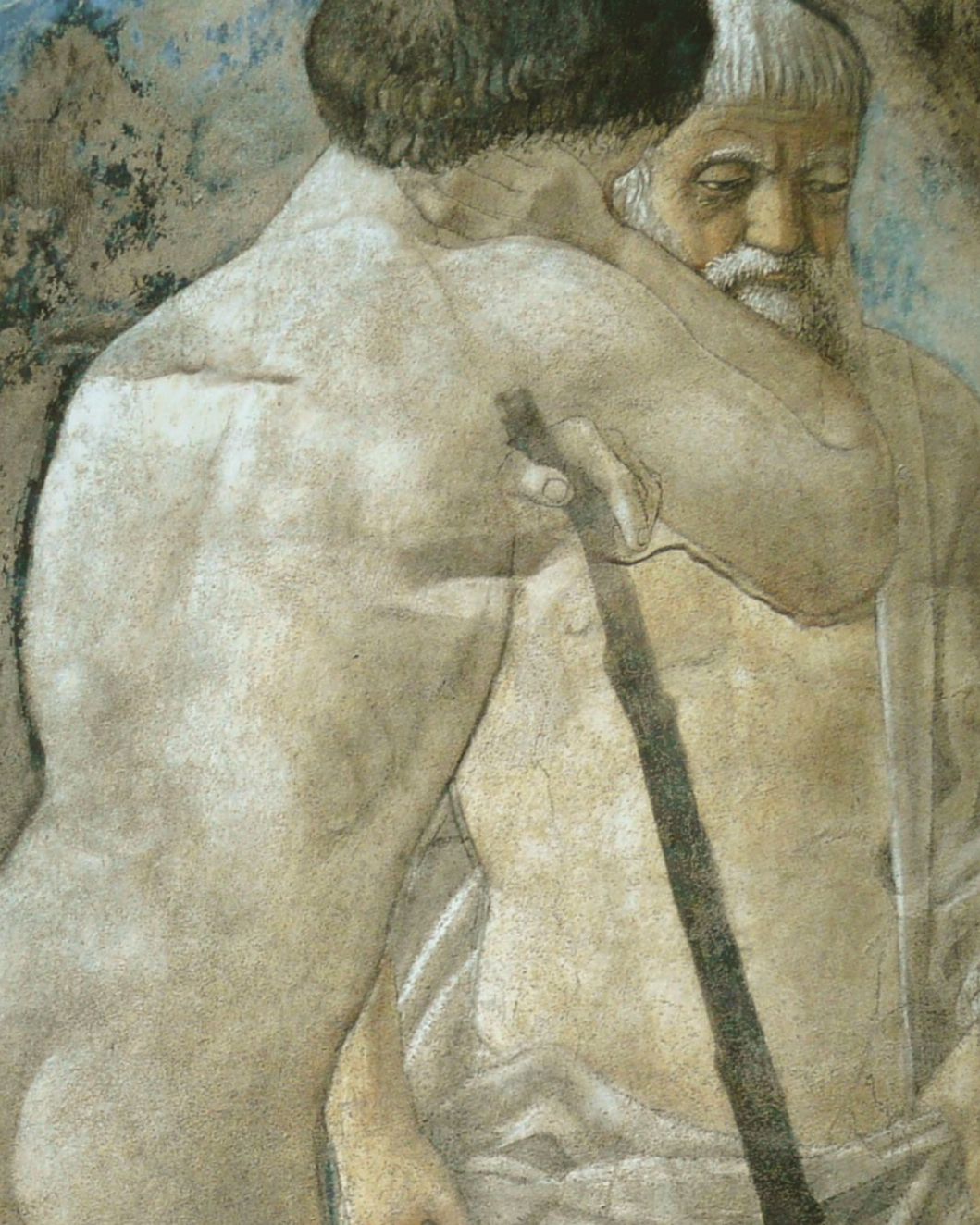
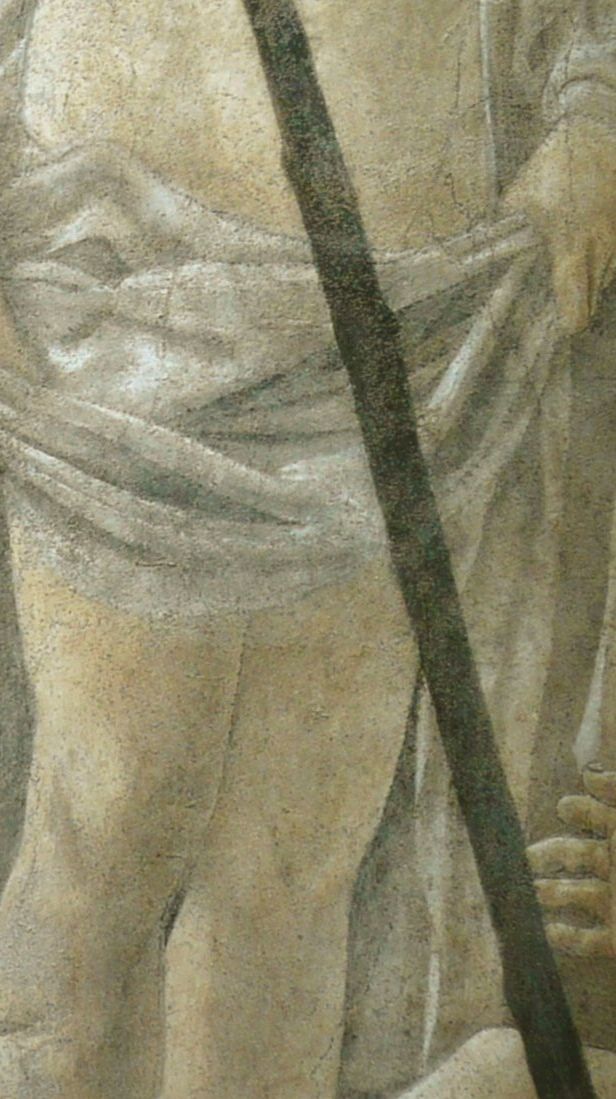
The long diagonal
A dark staff or rod falls towards the bottom of the scene. Its diagonal cuts across the brighter areas of the standing bodies and binds the figures together.
What did Seth bring back?
The journey to Paradise belongs to medieval Christian legend. Genesis supplies Adam and Eve, the forbidden tree and the Fall. The more elaborate story about Seth seeking a remedy and the wood eventually becoming Christ’s Cross circulated in several forms. In the chapter on the Finding of the Cross in Jacobus de Voragine’s Golden Legend, the request for oil is attributed to the apocryphal Gospel of Nicodemus. Jacobus then records variants. In one, the angel gives Seth a branch to plant on Mount Lebanon. In another, Seth receives part of the tree from which Adam ate, returns to find his father dead and plants it on the grave. The chapter’s title in William Caxton’s translation uses invention in the older sense of finding or discovery. Another version in Caxton’s collection has Seth place kernels under his father’s tongue. Three trees grow from them. The burial could therefore be pictured as a planting without every telling agreeing on what was planted or where. [9]
The versions matter when looking at the damaged burial group. The Musei Arezzo guide describes Seth planting a branch on the grave. Visit Arezzo’s account instead describes seeds from the Tree of Knowledge placed in Adam’s mouth. Jeanne van Waadenoijen reads the gesture as Seth placing a branch in the dead man’s mouth. The details differ, but the sequence remains clear. The remedy sought for a dying man gives way to a planting at his burial, and what grows from it eventually becomes the Cross. By placing the mature tree beside the funeral, the painting allows the viewer to grasp the outcome before the rest of the chapel shows what happens to the wood. Sarah K. Kozlowski reads the great tree as spanning both ends of this part of the story, the source of the small living piece and the mature tree it will become. [1] [2] [6] [9] [10]
From the living tree to the sacred wood
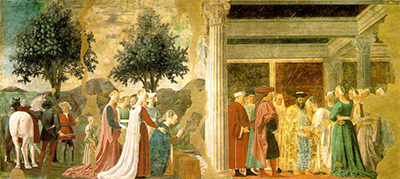
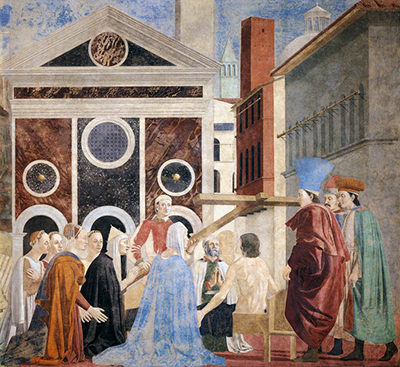
Directly below the lunette, the Queen of Sheba kneels before a beam that has been laid across water as a crossing. Piero makes it possible to see both states of the material by shifting attention down one tier. Above, the wood grows upright and branches into the sky. Below, workers have cut and squared it, and its weight and length are visible as the queen approaches. She recognises its future use before it has the shape of a cross. The Annunciation, on the chapel’s rear wall, brings Christ into the story through Gabriel’s message to Mary. It gives the future use of the beam its Christian setting. The link is theological as well as material. In the medieval Christian reading, Adam’s disobedience brought death into human life, and Christ’s death offered redemption. Making the Cross out of wood that can be traced back to Eden gives that reversal a physical form. [1] [2] [9] [10]
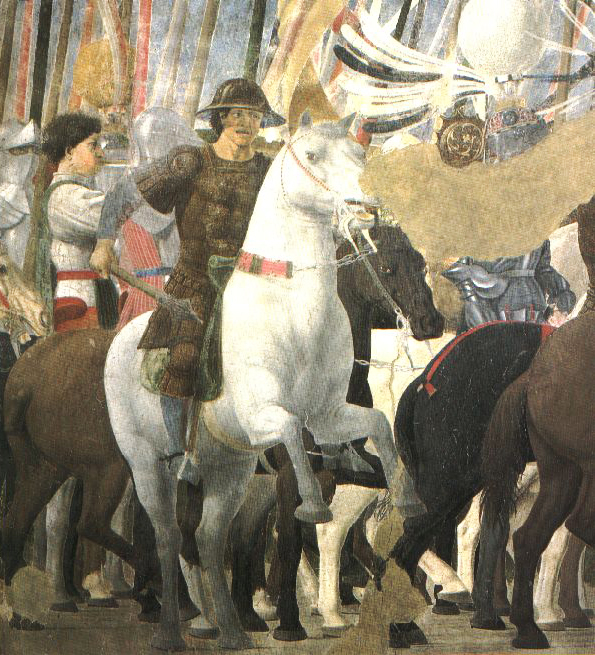
Across the chapel, in the opposite lunette, Heraclius brings the recovered Cross back to Jerusalem in the Exaltation of the Cross. The tall Cross and the tall tree give the two scenes a visible correspondence. Each rises between groups of people. One marks a burial in which the wood’s future is still unknown to those gathered around Adam. The other presents the sacred object receiving public veneration. Moving between the two lunettes brings the beginning and end of the wood’s story together, while looking down the right wall reveals an intermediate stage. The chapel’s arrangement makes both comparisons possible over the course of a single visit. [1] [6] [10]
How much of the fresco survives?
The tree now reads chiefly as trunk and branches. In 1993, during the conservation campaign, art historian Charles Hope reported surviving traces of the green pigment of its former foliage. Van Waadenoijen identifies the lost leaves as work applied a secco, meaning on plaster that had already dried. It is therefore reasonable to imagine a leafier tree than the one now visible, while leaving the exact shape and density of the canopy open. The foliage matters to the story because the legend calls for a thriving tree capable of yielding a substantial beam. Its sparse appearance today reflects the history of the paint surface. [6] [7]
The conservation team began its investigations in 1985, and the regional museum directorate records the completion of the long campaign in 2000. Writing for ICCROM’s GraDoc proceedings, Stefano Casciu, Giuseppe A. Centauro and Massimo Chimenti describe a system linking photographs, graphic maps and historical and scientific records. The maps let conservators compare different kinds of evidence at the same point on the wall. That approach matters when reading the burial group, where some forms are clearer than others. Adam’s reclining body, the arrangement of his family and the broad gestures carry the scene. Finer points, such as exactly what Seth holds at the burial, depend in part on the surviving legend and on how scholars read the fragmentary painting. The regional directorate returned to the cycle for conservation maintenance in 2024. During that campaign, scaffolding gave visitors and scholars a temporary chance to see the wall paintings at close range. [1] [4] [6] [11] [12]
Browse the artworks
Compare Piero’s frescoes, panels and manuscript figures. The list includes ensembles and separately identifiable panels or scenes. Dates are approximate where the sources differ.
| Name | Date | Medium and source |
|---|---|---|
| The Baptism of Christ | Probably c. 1437–45 | Panel painting Catalogue. |
| The Flagellation of Christ | 1459–60 (GNDM) | Panel painting Catalogue. |
| The History of the True Cross | Mid-fifteenth century | Wall painting Catalogue. |
| Dream of Constantine | Mid-fifteenth century | Wall painting Catalogue. |
| The Duke and Duchess of Urbino | About 1473–75 (Uffizi) | Panel painting Catalogue. |
| The Resurrection | About 1458–68 (Opificio) | Wall painting Catalogue. |
| Brera Madonna | About 1472–74 | Panel painting Catalogue. |
| Annunciation at Arezzo | Mid-fifteenth century | Wall painting Catalogue. |
| Madonna del Parto | About 1450–65 (Monterchi) | Wall painting Catalogue. |
| Polyptych of the Misericordia | Commissioned 1445 | Panel painting Catalogue. |
| The Nativity | Early 1480s (National Gallery) | Panel painting Catalogue. |
| Madonna di Senigallia | About 1474–75 (GNDM) | Panel painting Catalogue. |
| Death of Adam | Mid-fifteenth century | Wall painting Catalogue. |
| Queen of Sheba | Mid-fifteenth century | Wall painting Catalogue. |
| Victory of Constantine | Mid-fifteenth century | Wall painting Catalogue. |
| Battle between Heraclius and Chosroes | Mid-fifteenth century | Wall painting Catalogue. |
| Saint Mary Magdalen | Wall painting Catalogue. | |
| The Augustinian Polyptych | 1454–69 | Panel painting Catalogue. |
| Polyptych of Perugia | About 1467–69 (GNU) | Panel painting Catalogue. |
| Perugia Annunciation | About 1468–70 (national catalogue) | Panel painting Catalogue. |
| St Francis and St Elizabeth | About 1467–69 (GNU) | Panel painting Catalogue. |
| Stigmatisation of St Francis | About 1468–70 (national catalogue) | Panel painting Catalogue. |
| An Augustinian Nun (Saint Monica) | 1454–69 | Panel painting Catalogue. |
| Augustinian Saint | 1454–69 | Panel painting Catalogue. |
| Saint Michael | 1454–69 | Panel painting Catalogue. |
| Saint Nicholas of Tolentino | 1454–69 | Panel painting Catalogue. |
| Saint John the Evangelist | 1454–69 | Panel painting Catalogue. |
| Virgin and Child Enthroned with Four Angels | About 1460–70 (Clark) | Panel painting Catalogue. |
| Portrait of Sigismondo Pandolfo Malatesta | About 1450–51, often proposed. Louvre catalogue range 1450–75. | Panel painting Catalogue. |
| Sigismondo before St Sigismund | 1451 | Wall painting Catalogue. |
| St Jerome and a Donor | 1460s (Accademia); about 1450 also proposed | Panel painting Catalogue. |
| St Jerome in Penitence | 1450, dated on the panel | Panel painting Catalogue. |
| Saint Julian | About 1455–60, often proposed | Wall painting Catalogue. |
| Saint Augustine | 1454–69 | Panel painting Catalogue. |
| Saint Apollonia | 1454–69 | Panel painting Catalogue. |
| Crucifixion from the Augustinian Polyptych | 1454–69 | Panel painting Catalogue. |
| Saint Louis of Toulouse | Wall painting Catalogue. | |
| Burial of the Wood | Mid-fifteenth century | Wall painting Catalogue. |
| Discovery and Proof of the True Cross | Mid-fifteenth century | Wall painting Catalogue. |
| Exaltation of the Cross | Mid-fifteenth century | Wall painting Catalogue. |
| Saint Anthony Raises a Child | About 1467–69 (GNU) | Panel painting Catalogue. |
| Saint Elizabeth Revives a Child | About 1467–69 (GNU) | Panel painting Catalogue. |
| Hercules | About 1470 | Wall painting Catalogue. |
| Portrait of a Boy (possibly Guidobaldo da Montefeltro) | Panel painting Catalogue. | |
| De prospectiva pingendi, Reggio Emilia witness (figures) | Manuscript diagrams Catalogue. | |
| The Interrogation of Judas | Mid-fifteenth century | Wall painting Catalogue. |
| Two prophets, Bacci Chapel | Mid-fifteenth century | Wall painting Catalogue. |
| Saint Clare of Assisi, upper predella | About 1467–69 (GNU) | Panel painting Catalogue. |
| Saint Agatha, upper predella | About 1467–69 (GNU) | Panel painting Catalogue. |
| Lost centre of the Augustinian Polyptych | 1454–69 | Lost panel or panels Catalogue. |
Frequently Asked Questions
The figures of Adam and Seth come from Genesis. Seth’s request for the oil of mercy and the story connecting the tree to Christ’s Cross belong to medieval Christian legend. The Golden Legend records several versions. [9]
Discussion
Look again at the images and ideas explored in Death and Burial of Adam by Piero della Francesca. These editorial prompts invite your observations.
Reader Insights
Follow Seth from Adam’s side to the distant encounter and back to the burial. What changes in scale, height or gesture tell you that time has passed?
Look from the upright tree down to the squared beam beneath it. How does the placement help you recognise the wood as part of the same story?
Compare the tree in the opening lunette with the Cross in the opposite lunette. Where does each group of people direct your attention?
Join the Conversation
Share a detail, comparison or question about Death and Burial of Adam by Piero della Francesca below.
References
- Musei Arezzo. Frescoes by Piero della Francesca, “Death and Burial of Adam”, related scene entries and chapel diagram. View source.
- Visit Arezzo. Guida a “La leggenda della vera Croce” di Piero della Francesca, numbered episode summaries. View source.
- Sara Rutigliano, ed. 1452–1466 – Gli affreschi di Piero della Francesca nella Chiesa di San Francesco ad Arezzo. Catalogo Generale dei Beni Culturali, 2021. Includes N. Perazzo’s negative 0900644622. View source.
- Direzione regionale Musei nazionali Toscana. Basilica di San Francesco. View source.
- Katsuhiko Hayashi. Study on the dating of Piero della Francesca’s Legend of the True Cross. Bigaku 61, no. 1, 2010, pp. 73–84. View source.
- Jeanne van Waadenoijen. “The Legend of the True Cross by Piero della Francesca: Its Meaning and Commission”, in Art and Religion in the Renaissance, 2025, especially pp. 114–116 and 121–122. View source.
- Charles Hope. “Restoration or Ruination?” The New York Review of Books, 18 November 1993. View source.
- Michael John Barwell. Patterns of Redemption: Parachronicity in the Work of Piero della Francesca, Frank Zappa and Stanley Spencer. Doctoral thesis, University of Warwick, 2002, pp. 67–68. View source.
- Jacobus de Voragine. “Of the Invention of the Holy Cross”, The Golden Legend, vol. 3, translated by William Caxton, edited by F. S. Ellis. View source.
- Sarah K. Kozlowski. “Matter and Meaning in Piero della Francesca’s Legend of the True Cross”, in Space, Image, and Reform in Early Modern Art, 2021, pp. 191–210, especially pp. 197–198. View source.
- Stefano Casciu, Giuseppe A. Centauro and Massimo Chimenti. “The Archival Documentation System: The Computerized Heart of the Restored ‘History of the True Cross’ by Piero della Francesca”, in Werner Schmid, ed., GraDoc: Graphic Documentation Systems in Mural Painting Conservation, ICCROM, 2000, pp. 208–219. View source.
- Direzione regionale Musei nazionali Toscana. Verso la luce, retrospective account of access to the 2024 maintenance campaign. View source.