 by Tom Gurney
Tom Gurney BSc (Hons) is an art history expert with over 20 years experience
Published on June 19, 2020 / Updated on October 14, 2023
Email: tomgurney1@gmail.com / Phone: +44 7429 011000
Polyptych of the Misericordia by Piero della Francesca: Introduction
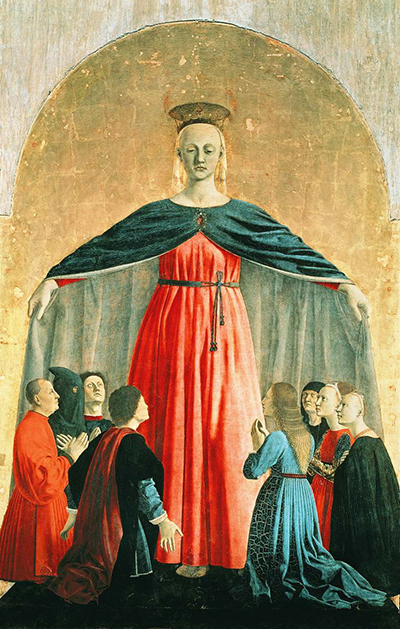
Eight people kneel beneath the Virgin’s cloak in Piero della Francesca’s Polyptych of the Misericordia. The dark fabric curves around them, leaving their faces and folded hands visible. Above them, in a much smaller scene, Christ hangs on the cross. Around both images are standing saints, and along the base are episodes of Christ’s Passion and its aftermath. Piero and his collaborators made the altarpiece for the confraternity of Santa Maria della Misericordia in his hometown of Sansepolcro, where it is now exhibited in the Museo Civico. The commission dates from 1445, while payments and other records trace the project into the 1460s. [1] [2] [3]
At a Glance
- TitlePolyptych of the Misericordia, or Polittico della Madonna della Misericordia
- ArtistPiero della Francesca, with other hands identified in subsidiary passages
- DateCommissioned in 1445, with work and payments extending into the 1460s
- PatronConfraternity of Santa Maria della Misericordia, Borgo San Sepolcro
- MediumPaint and gold leaf on wood, using mixed technique
- LocationMuseo Civico di Sansepolcro, Italy
- Principal subjectThe Madonna of Mercy sheltering kneeling devotees
- DisplaySurviving sections in a modern reassembly documented by the Museo Civico in 2014
This work across Piero della Francesca’s career
The Baptism of Christ
Probably about 1437–45Misericordia Polyptych (current article)
Commissioned 1445, in progress into the 1460sThe History of the True Cross
Mid-fifteenth centuryThe Resurrection
About 1458–68 (Opificio)The Flagellation of Christ
1459–60 (GNDM)The Montefeltro Altarpiece
About 1472–74 (Brera)The Duke and Duchess of Urbino
About 1473–75 (Uffizi)The Nativity
Early 1480s (National Gallery)Contents
- A town confraternity commissions an altarpiece
- Why the date extends into the 1460s
- Under the Virgin’s mantle
- From the flanking saints to the Crucifixion
- What gold, paint and wood can tell us
- From church furnishing to museum display
- Annotated details
A town confraternity commissions an altarpiece
The Misericordia was a lay religious association. Its members cared for the poor, ran a hospital and organised celebrations in honour of the Virgin for the town. The altarpiece was intended for the high altar of the company’s own church or oratory by the town walls. A Franciscan celebrated Mass there on Sundays and feast days. The painting’s audience therefore included people who came to worship as well as the brothers whose work the image of shelter evoked. Piero’s father, Benedetto, had served the company as treasurer and hospital administrator, and Piero’s brother Marco was also involved in the hospital’s administration. [1] [3] [4]
A painting for this altar had been under discussion since well before Piero’s contract. In his 1422 will Urbano di Meo Pichi left sixty florins for an altarpiece, as well as a separate bequest for hospital beds. The confraternity ordered a wooden structure in 1428 from the local carpenter Bartolomeo di Giovannino d’Angelo, using a design by Ottaviano Nelli of Gubbio. The 1445 agreement asked Piero to follow the existing structure’s form and dimensions and made him responsible for the woodwork. Christa Gardner von Teuffel reads the terms as a requirement to make a new structure to the older model. The Pichi financing was significant, but the confraternity’s officers, acting with a mandate from their company, were the parties who commissioned Piero and reserved the right to specify the figures and ornaments. [2] [3] [5]
The agreed price was 150 florins, including the cost of materials, construction and installation. The officers stipulated fine gold and high-quality colours, singling out ultramarine. Piero had three years to deliver and install the work, and undertook to repair faults due to the wood or his workmanship for ten years at his own expense. The agreement even specified that no other painter was to put a brush to the altarpiece. Those terms show how closely the company tried to control the commission, while the physical evidence suggests that more than one painter ultimately took part. [2] [5] [6]
Why the date extends into the 1460s
The surviving papers distinguish the date of the agreement from the progress of the work. Piero’s father accepted a payment on his behalf in 1446 and Marco received money in 1450. In 1454 representatives of the Pichi heirs pressed for Piero’s return. Some of the records still refer to the work in terms of construction. Reading these alongside the later payments, James R. Banker argues that Piero began the actual making in the early 1450s and did much of the painting around 1460–61. His reconstruction leaves room for different panels to have been painted at different stages. [3]
The company drew on the sale of land to meet its expenses. An agreement in 1461 records money paid to Piero by a buyer on the confraternity’s behalf, and another sale in 1462 earmarked part of the proceeds for the altarpiece. A document of 1467 still refers to money transferred to him towards the commission. Those transactions establish a history of payment. Andrea Gori separately proposes that the altarpiece may already have been installed by the feast of the Annunciation in either 1461 or 1462, drawing on documentary evidence about an indulgence for the church. The presence of Saint Bernardine of Siena among the principal saints gives another clue. His canonisation in 1450 supports a post-1450 date for his depiction as a saint. [3] [5] [7]
Piero was also taking on other commissions in Sansepolcro. His Baptism of Christ formed the centre of a different altarpiece, for San Giovanni in Val d’Afra. The Augustinian Polyptych, commissioned in 1454 for Sant’Agostino, likewise had its own patrons, structure and set of saints. Its surviving panels are now dispersed, and the central image is missing. Technical study for the Poldi Pezzoli Museum’s 2024 exhibition found that some Augustinian components retained an older gesso layer underneath Piero’s preparation, consistent with documentary evidence that he reused an existing wooden structure for that commission. The Misericordia contract, by comparison, speaks of following a model. Its central image and much of the surrounding ensemble can still be studied together in the town for which it was made. [5] [8] [9]
Annotated Details from Polyptych of the Misericordia
The numbered points identify visible features discussed in this article. Return from each detail to the numbered overview. Madonna of Mercy, central panel of the Misericordia Polyptych, Sansepolcro. Image source. Public domain.
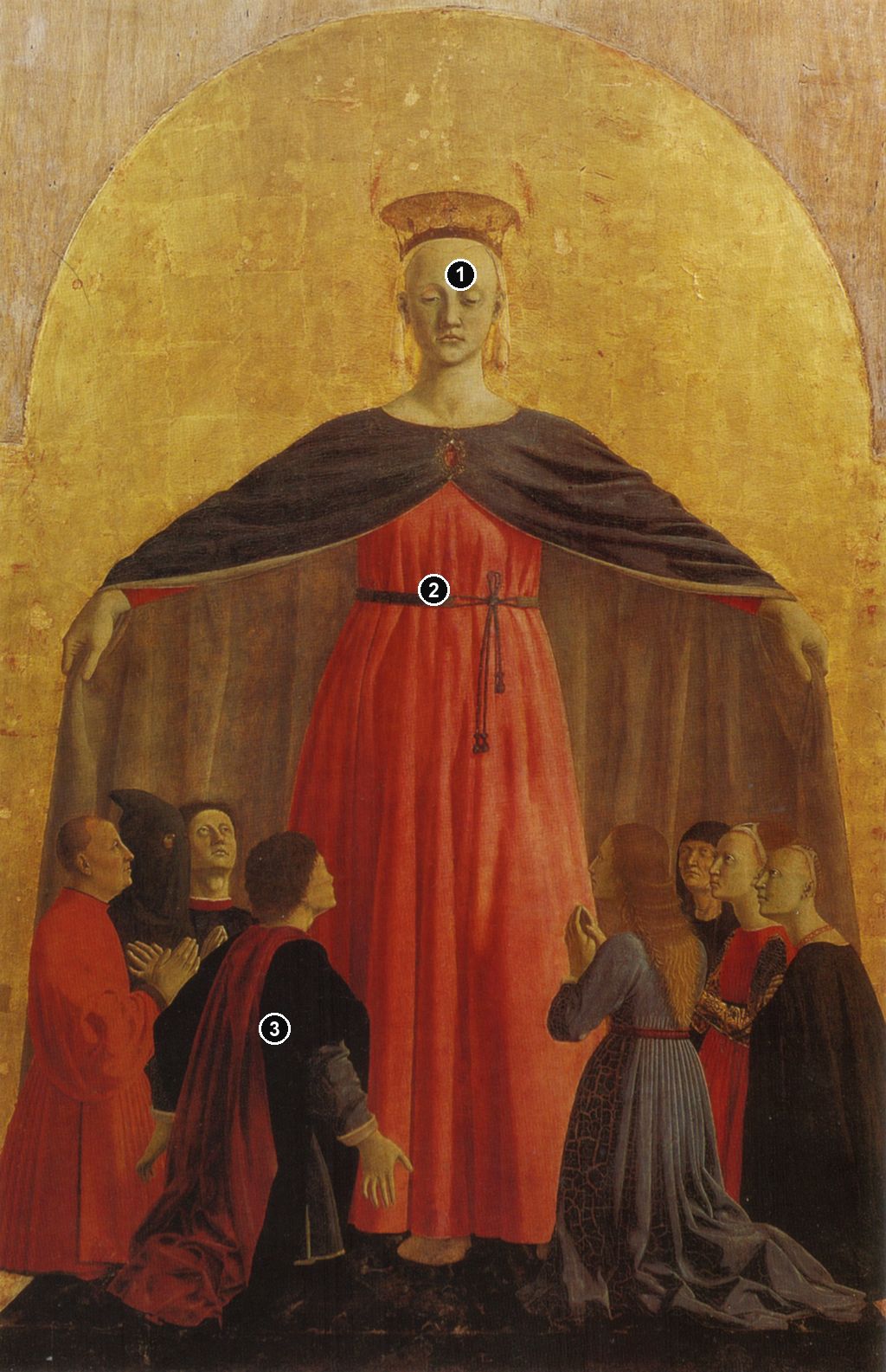
Details from POLYPTYCH OF THE MISERICORDIA
Compare the cropped details with the source images above. Notice how their colours, shapes and positions contribute to the larger compositions.
The gilded upper field
The Virgin’s head and crown are set beneath the rounded field of gold. Dots and incisions catch enough light to separate the halo from the surface around it.
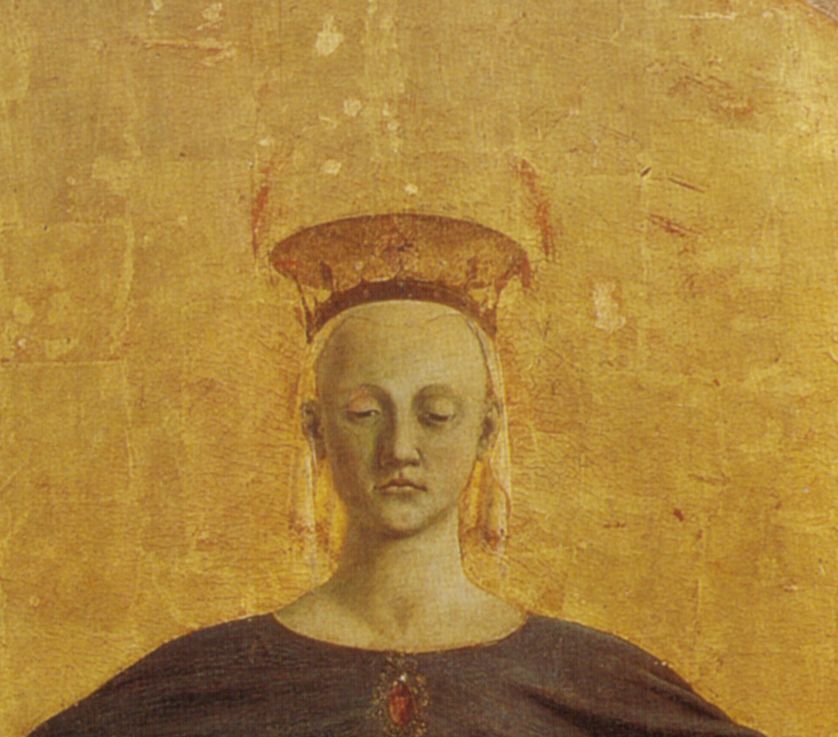
The arms and mantle
The Virgin stretches a dark mantle out to both sides. Its folds echo the large outline of the painted panel while sheltering the kneelers below.
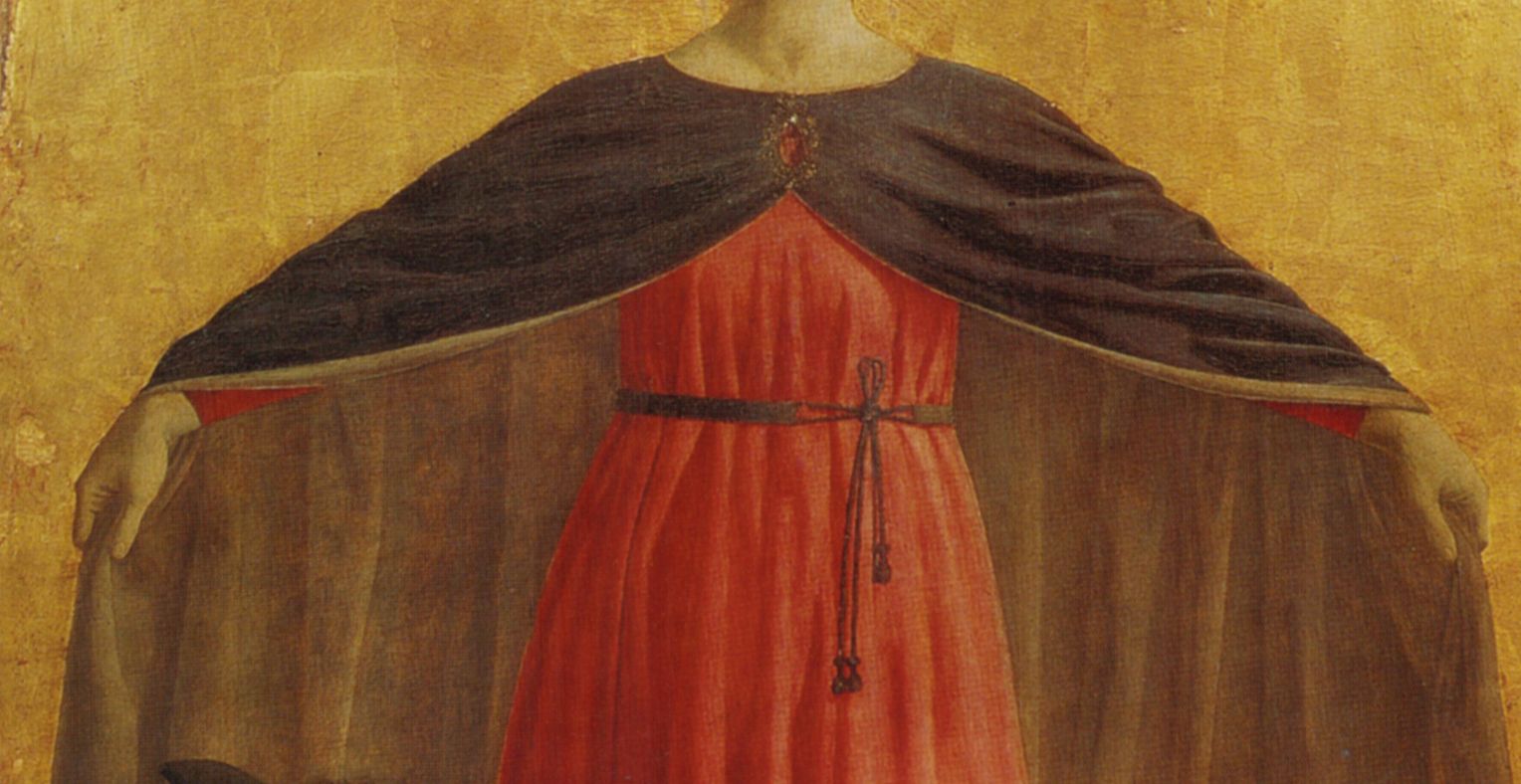
Figures under the mantle
Faces overlap in a shallow cluster under the left side of the mantle. Their eyes and profile angles remain legible even where their bodies overlap.
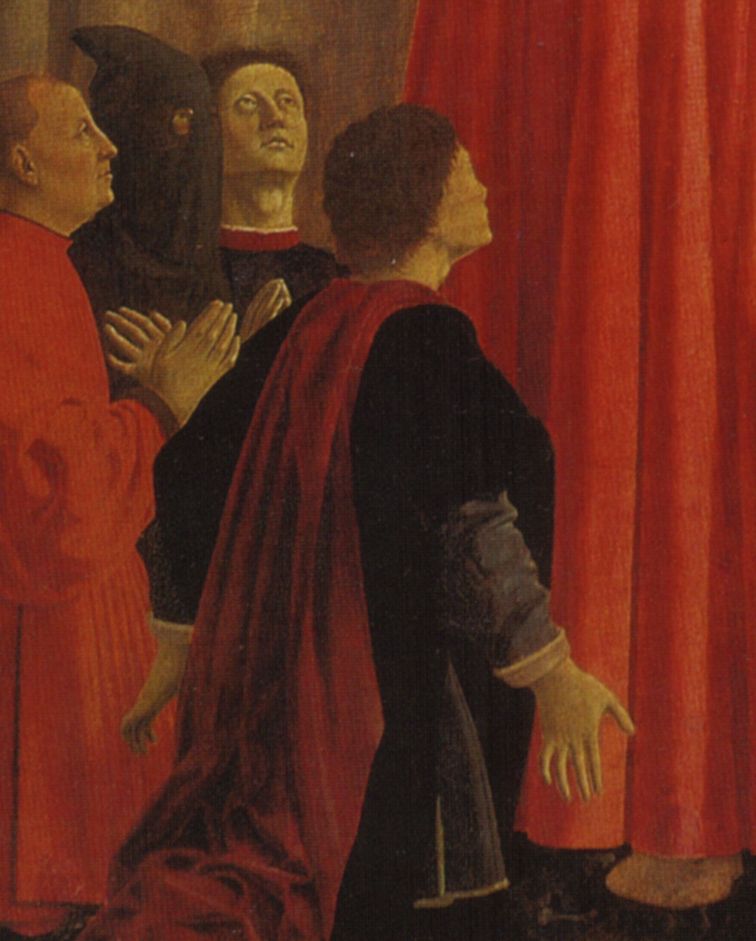
Under the Virgin’s mantle
Mary stands frontally in a red dress. The borders of her mantle sweep downward on either side while the fall of the central dress, the knot at her waist and the upright position of her head keep the picture firmly centred. Four men kneel to the viewer’s left and four women to the right. Their overlap gives the groups depth, and individual figures turn or lift their heads at different angles. On the men’s side, the partly obscured face of an upward-looking man catches the light beside a dark hood. On the other side the nearest woman turns towards Mary, so that the eye follows her prayer inwards. The setting beyond the group is gold. The shelter itself has volume because the drapery bends around people who occupy different positions beneath it. [1] [4] [10]
The Madonna of Mercy was a familiar subject in which Mary interceded for those who sought protection. Her increased size makes it possible to show a whole community gathered under a single garment. For a company responsible for tending vulnerable townspeople, the action also gave visible form to the work of mercy. Machtelt Israëls has drawn attention to the knotted cords at Mary’s waist, which differ from her simpler belt in the Annunciation above. Israëls suggests that they may evoke concord, an association she grounds in other images and in a fifteenth-century devotional text belonging to another Sansepolcro confraternity. The detail is easily overlooked amid the sweeping folds, yet it sits on the axis around which the two groups gather. [4]
The kneelers are painted with enough individuality to have prompted attempts to name them. The upward-looking man on the left is often proposed as Piero, and comparison has been made with a sleeping guard in his Resurrection, also at the Museo Civico. The Metapictor project at the University of Innsbruck records competing identifications and shows how the supposed resemblance has been disputed. The comparison between the two paintings still rewards close looking, especially in the different ways Piero uses a tilted head to suggest a person’s place within a group. The kneeler’s name remains uncertain. [10]
Diane Cole Ahl places the Madonna within a local tradition of devotional sculpture. Records of the 1430s refer to a lost image of the Virgin, probably a statue, that figured in the confraternity’s rites. Candles were bought for processions, and on Maundy Thursday the brothers ceremonially removed the Madonna’s finery. Ahl suggests that this earlier object may have supplied a precedent for Piero’s stately figure. The low view of the Virgin’s face and the way her dress falls vertically make her seem almost like a carved figure seen from a worshipper’s position. The proposal connects the panel’s appearance to practices already familiar to the people who commissioned it. [11]
From the flanking saints to the Crucifixion
On the left stand Saint Sebastian and Saint John the Baptist. On the right are Saint John the Evangelist and Saint Bernardine of Siena. Sebastian’s exposed body and arrows identify the martyr. The Baptist’s gesture sets up a movement towards the central axis of the altarpiece, while the book held by the Evangelist refers to his writing. Israëls links the Evangelist to the town that honoured him as patron and the Baptist to Florence, which gained control of Sansepolcro in 1441. The inclusion of the recently canonised Bernardine and the presence of Saint Francis in the upper register also suit a commission with close connections to the Franciscan community. [4] [6] [12]
Above the main saints, the Angel Gabriel and the Virgin Annunciate occupy separate compartments on either side of the Crucifixion. The conservation study identifies the outer saints as Benedict and Francis. In the centre Christ’s outstretched arms are echoed by the gestures of the two mourners, the Virgin and John the Evangelist. The mourners’ raised arms and the compressed group make this small compartment especially legible from below. It invites comparison with Masaccio’s Crucifixion, made for the upper part of an altarpiece at the Carmine in Pisa and now in the Museo di Capodimonte. Both painters use an emphatic cross and strong gestures on gold to make a scene near the top of a vertical ensemble carry its full weight. [4] [12] [13]
Six smaller saints and two confraternity devices occupy the narrow outer supports. The five scenes in the base, or predella, show the Agony in the Garden, the Flagellation, the Entombment, the women at the tomb and Christ’s encounter with Mary Magdalene after the Resurrection, known as the Noli me tangere. The Crucifixion appears above the Madonna instead of within the predella. Israëls argues from historic descriptions and comparisons that the original narrative began from the viewer’s right. In her reading the eye rises from the predella at the centre, meets Mary and the Crucifixion, then returns to the remaining scenes below. The sequence is a scholarly reconstruction, and it adds a way of reading the image of intercession alongside the episodes of Christ’s suffering and Resurrection. [4] [12] [14]
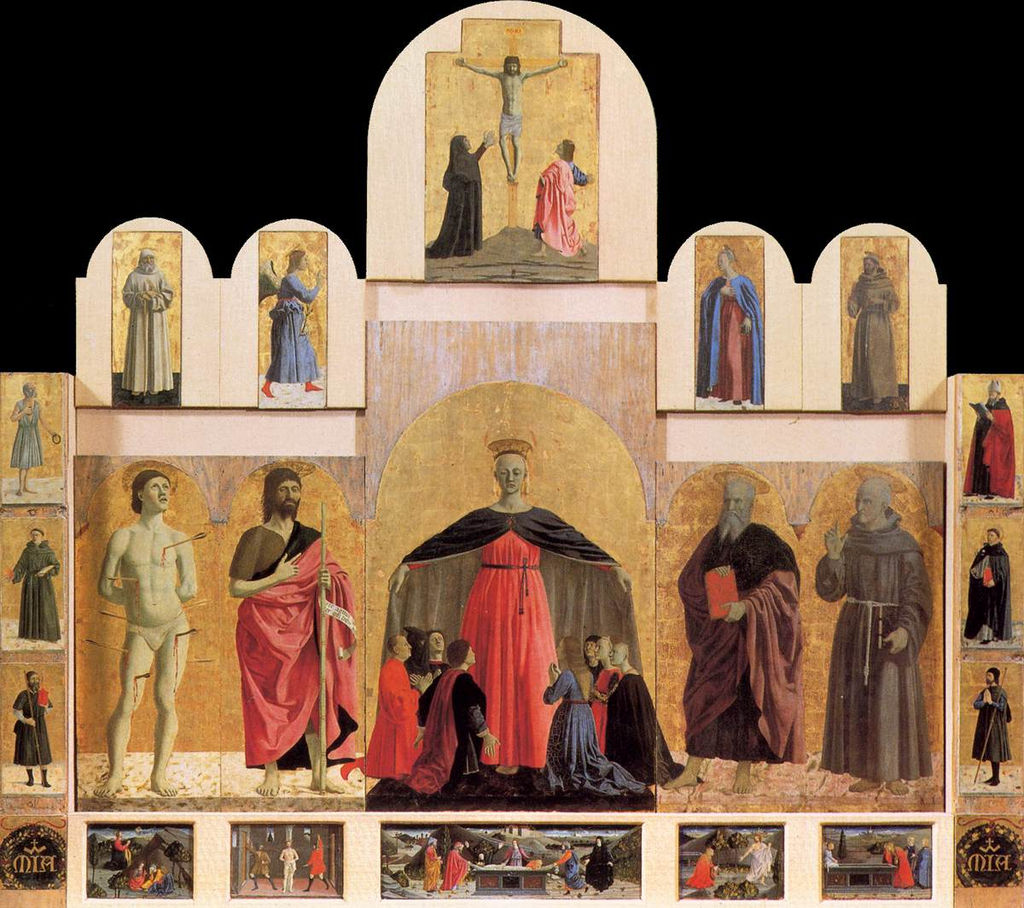
The assembled Misericordia Polyptych, Museo Civico, Sansepolcro. Image source. Public domain. Resized only; native appearance preserved.
What gold, paint and wood can tell us
A cross-section of the gilding beside John the Evangelist shows how the contractual demand for fine gold was met in a specific area. Under the microscope, the gold occupies a layer only a few micrometres thick. Beneath it are bole, a fine clay preparation used for gilding, and several coats of gypsum ground. Analysis of the same sample detected pure gold. In a sample from the blue clothing of a kneeling woman, the scientists identified lapis lazuli with lead white. Gold and ultramarine, the expensive materials named in the contract, can thus be traced to particular places on the painted surface. [2] [15]
Piero made the main figures share a shallow space despite the gold behind them. Follow the floor under the saints across the central register, looking where the cloak and the kneelers meet the adjoining compartments. Roberto Bellucci and Cecilia Frosinini found extensions, including part of the mantle and details of feet, added over previously painted floor colour near the joins. They interpret those touches as an effort to tie the central panel and its neighbours together. On the right, the Evangelist’s tilted halo also catches a painted reflection of his face. Pigment analysis found that the reflected area lacks the vermilion detected in the flesh it mirrors, consistent with the cooler tone Piero gave the reflection. Here a gold disc functions as a surface that seems to respond to a figure in space. [6] [16]
Examining the surface and radiographs together, Bellucci and Frosinini found that paint and gold meet very precisely in the main and upper compartments, even around the fingers of the Virgin in the Crucifixion. They observed no incised outlines serving as boundaries between the gold and paint in those figures. The small saints on the outer supports, by comparison, have fine incised contours. That difference in preparation supports the distinction between Piero’s principal panels and work by another hand in the margins. In the predella, the pigment studies also found differences in how similar passages were made. The researchers detected lead-tin yellow in Mary Magdalene’s hair in the Noli me tangere and the women-at-the-tomb scene, but not in the tested passage of her hair in the Entombment. The difference helps researchers group passages by painting practice. Identification of individual painters still depends on independent evidence. [6] [16]
The predella has traditionally been associated with Giuliano Amidei. Banker considers Amidei a plausible collaborator because the Camaldolese monk was in Sansepolcro while work was under way and was paid to paint a monogram for the company. That documented task places him in the company’s orbit without settling the attribution of the five scenes. Art-historical comparisons have also led scholars to question the attribution to Amidei. The devotional programme can be read as a whole while the responsibility for individual details, passages and marginal panels remains open. [3] [8] [16]
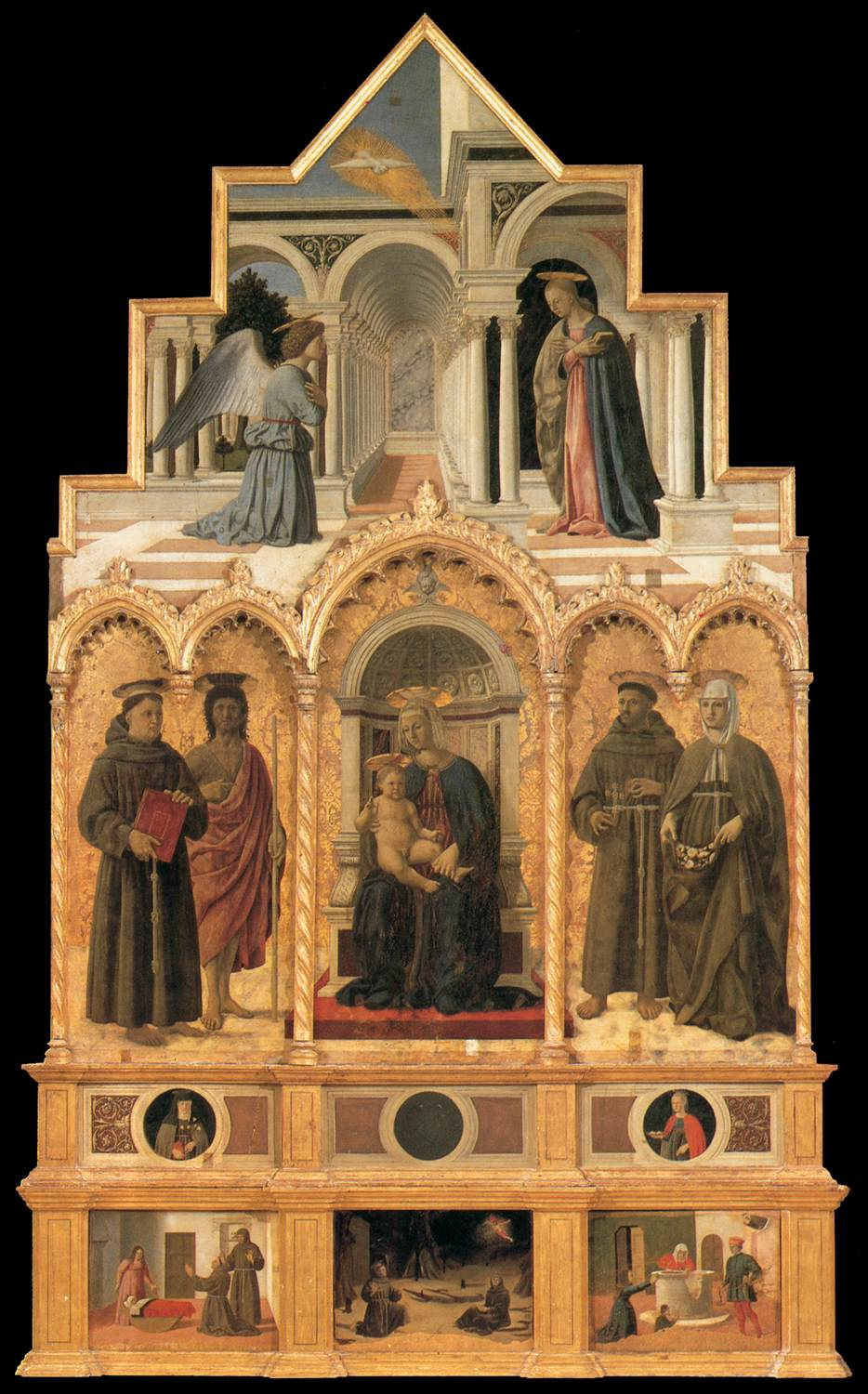
Sant’Antonio Polyptych in its current assembly, Galleria Nazionale dell’Umbria, Perugia. Image source. Public domain. Resized only; native appearance preserved.
From church furnishing to museum display
The current altarpiece brings together pieces that were altered for different settings. By 1635 a pastoral visitation described a large wooden altar incorporating Piero’s paintings. Nineteenth-century inventories show how far that arrangement departed from the continuous base one might expect: the smaller scenes appeared on the bases of columns and the Entombment was set apart at the centre. The original fifteenth-century framework was lost, and edges of several paintings were cut down. Reassembly began before the work entered the civic collection in 1901. The Museo Civico records the completion of conservation treatment in 2010 and dates the present arrangement to the study and reassembly in 2014. [1] [7] [14] [17] [18]
The backs and edges of the boards supplied clues that could never be read from the painted faces alone. Ciro Castelli and Andrea Gori compared wood grain, old cuts and dowels visible in X-rays. In the case of the Madonna and the Crucifixion, the alignment included regularly spaced dowels. The team used those features to infer that both scenes belonged to one original support, with the boards narrowing where they rose from the larger Madonna to the smaller Crucifixion. They also found evidence for connecting the areas of the upper saints with the panels below. That research changes how the work can be imagined: its visual tiers were originally integrated into the construction of the wood itself. [12] [17]
The new display uses shaped additions to give a sense of the missing areas while keeping the cut outlines of the historic panels distinguishable. To work out the extent of Gabriel’s lost wing, the team drew on Piero’s Annunciation in the Sant’Antonio Polyptych at Perugia and consulted an angel in the True Cross cycle at Arezzo for the cut area. The museum mount thus lets the eye follow relationships across the boards while retaining observable traces of their separation. Viewing the ensemble whole and then returning to the mantle, the saint panels and the predella in turn makes its scale and assembly clearer. Other works in the guide to Piero’s paintings show how he adjusted figures and gestures to very different settings. [1] [17]
Browse the artworks
Compare Piero’s frescoes, panels and manuscript figures. The list includes ensembles and separately identifiable panels or scenes. Dates are approximate where the sources differ.
| Name | Date | Medium and source |
|---|---|---|
| The Baptism of Christ | Probably c. 1437–45 | Panel painting Catalogue. |
| The Flagellation of Christ | 1459–60 (GNDM) | Panel painting Catalogue. |
| The History of the True Cross | Mid-fifteenth century | Wall painting Catalogue. |
| Dream of Constantine | Mid-fifteenth century | Wall painting Catalogue. |
| The Duke and Duchess of Urbino | About 1473–75 (Uffizi) | Panel painting Catalogue. |
| The Resurrection | About 1458–68 (Opificio) | Wall painting Catalogue. |
| Brera Madonna | About 1472–74 | Panel painting Catalogue. |
| Annunciation at Arezzo | Mid-fifteenth century | Wall painting Catalogue. |
| Madonna del Parto | About 1450–65 (Monterchi) | Wall painting Catalogue. |
| Polyptych of the Misericordia | Commissioned 1445 | Panel painting Catalogue. |
| The Nativity | Early 1480s (National Gallery) | Panel painting Catalogue. |
| Madonna di Senigallia | About 1474–75 (GNDM) | Panel painting Catalogue. |
| Death of Adam | Mid-fifteenth century | Wall painting Catalogue. |
| Queen of Sheba | Mid-fifteenth century | Wall painting Catalogue. |
| Victory of Constantine | Mid-fifteenth century | Wall painting Catalogue. |
| Battle between Heraclius and Chosroes | Mid-fifteenth century | Wall painting Catalogue. |
| Saint Mary Magdalen | Wall painting Catalogue. | |
| The Augustinian Polyptych | 1454–69 | Panel painting Catalogue. |
| Polyptych of Perugia | About 1467–69 (GNU) | Panel painting Catalogue. |
| Perugia Annunciation | About 1468–70 (national catalogue) | Panel painting Catalogue. |
| St Francis and St Elizabeth | About 1467–69 (GNU) | Panel painting Catalogue. |
| Stigmatisation of St Francis | About 1468–70 (national catalogue) | Panel painting Catalogue. |
| An Augustinian Nun (Saint Monica) | 1454–69 | Panel painting Catalogue. |
| Augustinian Saint | 1454–69 | Panel painting Catalogue. |
| Saint Michael | 1454–69 | Panel painting Catalogue. |
| Saint Nicholas of Tolentino | 1454–69 | Panel painting Catalogue. |
| Saint John the Evangelist | 1454–69 | Panel painting Catalogue. |
| Virgin and Child Enthroned with Four Angels | About 1460–70 (Clark) | Panel painting Catalogue. |
| Portrait of Sigismondo Pandolfo Malatesta | About 1450–51, often proposed. Louvre catalogue range 1450–75. | Panel painting Catalogue. |
| Sigismondo before St Sigismund | 1451 | Wall painting Catalogue. |
| St Jerome and a Donor | 1460s (Accademia); about 1450 also proposed | Panel painting Catalogue. |
| St Jerome in Penitence | 1450, dated on the panel | Panel painting Catalogue. |
| Saint Julian | About 1455–60, often proposed | Wall painting Catalogue. |
| Saint Augustine | 1454–69 | Panel painting Catalogue. |
| Saint Apollonia | 1454–69 | Panel painting Catalogue. |
| Crucifixion from the Augustinian Polyptych | 1454–69 | Panel painting Catalogue. |
| Saint Louis of Toulouse | Wall painting Catalogue. | |
| Burial of the Wood | Mid-fifteenth century | Wall painting Catalogue. |
| Discovery and Proof of the True Cross | Mid-fifteenth century | Wall painting Catalogue. |
| Exaltation of the Cross | Mid-fifteenth century | Wall painting Catalogue. |
| Saint Anthony Raises a Child | About 1467–69 (GNU) | Panel painting Catalogue. |
| Saint Elizabeth Revives a Child | About 1467–69 (GNU) | Panel painting Catalogue. |
| Hercules | About 1470 | Wall painting Catalogue. |
| Portrait of a Boy (possibly Guidobaldo da Montefeltro) | Panel painting Catalogue. | |
| De prospectiva pingendi, Reggio Emilia witness (figures) | Manuscript diagrams Catalogue. | |
| The Interrogation of Judas | Mid-fifteenth century | Wall painting Catalogue. |
| Two prophets, Bacci Chapel | Mid-fifteenth century | Wall painting Catalogue. |
| Saint Clare of Assisi, upper predella | About 1467–69 (GNU) | Panel painting Catalogue. |
| Saint Agatha, upper predella | About 1467–69 (GNU) | Panel painting Catalogue. |
| Lost centre of the Augustinian Polyptych | 1454–69 | Lost panel or panels Catalogue. |
Frequently Asked Questions
The confraternity commissioned it in 1445 and specified three years for delivery. Records show a much longer project, and the main phase of painting may have taken place around 1460–61. The date of installation around 1461–62 is an inference, while financial documents continue into the later 1460s. [2] [3] [7]
The attribution of the predella remains debated. It has historically been linked to Giuliano Amidei, and his documented work for the confraternity makes the proposal plausible. Study of the five scenes reveals differences in technique, and the identity of their painter or painters remains uncertain. [3] [8] [16]
It is displayed in the Museo Civico in Sansepolcro, the town for which the confraternity commissioned it. The museum’s multimedia guide identifies the room dedicated to the polyptych. [1]
Discussion
Look again at the images and ideas explored in Polyptych of the Misericordia by Piero della Francesca. These editorial prompts invite your observations.
Reader Insights
Where does the Virgin’s mantle seem to come closest to the viewer? Which painted details make the space beneath it feel deep?
What changes in the way you read the altarpiece if you begin with the predella and look up to the Crucifixion before returning to the scenes below?
What can the surviving joinery establish about the original altarpiece, and what still depends on comparison with other works?
Join the Conversation
Share a detail, comparison or question about Polyptych of the Misericordia by Piero della Francesca below.
References
- Museo Civico di Sansepolcro. “Polittico della Madonna della Misericordia.” Multimedia museum guide. View source.
- Archivio di Stato di Firenze, Notarile Antecosimiano 7026, ff. 92r–v. Confraternity commission, 1445. Italian Renaissance Document Site, document 68. See also the Latin transcription in Banker, document 17. View source 1. View source 2.
- James R. Banker. “Documenti relativi alla compagnia di Santa Maria della Misericordia e alla tavola di Piero della Francesca.” In Mariangela Betti, Cecilia Frosinini and Paola Refice, eds., Ripensando Piero della Francesca. Il Polittico della Misericordia di Sansepolcro, pp. 15–29. Florence, 2010. View source.
- Machtelt Israëls. “Commissioni parallele e narrazioni insolite: Piero della Francesca e il Sassetta a Borgo San Sepolcro.” In Ripensando Piero della Francesca, pp. 99–115. 2010. View source.
- Christa Gardner von Teuffel. “Piero della Francesca: la Madonna della Misericordia. I contratti artistici: esame e contestualizzazione.” In Ripensando Piero della Francesca, pp. 71–84. 2010. View source.
- Roberto Bellucci and Cecilia Frosinini. “La pianificazione dell’opera e il disegno preparatorio nel Polittico della Misericordia.” In Ripensando Piero della Francesca, pp. 189–202. 2010. View source.
- Andrea Gori. “La chiesa e l’oratorio dell’ospedale della Misericordia: due ambienti per il polittico di Piero della Francesca.” In Ripensando Piero della Francesca, pp. 43–55. 2010. View source.
- Andrea Di Lorenzo. “I Pichi di Sansepolcro e le loro commissioni artistiche nel Quattrocento.” In Ripensando Piero della Francesca, pp. 85–97. 2010. See also the National Gallery’s catalogue entry for Saint Michael from the Augustinian altarpiece. View source 1. View source 2.
- Museo Poldi Pezzoli. Il polittico agostiniano riunito, exhibition research dossier. Milan, 2024. View source.
- University of Innsbruck, Metapictor. “Schutzmantelmadonna.” View source.
- Diane Cole Ahl. “The Misericordia Polyptych: Reflections on Spiritual and Visual Culture in Sansepolcro.” In Jeryldene M. Wood, ed., The Cambridge Companion to Piero della Francesca, pp. 14–29. Cambridge University Press, 2002. View source.
- Ciro Castelli and Andrea Gori. “Il Polittico della Misericordia: indagini conoscitive e intervento conservativo.” In Ripensando Piero della Francesca, pp. 145–168. 2010. View source.
- Museo e Real Bosco di Capodimonte. “Capodimonte oggi racconta… la Crocifissione di Masaccio.” View source.
- Paola Refice. “Il Polittico della Misericordia: vicende conservative dall’Ottocento al primo Novecento. Aggiunte documentarie.” In Ripensando Piero della Francesca, pp. 35–41. 2010. View source.
- Fabio Talarico, Giancarlo Sidoti and Pierluigi Bianchetti. “Le sezioni stratigrafiche del Polittico della Misericordia nell’archivio dell’ISCR: analisi SEM-EDS e ‘rilettura’ al microscopio ottico.” In Ripensando Piero della Francesca, pp. 179–188. 2010. View source.
- Pietro Moioli, Claudio Seccaroni, Lara Boselli et al. “Caratterizzazione dei materiali pittorici del Polittico della Misericordia mediante analisi non invasive.” In Ripensando Piero della Francesca, pp. 169–178. 2010. View source.
- Rossella Cavigli. “Piero della Francesca. Polittico della Misericordia (1445–1462): restauro e studio per la ricomposizione del polittico nel suo nuovo allestimento museale.” Museo nazionale d’arte medievale e moderna di Arezzo, restoration dossier. View source.
- Museo Civico di Sansepolcro. “Restauri effettuati.” Entry for 2010. View source.
Related Paintings
The Augustinian Polyptych
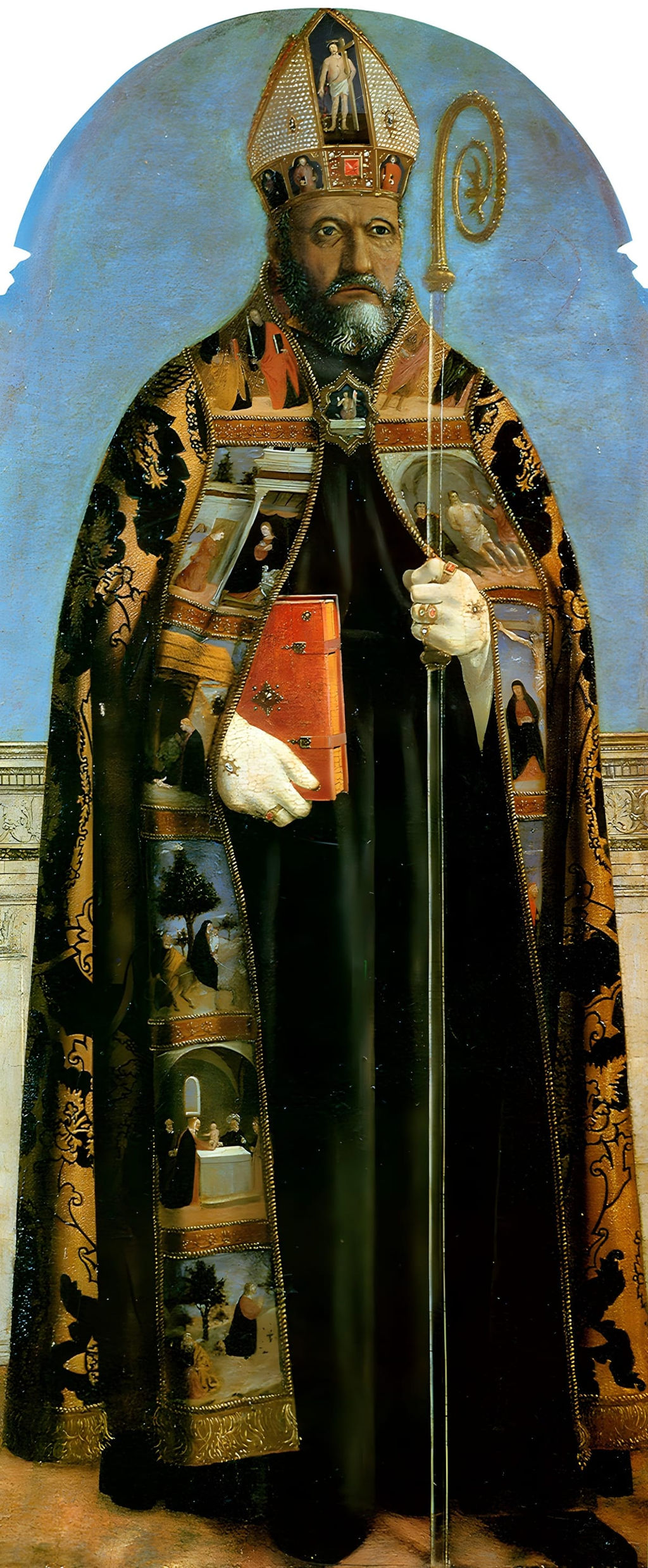
Piero della Francesca, Saint Augustine, surviving panel from the Augustinian Polyptych, Lisbon. Image source. Public domain. Resized only; native appearance preserved.