 by Tom Gurney
Tom Gurney BSc (Hons) is an art history expert with over 20 years experience
Published on June 19, 2020 / Updated on October 14, 2023
Email: tomgurney1@gmail.com / Phone: +44 7429 011000
Saint Jerome in Penitence: Introduction
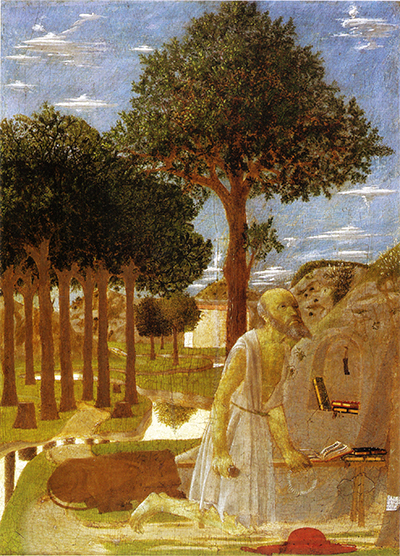
Saint Jerome kneels on stony ground, holding prayer beads in his left hand and lifting a stone towards his bare chest with his right. His head is raised towards a small crucifix attached to a tree. Behind him, slender trunks reflect in a river that bends away towards low hills. Piero della Francesca signed and dated the picture on a little painted slip of paper attached to the trunk at the lower right. This is the chestnut panel of 1450 in Berlin’s Gemäldegalerie, also known as Saint Jerome in the Wilderness. Its landscape is as rewarding to examine at close range as the few objects Jerome has brought to his retreat. [1] [2]
At a Glance
- ArtistPiero della Francesca [1]
- Date1450, inscribed on the panel [1]
- MediumTempera on chestnut [2]
- Dimensions51 × 38 cm, or 58.8 × 46 cm with the original frame [1] [2]
- CollectionGemäldegalerie, Staatliche Museen zu Berlin, inventory 1904 [1]
- AcquisitionGift of Henryk Lion in 1922 [1]
This work across Piero della Francesca’s career
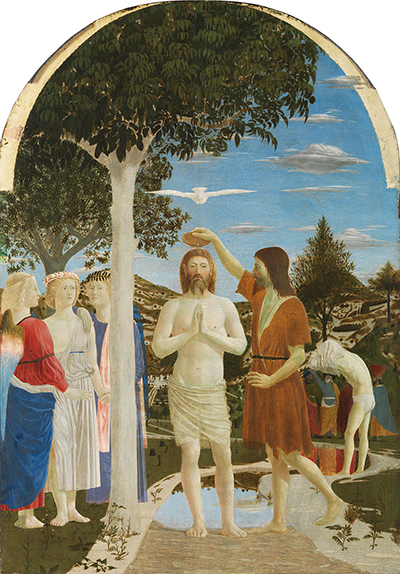
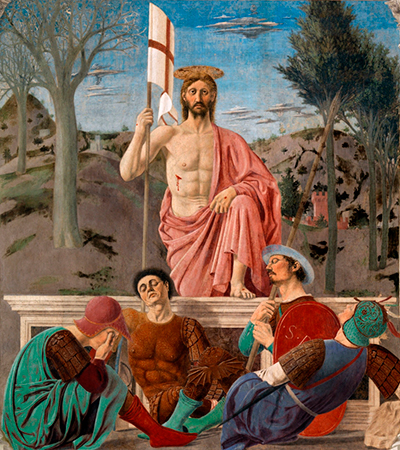
The Baptism of Christ
Probably about 1437–45Saint Jerome in Penitence (current article)
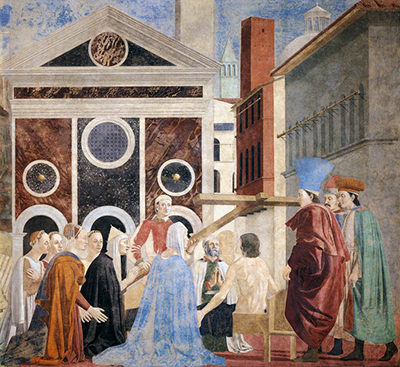
1450, dated on the panelThe History of the True Cross
Mid-fifteenth centuryThe Resurrection
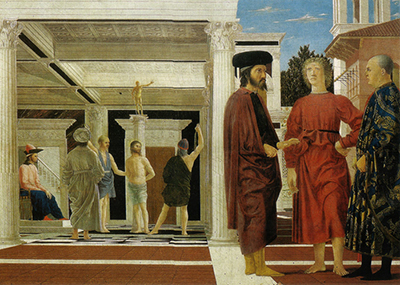
About 1458–68 (Opificio)The Flagellation of Christ
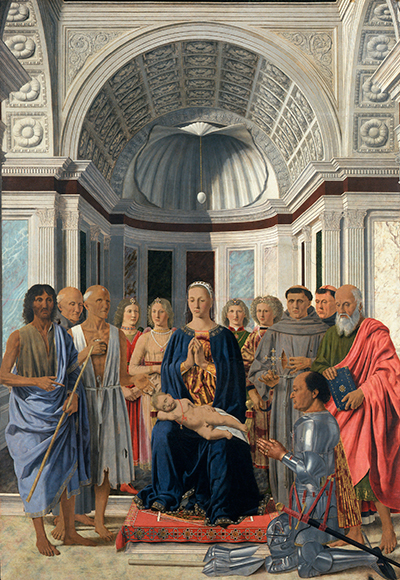
1459–60 (GNDM)The Montefeltro Altarpiece
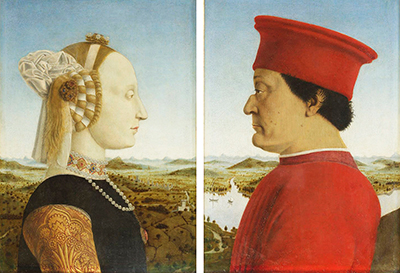
About 1472–74 (Brera)The Duke and Duchess of Urbino
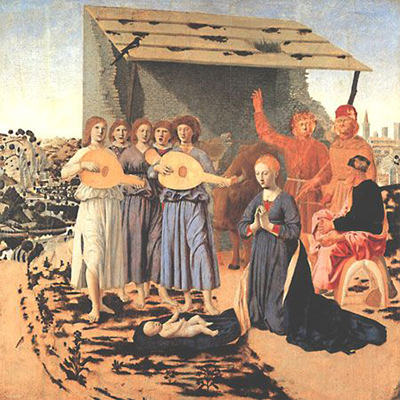
About 1473–75 (Uffizi)The Nativity
Early 1480s (National Gallery)Contents
- What Jerome takes into the wilderness
- How the trees measure distance
- What the date tells us about Ancona
- Two ways the composition was taken further
- Annotated details
What Jerome takes into the wilderness
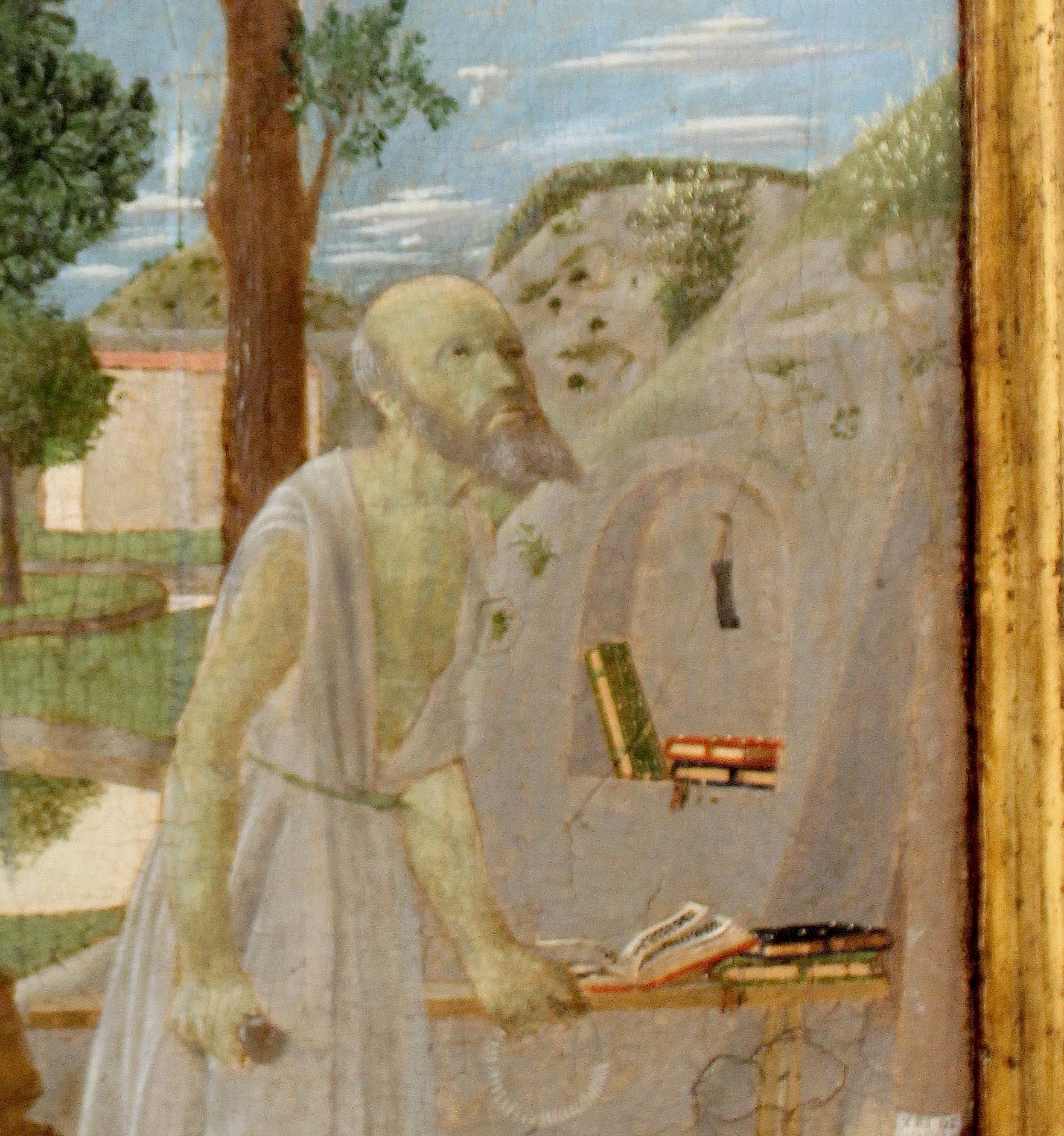
The gestures of the two hands give the painting its subject. The beads mark the progress of prayer. The stone is for striking the breast in penitence, a gesture of remorse practised here in solitude. Jerome’s raised face directs attention to the crucifix. The cross is thin enough to be easy to miss amid the branches and trunk. Once found, it explains the slight backward tilt of the head and the direction of the saint’s gaze. The hardness of the ground, the rough cloth and the stone in his hand make the practical demands of his retreat palpable. [1] [2]
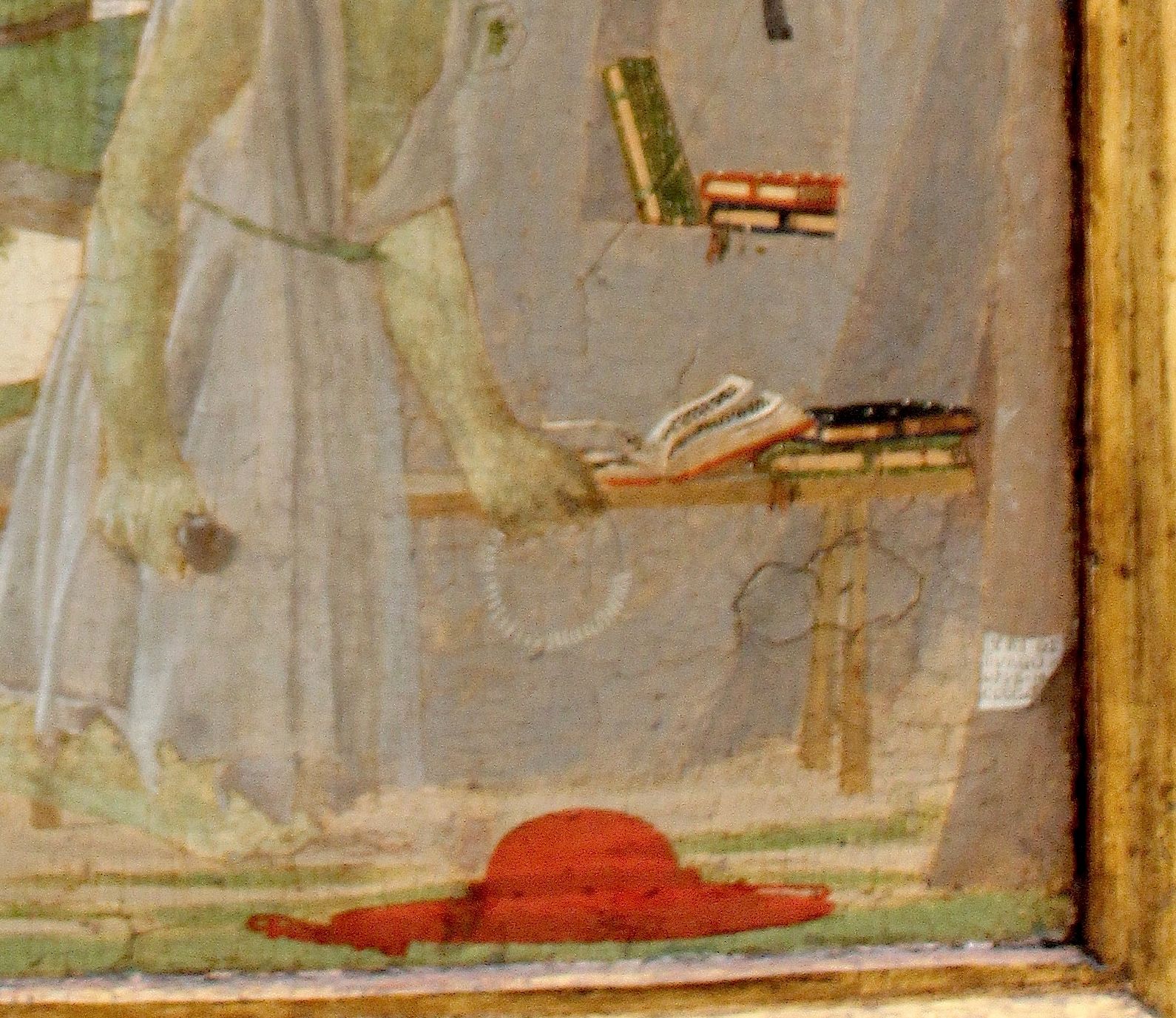
A few steps away, Piero gives Jerome the equipment of a scholar. Books and a case for writing tools sit in a niche in the rock. On a plain wooden bench are further volumes, including one lying open with its pages lifting. The niche makes a small library out of the rock face, while the open volume suggests work recently interrupted. Jerome, who lived in the fourth and early fifth centuries, is best known for his work on the Latin Bible associated with the Vulgate. The placement of the books within sight of the crucifix gives study and prayer a place in the same daily routine. [2] [3]
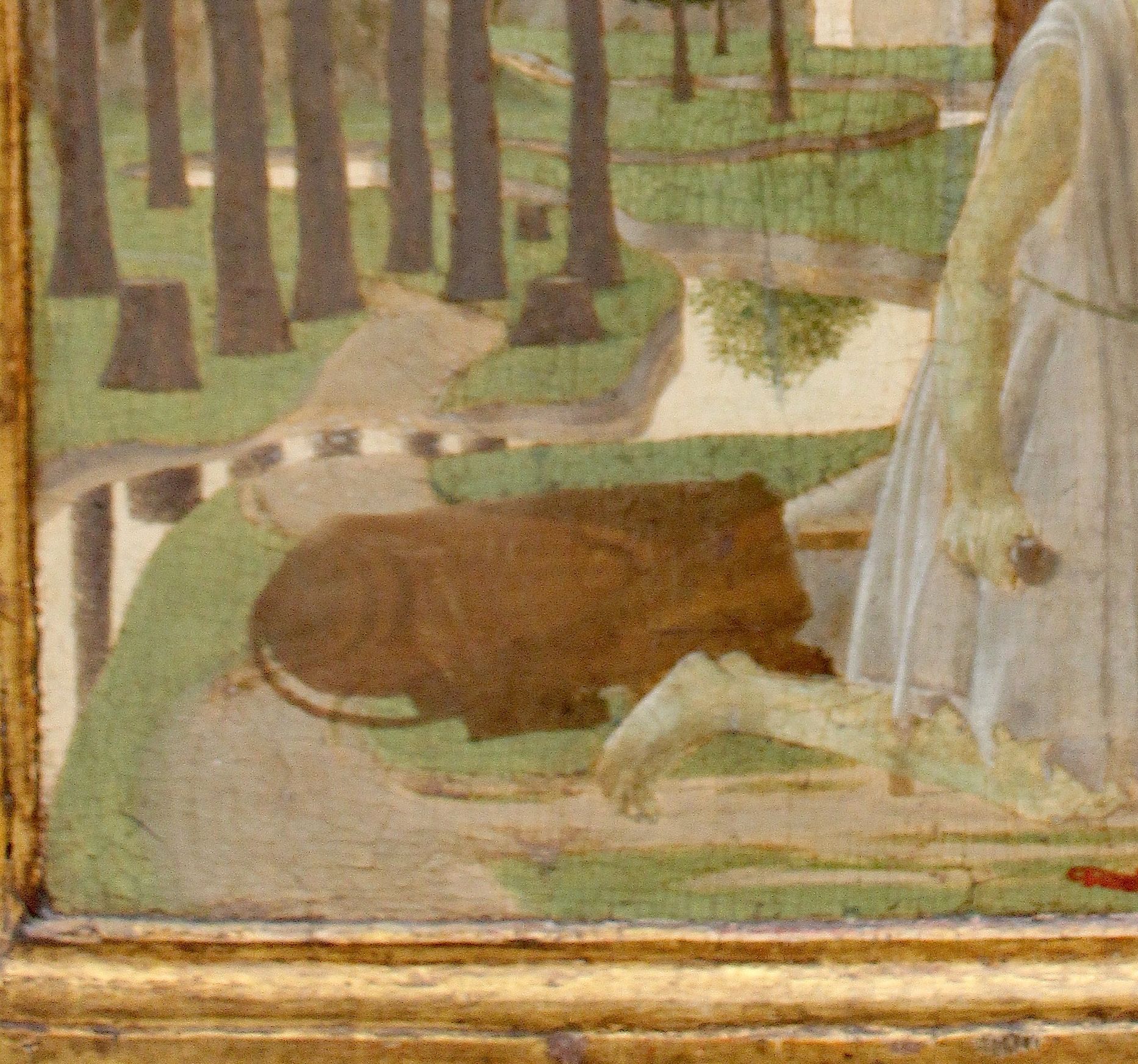
Look low down for two more clues to his identity. The red, broad-brimmed hat is the cardinal’s galero, a convention of later Christian art that associates Jerome with authority in the Church. The office of cardinal in the sense evoked by the hat came later. Jerome served Pope Damasus in Rome, and painters could use familiar ecclesiastical dress to make that standing legible to their own audiences. In this picture the hat lies on the ground, a flash of colour away from his body. The lion at the lower left is far harder to see because the paint in that area is poorly preserved. In legend, Jerome drew a thorn from its paw, and the animal then became his companion. Both attributes belong to a lifetime of stories a viewer could bring to this single moment of prayer. [1] [2] [3]
How the trees measure distance
The space opens up to the left of the saint. Start with the trunk carrying the crucifix and the signature, then compare its size with the slimmer trees farther back. They divide the view into intervals. Below them, the reflections continue their vertical lines into the water, where the course of the river leads the eye sideways and into depth. The distant hills and light streaks of cloud extend the view again. Piero gives the land the order of a composition without suppressing the irregular edges of the trees or the shapes of their crowns. [1] [2]
The interval between Jerome and the distant landscape matters to the subject. His knees touch a patch of dry, thin soil close to the picture plane. Across the river the landscape opens into softer forms, with enough trees and water to make the retreat seem habitable. Keith Christiansen of the Metropolitan Museum of Art has suggested that Piero recalled the upper Tiber Valley, with the Apennine foothills beyond. He reads the small building in the distance as an allusion to Jerome’s hermitage near Bethlehem. These readings can coexist. Piero had a way of making the terrain of a sacred story look familiar to an Italian viewer, even when the story took place elsewhere. In The Baptism of Christ, painted for a church in Sansepolcro, a winding channel and trees of diminishing size do comparable work. The scale here brings the reflected trunks and the things on Jerome’s bench within the same intimate field of view. [2] [4]
Much of the landscape’s organisation was once harder to see. Berlin records that conservators removed old overpaint from the background during a treatment begun in 1968, exposing Piero’s tree crowns and the fine clouds. Christiansen notes that earlier cleaning had already worn the paint surface, and that the extent of the repainting had made some scholars doubt the attribution. The landscape recovered in treatment helped make it possible to judge the painting again. Its present surface reflects both discoveries and losses. The faintness of the lion, for example, offers a poor measure of how readily Piero’s first viewers could have recognised it. [1] [2]
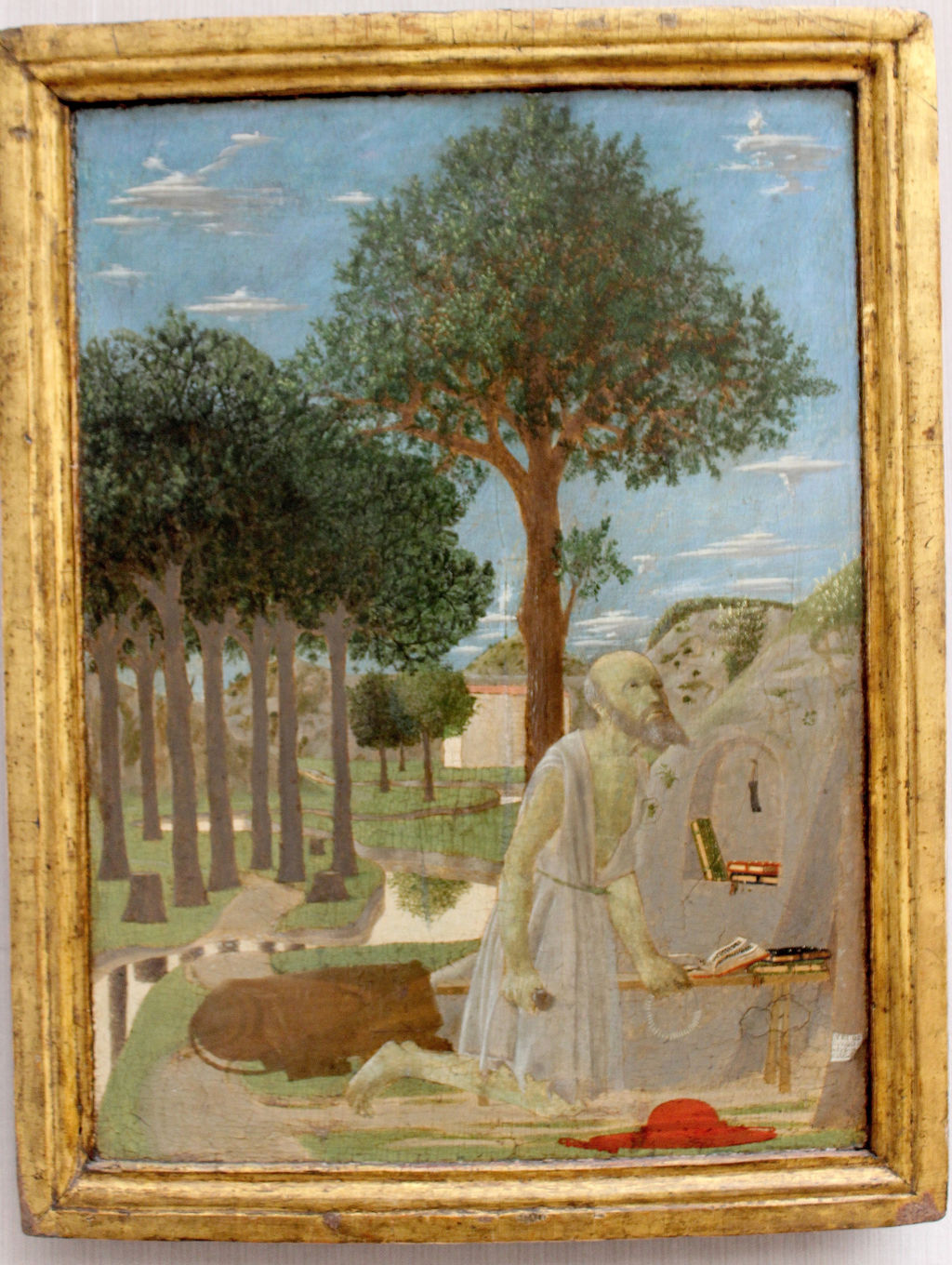
Piero della Francesca, Saint Jerome in Penitence, Gemäldegalerie, Berlin. Miguel Hermoso Cuesta. Image source. CC BY-SA 4.0. Resized from the source. This reproduction uses CC BY-SA 4.0.
Annotated Details from Saint Jerome in Penitence
The numbered points identify visible features discussed in this article. Return from each detail to the numbered overview. Piero della Francesca, Saint Jerome in Penitence, Gemäldegalerie, Berlin. Miguel Hermoso Cuesta. Image source. CC BY-SA 4.0. The numbered overview and detail crops are adaptations under CC BY-SA 4.0.
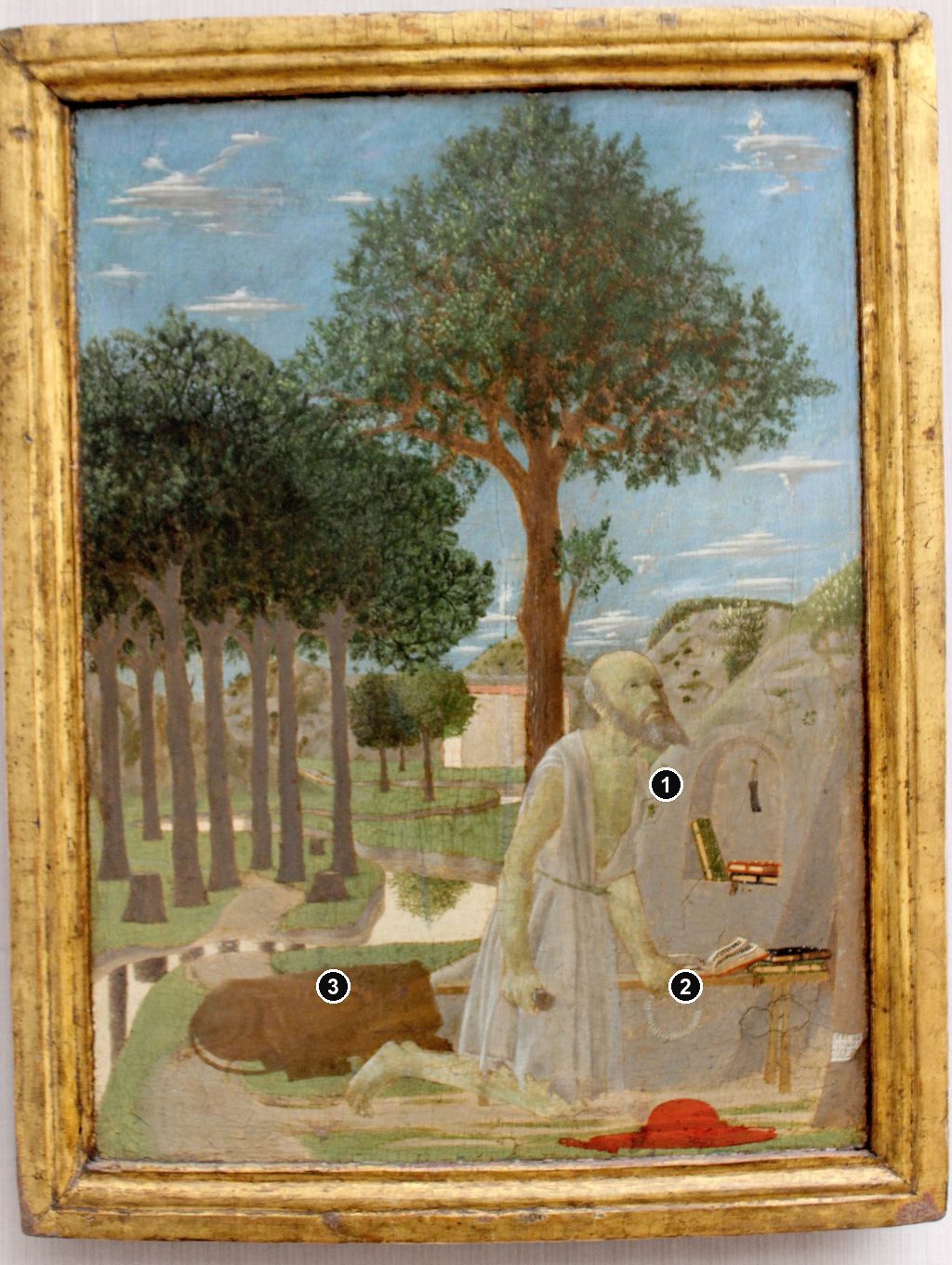
Details from SAINT JEROME IN PENITENCE
Compare the cropped details with the source images above. Notice how their colours, shapes and positions contribute to the larger compositions.
Jerome beside the rocks
Jerome kneels low in profile against the pale rocks. His figure is partly edged by the tall tree and its dense foliage.
Books and the discarded hat
Books sit in recesses and on a ledge cut into the rock. The bright red hat below appears close to the picture’s lower edge.
The lion and the trees
The lion rests low behind the kneeling saint. Tall trunks in the background reinforce the horizontal stretch of the animal and path below.
What the date tells us about Ancona
At the foot of the tree the painted paper curls slightly, like a small label pinned in place. This device is called a cartellino. The Latin identifies the picture as the work of Piero of Borgo, the shortened name of his native Borgo San Sepolcro, and gives the year as MCCCCL, or 1450. Piero places the words inside the picture, so that reading the signature means noticing something he has made to look like a physical object. The lettering is tiny, suited to a painting examined close up. Its date is unusually valuable for the artist’s biography. An inscribed year gives scholars a fixed point from which to compare related paintings whose dates must be inferred. [1] [2]
A document places Piero in the Adriatic port of Ancona in that very year. On 18 March 1450 he witnessed the will of Simona, the widow of Count Giovanni Ferretti. The coincidence connects the painting to a period of his career away from Sansepolcro. It also places him in the company of a family with the means to commission art. Berlin identifies Gerolamo Ferretti, a civic officeholder and a member of the same family, as a possible patron. Jerome was his name saint, and a later picture associated with his family chapel takes up Piero’s composition. The date on the painted paper and the dated will are independent pieces of evidence. Together they make the Ancona setting persuasive, while the commission itself remains a matter of inference. [1] [2] [5]
The panel measures about 51 by 38 centimetres and survives in its original frame. The format and detail point to personal devotion. A viewer could return to it repeatedly, noticing the different signs of prayer and study the way one notices objects in a familiar room. The frame that survives with it gives a better idea of how deliberately the borders of that view were set. Henryk Lion gave the work to the Berlin collection in 1922. In 2014 it was shown at the Metropolitan Museum of Art in Piero della Francesca: Personal Encounters, an exhibition that brought four small paintings together to examine the part private devotion played in his work. [1] [2] [6]
Two ways the composition was taken further
The most direct comparison is in Turin. The Galleria Sabauda’s Penitent Saint Jerome in the Wilderness is an arched panel about two metres across, now generally attributed to Nicola di Maestro Antonio d’Ancona. Its design takes up Piero’s combination of the saint, his books and a landscape lit by clear daylight, translating it into the broad upper section of an altarpiece, known as a lunette. The Italian catalogue draws attention to the carefully placed books, down to the shadows cast by the metal studs on their bindings. The detail makes a point about what an imitator valued in Piero’s work. Nicola took an interest in both the devotional subject and the way ordinary things occupy light and space. The scale also changed how people would look at the image, from studying a prayer panel within arm’s reach to looking up at an altarpiece. [1] [7]
The Turin panel once went by Piero’s name in the Gualino collection and has been assigned to several other painters. Its current attribution depends in part on comparison with the figures and landscape of Nicola’s signed altarpiece of 1472 for San Francesco alle Scale in Ancona, now in the Carnegie Museum of Art, Pittsburgh. The affinities between the two works also underpin the proposal that the Turin lunette once topped that altarpiece. This later adaptation helps explain the proposed Ferretti connection, even though the exact history of the small Berlin work before its arrival in the museum remains less secure than the date on its surface. [1] [2] [7] [8]
Art historian Carlo Bertelli proposed another route by which the design might have travelled. A larger public painting by Piero, now lost, could have supplied a model for Nicola as well as for Piero’s own small panel. The two surviving works show that Piero’s design circulated in Ancona. The route it took from one painter to the other remains open. [9]
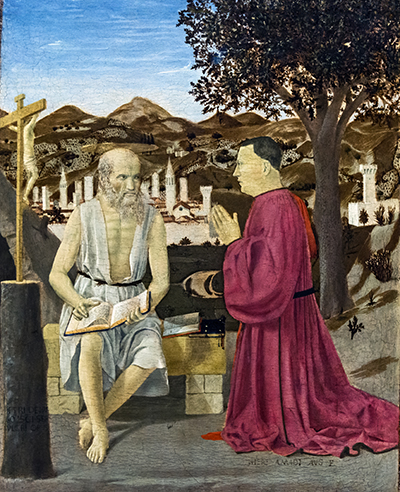
Piero himself returned to the saint in the small Venetian panel Saint Jerome and a Donor. There the saint pauses over a book as a kneeling man approaches. Both paintings were signed, but only the Berlin panel carries the year. The books and the crucifix are common to both. In Berlin those objects help the viewer imagine the habits of someone who has withdrawn into solitude. In Venice they frame the meeting between a saint and a worshipper. Seen alongside each other, the two panels offer distinct ways for a person praying before a picture to imagine an encounter with Jerome. [1] [2] [10]
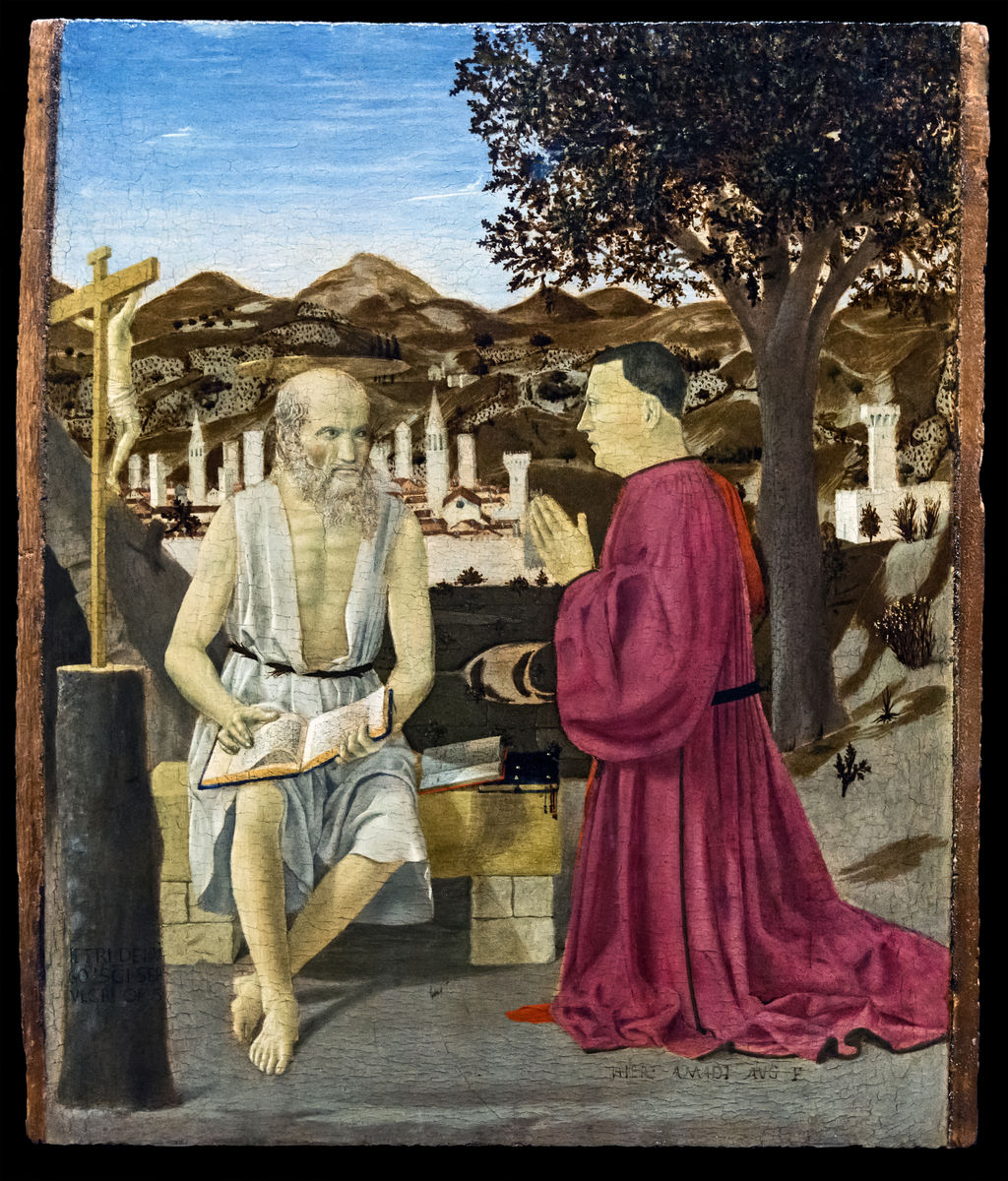
Piero della Francesca, Saint Jerome and a Donor, Gallerie dell’Accademia, Venice. Didier Descouens. Image source. CC BY-SA 4.0. Resized from the source. This reproduction uses CC BY-SA 4.0.
Browse the artworks
Compare Piero’s frescoes, panels and manuscript figures. The list includes ensembles and separately identifiable panels or scenes. Dates are approximate where the sources differ.
| Name | Date | Medium and source |
|---|---|---|
| The Baptism of Christ | Probably c. 1437–45 | Panel painting Catalogue. |
| The Flagellation of Christ | 1459–60 (GNDM) | Panel painting Catalogue. |
| The History of the True Cross | Mid-fifteenth century | Wall painting Catalogue. |
| Dream of Constantine | Mid-fifteenth century | Wall painting Catalogue. |
| The Duke and Duchess of Urbino | About 1473–75 (Uffizi) | Panel painting Catalogue. |
| The Resurrection | About 1458–68 (Opificio) | Wall painting Catalogue. |
| Brera Madonna | About 1472–74 | Panel painting Catalogue. |
| Annunciation at Arezzo | Mid-fifteenth century | Wall painting Catalogue. |
| Madonna del Parto | About 1450–65 (Monterchi) | Wall painting Catalogue. |
| Polyptych of the Misericordia | Commissioned 1445 | Panel painting Catalogue. |
| The Nativity | Early 1480s (National Gallery) | Panel painting Catalogue. |
| Madonna di Senigallia | About 1474–75 (GNDM) | Panel painting Catalogue. |
| Death of Adam | Mid-fifteenth century | Wall painting Catalogue. |
| Queen of Sheba | Mid-fifteenth century | Wall painting Catalogue. |
| Victory of Constantine | Mid-fifteenth century | Wall painting Catalogue. |
| Battle between Heraclius and Chosroes | Mid-fifteenth century | Wall painting Catalogue. |
| Saint Mary Magdalen | Wall painting Catalogue. | |
| The Augustinian Polyptych | 1454–69 | Panel painting Catalogue. |
| Polyptych of Perugia | About 1467–69 (GNU) | Panel painting Catalogue. |
| Perugia Annunciation | About 1468–70 (national catalogue) | Panel painting Catalogue. |
| St Francis and St Elizabeth | About 1467–69 (GNU) | Panel painting Catalogue. |
| Stigmatisation of St Francis | About 1468–70 (national catalogue) | Panel painting Catalogue. |
| An Augustinian Nun (Saint Monica) | 1454–69 | Panel painting Catalogue. |
| Augustinian Saint | 1454–69 | Panel painting Catalogue. |
| Saint Michael | 1454–69 | Panel painting Catalogue. |
| Saint Nicholas of Tolentino | 1454–69 | Panel painting Catalogue. |
| Saint John the Evangelist | 1454–69 | Panel painting Catalogue. |
| Virgin and Child Enthroned with Four Angels | About 1460–70 (Clark) | Panel painting Catalogue. |
| Portrait of Sigismondo Pandolfo Malatesta | About 1450–51, often proposed. Louvre catalogue range 1450–75. | Panel painting Catalogue. |
| Sigismondo before St Sigismund | 1451 | Wall painting Catalogue. |
| St Jerome and a Donor | 1460s (Accademia); about 1450 also proposed | Panel painting Catalogue. |
| St Jerome in Penitence | 1450, dated on the panel | Panel painting Catalogue. |
| Saint Julian | About 1455–60, often proposed | Wall painting Catalogue. |
| Saint Augustine | 1454–69 | Panel painting Catalogue. |
| Saint Apollonia | 1454–69 | Panel painting Catalogue. |
| Crucifixion from the Augustinian Polyptych | 1454–69 | Panel painting Catalogue. |
| Saint Louis of Toulouse | Wall painting Catalogue. | |
| Burial of the Wood | Mid-fifteenth century | Wall painting Catalogue. |
| Discovery and Proof of the True Cross | Mid-fifteenth century | Wall painting Catalogue. |
| Exaltation of the Cross | Mid-fifteenth century | Wall painting Catalogue. |
| Saint Anthony Raises a Child | About 1467–69 (GNU) | Panel painting Catalogue. |
| Saint Elizabeth Revives a Child | About 1467–69 (GNU) | Panel painting Catalogue. |
| Hercules | About 1470 | Wall painting Catalogue. |
| Portrait of a Boy (possibly Guidobaldo da Montefeltro) | Panel painting Catalogue. | |
| De prospectiva pingendi, Reggio Emilia witness (figures) | Manuscript diagrams Catalogue. | |
| The Interrogation of Judas | Mid-fifteenth century | Wall painting Catalogue. |
| Two prophets, Bacci Chapel | Mid-fifteenth century | Wall painting Catalogue. |
| Saint Clare of Assisi, upper predella | About 1467–69 (GNU) | Panel painting Catalogue. |
| Saint Agatha, upper predella | About 1467–69 (GNU) | Panel painting Catalogue. |
| Lost centre of the Augustinian Polyptych | 1454–69 | Lost panel or panels Catalogue. |
Frequently Asked Questions
It belongs to the Gemäldegalerie in Berlin. The museum’s catalogue title is Der heilige Hieronymus, meaning Saint Jerome. [1]
The paint at the lower left is in poor condition. The museum identifies the reclining animal there as the lion from the legend in which Jerome removes a thorn from its paw. [1]
Discussion
Look again at the images and ideas explored in Saint Jerome in Penitence. These editorial prompts invite your observations.
Reader Insights
Follow the reflections. Compare the upright trees with their reflections. How do those repeated lines affect the distance you perceive between Jerome and the hills?
Read the objects before the figure. Start with the hat, books and beads, then look at Jerome’s pose. Which of those objects most changes how you understand what he is doing?
Compare the scale of the two paintings. Imagine looking up at Nicola’s two-metre lunette. Which details carry across from Piero’s small panel, and which reward the Berlin viewer for coming closer?
Join the Conversation
Share a detail, comparison or question about Saint Jerome in Penitence below.
References
- Staatliche Museen zu Berlin, Gemäldegalerie, Der heilige Hieronymus, inventory 1904 View source.
- Keith Christiansen, Piero della Francesca: Personal Encounters, Metropolitan Museum of Art, 2013, pp. 26–31 View source.
- Morgan Library & Museum, The Hours of Catherine of Cleves, Jerome and the lion, manuscript M.917/945, pp. 242–243 View source.
- National Gallery, London, Piero della Francesca, The Baptism of Christ, NG665 View source.
- Fabiola Cogliandro, ‘Testimonianze artistiche nella chiesa del Santissimo Crocifisso di Numana’, Il capitale culturale, pp. 113–114 View source.
- Metropolitan Museum of Art, Piero della Francesca: Personal Encounters, exhibition, 2014 View source.
- Catalogo generale dei beni culturali, Galleria Sabauda, San Girolamo penitente nel deserto, inventory 969 View source.
- Carnegie Museum of Art, Nicola di Maestro Antonio d’Ancona, Madonna and Child Enthroned with Saints Leonard, Jerome, John the Baptist, and Francis, 1472 View source.
- Carlo Bertelli, “Piero della Francesca”, Treccani, 2016 View source.
- Gallerie dell’Accademia, Venice, Piero della Francesca, San Girolamo e un devoto, catalogue 47 View source.