 by Tom Gurney
Tom Gurney BSc (Hons) is an art history expert with over 20 years experience
Published on June 19, 2020 / Updated on October 14, 2023
Email: tomgurney1@gmail.com / Phone: +44 7429 011000
Saint Francis and Saint Elizabeth by Piero della Francesca: Introduction
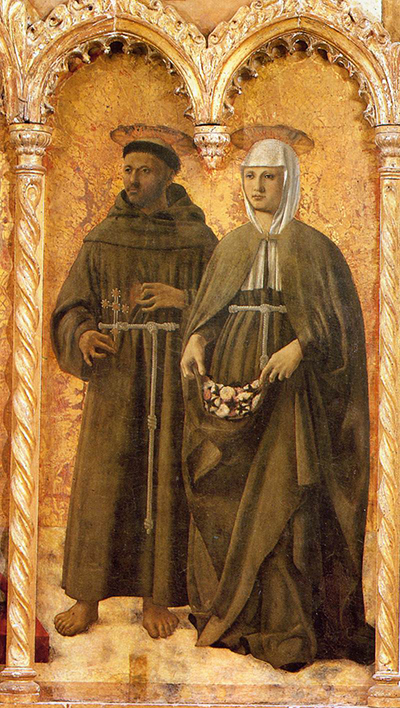
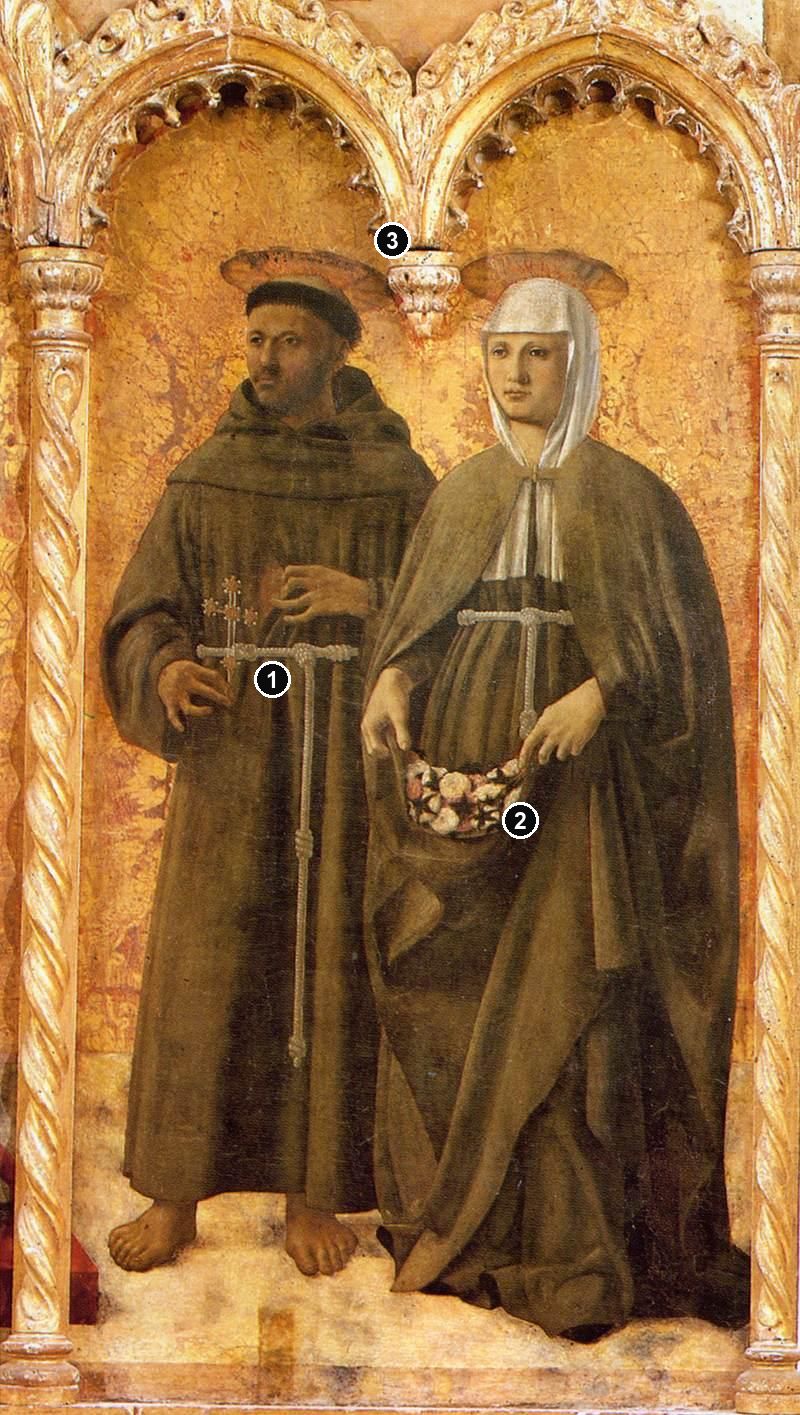
Saint Francis of Assisi holds a crystal cross and Saint Elizabeth of Hungary gathers roses in the fold of her dress. They stand on the viewer’s right of Piero della Francesca’s Polyptych of Sant’Antonio, facing into the same gold-backed assembly as the enthroned Virgin and Child. The two figures are easy to recognise by the objects they hold, but their pairing also tells us something about the women who commissioned the altarpiece. Francis was the founder of the order to which the commissioners belonged, while Elizabeth offered a model of Franciscan charity for women. Both appear again, on a much smaller scale, in the stories at the base of the altarpiece. [1] [2] [3]
At a Glance
- ArtistPiero della Francesca. [1]
- DateAbout 1467–69 for the altarpiece, according to the Galleria Nazionale dell’Umbria. [1]
- PositionFrancis stands beside the throne on the viewer’s right, and Elizabeth stands at the outer right. [1]
- AttributesFrancis carries a crystal cross and Elizabeth holds roses in the fold of her clothing. [2] [3]
- LocationThe polyptych is in the Galleria Nazionale dell’Umbria, Perugia. [1]
This work across Piero della Francesca’s career
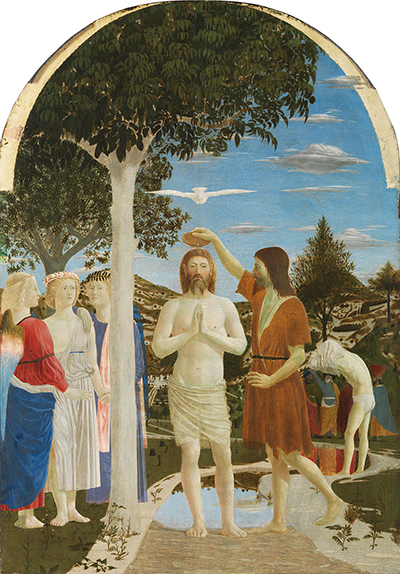
The Baptism of Christ
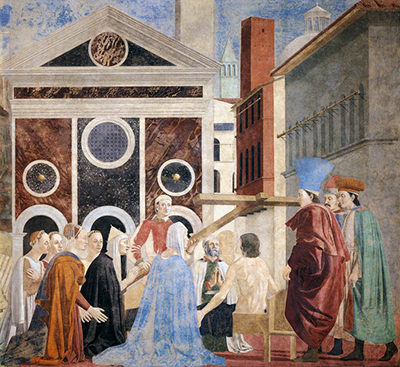
Probably about 1437–45The History of the True Cross
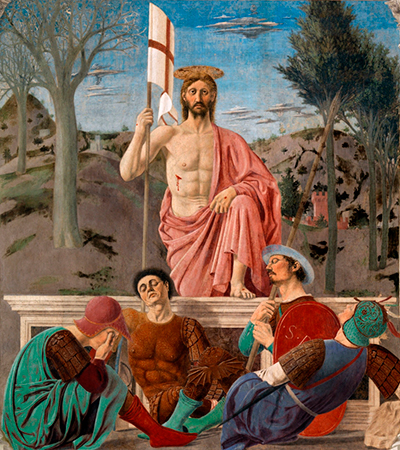
Mid-fifteenth centuryThe Resurrection
About 1458–68 (Opificio)The Flagellation of Christ
1459–60 (GNDM)Saint Francis and Saint Elizabeth (current article)
About 1467–69 (GNU)The Montefeltro Altarpiece
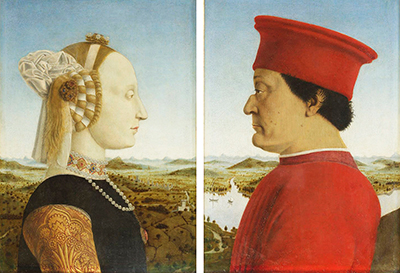
About 1472–74 (Brera)The Duke and Duchess of Urbino
About 1473–75 (Uffizi)The Nativity
Early 1480s (National Gallery)Contents
- Two saints under adjoining arches
- Francis’s crystal cross
- Elizabeth’s roses and white veil
- The gold, the frame and the church
- The same saints in the predella
- Annotated details
Two saints under adjoining arches
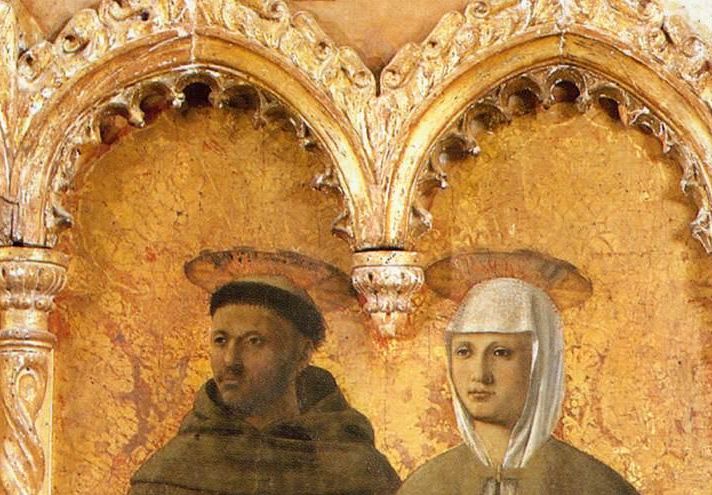
Francis occupies the inner position, nearest the Virgin and Child, while Elizabeth stands at the far right. Across the throne, John the Baptist occupies the other inner position, with Anthony of Padua on the outside. Although each head has its own arch, no full-height column splits Francis and Elizabeth apart. The small pendant between the arches marks an interval above their shoulders, leaving their silhouettes to meet below it. Francis’s cowl and the sloping edge of Elizabeth’s cloak almost touch, and the two pale rope belts carry the eye across the darker fabric at waist height. Across the Perugia Polyptych, the light-coloured floor runs beneath the saints towards the throne. The main tier keeps the divisions of an altarpiece with several compartments while giving the figures a common level on which to stand. [1] [4]
A closer look reveals how differently the figures occupy the space. Francis’s habit hangs in long folds and stops short of the floor, exposing both bare feet. Elizabeth’s cloak spreads as it descends and conceals her feet, and a deep fold of cloth rises at the front where her hands hold the flowers. Her white veil concentrates light around her face, while Francis’s face sits between the darker shapes of his hair and hood. Their haloes share the same tilted, elliptical shape. With a gold surface behind both heads, Piero uses these smaller differences in light, dress and stance to keep the figures distinct. [1] [2]
Francis’s crystal cross
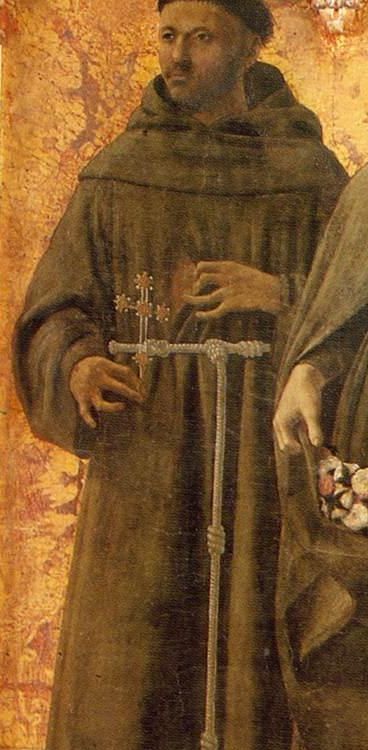
Francis’s lower hand holds the slender stem of the cross. Pale glints pick out its arms against the brown habit, where a solid gold object would read quite differently. His other hand is raised across his body, near enough to the cross for the eye to pass from one to the other. The state catalogue identifies the cross as crystal and associates its transparency with other details across the altarpiece, including a glass vessel, pearls and the reflective haloes. That group of observations explains why the surface of the picture rewards close looking. The cross is small, and much of its effect depends on the surrounding darkness of the cloth. [1] [2]
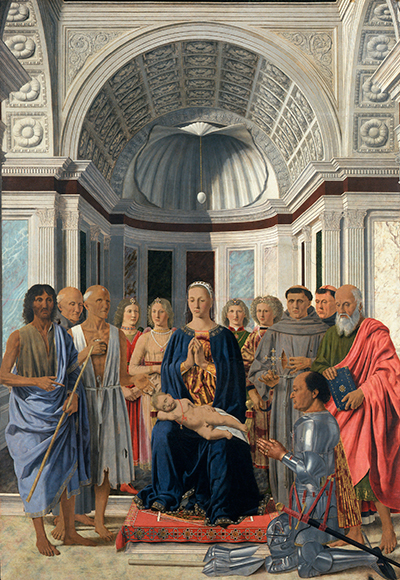
Piero used a related device in the Montefeltro Altarpiece in Milan. There, the Pinacoteca di Brera identifies a rock crystal cross in Francis’s hand and describes how the saint draws open his habit to show the wound in his side. In Perugia the closed habit and the long white cord make the waist the focus of the figure, with the cross held just to one side. Seen together, the two pictures show how Piero could retain the crystalline attribute and vary the gesture through which viewers encounter the saint. The gallery in Perugia connects this interest in transparency to Piero’s exposure to Flemish painting, especially through Urbino. Vittoria Garibaldi, as reported in the state catalogue, also considered Rome a possible place for that encounter. [1] [2] [5]
Annotated Details from Saint Francis and Saint Elizabeth
The numbered points identify visible features discussed in this article. Return from each detail to the numbered overview. Saint Francis and Saint Elizabeth of Hungary, right-hand panel of the Sant’Antonio Polyptych. Image source. Public domain.
Details from SAINT FRANCIS AND SAINT ELIZABETH
Compare the cropped details with the source images above. Notice how their colours, shapes and positions contribute to the larger compositions.
Francis’s habit and cross
The loose sleeve and cord define the habit. The small cross is held upright against the dark garment.
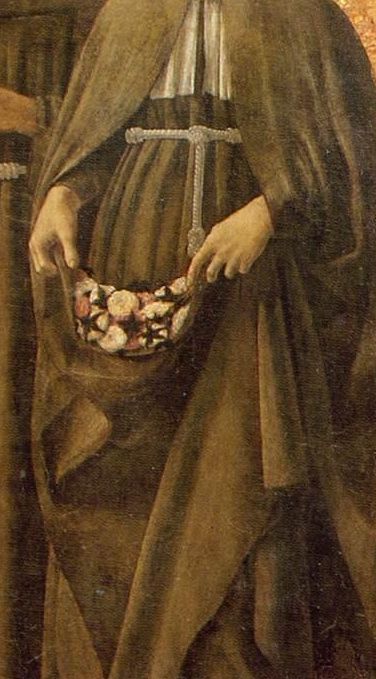
Elizabeth’s apron
Elizabeth holds the gathered apron so its contents can be seen. The pale marks of the roses contrast with the folds of the darker dress.
The paired gilded arches
The point at which the two arches meet divides the gold field above. Each saint has a separate halo below it.
Elizabeth’s roses and white veil
Elizabeth supports a cluster of pale and reddish flowers by holding up the fabric with both hands. The roses recall the legend in which food carried for the poor changed into flowers. Piero gives the viewer the result of the miracle in a single detail. The small forms are crowded by the weight of the cloth, and the hands at either end make the fold read as a container. A veil frames her face and a rope encircles her waist. With these cues alongside the roses, Piero presents the daughter of a king in dress that visually allies her with the friar. [1] [3] [6]
Elizabeth is also known as Elizabeth of Thuringia, where she married Landgrave Ludwig IV. After his death, she founded a hospital at Marburg in 1228 and devoted herself to the sick and poor. Her connection to Franciscan poverty and care gives the roses their significance in this setting. The flowers belong to the tradition that grew around her acts of charity. The hospital belongs to her documented life. For the Franciscan women who commissioned the altarpiece, the choice to depict Elizabeth in a veil and cord would have brought that charitable example close to their own devotional life. That is an interpretation of her position and costume, since the commissioners’ individual reasons for choosing her are unrecorded in the catalogue. [1] [3] [6]
Benozzo Gozzoli’s altarpiece for the Collegio di San Gerolamo offers a local comparison. That commission dates to about 1456 and the picture is now in the same Perugia museum. Rolando Bellini and Melanie Zefferino compare the two painters’ treatment of Elizabeth. In Gozzoli’s picture she also holds up her clothing to contain the flowers and wears no crown, yet the cut and finish of her overgarment are considerably richer. Clémentine Denèle’s study of earlier Italian images likewise traces representations of Elizabeth in both regal and Franciscan dress. The roses could accompany either presentation. In Piero’s version, the position beside Francis and the echo of his cord do much of the work of establishing the relationship. [3] [7] [8]
The gold, the frame and the church
The Galleria Nazionale dell’Umbria dates the altarpiece to about 1467–69 and records a municipal grant in 1468. The Franciscan tertiaries of Sant’Antonio da Padova commissioned it for the outer church of their convent at Porta Sant’Angelo. The gallery identifies Ilaria Baglioni, daughter of the Perugian lord Braccio Baglioni, as the head of the community at the time. Anthony, the convent’s patron saint, anchors one end of the main tier, and Elizabeth, an exemplar of Franciscan charity, anchors the other. The arrangement lets the community’s particular allegiances appear within a larger image centred on Mary and Christ. Catherine Plazzotta and Tom Henry point out that the painted lighting is consistent with the light from the church windows to the left. Look at the modelling of Elizabeth’s white veil and then at the halo. The first makes the light legible across a rounded head, while the second gives it a metallic glint. [1] [4]
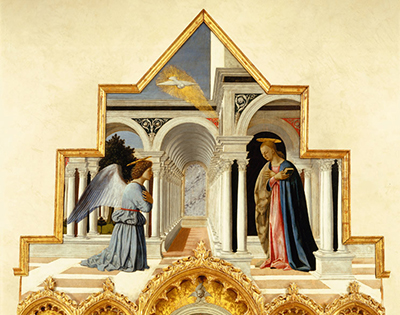
The arched frame and patterned gold ground make a sharp change from the deep colonnade in the Perugia Annunciation directly above. Cesare Brandi’s 1954 conservation report shows how strongly that difference shaped early debates about the altarpiece. More recent evidence reported in the state catalogue identified snapped-line and scribed markings on the boards, traces of an overall construction plan. The ensemble combines egg tempera, oil and gold on poplar. For the standing saints, the arrangement of the boards and frame belongs to the altarpiece’s construction, while the soft modelling of faces and carefully painted reflections make the individual figures appear physically present within it. [1] [2] [4] [9]
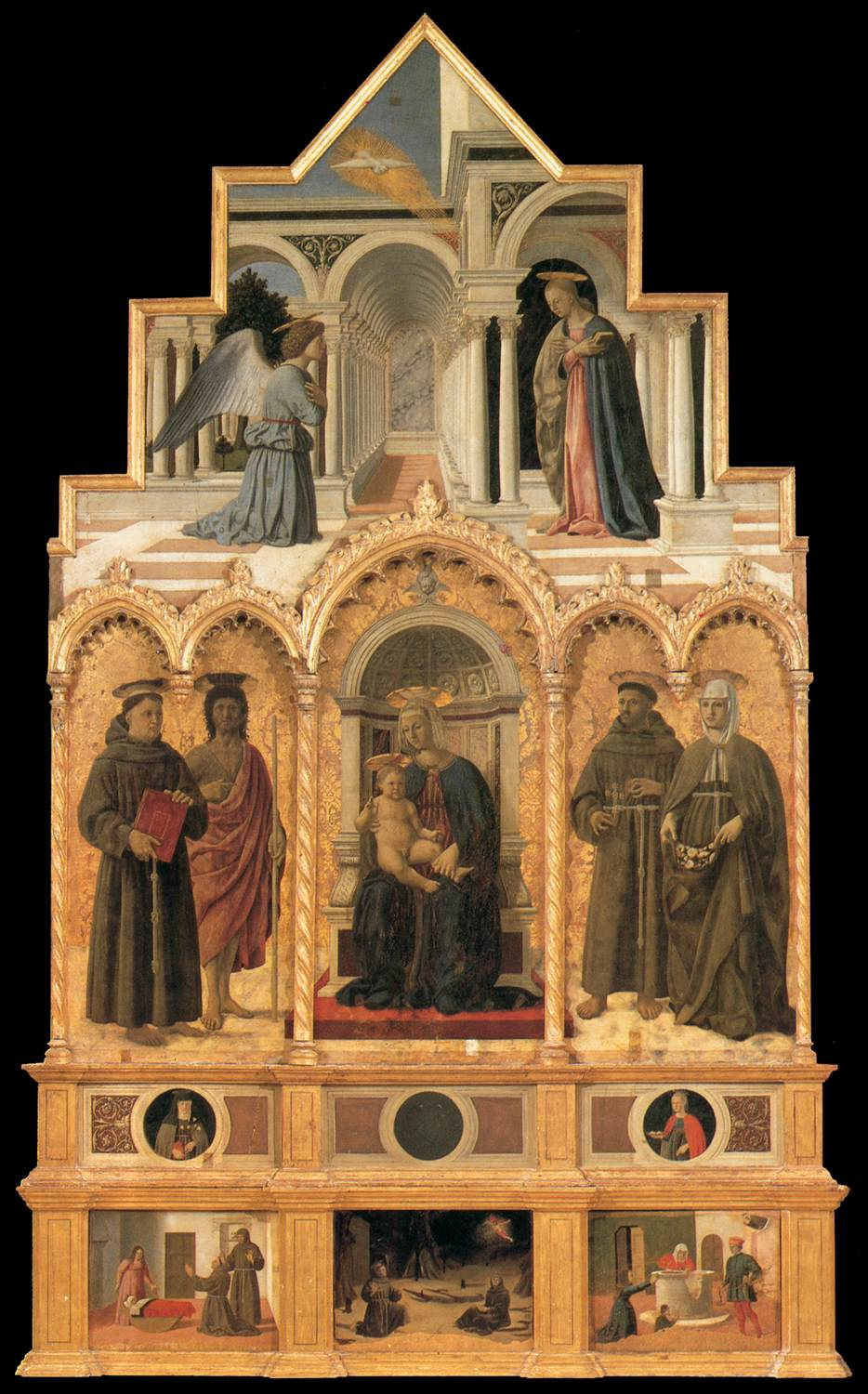
Sant’Antonio Polyptych in its current assembly, Galleria Nazionale dell’Umbria, Perugia. Image source. Public domain. Resized only; native appearance preserved.
The same saints in the predella
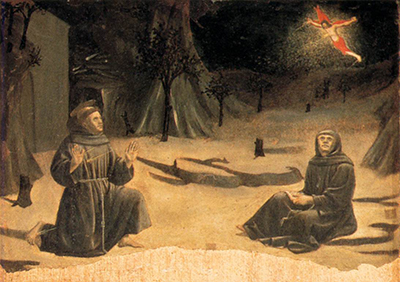
The bottom tier, or lower predella, places the Stigmatisation of Saint Francis in the middle and Elizabeth’s well miracle at the right. Francis is shown receiving the wounds of Christ in a nocturnal setting. The standing figure’s cross points towards the same devotion in a compact form. In Elizabeth’s well miracle, she revives a child who has fallen into a well. The round stone rim occupies the foreground, with figures standing and kneeling around it. The well provides a focus for the different reactions, much as Elizabeth’s hands draw the eye towards the roses in the standing image. The flowers held by the standing Elizabeth evoke a different legend, the transformation of the food she carried for the poor. The two ways of depicting Elizabeth can be read together. The raised cloth identifies her above and the action around the well shows her interceding below. [1] [2] [3]
Anthony also reappears in a miracle in the lower predella, completing a group of three saints from the main register whose stories a viewer could follow along the base. An upper predella contains the smaller figures of Clare of Assisi and Agatha. The choice of Clare gives the Franciscan community a further point of recognition on the same object. Read from top to bottom, the two standing saints are part of an assembly around Mary and Christ. The episodes at the base show why those particular saints were invoked, through the wounds Francis receives and the help Elizabeth brings to a child. [1]
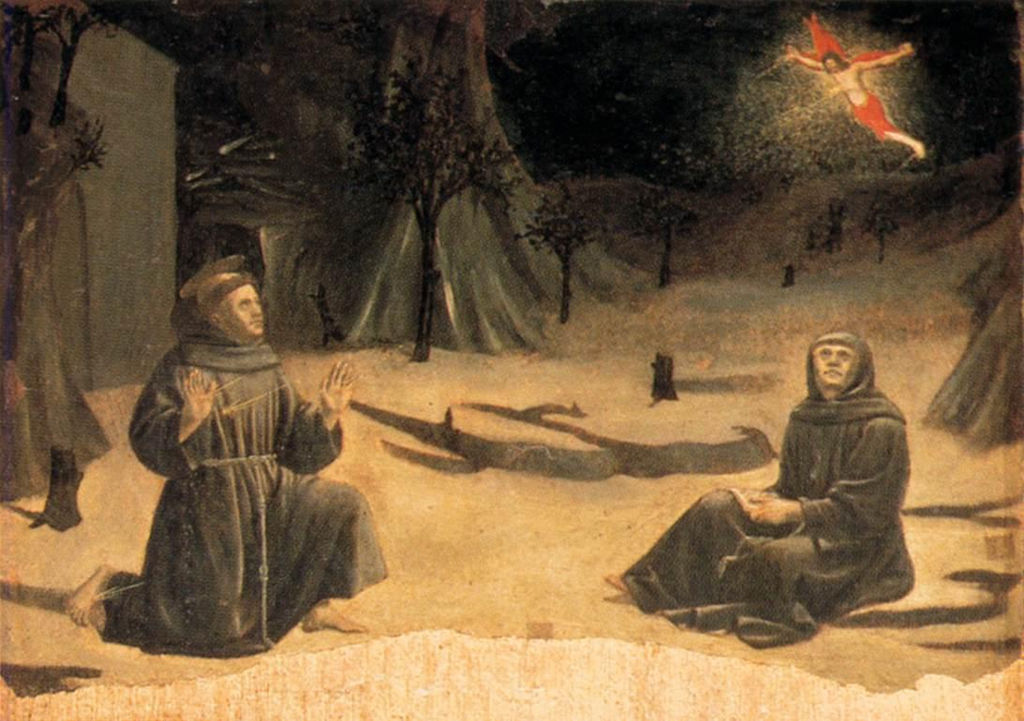
Stigmatisation of Saint Francis, central predella scene of the Sant’Antonio Polyptych. Image source. Public domain. Resized only; native appearance preserved.
Browse the artworks
Compare Piero’s frescoes, panels and manuscript figures. The list includes ensembles and separately identifiable panels or scenes. Dates are approximate where the sources differ.
| Name | Date | Medium and source |
|---|---|---|
| The Baptism of Christ | Probably c. 1437–45 | Panel painting Catalogue. |
| The Flagellation of Christ | 1459–60 (GNDM) | Panel painting Catalogue. |
| The History of the True Cross | Mid-fifteenth century | Wall painting Catalogue. |
| Dream of Constantine | Mid-fifteenth century | Wall painting Catalogue. |
| The Duke and Duchess of Urbino | About 1473–75 (Uffizi) | Panel painting Catalogue. |
| The Resurrection | About 1458–68 (Opificio) | Wall painting Catalogue. |
| Brera Madonna | About 1472–74 | Panel painting Catalogue. |
| Annunciation at Arezzo | Mid-fifteenth century | Wall painting Catalogue. |
| Madonna del Parto | About 1450–65 (Monterchi) | Wall painting Catalogue. |
| Polyptych of the Misericordia | Commissioned 1445 | Panel painting Catalogue. |
| The Nativity | Early 1480s (National Gallery) | Panel painting Catalogue. |
| Madonna di Senigallia | About 1474–75 (GNDM) | Panel painting Catalogue. |
| Death of Adam | Mid-fifteenth century | Wall painting Catalogue. |
| Queen of Sheba | Mid-fifteenth century | Wall painting Catalogue. |
| Victory of Constantine | Mid-fifteenth century | Wall painting Catalogue. |
| Battle between Heraclius and Chosroes | Mid-fifteenth century | Wall painting Catalogue. |
| Saint Mary Magdalen | Wall painting Catalogue. | |
| The Augustinian Polyptych | 1454–69 | Panel painting Catalogue. |
| Polyptych of Perugia | About 1467–69 (GNU) | Panel painting Catalogue. |
| Perugia Annunciation | About 1468–70 (national catalogue) | Panel painting Catalogue. |
| St Francis and St Elizabeth | About 1467–69 (GNU) | Panel painting Catalogue. |
| Stigmatisation of St Francis | About 1468–70 (national catalogue) | Panel painting Catalogue. |
| An Augustinian Nun (Saint Monica) | 1454–69 | Panel painting Catalogue. |
| Augustinian Saint | 1454–69 | Panel painting Catalogue. |
| Saint Michael | 1454–69 | Panel painting Catalogue. |
| Saint Nicholas of Tolentino | 1454–69 | Panel painting Catalogue. |
| Saint John the Evangelist | 1454–69 | Panel painting Catalogue. |
| Virgin and Child Enthroned with Four Angels | About 1460–70 (Clark) | Panel painting Catalogue. |
| Portrait of Sigismondo Pandolfo Malatesta | About 1450–51, often proposed. Louvre catalogue range 1450–75. | Panel painting Catalogue. |
| Sigismondo before St Sigismund | 1451 | Wall painting Catalogue. |
| St Jerome and a Donor | 1460s (Accademia); about 1450 also proposed | Panel painting Catalogue. |
| St Jerome in Penitence | 1450, dated on the panel | Panel painting Catalogue. |
| Saint Julian | About 1455–60, often proposed | Wall painting Catalogue. |
| Saint Augustine | 1454–69 | Panel painting Catalogue. |
| Saint Apollonia | 1454–69 | Panel painting Catalogue. |
| Crucifixion from the Augustinian Polyptych | 1454–69 | Panel painting Catalogue. |
| Saint Louis of Toulouse | Wall painting Catalogue. | |
| Burial of the Wood | Mid-fifteenth century | Wall painting Catalogue. |
| Discovery and Proof of the True Cross | Mid-fifteenth century | Wall painting Catalogue. |
| Exaltation of the Cross | Mid-fifteenth century | Wall painting Catalogue. |
| Saint Anthony Raises a Child | About 1467–69 (GNU) | Panel painting Catalogue. |
| Saint Elizabeth Revives a Child | About 1467–69 (GNU) | Panel painting Catalogue. |
| Hercules | About 1470 | Wall painting Catalogue. |
| Portrait of a Boy (possibly Guidobaldo da Montefeltro) | Panel painting Catalogue. | |
| De prospectiva pingendi, Reggio Emilia witness (figures) | Manuscript diagrams Catalogue. | |
| The Interrogation of Judas | Mid-fifteenth century | Wall painting Catalogue. |
| Two prophets, Bacci Chapel | Mid-fifteenth century | Wall painting Catalogue. |
| Saint Clare of Assisi, upper predella | About 1467–69 (GNU) | Panel painting Catalogue. |
| Saint Agatha, upper predella | About 1467–69 (GNU) | Panel painting Catalogue. |
| Lost centre of the Augustinian Polyptych | 1454–69 | Lost panel or panels Catalogue. |
Frequently Asked Questions
Saint Francis receives the stigmata in the central scene. Elizabeth revives a child who has fallen down a well in the scene at the right. [1]
Discussion
Look again at the images and ideas explored in Saint Francis and Saint Elizabeth by Piero della Francesca. These editorial prompts invite your observations.
Reader Insights
Follow the pale rope belts across the two figures. How do they affect the sense that Francis and Elizabeth stand together under adjoining arches?
Compare the standing Elizabeth’s raised fold of cloth with the predella scene of the child at the well. What does each image ask you to notice first?
Join the Conversation
Share a detail, comparison or question about Saint Francis and Saint Elizabeth by Piero della Francesca below.
References
- Galleria Nazionale dell’Umbria, Polittico di Sant’Antonio, object 63106. View source.
- Istituto Centrale per il Catalogo e la Documentazione, Polittico di Sant’Antonio, catalogue record ICCD14760307, pp. 4–5. View source.
- Rolando Bellini and Melanie Zefferino, “Rose e visioni. L’iconografia di una santa tra Medioevo e Ancien Régime: Elisabetta d’Ungheria,” in L’umiltà e le rose, especially pp. 216–19. View source.
- Catherine Plazzotta and Tom Henry, National Gallery Catalogue entry for Raphael’s The Procession to Calvary, original location discussion and fig. 18. View source.
- Pinacoteca di Brera, DescriVedendo Brera, entry on the Montefeltro Altarpiece. View source.
- Philipps-Universität Marburg, Museum für Kunst und Kulturgeschichte, Elisabeths Geschichte und ihre Verbindung zu Marburg. View source.
- Galleria Nazionale dell’Umbria, Benozzo Gozzoli – Sala 10, Pala della Sapienza Nuova. View source.
- Clémentine Denèle, Une sainte reine et franciscaine, Mélanges de l’École française de Rome – Moyen Âge 125, no. 1 (2013), pp. 137–47. View source.
- Cesare Brandi, Restauri a Piero della Francesca, Bollettino d’Arte, July–September 1954, especially pp. 253–54. View source.