 by Tom Gurney
Tom Gurney BSc (Hons) is an art history expert with over 20 years experience
Published on June 19, 2020 / Updated on October 14, 2023
Email: tomgurney1@gmail.com / Phone: +44 7429 011000
Polyptych of Perugia: Introduction
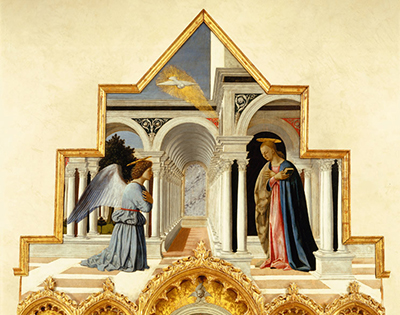
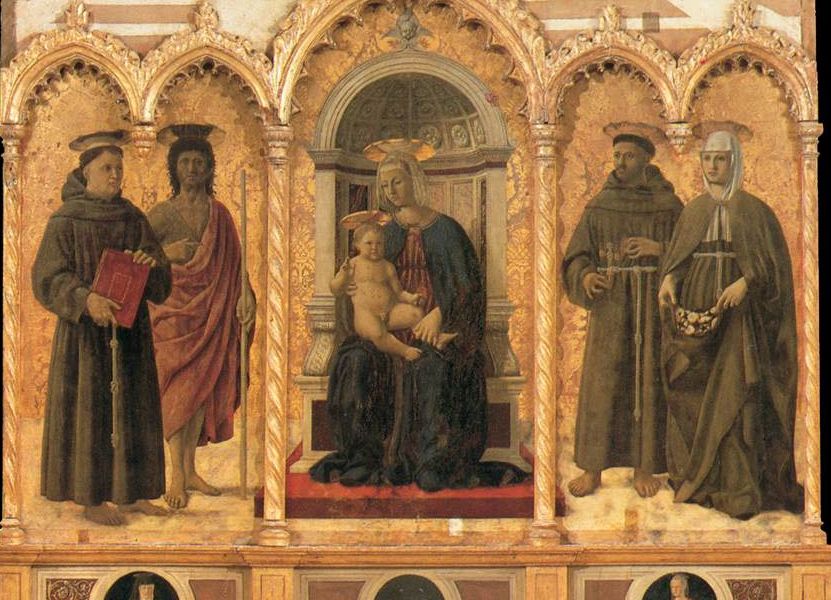
Piero della Francesca built the Polyptych of Perugia around a seated Madonna and Child, with Franciscan saints beside them and stories of those saints in the narrow panels below. The largest surprise comes above the Virgin's throne. An arcade in the Annunciation leads the eye deep into a courtyard, opening up a space of quite different dimensions from the shallow, gilded setting of the main tier. The whole altarpiece, also called the Polyptych of Sant’Antonio, was made for the Franciscan women of Sant’Antonio da Padova. It is now in the Galleria Nazionale dell’Umbria in Perugia. [1]
The altarpiece is about 3.9 metres high. In the church, the saints and the child in Mary's lap would have been legible from farther away than the little figures in the scenes below. A close view in the museum reverses some of that advantage. The lower paintings reward sustained attention, and the empty centre between the two female saints in the upper predella draws attention to something a photograph of the Annunciation alone could never convey. The lower structure once helped the sisters see the celebration at the altar from their enclosed choir. The object has a history of use as well as a history of painting. [1] [2]
At a Glance
- ArtistPiero della Francesca, with workshop participation proposed on technical and stylistic grounds [1] [3]
- DateAbout 1467–69 in the holding museum’s catalogue, with municipal funding documented in 1468 [1] [2]
- MediumTempera and oil on wood, with gilding [1] [2]
- Original locationHigh altar of the outer church of Sant’Antonio da Padova, Perugia [1] [2]
- CollectionGalleria Nazionale dell’Umbria, Perugia, inventories 111–114 [1]
- StructureFour registers including a crowning Annunciation and two distinct predellas [1] [2]
This work across Piero della Francesca’s career
The Baptism of Christ
Probably about 1437–45The History of the True Cross
Mid-fifteenth centuryThe Resurrection
About 1458–68 (Opificio)The Flagellation of Christ
1459–60 (GNDM)Polyptych of Sant’Antonio (current article)
About 1467–69 (GNU)The Montefeltro Altarpiece
About 1472–74 (Brera)The Duke and Duchess of Urbino
About 1473–75 (Uffizi)The Nativity
Early 1480s (National Gallery)Contents
- The women who commissioned the altarpiece
- Four registers in a narrow sanctuary
- The Annunciation above the throne
- Two predellas with different purposes
- How the panels were made and dated
- From church furnishing to museum object
- Annotated details
The women who commissioned the altarpiece
The sisters commissioned the work for the high altar of their outer church near Porta Sant’Angelo. They were Franciscan tertiaries, women who followed the rule of the Franciscan Third Order. This community traced its origins to a religious group active in Perugia in the fourteenth century and had close links with the women's house of Sant’Anna at Foligno. Some of the women who entered Sant’Antonio came from established Perugian families and continued to draw on those ties. The house also took part in charitable work that brought its members into contact with people outside the convent. [1] [2] [4]
Ilaria Baglioni, a daughter of Braccio Baglioni, held office as minister in 1467 and 1469. Beverley Lyle's study of Franciscan patronage also brings Margherita di Onofrio into view. Margherita had long been involved in the life of the convent, and her brother Giacomo acted as a legal representative for both her and the community. Those connections help explain how the sisters could commission an ambitious altarpiece and seek support from the city. The municipal grant recorded in 1468 offers direct evidence of civic involvement. Who first approached Piero remains uncertain. [1] [2] [4]
Two altars at Sant’Antonio help establish the setting. Piero's stood in the outer church, used for public worship. The inner church served the women of the convent and would eventually have an altarpiece by Raphael. The National Gallery's catalogue places the two works back to back across a dividing wall. It also notes that the painted light in Piero's altarpiece comes from the side corresponding to the windows in the outer church. This is a correspondence between a painted effect and the building, and it makes the apparent direction of light in the altarpiece worth noticing. [5]
Four registers in a narrow sanctuary
A polyptych is a work made up of multiple panels. At Sant’Antonio, those panels are arranged in four horizontal levels. At the top stands the shaped crowning panel, known in Italian as a cimasa. Below it come the Madonna and Child with four saints, a comparatively shallow band with round portraits of female saints, and a second band containing three rectangular narrative paintings. The two bands at the base are both called predellas. The museum relates the tall arrangement to the narrow presbytery, the part of the church that housed the altar. [1] [2]
The national catalogue describes three painted compartments in the main tier. The central compartment houses the Virgin's throne. Two saints occupy each of the flanking compartments, where small arches divide the openings above them. These arches are part of the gilded framework. The niche around the Virgin, by comparison, is architecture painted into the central panel. Its curved shell of coffering hangs over a throne whose sides project into the shallow room. The physical frame tells the viewer where one compartment ends. The painted floor and the placing of bodies suggest that the figures on either side belong to a shared space. [2] [4]
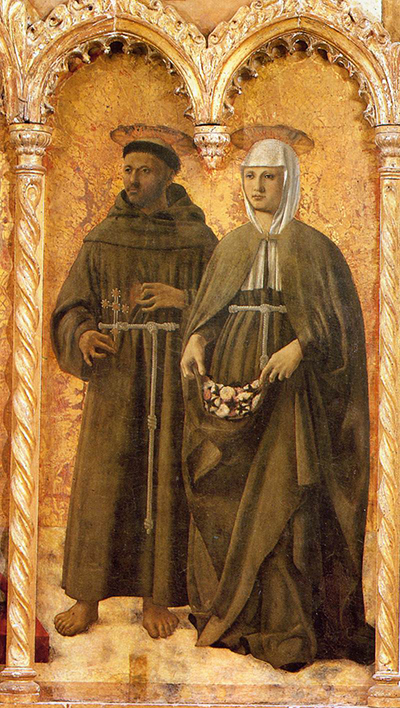
The two Franciscans in dark habits stand on opposite sides of the Virgin. Saint Anthony of Padua, the dedicatee of the convent, is at the viewer's far left, with John the Baptist beside him. Saint Francis stands to Mary's right and Saint Elizabeth of Hungary occupies the outer position beside Francis. The four come together around the central group. The narrow overlap between the paired figures and the marble floor behind their feet give their bodies room to stand even where there is a close gold ground. A tilted, disk-shaped halo likewise occupies space. Its highlight can appear to belong to the same scene as the light falling across a face. [1] [2] [4]
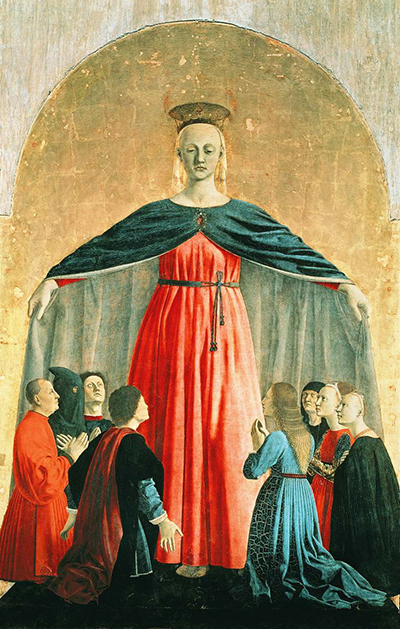
Some of the most telling details are small. The Child blesses with one hand and holds a goldfinch in the other, which Lyle reads as a sign of the Passion. The national catalogue points to the crystal cross carried by Francis, the glass vessel, and the pearls on the Madonna as evidence of Piero's interest in rendering lustrous or transparent objects. Two kinds of gold effect also need to be distinguished. There is the gilding on the visible framework, and there is the patterned gold behind the figures, which can suggest the surface of a hanging. Look across the central tier and the material shifts in an instant from fabric to stone, glass or metal. The tight arrangement makes those changes more apparent. [2] [4]
The earlier Guidalotti Polyptych by Fra Angelico offers a local comparison for the scale, gilded divisions and hierarchy of Piero's ensemble. It was made for a chapel in San Domenico and is now also in the Galleria Nazionale dell’Umbria. Roberto Longhi and Lyle each connected the two works. The formal kinship makes sense in a city where patrons could see and value earlier altarpieces of this type. Details of the order given to Piero, including whether the sisters stipulated a match to Fra Angelico's framework, remain a matter of interpretation. Another comparison is Piero's own Polyptych of the Misericordia in Sansepolcro, where the gold ground and arrangement of smaller panels serve a different patron and devotional focus. [4] [6] [7]
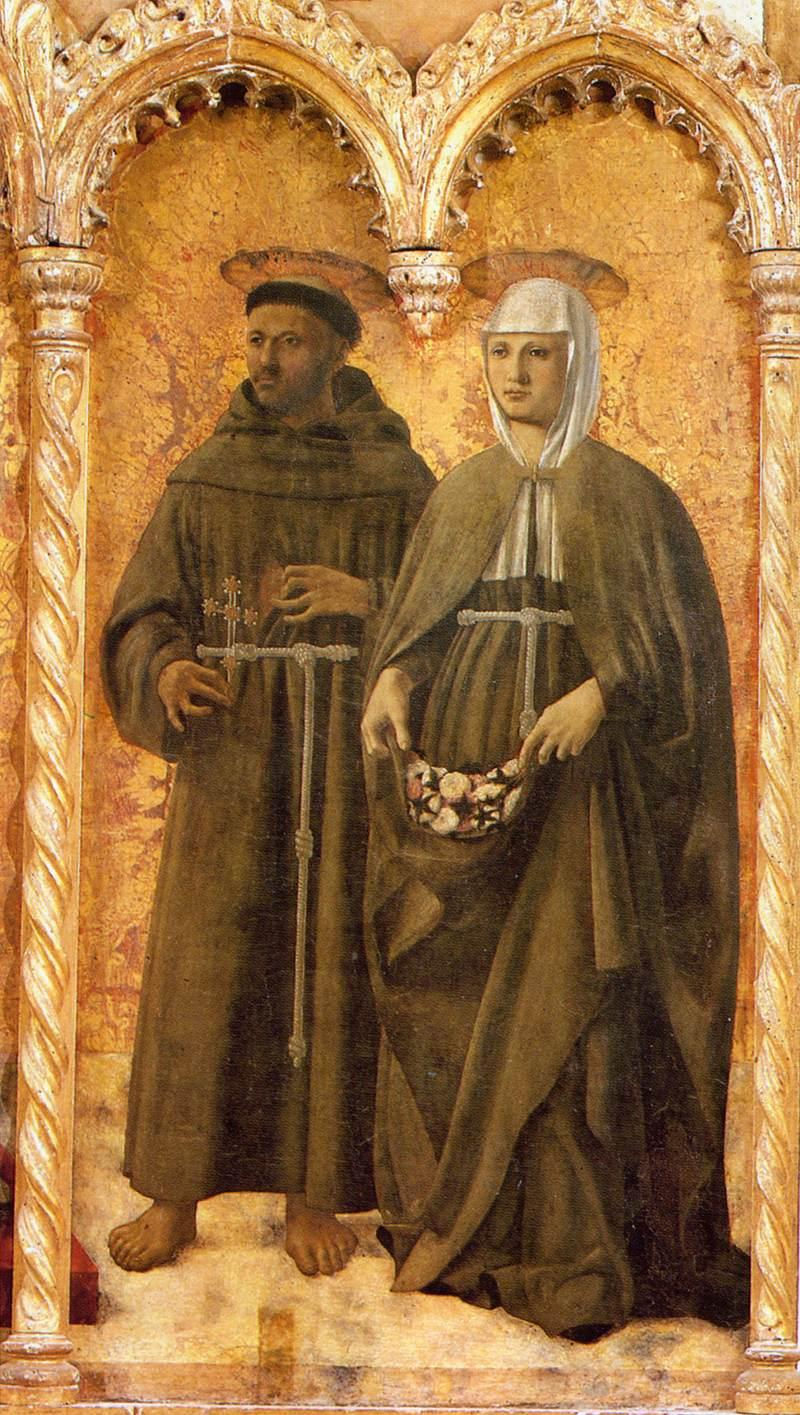
Saint Francis and Saint Elizabeth of Hungary, right-hand panel of the Sant’Antonio Polyptych. Image source. Public domain. Resized only; native appearance preserved.
Annotated Details from Polyptych of Perugia
The numbered points identify visible features discussed in this article. Return from each detail to the numbered overview. Sant’Antonio Polyptych in its current assembly, Galleria Nazionale dell’Umbria, Perugia. Image source. Public domain.
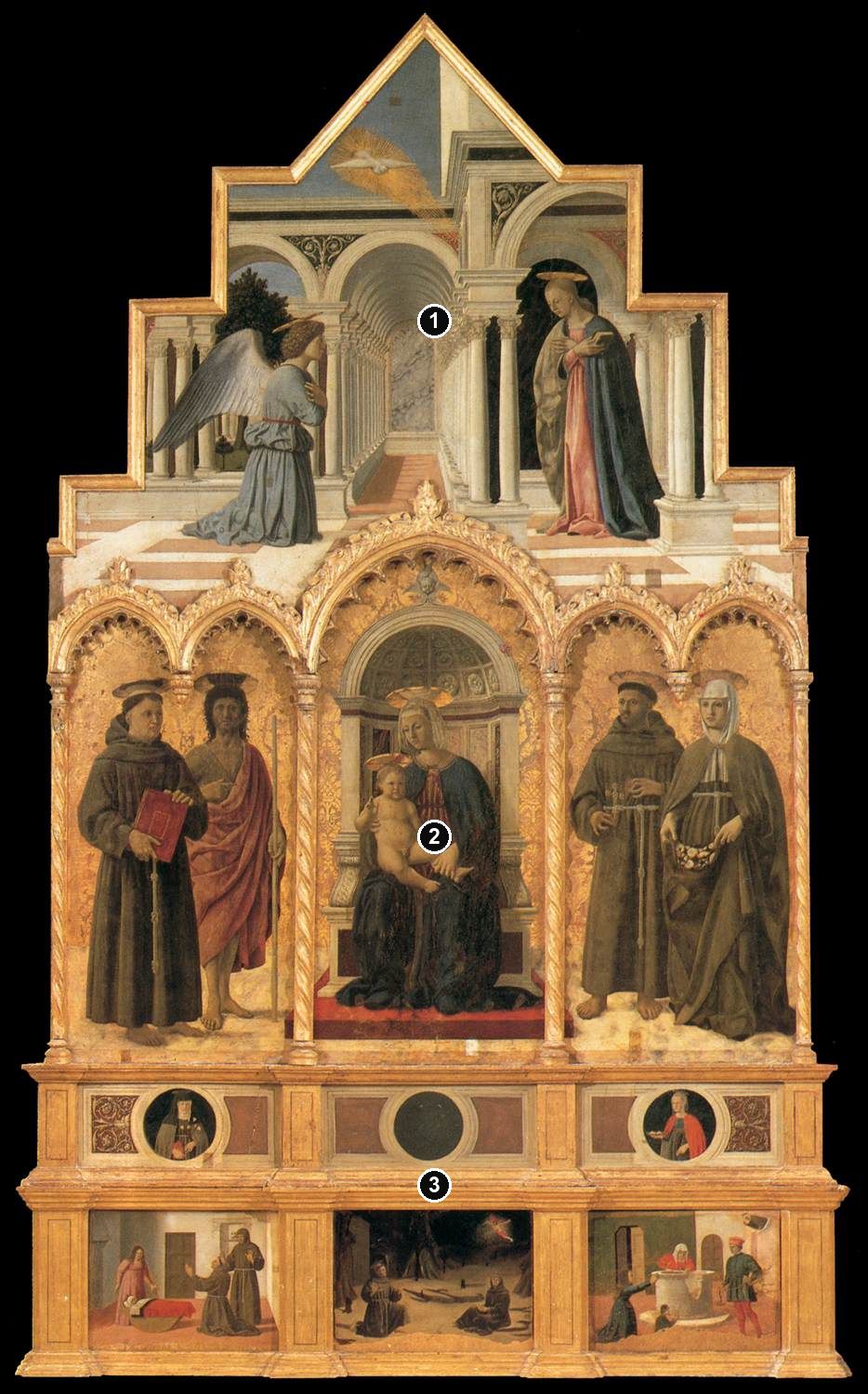
Details from POLYPTYCH OF PERUGIA
Compare the cropped details with the source images above. Notice how their colours, shapes and positions contribute to the larger compositions.
The Annunciation above the saints
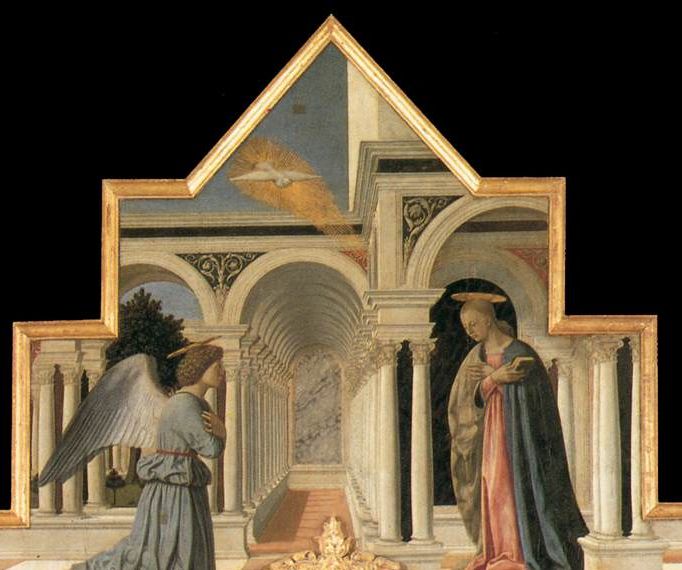
The crowning scene opens a space behind Gabriel and Mary. Its stepped outline meets the change from painted architecture to the gilt frame below.
The gold-ground register
The Virgin and Child occupy the larger central arch. Two groups of standing saints flank them, separated by the visible mouldings.
Roundels above narrative scenes
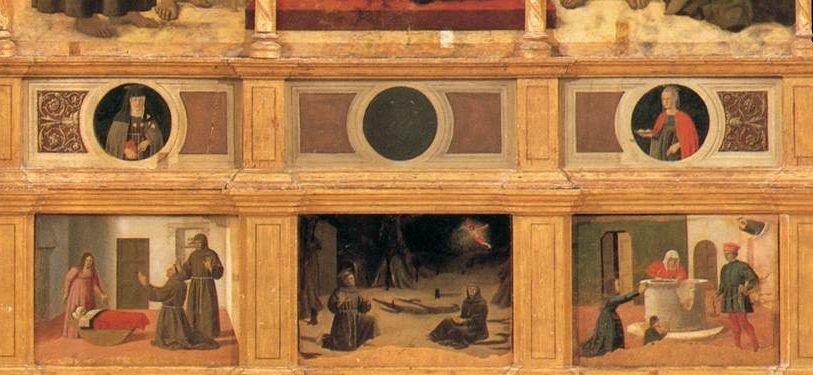
A narrow band of round openings sits above the three rectangular scenes. The dark central opening breaks the rhythm of the two surviving painted roundels.
The Annunciation above the throne
Gabriel kneels at the left of the crowning panel and Mary stands under an arch on the right. Between them, the arcaded passage contracts in scale so quickly that a surprisingly long stretch of architecture seems to fit into the narrow central opening. A sequence of pillars marks out that depth against both the near plane of the figures and the shaped perimeter of the panel. The holding gallery relates the scene to the geometry Piero later set out in De prospectiva pingendi. The separate Perugia Annunciation examines the construction of this space and the positions of its two figures in detail. [1] [8]
Within the ensemble, the scene gives a beginning to the story embodied by the child on Mary's lap. In the upper panel she hears that she is to bear Christ. The large register immediately below shows her as his mother. Farther down the central axis, Francis receives the wounds of the crucified Christ. The chain from the Annunciation to the Stigmatisation links images that are physically far apart. That axis also runs through the centre of the upper predella, where a later opening records a change in the convent’s use. Looking along this line makes it possible to follow the altarpiece's devotional design while also seeing where its use led to a material alteration. [1] [2] [4]
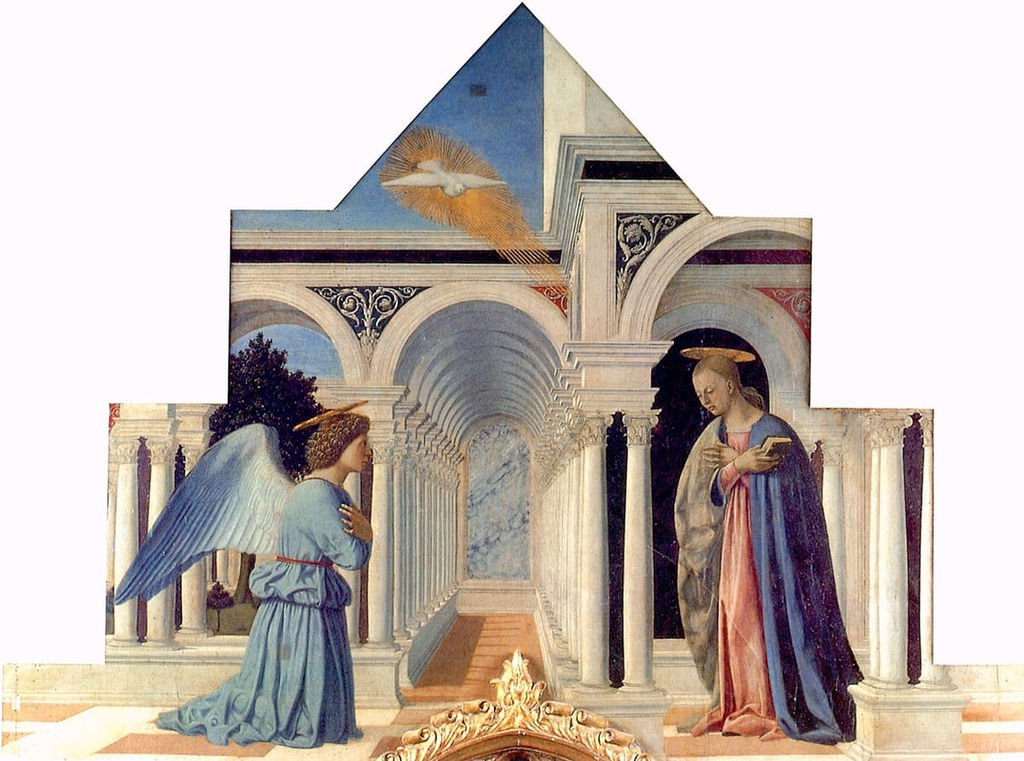
Piero della Francesca, Annunciation, crown of the Sant’Antonio Polyptych, Perugia. Image source. Public domain. Resized only; native appearance preserved.
Two predellas with different purposes
The upper predella contains two circular half-length images. Saint Clare of Assisi is on the viewer's left beneath the two saints on that side. Saint Agatha is on the right beneath Francis and Elizabeth. Clare established the form of Franciscan religious life associated with the Poor Clares. Agatha is an early Christian martyr. The women are set within circles rather than shown acting out an episode. Their format is suited to a narrow band below the full-length saints and makes this level resemble a series of small devotional portraits. [1] [2] [4]
The centre of this upper band once contained a small panel that has been lost. The museum connects its removal to the introduction of definitive enclosure in 1572, when it says a metal grille took its place so that the sisters could attend the Eucharist from the cloistered side. The national catalogue describes the lost piece as a small movable door and discusses the removal and enlargement of the opening in connection with the altarpiece's later relocation within the church complex. It also notes that the opening communicated through a wall. The accounts tie the loss to the use of the building, while leaving the sequence of adaptations open to question. Nor can a viewer recover the subject of the missing painting from the shape of the opening. [1] [2]
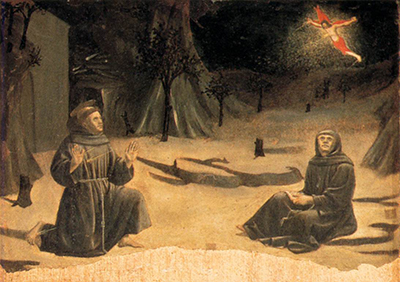
The lower predella tells stories from the lives of the three Franciscan saints in the main tier. On the left, Saint Anthony of Padua restores a dead child to life. The miracle has its own setting and witnesses, expanding the identity of the standing saint above into an episode that could be followed at close range. In the centre, Francis receives the stigmata in a rocky nocturnal landscape. Here the saint's body registers the event while the concentrated light makes the vision conspicuous within the surrounding dark. On the right, Saint Elizabeth of Hungary revives a child who has fallen into a well. The raised rim of the well and the figures around it concentrate attention on the place of danger and rescue. [1] [4] [3]
Seen together, the two child miracles give the dark scene between them a pair of earthly counterparts. There is a clear link from each story to its saint in the main tier. It is especially close on the right, where the panel of Saint Francis and Saint Elizabeth brings together the two people whose stories are next to each other at the base. Lyle reads the parity of Anthony's and Elizabeth's miracles as an emphasis on the equal value of their acts of care. From that perspective, the altarpiece offered an especially direct example of a woman practising the charity central to the sisters' work. The juxtaposition is visible in the painting. Its connection to the community's debates about enclosure is a historical interpretation. [1] [4] [3]
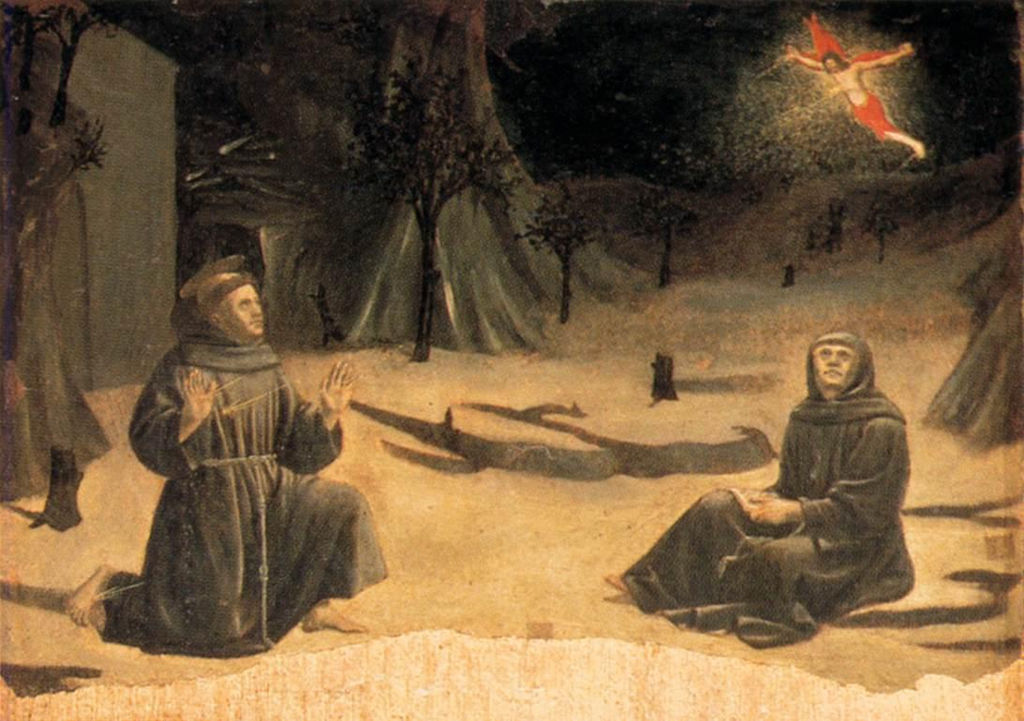
Stigmatisation of Saint Francis, central predella scene of the Sant’Antonio Polyptych. Image source. Public domain. Resized only; native appearance preserved.
How the panels were made and dated
The Galleria Nazionale dell’Umbria describes the work as tempera and oil on wood. Gilding also belongs to its construction and appearance. The museum interprets the use of oil in relation to Piero's familiarity with Netherlandish painting and the court of Urbino, whereas Vittoria Garibaldi also considered what he could have seen during his documented time in Rome in 1459. The sheen of a halo, the way light passes through glass and the play of light across the Stigmatisation are effects a visitor can look for. Their presence cannot establish where Piero first encountered the techniques. [1] [2]
The distinction between the upper and main paintings has led to different accounts of how the work took shape. In his 1954 report, the restorer Cesare Brandi noted that the crowning panel was narrower than the body and had strips added on either side from an early stage. He also found places where the painted edge did not precisely follow the present arches. The paint stops at the stepped outline above, even though the surviving frame around the gable is later. Brandi thought there was room to consider whether Piero had originally conceived the Annunciation separately. The national catalogue, drawing on later conservation, cites lines marked with a snapped cord and a marking gauge as evidence of a coordinated design across the panels. The physical evidence allows for individual parts to have been prepared in different ways within an overall plan. It does not give the date or order of every painting operation. [2] [3]
Brandi also argued for collaboration. He pointed to the difference in the handling of the brocade on the Madonna's dress, comparing the fine work near the neckline with the treatment elsewhere on the garment. That difference was his evidence for the involvement of another painter. The gallery and national catalogue identify Piero as the artist of the ensemble. The attribution of a whole commission and the question of how much help the artist had in executing it can therefore be considered separately. A single change in handling does not name an assistant or establish a boundary between two hands throughout the altarpiece. [1] [2] [3]
The museum dates the work to about 1467–69. The National Gallery uses 1467–68, while the national catalogue's dating field gives about 1468–70 and its historical note also discusses Garibaldi's earlier dating near 1459. In the Cambridge Companion to Piero della Francesca, the dating argument begins with permission for Masses at Sant’Antonio in 1455 and ends with the sisters' request for assistance to pay for a completed altarpiece in 1468. The municipal document gives historians a point of reference independent of style, although the year of a grant says little about the interval between drawing out an individual panel and finishing its surface. The familiar date of 1468 is best understood in light of that financial record. [1] [2] [5] [9]
From church furnishing to museum object
Giorgio Vasari saw and described the work at Sant’Antonio in the sixteenth century. Later records track changes to its setting and structure. The national catalogue associates the loss of framing elements and a period of detachment of the lower predella with moves inside the church complex. Such changes matter because that lower tier had also served as a support. The ensemble entered the civic collection in 1810, in the context of the Napoleonic suppression of religious houses. A visitor sees the surviving panels together today, after changes that altered both the framework around them and the surfaces of individual paintings. [2] [3] [9]
Brandi's photographs make some of those surface changes unusually concrete. An earlier restorer had spread a grey layer across original paint, old fills and retouches on the Annunciation, apparently to make it look tonally closer to the other parts. Brandi's team reduced the grey layer and documented it with samples left during cleaning. They also realigned the poorly joined board carrying Mary. On the main tier they left a slight curve in the support because its shape appeared to have remained stable over several decades. A board that had been imperfectly rejoined and a slight old warp presented distinct problems. The restoration decisions followed from the condition of each piece. [3]
The three lower narratives had suffered from extensive repainting. In Elizabeth's scene, photographs taken before, during and after treatment show what happened when Brandi's team removed overpaint from the standing man on the right. A previous repair had supplied feet in a different position and colour. Cleaning recovered evidence for the figure's original stance and red colour there. The episode offers a concrete reason for treating older descriptions of these panels with care. An earlier description of the composition may record details introduced centuries after the altarpiece was made. [3]
The gallery lists a further conservation campaign in the 1990s. Tecni.Re.Co., the firm responsible for work on the painted panels and frames, records its involvement from 1989 to 1993. The national catalogue also lists work by Coo.Be.C. between 2002 and 2006. Taken together, the later evidence of planning marks and Brandi’s photographs of joins and cleaned surfaces show how a coordinated design survived being moved, reshaped and repaired. [2] [3] [10] [11]
The first audiences for the ensemble after its removal from Sant’Antonio included artists in training. The museum identifies it as one of the works housed in the former Olivetan monastery of Montemorcino Nuovo for study by students of Perugia’s Academy of Fine Arts. The municipal gallery opened to the public in 1863 and moved to Palazzo dei Priori in 1879. The comparison with Fra Angelico’s altarpiece has an institutional history too. Both works passed through Montemorcino, and in the present collection they let us compare two Perugian commissions whose original sites and audiences were distinct. [12]
Browse the artworks
Compare Piero’s frescoes, panels and manuscript figures. The list includes ensembles and separately identifiable panels or scenes. Dates are approximate where the sources differ.
| Name | Date | Medium and source |
|---|---|---|
| The Baptism of Christ | Probably c. 1437–45 | Panel painting Catalogue. |
| The Flagellation of Christ | 1459–60 (GNDM) | Panel painting Catalogue. |
| The History of the True Cross | Mid-fifteenth century | Wall painting Catalogue. |
| Dream of Constantine | Mid-fifteenth century | Wall painting Catalogue. |
| The Duke and Duchess of Urbino | About 1473–75 (Uffizi) | Panel painting Catalogue. |
| The Resurrection | About 1458–68 (Opificio) | Wall painting Catalogue. |
| Brera Madonna | About 1472–74 | Panel painting Catalogue. |
| Annunciation at Arezzo | Mid-fifteenth century | Wall painting Catalogue. |
| Madonna del Parto | About 1450–65 (Monterchi) | Wall painting Catalogue. |
| Polyptych of the Misericordia | Commissioned 1445 | Panel painting Catalogue. |
| The Nativity | Early 1480s (National Gallery) | Panel painting Catalogue. |
| Madonna di Senigallia | About 1474–75 (GNDM) | Panel painting Catalogue. |
| Death of Adam | Mid-fifteenth century | Wall painting Catalogue. |
| Queen of Sheba | Mid-fifteenth century | Wall painting Catalogue. |
| Victory of Constantine | Mid-fifteenth century | Wall painting Catalogue. |
| Battle between Heraclius and Chosroes | Mid-fifteenth century | Wall painting Catalogue. |
| Saint Mary Magdalen | Wall painting Catalogue. | |
| The Augustinian Polyptych | 1454–69 | Panel painting Catalogue. |
| Polyptych of Perugia | About 1467–69 (GNU) | Panel painting Catalogue. |
| Perugia Annunciation | About 1468–70 (national catalogue) | Panel painting Catalogue. |
| St Francis and St Elizabeth | About 1467–69 (GNU) | Panel painting Catalogue. |
| Stigmatisation of St Francis | About 1468–70 (national catalogue) | Panel painting Catalogue. |
| An Augustinian Nun (Saint Monica) | 1454–69 | Panel painting Catalogue. |
| Augustinian Saint | 1454–69 | Panel painting Catalogue. |
| Saint Michael | 1454–69 | Panel painting Catalogue. |
| Saint Nicholas of Tolentino | 1454–69 | Panel painting Catalogue. |
| Saint John the Evangelist | 1454–69 | Panel painting Catalogue. |
| Virgin and Child Enthroned with Four Angels | About 1460–70 (Clark) | Panel painting Catalogue. |
| Portrait of Sigismondo Pandolfo Malatesta | About 1450–51, often proposed. Louvre catalogue range 1450–75. | Panel painting Catalogue. |
| Sigismondo before St Sigismund | 1451 | Wall painting Catalogue. |
| St Jerome and a Donor | 1460s (Accademia); about 1450 also proposed | Panel painting Catalogue. |
| St Jerome in Penitence | 1450, dated on the panel | Panel painting Catalogue. |
| Saint Julian | About 1455–60, often proposed | Wall painting Catalogue. |
| Saint Augustine | 1454–69 | Panel painting Catalogue. |
| Saint Apollonia | 1454–69 | Panel painting Catalogue. |
| Crucifixion from the Augustinian Polyptych | 1454–69 | Panel painting Catalogue. |
| Saint Louis of Toulouse | Wall painting Catalogue. | |
| Burial of the Wood | Mid-fifteenth century | Wall painting Catalogue. |
| Discovery and Proof of the True Cross | Mid-fifteenth century | Wall painting Catalogue. |
| Exaltation of the Cross | Mid-fifteenth century | Wall painting Catalogue. |
| Saint Anthony Raises a Child | About 1467–69 (GNU) | Panel painting Catalogue. |
| Saint Elizabeth Revives a Child | About 1467–69 (GNU) | Panel painting Catalogue. |
| Hercules | About 1470 | Wall painting Catalogue. |
| Portrait of a Boy (possibly Guidobaldo da Montefeltro) | Panel painting Catalogue. | |
| De prospectiva pingendi, Reggio Emilia witness (figures) | Manuscript diagrams Catalogue. | |
| The Interrogation of Judas | Mid-fifteenth century | Wall painting Catalogue. |
| Two prophets, Bacci Chapel | Mid-fifteenth century | Wall painting Catalogue. |
| Saint Clare of Assisi, upper predella | About 1467–69 (GNU) | Panel painting Catalogue. |
| Saint Agatha, upper predella | About 1467–69 (GNU) | Panel painting Catalogue. |
| Lost centre of the Augustinian Polyptych | 1454–69 | Lost panel or panels Catalogue. |
Frequently Asked Questions
Discussion
Look again at the images and ideas explored in Polyptych of Perugia. These editorial prompts invite your observations.
Reader Insights
Follow the central axis from the Annunciation through the Madonna and Child to the Stigmatisation. Where does the frame interrupt that connection, and where does the painting restore it?
Compare the account of Anthony’s miracle at the left of the lower predella with Elizabeth’s at the right. How do their positions affect your reading of the Franciscan saints above?
Look at the patterned gold behind the saints and then at the recession of the arcade above. Which details do the most to suggest how far each group of figures stands from its background?
Join the Conversation
Share a detail, comparison or question about Polyptych of Perugia below.
References
- Galleria Nazionale dell’Umbria. Polittico di Sant’Antonio, collection record 63106. View source.
- Istituto Centrale per il Catalogo e la Documentazione. Polittico di Sant’Antonio, national catalogue record 1000016171, especially pp. 1–6. View source.
- Brandi, Cesare. “Restauri a Piero della Francesca”. Bollettino d’Arte 39, no. 3, 1954, pp. 241–58, especially pp. 253–58 and figs. 25–38. View source.
- Lyle, Beverley N. Peripheral Backwater or Innovative Upland? Patterns of Franciscan Patronage in Renaissance Perugia, c. 1390–1527. PhD thesis, Oxford Brookes University, 2008, pp. 76–84. View source.
- Henry, Tom. The Procession to Calvary, “The patron and original location”, fig. 18. Online edition, 2024. From Carol Plazzotta and Tom Henry, The Sixteenth Century Italian Paintings, vol. 4, Raphael, 2022. View source.
- Longhi, Roberto. Piero della Francesca, Milan, 1946, pp. 85–87, reproduced by Fondazione Arte. View source.
- Betti, Mariangela, Cecilia Frosinini and Paola Refice, eds. Ripensando Piero della Francesca. Il Polittico della Misericordia di Sansepolcro. Florence, 2010. View source.
- Galleria Nazionale dell’Umbria. Piero della Francesca – Sala 13, tactile interpretation of the Annunciation. View source.
- Wood, Jeryldene M. “Introduction”, The Cambridge Companion to Piero della Francesca. Cambridge University Press, 2002, p. 10. View source.
- Galleria Nazionale dell’Umbria. Piero della Francesca, Polittico di Sant’Antonio, restoration archive. View source.
- Tecni.Re.Co. Polittico di Sant’Antonio, Galleria Nazionale dell’Umbria treatment register. View source.
- Galleria Nazionale dell’Umbria. Museum history, from the Academy collection to Palazzo dei Priori. View source.
Related Paintings
Annunciation (Perugia)
Piero della Francesca, Annunciation, crown of the Sant’Antonio Polyptych, Perugia. Image source. Public domain. Resized only; native appearance preserved.
The Augustinian Polyptych
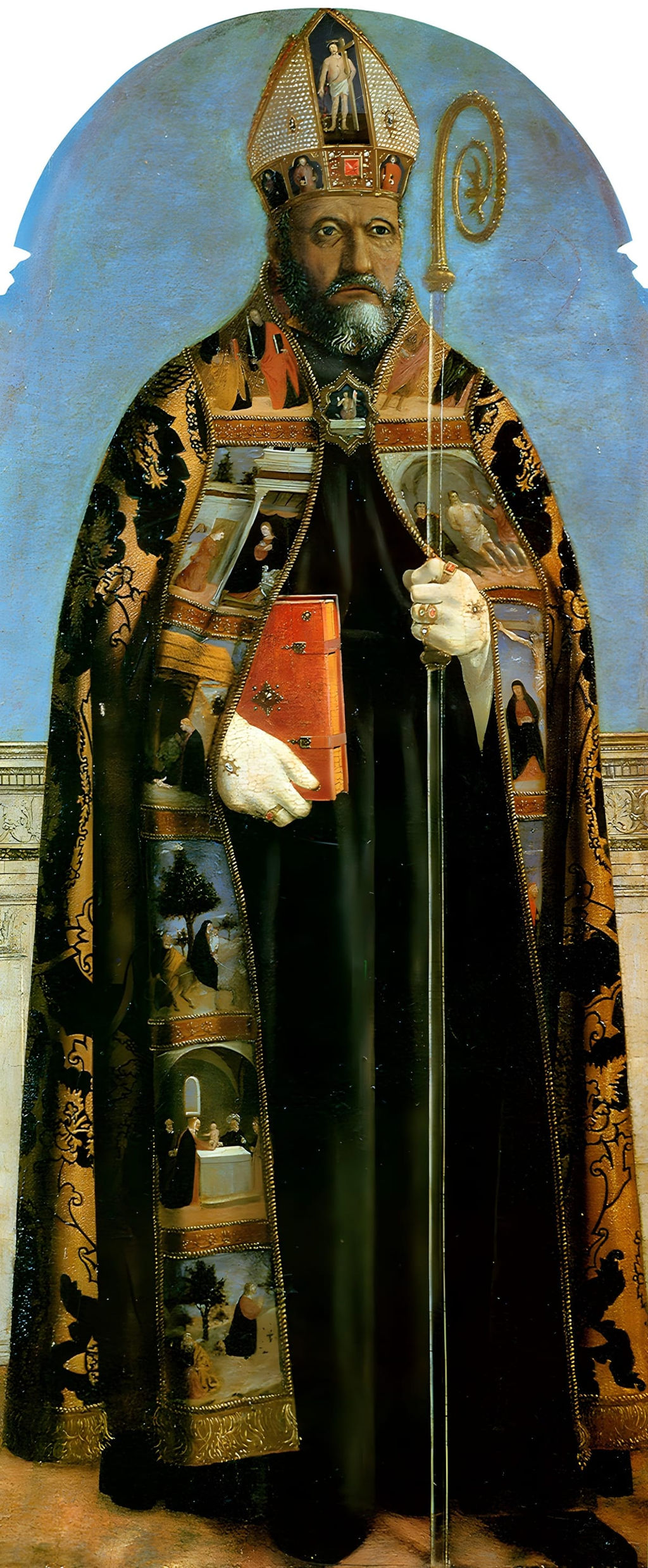
Piero della Francesca, Saint Augustine, surviving panel from the Augustinian Polyptych, Lisbon. Image source. Public domain. Resized only; native appearance preserved.