 by Tom Gurney
Tom Gurney BSc (Hons) is an art history expert with over 20 years experience
Published on June 19, 2020 / Updated on October 14, 2023
Email: tomgurney1@gmail.com / Phone: +44 7429 011000
The Stigmatisation of Saint Francis: Introduction
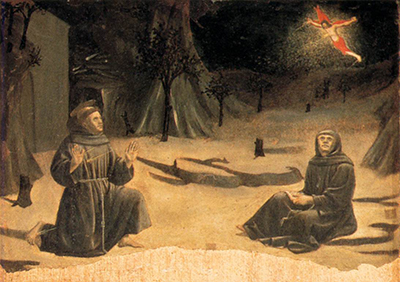
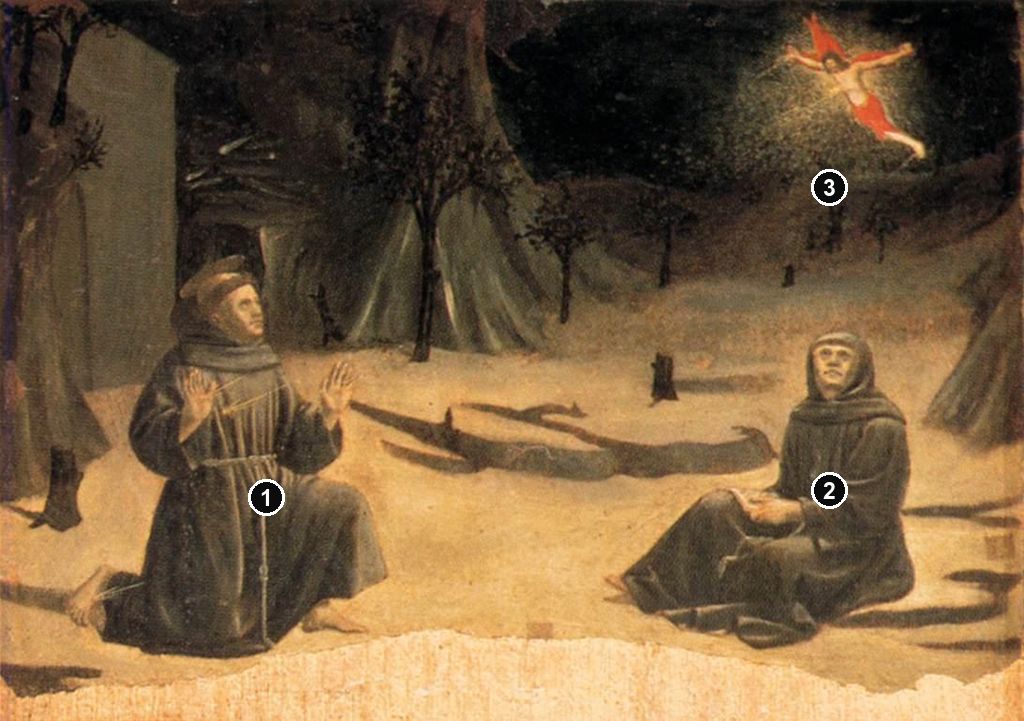
Saint Francis kneels in a clearing with both palms open. Above him, a tiny crucified figure with red wings seems to set the night alight. On the other side of the clearing, a second friar sits with his hands gathered in his lap. The space between the two men takes up much of the panel, yet the fine rays descending to Francis give the scene a precise focus. This is the central scene in the lower predella, the band of narrative paintings at the foot of Piero della Francesca’s Perugia Polyptych. It now forms part of the altarpiece on display at the Galleria Nazionale dell’Umbria. [1] [2]
At a Glance
- ArtistPiero della Francesca, as catalogued for the individual compartment. [3]
- DateAbout 1468–70 according to the national component catalogue. [3]
- MediumOil on wood in the component record. The museum records tempera and oil on wood for the whole altarpiece. [1] [3]
- Dimensions37.7 cm high by 54.5 cm wide in the national component catalogue. [3]
- PositionCentre of the lower predella of the Polyptych of Sant’Antonio. [1] [4]
- CollectionGalleria Nazionale dell’Umbria, Palazzo dei Priori, Perugia. [1] [3]
This work across Piero della Francesca’s career
The Baptism of Christ
Probably about 1437–45The History of the True Cross
Mid-fifteenth centuryThe Resurrection
About 1458–68 (Opificio)The Flagellation of Christ
1459–60 (GNDM)The Stigmatisation of Saint Francis (current article)
About 1468–70 (national catalogue)The Montefeltro Altarpiece
About 1472–74 (Brera)The Duke and Duchess of Urbino
About 1473–75 (Uffizi)The Nativity
Early 1480s (National Gallery)Contents
- What happened at La Verna?
- How the light makes the landscape visible
- Francis twice in the same altarpiece
- Other ways to paint the apparition
- Annotated details
What happened at La Verna?
The stigmata are marks corresponding to the wounds Christ received at the Crucifixion. In the Franciscan tradition, Francis received them in 1224 while on retreat at La Verna, a mountain hermitage in the Tuscan Apennines. Thomas of Celano’s early Life of Saint Francis describes a man with six wings and the posture of someone fastened to a cross. Francis is drawn to the figure’s kindly expression and troubled by its suffering. While he is still trying to make sense of the encounter, marks resembling nail wounds appear in his hands and feet. Celano also describes a wound in the right side like the one made by the lance in Christ’s side. [5] [6]
Bonaventure’s Major Legend sets the event near the feast of the Exaltation of the Cross, during a period of fasting in honour of Saint Michael. He describes a radiant seraph descending towards Francis, who is praying on the mountainside. Within its wings appears the likeness of a crucified man. Bonaventure makes sense of the union of a suffering body and an angelic figure by relating it to Francis’s own transformation. As the vision fades, it leaves him with an inward fire and with outward signs of the Passion. Piero draws that inward and outward experience into a single image. The rays make a visible connection between the body in the air and the man on the ground, and Francis’s raised hands give a viewer a place to look for an event that the written lives unfold over time. [2] [5]
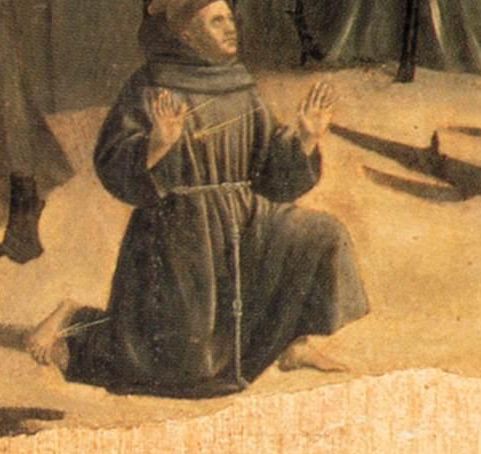
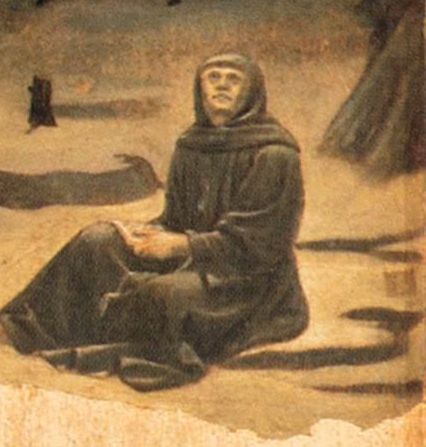
Bonaventure places the apparition in the morning. The Galleria describes the painting as a nocturne, and the black sky in the upper right makes the luminous figure unusually conspicuous. The painting gives the brightness described in the text a scale and intensity of its own. It is also selective about who receives the revelation. The seated friar, identified as Brother Leo by art historian Harriet Edquist, is near enough to share the lit ground. His gathered hands and largely frontal face give him a different role from Francis, who turns up towards the vision and opens his palms. Their contrasting postures allow the viewer to imagine a companion’s proximity to an experience whose meaning belongs to Francis. [1] [2] [5] [4]
Leo also provides a link to a surviving object from the Franciscan tradition. A small piece of parchment kept at the Sacro Convento in Assisi bears Francis’s praises of God on one side and a blessing addressed to Leo on the other. Leo added an inscription in red associating the praises with the apparition and the imprinting of the wounds at La Verna. The note is evidence of how someone close to Francis understood the event. It helps explain why the second friar is more than a device for filling the clearing, even though the painting leaves his precise experience of the apparition open. [4] [7]
How the light makes the landscape visible
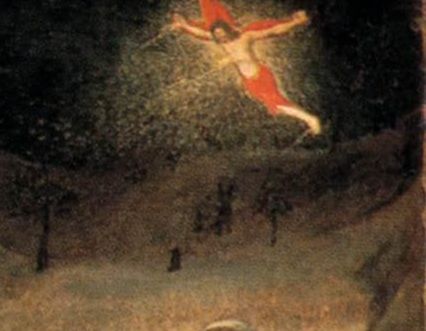
The picture contains two kinds of rays. The apparition is surrounded by a broad haze that softens into the dark around it. Finer lines descend towards Francis and meet his raised hands and the front of his habit. Through that distinction, the glow lights up a place while the finer rays make the stigmatisation intelligible as a particular encounter. Francis’s upturned face and the ridges of his grey habit catch the light. The foot emerging below his robe is close to the earth, and the cord loops around the folds at his waist. These details give weight to a figure whose attention is directed upward. [1] [2]
The low foreground is much brighter than the woodland behind it. Cast shadows stretch across that open ground, interrupted by a stump and the dark shapes of the two friars. A few slender trunks stand in front of the rock faces, and the ground recedes into darkness on the right. The clearing is large enough for the two friars to occupy distinct places, but the enclosing slopes keep the event close to the viewer. A diagonal from the luminous figure to Francis cuts across this shallower arrangement. The rising gesture of his hands makes it easy to follow that diagonal back towards the apparition. [2] [4]
Italy’s national catalogue records this compartment as oil on wood, 37.7 by 54.5 centimetres, and names Piero as the painter. The Galleria identifies tempera and oil on wood for the polyptych as a whole and singles out the stigmatisation for the intensity of the light achieved with oil. Notice the difference between the soft edge of the light around the seraph and the hard edge of the shadows on the ground. Both effects are necessary for the apparition to seem at once extraordinary and present in the same space as the two friars. [1] [3]
A pale, uneven area interrupts the foreground along the lower edge. Cesare Brandi’s 1954 report describes how heavily the three lower predella panels had been damaged and overpainted. He explains that the conservators filled extensive losses with lightly textured material and publishes photographs of the Francis panel before and after treatment. That history matters particularly in a picture whose effect depends on very small differences of tone. The bright ground that remains between the friars participates in the scene’s illumination. The pale band at the edge marks an interruption in the surviving paint surface. [2] [8]
Annotated Details from The Stigmatisation of Saint Francis
The numbered points identify visible features discussed in this article. Return from each detail to the numbered overview. Stigmatisation of Saint Francis, central predella scene of the Sant’Antonio Polyptych. Image source. Public domain.
Details from THE STIGMATISATION OF SAINT FRANCIS
Compare the cropped details with the source images above. Notice how their colours, shapes and positions contribute to the larger compositions.
Francis in the clearing
Francis kneels with palms lifted. His dark habit and its broad folds stand out against the light ground.
The second friar
The friar sits just beyond a strong horizontal shadow. The direction of his attention articulates a second response to the bright figure overhead.
The luminous seraph
The smallest, brightest patch occurs in the upper right, where the winged figure appears against a dark stretch of sky.
Francis twice in the same altarpiece
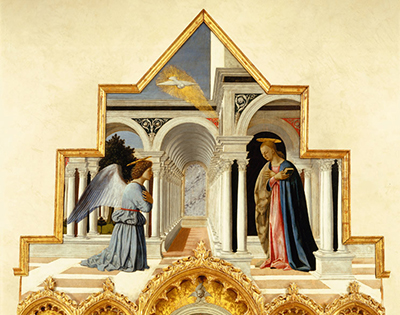
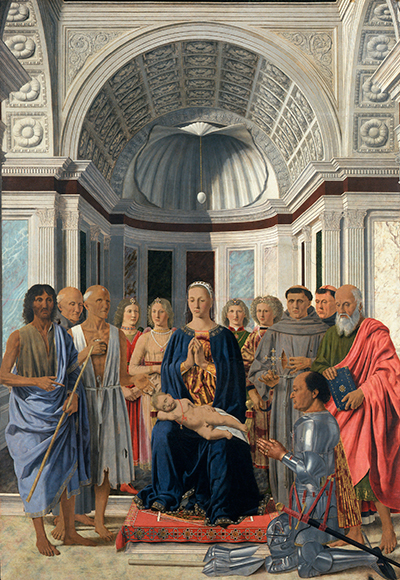
The Franciscan Tertiaries of Sant’Antonio commissioned the altarpiece for the outer church of their monastery at Porta Sant’Angelo in Perugia. The Galleria links its completion to a contribution from the city in 1468 and dates the assembled work to about 1467–69. The national catalogue assigns about 1468–70 to the Stigmatisation panel specifically. The altarpiece was designed for a confined sanctuary. Its four registers put the Annunciation at the top and the seated Virgin and Child with standing saints below it. The narrow upper predella includes Clare of Assisi and Agatha in roundels. The three miracle scenes occupy the separate, lowest tier. [1] [3]
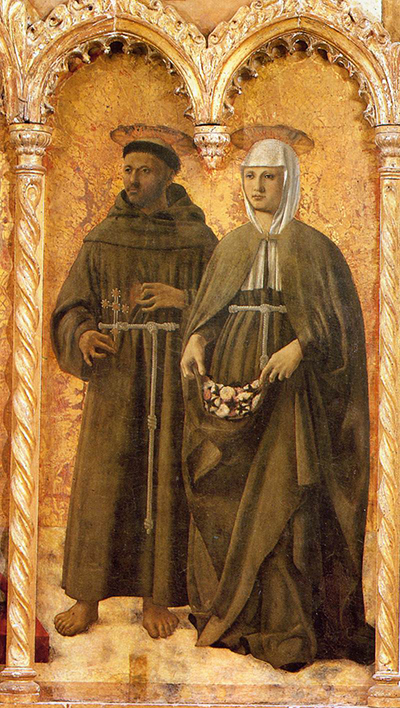
Look to the right of the throne in the main register and the kneeling friar reappears, now standing beside Elizabeth of Hungary. In Saint Francis and Saint Elizabeth, Francis holds a crystal cross and opens his habit to show his wound. A viewer who looks down to the lower predella finds the story behind that attribute. Above, the saint can display the mark to a worshipper. Below, he turns away from the viewer and towards the apparition as the marks are being given. The gold behind the standing figure and the darkness around the kneeling one give viewers two ways to recognise the same saint. [1] [2] [3] [9]
In the lower row, Anthony of Padua raises a dead child on the left and Elizabeth revives a child who fell down a well on the right. Anthony’s scene takes place indoors by a bed, while Elizabeth’s is organised around the stone rim of the well. Read from left to right, the row passes from a domestic interior through a dark mountain clearing to a gathering within a built setting. Its middle scene also changes the role of the saint. Anthony and Elizabeth intercede on behalf of children. At La Verna, the bodily change takes place in Francis himself. The scene sits on the altarpiece’s central axis, directly below the Virgin and Child. The standing Francis is offset to their right. Edquist sees a further correspondence along that axis, between the radiance of the seraph at the bottom and the light of the Annunciation at the top. [1] [2] [4] [8]
The national catalogue describes the present lower tier as a reconstruction of a box-like support. The three small panels were inserted into that structure after later framing was removed. This helps explain why the scene can be both a picture in its own right and part of the altarpiece’s base. In Perugia the gold uprights frame the wooded clearing and give it a clear beginning and end. Seeing the panel in place makes its scale and its position beneath the Virgin as apparent as its darkness. [1] [3]
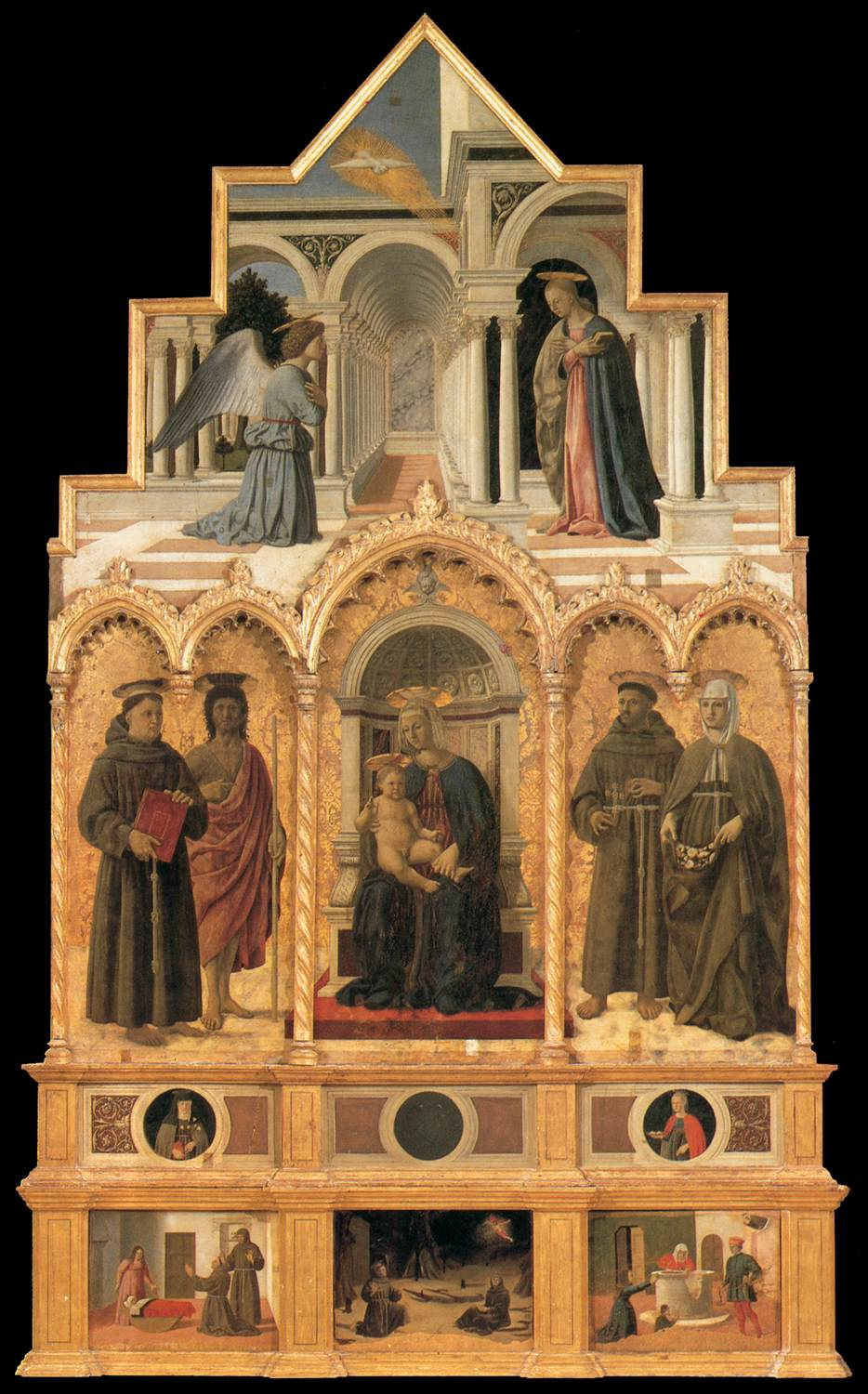
Sant’Antonio Polyptych in its current assembly, Galleria Nazionale dell’Umbria, Perugia. Image source. Public domain. Resized only; native appearance preserved.
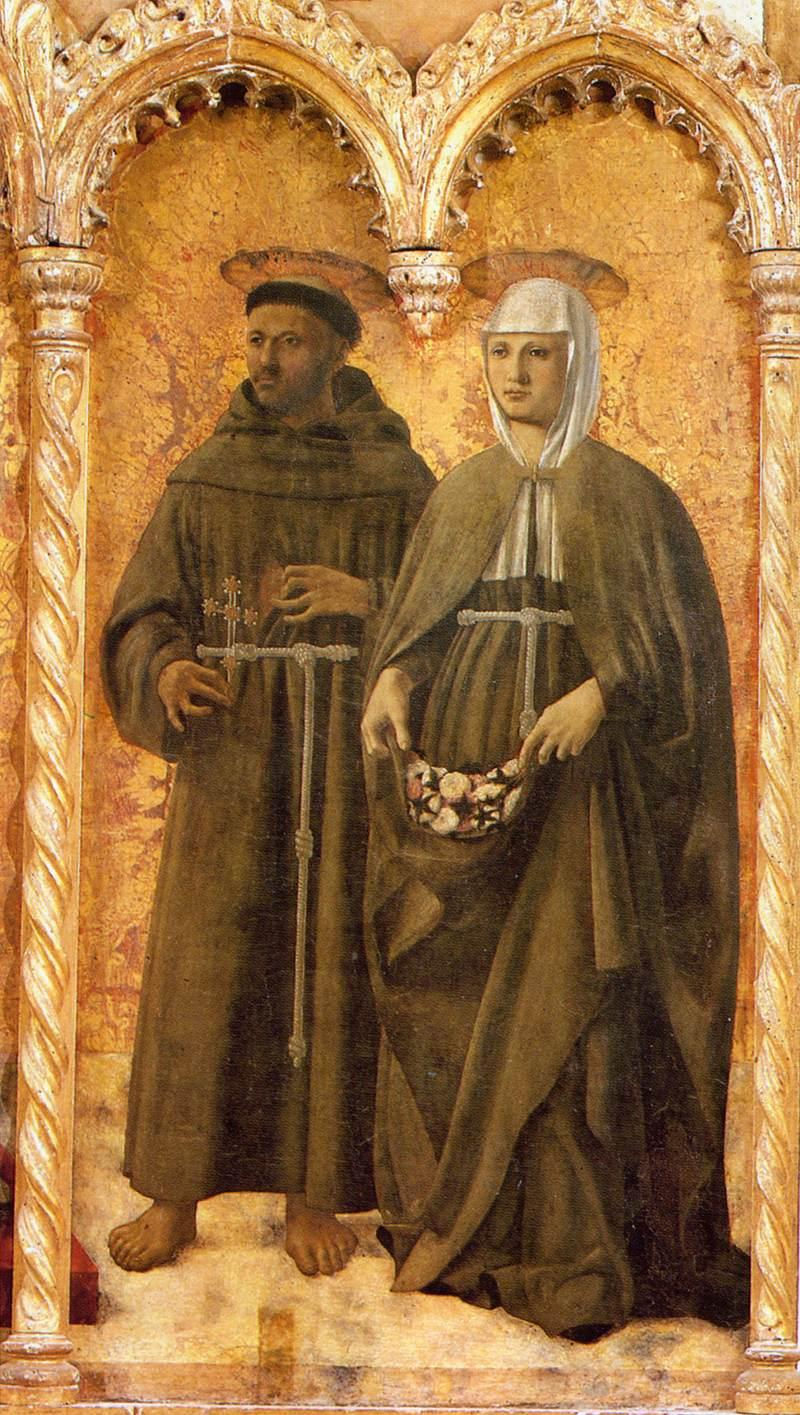
Saint Francis and Saint Elizabeth of Hungary, right-hand panel of the Sant’Antonio Polyptych. Image source. Public domain. Resized only; native appearance preserved.
Other ways to paint the apparition
Sassetta used the same subject for the double-sided altarpiece made for the Franciscan friars of Borgo San Sepolcro in 1437–44. His painting, now in the National Gallery in London, also connects the kneeling Francis to a winged Christ by rays. The friars’ written instructions put Sassetta’s panel beside the granting of the Portiuncula Indulgence. In that setting, the vision could reinforce the claim that Francis had received divine approval. Piero’s panel belongs to a sequence devoted to three different saints. Its broad clearing and illuminated companion make the shared physical setting a prominent part of the account. The two works show how the neighbours of a scene can change what a viewer takes from it. [2] [10]
Infrared examination of Sassetta’s picture reveals that he repeatedly adjusted the size and shape of the shadow cast by Francis. His revisions show how carefully a fifteenth-century painter could work out the visible effects of the vision. In Perugia, shadows spread from several features of the landscape and from the figures themselves. Comparing the finished scenes draws attention to the extent of the light in Piero’s clearing and to how much space it occupies. [2] [11]
A comparison within Piero’s work brings the lighting into focus. In the Dream of Constantine at Arezzo, light from an apparition picks out the imperial tent and the people around it. The emperor lies asleep amid a guarded encampment. In the small Perugia panel Francis is awake, with his face and hands turned towards the source. The two pictures give visible consequences to an apparition by showing what it illuminates. The tent makes that change evident on a continuous fabric surface, while the predella spreads light over bare ground, where the length and direction of the shadows give the vision a presence beyond the winged figure itself. [1] [2] [12]
Browse the artworks
Compare Piero’s frescoes, panels and manuscript figures. The list includes ensembles and separately identifiable panels or scenes. Dates are approximate where the sources differ.
| Name | Date | Medium and source |
|---|---|---|
| The Baptism of Christ | Probably c. 1437–45 | Panel painting Catalogue. |
| The Flagellation of Christ | 1459–60 (GNDM) | Panel painting Catalogue. |
| The History of the True Cross | Mid-fifteenth century | Wall painting Catalogue. |
| Dream of Constantine | Mid-fifteenth century | Wall painting Catalogue. |
| The Duke and Duchess of Urbino | About 1473–75 (Uffizi) | Panel painting Catalogue. |
| The Resurrection | About 1458–68 (Opificio) | Wall painting Catalogue. |
| Brera Madonna | About 1472–74 | Panel painting Catalogue. |
| Annunciation at Arezzo | Mid-fifteenth century | Wall painting Catalogue. |
| Madonna del Parto | About 1450–65 (Monterchi) | Wall painting Catalogue. |
| Polyptych of the Misericordia | Commissioned 1445 | Panel painting Catalogue. |
| The Nativity | Early 1480s (National Gallery) | Panel painting Catalogue. |
| Madonna di Senigallia | About 1474–75 (GNDM) | Panel painting Catalogue. |
| Death of Adam | Mid-fifteenth century | Wall painting Catalogue. |
| Queen of Sheba | Mid-fifteenth century | Wall painting Catalogue. |
| Victory of Constantine | Mid-fifteenth century | Wall painting Catalogue. |
| Battle between Heraclius and Chosroes | Mid-fifteenth century | Wall painting Catalogue. |
| Saint Mary Magdalen | Wall painting Catalogue. | |
| The Augustinian Polyptych | 1454–69 | Panel painting Catalogue. |
| Polyptych of Perugia | About 1467–69 (GNU) | Panel painting Catalogue. |
| Perugia Annunciation | About 1468–70 (national catalogue) | Panel painting Catalogue. |
| St Francis and St Elizabeth | About 1467–69 (GNU) | Panel painting Catalogue. |
| Stigmatisation of St Francis | About 1468–70 (national catalogue) | Panel painting Catalogue. |
| An Augustinian Nun (Saint Monica) | 1454–69 | Panel painting Catalogue. |
| Augustinian Saint | 1454–69 | Panel painting Catalogue. |
| Saint Michael | 1454–69 | Panel painting Catalogue. |
| Saint Nicholas of Tolentino | 1454–69 | Panel painting Catalogue. |
| Saint John the Evangelist | 1454–69 | Panel painting Catalogue. |
| Virgin and Child Enthroned with Four Angels | About 1460–70 (Clark) | Panel painting Catalogue. |
| Portrait of Sigismondo Pandolfo Malatesta | About 1450–51, often proposed. Louvre catalogue range 1450–75. | Panel painting Catalogue. |
| Sigismondo before St Sigismund | 1451 | Wall painting Catalogue. |
| St Jerome and a Donor | 1460s (Accademia); about 1450 also proposed | Panel painting Catalogue. |
| St Jerome in Penitence | 1450, dated on the panel | Panel painting Catalogue. |
| Saint Julian | About 1455–60, often proposed | Wall painting Catalogue. |
| Saint Augustine | 1454–69 | Panel painting Catalogue. |
| Saint Apollonia | 1454–69 | Panel painting Catalogue. |
| Crucifixion from the Augustinian Polyptych | 1454–69 | Panel painting Catalogue. |
| Saint Louis of Toulouse | Wall painting Catalogue. | |
| Burial of the Wood | Mid-fifteenth century | Wall painting Catalogue. |
| Discovery and Proof of the True Cross | Mid-fifteenth century | Wall painting Catalogue. |
| Exaltation of the Cross | Mid-fifteenth century | Wall painting Catalogue. |
| Saint Anthony Raises a Child | About 1467–69 (GNU) | Panel painting Catalogue. |
| Saint Elizabeth Revives a Child | About 1467–69 (GNU) | Panel painting Catalogue. |
| Hercules | About 1470 | Wall painting Catalogue. |
| Portrait of a Boy (possibly Guidobaldo da Montefeltro) | Panel painting Catalogue. | |
| De prospectiva pingendi, Reggio Emilia witness (figures) | Manuscript diagrams Catalogue. | |
| The Interrogation of Judas | Mid-fifteenth century | Wall painting Catalogue. |
| Two prophets, Bacci Chapel | Mid-fifteenth century | Wall painting Catalogue. |
| Saint Clare of Assisi, upper predella | About 1467–69 (GNU) | Panel painting Catalogue. |
| Saint Agatha, upper predella | About 1467–69 (GNU) | Panel painting Catalogue. |
| Lost centre of the Augustinian Polyptych | 1454–69 | Lost panel or panels Catalogue. |
Frequently Asked Questions
Discussion
Look again at the images and ideas explored in The Stigmatisation of Saint Francis. These editorial prompts invite your observations.
Reader Insights
Follow the rays from the seraph towards Francis, then trace the shadows on the ground. How does each set of lines tell you something different about the event?
Compare Francis’s hands in the clearing with his gesture in the main register. Where does each version direct your attention?
Read the three lower scenes from left to right. What changes when the sequence moves from a group gathered around a child to a single friar receiving a vision and then back to another group?
Join the Conversation
Share a detail, comparison or question about The Stigmatisation of Saint Francis below.
References
- Galleria Nazionale dell’Umbria, Polittico di Sant’Antonio, collection entry and historical commentary. View source.
- Web Gallery of Art, The Stigmatisation of St Francis, reproduction of the Perugia panel, used for visual analysis. View source.
- Ministero della Cultura, San Francesco d’Assisi riceve le stimmate, national component record 1000016171-6, inventory 112. View source.
- Harriet Edquist, ‘Walking in the Way of Metaphors and Enigmatic Images’, Australian Journal of Art 6, no. 1 (1987), pp. 4–16, especially pp. 6–10. View source.
- Thomas of Celano, Life of Saint Francis, §§94–95, and Bonaventure, Major Legend, XIII.1–5, in the International Council of the Secular Franciscan Order’s Franciscan Centenary study material, pp. 9–10. View source.
- The Frick Collection, St. Francis in the Desert, exhibition entry, for the date and location of the La Verna episode. View source.
- Basilica di San Francesco in Assisi, Le stimmate di Francesco, segni della Passione del Signore e di un cuore liberato, account of the chartula in the relics chapel and transcription of Brother Leo’s annotation. View source.
- Cesare Brandi, Restauri a Piero della Francesca, Bollettino d’Arte 39 (1954), pp. 241–258, especially pp. 256–258 and figs. 35–38. View source.
- Carlo Bertelli, Piero della Francesca, I classici della pittura, Treccani (2016), discussion of Francis’s gesture and wound in the Perugia altarpiece. View source.
- National Gallery, London, Sassetta, The Stigmatisation of Saint Francis, NG4760, collection entry and discussion of the friars’ instructions. View source.
- Rachel Billinge, ‘Some Panels from Sassetta’s Sansepolcro Altarpiece’ revisited, National Gallery Technical Bulletin 30 (2009), pp. 14–16 and fig. 3. View source.
- Musei di Arezzo, Piero della Francesca and Giorgio Vasari, discussion of light in the Dream of Constantine. View source.