 by Tom Gurney
Tom Gurney BSc (Hons) is an art history expert with over 20 years experience
Published on June 19, 2020 / Updated on October 14, 2023
Email: tomgurney1@gmail.com / Phone: +44 7429 011000
Saint Nicholas of Tolentino: Introduction
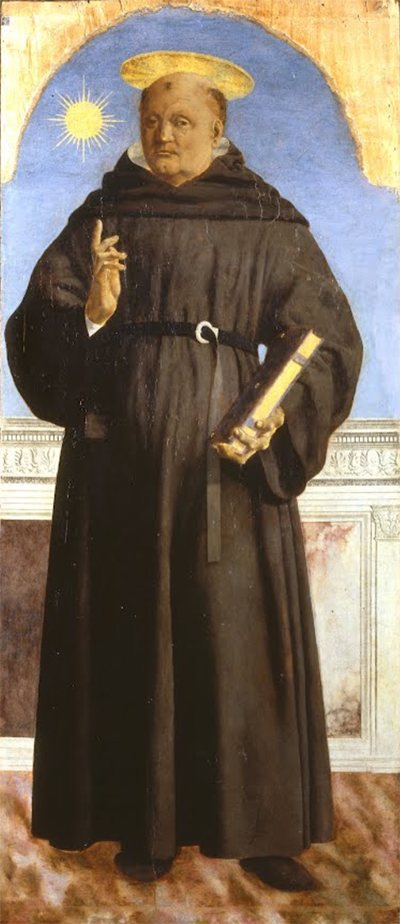
A star hangs above the shoulder of Piero della Francesca’s Saint Nicholas of Tolentino. Nicholas raises one finger towards it while his other hand holds a small book. His dark habit fills most of the tall, narrow panel, and the gold halo tilts behind his closely shaven head. Piero painted this figure for the high altar of the Augustinian church in his native Borgo San Sepolcro, now Sansepolcro. Commissioned in 1454 and completed by 1469, the Augustinian Polyptych was broken up in the sixteenth century. Nicholas entered the collection of Gian Giacomo Poldi Pezzoli and is now in the museum that bears his name in Milan. [1] [2]
At a Glance
- ArtistPiero della Francesca. [1]
- Date1454–1469, the museum’s date range for the commissioned altarpiece. [1]
- MediumOil on panel in the current catalogue, with poplar and gilding identified in the technical study. [1] [2]
- Dimensions139.4 × 59.2 cm in the museum’s current object record. [1]
- CollectionMuseo Poldi Pezzoli, Milan, inventory 0445. [1]
- Original positionFar right of the main tier of the Augustinian Polyptych. [2] [3] [4]
This work across Piero della Francesca’s career
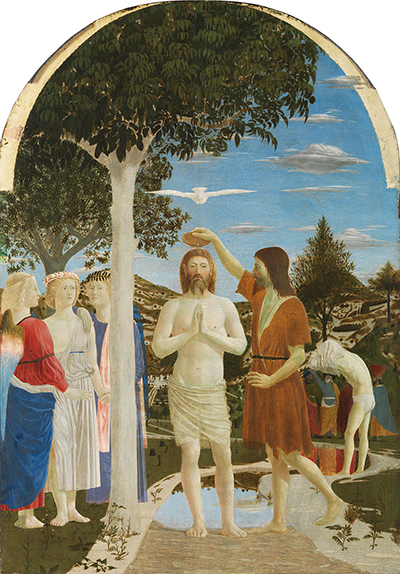
The Baptism of Christ
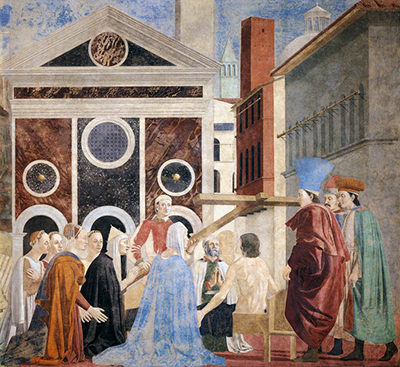
Probably about 1437–45The History of the True Cross
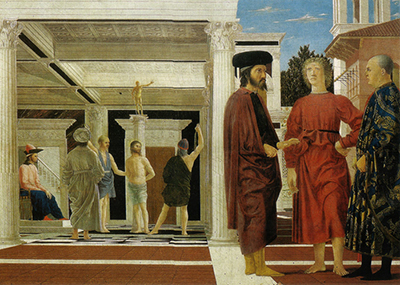
Mid-fifteenth centurySaint Nicholas of Tolentino (current article)
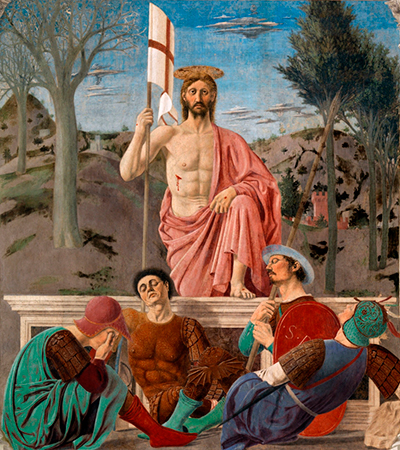
1454–69, Augustinian commissionThe Resurrection
About 1458–68 (Opificio)The Flagellation of Christ
1459–60 (GNDM)The Montefeltro Altarpiece
About 1472–74 (Brera)The Duke and Duchess of Urbino
About 1473–75 (Uffizi)The Nativity
Early 1480s (National Gallery)Contents
- The friar who points to a star
- The outermost saint on the right
- What the panel reveals under examination
- From a private collection to the Milan reunion
- Annotated details
The friar who points to a star
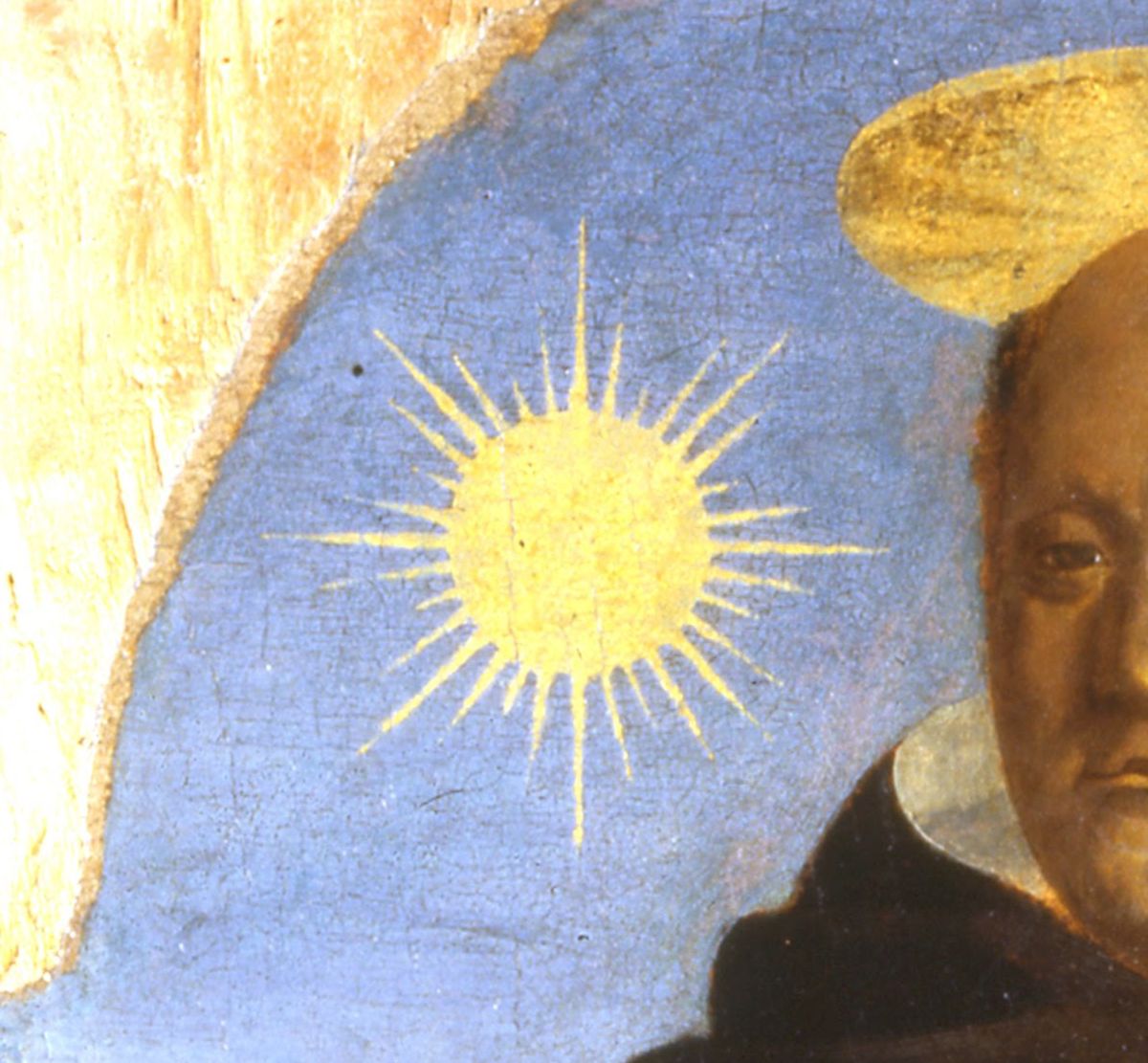
The saint’s raised finger draws the eye up along the left side of the panel, past the patterned marble parapet to the star in the blue sky. The Poldi Pezzoli’s current catalogue associates the star with the legend that a light appeared to Nicholas to show him where he would be buried. The museum’s earlier description for Google Arts & Culture records another version, in which a star appeared at his birth. For Piero, moving the emblem into the sky gave Nicholas somewhere to point. A comparable image at the Oratory of San Vincenzo in Sesto Calende shows a radiant emblem on the habit itself. The star in Piero’s painting makes the open sky part of the saint’s story. [1] [5] [6]
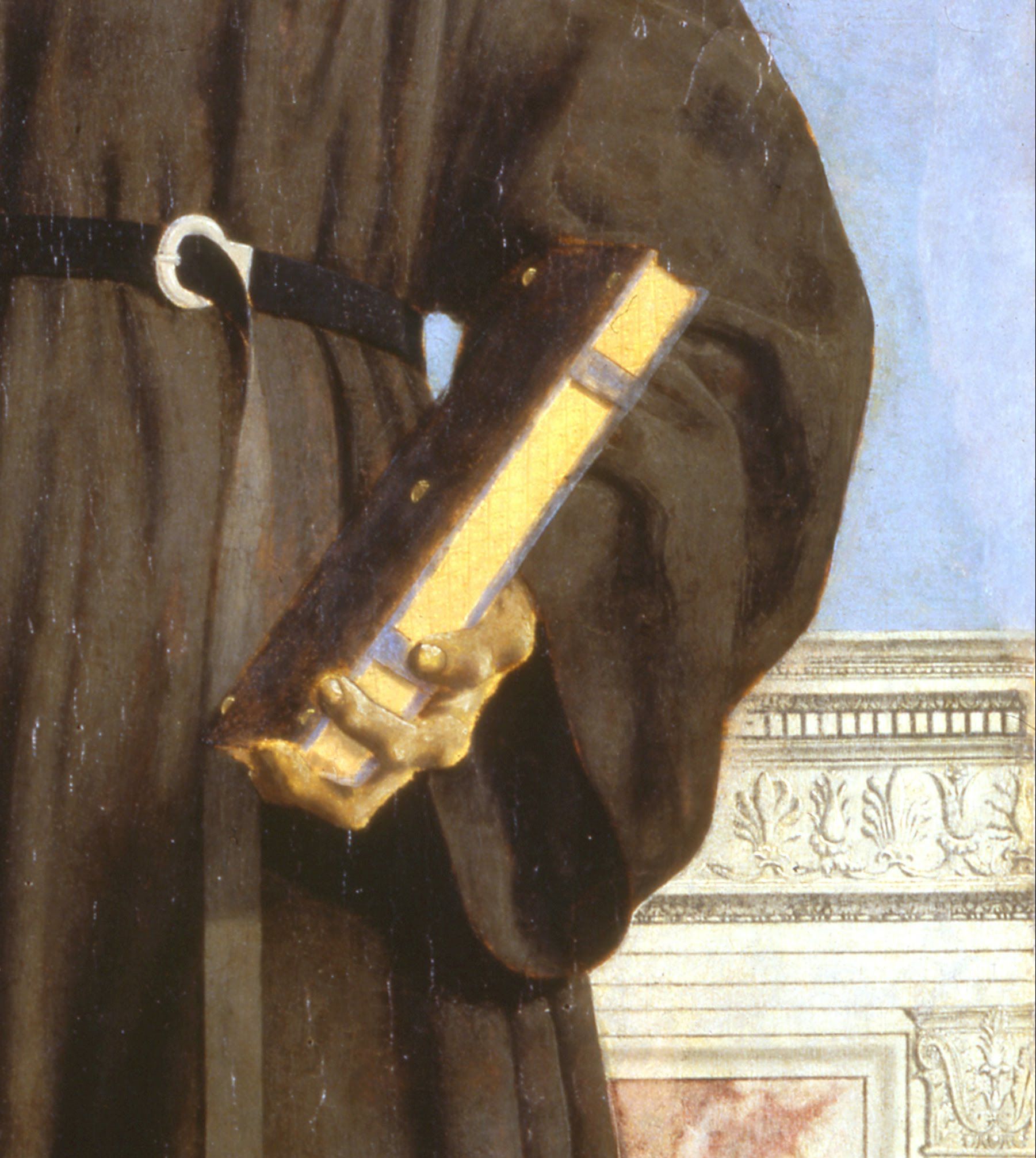
The object in Nicholas’s left hand is a bound book. The small block of yellow page edges and the blue cover help to distinguish it from a scroll, and both are described in the 2024 examination of the pigments. Piero shows the exterior of the volume, leaving its contents open to interpretation. It suits a priest whose life the Augustinian Order remembers for preaching, hearing confessions and praying for the dead. Those activities help explain why a book could make sense to the friars who saw the figure daily, even if the star and the habit do more to identify the individual saint. [1] [2] [7] [8]
Nicholas was born at Sant’Angelo in Pontano in 1245 and spent the last decades of his life in Tolentino, where he died in 1305. His order remembers him for tending the sick and poor as well as for his prayers on behalf of souls in purgatory. He was the first member of the Augustinian Order to be canonised, in 1446, only eight years before Piero received the commission. His following already extended beyond the Marche. Jun Kawada’s study of plague devotion discusses an early fifteenth-century painting at Pisa in which the saint protects the city, an example of the public roles his image had acquired by Piero’s time. At Sansepolcro the commission placed Nicholas among the principal standing saints in the church of his own order. [1] [2] [8] [9]
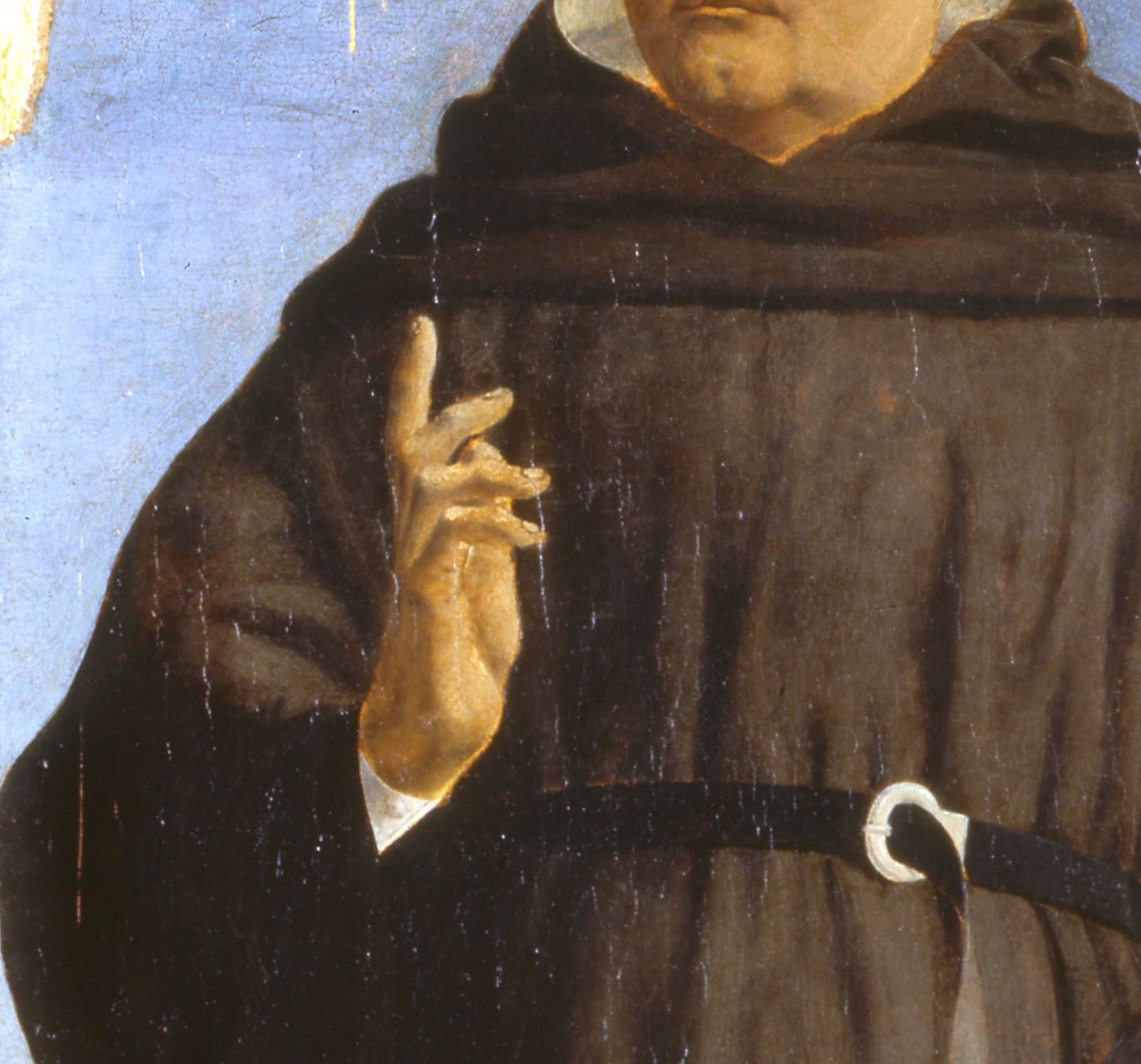
The leather belt and clasp make the habit particularly tangible. A little white undergarment shows at the neckline, and the long dark folds descend to the stone beneath his feet. The local friars would have recognised the black hooded garment and buckled belt as their own dress. The Poldi Pezzoli’s collection tour compares the shape of Piero’s buckle with the almost identical outline of a buckle on a much more elaborate late fifteenth-century Lombard girdle. The likeness gives a sense of how closely Piero observed the form of an ordinary fastening. The shaved crown, broad cheek and weight of the figure give Nicholas the appearance of someone observed from life. The museum has floated the possibility that the prior named in the commission served as a model, though the sitter’s identity is undocumented. [1] [5] [10]
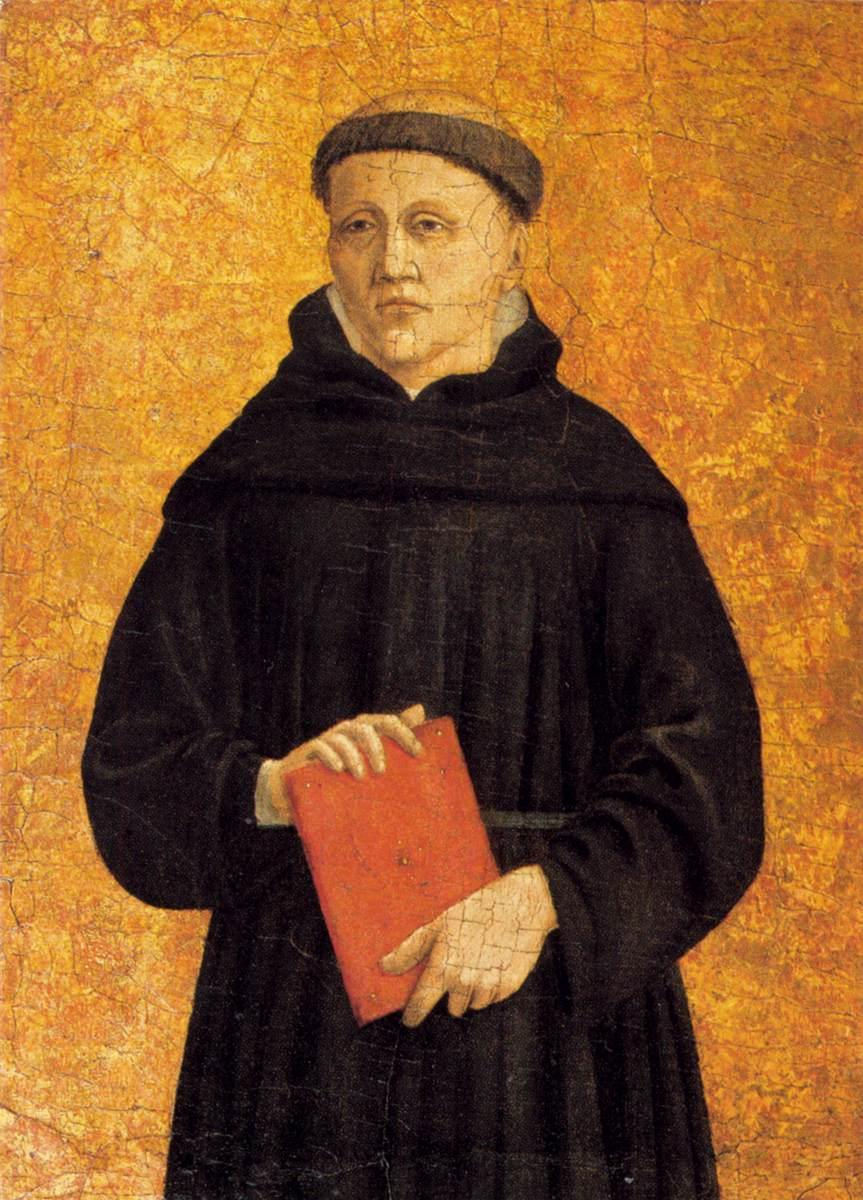
An Augustinian Saint, possibly Saint Leonard, The Frick Collection, New York. Image source. Public domain. Resized only; native appearance preserved.
The outermost saint on the right
Facing the altarpiece, a worshipper would have seen Nicholas at the far right of the main tier, beyond Saint John the Evangelist. Saint Augustine and Saint Michael occupied the left. The friar’s broad dark silhouette has particular force in that company. Across the centre, the bishop’s vestments shimmer with gold brocade, and Michael’s armour turns the light into points of colour. On Nicholas’s side the small flashes from book, halo, buckle and star stand out against the expanse of cloth. Each figure has a distinct surface and weight, while the sky and stone parapet give them a setting in common. [1] [2] [3]
Even in isolation the panel contains signs of that larger space. At the top, the halo appears as an angled gold disc. At the bottom, the floor gives the standing figure a credible place to put his feet. Behind him, the pale stone uprights and coloured insets give the viewer a horizontal line to follow across the tall composition. Roberto Bellucci, who worked on the technical study, describes how the original arch on each outer panel was offset towards the middle of the altarpiece. Later alterations made the arch more symmetrical for display as a separate painting. The earlier curve, like the parapet, helps explain how the individual compartments guided the eye towards the same centre. [1] [2] [4]
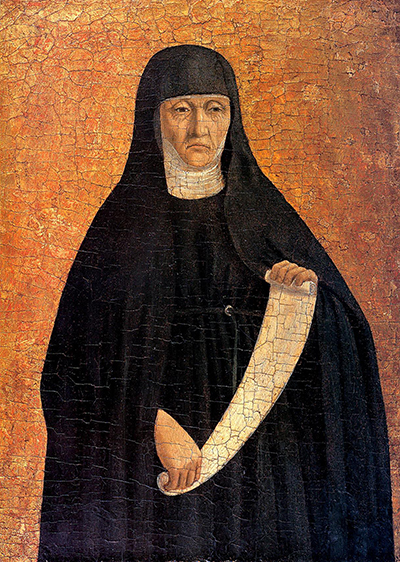
The Frick Collection’s much smaller Augustinian Friar also holds a book, in that case red and set against gold. The Frick has proposed Saint Leonard with a question mark. Its companion Augustinian Nun is generally identified as Saint Monica. These smaller figures belonged to the architectural framework of the polyptych. Nicholas occupied an altogether different scale and setting. The name can also cause confusion with Nicholas of Bari, the bishop associated with Myra. The latter commonly appears in episcopal dress with a crozier and sometimes with three gold balls. In Piero’s panel the friar’s own dress and the star above his shoulder are the details to follow. [1] [11] [12]
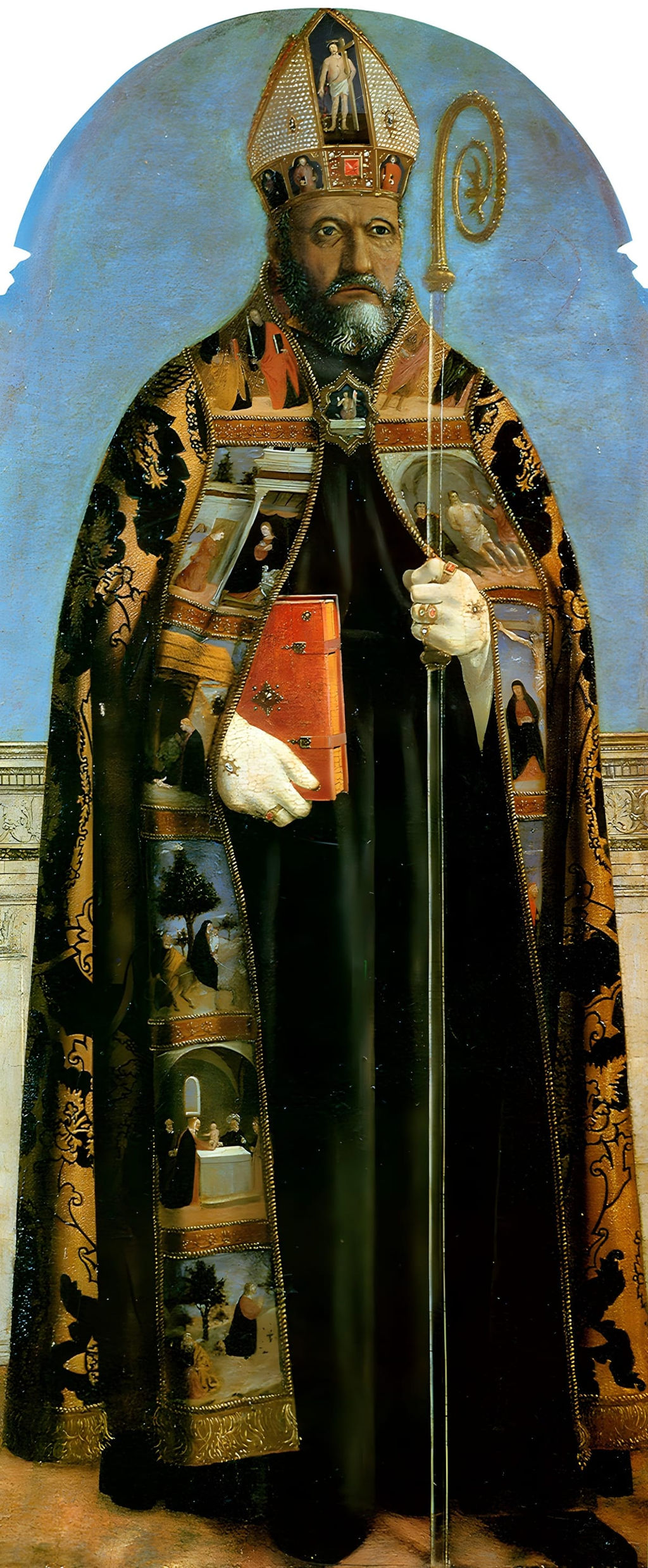
Piero della Francesca, Saint Augustine, surviving panel from the Augustinian Polyptych, Lisbon. Image source. Public domain. Resized only; native appearance preserved.
Annotated Details from Saint Nicholas of Tolentino
The numbered points identify visible features discussed in this article. Return from each detail to the numbered overview. Piero della Francesca, Saint Nicholas of Tolentino, Museo Poldi Pezzoli, Milan. Image source. Public domain.
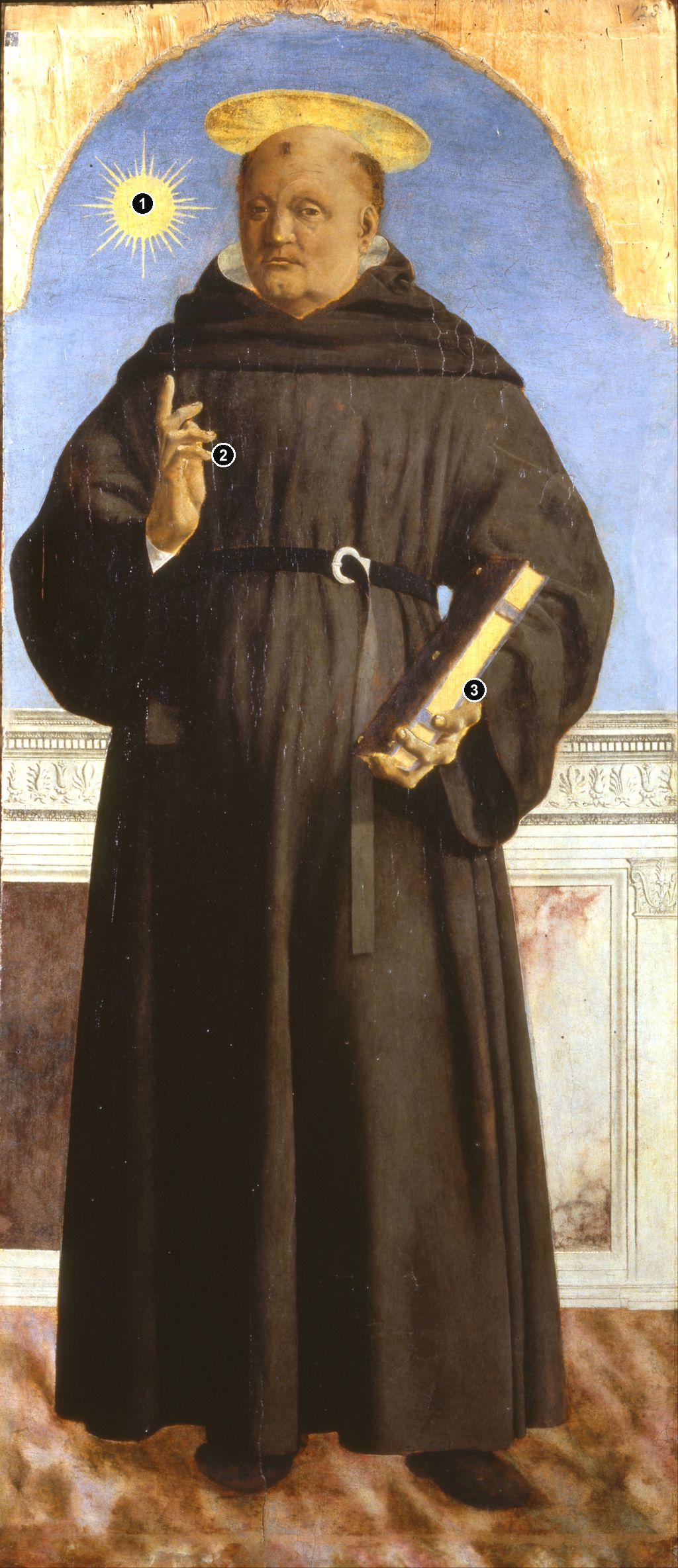
Details from SAINT NICHOLAS OF TOLENTINO
Compare the cropped details with the source images above. Notice how their colours, shapes and positions contribute to the larger compositions.
The star
A bright star appears beside the head. Its rays sit over the blue ground below the gilt curve at the top.
Gesture and habit
The raised hand stands away from the dark habit. The figure’s broad silhouette is clearer where the cloth meets the blue field.
The gilded book
The lowered hand holds a book at an angle. Its pale, decorative edge catches light against the largely unbroken dark cloth.
What the panel reveals under examination
Conservation records from 1994–95 include a report, photographs and graphic maps. This work preceded the Poldi Pezzoli’s 1996 exhibition on the reconstruction of the polyptych. Bellucci’s account of the Opificio delle Pietre Dure investigations describes marks cut into the preparation to define forms such as the architecture, alongside the use of pounced drawings and freehand lines. The painted saint looks serenely settled, but the construction under the surface distinguishes work that had to be laid out precisely across the ensemble from details that could be adjusted on the board. [4] [13] [14]
The 2024 campaign combined infrared and ultraviolet imaging, radiography and close analysis of pigments. Small dots survive in parts of the drawing transferred by pouncing, a process that carries a design from a perforated sheet to the panel by means of powder. The researchers found that the two hands appear to have been outlined with different materials. Close to the thumb and forefinger of the book hand, fine dry lines connect tiny marks and pick out the nails. There is a slight correction at the tip of the forefinger. The hand that points towards the star appears to have been drawn with a liquid medium. The difference gives a rare view of the small choices Piero made within a carefully ordered design. [2] [4]
The dark grey of Nicholas’s habit is a mixture of pigments, including carbon black, lead white, red lead and a copper-based pigment. In the sky the researchers detected ultramarine alongside a copper blue, probably azurite. They also identified repairs in the sky and on the star. Age and restoration therefore matter when comparing the exact colours of the surviving panels. The radiograph traces another part of the painting’s history. The single poplar board was thinned, and horizontal marks record the removal of crosspieces. Bellucci also records later fittings on the back. The object on the wall in Milan carries evidence of carpentry, painting and the changes made as it became a picture that could travel and be displayed on its own. [2] [4]
From a private collection to the Milan reunion
The collector Gian Giacomo Poldi Pezzoli bought the panel from the antiquarian Antonio Fidanza in the late 1870s. At the time of his death the picture was in Giuseppe Bertini’s studio at Brera, and the museum records its acquisition as part of the 1879 bequest. The early inventories credited it to Fra Carnevale. August Schmarsow attributed it to Piero in 1912, and Tancred Borenius recognised in 1916 that the figure long taken for Thomas Aquinas was Nicholas of Tolentino. Millard Meiss picked up that correction in his 1941 study of the dispersed altarpiece. Once the man in the painting had a place in the Augustinian Order, his dress and attributes could help connect the Milan panel to the documented Sansepolcro commission. [1] [10] [15] [16] [17]
In 2024 the Poldi Pezzoli used its own panel as the starting point for new technical work, which encouraged parallel studies by lending institutions. The museum brought all eight known surviving panels together from 20 March to 24 June. Evidence for a possible Coronation of the Virgin came chiefly from traces at the inner edges of Saint Michael and Saint John, where figures and architecture had extended across the joins into the lost centre. Nicholas had stood further out. His panel helped show how the same architecture, light and sky held the larger saints together across the width of the main tier. The temporary reunion restored that visual relationship for visitors. The museum lists Nicholas today in its Golden Room. [1] [2] [18]
Browse the artworks
Compare Piero’s frescoes, panels and manuscript figures. The list includes ensembles and separately identifiable panels or scenes. Dates are approximate where the sources differ.
| Name | Date | Medium and source |
|---|---|---|
| The Baptism of Christ | Probably c. 1437–45 | Panel painting Catalogue. |
| The Flagellation of Christ | 1459–60 (GNDM) | Panel painting Catalogue. |
| The History of the True Cross | Mid-fifteenth century | Wall painting Catalogue. |
| Dream of Constantine | Mid-fifteenth century | Wall painting Catalogue. |
| The Duke and Duchess of Urbino | About 1473–75 (Uffizi) | Panel painting Catalogue. |
| The Resurrection | About 1458–68 (Opificio) | Wall painting Catalogue. |
| Brera Madonna | About 1472–74 | Panel painting Catalogue. |
| Annunciation at Arezzo | Mid-fifteenth century | Wall painting Catalogue. |
| Madonna del Parto | About 1450–65 (Monterchi) | Wall painting Catalogue. |
| Polyptych of the Misericordia | Commissioned 1445 | Panel painting Catalogue. |
| The Nativity | Early 1480s (National Gallery) | Panel painting Catalogue. |
| Madonna di Senigallia | About 1474–75 (GNDM) | Panel painting Catalogue. |
| Death of Adam | Mid-fifteenth century | Wall painting Catalogue. |
| Queen of Sheba | Mid-fifteenth century | Wall painting Catalogue. |
| Victory of Constantine | Mid-fifteenth century | Wall painting Catalogue. |
| Battle between Heraclius and Chosroes | Mid-fifteenth century | Wall painting Catalogue. |
| Saint Mary Magdalen | Wall painting Catalogue. | |
| The Augustinian Polyptych | 1454–69 | Panel painting Catalogue. |
| Polyptych of Perugia | About 1467–69 (GNU) | Panel painting Catalogue. |
| Perugia Annunciation | About 1468–70 (national catalogue) | Panel painting Catalogue. |
| St Francis and St Elizabeth | About 1467–69 (GNU) | Panel painting Catalogue. |
| Stigmatisation of St Francis | About 1468–70 (national catalogue) | Panel painting Catalogue. |
| An Augustinian Nun (Saint Monica) | 1454–69 | Panel painting Catalogue. |
| Augustinian Saint | 1454–69 | Panel painting Catalogue. |
| Saint Michael | 1454–69 | Panel painting Catalogue. |
| Saint Nicholas of Tolentino | 1454–69 | Panel painting Catalogue. |
| Saint John the Evangelist | 1454–69 | Panel painting Catalogue. |
| Virgin and Child Enthroned with Four Angels | About 1460–70 (Clark) | Panel painting Catalogue. |
| Portrait of Sigismondo Pandolfo Malatesta | About 1450–51, often proposed. Louvre catalogue range 1450–75. | Panel painting Catalogue. |
| Sigismondo before St Sigismund | 1451 | Wall painting Catalogue. |
| St Jerome and a Donor | 1460s (Accademia); about 1450 also proposed | Panel painting Catalogue. |
| St Jerome in Penitence | 1450, dated on the panel | Panel painting Catalogue. |
| Saint Julian | About 1455–60, often proposed | Wall painting Catalogue. |
| Saint Augustine | 1454–69 | Panel painting Catalogue. |
| Saint Apollonia | 1454–69 | Panel painting Catalogue. |
| Crucifixion from the Augustinian Polyptych | 1454–69 | Panel painting Catalogue. |
| Saint Louis of Toulouse | Wall painting Catalogue. | |
| Burial of the Wood | Mid-fifteenth century | Wall painting Catalogue. |
| Discovery and Proof of the True Cross | Mid-fifteenth century | Wall painting Catalogue. |
| Exaltation of the Cross | Mid-fifteenth century | Wall painting Catalogue. |
| Saint Anthony Raises a Child | About 1467–69 (GNU) | Panel painting Catalogue. |
| Saint Elizabeth Revives a Child | About 1467–69 (GNU) | Panel painting Catalogue. |
| Hercules | About 1470 | Wall painting Catalogue. |
| Portrait of a Boy (possibly Guidobaldo da Montefeltro) | Panel painting Catalogue. | |
| De prospectiva pingendi, Reggio Emilia witness (figures) | Manuscript diagrams Catalogue. | |
| The Interrogation of Judas | Mid-fifteenth century | Wall painting Catalogue. |
| Two prophets, Bacci Chapel | Mid-fifteenth century | Wall painting Catalogue. |
| Saint Clare of Assisi, upper predella | About 1467–69 (GNU) | Panel painting Catalogue. |
| Saint Agatha, upper predella | About 1467–69 (GNU) | Panel painting Catalogue. |
| Lost centre of the Augustinian Polyptych | 1454–69 | Lost panel or panels Catalogue. |
Frequently Asked Questions
Discussion
Look again at the images and ideas explored in Saint Nicholas of Tolentino. These editorial prompts invite your observations.
Reader Insights
Follow the line from Nicholas’s raised forefinger to the star. How does that gesture affect your sense of a figure whose body is so still?
Compare the habit with Michael’s armour. Which small patches of light make each material recognisable?
Look at the angle of the halo and the horizontal edge of the parapet. Where do they make you feel you are standing in relation to Nicholas?
Join the Conversation
Share a detail, comparison or question about Saint Nicholas of Tolentino below.
References
- Museo Poldi Pezzoli, Saint Nicholas of Tolentino, object record 0445. View source.
- Museo Poldi Pezzoli, Il polittico agostiniano riunito, exhibition dossier, 2024, especially Marco Gargano and colleagues on the panel’s materials and technique, pp. 11–17, and Machtelt Brüggen Israëls on the ensemble, pp. 18–19. View source.
- National Gallery, London, Saint Michael, NG769. View source.
- Roberto Bellucci, Caro Marco, ancora Piero, 2025, author’s copy. View source.
- Museo Poldi Pezzoli, Saint Nicholas of Tolentino, Google Arts & Culture collection entry. View source.
- Lombardia Beni Culturali, San Nicola da Tolentino, SIRBeC catalogue record for the Sesto Calende fresco. View source.
- Museo Poldi Pezzoli, San Nicola da Tolentino, Italian object record. View source.
- Order of Saint Augustine, Saint Nicholas of Tolentino, Priest. View source.
- Jun Kawada, The Expansion of the Figure of Saint Nicholas of Tolentino and the Plague from 14th Century to 17th Century in Italy. View source.
- Museo Poldi Pezzoli, Itinerario Piero, stops 1 and 9. View source.
- The Frick Collection, Piero della Francesca in America, exhibition materials, 2013. View source.
- National Gallery, London, St Nicholas of Bari. View source.
- Centro per la Conservazione ed il Restauro dei Beni Culturali La Venaria Reale, Saper vedere archive inventory, entry 298. View source.
- Museo Poldi Pezzoli, The Augustinian Polyptych: New Research, conference programme, 7 May 2024. View source.
- Alessandra Quarto, Poldi Pezzoli director, interview on the reunited polyptych, 2024. View source.
- Tancred Borenius, Professor Venturi on Quattrocento Painting, The Burlington Magazine, July 1916. View source.
- Millard Meiss, A Documented Altarpiece by Piero Della Francesca, The Art Bulletin 23, 1941, pp. 53–68. View source.
- Museo Poldi Pezzoli, Piero della Francesca. The Augustinian Polyptych Reunited, exhibition record, 2024. View source.
Related Paintings
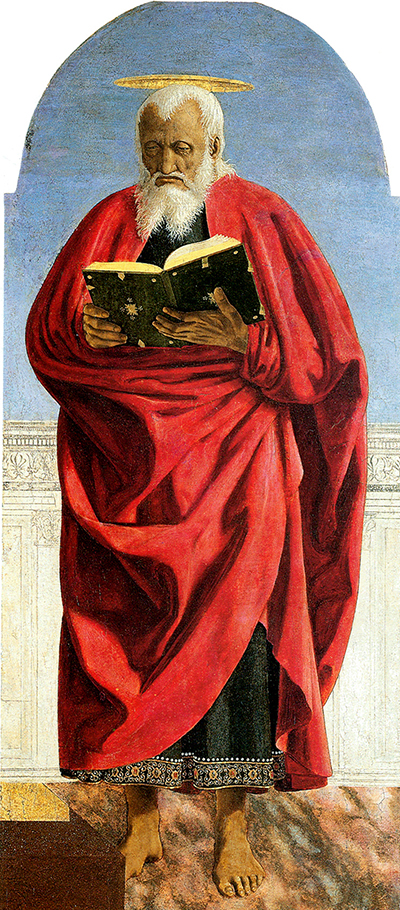
The Augustinian Polyptych
Piero della Francesca, Saint Augustine, surviving panel from the Augustinian Polyptych, Lisbon. Image source. Public domain. Resized only; native appearance preserved.