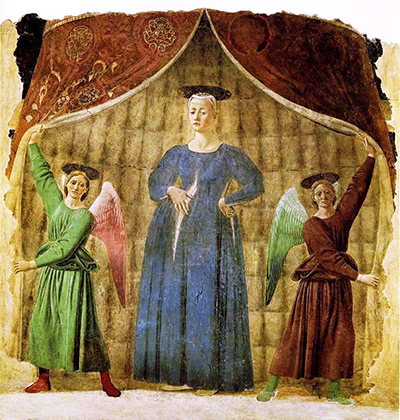
 by Tom Gurney
Tom Gurney BSc (Hons) is an art history expert with over 20 years experience
Published on June 19, 2020 / Updated on October 14, 2023
Email: tomgurney1@gmail.com / Phone: +44 7429 011000
The Nativity by Piero della Francesca: Introduction
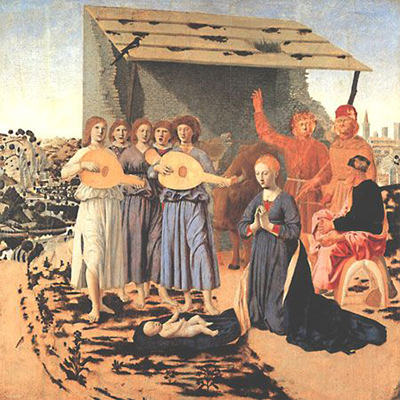
In Piero della Francesca’s Nativity, the newborn Christ lies almost at ground level on the blue mantle that Mary has spread beneath him. Behind them, one shepherd raises a hand towards a gap in a stable roof. The gesture was hard to explain when the wall beside him looked uniformly pale. Conservation completed in 2022 brought an existing patch of light back into view. The hand now leads the eye to stones lit through the broken thatch, a small detail that changes how the whole picture tells the story of Christ’s birth. [1] [2]
The National Gallery in London dates the panel to the early 1480s, late in Piero’s career. Its weathered shelter and distant town suggest the countryside around his native Sansepolcro, while the kneeling Virgin and the child on the ground recall a vision that Saint Bridget of Sweden described after visiting Bethlehem. A family inventory places the painting in a bedchamber by 1500. The local landscape, the visionary account and the evidence of domestic use together suggest how intimately a viewer in Piero’s household might have encountered the scene. [1] [2] [3]
At a Glance
- ArtistPiero della Francesca
- TitleThe Nativity
- DateEarly 1480s, according to the National Gallery
- MediumOil on wood, probably poplar
- Dimensions124.4 × 122.6 cm
- CollectionThe National Gallery, London, NG908
- AcquisitionBought at the Alexander Barker sale, 1874
- Early documented settingA likely principal bedchamber in Piero’s family home in Borgo San Sepolcro
- Recent conservationCompleted in 2022 [1] [2] [3]
This work across Piero della Francesca’s career
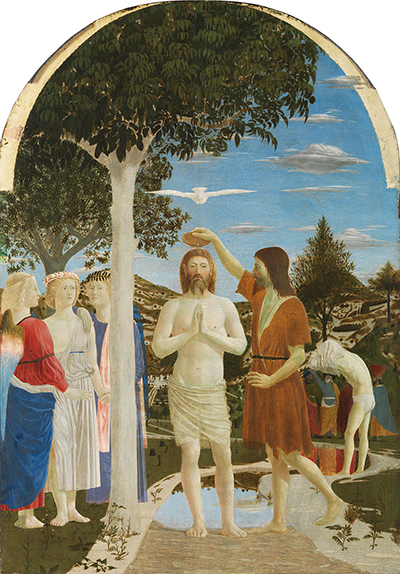
The Baptism of Christ
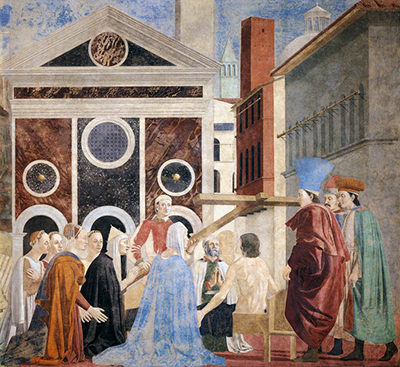
Probably about 1437–45The History of the True Cross
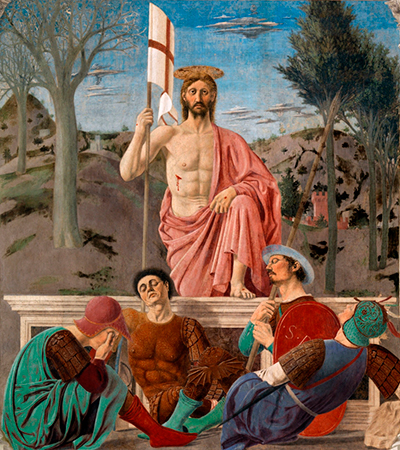
Mid-fifteenth centuryThe Resurrection
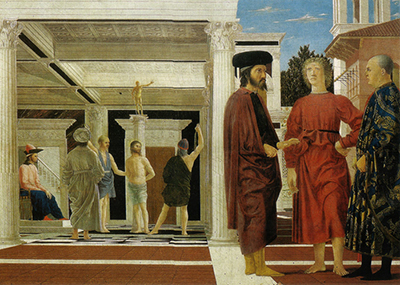
About 1458–68 (Opificio)The Flagellation of Christ
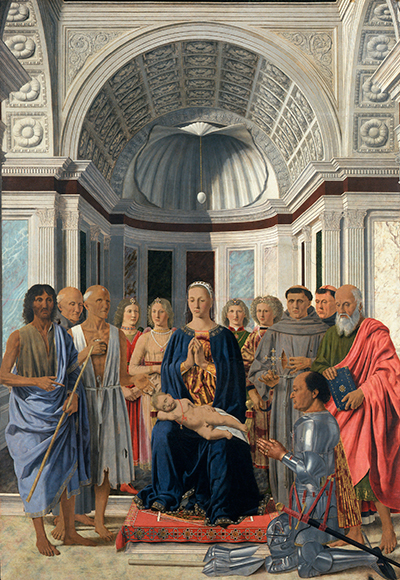
1459–60 (GNDM)The Montefeltro Altarpiece
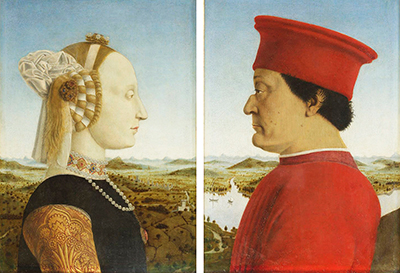
About 1472–74 (Brera)The Duke and Duchess of Urbino
About 1473–75 (Uffizi)The Nativity (current article)
Early 1480s (National Gallery)Contents
- A birth seen through Saint Bridget’s eyes
- Five angels, two shepherds and a quiet hillside
- The landscape, oil paint and two kinds of light
- In Piero’s family house
- What changed in the 2022 conservation
- Was the painting left unfinished?
- Annotated details
A birth seen through Saint Bridget’s eyes
Luke’s Gospel gives the shepherds a sign by which to recognise Christ. They will find a baby wrapped in cloths and lying in a manger. The angels praise God before the shepherds set out for Bethlehem. Piero shifts the moment of adoration to the ground in front of the stable, where Mary kneels before her naked child. The Swedish mystic Birgitta, known in English as Bridget, described seeing Mary kneel at the birth during a visit to Bethlehem in 1372. The account appears in Book VII of her Revelations. The infant lay on the ground and shone so brightly that the candle Joseph had put on the cave wall lost its power to illuminate. Bridget also heard angels singing. [4] [5]
Piero selects and rearranges those details. Bridget saw a cave and described Mary setting aside a white mantle. Piero gives Mary a building made of stone and timber and uses her deep blue cloak as a place to lay the child. Bridget’s light comes from the newborn himself. The National Gallery reads the bright area on Piero’s stable wall as another expression of divine light, entering through the roof and giving the younger shepherd something to point out. The painting keeps Mary’s posture and the angels’ music from the visionary tradition while giving the miracle a physical setting of its own. [1] [2] [5]
The Nativity was already a long-established subject when Bridget travelled to Bethlehem. Earlier medieval images often showed Mary resting on a bed and Christ in the manger. The ox and ass were already familiar features of those pictures. Maria H. Oen traces how the vision brought older details together with the kneeling Virgin and the naked, radiant child, giving painters a different moment to depict. Filippo Lippi’s Adoration in the Forest in Berlin provides a comparison. Mary kneels before a naked child at ground level there too, but trees enclose the scene and Saint Bernard of Clairvaux joins the adoration. Piero opens up the landscape and gives much of the foreground to his musicians. In both pictures, the kneeling Virgin makes the birth a subject for prayer, while the different witnesses suggest different ways of joining in. [5] [6]
Five angels, two shepherds and a quiet hillside
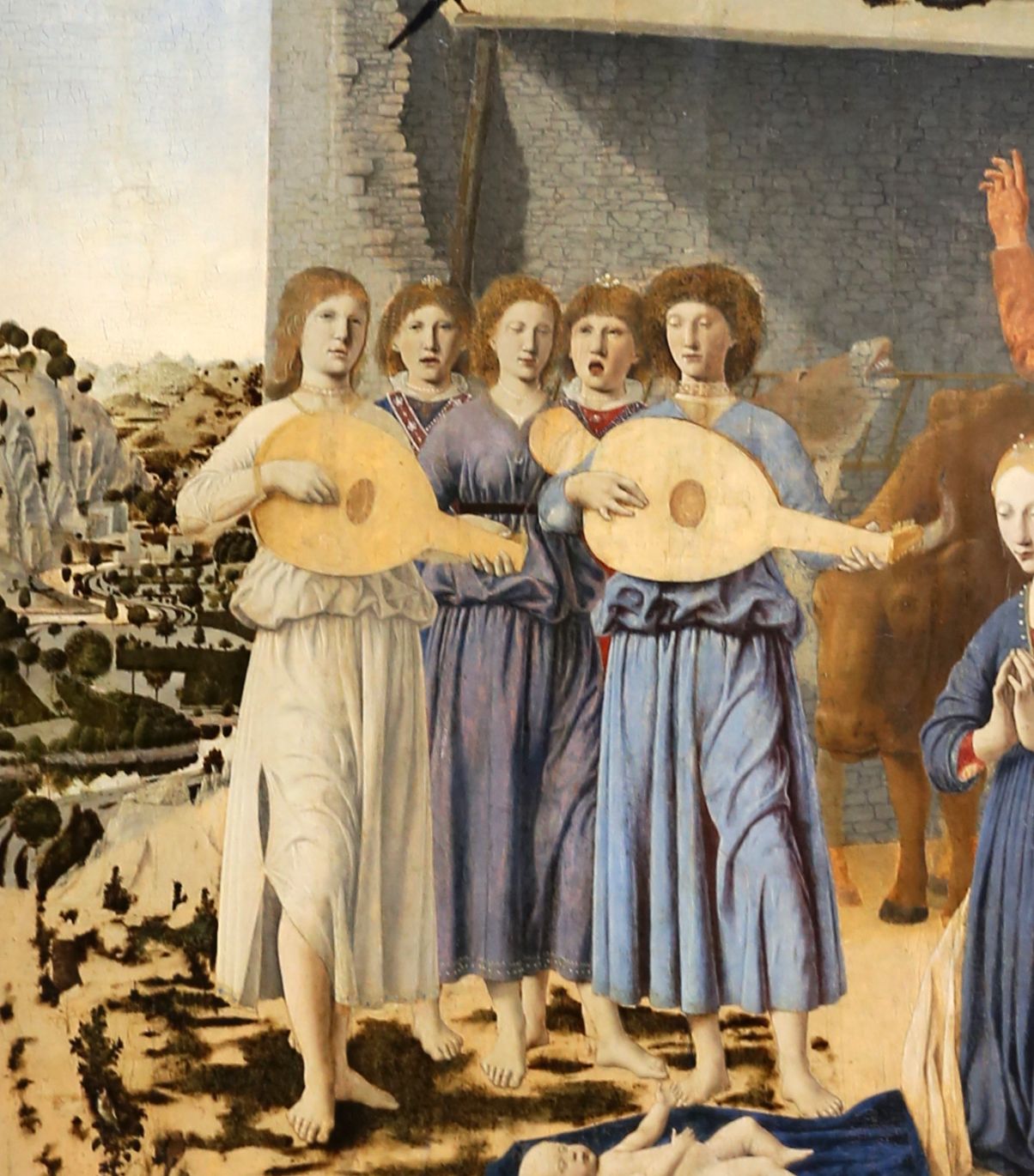
Piero sets the five angels to the left in two closely spaced ranks. Their upright bodies form a group as solid as the nearby stable. Yet the hands on the instruments, the parted lips and the slightly different turns of the heads give each singer or player a separate part in the performance. Peter Schade, who wrote about the panel’s reframing, identifies two lutes and a fiddle. The lutes cross the bodies of the front players at different angles. Their rounded bodies and long necks punctuate the upright folds of the gowns. The angels are gathered close enough to look and sound like an ensemble. [1] [7]
One blue gown answers another across the group, and the blue of Mary’s clothes carries that relationship into the open ground on the right. The eye can follow the colour across a gap where the ear might imagine the music carrying. The baby’s raised arms and the tips of Mary’s joined fingers keep attention at a much smaller scale. So do the details near her face, where fine pearls and a veil have to be picked out against the light. Piero gives the choir considerable space, yet the pale child just above the earth remains the focus of Mary’s attention. [1] [7]
The stable has its own interruptions. An ass opens its mouth behind the angels and an ox lowers its head towards the child. A magpie perches on the roof, and the Gallery identifies three finches amid the vegetation and rocks. The animals help give the scene different tempos. The ass seems to add a rough sound to the music, while a perched bird can be seen only by slowing down and looking. The household that knew the birds and the terrain around Sansepolcro could have recognised these small signs of ordinary life even as it considered the extraordinary birth. The magpie also has a possible family association. The art historian Carlo Bertelli links it tentatively with the Pichi family, into which Piero’s niece Romana married in 1480. The bird is visible, while its heraldic significance remains a proposal. [1] [8]
Joseph contributes another kind of attention. The National Gallery compares his crossed-legged pose on the donkey’s saddle with the ancient bronze known as the Spinario. In that sculpture a seated boy draws a thorn from his foot. Piero adapts the bend of the body and the turned foot to a recognisable figure at a rough shelter. Joseph’s position leads the eye from Mary to the shepherds behind him. Follow the younger shepherd’s raised hand and the route ends at the roof and the wall, where divine light has become something a witness can see and point out to someone else. [1] [2] [9]
Annotated Details from The Nativity
The numbered points identify visible features discussed in this article. Return from each detail to the numbered overview. Piero della Francesca, The Nativity, in its frame before the National Gallery’s recent treatment. Sailko. Image source. CC BY 3.0. The numbered overview and detail crops are adaptations under CC BY 3.0.
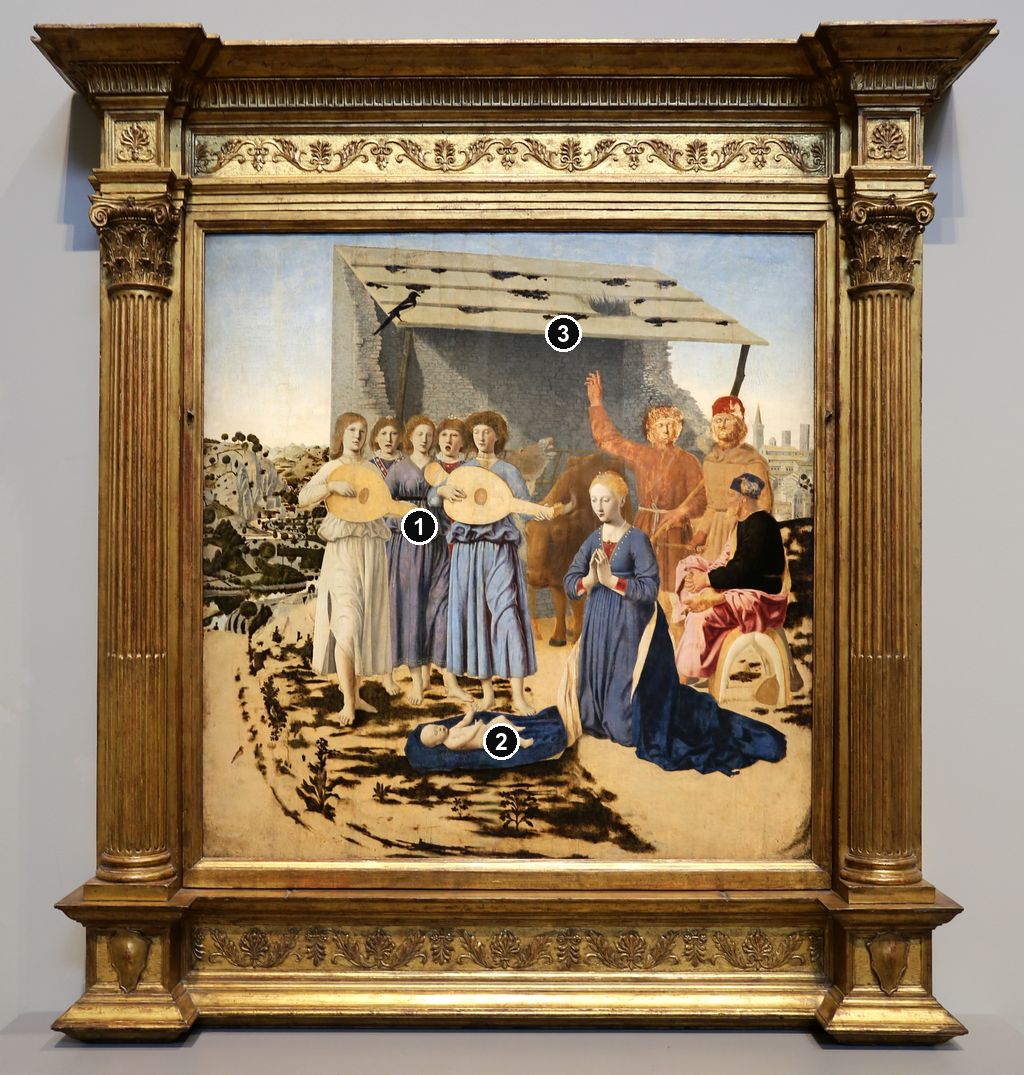
Details from THE NATIVITY
Compare the cropped details with the source images above. Notice how their colours, shapes and positions contribute to the larger compositions.
The angels’ instruments
The round backs and pale faces of the stringed instruments repeat across the line of singing angels.
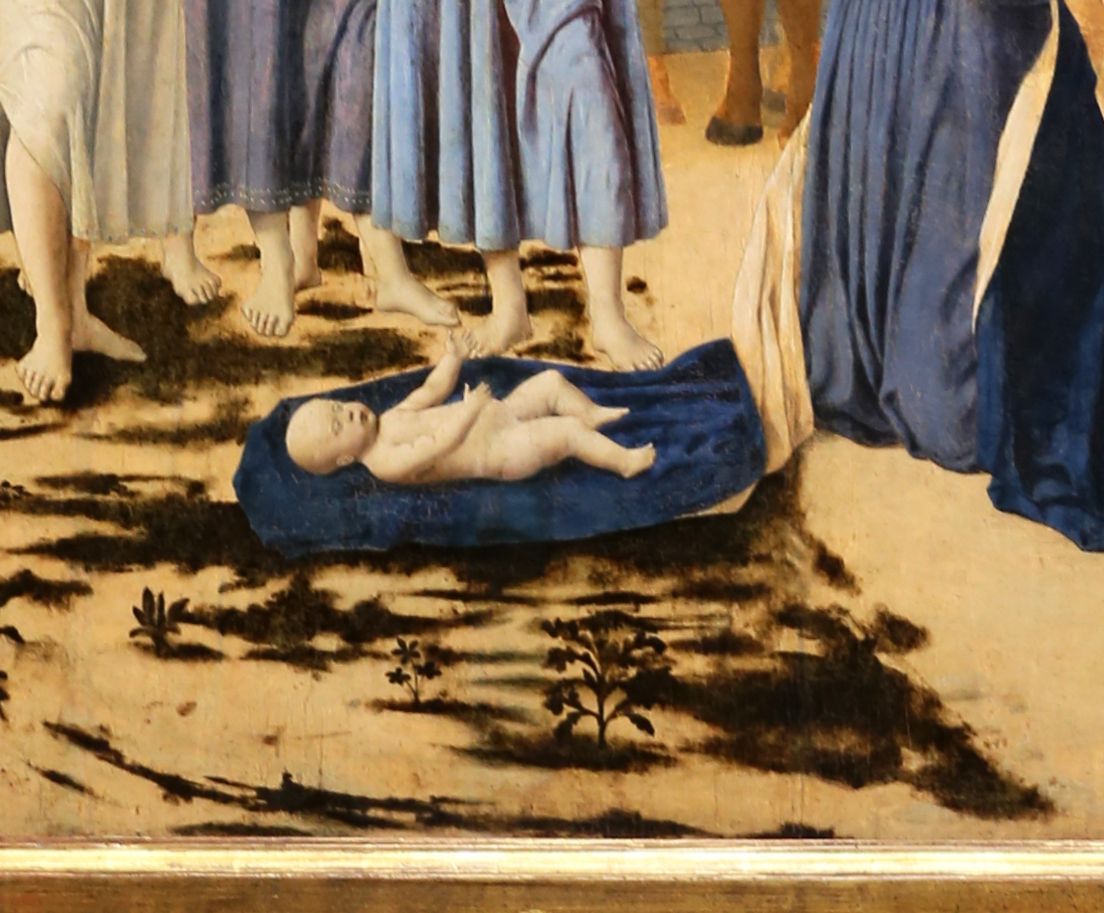
The child on the ground
Christ lies low on the blue cloak, separate from the upright figures. The ground around him is noticeably more worn in this earlier photograph.
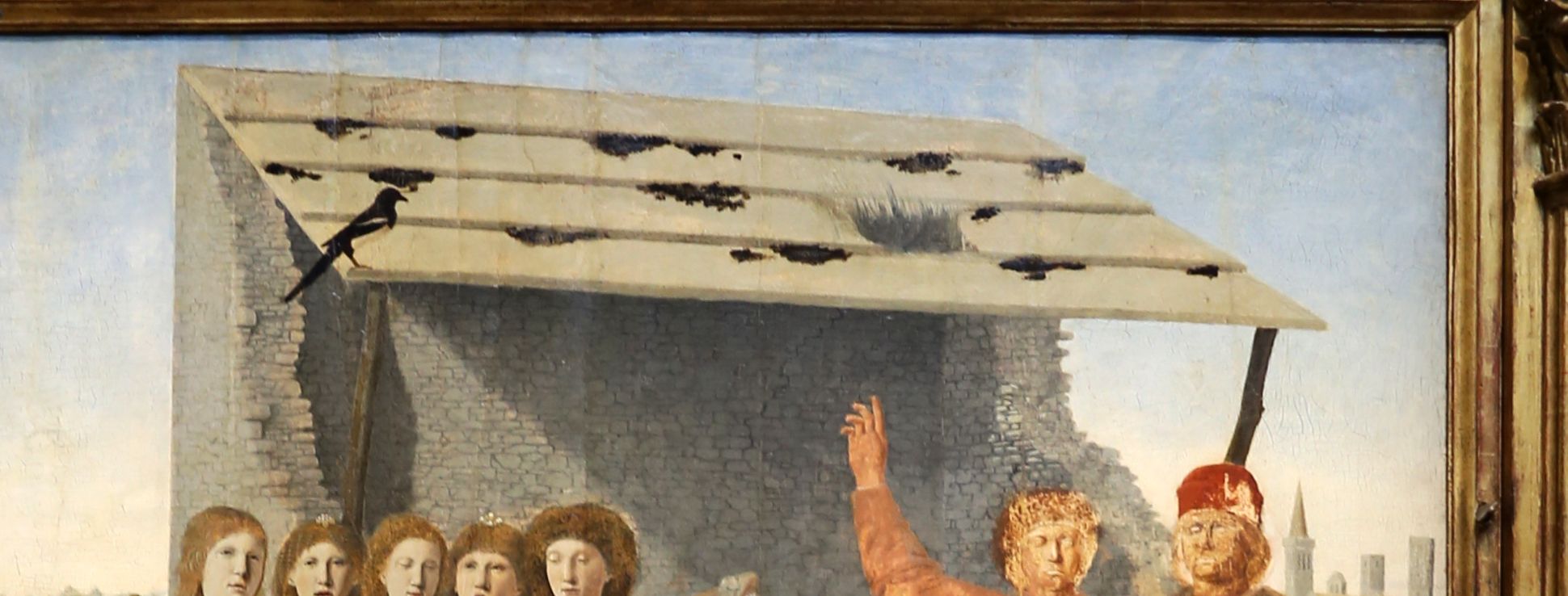
The damaged lean-to
Light catches the sloping roof above the group. Its straight lower edge and parallel marks establish the angle of the modest painted shelter.
The landscape, oil paint and two kinds of light
A river winds away through the hills on the left. On the right, distant roofs and a church suggest an inhabited town below the hill. The two openings extend the scene beyond the shelter, which occupies much of the middle distance. Piero leaves a wide strip of stony ground between the viewer and the gathering. Its sparse grasses and low irregularities establish the terrain before any angel or shepherd appears. They also make the mantle conspicuous as a soft blue surface on which a newborn can lie. [1] [8]
The Baptism of Christ offers a close comparison in the same collection. Piero used tempera for that earlier panel and set the baptism within a landscape also suggestive of Borgo Sansepolcro. Here the oil medium allowed him to build colour in translucent layers. Much of the colour in the Virgin’s and the angels’ clothing survives well. Dunkerton notes that Piero left fingerprints in places where he blotted the final glazes, including around foliage that has since darkened. These small marks survive alongside deep folds and fine details because the surface has aged unevenly. The saturation and the present darkness of some passages tell different parts of the painting’s material history. [1] [2] [10]
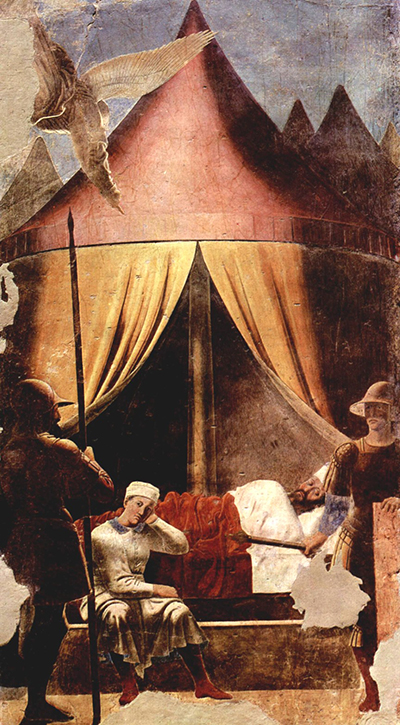
The stable wall distinguishes daylight from miraculous illumination without changing the overall brightness of the scene. After treating the abraded area, the conservators could read some of the crumbling wall as lying in the shadow of the roof and a small group of stones as lit where the roof opens. The people themselves have few clear cast shadows. The National Gallery reads this as a deliberate part of the vision. In the Dream of Constantine, Piero makes a divine visitor’s appearance unmistakable by lighting a tent and its occupants against the darkness. The daylight of the Nativity asks for a closer look. The younger shepherd shows the viewer where to look within it. [1] [2] [11]
The painting also belongs to an international tradition of fifteenth-century Nativities. The central scene of Hugo van der Goes’s Portinari Triptych shows an adoration at a worn shelter, with the newborn Christ low in the foreground. Its three panels, conspicuous donor portraits and destination at Sant’Egidio in Florence give it a very different scale and function. Bertelli considers a Netherlandish connection for Piero’s panel and proposes that he may have known an earlier model close to Rogier van der Weyden through Lippi. The Uffizi documents the triptych’s arrival in Florence in 1483. Since the exact date of Piero’s panel is uncertain, the works can be compared without assuming he saw the triptych there. [1] [6] [8] [12]
In Piero’s family house
The inventory drawn up for the estate of Francesco di Marco della Francesca on 30 January 1500 describes a panel of the Nativity by Piero’s hand. It lists the picture in a room with a bed and walnut chests, one with inlay, along with another image of Mary. The National Gallery identifies this as probably the principal bedchamber of the family palace. The inventory is direct evidence of where the panel was kept eight years after Piero’s death. The size of the panel and its subject make sense in a room where the family could pray in front of it and see it repeatedly. The document leaves the original circumstances of the commission open. [1] [2] [3]
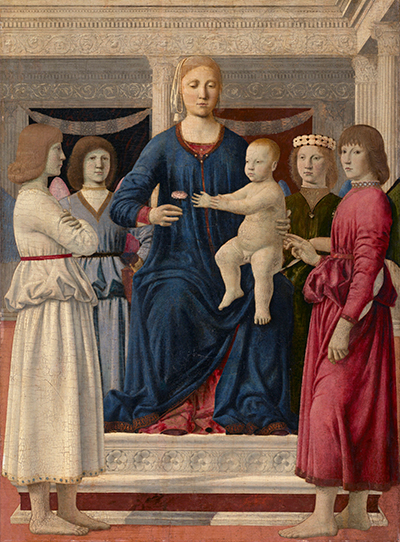
Machtelt Israëls locates the panel within Piero’s wider work on the decoration of the family palazzo and discusses it alongside the Virgin and Child Enthroned with Four Angels. In the latter, the angels gather around a throne in a compressed architectural setting. The Nativity offers a different arrangement for a similarly concentrated encounter with Mary and Christ. Its angels stand to one side, leaving the child in the open air with Mary and the ground between him and the viewer. [13] [14]
The Gallery’s online record also reproduces Martin Davies’s older provenance account, which opens its detailed modern trail with Giuseppe Marini-Franceschi in 1825. He sent the picture to the Uffizi for storage. It subsequently appears in sale and ownership records in Florence and may for a time have hung in the family’s private chapel in Sansepolcro. Alexander Barker acquired it by 1861, and the National Gallery bought it at his sale on 6 June 1874. The possible chapel display belongs to the panel’s later life. The bedchamber inventory is much closer to Piero’s lifetime. The conservators document candle burns low on the painting, and Bertelli takes this as evidence that it stood above an altar at some point. The burns themselves leave the date and room uncertain. [1] [2] [3] [8]
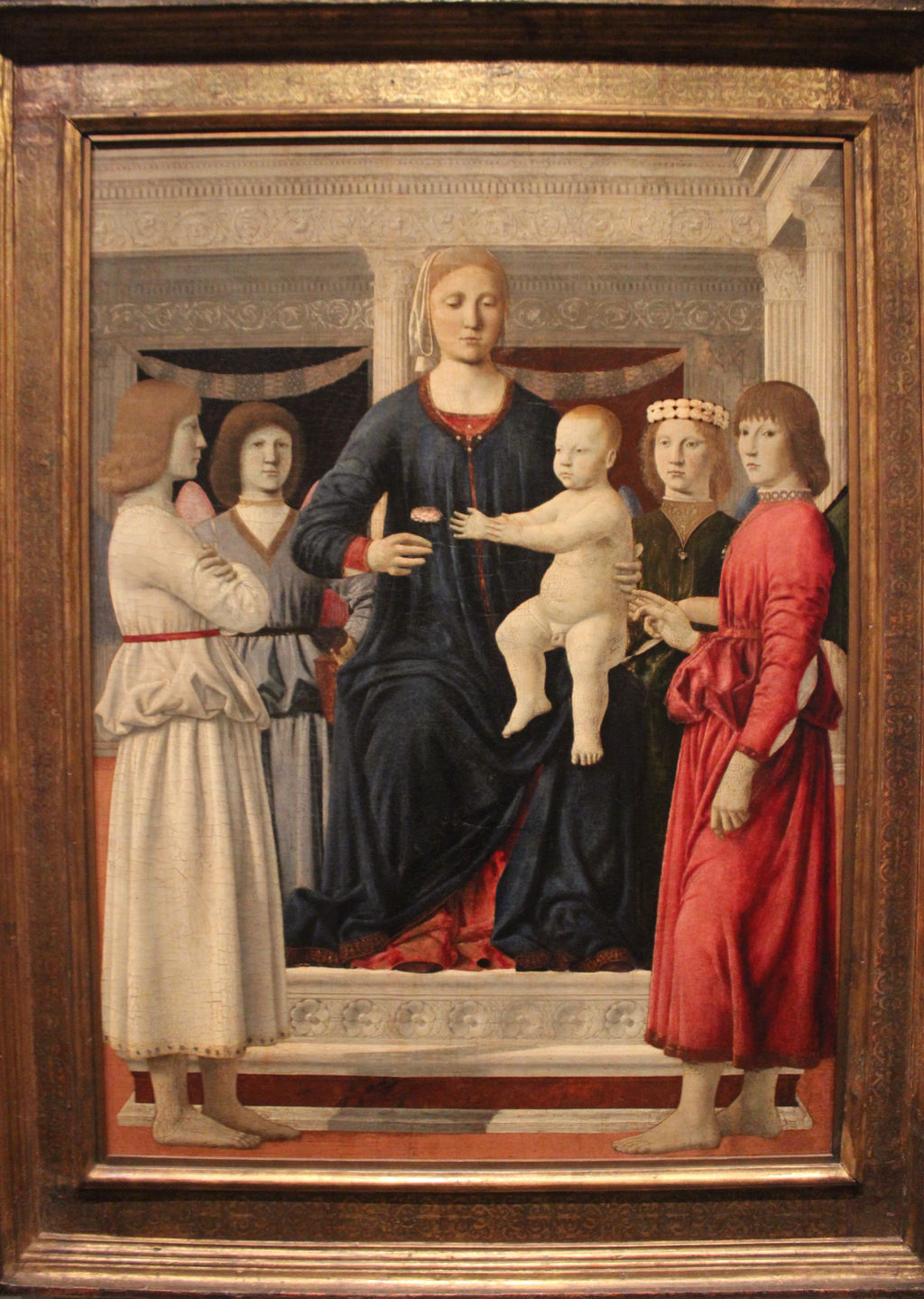
Piero della Francesca, Virgin and Child Enthroned with Four Angels, Clark Art Institute. Miguel Hermoso Cuesta. Image source. CC BY-SA 4.0. Resized from the source. This reproduction uses CC BY-SA 4.0.
What changed in the 2022 conservation
The support consists of three wooden boards, reported to have come apart by the time the painting reached London in 1861. Repairers shaved the edges before rejoining them. One seam crosses the rightmost angel of the group, taking some width from the face and disturbing the proportions of his lute. In 1884 a wooden cradle was attached to the back to brace the boards. A further structural treatment in 1949 addressed problems with that assembly, but the rigid panel continued to experience tensions and paint flaking. Paint, varnish and retouching from different campaigns also aged differently. There was therefore a structural question as well as the more visible question of how to treat the uneven surface. [2]
Senior Restorer Jill Dunkerton led the recent conservation, with Britta New directing work on the panel. The team eased tension and introduced a more flexible support at the back. Where the old seam distorted the angel and lute, the conservators opened the join and inserted narrow slivers of wood from behind to recover the missing spacing. The change is easy to miss in a photograph of the whole work. It matters because the painted lines of an instrument are particularly sensitive to a small break, and because the edges of a face can appear strangely pinched when a narrow vertical section disappears. [2] [15]
The shepherds posed a different problem. Before treatment, abrasion and exposed white gesso, the preparatory layer beneath the paint, left their heads unusually pale. Surviving lines of Piero’s underdrawing were visible. The conservators toned the brightest losses with reversible retouching while leaving those lines legible. They also retouched the stable wall to recover the relationship between the shaded masonry and the brighter stones. The nearby figures now read as farther back in the scene, and the younger man’s gesture links the people to the stable roof. The new display opened on 1 December 2022. The painting was presented in a period Tuscan walnut frame selected for its suitability to a domestic picture and its close fit. [2] [7] [15]
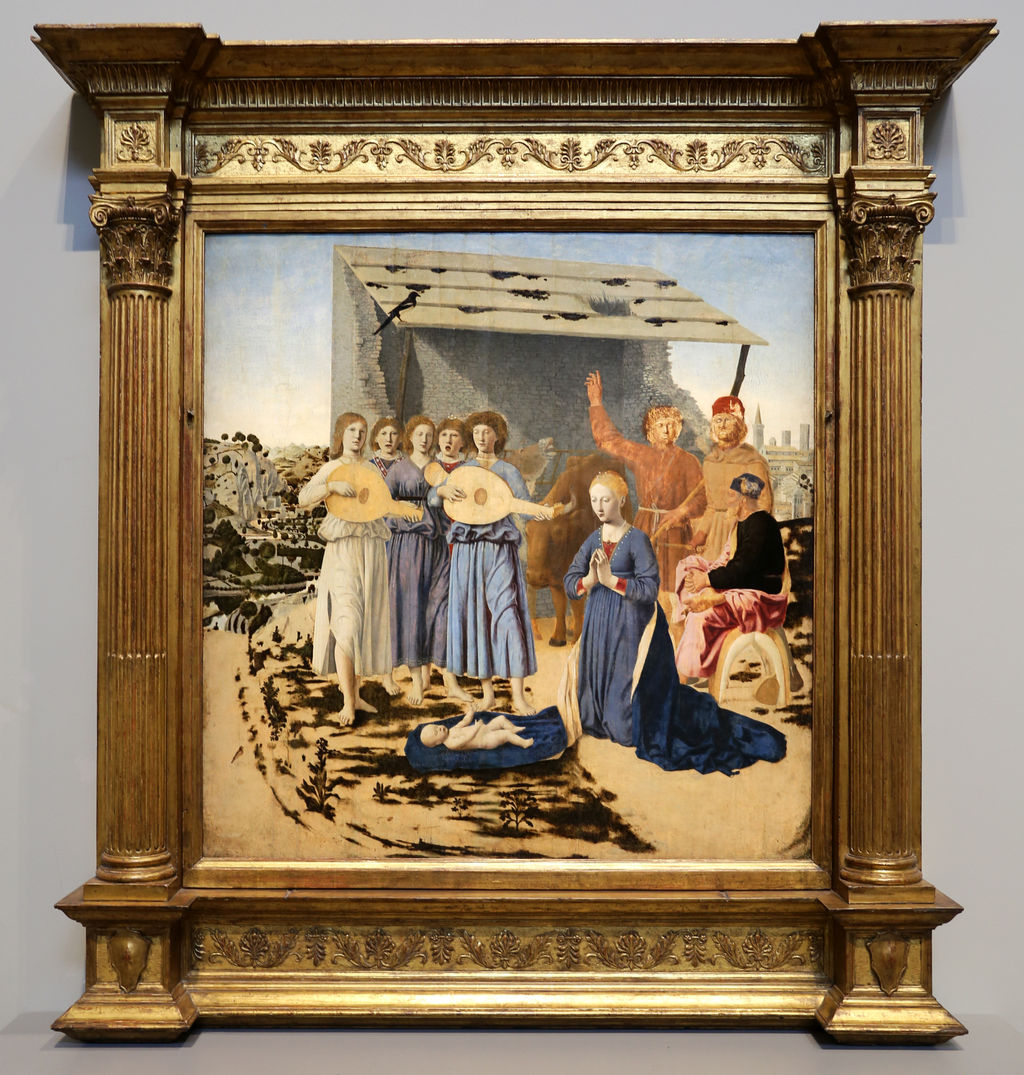
Piero della Francesca, The Nativity, in its frame before the National Gallery’s recent treatment. Sailko. Image source. CC BY 3.0. Resized from the source. This reproduction uses CC BY 3.0.
Was the painting left unfinished?
Severe wear, visible lines beneath the paint and the lack of clear figure shadows had encouraged an older view that Piero left a commissioned altarpiece incomplete. The inventory records the Nativity among furnishings and does not describe it as unfinished, although other works were described that way. The National Gallery’s examination identified areas where upper layers had once been present and were subsequently stripped or worn away. It also found carefully worked passages that survive in far better condition. Together these observations explain how the uneven appearance of a painting already in use could later give the impression that work on it had stopped. [1] [2] [3]
The judgement about the retouching has been debated in its own right. Writing after the work went back on view, the critic Jonathan Jones argued that the rugged foreground might be a deliberate instance of incomplete finish and objected to the visual effect of the treatment. Dunkerton describes the shepherds’ treatment as a compromise that brings them back into the space while retaining evidence of damage and the artist’s drawn lines. The strongest evidence concerns specific passages, such as the lost layers on the wall and the damaged heads. Firm conclusions about how much detail Piero intended in every part of the foreground are harder to reach. Compare the shepherd who points with the stones he indicates. Their relationship is easier to see after conservation, even though their surfaces still carry the wear of centuries. [2] [15] [16]
Browse the artworks
Compare Piero’s frescoes, panels and manuscript figures. The list includes ensembles and separately identifiable panels or scenes. Dates are approximate where the sources differ.
| Name | Date | Medium and source |
|---|---|---|
| The Baptism of Christ | Probably c. 1437–45 | Panel painting Catalogue. |
| The Flagellation of Christ | 1459–60 (GNDM) | Panel painting Catalogue. |
| The History of the True Cross | Mid-fifteenth century | Wall painting Catalogue. |
| Dream of Constantine | Mid-fifteenth century | Wall painting Catalogue. |
| The Duke and Duchess of Urbino | About 1473–75 (Uffizi) | Panel painting Catalogue. |
| The Resurrection | About 1458–68 (Opificio) | Wall painting Catalogue. |
| Brera Madonna | About 1472–74 | Panel painting Catalogue. |
| Annunciation at Arezzo | Mid-fifteenth century | Wall painting Catalogue. |
| Madonna del Parto | About 1450–65 (Monterchi) | Wall painting Catalogue. |
| Polyptych of the Misericordia | Commissioned 1445 | Panel painting Catalogue. |
| The Nativity | Early 1480s (National Gallery) | Panel painting Catalogue. |
| Madonna di Senigallia | About 1474–75 (GNDM) | Panel painting Catalogue. |
| Death of Adam | Mid-fifteenth century | Wall painting Catalogue. |
| Queen of Sheba | Mid-fifteenth century | Wall painting Catalogue. |
| Victory of Constantine | Mid-fifteenth century | Wall painting Catalogue. |
| Battle between Heraclius and Chosroes | Mid-fifteenth century | Wall painting Catalogue. |
| Saint Mary Magdalen | Wall painting Catalogue. | |
| The Augustinian Polyptych | 1454–69 | Panel painting Catalogue. |
| Polyptych of Perugia | About 1467–69 (GNU) | Panel painting Catalogue. |
| Perugia Annunciation | About 1468–70 (national catalogue) | Panel painting Catalogue. |
| St Francis and St Elizabeth | About 1467–69 (GNU) | Panel painting Catalogue. |
| Stigmatisation of St Francis | About 1468–70 (national catalogue) | Panel painting Catalogue. |
| An Augustinian Nun (Saint Monica) | 1454–69 | Panel painting Catalogue. |
| Augustinian Saint | 1454–69 | Panel painting Catalogue. |
| Saint Michael | 1454–69 | Panel painting Catalogue. |
| Saint Nicholas of Tolentino | 1454–69 | Panel painting Catalogue. |
| Saint John the Evangelist | 1454–69 | Panel painting Catalogue. |
| Virgin and Child Enthroned with Four Angels | About 1460–70 (Clark) | Panel painting Catalogue. |
| Portrait of Sigismondo Pandolfo Malatesta | About 1450–51, often proposed. Louvre catalogue range 1450–75. | Panel painting Catalogue. |
| Sigismondo before St Sigismund | 1451 | Wall painting Catalogue. |
| St Jerome and a Donor | 1460s (Accademia); about 1450 also proposed | Panel painting Catalogue. |
| St Jerome in Penitence | 1450, dated on the panel | Panel painting Catalogue. |
| Saint Julian | About 1455–60, often proposed | Wall painting Catalogue. |
| Saint Augustine | 1454–69 | Panel painting Catalogue. |
| Saint Apollonia | 1454–69 | Panel painting Catalogue. |
| Crucifixion from the Augustinian Polyptych | 1454–69 | Panel painting Catalogue. |
| Saint Louis of Toulouse | Wall painting Catalogue. | |
| Burial of the Wood | Mid-fifteenth century | Wall painting Catalogue. |
| Discovery and Proof of the True Cross | Mid-fifteenth century | Wall painting Catalogue. |
| Exaltation of the Cross | Mid-fifteenth century | Wall painting Catalogue. |
| Saint Anthony Raises a Child | About 1467–69 (GNU) | Panel painting Catalogue. |
| Saint Elizabeth Revives a Child | About 1467–69 (GNU) | Panel painting Catalogue. |
| Hercules | About 1470 | Wall painting Catalogue. |
| Portrait of a Boy (possibly Guidobaldo da Montefeltro) | Panel painting Catalogue. | |
| De prospectiva pingendi, Reggio Emilia witness (figures) | Manuscript diagrams Catalogue. | |
| The Interrogation of Judas | Mid-fifteenth century | Wall painting Catalogue. |
| Two prophets, Bacci Chapel | Mid-fifteenth century | Wall painting Catalogue. |
| Saint Clare of Assisi, upper predella | About 1467–69 (GNU) | Panel painting Catalogue. |
| Saint Agatha, upper predella | About 1467–69 (GNU) | Panel painting Catalogue. |
| Lost centre of the Augustinian Polyptych | 1454–69 | Lost panel or panels Catalogue. |
Frequently Asked Questions
It belongs to the National Gallery, London, where it is catalogued as NG908. The Gallery bought the painting in 1874. [1]
Discussion
Look again at the images and ideas explored in The Nativity by Piero della Francesca. These editorial prompts invite your observations.
Reader Insights
Follow the blues from the angels to Mary. How does their repetition connect the musicians to the quieter exchange between Mary and the child?
Compare an image dated before the 2022 treatment with the National Gallery’s current view. How does the shepherd’s gesture read in each?
Imagine seeing the painting regularly in a bedchamber. Which features would catch your eye from across the room, and which would reward looking close?
Join the Conversation
Share a detail, comparison or question about The Nativity by Piero della Francesca below.
References
- The National Gallery, London. The Nativity, NG908. Object entry, key facts and Martin Davies’s provenance excerpt. View source.
- Jill Dunkerton. “The Restoration of Piero della Francesca’s Nativity”. The National Gallery Review of the Year 2022–2023, pp. 22–23. View source.
- Italian Renaissance Document Site. Inventory of the estate of Francesco di Marco della Francesca, 30 January 1500. Archival transcription. View source.
- Luke 2:1–20. New American Bible, Revised Edition, United States Conference of Catholic Bishops. View source.
- Maria H. Oen. “Iconography and Visions: St. Birgitta’s Revelation of the Nativity of Christ”. In The Locus of Meaning in Medieval Art, edited by Lena Liepe (2019), pp. 212–237. Includes excerpts from Book VII, chapter 21, of the Revelations, translated by Denis Searby. View source.
- Gemäldegalerie, Staatliche Museen zu Berlin. Filippo Lippi, Die Anbetung im Walde (The Adoration in the Forest). Collection entry. View source.
- Peter Schade. “Framing Piero della Francesca’s Nativity”. The National Gallery Review of the Year 2022–2023, pp. 24–25. View source.
- Carlo Bertelli. “Piero della Francesca”. I classici della pittura, Treccani (2016), section “La Natività”. View source.
- Musei Capitolini. Spinario. Collection entry. View source.
- The National Gallery, London. The Baptism of Christ, NG665. Object entry and key facts. View source.
- Musei di Arezzo. “Piero della Francesca and Giorgio Vasari”. Discussion of the light in the Dream of Constantine. View source.
- Gallerie degli Uffizi. Il Trittico Portinari di Hugo van der Goes. Exhibition and documentary chronology. View source.
- Machtelt Israëls. “Piero at Home: The Art of Piero della Francesca”. The Frick Collection, lecture summary, 2013. View source.
- The Frick Collection. Virgin and Child Enthroned with Four Angels. Exhibition entry. View source.
- The National Gallery, London. “Restoring Piero della Francesca’s Nativity” and 2022 return-to-display announcement. View source 1. View source 2.
- Jonathan Jones. Review of the restored Nativity. The Guardian, 17 December 2022. View source.