 by Tom Gurney
Tom Gurney BSc (Hons) is an art history expert with over 20 years experience
Published on June 19, 2020 / Updated on October 14, 2023
Email: tomgurney1@gmail.com / Phone: +44 7429 011000
Piero della Francesca Quotes and Writings: Introduction
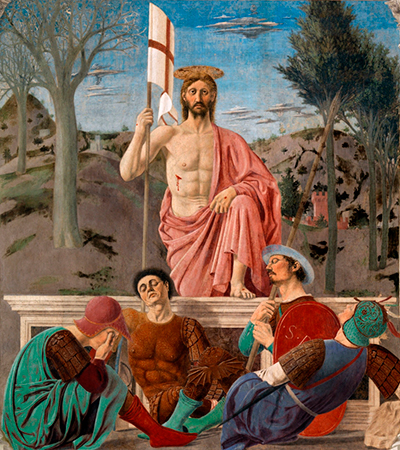
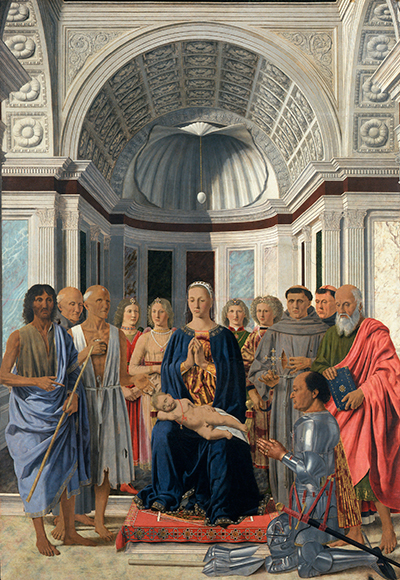
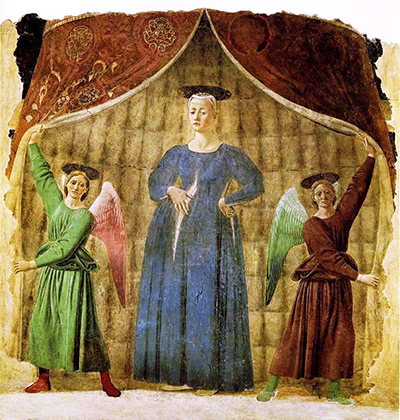
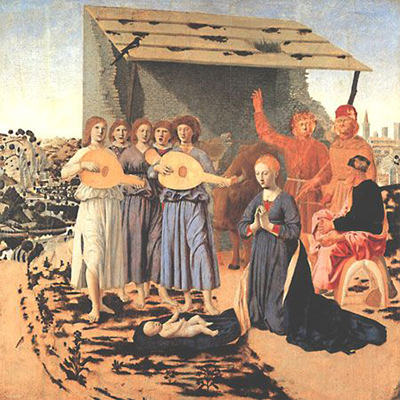
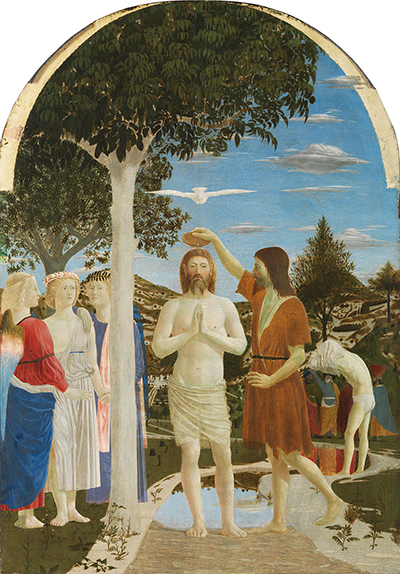
Piero della Francesca’s own words survive in a painter’s handbook and in records of the business of his life. In one, he sets out what a painter needs to know about drawing, proportion and colour. In another, he puts his name to an undertaking about his niece’s dowry. His signature on a small painting of Saint Jerome offers a third kind of evidence. Each survives in a form we can identify, from a manuscript in Piero’s hand to a few lines painted on a tree trunk. The famous verdict on The Resurrection belongs to a much later visitor, the English writer Aldous Huxley. [1] [2] [3] [4]
At a Glance
- Principal source for Piero’s words on artThe opening of De prospectiva pingendi, Book I, in the vernacular text edited by Chiara Gizzi. [1]
- Surviving words in Piero’s handAn undertaking concerning the dowry of his niece Contessa, dated 27 December 1487. [2]
- Painted signatureThe inscription on Berlin’s Saint Jerome names Piero by his place of origin and gives the year 1450. [3]
- Early receptionLuca Pacioli praised Piero in print in 1494. Giorgio Vasari portrayed him as a learned painter and accused Pacioli of taking credit for his work in 1550. [5] [6]
Contents
- Piero on the three parts of painting
- Reading the book alongside its drawings
- Piero’s signature and an undertaking in his own hand
- What Luca Pacioli and Giorgio Vasari wrote about him
- What Huxley meant by “the greatest picture in the world”
Piero on the three parts of painting
La pictura contiene in sé tre parti principali, quali diciamo essere disegno, commensuratio et colorare.
“In painting there are three principal parts, which we call drawing, proportional measurement and colouring.” English translation by TheHistoryOfArt.org from De prospectiva pingendi, Book I, proem, I.0.1, in the Parma manuscript, folio 1r, as edited by Chiara Gizzi, p. 81. [1]
Piero defines each term before explaining which one his book will teach. Drawing supplies the profiles and contours of an object. Proportional measurement puts those outlines in their proper places. Colouring renders the colours that appear in things, lighter or darker as the light changes. The unusual word commensuratio matters because the outlines have to agree with one another in the finished image. A row of foreground and background figures can be drawn convincingly one at a time and still sit awkwardly together if their relative sizes and positions fail to describe the ground they share. [1]
That is the part of painting Piero calls perspective. He says he will bring in as much drawing as the demonstration requires, leaving colouring aside so that he can show what lines, angles and proportions do. The description of colouring in the preceding sentence still deserves attention. Light is already there, as a reason a colour looks different from place to place. Piero acknowledges a problem the painter faces and tells his reader which part of it the book is equipped to answer. A reader looking for his instructions for mixing pigment will have to look elsewhere. [1]
He makes a similar decision when he introduces the eye. He limits the discussion to what painting requires, then considers how a change in the distance between an eye and an object changes the angle at which the object is seen. A little further on, he takes the geometer’s definition of a point, which has no parts, and asks what can actually be marked and seen. His working definition makes a point as small as the eye can make out. That choice gives a reader holding a pen something to do with the definition. It also explains why Piero starts with marks on a surface before working up to problems such as the appearance of a human head or an architectural capital. The mathematics article follows the constructions themselves. [1]

Diagram for Book I, proposition 1, fol. 1v of the Parma manuscript of De prospectiva pingendi. Piero della Francesca, MS Parm. 1576, Biblioteca Palatina, Parma. Chiara Gizzi (ed.), De prospectiva pingendi, Edizioni Ca’ Foscari, 2016, Book I, proposition 1, fol. 1v, fig. 2. Image source. CC BY 4.0. Resized from the source. This reproduction uses CC BY 4.0.
Reading the book alongside its drawings
The opening sentence looks deceptively settled when lifted out of a manuscript. The Parma copy, Biblioteca Palatina, MS Parm. 1576, is in Piero’s hand. Gizzi’s comparison of the surviving copies places its version of the work after the other surviving versions she studied. The apparatus on the page with the opening sentence records a small change in word order in another witness. In the account of the eye that follows, one variant reads ‘we said’ where the Parma text reads ‘I said’. The explanation remains recognisable while the voice changes. Identifying the edition and the folio tells readers which version of Piero’s explanation they are hearing. [1] [7]
The treatise also circulated in Latin. Pacioli credits a master named Matteo of the Borgo with translating it, and the Bordeaux manuscript combines a Latin text written by a copyist with drawings and interventions identified as Piero’s. The Biblioteca Panizzi in Reggio Emilia describes another pattern of collaboration in its Italian manuscript. Piero’s hand appears in drawings, corrections and more than sixty marginal notes. To read a sentence together with its figure is to see how the language works. An instruction to take a line from a given point acquires a precise meaning when the point can be found on the page. The surviving drawings belong to that process of demonstration. [7] [8] [9]
The book also reached a courtly audience. In the dedication of his later Libellus on regular solids to Guidobaldo da Montefeltro, Piero refers to his earlier work on perspective and asks for the new work to be placed with it among the books of Guidobaldo and his father. A practical demonstration for someone drawing figures could also belong in a ducal library. That setting helps explain why the wording of the treatise matters alongside its diagrams. The book had to make the work of a painter legible to readers who might encounter it far from the place where pictures were made. [7]
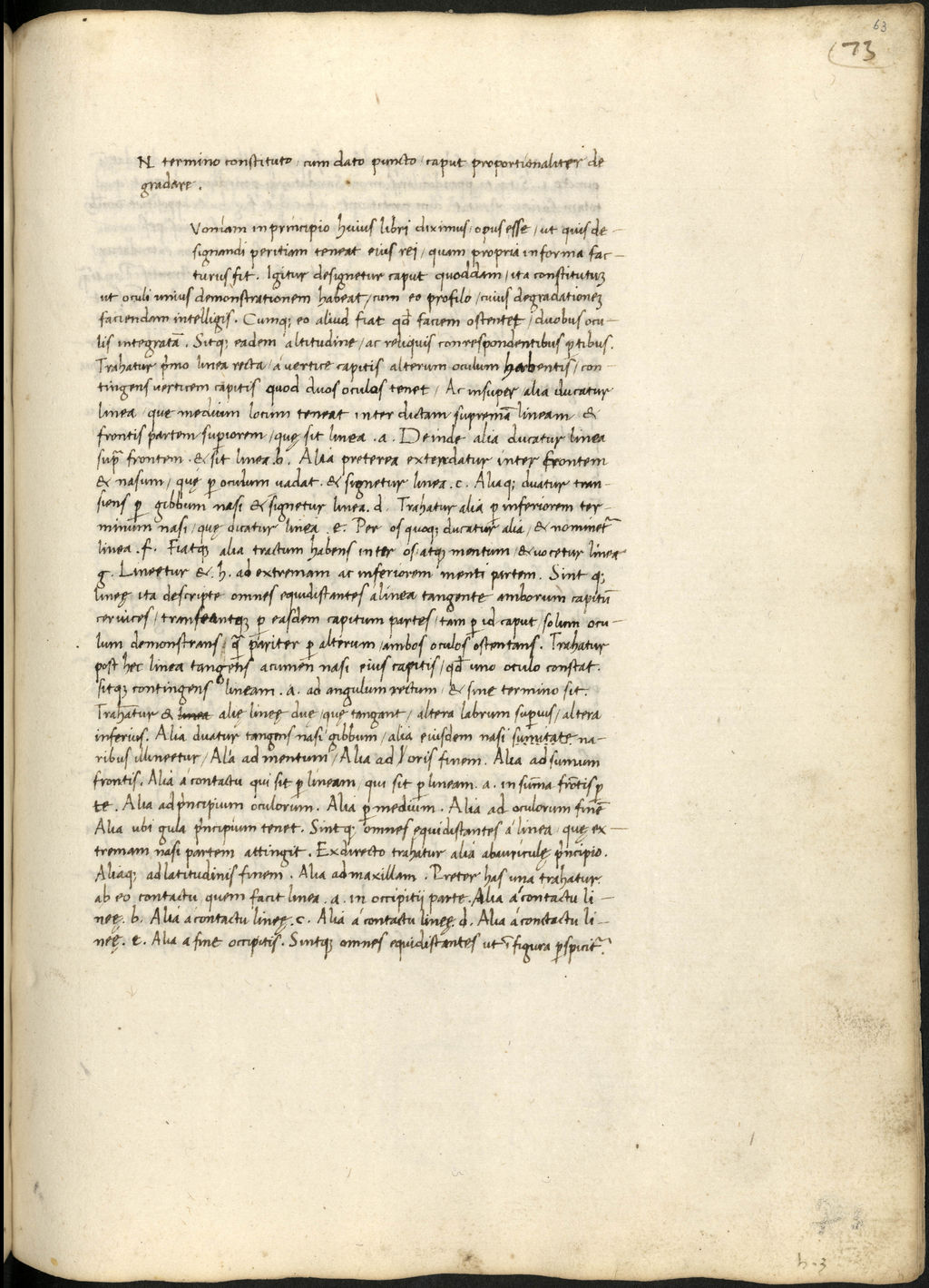
Bordeaux, Bibliothèque municipale, MS 616, folio 73 recto, from the Latin transmission of De prospectiva pingendi. Image source. Public domain. Resized only; native appearance preserved.
Piero’s signature and an undertaking in his own hand
PETRI DE / BVRGO / OPVS• M / CCCCL
“Work of Piero of the Borgo, 1450.” English translation by TheHistoryOfArt.org from the painted inscription on Saint Jerome, Gemäldegalerie, Berlin, inv. 1904. The slashes mark line breaks. The museum records the T and R in PETRI as joined. [3]
Piero’s name appears on a small painted label, or cartellino, at the front right of the panel. The label seems to belong to the landscape, attached to a tree trunk. Its lettering also names the maker outside that painted world. The Borgo is Borgo San Sepolcro, now Sansepolcro, and it identifies Piero through his town in this condensed public form. The Latin inscription speaks of the painter in the third person. It gives us a name and a year in the picture’s own material, where a remark supposedly made about the painting would need an entirely different kind of witness. [3]
In Sansepolcro on 27 December 1487, Piero wrote a different version of his name. He was endorsing an act relating to the dowry of his niece Contessa after the death of her father, Piero’s brother Marco. The opening of his endorsement reads as follows. [2]
Io Pietro de Franceschi dipintore so’ contento de quanto in questa scricta se contene
“I, Pietro de Franceschi, painter, agree to what is contained in this document.” English translation by TheHistoryOfArt.org from the autograph passage in Archivio di Stato di Firenze, Notarile antecosimiano, 7000, 1487 file, doc. 8, transcribed by James R. Banker and revised by Matteo Mazzalupi. [2]
The word dipintore, painter, is the occupation Piero claims even while acting for his family. He then states that he has signed in his own hand. A further passage, which the transcription identifies as Piero’s in another ink, undertakes the obligation in the name of his late brother. His language performs a legal act. The document makes it possible to distinguish his written endorsement from circumstances or decisions recorded by a notary. It gives the biography an unusually direct piece of evidence for the responsibilities Piero took on at home. [2]
What Luca Pacioli and Giorgio Vasari wrote about him
In the dedication of his Summa to Guidobaldo in 1494, Luca Pacioli called his fellow townsman Piero “el Monarcha ali tempi nostri dela pictura” (“the monarch of painting in our times” in TheHistoryOfArt.org’s translation). The phrase comes from folio 2r of the Venice edition, as transcribed by Tom Henry. Pacioli’s compliment introduces a point about the knowledge painters use. He singles out Piero’s treatise on painting and linear perspective, places it in the duke’s library and goes on to name other painters whose work he associates with instruments of measurement. The title he bestows on Piero is praise, and the surrounding passage tells us specifically what earned it. [5]
In the first edition of his Lives in 1550, Giorgio Vasari described Piero as “maestro raro e divino nelle difficultà de’ corpi regolari” (“a rare and divine master of the difficulties of regular solids” in TheHistoryOfArt.org’s translation). He makes the judgement in the opening of the Life of Piero della Francesca. Within a few lines, praise gives way to an accusation. Vasari says Piero was overtaken by blindness in old age and that Fra Luca, having learnt from him, published the older man’s work under his own name. Vasari’s opening image of an ass under a lion’s skin gives a sense of how deliberately he shapes the account as a story of stolen credit. [6]
A will made in the cloister of San Francesco at Sansepolcro on 20 September 1484 puts both men in the same place. Piero was one of the witnesses, and Pacioli was present as guardian of the Franciscan convent. The record gives the two townsmen a shared date and setting. The best evidence of Pacioli’s engagement with Piero’s mathematics lies in the texts themselves. [10] [11]
The Vatican Library preserves the Latin Libellus in Urb. lat. 632, and examples from Piero’s work on solids recur in Italian in Pacioli’s Divina proportione, printed in 1509. Hannah Baader has studied the transfer, and Argante Ciocci examines how the surviving texts bear on the question of whose Italian wording reached print. The overlap can be studied even where Vasari’s account of the men’s personal relationship and motives outruns what their works establish. Pacioli’s extravagant public praise of Piero also belongs in the record of that relationship. [5] [6] [12] [13] [10]
What Huxley meant by “the greatest picture in the world”
The greatest picture in the world…. You smile. The expression is ludicrous, of course.
Aldous Huxley, “The Best Picture”, in Along the Road (1925), in the paragraph following his description of Piero’s Resurrection. [4]
Huxley’s sentence is sometimes reduced to its first six words. In the essay, he has just described the colours and the condition in which he saw the mural at Sansepolcro. He then imagines the reader smiling and compares the business of ranking artists to picking a sports team. He returns to the mural with a more personal account of the kind of grandeur he sees in Piero, and with an argument about the integrity he values in a painter. The change of register is part of the essay’s pleasure. He makes the declaration, invites the reader’s scepticism and then explains why he still feels justified in saying it. [4]
The museum also supplies a context that Huxley’s claim can easily eclipse. The risen Christ was a civic emblem of Sansepolcro, and Piero’s mural occupied a building that housed the town’s government. Huxley writes about the judgement that formed when he made his visit. The civic setting allows a reader to ask what the much earlier viewers who used that building might have recognised in the same image. One line travelled widely thanks to Huxley. The painting had already spoken to a local audience for centuries. [4] [14]
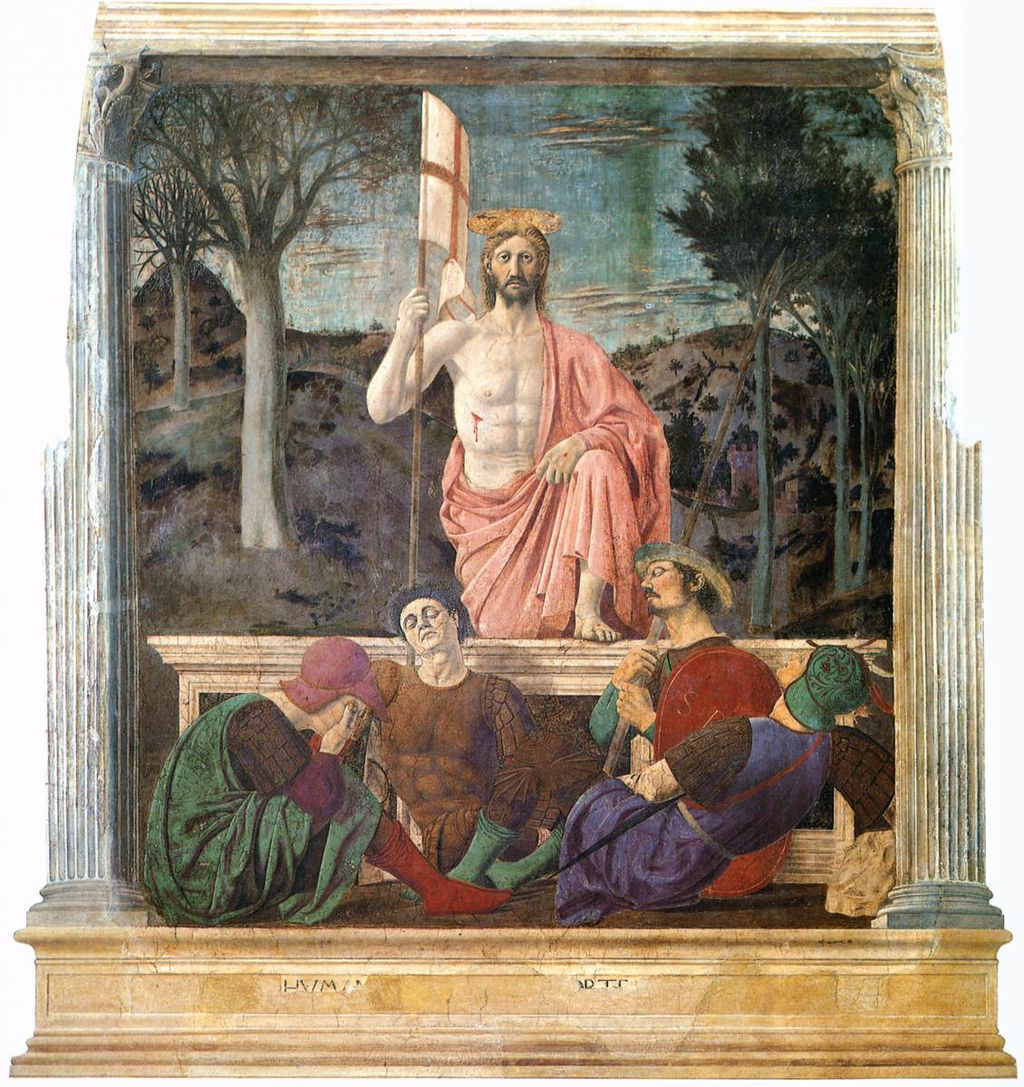
Piero della Francesca, The Resurrection, Museo Civico, Sansepolcro. Image source. Public domain. Resized only; native appearance preserved.
Browse the artworks
Compare Piero’s frescoes, panels and manuscript figures. The list includes ensembles and separately identifiable panels or scenes. Dates are approximate where the sources differ.
| Name | Date | Medium and source |
|---|---|---|
| The Baptism of Christ | Probably c. 1437–45 | Panel painting Catalogue. |
| The Flagellation of Christ | 1459–60 (GNDM) | Panel painting Catalogue. |
| The History of the True Cross | Mid-fifteenth century | Wall painting Catalogue. |
| Dream of Constantine | Mid-fifteenth century | Wall painting Catalogue. |
| The Duke and Duchess of Urbino | About 1473–75 (Uffizi) | Panel painting Catalogue. |
| The Resurrection | About 1458–68 (Opificio) | Wall painting Catalogue. |
| Brera Madonna | About 1472–74 | Panel painting Catalogue. |
| Annunciation at Arezzo | Mid-fifteenth century | Wall painting Catalogue. |
| Madonna del Parto | About 1450–65 (Monterchi) | Wall painting Catalogue. |
| Polyptych of the Misericordia | Commissioned 1445 | Panel painting Catalogue. |
| The Nativity | Early 1480s (National Gallery) | Panel painting Catalogue. |
| Madonna di Senigallia | About 1474–75 (GNDM) | Panel painting Catalogue. |
| Death of Adam | Mid-fifteenth century | Wall painting Catalogue. |
| Queen of Sheba | Mid-fifteenth century | Wall painting Catalogue. |
| Victory of Constantine | Mid-fifteenth century | Wall painting Catalogue. |
| Battle between Heraclius and Chosroes | Mid-fifteenth century | Wall painting Catalogue. |
| Saint Mary Magdalen | Wall painting Catalogue. | |
| The Augustinian Polyptych | 1454–69 | Panel painting Catalogue. |
| Polyptych of Perugia | About 1467–69 (GNU) | Panel painting Catalogue. |
| Perugia Annunciation | About 1468–70 (national catalogue) | Panel painting Catalogue. |
| St Francis and St Elizabeth | About 1467–69 (GNU) | Panel painting Catalogue. |
| Stigmatisation of St Francis | About 1468–70 (national catalogue) | Panel painting Catalogue. |
| An Augustinian Nun (Saint Monica) | 1454–69 | Panel painting Catalogue. |
| Augustinian Saint | 1454–69 | Panel painting Catalogue. |
| Saint Michael | 1454–69 | Panel painting Catalogue. |
| Saint Nicholas of Tolentino | 1454–69 | Panel painting Catalogue. |
| Saint John the Evangelist | 1454–69 | Panel painting Catalogue. |
| Virgin and Child Enthroned with Four Angels | About 1460–70 (Clark) | Panel painting Catalogue. |
| Portrait of Sigismondo Pandolfo Malatesta | About 1450–51, often proposed. Louvre catalogue range 1450–75. | Panel painting Catalogue. |
| Sigismondo before St Sigismund | 1451 | Wall painting Catalogue. |
| St Jerome and a Donor | 1460s (Accademia); about 1450 also proposed | Panel painting Catalogue. |
| St Jerome in Penitence | 1450, dated on the panel | Panel painting Catalogue. |
| Saint Julian | About 1455–60, often proposed | Wall painting Catalogue. |
| Saint Augustine | 1454–69 | Panel painting Catalogue. |
| Saint Apollonia | 1454–69 | Panel painting Catalogue. |
| Crucifixion from the Augustinian Polyptych | 1454–69 | Panel painting Catalogue. |
| Saint Louis of Toulouse | Wall painting Catalogue. | |
| Burial of the Wood | Mid-fifteenth century | Wall painting Catalogue. |
| Discovery and Proof of the True Cross | Mid-fifteenth century | Wall painting Catalogue. |
| Exaltation of the Cross | Mid-fifteenth century | Wall painting Catalogue. |
| Saint Anthony Raises a Child | About 1467–69 (GNU) | Panel painting Catalogue. |
| Saint Elizabeth Revives a Child | About 1467–69 (GNU) | Panel painting Catalogue. |
| Hercules | About 1470 | Wall painting Catalogue. |
| Portrait of a Boy (possibly Guidobaldo da Montefeltro) | Panel painting Catalogue. | |
| De prospectiva pingendi, Reggio Emilia witness (figures) | Manuscript diagrams Catalogue. | |
| The Interrogation of Judas | Mid-fifteenth century | Wall painting Catalogue. |
| Two prophets, Bacci Chapel | Mid-fifteenth century | Wall painting Catalogue. |
| Saint Clare of Assisi, upper predella | About 1467–69 (GNU) | Panel painting Catalogue. |
| Saint Agatha, upper predella | About 1467–69 (GNU) | Panel painting Catalogue. |
| Lost centre of the Augustinian Polyptych | 1454–69 | Lost panel or panels Catalogue. |
Frequently Asked Questions
Aldous Huxley used the phrase in “The Best Picture”, published in Along the Road in 1925. The essay both makes the claim and questions the usefulness of ranking works of art. [4]
Discussion
Look again at the images and ideas explored in Piero della Francesca Quotes and Writings. These editorial prompts invite your observations.
Reader Insights
What does Piero’s decision to discuss light in his opening and then leave colouring aside tell you about the kind of book he wanted to write?
What do the painted signature and the dowry undertaking tell you about how Piero identified himself for different readers?
How does Huxley’s argument change when you read past his first claim about The Resurrection?
Join the Conversation
Share a detail, comparison or question about Piero della Francesca Quotes and Writings below.
References
- Piero della Francesca, De prospectiva pingendi, critical text, ed. Chiara Gizzi (Venice, Edizioni Ca’ Foscari, 2016), Book I, proem, pp. 81–83, §§ I.0.1–22. Edition record and CC BY licence. View source 1. View source 2.
- Archivio di Stato di Firenze, Notarile antecosimiano, 7000, Leonardo di Mario Fedeli, 1487 file, doc. 8, Piero’s endorsement of a dowry undertaking, 27 December 1487, transcribed by James R. Banker and revised by Matteo Mazzalupi, Italian Renaissance Documents Site. Published in Banker, Documenti fondamentali per la conoscenza della vita e dell’arte di Piero della Francesca (2013), doc. CCXXXIII, pp. 178–79. View source.
- Staatliche Museen zu Berlin, Gemäldegalerie, Der heilige Hieronymus, inv. 1904, entry by Stephan Weppelmann, signature and inscription field. View source.
- Aldous Huxley, “The Best Picture”, in Along the Road: Notes and Essays of a Tourist, Part III, 1925, Aldous Huxley Archive transcription. View source.
- Luca Pacioli, Summa de arithmetica, geometria, proportioni et proportionalità, Venice, 1494, dedication to Guidobaldo, fol. 2r, transcribed by Tom Henry, Italian Renaissance Documents Site. View source.
- Giorgio Vasari, “Pietro della Francesca”, in Le vite de’ più eccellenti pittori, scultori e architettori, 1550 edition, opening paragraphs. View source.
- Chiara Gizzi, “Il De prospectiva pingendi e gli altri trattati pierfrancescani”, in De prospectiva pingendi (2016), especially pp. 15–19. View source.
- Biblioteca Panizzi, Digital manuscript catalogue, De prospectiva pingendi, description of the Reggio Emilia witness. View source.
- Museo Galileo, De prospectiva pingendi, manuscript exhibition, on the vernacular and Latin witnesses. View source.
- Argante Ciocci, “Giorgio Vasari, Luca Pacioli e Piero della Francesca. La questione dell’autografia del Libellus nell’edizione a stampa del 1509”, in Giulio Firpo and Matteo Martelli, eds., Piero della Francesca, Luca Pacioli, Giorgio Vasari e la civiltà del Rinascimento (Città di Castello, 2024), pp. 107–42. View source.
- Archivio di Stato di Firenze, Notarile antecosimiano, 3039, Ranieri dei Boddi, file 5, will of Nera di Pietro di Veltre, witnessed by Piero, 20 September 1484, transcribed by James R. Banker and revised by Matteo Mazzalupi, Italian Renaissance Documents Site. View source.
- Biblioteca Apostolica Vaticana, Urb. lat. 632, Piero della Francesca, Libellus de quinque corporibus regularibus. View source.
- Hannah Baader, “Das fünfte Element oder Malerei als achte Kunst”, in Valeska von Rosen, Klaus Krüger and Rudolf Preimesberger, eds., Der stumme Diskurs der Bilder (2003), pp. 177–203, especially the discussion of Pacioli’s incorporation of Piero’s treatise. View source.
- Museo Civico di Sansepolcro, La Resurrezione, museum interpretation on the building and civic emblem. View source.