 by Tom Gurney
Tom Gurney BSc (Hons) is an art history expert with over 20 years experience
Published on June 19, 2020 / Updated on October 14, 2023
Email: tomgurney1@gmail.com / Phone: +44 7429 011000
Battle between Heraclius and Chosroes: Introduction
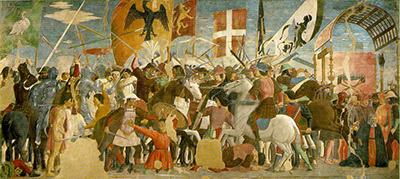
On the lower left wall of the Bacci Chapel, the emperor Heraclius's forces ride into a mass of men, horses and weapons. Piero della Francesca carries the action almost to the end of the wall, where it gives way to a different scene. Beneath a canopy, the Persian king Chosroes kneels among standing witnesses and awaits execution. The two episodes share a single fresco in the History of the True Cross at the Basilica of San Francesco in Arezzo. Together they tell how the Christian emperor won back the wood revered as the Cross of Christ. [1] [2]
At a Glance
- ArtistPiero della Francesca, with workshop participation.
- DateMid-fifteenth century, within the chapel cycle generally dated 1452–1466.
- MediumFresco.
- LocationBacci Chapel, Basilica of San Francesco, Arezzo. Lower left wall when facing the altar.
- SubjectHeraclius's victory and the condemnation of Chosroes in the legend of the recovery of the True Cross.
This work across Piero della Francesca’s career
The Baptism of Christ
Probably about 1437–45The History of the True Cross
Mid-fifteenth centuryBattle between Heraclius and Chosroes (current article)
Mid-fifteenth century, Bacci ChapelThe Resurrection
About 1458–68 (Opificio)The Flagellation of Christ
1459–60 (GNDM)The Montefeltro Altarpiece
About 1472–74 (Brera)The Duke and Duchess of Urbino
About 1473–75 (Uffizi)The Nativity
Early 1480s (National Gallery)Contents
- The battle on the left wall
- How Piero paints the clash
- The king under the canopy
- Khosrow II and the events behind the legend
- Across the chapel and up to the lunette
- What the restored surface can tell us
- Annotated details
The battle on the left wall
Standing in the nave and facing the altar, look to the bottom tier of the chapel's left wall. Across the room, at the same level, is the Victory of Constantine at the Battle of the Milvian Bridge. This pairing makes sense of a cycle that takes its episodes from different centuries and arranges them to answer one another across the chapel. Constantine advances under the protection of the sign of the Cross. Heraclius fights centuries later, when the relic itself has fallen into Persian hands. The fresco on the left also looks towards the end of the story, the Exaltation of the Cross, in the lunette above on the same wall. [1] [2] [3]
The episode belongs to a legend that followed the wood through many changes in status. In The Queen of Sheba, the queen recognises something sacred in a timber laid down as a bridge. Later Helena establishes which of three excavated crosses bore Christ. In the Heraclius episode, a ruler has seized the relic and given it a place in his own ceremony. That sequence makes the furnishings at the far right as important to the story as the armies. The relic has become an object whose possession and treatment can define a ruler. [1] [3] [4]
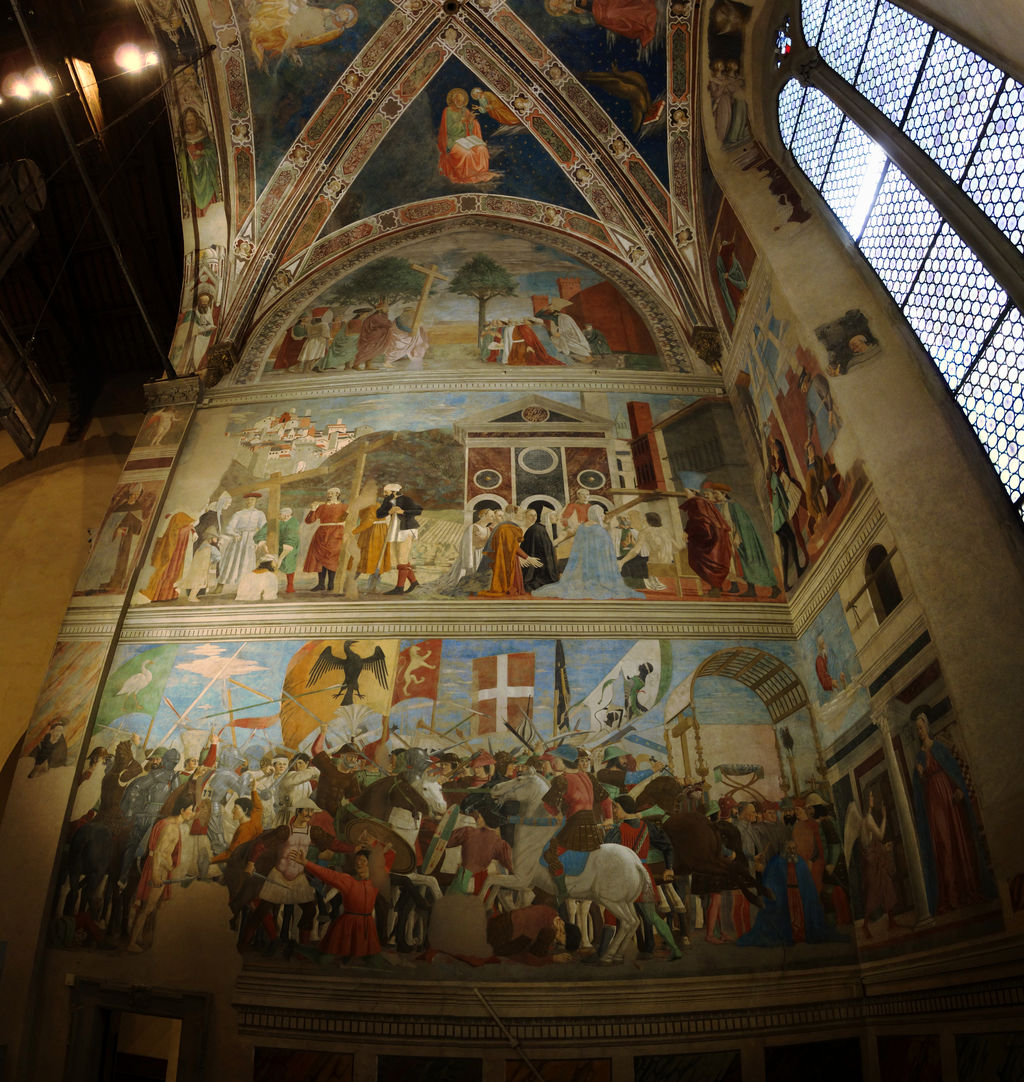
Left wall of the Bacci Chapel in San Francesco, Arezzo, as seen from the nave facing the altar. Spike. Image source. CC BY-SA 4.0. Resized from the source. This reproduction uses CC BY-SA 4.0.
How Piero paints the clash
Follow the mounted figures in from the left. The shiny plates of their armour and the heads of their horses are soon cut across by bright sleeves, spear shafts and foot soldiers. In the centre two pale horses face towards each other at different angles. The horse on the right turns its white head into the crowd while showing its broad flank and rump. The intervening shields, bodies and tack make it hard to follow any one horse from head to hoof. Look lower and more legs appear through narrow gaps. The battlefield seems to continue behind the people who block our view. [1] [5]
Some of the clearest shapes belong to people in the most precarious positions. A man in a red-orange tunic stretches out an arm in the foreground, close to the rim of a tilted shield. Nearby, a fallen figure has curled forward at a horse's feet. Farther back, a rider falls across his horse in a passage Carlo Bertelli reads as the defeat of Chosroes's son. That identification connects an incident within the mass of fighting to a particular episode in the legend. In Jacobus de Voragine's account, Heraclius meets the king's son in single combat on a bridge, under an agreement meant to spare both armies. The fresco sets the individual struggle inside a general battle and gives the viewer both scales of action at once. [4] [5]
The standards are easier to read from across the chapel. Above the helmets the black eagle spreads its wings against yellow. A lion rears on red, and a broad white cross divides another red field. Some poles point into the mêlée and others extend into clear sky. The flags make the upper part of the picture feel as active as the ground, although the broad patches of colour give the eye time to register distinct emblems. Bertelli notes the effect of torn cloth showing both faces and compares the opposing horses to ancient sculptural models. The eagle also appears above Constantine's troops, giving a viewer looking from wall to wall a recognisable sign of imperial authority. These are devices of Renaissance storytelling, and the emblems do their work even when the figures beneath them are too crowded to distinguish. [1] [5]
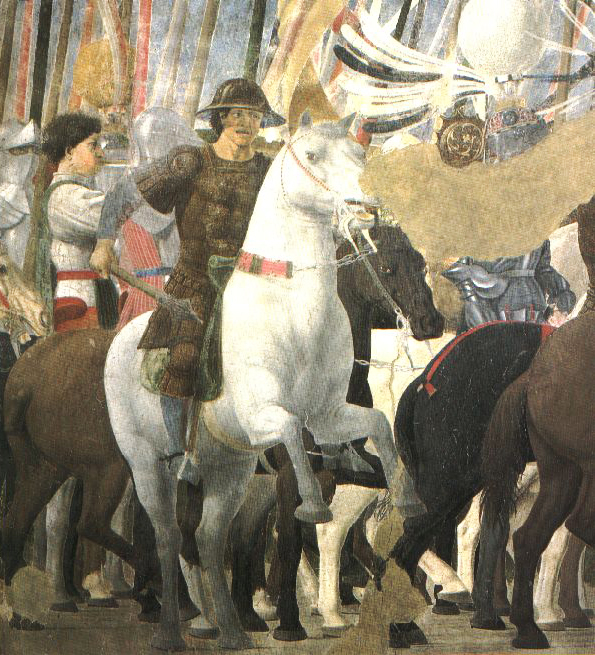
Piero gives the combatants a mixture of fifteenth-century plate armour and clothing in an imagined Roman manner. Bare limbs are visible beside metal coverings, and a costume can be as legible at a distance as a face is hard to recognise. The art historian Paolo Torriti has identified a recurring luxury textile design on the helmet of a fallen soldier and on the cushion of the royal seat. He also traces it in the Queen of Sheba episode. These small repetitions become apparent only at close range. They tie battlefield equipment and court display to the same tastes in richly patterned fabric. [5] [6]
Annotated Details from Battle between Heraclius and Chosroes
The numbered points identify visible features discussed in this article. Return from each detail to the numbered overview. Each caption identifies the work shown.
Chosroes and the spectators (detail)
Chosroes awaiting execution, detail of the Battle between Heraclius and Chosroes, Arezzo. Image source. Public domain.
.jpg)
Helmeted figure in the battle (detail)
Helmeted warrior, detail of the Battle between Heraclius and Chosroes, Arezzo. Image source. Public domain.
.jpg)
Details from BATTLE BETWEEN HERACLIUS AND CHOSROES
Compare the cropped details with the source images above. Notice how their colours, shapes and positions contribute to the larger compositions.
Chosroes and the spectators (detail)
The defeated ruler
The grey-haired ruler is placed below the standing men. The positions and heights of the faces differentiate the execution episode from the turmoil elsewhere.
 Detail 01 the-defeated-ruler.jpg)
The standing spectators
Heads turn in different directions. Their hats and helmets mark separate figures even where the bodies are pressed close.
 Detail 02 the-standing-spectators.jpg)
Paint losses across the group
A light vertical break interrupts several contours. It is visible as loss across the painted surface rather than part of the scene’s action.
 Detail 03 paint-losses-across-the-group.jpg)
Helmeted figure in the battle (detail)
Decoration on the helmet
Dark incised-looking lines on the helmet contrast with the broader highlights on its crown. Piero makes the patterned and reflective surfaces separately legible.
 Detail 04 decoration-on-the-helmet.jpg)
Face in shade
The eyes appear below the low rim, while the cheek and beard meet dark areas of the helmet. Only part of the battle is shown in this detail.
 Detail 05 face-in-shade.jpg)
Plates of armour
Parallel boundaries follow the curve of the metal over the shoulder, turning the body within a relatively narrow painted space.
 Detail 06 plates-of-armour.jpg)
The king under the canopy
On the far right, the curve of the canopy frames a smaller group of standing men and the kneeling Chosroes. The arched framework recedes into space, and the empty folding seat stands out against a plain cloth behind it. Higher up at the right is the cockerel on its support. The standing men close around the king, whose long dark robe spreads near the floor. The picture stops at the sentence and the moment before the killing. Behind the spectators, the empty seat makes it possible to imagine what the story says happened earlier, when Chosroes was enthroned. [1] [3] [4] [5]
In the Golden Legend, the king sets the Cross on one side of his throne and the cockerel on the other, and demands to be revered as God. The arrangement imitates the Trinity, with the relic standing for the Son and the bird for the Holy Spirit. After the battle Heraclius offers Chosroes his life and kingdom if he accepts baptism. He refuses, and Heraclius orders his death and takes the relic back. Piero gives the king's condemnation a place beside the battle, leaving the recovery of the wood to be understood through its former setting and its later appearance in Jerusalem. The eye crosses from a mass of bodies in motion to the comparatively still group gathered around a single kneeling man. The absence of a painted division makes the change in tempo do the work of separating the two moments. [1] [4] [5]
The encounter was already an established subject in medieval religious art. An enamel plaque made in the Meuse valley around 1160–1170, now in the Louvre, shows the defeated Chosroes before Heraclius. At just under fifteen centimetres long, it fits the encounter and a cherub onto a piece made for a cross. The comparison shows how differently artists could tell the same story. The plaque isolates the two rulers. Piero gives the royal encounter a relatively small place in a scene extending across a chapel wall and supplies it with witnesses. [7]
Giorgio Vasari, writing in the sixteenth century, said Piero portrayed members of the Bacci family and other prominent people from Arezzo around the execution. The witnesses' distinct faces reward that kind of scrutiny. The identity of the bareheaded man in profile remains disputed. Harald Rupfle's catalogue at the University of Innsbruck records proposals that include Francesco Bacci, Giovanni Bacci and Jacopo Anastagi, alongside a suggestion that it is Piero himself. Vasari's account is evidence of a tradition about who modelled for the spectators. The face and its setting leave room for different identifications. [8] [9]
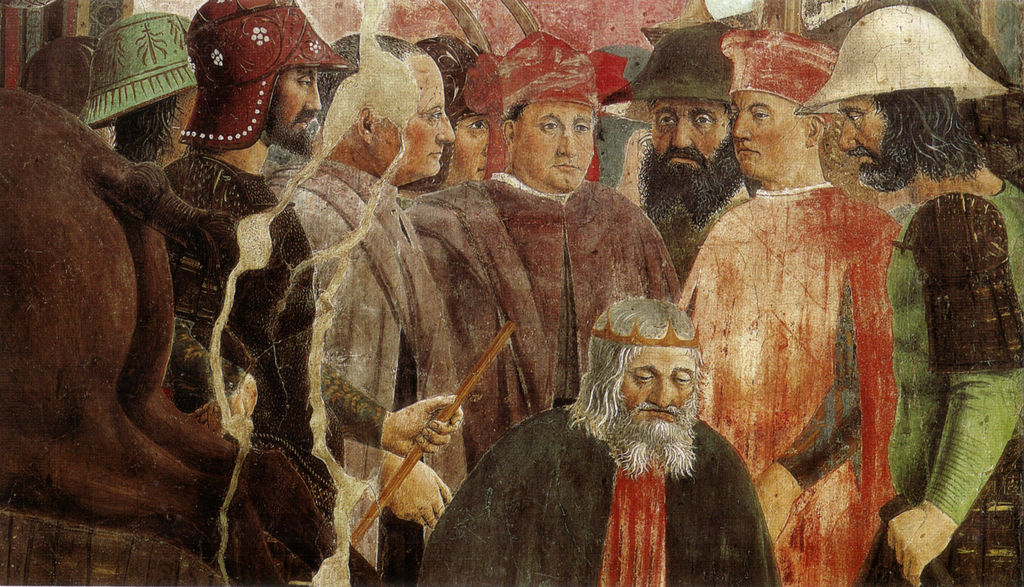
Chosroes awaiting execution, detail of the Battle between Heraclius and Chosroes, Arezzo. Image source. Public domain. Resized only; native appearance preserved.
Khosrow II and the events behind the legend
Chosroes is a form of the name Khosrow II, the ruler of the Sasanian Empire. Persian forces captured Jerusalem in 614 and took away the relic. In December 627 Heraclius defeated a Persian army near Nineveh, where the commander Rāhzāḏ was killed. Khosrow was overthrown in 628 by a coup that brought his son Kavadh II, also known as Shiroe, to the throne. Khosrow was killed in captivity, and peace negotiations followed. The return of the relic to Jerusalem is commonly dated to 630. These events were spread across years, places and changes of government. The fresco brings the defeat and the death together and gives Heraclius authority over both. [10] [11]
The seventh-century Chronicon Paschale preserves a dispatch from Heraclius that was read at Hagia Sophia in Constantinople at Pentecost in 628. It announced Khosrow's fall and Shiroe's proclamation as king. The dispatch celebrates the fall in explicitly Christian language, treating Khosrow's downfall as a reason for Christians to give thanks. The early source thus shows that a religious interpretation of the victory circulated within months of the coup. The story of the cockerel, the rival worship at the throne and the offer of baptism belongs to the medieval legend that shaped the Arezzo fresco. The dispatch and the legend preserve different kinds of evidence about the way the victory was remembered. [4] [10] [12]
Across the chapel and up to the lunette
Across from Heraclius, Constantine moves forward with a small cross extended in his hand. There is room between his army and the retreating figures to see the river and landscape. When the eye comes back to Heraclius, the spaces between men and horses are much smaller and the weapons pass in front of nearly everything. The two frescoes give military victory different appearances even though both episodes concern the power of the Cross. The imperial eagle stays recognisable across the room, while the stretch of open landscape in one scene has no counterpart in the crowded centre of the other. [1] [5] [6]
The Exaltation changes both the scale and purpose of the sight line. Above the battle wall a large cross stands against open sky, with people approaching or kneeling. In the legend, a heavenly messenger forces Heraclius to set aside the signs of his rank before he can enter Jerusalem with the relic. A king kneels under the canopy below after a military defeat. Above, Jerusalem's citizens kneel before the recovered Cross. The repetition of the posture gives the wall two pictures of submission, with very different reasons for bending the knee. [1] [3] [4]
What the restored surface can tell us
Musei di Arezzo dates the chapel cycle to 1452–1466. That span is useful for the commission as a whole. The battle bears no inscribed date, and estimates for the individual fresco depend on how scholars reconstruct the painting campaigns. Bertelli places it before 1459 and discusses contributions by assistants. The armour, fine textiles and diverse headgear help situate the work in Piero's world. They provide clues for dating, alongside the documentary record and the physical relationships between different parts of the painted wall. [2] [5] [6] [9]
A much later set of dates belongs to the conservation of the chapel. A project to examine the paintings began in 1985, and the restoration itself started in 1991. Conservators used a measured drawing of the walls, derived from photographs, to locate the results of different kinds of examination. Stefano Casciu and colleagues published examples from the battle showing where the ultraviolet fluorescence photographs were taken and how a particular image was aligned to that drawing. With the photograph and the survey in register, the team could compare responses on the surface at the same point on the wall with other records in the archive. The published battle detail illustrates that mapping procedure. Identification of a pigment would require material evidence beyond the bright or dark response in the image. [13]
Browse the artworks
Compare Piero’s frescoes, panels and manuscript figures. The list includes ensembles and separately identifiable panels or scenes. Dates are approximate where the sources differ.
| Name | Date | Medium and source |
|---|---|---|
| The Baptism of Christ | Probably c. 1437–45 | Panel painting Catalogue. |
| The Flagellation of Christ | 1459–60 (GNDM) | Panel painting Catalogue. |
| The History of the True Cross | Mid-fifteenth century | Wall painting Catalogue. |
| Dream of Constantine | Mid-fifteenth century | Wall painting Catalogue. |
| The Duke and Duchess of Urbino | About 1473–75 (Uffizi) | Panel painting Catalogue. |
| The Resurrection | About 1458–68 (Opificio) | Wall painting Catalogue. |
| Brera Madonna | About 1472–74 | Panel painting Catalogue. |
| Annunciation at Arezzo | Mid-fifteenth century | Wall painting Catalogue. |
| Madonna del Parto | About 1450–65 (Monterchi) | Wall painting Catalogue. |
| Polyptych of the Misericordia | Commissioned 1445 | Panel painting Catalogue. |
| The Nativity | Early 1480s (National Gallery) | Panel painting Catalogue. |
| Madonna di Senigallia | About 1474–75 (GNDM) | Panel painting Catalogue. |
| Death of Adam | Mid-fifteenth century | Wall painting Catalogue. |
| Queen of Sheba | Mid-fifteenth century | Wall painting Catalogue. |
| Victory of Constantine | Mid-fifteenth century | Wall painting Catalogue. |
| Battle between Heraclius and Chosroes | Mid-fifteenth century | Wall painting Catalogue. |
| Saint Mary Magdalen | Wall painting Catalogue. | |
| The Augustinian Polyptych | 1454–69 | Panel painting Catalogue. |
| Polyptych of Perugia | About 1467–69 (GNU) | Panel painting Catalogue. |
| Perugia Annunciation | About 1468–70 (national catalogue) | Panel painting Catalogue. |
| St Francis and St Elizabeth | About 1467–69 (GNU) | Panel painting Catalogue. |
| Stigmatisation of St Francis | About 1468–70 (national catalogue) | Panel painting Catalogue. |
| An Augustinian Nun (Saint Monica) | 1454–69 | Panel painting Catalogue. |
| Augustinian Saint | 1454–69 | Panel painting Catalogue. |
| Saint Michael | 1454–69 | Panel painting Catalogue. |
| Saint Nicholas of Tolentino | 1454–69 | Panel painting Catalogue. |
| Saint John the Evangelist | 1454–69 | Panel painting Catalogue. |
| Virgin and Child Enthroned with Four Angels | About 1460–70 (Clark) | Panel painting Catalogue. |
| Portrait of Sigismondo Pandolfo Malatesta | About 1450–51, often proposed. Louvre catalogue range 1450–75. | Panel painting Catalogue. |
| Sigismondo before St Sigismund | 1451 | Wall painting Catalogue. |
| St Jerome and a Donor | 1460s (Accademia); about 1450 also proposed | Panel painting Catalogue. |
| St Jerome in Penitence | 1450, dated on the panel | Panel painting Catalogue. |
| Saint Julian | About 1455–60, often proposed | Wall painting Catalogue. |
| Saint Augustine | 1454–69 | Panel painting Catalogue. |
| Saint Apollonia | 1454–69 | Panel painting Catalogue. |
| Crucifixion from the Augustinian Polyptych | 1454–69 | Panel painting Catalogue. |
| Saint Louis of Toulouse | Wall painting Catalogue. | |
| Burial of the Wood | Mid-fifteenth century | Wall painting Catalogue. |
| Discovery and Proof of the True Cross | Mid-fifteenth century | Wall painting Catalogue. |
| Exaltation of the Cross | Mid-fifteenth century | Wall painting Catalogue. |
| Saint Anthony Raises a Child | About 1467–69 (GNU) | Panel painting Catalogue. |
| Saint Elizabeth Revives a Child | About 1467–69 (GNU) | Panel painting Catalogue. |
| Hercules | About 1470 | Wall painting Catalogue. |
| Portrait of a Boy (possibly Guidobaldo da Montefeltro) | Panel painting Catalogue. | |
| De prospectiva pingendi, Reggio Emilia witness (figures) | Manuscript diagrams Catalogue. | |
| The Interrogation of Judas | Mid-fifteenth century | Wall painting Catalogue. |
| Two prophets, Bacci Chapel | Mid-fifteenth century | Wall painting Catalogue. |
| Saint Clare of Assisi, upper predella | About 1467–69 (GNU) | Panel painting Catalogue. |
| Saint Agatha, upper predella | About 1467–69 (GNU) | Panel painting Catalogue. |
| Lost centre of the Augustinian Polyptych | 1454–69 | Lost panel or panels Catalogue. |
Frequently Asked Questions
Discussion
Look again at the images and ideas explored in Battle between Heraclius and Chosroes. These editorial prompts invite your observations.
Reader Insights
Start with the flags and follow their poles down. Where does that route through the painting lead your eye, and where does the movement of the horses carry it next?
Compare Chosroes kneeling beneath the canopy with the kneeling figures in the Exaltation. How do the positions of the standing witnesses around each group change the meaning of the gesture?
Look for the imperial eagle on both walls. What else feels familiar between the two battle scenes, and how does Piero direct your attention to different parts of each field?
Join the Conversation
Share a detail, comparison or question about Battle between Heraclius and Chosroes below.
References
- Musei di Arezzo, Frescoes by Piero della Francesca, guide to the chapel, episodes 5 and 8–9. View source.
- Musei di Arezzo, Frescoes by Piero della Francesca, basilica and chapel overview. View source.
- Visit Arezzo, Guide to “The Legend of the True Cross” by Piero della Francesca. View source.
- Jacobus de Voragine, “The Exaltation of the Holy Cross”, The Golden Legend, vol. 5, translated by William Caxton, edited by F. S. Ellis. View source.
- Carlo Bertelli, “Piero della Francesca”, I classici della pittura, Treccani, 2016, sections on the Bacci Chapel. View source.
- Paolo Torriti, “Piero della Francesca ad Arezzo. Moda e gioielli alla metà del XV secolo”, University of Siena repository, discussion of the battle and fig. 5. View source.
- Musée du Louvre, Plaque d’une croix. Chérubin, Héraclius et Chosroès, collection record MRR 245. View source.
- Giorgio Vasari, “Vita di Piero della Francesca”, Le vite, Giuntina edition, 1568, Fondazione Memofonte digital text. View source.
- Harald Rupfle, “Die Schlacht zwischen Heraklius und Chosroes”, Metapictor, University of Innsbruck. View source.
- James Howard-Johnston, “Ḵosrow II”, Encyclopaedia Iranica, sections on the final campaign and the coup. View source.
- James Howard-Johnston, “The Difficult Road to Peace”, The Last Great War of Antiquity, Oxford University Press, 2021, pp. 321–359. View source.
- Chronicon Paschale, entry for 628, excerpt in the translation of Michael and Mary Whitby, pp. 182–183, at Corpus Coranicum. View source.
- Stefano Casciu, Giuseppe A. Centauro and Massimo Chimenti, “The Archival Documentation System. The Computerized Heart of the Restored ‘History of the True Cross’ by Piero della Francesca”, GraDoc, ICCROM, 2000, pp. 208–214, especially figs. 4 and 6. View source.