


 by Tom Gurney
Tom Gurney BSc (Hons) is an art history expert with over 20 years experience
Published on June 19, 2020 / Updated on October 14, 2023
Email: tomgurney1@gmail.com / Phone: +44 7429 011000
Piero della Francesca: Introduction
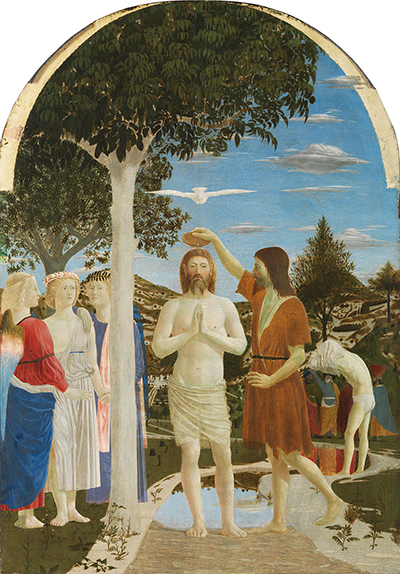
In Piero della Francesca’s Baptism of Christ, you can almost miss the water that gives the painting its subject. It falls from a shallow bowl in a fine thread that reaches Christ’s forehead. Above it, a white dove spreads its wings. Below it, Christ holds his palms together, standing so upright that you might follow the centre of the painting down through the dove, the water and the hands. Step back and another upright comes into view, the pale trunk of a tree beside him. It anchors the group of angels to the left, while a wandering stream draws the eye behind the Baptist and into the hills. The whole scene seems to hold still for the few seconds it takes the water to fall. [1]
The event belongs to the River Jordan, yet the slopes, riverbank and small walled settlement suggest the country around Sansepolcro, the Tuscan town where Piero was born and where the panel was once part of an altarpiece. Small plants and distant reflections reward a closer look, but the painting remains easy to read from farther away. That balance is a good introduction to Piero. He gives the eye an arrangement it can grasp at once, then reveals how much particular things matter inside it. [1]
Piero di Benedetto dei Franceschi was an Italian Renaissance painter and mathematician, born in Borgo San Sepolcro in the early fifteenth century. The National Gallery gives his birth as about 1415–20, and the Frick Collection places it around 1412. He died in his hometown in 1492. His commissions ranged from painted altarpieces and chapel murals to portraits for Italian rulers. He also wrote a systematic treatise on how to draw in perspective. A painted floor and a page of geometrical diagrams can look like products of very different minds. In Piero’s work both explore how a flat surface can give a convincing sense of where things are. [2] [3] [4]
At a Glance
- LifetimePiero was born in Sansepolcro in the early fifteenth century and died there in 1492. The exact birth year is uncertain. [2] [3]
- Training and workIn 1439 he worked with Domenico Veneziano in Florence. His commissions also took him to Arezzo, Rimini, Rome and Urbino. [3] [4]
- Major mural cycleThe History of the True Cross covers the walls of the Bacci Chapel at San Francesco in Arezzo. [5]
- Known signatureThe Flagellation of Christ identifies him as Piero of Borgo San Sepolcro. [6]
- Perspective treatiseDe prospectiva pingendi survives in three Italian and four Latin manuscripts. [7]
Piero della Francesca’s connections
Follow Piero’s relationships through the rooms, paintings and commissions that brought them together.
- Domenico Veneziano: The two painters worked on the Sant’Egidio frescoes in Florence. The surviving document ties Piero to the project in 1439. [8]
- Bicci di Lorenzo: Bicci began work in the Bacci Chapel. Piero took on the fresco cycle after him. [5]
- Leon Battista Alberti: Alberti designed the Tempio’s exterior, while Piero painted the kneeling Malatesta in its interior. [9]
- Sigismondo Pandolfo Malatesta: Piero’s signed fresco depicts the lord of Rimini in prayer before his namesake saint. [9]
- Federico da Montefeltro: The armoured duke kneels before the Virgin and Child in the altarpiece now in Brera. [10]
Piero della Francesca in context
Italian Early Renaissance
Piero’s fifteenth-century contextEarly Netherlandish painting
Comparative painting traditions in the fifteenth centuryDomenico Veneziano
Worked with Piero in 1439; died 1461Leon Battista Alberti
Active across Piero’s career; died 1472Piero della Francesca
Recorded in the 1430s; died 1492Andrea Mantegna
Born c. 1431; lived beyond the period shownThe Baptism of Christ
Probably about 1437–45The History of the True Cross
Mid-fifteenth centuryThe Resurrection
About 1458–68 (Opificio)The Flagellation of Christ
1459–60 (GNDM)The Montefeltro Altarpiece
About 1472–74 (Brera)The Duke and Duchess of Urbino
About 1473–75 (Uffizi)The Nativity
Early 1480s (National Gallery)Essential Piero della Francesca works
The Flagellation of Christ
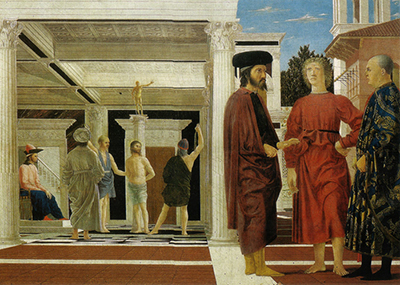
1459–60 (GNDM) · Two groups occupy one measured panel, and their connection in the narrative remains in dispute. [6]
The Baptism of Christ
Probably about 1437–45 · A few vertical alignments hold together water, figures and a spacious landscape. [1]
The Resurrection
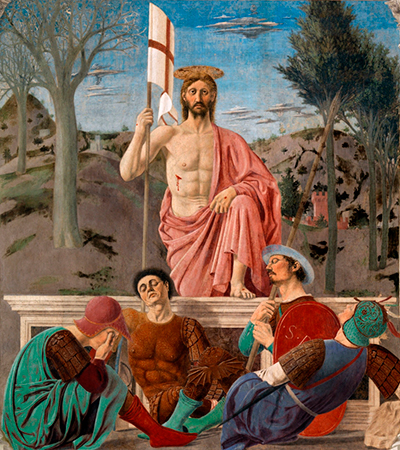
About 1458–68 (Opificio) · The risen Christ faces the viewer while four figures sleep below him. [11]
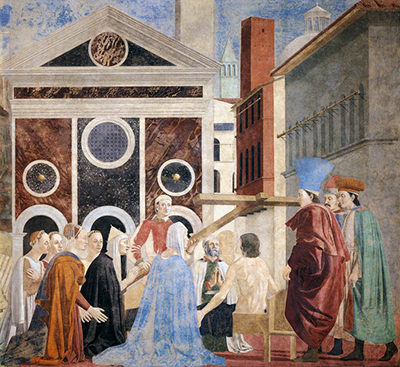
The History of the True Cross
Mid-fifteenth century · The Bacci Chapel frescoes turn the history of a sacred relic into a sequence across a room. [5]
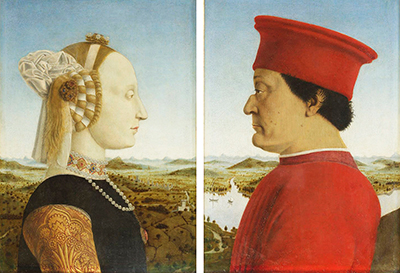
The Duke and Duchess of Urbino
About 1473–75 (Uffizi) · Two facing profiles share a landscape; their reverses show triumphs. [12]
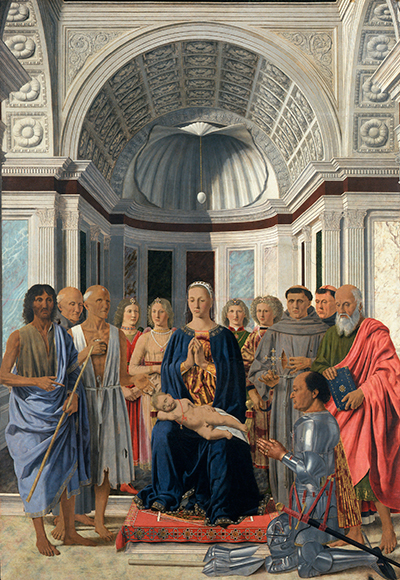
The Montefeltro Altarpiece
About 1472–74 (Brera) · The duke’s armour and a suspended egg help the eye measure a painted interior. [10]
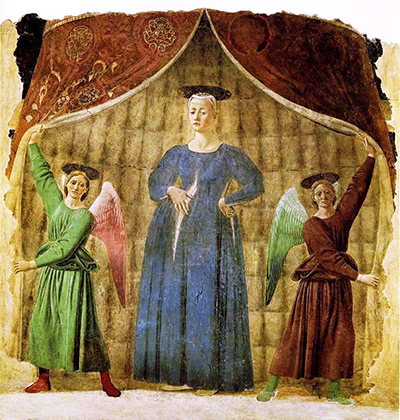
Madonna del Parto
Mid-fifteenth century · Two angels part the curtain around a pregnant Virgin.
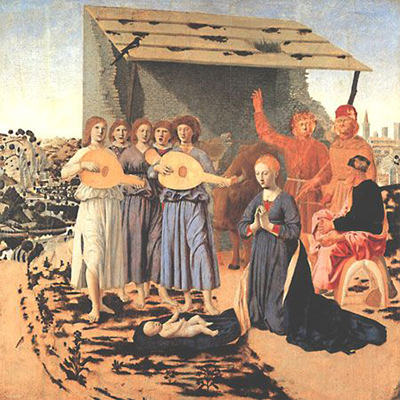
The Nativity
Late in Piero’s career · The infant and singers gather before a stable in a quiet landscape. [13]
Contents
- A painter from Borgo San Sepolcro
- A ruler in Rimini and a chapel in Arezzo
- A small painting with a deep interior
- The Montefeltro court in two formats
- Paintings that once belonged together
- What he put on paper
- Where to begin looking
A painter from Borgo San Sepolcro
Sansepolcro lies in the upper Tiber valley, near Tuscany’s border with Umbria. In Piero’s day the Borgo had its own economy, religious foundations and patrons. The valley grew woad, a source of blue dye traded with textile centres including Florence and Siena. Its name invokes the Holy Sepulchre in Jerusalem. A local foundation legend credited two returning pilgrims with establishing a shrine there. For an artist who painted sacred stories in recognisably local surroundings, the town offered both commissions and a community with its own way of placing itself in Christian history. [8] [14]
In Florence in 1439, Piero worked on a fresco project at Sant’Egidio with Domenico Veneziano. The years that followed took him to such different settings as the papal court in Rome, the Malatesta court at Rimini and the Montefeltro court at Urbino. He also kept taking substantial commissions in the Borgo. The destinations matter because a ruler’s portrait, a painting for a confraternity and the decoration of a church choir posed different problems of access, scale and audience. The biography follows the documents that connect these places and what they reveal about his career. [3] [4] [8]
The Polyptych of the Misericordia shows what a local commission could demand. Ordered by the Compagnia della Misericordia in 1445, the work was an altarpiece made up of multiple panels. A tall Virgin opens her cloak and shelters two small groups of kneeling people. Their heads make an arc beneath her hands. At the centre, a strip of her red dress divides the worshippers. The gold behind the Virgin gives little sense of distance, yet her cloak has a dark interior where the figures can gather. The change in scale establishes her importance, while the arrangement beneath the fabric makes her protection physically imaginable. [15]
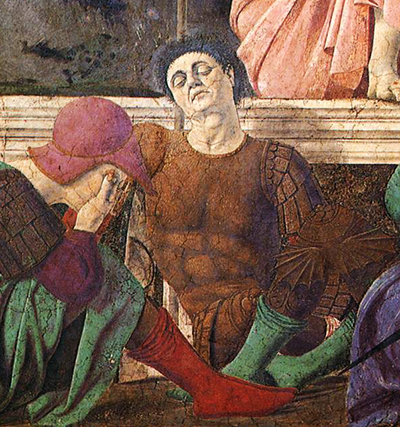
In the Museo Civico, you can compare the altarpiece with the Resurrection, a mural in a building once used for civic government. Christ looks straight ahead as he raises one foot onto the lip of the tomb. At his feet, four men sleep in different positions, their tilted heads and folded limbs interrupting the long horizontal of the stone. The landscape to either side gives another form to the change the painting depicts. Bare trunks and branches rise on the left, with trees in leaf on the right. An opposition of seasons can read as a passage from death to life without needing a second episode or an explanatory inscription. [11] [16]
Conservators at the Opificio delle Pietre Dure studied the mural’s bricks, plaster and pigments as well as its painted surface. They found that Piero combined work on wet plaster with colours applied after the plaster had dried. Examination of the masonry showed that the picture was moved with a section of its wall. Its original position remains uncertain. The painted masonry and its present supporting wall belong to different moments in the history of the building. [11]
Four stages of Piero della Francesca’s career
These periods group related developments; painting, travel and local work overlap across their boundaries.
Work in Sansepolcro and Florence
Records place Piero in his hometown and then in Florence with Domenico Veneziano. In the Baptism he sets a public sacred event among shallow water, pale light and a recognisably Tuscan landscape. [1]
Commissions for chapels and civic spaces
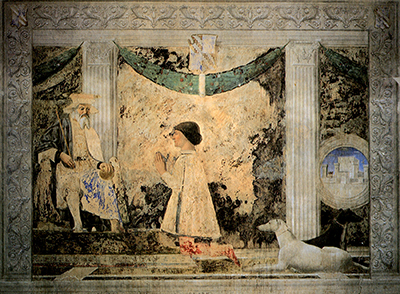
Piero combined work in his hometown with commissions elsewhere in central Italy. In Rimini, an architectural room binds the kneeling ruler and his patron saint within the same measured space. [9]
Work associated with the Montefeltro court
The Montefeltro altarpiece sets a ruler in armour beside saints and angels. The foreshortened vault, hanging egg and reflections give the chapel-like interior different depths. [10]
Late painting and writings
Piero worked in oil on the Nativity, using a softly lit setting for the miraculous event. His writings circulated in manuscript and explain how to represent measured solid forms. [13]
A ruler in Rimini and a chapel in Arezzo
Piero’s signed and dated mural of 1451 at the Tempio Malatestiano in Rimini shows Sigismondo Pandolfo Malatesta kneeling before Saint Sigismund. The lord of Rimini appears in profile with his hands raised together. The saint sits on the left, and two dogs rest behind the kneeling figure. On the far right a round opening looks onto the ruler’s fortress. The pilasters give the act of prayer and the view of Rimini distinct places within a single room. The dogs occupy the same carefully measured setting as the solemn encounter. Their quiet presence gives a sense of how little action Piero needed to make the room seem inhabited. [9]
The fresco belongs to a church that Sigismondo was transforming with the work of several artists, including Leon Battista Alberti, who designed its exterior. Compare it with the smaller portrait of Sigismondo at the Louvre. Against a dark ground, the forehead, nose and chin form a single readable contour. The museum considers the panel probably related to the conception of the fresco. Whatever the precise sequence, the comparison shows how much can change around the same profile. On the panel it holds the viewer’s attention almost alone. In the church it is one element in a room built around the act of kneeling. [9] [17]
At the Basilica of San Francesco in Arezzo, where Piero continued work begun by Bicci di Lorenzo in the Bacci Chapel, the scale of the task changed. The History of the True Cross follows the legendary wood of Christ’s cross across centuries. Its episodes include the death of Adam, the Queen of Sheba’s recognition of the wood, battles, and the recovery and return of the cross. The medieval Golden Legend provides a literary point of reference. In the chapel the episodes occupy different levels and face different directions. A visitor sees neighbours and counterparts before reconstructing the whole sequence of events. [5] [18]
In the scene of the Queen of Sheba, the queen kneels before the wood on one side and meets Solomon on the other. Her movement from landscape into architecture gives a shared scene two distinct kinds of space. The women behind her echo one another’s upright posture as she lowers herself. Indoors, bodies and columns mark the intervals around the meeting. Watch how the queen’s gesture changes between the two episodes. Piero can interrupt a long arrangement with one inclination of a head or torso, then pick up a related inclination elsewhere. The figures tell you where the meeting is happening and how to attend to it. [5] [18]
The Dream of Constantine uses a different kind of attention. An angel descends towards a tent where the emperor lies asleep. Follow the light around the opening. It picks out the tent’s fabric and parts of the people gathered there, leaving the guard at the left largely in shadow. A receptive surface becomes a way of showing who stands where and which way they face. In the Baptism, daylight lets us see small things throughout a landscape. Here a more concentrated light lets us discover the event in a darkened camp. Above the tents, there are still stars in a sky beginning to lighten. On the other side of the chapel window, the angel of the Annunciation appears to Mary in daylight. Comparing the two scenes brings out just how carefully Piero varied the conditions under which a figure comes into view. The cycle was restored in a long campaign completed in 2000. Its conservators used a common system of drawings and records to keep track of differences in materials and condition across the chapel. [1] [5] [18] [19]
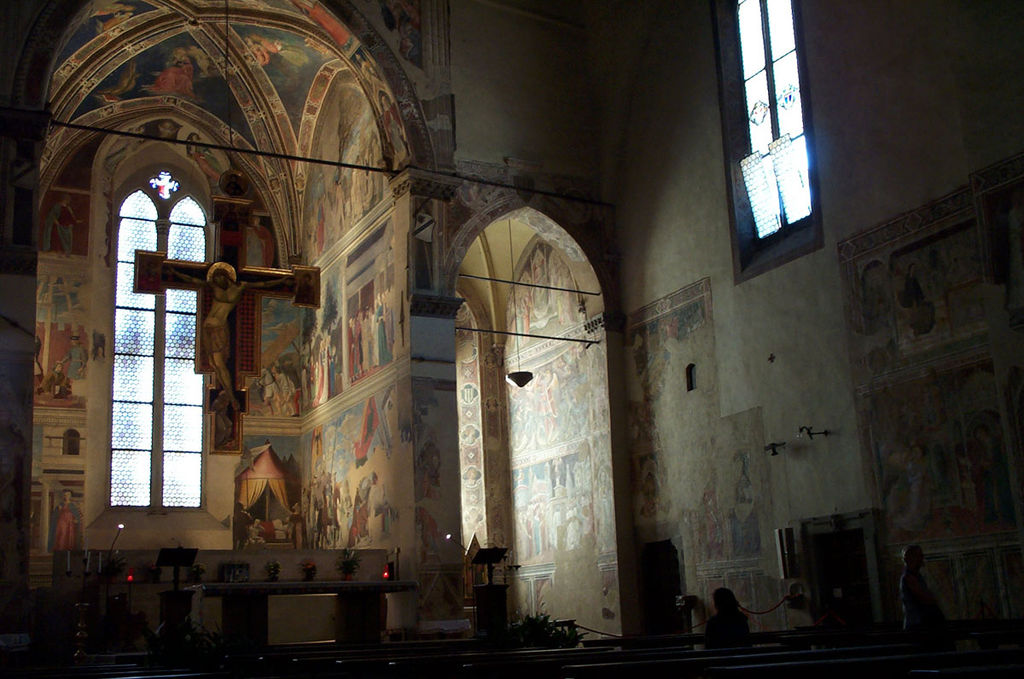
An oblique view of the Bacci Chapel with its window, suspended crucifix and right wall. louis-garden. Image source. CC BY-SA 2.5. Resized from the source. This reproduction uses CC BY-SA 2.5.
A small painting with a deep interior
In the Flagellation of Christ in Urbino, Piero reverses an expectation about size. The event named in the title is at the left, inside a building and some distance from us. Three much larger figures stand together in the open foreground at the right. There is room in front of them, as if another person might enter from where we stand. Christ is far enough back that the upright column beside him helps the eye locate his body. Inside the building, the patterned pavement gives us a succession of smaller intervals to follow into depth. The architecture makes it clear how the distant event and the people outside can coexist in the painting. Their relationship within the story remains harder to establish. [6] [20]
Try looking at just the boundary between the covered and open spaces. The pavement leads across the front of the building, and the upright at its edge separates the smaller figures beneath the roof from the more immediate group. Follow that upright upwards, then look back down to the lined floor. The eye makes the journey readily, but the painting refuses to settle on a single centre of interest. The foreground trio has presence and colour. The distant figures have the force of the action and the concentration of architectural detail. Piero uses a coherent space to give each group a different claim on our attention. [6] [20]
The Galleria Nazionale delle Marche records competing accounts of who the three men were and what the painting was for. One historical line of interpretation links the foreground to the death of Oddantonio da Montefeltro. Others connect the picture with church politics or a different loss in the Montefeltro family. The signature is on the step of Pilate’s seat and identifies the painter with Borgo San Sepolcro. Its position rewards the particular kind of looking the picture requires, as the most secure historical clue is a tiny mark inside its least immediate space. [6] [20]
The Montefeltro court in two formats
In the paired portraits of Federico da Montefeltro and Battista Sforza, now at the Uffizi, each sitter is close enough to see the textures of skin, cloth and jewels. The far-off land has waterways and roads fine enough to follow with your eye. The horizon carries over across the gap between the panels, giving two separately framed people a shared world. Federico’s face and cap have firm, short contours. Battista’s pale forehead, pearl ornaments and elaborate dress give her profile a quite different density of tiny detail. The compositional balance can survive these differences precisely because the continuous landscape keeps the two sides in corresponding positions. [12]
Both panels are painted on the back. The couple appear again, carried in triumphal cars and accompanied by personifications of virtues. The portraits ask us to look at a particular brow, ear or garment. The reverses ask us to read an act of public praise and the Latin inscriptions beneath the scenes. The Uffizi dates the diptych to around 1473–75. Battista died in 1472, and the museum allows that the pallor of her face may allude to her death as well as reflecting contemporary ideals of beauty. That possibility would give the shared landscape a commemorative role, letting the pair face one another across a world they once shared. [12]
In the panel now called the Montefeltro Altarpiece, Federico kneels in armour before the Virgin and sleeping Child. Behind them, the coffers in a vaulted apse diminish into the distance. An egg hangs from a shell above. It appears directly over the Virgin’s head, but following the architecture back gives it a place well behind her. Piero can bring two objects into striking alignment while keeping them at different depths. Brera’s description also draws attention to a tiny shape in the armour, the reflection of an arched window. The egg works at the scale of the whole composition. The reflected light establishes the same imaginary interior in a surface no larger than part of a shoulder. [10] [21]
The altarpiece came to Brera from San Bernardino outside Urbino, and its first intended setting remains disputed. The museum’s account of restoration and study reports that the panel was reduced in size. Its painted building would have been more expansive than the rectangle we see today. The portraits and the altarpiece show different aspects of Federico’s public identity. In Florence his head makes one half of a dynastic pair. In Milan his whole body turns towards the Madonna, bringing the military identity signalled by the armour into a sacred assembly. [12] [10]
Paintings that once belonged together
A single panel in a gallery can carry clues to a larger object. The Augustinian Polyptych was painted for the high altar of the Augustinians in Sansepolcro and completed in 1469. Its surviving panels now belong to institutions in Europe and the United States. When the Museo Poldi Pezzoli reunited eight of them in 2024, the central panel was still missing. Looking together at the surviving saints made it possible to compare paint at edges that had once faced the centre. The exhibition team reported minute traces of angels’ wings on the panels of Saint Michael and Saint John the Evangelist. The wings had once crossed into the adjacent saints’ spaces from the central scene. Together with fragments of costume and steps, these traces led the team to propose a Coronation of the Virgin for the lost centre. [22] [23]
The researchers also compared what lay under the paint. They found differences in the way small and large panels had been prepared, consistent with the contract’s requirement to reuse older material. The exhibition’s research describes the use of thin translucent layers of oil paint for effects such as clear rock crystal and glinting stones. Read at arm’s length, those surfaces reward the same scrutiny as the armour in the Montefeltro panel. Read at altar scale, the neighbouring figures occupy a setting continuous enough for the wings to cross from one section to another. The paintings overview brings together other surviving works by their original uses, which are often more revealing than their present museum arrangement. [21] [22] [23]
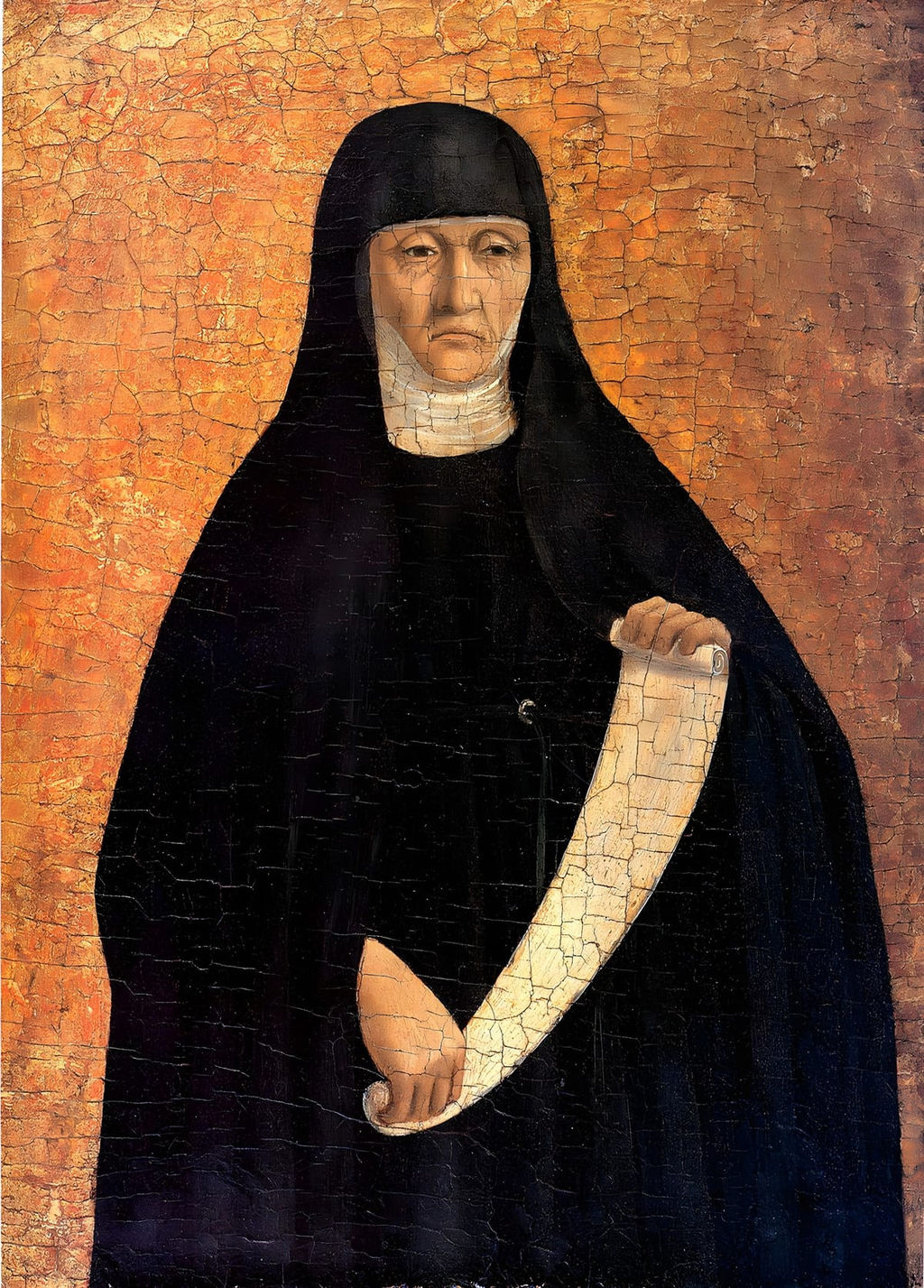
Piero della Francesca, An Augustinian Nun (Saint Monica), The Frick Collection, New York. Image source. Public domain. Resized only; native appearance preserved.
What he put on paper
In De prospectiva pingendi, roughly On Perspective for Painting, Piero explains how to draw shapes and bodies as they appear from a chosen position. Given a viewpoint, a painter who knows the size and arrangement of things can work out how their appearances change as they tilt or recede. An object seen obliquely takes up less of the field of view in one direction. A regular pavement can therefore appear compressed far back in a picture, while still looking like a floor made of tiles of the same size. Piero sets out procedures and gives mathematical reasons for them, with diagrams that are integral to the text. [7]
The treatise proceeds from flat figures and solids to difficult objects such as a human head. In that exercise, illustrated in the Museo Galileo’s exhibition, Piero marks points on measured views of the head and uses their positions to construct how it would look from a different angle. A draughtsman can thus work towards a head viewed from below even though a nose, cheek and eye socket belong to a shape more complicated than any tile. This was knowledge that could be communicated in stages and used by another painter. Seven handwritten copies survive, three in Italian and four in Latin. Museo Galileo presents the manuscripts side by side, so that a reader can compare the text and figures across copies. [7] [24]
The treatise helps explain why a seemingly incidental thing, such as the angle of a head or a break between floor slabs, has such power in Piero’s paintings. It also suggests the limit of a diagram as a reading of an artwork. In the Flagellation the pavement gives the eye a route towards Christ, but there is still a decision to make about where to look first. In the Baptism the visible axis draws attention to the moment water touches a forehead. The geometry in either work supports a choice about what the viewer notices, for how long and in what order. The mathematics article takes up the treatise and Piero’s other mathematical writings in their own right. [1] [6] [7]
Where to begin looking
The Baptism in London is a good place to practise moving between scales. First let the dove, Christ, tree and angels establish the whole picture. Then look for the thread of water, the man taking off his clothes on the bank and the small patches of colour reflected farther upstream. At Arezzo, start with the opposite exercise. Take in the chapel as a room before looking for one face or patch of light. In Sansepolcro, go from the Misericordia to the Resurrection and compare how each makes a central figure rise above the people beneath. Each approach gives a different sense of how Piero placed a viewer in relation to a picture. [1] [15] [11] [5]
The National Gallery’s Nativity offers another point of comparison with the Baptism. Piero again uses the hills of a familiar landscape and little touches of everyday life, including a rough shelter and a donkey. The Nativity’s oil paint gives the colours a richness distinct from the pale egg tempera of the earlier panel. Look for the light on the stable wall, where it falls through an opening in the roof, and at the space around the angels. They cast no visible shadows. Following its conservation treatment, the gallery read this absence as deliberate and related it to Saint Bridget of Sweden’s vision of the birth of Christ. It now places the picture in a domestic context, probably the principal bedchamber of Piero’s family home. A visitor in London can take in two sacred stories set on familiar ground and intended for very different rooms. [1] [13]
Some works can be understood especially well in the buildings that still house them. Others enter into different conversations in museums, where a panel might stand apart from its original frame, or its back can be studied alongside its front. The guide to where to see Piero’s work brings these places together. Once you have seen an example of each kind, familiar works often look different. A strip of landscape between a sitter and the edge of a panel may carry the connection to an entire second portrait. The little step where a name is written may be the place where an artist from the Borgo makes himself known in the world he has built. [6] [12]
Watch talks on Piero della Francesca
Start with the National Gallery’s overview or hear two lectures on his career and landscapes.
Piero della Francesca: A quiet revolutionary
An introduction to what sets Piero’s paintings apart, from the organisation of space to the treatment of light.
Watch on YouTubeBrowse the artworks
Compare Piero’s frescoes, panels and manuscript figures. The list includes ensembles and separately identifiable panels or scenes. Dates are approximate where the sources differ.
| Name | Date | Medium and source |
|---|---|---|
| The Baptism of Christ | Probably c. 1437–45 | Panel painting Catalogue. |
| The Flagellation of Christ | 1459–60 (GNDM) | Panel painting Catalogue. |
| The History of the True Cross | Mid-fifteenth century | Wall painting Catalogue. |
| Dream of Constantine | Mid-fifteenth century | Wall painting Catalogue. |
| The Duke and Duchess of Urbino | About 1473–75 (Uffizi) | Panel painting Catalogue. |
| The Resurrection | About 1458–68 (Opificio) | Wall painting Catalogue. |
| Brera Madonna | About 1472–74 | Panel painting Catalogue. |
| Annunciation at Arezzo | Mid-fifteenth century | Wall painting Catalogue. |
| Madonna del Parto | About 1450–65 (Monterchi) | Wall painting Catalogue. |
| Polyptych of the Misericordia | Commissioned 1445 | Panel painting Catalogue. |
| The Nativity | Early 1480s (National Gallery) | Panel painting Catalogue. |
| Madonna di Senigallia | About 1474–75 (GNDM) | Panel painting Catalogue. |
| Death of Adam | Mid-fifteenth century | Wall painting Catalogue. |
| Queen of Sheba | Mid-fifteenth century | Wall painting Catalogue. |
| Victory of Constantine | Mid-fifteenth century | Wall painting Catalogue. |
| Battle between Heraclius and Chosroes | Mid-fifteenth century | Wall painting Catalogue. |
| Saint Mary Magdalen | Wall painting Catalogue. | |
| The Augustinian Polyptych | 1454–69 | Panel painting Catalogue. |
| Polyptych of Perugia | About 1467–69 (GNU) | Panel painting Catalogue. |
| Perugia Annunciation | About 1468–70 (national catalogue) | Panel painting Catalogue. |
| St Francis and St Elizabeth | About 1467–69 (GNU) | Panel painting Catalogue. |
| Stigmatisation of St Francis | About 1468–70 (national catalogue) | Panel painting Catalogue. |
| An Augustinian Nun (Saint Monica) | 1454–69 | Panel painting Catalogue. |
| Augustinian Saint | 1454–69 | Panel painting Catalogue. |
| Saint Michael | 1454–69 | Panel painting Catalogue. |
| Saint Nicholas of Tolentino | 1454–69 | Panel painting Catalogue. |
| Saint John the Evangelist | 1454–69 | Panel painting Catalogue. |
| Virgin and Child Enthroned with Four Angels | About 1460–70 (Clark) | Panel painting Catalogue. |
| Portrait of Sigismondo Pandolfo Malatesta | About 1450–51, often proposed. Louvre catalogue range 1450–75. | Panel painting Catalogue. |
| Sigismondo before St Sigismund | 1451 | Wall painting Catalogue. |
| St Jerome and a Donor | 1460s (Accademia); about 1450 also proposed | Panel painting Catalogue. |
| St Jerome in Penitence | 1450, dated on the panel | Panel painting Catalogue. |
| Saint Julian | About 1455–60, often proposed | Wall painting Catalogue. |
| Saint Augustine | 1454–69 | Panel painting Catalogue. |
| Saint Apollonia | 1454–69 | Panel painting Catalogue. |
| Crucifixion from the Augustinian Polyptych | 1454–69 | Panel painting Catalogue. |
| Saint Louis of Toulouse | Wall painting Catalogue. | |
| Burial of the Wood | Mid-fifteenth century | Wall painting Catalogue. |
| Discovery and Proof of the True Cross | Mid-fifteenth century | Wall painting Catalogue. |
| Exaltation of the Cross | Mid-fifteenth century | Wall painting Catalogue. |
| Saint Anthony Raises a Child | About 1467–69 (GNU) | Panel painting Catalogue. |
| Saint Elizabeth Revives a Child | About 1467–69 (GNU) | Panel painting Catalogue. |
| Hercules | About 1470 | Wall painting Catalogue. |
| Portrait of a Boy (possibly Guidobaldo da Montefeltro) | Panel painting Catalogue. | |
| De prospectiva pingendi, Reggio Emilia witness (figures) | Manuscript diagrams Catalogue. | |
| The Interrogation of Judas | Mid-fifteenth century | Wall painting Catalogue. |
| Two prophets, Bacci Chapel | Mid-fifteenth century | Wall painting Catalogue. |
| Saint Clare of Assisi, upper predella | About 1467–69 (GNU) | Panel painting Catalogue. |
| Saint Agatha, upper predella | About 1467–69 (GNU) | Panel painting Catalogue. |
| Lost centre of the Augustinian Polyptych | 1454–69 | Lost panel or panels Catalogue. |
Frequently Asked Questions
Piero developed and explained mathematical procedures for perspective in painting. Leon Battista Alberti had set out its theoretical principles decades before Piero wrote his illustrated treatise. [7]
Discussion
Look again at the images and ideas explored in Piero della Francesca. These editorial prompts invite your observations.
Reader Insights
Compare the tree trunk and Christ’s body in the Baptism. Where does your eye leave those upright forms and begin to follow the river into the distance?
Look at the two profiles and the landscape behind them in the Urbino diptych. What seems continuous across the panels, and where does Piero let each panel stand on its own?
Compare the light on the figures at the opening of Constantine’s tent with the reflections in Federico’s armour in the Montefeltro panel. What does each patch of light tell you about the space around it?
Join the Conversation
Share a detail, comparison or question about Piero della Francesca below.
References
- National Gallery, London, The Baptism of Christ, NG665, collection entry, image and provenance. View source.
- National Gallery, London, Piero della Francesca, artist record. View source.
- The Frick Collection, The Painter, exhibition research for Piero della Francesca in America, 2013. View source.
- Istituto della Enciclopedia Italiana, Piero della Francesca, Treccani artist entry and documentary chronology. View source.
- Direzione regionale Musei nazionali Toscana, Basilica di San Francesco, official site record, cycle description and restoration chronology. View source.
- Galleria Nazionale delle Marche, Flagellation, collection entry, signature and history of interpretation. View source.
- Museo Galileo and Fondazione Palazzo Magnani, De Prospectiva Pingendi, manuscript exhibition and comparative digital facsimiles. View source.
- Museo Civico di Sansepolcro, Biografie degli artisti, Piero della Francesca, museum biography. View source.
- Comune di Rimini, Il Tempio Malatestiano e le chiese del Riminese, municipal guide to the building and Piero’s dated mural. View source.
- Pinacoteca di Brera, Madonna and Child with Saints, Angels and Federico da Montefeltro (San Bernardino Altarpiece), collection entry, inv. 180. View source.
- Opificio delle Pietre Dure, Piero della Francesca, La Resurrezione, 1458–1468, Museo Civico, Sansepolcro, condition, material analysis and conservation report. View source.
- Daniela Parenti, Uffizi Galleries, I duchi di Urbino Federico da Montefeltro e Battista Sforza, collection entry with views of both faces and reverses, inv. 1890 nn. 1615, 3342. View source.
- National Gallery, London, The Nativity, NG908, collection entry with results of the conservation treatment completed in 2022. View source.
- The Frick Collection, His City, exhibition research for Piero della Francesca in America, 2013. View source.
- Ministero della Cultura, Catalogo Generale dei Beni Culturali, Madonna della misericordia e santi, storie della Passione di Cristo, 0900430246-0, national catalogue record and contract history. View source.
- Werner Busch, ‘Lucas van Leydens “Große Hagar” und die augustinische Typologieauffassung der Vorreformation’, Zeitschrift für Kunstgeschichte 45, 1982, pp. 97–129, comparison with Piero on p. 101. View source.
- Musée du Louvre, Portrait de Sigismond Malatesta, seigneur de Rimini, RF 1978 1, collection entry. View source.
- Carlo Bertelli, Piero della Francesca, I classici della pittura, Treccani, 2016, catalogue discussion of the Bacci Chapel and its scenes. View source.
- Stefano Casciu, Giuseppe A. Centauro and Massimo Chimenti, ‘The Archival Documentation System’, in Graphic Documentation Systems in Mural Painting Conservation, ICCROM, 2000, p. 208 onwards. View source.
- Polo Museale delle Marche, Piero della Francesca, Flagellazione, exhibition dossier on composition and proposed identifications. View source.
- Pinacoteca di Brera, DescriVedendo Brera, ‘La Pala Montefeltro’, description of the painted space and the armour reflection. View source.
- Museo Poldi Pezzoli, Piero della Francesca. The Augustinian Polyptych reunited, exhibition dossier, Milan, 2024. View source.
- Museo Poldi Pezzoli, Piero della Francesca. Il polittico agostiniano riunito, 2024 exhibition press kit, research findings on binding media, panel preparation and the proposed central image. View source.
- Museo Galileo, Piero della Francesca. Sezione VII: La figura umana, exhibition commentary on the perspective construction of a head. View source.