 by Tom Gurney
Tom Gurney BSc (Hons) is an art history expert with over 20 years experience
Published on June 19, 2020 / Updated on October 14, 2023
Email: tomgurney1@gmail.com / Phone: +44 7429 011000
Sigismondo Pandolfo Malatesta Praying in Front of St Sigismund: Introduction
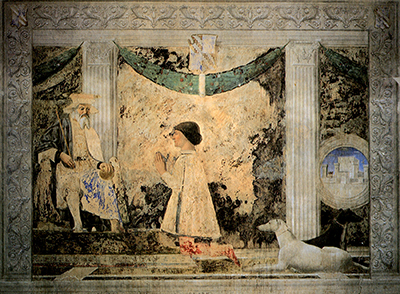
In Piero della Francesca’s fresco at the Tempio Malatestiano in Rimini, the lord who commissioned the painting kneels with his hands joined. His patron saint sits on a raised throne at the left. Two greyhounds lie at the right, below a round opening that frames the ruler’s fortress. The painting is conventionally dated 1451, a reading based on historical records of a now damaged inscription. Its details bring a portrait of a fifteenth-century ruler, a prayer to a sixth-century saint and a view of Rimini into the same room. [1] [2]
At a Glance
- ArtistPiero della Francesca [1]
- DateConventionally 1451, with the end of the inscribed date damaged [1]
- MediumDetached fresco transferred to canvas [1]
- Dimensions257 × 345 cm [1]
- LocationTempio Malatestiano, Rimini, Italy [3]
- Original settingRelic Chamber adjoining the chapel of Saint Sigismund [4]
This work across Piero della Francesca’s career
The Baptism of Christ
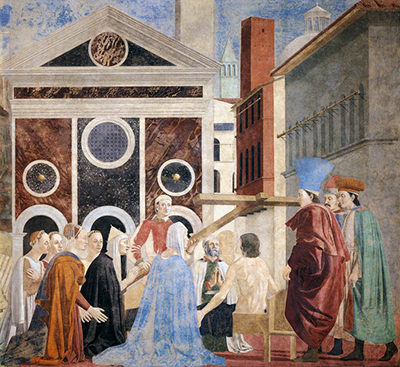
Probably about 1437–45The History of the True Cross
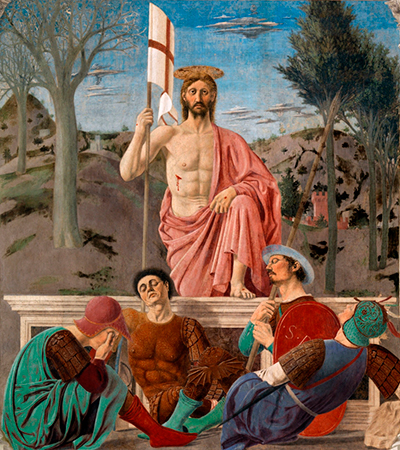
Mid-fifteenth centuryThe Resurrection
About 1458–68 (Opificio)The Flagellation of Christ
1459–60 (GNDM)The Montefeltro Altarpiece
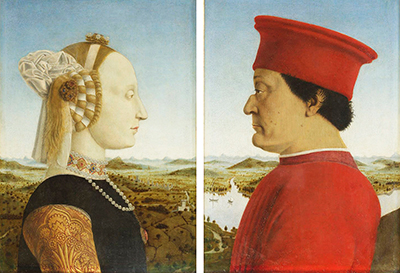
About 1472–74 (Brera)The Duke and Duchess of Urbino
About 1473–75 (Uffizi)The Nativity
Early 1480s (National Gallery)Contents
- A commission for the Malatesta church
- Two Sigismunds and a remembered emperor
- The painted hall and the greyhounds
- Castel Sismondo through the round opening
- What the signature and damage tell us
- The Louvre portrait and the fresco
- Annotated details
A commission for the Malatesta church
Sigismondo Pandolfo Malatesta ruled Rimini from 1432 to 1468. A condottiere, or commander who contracted his military services, he also sponsored a major remodelling of the Franciscan church of San Francesco, where members of his family were already buried. The resulting building, known as the Tempio Malatestiano and now Rimini’s cathedral, was the work of several hands. Matteo de’ Pasti oversaw the works and helped shape the interior, Agostino di Duccio and his workshop provided sculpture, and Leon Battista Alberti designed the classical exterior that was left unfinished. Piero’s painting belongs to the campaign inside the existing church, where the new chapels gave Sigismondo places to honour his family and his patron saint. [3] [5]
The fresco was originally high above the entrance on the inside wall of the small Cella delle Reliquie, or Relic Chamber, between the chapel of Saint Sigismund and the chapel of Saint Michael. A barred opening connected the chamber visually to the adjacent chapel. The position above the door helps explain why the painting could be monumental in scale yet addressed to a restricted audience. A visitor standing beneath it in the small chamber would have encountered the fictive hall high up on a real wall. The cathedral now displays the detached painting in the last chapel on the right, near the presbytery. That move changed the distance and angle from which the scene could be seen. [1] [5] [6] [4]
Marilyn Aronberg Lavin reads the fresco in light of the Greek dedications on the sides of the Tempio. They present the building as a thank offering for deliverance and victory, made to God and to the city. In the fresco the motifs that make this interpretation plausible are visible at a glance. The joined hands address the saint, while the nearby fortress locates the donor’s power in a real place. An image intended for a small room could still make a claim about how the ruler understood his obligations to Rimini. [6]
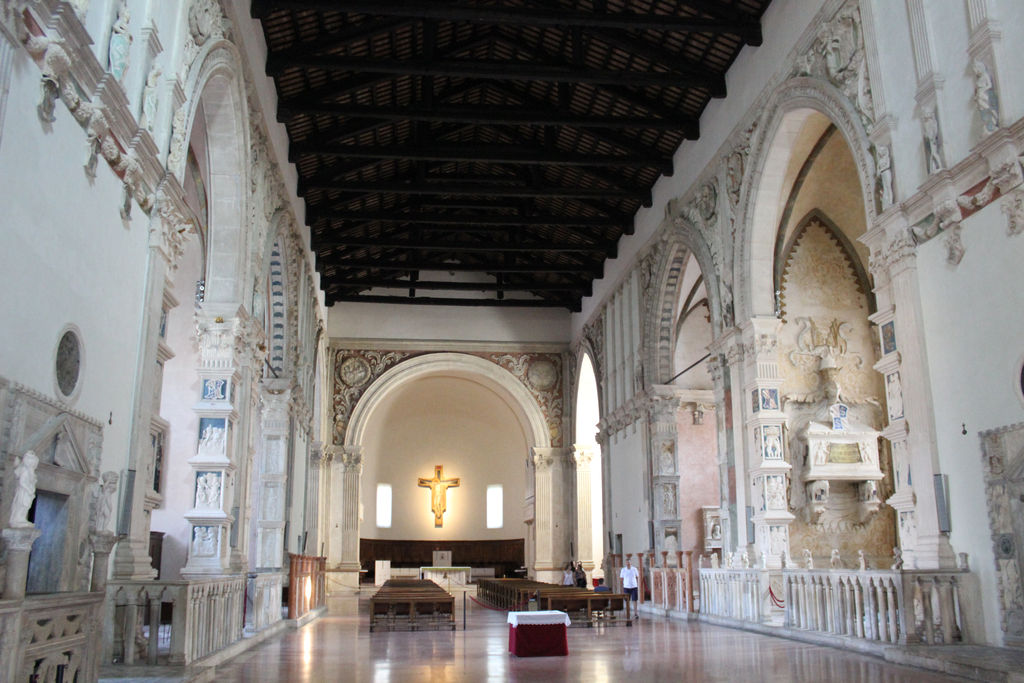
The nave of the Tempio Malatestiano, looking towards the altar, Rimini. Tulumnes. Image source. CC BY-SA 4.0. Resized from the source. This reproduction uses CC BY-SA 4.0.
Two Sigismunds and a remembered emperor
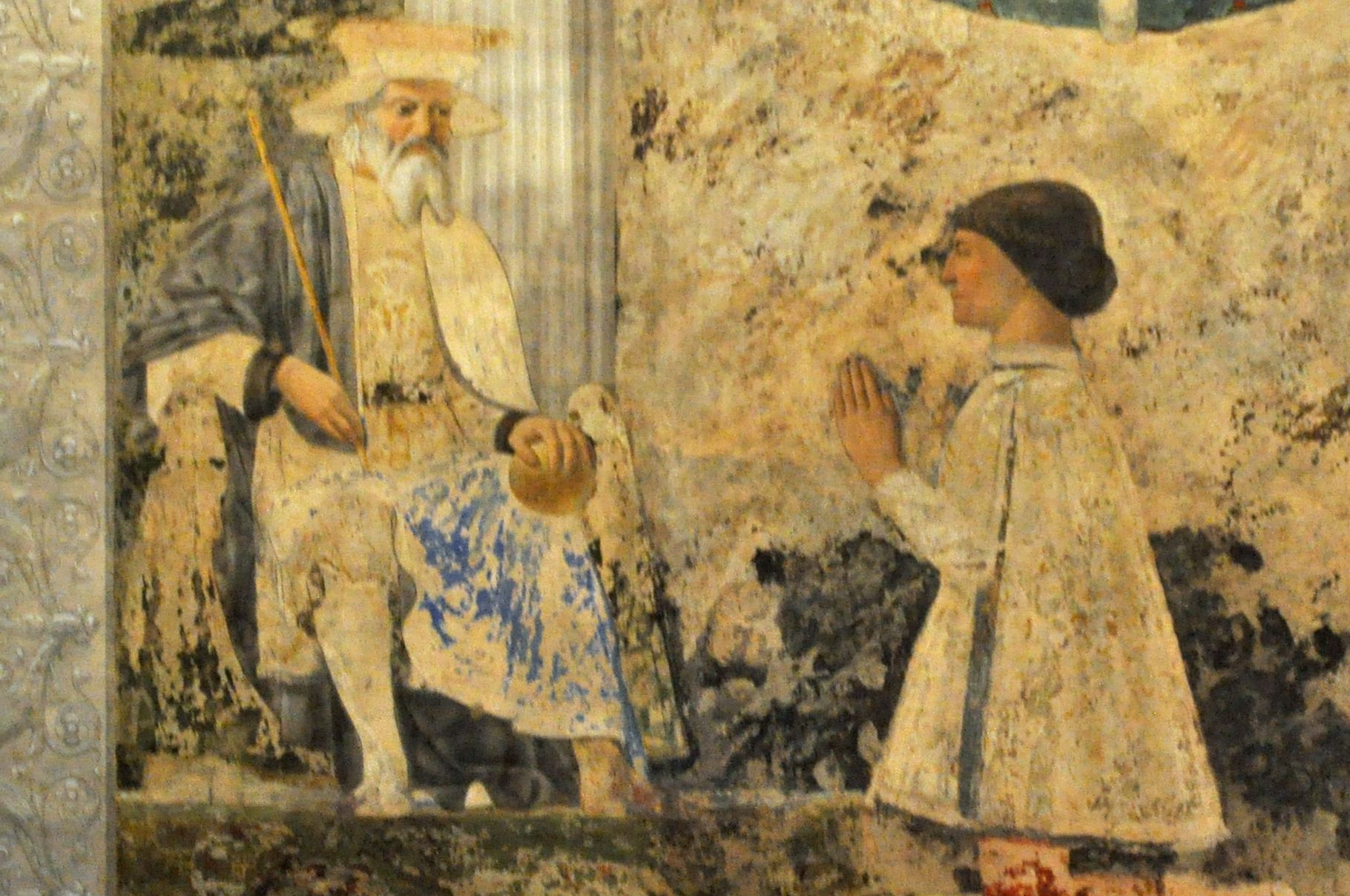
The seated figure is Saint Sigismund, the early medieval king of the Burgundians and Malatesta’s namesake. His halo identifies him as holy, and the sceptre and orb identify him as a monarch. The saint turns at an angle, while the donor’s face is presented in strict profile. Piero makes him large enough to share the saint’s room on human terms while marking the difference in rank through posture and elevation. Kneeling lowers the lord of Rimini, but his upright torso, joined hands and long coat form a silhouette as deliberate as that of a court portrait. [1] [5] [6]
The saint’s features and headgear have been read as recalling a third Sigismund, the Holy Roman Emperor Sigismund of Luxembourg. In 1433 the emperor knighted the young Malatesta and his brother Domenico in Rimini. If the resemblance was intended, it would have recalled an encounter central to the patron’s public standing. The gesture Piero actually paints is prayer, and the inscription names the enthroned figure as the saint. The possible imperial echo gives the audience a second association without fixing the scene to the date or ceremony of the knighting. Marika Schraven connects that association with a ruler whose family had long held Rimini but still depended on papal recognition of its rule. [1] [2] [7]
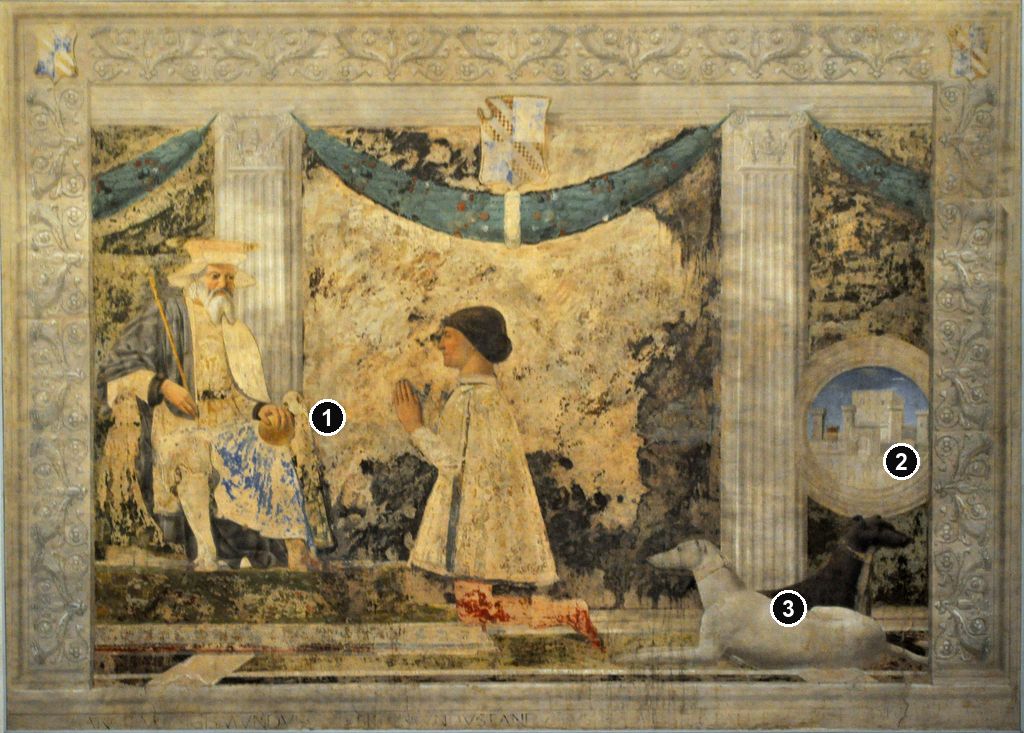
Annotated Details from Sigismondo Pandolfo Malatesta Praying in Front of St Sigismund
The numbered points identify visible features discussed in this article. Return from each detail to the numbered overview. Sigismondo Pandolfo Malatesta before Saint Sigismund, Tempio Malatestiano, Rimini. Henry Townsend. Image source. Public domain.
Details from SIGISMONDO PANDOLFO MALATESTA PRAYING IN FRONT OF ST SIGISMUND
Compare the cropped details with the source images above. Notice how their colours, shapes and positions contribute to the larger compositions.
The seated saint and kneeling ruler
The saint sits at the left beside a fluted upright. The kneeling ruler’s folded hands face him across the painted floor.
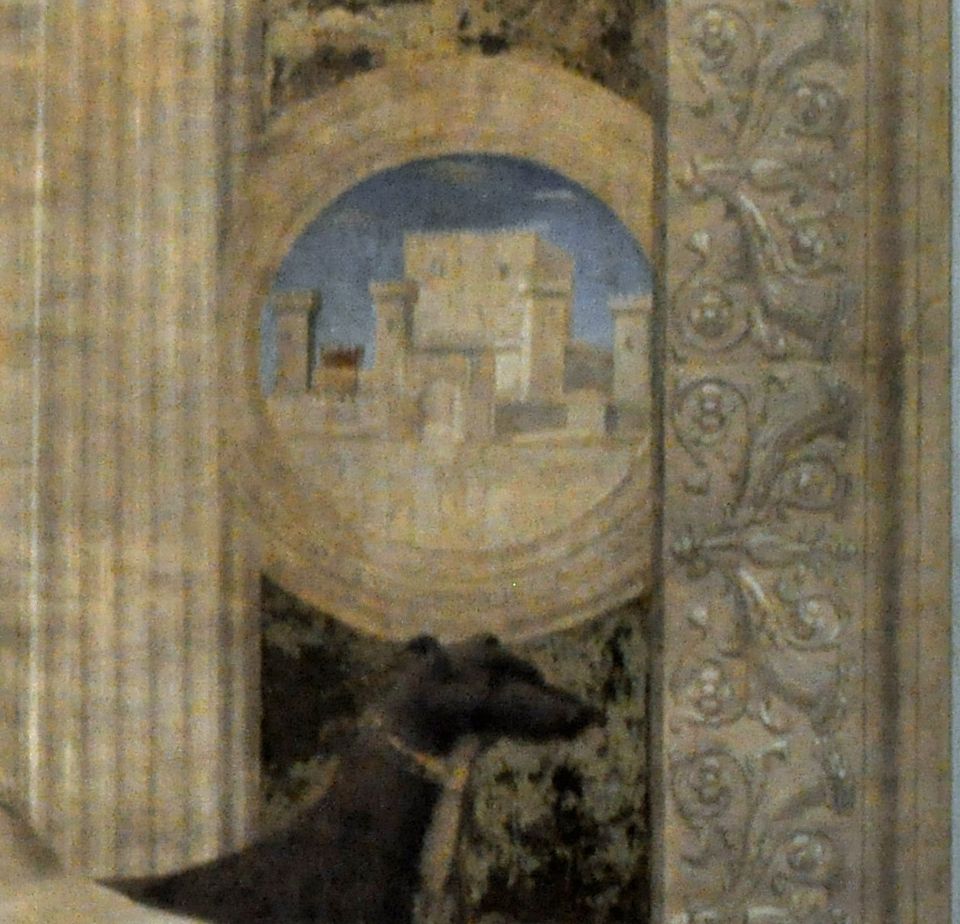
The distant building in the roundel
A wall and towers appear in a circular opening. The sharp boundary keeps this second view distinct from the interior.
Two greyhounds
The light animal lies across the foreground. The other dog is darker and nearer the base of the painted architecture.
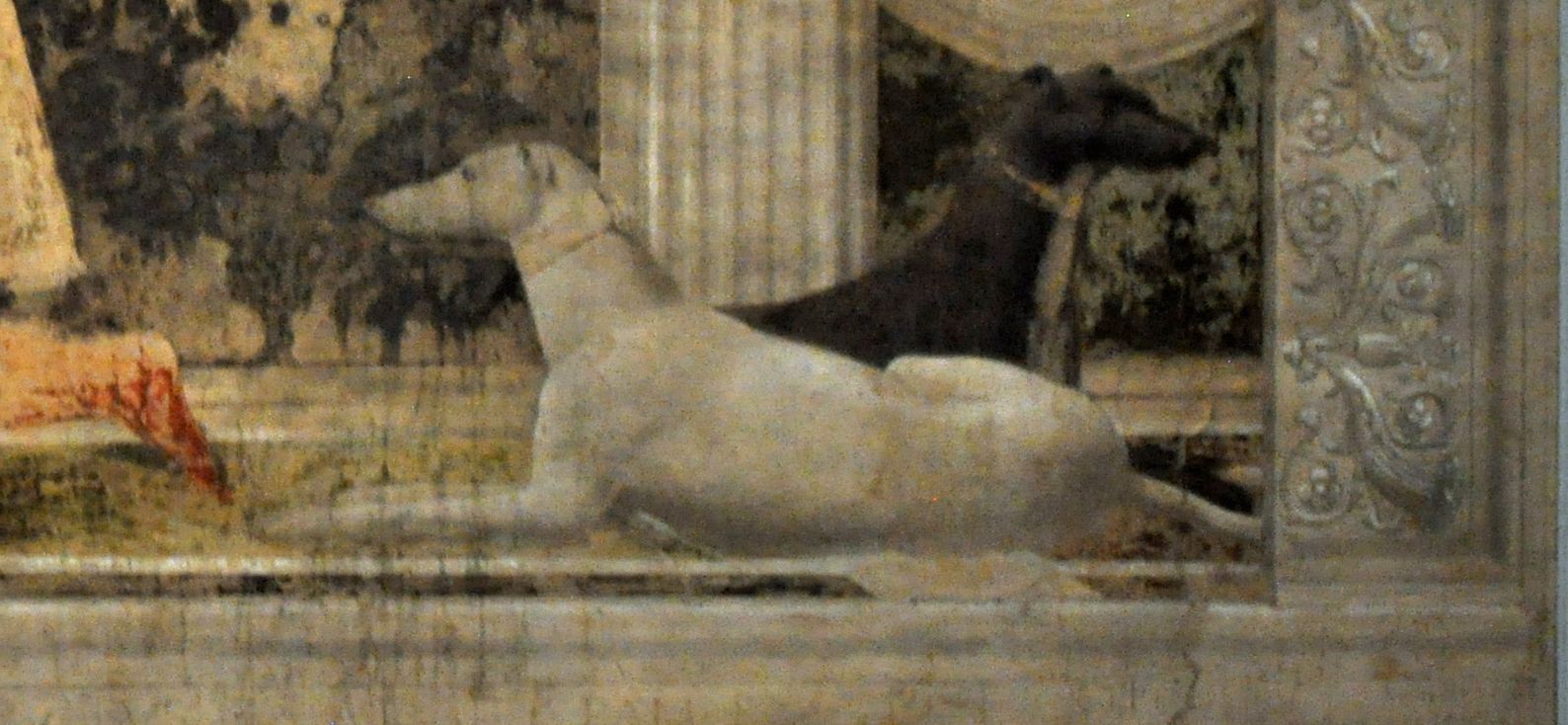
The painted hall and the greyhounds
An elaborate painted border encloses the scene. Inside it, pilasters divide the back wall, a green festoon hangs beneath a shield above the donor, and the low platform at the left supports the saint’s throne. A spectator can read the height of the throne both from the platform and from the cloth hanging over it. The flat back wall lends order to the hall, while those small changes in depth allow the bodies, platform and furniture to occupy different positions in it. Lavin’s geometric study traces relationships between the widths of the pilasters and border and the dimensions of the round opening. A reader can see the broad effect without a diagram. The pilasters separate the fields of action while the festoons help the eye move across them. [1] [5] [6]
The placement and poses also lead the eye diagonally across the mural. Starting at floor level on the right, the hounds give way to the kneeling donor and then to the higher, seated saint. The white hound turns towards the figures, while the dark hound faces right. At the point where their bodies overlap, the change of colour preserves two distinct outlines. The picture’s formality can make every detail look like a symbol, yet the opposed heads also solve a practical problem of composition. They direct attention towards the prayer and back out towards the margin of the hall. [1] [6]
The cathedral’s account associates the white dog with fidelity and the dark one with vigilance. Lavin offers a more specific interpretation, reading the pair as faith owed to God and loyalty between a ruler and his subjects. Greyhounds also belong to a courtly world in which hunting dogs were familiar. The three readings can coexist as possibilities. The pairing of the animals and their positions can be seen directly, while the assignment of a particular virtue to each depends on the interpretation adopted. [1] [5] [6]
Castel Sismondo through the round opening
The view over the dogs is of Castel Sismondo, the Malatesta residence and fortress in Rimini. Piero shows the compact mass of the walls and towers beneath a band of sky. The round surround has an inscription identifying the fortress and dating it to 1446. Rimini’s municipal account records that work began in 1437 and the residence was occupied by 1446, even though construction continued. The date in the roundel refers to the castle. The date beside the painter’s name belongs to the fresco. Only the core of the old fortress survives, so the mural and the contemporary medal images give a sense of the extent of Sigismondo’s building. [1] [2] [8]
The opening behaves like a window, because it allows a view beyond the interior. Its circular shape, lettering and compact image also invite comparison with the reverse of a medal. Matteo de’ Pasti’s bronze medal in the National Gallery of Art in Washington pairs a profile portrait of the lord with a reverse showing the castle. A separate medal reverse there, catalogued after Matteo, shows the proposed Tempio with a dome. These are different buildings and different claims. The mural and the castle medal display the place from which Malatesta ruled, while the San Francesco reverse preserves a design for the patron’s church that was never realised in that form. [3] [6] [9] [10]
Bronze medals bearing the castle also turned up inside the castle itself. Schraven records twenty-four portrait medals discovered in cavities along the walls of the main hall in 1983. They were grouped in threes, with a larger castle medal alongside two smaller medals bearing the Malatesta helmet. In the room Piero painted, the image of the castle was there to be seen. The medals sealed inside the real building tied the ruler’s name to the fabric of his fortress, where future finders could rediscover it. [7]
A later witness to the castle’s painted appearance survives in the Italian national heritage catalogue. In 1912 Mariano Mancini made a drawing touched with watercolour of the roundel, associated with work on the fresco in 1911–13. Its record includes correspondence about ordering and paying for the copy and describes the mural in the Relic Chamber. The sheet documents how the detail was recorded before the wartime removal. It can help a reader make sense of the subject and the circular lettering even where the mural’s surface has suffered. [4]
What the signature and damage tell us
The strip below the scene identifies the two figures and names the painter. One conventional transcription of the signature and date is PETRI DE BVRGO OPVS MCCCC[LI], meaning the work of Piero of Borgo, dated 1451. The brackets mark the damaged ending of the year. Borgo refers to the painter’s home town, now Sansepolcro. Historic engravings support the usual date. Lavin questioned the reliability of their readings and proposed 1450, which is why the date appears with a question mark in her later article. For the biography of Piero della Francesca, the named signature and the mid-century Rimini commission remain firm evidence even if the final numeral deserves qualification. [1] [2] [6]
There is a separate problem beneath the kneeling figure. The conventional reading of the abbreviation after the donor’s name is PAN. F., understood as identifying him as Pandolfo’s son. Angelo Turchini examined the inscription with infrared photography after noticing a possible difference in the final letter. He argued for PAN. E. and suggested a reading that includes a reference to knighthood. His study reproduces photographs and discusses the possibility that an apparent stroke could be a later retouch. The revised reading is a scholar’s interpretation of a damaged inscription, and the cathedral’s published account retains the conventional version. [1] [2]
The material history explains some of the difficulties in reading the fresco. Piero worked on wet plaster and added passages on the dry surface. The cathedral account associates the loss of much of the original brilliance, especially in parts of the clothing and furnishings, with the vulnerability of the dry additions. The painting was detached in 1944 after the cathedral suffered severe damage in the bombing of Rimini. An archival report describes an uneven separation and records portions of the preparatory drawing that remained on the wall. That drawing, a sinopia, laid out such elements as the donor’s head, the pilasters and parts of the decorative border before the finished surface covered them. The painted surface was transferred to canvas, and the fresco returned to Rimini in 1950. [1] [6] [11]
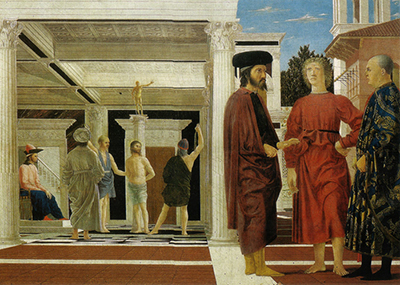
The Rimini work offers a useful comparison with Piero’s History of the True Cross in the Bacci Chapel at Arezzo. There the separate frescoes form a narrative distributed over several walls. Here Piero uses one extended wall image to make a relationship legible, giving the praying figure, seated saint and painted architecture distinct roles within a single view. [6] [12]
The Louvre portrait and the fresco
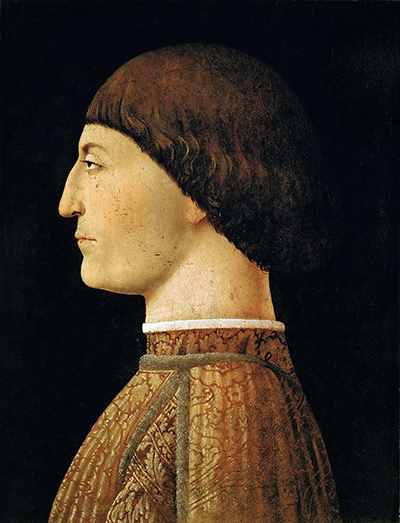
Piero’s Portrait of Sigismondo Pandolfo Malatesta in the Louvre isolates the same sitter against a dark background. The museum catalogues it as oil on poplar and gives it the broad date range 1450–75, while proposing that it was probably a first idea for the figure in the mural. The clean edge of the hair, prominent nose and close-fitting costume invite comparison with the face in the chapel. The panel makes the features legible through the strength of the outline. The face points left in both works. In Rimini the profile is one element within a full-length figure, and Piero gives the curve at the back of the head more room. [6] [13]
The Louvre’s suggestion is compatible with a close relationship between the works, while a specific transfer or copying procedure would require further evidence. What can be seen is how differently the likeness works in the two settings. The panel gives the sitter a place among courtly profile portraits and medals. The fresco still depends on a recognisable profile, but directs that profile towards another person. The turned face, raised hands and kneeling posture carry the portrait into an action, and the fortress supplies the place in which that donor held power. [6] [9] [13]
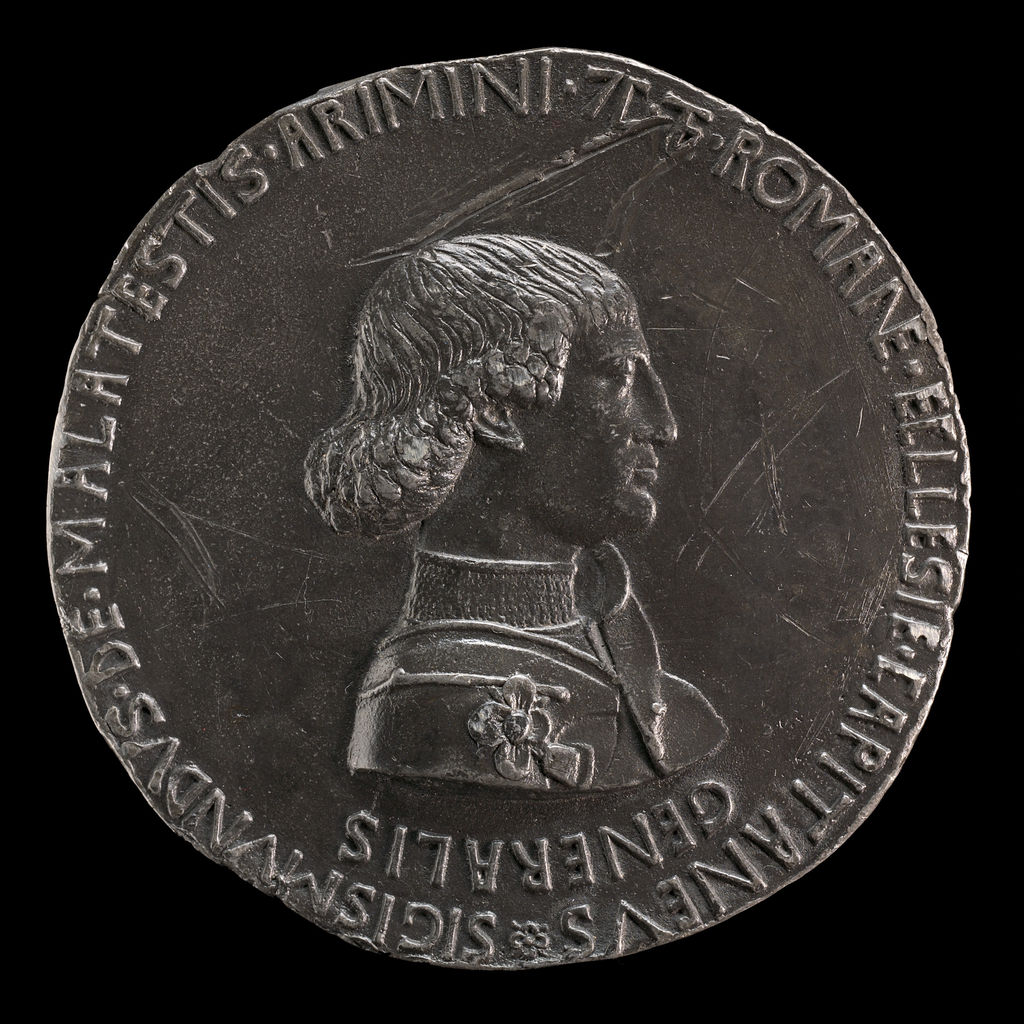
Pisanello, obverse of a medal of Sigismondo Pandolfo Malatesta, 1445. National Gallery of Art, Washington. National Gallery of Art, Washington, Samuel H. Kress Collection. Image source. Public domain. Resized only; native appearance preserved.
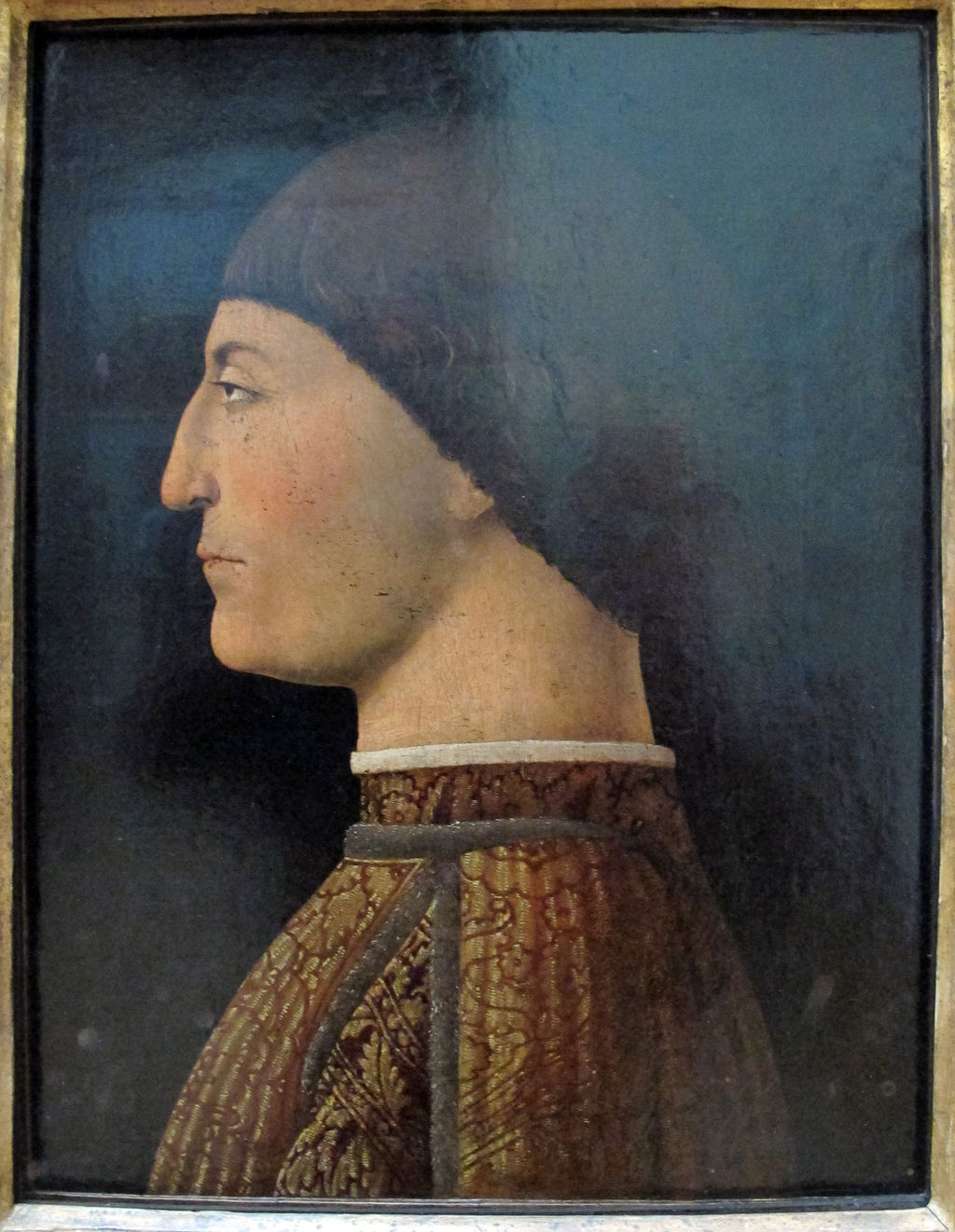
Piero della Francesca, portrait of Sigismondo Pandolfo Malatesta, Musée du Louvre. Sailko. Image source. CC BY 3.0. Resized from the source. This reproduction uses CC BY 3.0.
Browse the artworks
Compare Piero’s frescoes, panels and manuscript figures. The list includes ensembles and separately identifiable panels or scenes. Dates are approximate where the sources differ.
| Name | Date | Medium and source |
|---|---|---|
| The Baptism of Christ | Probably c. 1437–45 | Panel painting Catalogue. |
| The Flagellation of Christ | 1459–60 (GNDM) | Panel painting Catalogue. |
| The History of the True Cross | Mid-fifteenth century | Wall painting Catalogue. |
| Dream of Constantine | Mid-fifteenth century | Wall painting Catalogue. |
| The Duke and Duchess of Urbino | About 1473–75 (Uffizi) | Panel painting Catalogue. |
| The Resurrection | About 1458–68 (Opificio) | Wall painting Catalogue. |
| Brera Madonna | About 1472–74 | Panel painting Catalogue. |
| Annunciation at Arezzo | Mid-fifteenth century | Wall painting Catalogue. |
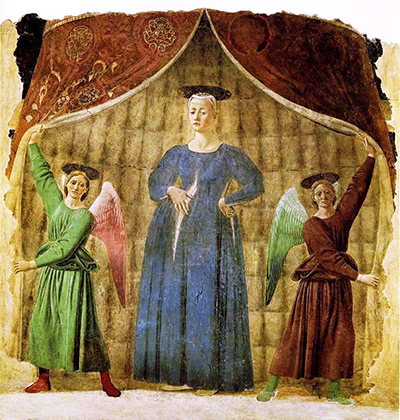
| Madonna del Parto | About 1450–65 (Monterchi) | Wall painting Catalogue. |
| Polyptych of the Misericordia | Commissioned 1445 | Panel painting Catalogue. |
| The Nativity | Early 1480s (National Gallery) | Panel painting Catalogue. |
| Madonna di Senigallia | About 1474–75 (GNDM) | Panel painting Catalogue. |
| Death of Adam | Mid-fifteenth century | Wall painting Catalogue. |
| Queen of Sheba | Mid-fifteenth century | Wall painting Catalogue. |
| Victory of Constantine | Mid-fifteenth century | Wall painting Catalogue. |
| Battle between Heraclius and Chosroes | Mid-fifteenth century | Wall painting Catalogue. |
| Saint Mary Magdalen | Wall painting Catalogue. | |
| The Augustinian Polyptych | 1454–69 | Panel painting Catalogue. |
| Polyptych of Perugia | About 1467–69 (GNU) | Panel painting Catalogue. |
| Perugia Annunciation | About 1468–70 (national catalogue) | Panel painting Catalogue. |
| St Francis and St Elizabeth | About 1467–69 (GNU) | Panel painting Catalogue. |
| Stigmatisation of St Francis | About 1468–70 (national catalogue) | Panel painting Catalogue. |
| An Augustinian Nun (Saint Monica) | 1454–69 | Panel painting Catalogue. |
| Augustinian Saint | 1454–69 | Panel painting Catalogue. |
| Saint Michael | 1454–69 | Panel painting Catalogue. |
| Saint Nicholas of Tolentino | 1454–69 | Panel painting Catalogue. |
| Saint John the Evangelist | 1454–69 | Panel painting Catalogue. |
| Virgin and Child Enthroned with Four Angels | About 1460–70 (Clark) | Panel painting Catalogue. |
| Portrait of Sigismondo Pandolfo Malatesta | About 1450–51, often proposed. Louvre catalogue range 1450–75. | Panel painting Catalogue. |
| Sigismondo before St Sigismund | 1451 | Wall painting Catalogue. |
| St Jerome and a Donor | 1460s (Accademia); about 1450 also proposed | Panel painting Catalogue. |
| St Jerome in Penitence | 1450, dated on the panel | Panel painting Catalogue. |
| Saint Julian | About 1455–60, often proposed | Wall painting Catalogue. |
| Saint Augustine | 1454–69 | Panel painting Catalogue. |
| Saint Apollonia | 1454–69 | Panel painting Catalogue. |
| Crucifixion from the Augustinian Polyptych | 1454–69 | Panel painting Catalogue. |
| Saint Louis of Toulouse | Wall painting Catalogue. | |
| Burial of the Wood | Mid-fifteenth century | Wall painting Catalogue. |
| Discovery and Proof of the True Cross | Mid-fifteenth century | Wall painting Catalogue. |
| Exaltation of the Cross | Mid-fifteenth century | Wall painting Catalogue. |
| Saint Anthony Raises a Child | About 1467–69 (GNU) | Panel painting Catalogue. |
| Saint Elizabeth Revives a Child | About 1467–69 (GNU) | Panel painting Catalogue. |
| Hercules | About 1470 | Wall painting Catalogue. |
| Portrait of a Boy (possibly Guidobaldo da Montefeltro) | Panel painting Catalogue. | |
| De prospectiva pingendi, Reggio Emilia witness (figures) | Manuscript diagrams Catalogue. | |
| The Interrogation of Judas | Mid-fifteenth century | Wall painting Catalogue. |
| Two prophets, Bacci Chapel | Mid-fifteenth century | Wall painting Catalogue. |
| Saint Clare of Assisi, upper predella | About 1467–69 (GNU) | Panel painting Catalogue. |
| Saint Agatha, upper predella | About 1467–69 (GNU) | Panel painting Catalogue. |
| Lost centre of the Augustinian Polyptych | 1454–69 | Lost panel or panels Catalogue. |
Frequently Asked Questions
Discussion
Look again at the images and ideas explored in Sigismondo Pandolfo Malatesta Praying in Front of St Sigismund. These editorial prompts invite your observations.
Reader Insights
The donor’s posture. Follow the sequence from the hounds to the kneeling figure and up to the saint. How does the change in height affect your impression of the donor’s authority?
A fortress in a circle. Compare the roundel with the reverse of Matteo de’ Pasti’s castle medal. How much of their resemblance comes from the way the frame and lettering concentrate attention on a few towers and walls?
Join the Conversation
Share a detail, comparison or question about Sigismondo Pandolfo Malatesta Praying in Front of St Sigismund below.
References
- Chiese Rimini, Tempio Malatestiano View source.
- Angelo Turchini, Un testo epigrafico di Piero della Francesca nel Tempio Malatestiano View source.
- Comune di Rimini, Tempio Malatestiano View source.
- Italian national heritage catalogue, Mariano Mancini’s drawing of the castle detail View source.
- Tempio Malatestiano, English cathedral guide View source.
- Marilyn Aronberg Lavin, Sigismondo Pandolfo Malatesta’s Surprising Duality: Images and Words, Predella 47 View source.
- Marika Schraven, Out of Sight, Yet Still in Place, RES 55/56 View source.
- Comune di Rimini, Castel Sismondo View source.
- National Gallery of Art, The Castle of Rimini, reverse of a medal by Matteo de’ Pasti View source.
- National Gallery of Art, San Francesco at Rimini, medal reverse after Matteo de’ Pasti View source.
- Alessia Zampini, University of Bologna doctoral research on wartime protection of Romagna’s monuments View source.
- Italian Ministry of Culture, Basilica di San Francesco in Arezzo View source.
- Musée du Louvre, Portrait de Sigismond Malatesta, RF 1978 1 View source.