 by Tom Gurney
Tom Gurney BSc (Hons) is an art history expert with over 20 years experience
Published on June 19, 2020 / Updated on October 14, 2023
Email: tomgurney1@gmail.com / Phone: +44 7429 011000
Piero della Francesca’s Mathematics and Perspective: Introduction
In Piero della Francesca’s treatise on perspective, a line has an ordinary length in the world and an apparent size from a particular place. To explain the difference, he starts with a triangle. One corner stands for the eye. The other two mark the ends of the line being looked at. The angle at the first corner tells us how much of the viewer’s field the line occupies. From that elementary construction Piero builds up to the problem of drawing a human head tilted in space. [1]
Perspective was one branch of his mathematical work. The Trattato d’Abaco covers practical reckoning, algebra and geometry. The Latin Libellus de quinque corporibus regularibus explores the five regular solids and develops problems that go considerably further. A manuscript in Florence preserves a fourth piece of evidence, Piero’s own copy of a Latin translation of works by Archimedes. The three treatises show the kinds of problem Piero put before his readers. The copy shows what he was willing to work through for himself. [2] [3] [4]
At a Glance
- Practical arithmeticThe vernacular Trattato d’Abaco treats mercantile reckoning and develops problems in algebra and geometry. [2] [5] [6]
- PerspectiveDe prospectiva pingendi relates the viewer’s eye, lines of sight and the picture plane to construct apparent size and position. [1]
- Solid geometryThe Latin Libellus deals with the five regular solids and includes further forms made by cutting or combining geometrical bodies. [3] [7] [8]
- Ancient mathematicsRicc. 106 contains Piero’s copy of part of Archimedes’ work in Iacopo da San Cassiano’s Latin translation. [4] [9]
- Transmission into printPacioli incorporated a vernacular version of the Libellus in his 1509 Divina proportione. [3] [10]
Contents
- The Trattato d’Abaco and the uses of proportion
- De prospectiva pingendi and the painter’s point of view
- The Libellus and the geometry of solids
- The Archimedes manuscript and a problem of volume
- Pacioli and the passage into print
- Perspective in the paintings
The Trattato d’Abaco and the uses of proportion
In Piero’s day, abaco referred to a tradition of written arithmetic useful in trade. The rules let a reader handle calculations such as changing the quantity of a sale, dividing a return among business partners or finding the terms of a barter. The tradition also supported work with algebra. Piero wrote his treatise in the vernacular, and the text moves from mercantile reckoning to problems involving roots, unknown quantities and the measurement of geometrical figures. The principal witness is his autograph in the Biblioteca Medicea Laurenziana in Florence, Ashburnham 359*. Museo Galileo distinguishes it from a later, partial witness in the Biblioteca Nazionale Centrale. [2] [5] [6]
A rule of three turns one known ratio into another. Suppose that six lengths of cloth cost fifteen coins, and a buyer wants four lengths at the same rate. Multiply four by fifteen and divide by six to get ten coins. The cloth units cancel, leaving a price. The calculation assumes that the rate stays the same, so the same rule serves for any purchase at that rate. The numbers here are a modern illustration of the operation. A reader trained to match quantities and units could carry the procedure from one transaction to the next. [5]
The same habits of calculation work with objects whose dimensions are harder to obtain. In Piero’s geometrical problems the data might describe only one part of a solid, such as the distance from a vertex to the opposite face. If a fixed ratio connects that distance with another dimension, the second can be calculated without a physical model. The reasoning has two stages. The geometer establishes which relationship holds for the shape, then the reckoner applies it to the given numbers. That distinction helps explain how a treatise introduced through the needs of merchants can make room for bodies built out of triangles and squares. [6] [7]
Piero also takes time over the number operations needed for algebra. He introduces roots through whole numbers whose squares are easy to recognise, and differentiates roots that have rational values from those that do not. Geometrical measurements quickly raise this issue. The diagonal of a square of side one has length √2. Writing that length as a root allows it to enter further calculations with its value intact, while a decimal approximation would give only a rounded measurement. The square is a modern illustration of why the problem of roots belongs in a manual that goes on to deal with geometry. [6]
De prospectiva pingendi and the painter’s point of view
Piero opens De prospectiva pingendi with “La pictura contiene in sé tre parti principali, quali diciamo essere disegno, commensuratio et colorare.” In English, “Painting has three principal parts, which we call drawing, proportional measurement and colouring” (our translation). By proportional measurement he means giving the outlines of objects their appropriate places and sizes in a view. He concentrates on this branch, which he identifies with perspective, and uses drawing where needed to establish it. His emphasis gives the word proportion a more specific job here than in the arithmetic treatise. The painter has to work out how the relationships between forms change when those forms are seen from one position. [1]
In Book I, proem §§6–11, Piero specifies five parts to a demonstration. There is the eye, the shape of the object, the distance between the two, the lines that connect the object’s extremities to the eye, and an intervening surface on which the object is represented. Piero calls that surface the termine. Imagine a pane of glass standing between you and a door. With your head held still and one eye fixed, you could mark the glass at each of the door’s four corners as you see them. A painted outline placed at those marks would coincide with the view of the door from that position. The glass is a way of picturing the geometrical function of Piero’s termine. [1]
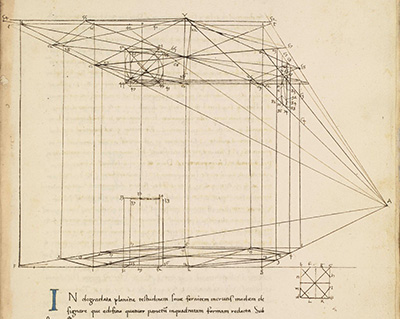
In Book I, proposition 1, Piero labels the eye A and the ends of a visible length B and C. Join A to B and A to C, then join B to C. The triangle gives a precise meaning to the apparent size of BC. It is seen under the angle BAC. Keep a ruler at right angles to your straight-ahead line of sight, centred in front of you, then move it farther away. The ruler has the same length, but the lines from its ends to your eye make a smaller angle. An artist using a fixed picture plane would mark a shorter interval on it. The construction makes distance a part of the explanation for size in a painting. [1]
As the treatise proceeds, a length becomes one component of a more complex construction. The early propositions deal with lines and plane figures and build the groundwork for laying out depth on a surface. The second book raises bodies from plane figures. The third treats difficult forms including an architectural capital and a human head. A straight edge is fixed by its two ends. A cheek or the ridge of a nose requires the painter to choose a set of points and find their positions in the new view. [1] [11] [12]
In the head exercise, Book III, proposition 8, Piero starts with views of the head and the outlines where a series of horizontal planes cut through it. You can think of those planes as slices through the forehead, face and skull, each giving the draughtsman a contour on which to locate points. The locations can be tracked in a view from above and in a side view. Set the picture plane and viewer in relation to these views and follow the sight lines from each selected point. The intersections give the horizontal and vertical placements that are brought together in the finished projection. Changing the arrangement produces a head seen from above, below or at an inclination. [11] [12]
The number of points in such an exercise comes with a practical trade-off. Sparse points leave the draughtsman considerable freedom in joining them. A denser set gives a more closely specified outline at the cost of many more constructions. The demonstration puts straightedge geometry to work on curves without requiring every point along a curve to be measured. A painter still has to articulate the resulting contour. [11] [12]
Why the manuscript versions matter
The treatise was already in some form in Federico da Montefeltro’s hands before his death in 1482. Museo Galileo dates the writing to around 1474–75 and allows for a longer period of development. Piero composed it in the vernacular and it circulated under a Latin title. [2] [13]
Luca Pacioli describes reading it and credits a master named Matteo with the Latin translation. The scholar James Banker identified him as Matteo di ser Paolo d’Anghiari. Piero continued revising the work across its two language traditions. Chiara Gizzi’s Ca’ Foscari edition finds that the autograph in Parma, Biblioteca Palatina, Parm. 1576, preserves a later stage of the text than the forms preserved in the other copies. The Reggio Emilia manuscript is particularly important for recovering an earlier stage. A copy can thus preserve earlier wording than a manuscript written in the author’s hand. [2] [14]
Museo Galileo’s comparison presents seven manuscript codices. Gizzi’s inventory also includes a partial vernacular copy in Bologna. The holdings at Parma, Reggio Emilia, Milan and Bordeaux help show why an illustration must be read in relation to the actual witness that preserves it. Counting copies and distinguishing revisions answer different questions. The drawings and manuscript studies examine what the surviving pages reveal through their figures, working marks and corrections. The opening and early testimony can be read in the documented extracts from Piero’s writings and reception. [2] [14] [13]
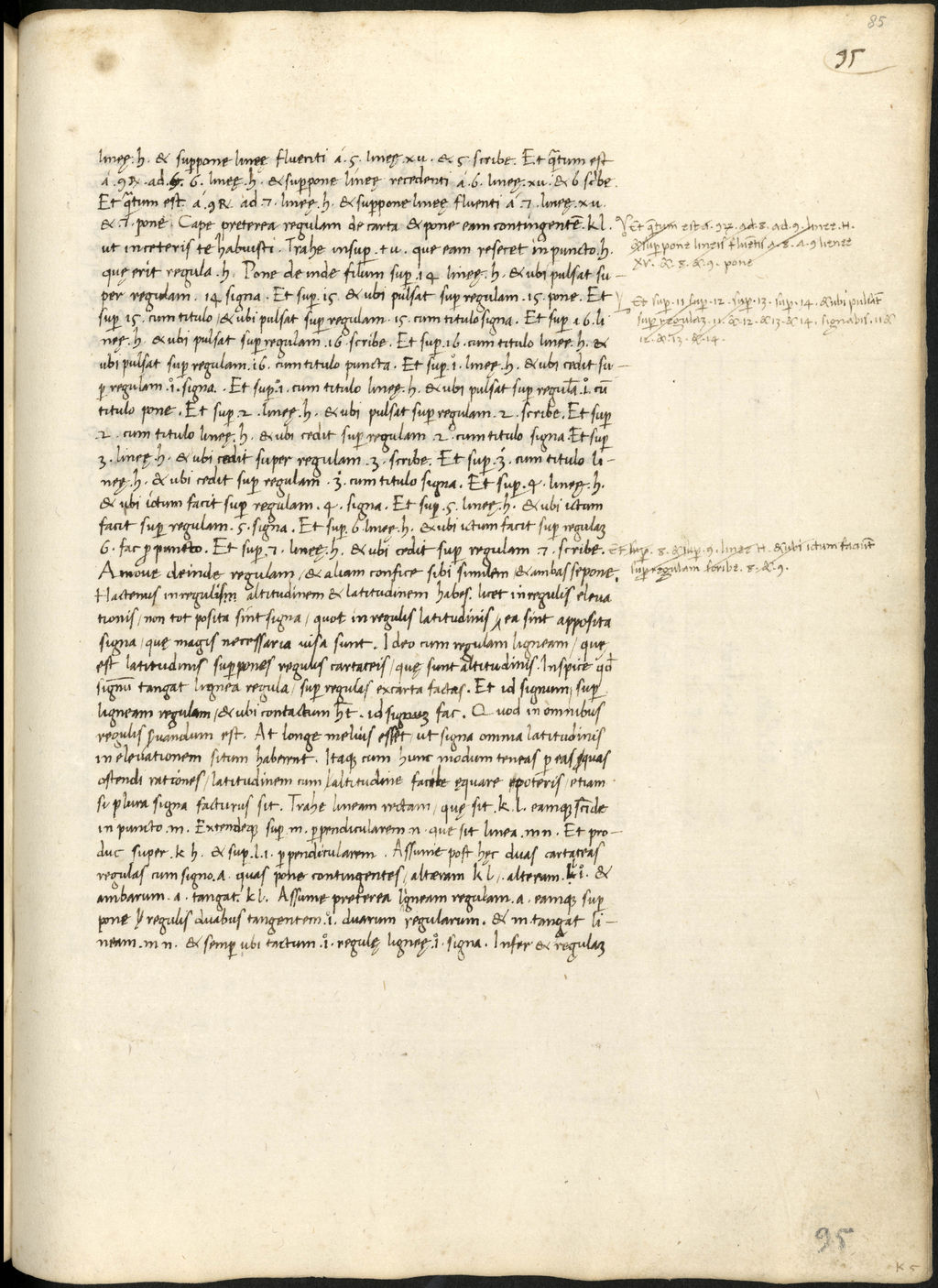
Bordeaux, Bibliothèque municipale, MS 616, folio 95 recto, from the Latin transmission of De prospectiva pingendi. Image source. Public domain. Resized only; native appearance preserved.

Diagram for Book I, proposition 1, fol. 1v of the Parma manuscript of De prospectiva pingendi. Piero della Francesca, MS Parm. 1576, Biblioteca Palatina, Parma. Chiara Gizzi (ed.), De prospectiva pingendi, Edizioni Ca’ Foscari, 2016, Book I, proposition 1, fol. 1v, fig. 2. Image source. CC BY 4.0. Resized from the source. This reproduction uses CC BY 4.0.
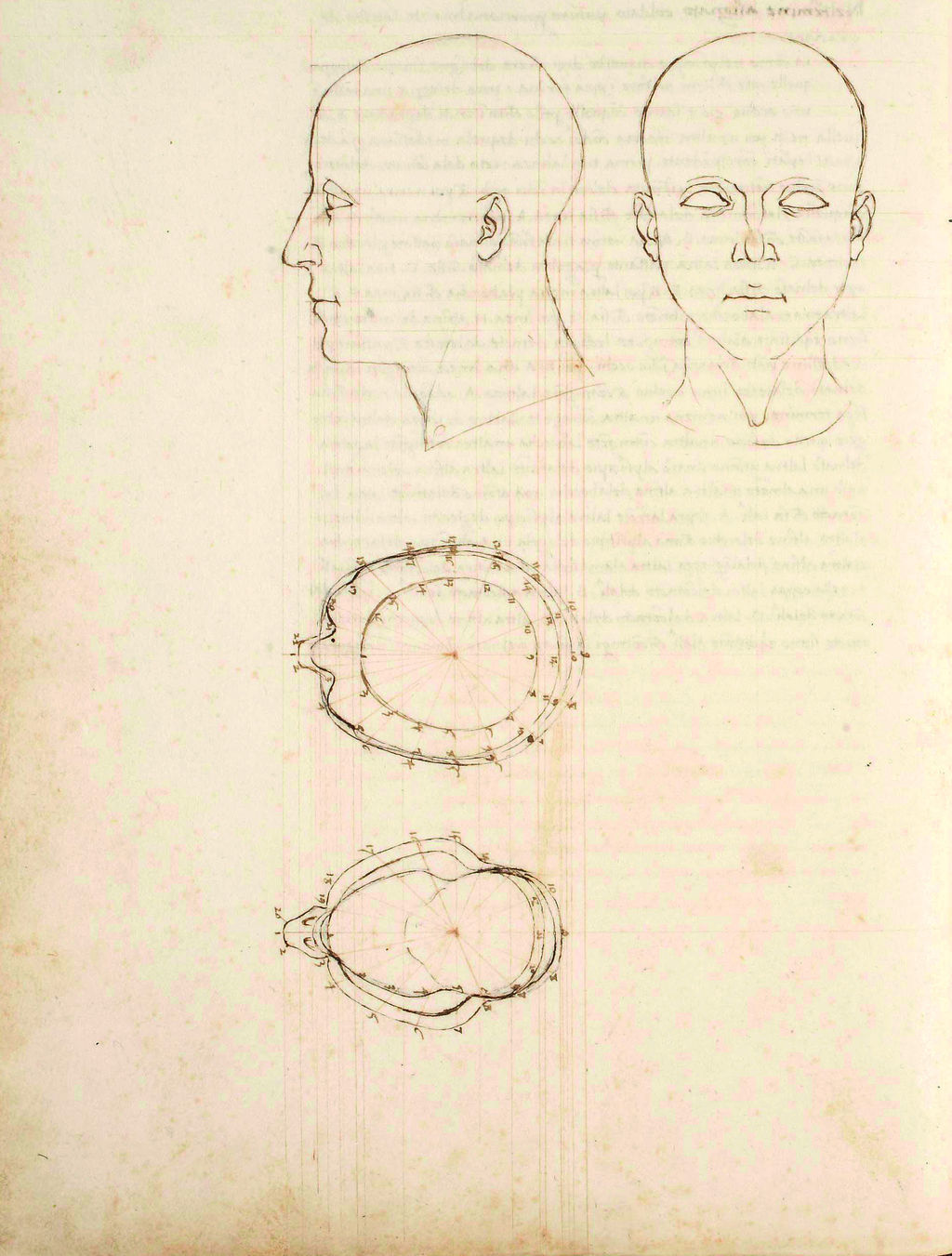
Studies of the head in profile, front and horizontal section, fol. 59v of the Parma manuscript. Piero della Francesca, MS Parm. 1576, Biblioteca Palatina, Parma. Chiara Gizzi (ed.), De prospectiva pingendi, Edizioni Ca’ Foscari, 2016, Book III, proposition 8a, fol. 59v, fig. 65. Image source. CC BY 4.0. Resized from the source. This reproduction uses CC BY 4.0.
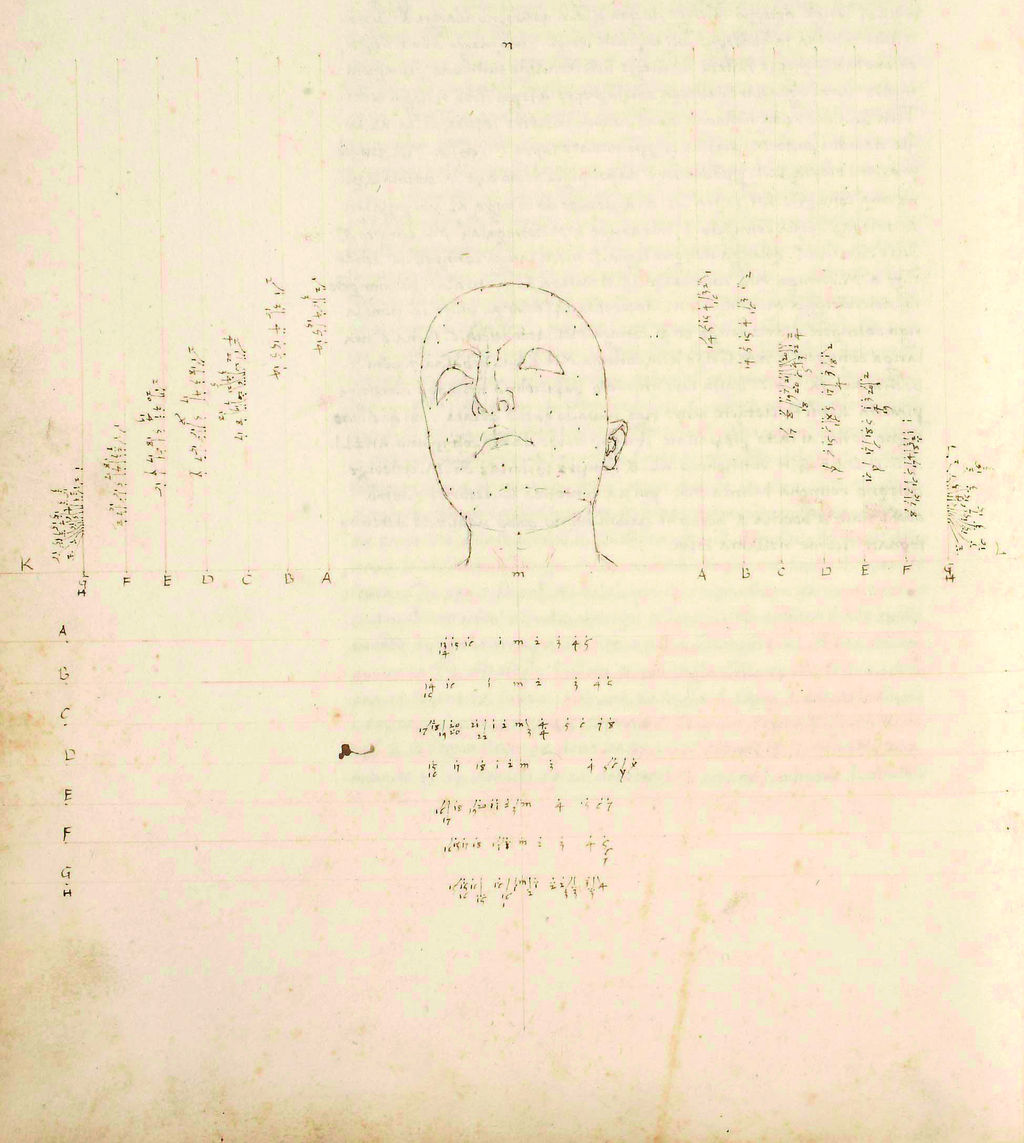
Foreshortened head with plotted measurements, fol. 76v of the Parma manuscript. Piero della Francesca, MS Parm. 1576, Biblioteca Palatina, Parma. Chiara Gizzi (ed.), De prospectiva pingendi, Edizioni Ca’ Foscari, 2016, Book III, proposition 8j, fol. 76v, fig. 74. Image source. CC BY 4.0. Resized from the source. This reproduction uses CC BY 4.0.
The Libellus and the geometry of solids
The five regular solids of the Libellus are the tetrahedron, cube, octahedron, dodecahedron and icosahedron. The cube has six square faces, the dodecahedron has twelve pentagonal ones, and the other three use equilateral triangles. For each solid all faces are alike and the same arrangement meets at every vertex. The line of study goes back to Euclid’s Elements. Piero asks what can be calculated about a solid from the measures he gives, what sphere can enclose it and how one body can be set inside another. He also explores solids with more than one kind of face. [3] [7]
Suppose that a regular tetrahedron has a height of four units, measured from a vertex down to the opposite face. In the problem studied by historian of mathematics Vera Viana, Piero gives the ratio of this axis to the diameter of the enclosing sphere as two to three. The diameter is therefore six units. If the axis were doubled, the diameter would double with it. The numbers are straightforward once the relationship is in hand. The geometrical issue is that the same ratio holds for a tetrahedron of any size. The outer sphere is understood to touch all four vertices, which is what makes its size a determinate question. [7]
Cutting the corners off a familiar solid gives a different sort of problem. Begin with a tetrahedron and mark the points one third of the way in from either end of each edge. Cut off each corner through the three nearest marks. Each cut exposes a triangular face, and what remains of each old triangle is a hexagon. The one-third spacing makes the new edges match the surviving middle thirds of the old edges. The result is the truncated tetrahedron, with four triangular and four hexagonal faces. This is a modern way to visualise a body Piero discusses and illustrates. It also shows why the proportions of the cut matter. Moving the cuts closer to the old corners still produces hexagons, but their edges are unequal. [7]
Viana identifies drawings of the truncated tetrahedron and the cuboctahedron in the Abaco, and a broader range of examples in the Libellus. These include the truncated cube, dodecahedron and icosahedron. She also identifies a description of the truncated octahedron through its six square and eight hexagonal faces. Today these forms are called Archimedean solids. The history of that name and the question of which earlier geometrical material reached Piero are separate from the identification of the forms he constructed. The two treatises together record a fifteenth-century investigation of how unfamiliar bodies can be derived from familiar ones. [7]
The Latin Libellus survives in Vatican Library manuscript Urb. lat. 632. The dedication to Guidobaldo da Montefeltro asks that it be placed with the perspective treatise Piero had presented to Guidobaldo’s father, Federico. The request places the two works in the context of the same court library and tells us the order in which the two works were presented. Gizzi notes that the leaves containing the dedication were added to the manuscript, so its presentation and the earlier writing of its text have to be dated separately. The two gifts suggest why a court interested in painting and geometry would value both treatises. One builds an image of a world seen from a chosen position. The other works out the dimensions and relationships of bodies in their own right. [2] [3] [15] [16]
The Archimedes manuscript and a problem of volume
The manuscript in the Biblioteca Riccardiana in Florence, Ricc. 106, is largely in Piero’s hand and contains works by Archimedes in a Latin translation by Iacopo da San Cassiano. James Banker established the attribution by comparing it with authenticated material, including the Florentine Abaco. The Riccardiana describes the many geometrical figures alongside the text. Comparison with a Vatican manuscript associated with Francesco dal Borgo has given further evidence about the text Piero copied and the corrections made as the manuscripts were worked on. The comparison led Paolo d’Alessandro, Carlo Maccagni and Pier Daniele Napolitani to date the Riccardiana copy before 1468, probably to 1458–59. [4] [17] [9]
A problem in the Libellus shows what it could mean to think with Archimedean geometry. Imagine two cylinders of equal diameter with their axes crossing at right angles. What volume do they have in common? Piero frames it as a hole made through one cylinder by the other. The intersecting form is sometimes called a double vault. With cylinders of diameter four, the overlap has a volume of 128/3 cubic units, two thirds of a cube of side four. Veronica Gavagna studies Piero’s comparison between this difficult solid and more familiar figures, including a sphere and a cone. Archimedes had tackled the same problem in the Method, whose relevant sections are damaged. Piero’s access to works by Archimedes supports the connection in technique. Whether he knew the Method itself is a separate question, and the surviving evidence gives no reason to assume he did. [8]
This example brings out a difference between copying and problem-solving. A copy of a translated ancient work could be used to follow an argument figure by figure. A new problem gave Piero the opportunity to adapt a way of comparing sizes and shapes to a form that was awkward to measure directly. The Libellus contains both familiar numerical questions and problems of that second kind. Its scope is wider than the names of the five solids on its title suggest. [3] [7] [8]
Pacioli and the passage into print
Luca Pacioli, a Franciscan mathematician from the same town as Piero, is both a witness to the painter’s reputation and a channel through which his mathematics reached print. In the Summa de arithmetica of 1494 he praises the Prospectiva and describes the relationship between the vernacular and Latin versions. His Summa also uses or reworks geometrical problems from the Trattato d’Abaco. Identifying a particular borrowing matters in this case, since writers in the abaco tradition shared many standard problem types and some passages in Piero’s own treatise can be traced to earlier writers. Similar subject matter alone is a much weaker indication of dependence than shared wording and a run of problems in the same order. [2] [18] [19]
The clearest case is the vernacular version of the Libellus printed as the third part of Pacioli’s Divina proportione at Venice in 1509. It transmits Piero’s treatise without identifying him as its author in that part. Giorgio Vasari subsequently accused Pacioli of passing off Piero’s work as his own. The surviving print and manuscript allow a more precise account than the accusation alone. Piero is the author of the treatise preserved in Latin. The possibility of a lost vernacular draft remains a hypothesis. Pacioli’s vernacular version incorporated the treatise in a publication with other material of his own. Leonardo da Vinci’s polyhedral designs belong to Pacioli’s project and have their own history. The edition of Piero’s theoretical writings presents his Latin and Pacioli’s vernacular version together, and treats the original manuscript and the drawings separately. [3] [7] [8] [10]
Perspective in the paintings
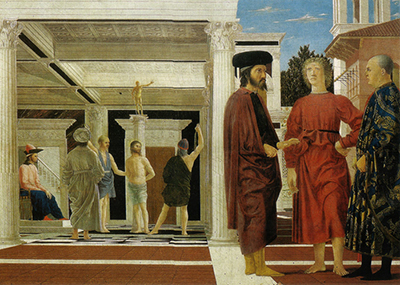
In The Flagellation of Christ, start at the right-hand group of three men and let the paving carry your eye towards the flagellation behind them. The floor pattern gives clues to how far apart the figures stand and how deep the columned chamber recedes. The architecture establishes a common space even as the figures occupy sharply distinct parts of the image. A viewer can follow the receding lines without understanding each construction in the treatise. In the painting those lines help give the figures their spatial and narrative separation. [20] [21]
In the Perugia Annunciation, at the top of the Sant’Antonio polyptych, the line of columns leads the eye into a narrow corridor between Gabriel and Mary. Each successive interval takes up less room on the panel. The repeated bases and arches give the viewer a regular architectural measure against which to see that change. The Galleria Nazionale dell’Umbria connects this central vanishing point with the principles of the perspective treatise. Compare the two paintings and the staging differs. The pavement of the Flagellation provides a continuous ground for groups at different depths, while the Annunciation’s corridor draws attention towards a concentrated opening within the architecture. [20] [22]
A painting also gives the artist choices that a geometrical demonstration has set aside. A continuous pavement can connect spaces, a column can interrupt a sight line and an opening can draw the eye away from a figure. J. V. Field’s study of Piero’s practice stresses that even a painter capable of a rigorous construction could adapt it to the needs of the image. Reading the treatise alongside the panels reveals what Piero could calculate and which visual effects that knowledge placed at his disposal. The particular construction of a finished painting remains a question for close examination of the work itself. [1] [21]
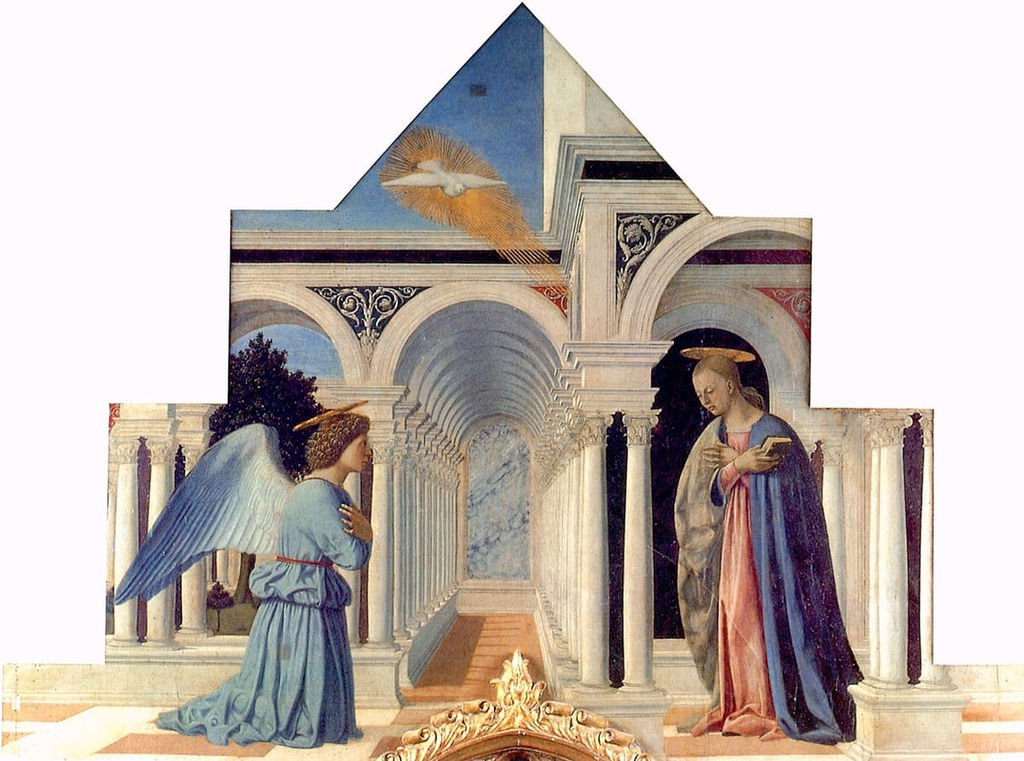
Piero della Francesca, Annunciation, crown of the Sant’Antonio Polyptych, Perugia. Image source. Public domain. Resized only; native appearance preserved.
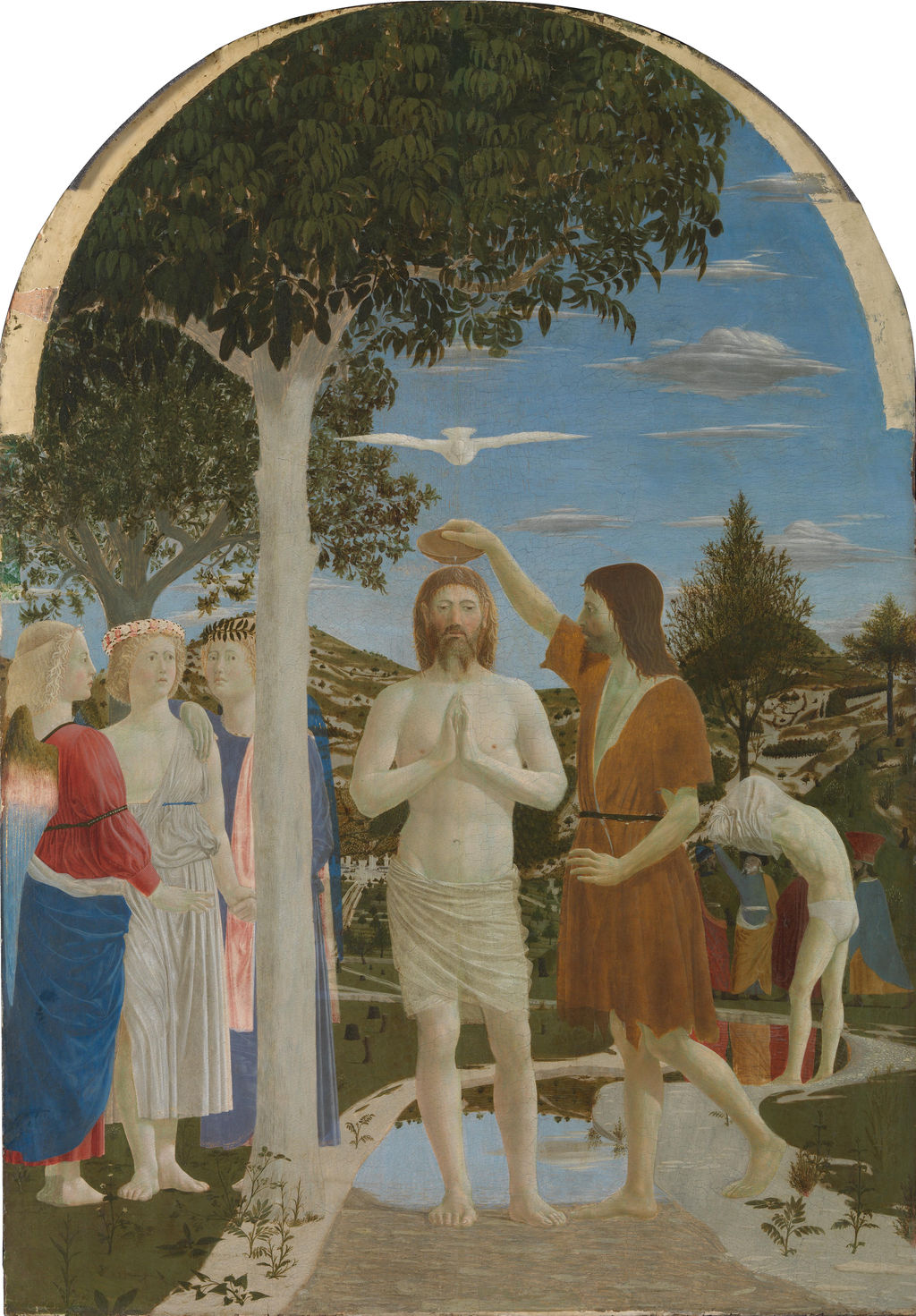
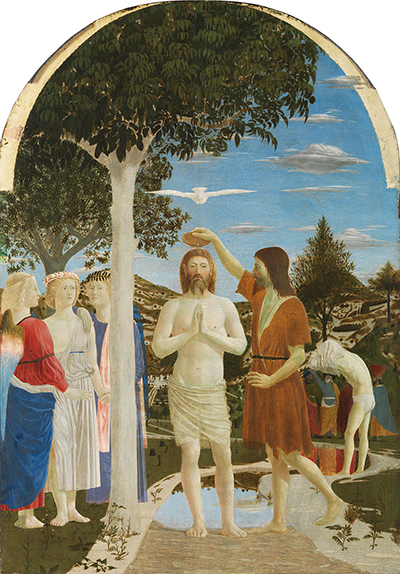
Piero della Francesca, The Baptism of Christ, National Gallery, London. Image source. Public domain. Resized only; native appearance preserved.
Browse the artworks
Compare Piero’s frescoes, panels and manuscript figures. The list includes ensembles and separately identifiable panels or scenes. Dates are approximate where the sources differ.
| Name | Date | Medium and source |
|---|---|---|
| The Baptism of Christ | Probably c. 1437–45 | Panel painting Catalogue. |
| The Flagellation of Christ | 1459–60 (GNDM) | Panel painting Catalogue. |
| The History of the True Cross | Mid-fifteenth century | Wall painting Catalogue. |
| Dream of Constantine | Mid-fifteenth century | Wall painting Catalogue. |
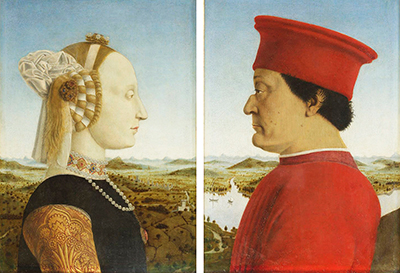
| The Duke and Duchess of Urbino | About 1473–75 (Uffizi) | Panel painting Catalogue. |
| The Resurrection | About 1458–68 (Opificio) | Wall painting Catalogue. |
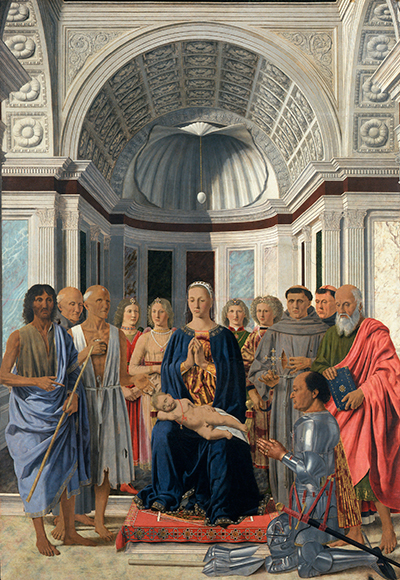
| Brera Madonna | About 1472–74 | Panel painting Catalogue. |
| Annunciation at Arezzo | Mid-fifteenth century | Wall painting Catalogue. |
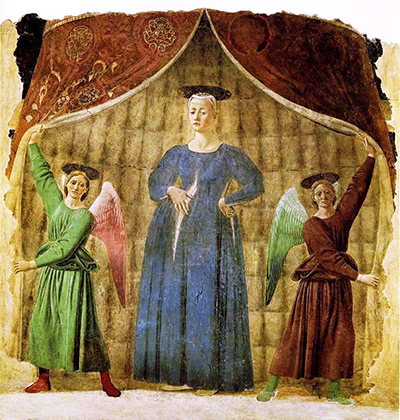
| Madonna del Parto | About 1450–65 (Monterchi) | Wall painting Catalogue. |
| Polyptych of the Misericordia | Commissioned 1445 | Panel painting Catalogue. |
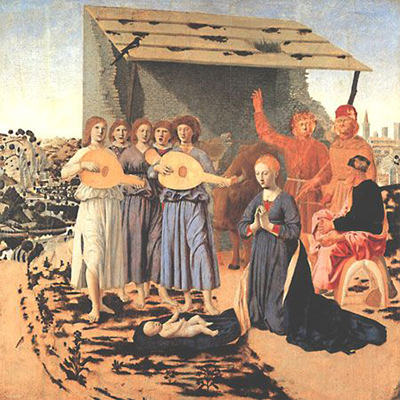
| The Nativity | Early 1480s (National Gallery) | Panel painting Catalogue. |
| Madonna di Senigallia | About 1474–75 (GNDM) | Panel painting Catalogue. |
| Death of Adam | Mid-fifteenth century | Wall painting Catalogue. |
| Queen of Sheba | Mid-fifteenth century | Wall painting Catalogue. |
| Victory of Constantine | Mid-fifteenth century | Wall painting Catalogue. |
| Battle between Heraclius and Chosroes | Mid-fifteenth century | Wall painting Catalogue. |
| Saint Mary Magdalen | Wall painting Catalogue. | |
| The Augustinian Polyptych | 1454–69 | Panel painting Catalogue. |
| Polyptych of Perugia | About 1467–69 (GNU) | Panel painting Catalogue. |
| Perugia Annunciation | About 1468–70 (national catalogue) | Panel painting Catalogue. |
| St Francis and St Elizabeth | About 1467–69 (GNU) | Panel painting Catalogue. |
| Stigmatisation of St Francis | About 1468–70 (national catalogue) | Panel painting Catalogue. |
| An Augustinian Nun (Saint Monica) | 1454–69 | Panel painting Catalogue. |
| Augustinian Saint | 1454–69 | Panel painting Catalogue. |
| Saint Michael | 1454–69 | Panel painting Catalogue. |
| Saint Nicholas of Tolentino | 1454–69 | Panel painting Catalogue. |
| Saint John the Evangelist | 1454–69 | Panel painting Catalogue. |
| Virgin and Child Enthroned with Four Angels | About 1460–70 (Clark) | Panel painting Catalogue. |
| Portrait of Sigismondo Pandolfo Malatesta | About 1450–51, often proposed. Louvre catalogue range 1450–75. | Panel painting Catalogue. |
| Sigismondo before St Sigismund | 1451 | Wall painting Catalogue. |
| St Jerome and a Donor | 1460s (Accademia); about 1450 also proposed | Panel painting Catalogue. |
| St Jerome in Penitence | 1450, dated on the panel | Panel painting Catalogue. |
| Saint Julian | About 1455–60, often proposed | Wall painting Catalogue. |
| Saint Augustine | 1454–69 | Panel painting Catalogue. |
| Saint Apollonia | 1454–69 | Panel painting Catalogue. |
| Crucifixion from the Augustinian Polyptych | 1454–69 | Panel painting Catalogue. |
| Saint Louis of Toulouse | Wall painting Catalogue. | |
| Burial of the Wood | Mid-fifteenth century | Wall painting Catalogue. |
| Discovery and Proof of the True Cross | Mid-fifteenth century | Wall painting Catalogue. |
| Exaltation of the Cross | Mid-fifteenth century | Wall painting Catalogue. |
| Saint Anthony Raises a Child | About 1467–69 (GNU) | Panel painting Catalogue. |
| Saint Elizabeth Revives a Child | About 1467–69 (GNU) | Panel painting Catalogue. |
| Hercules | About 1470 | Wall painting Catalogue. |
| Portrait of a Boy (possibly Guidobaldo da Montefeltro) | Panel painting Catalogue. | |
| De prospectiva pingendi, Reggio Emilia witness (figures) | Manuscript diagrams Catalogue. | |
| The Interrogation of Judas | Mid-fifteenth century | Wall painting Catalogue. |
| Two prophets, Bacci Chapel | Mid-fifteenth century | Wall painting Catalogue. |
| Saint Clare of Assisi, upper predella | About 1467–69 (GNU) | Panel painting Catalogue. |
| Saint Agatha, upper predella | About 1467–69 (GNU) | Panel painting Catalogue. |
| Lost centre of the Augustinian Polyptych | 1454–69 | Lost panel or panels Catalogue. |
Frequently Asked Questions
It gives the painter a surface on which to mark where the lines of sight pass. Once the eye and the object are fixed, those intersections determine the position of the object’s outline on the surface. [1]
The Biblioteca Medicea Laurenziana in Florence holds the principal Abaco witness and the Biblioteca Riccardiana in the same city holds the Archimedes copy. The Vatican Library provides a digital record for its Libellus manuscript. Museo Galileo brings together manuscripts of De prospectiva pingendi in a digital exhibition. [3] [4] [5] [13] [15]
Discussion
Look again at the images and ideas explored in Piero della Francesca’s Mathematics and Perspective. These editorial prompts invite your observations.
Reader Insights
In the Flagellation and the Perugia Annunciation, which repeated feature first tells you how far back the architecture recedes?
Try holding a rectangular card close to your eye, then farther away without turning it. What changes in its apparent size, and how would you show that change with Piero’s three-point diagram?
If a geometrical drawing had to let you calculate the size of a solid as well as recognise it, which lengths and angles would you want the draughtsman to specify?
Join the Conversation
Share a detail, comparison or question about Piero della Francesca’s Mathematics and Perspective below.
References
- Piero della Francesca. De prospectiva pingendi, critical text, edited by Chiara Gizzi. Edizioni Ca’ Foscari, 2016. Book I proem, pp. 81–82, proposition 1, p. 84, and Books II–III. View source.
- Chiara Gizzi. “Il De prospectiva pingendi e gli altri trattati pierfrancescani”. Introduction to De prospectiva pingendi, Edizioni Ca’ Foscari, 2016, pp. 15–24. View source.
- Fondazione Piero della Francesca. Edizione nazionale degli scritti teorici. Records for the 1995 Libellus and 2012 Trattato d’Abaco editions. View source.
- Biblioteca Riccardiana. “The Paper Parnassus”, entry on Archimedes, Ricc. 106. View source.
- Museo Galileo. “I.3. Piero della Francesca, Trattato d’Abaco”. See also the Biblioteca Medicea Laurenziana, Fondo Ashburnham catalogue, entry 359*, and Dartmouth’s Geometry in Art and Architecture, unit 13, on Piero’s rule of three. View source 1. View source 2. View source 3.
- Chiara Gizzi and Alessandra Sorci. “Tra geometria e pittura. Su lingua e disegno in Piero della Francesca”. In Lingua delle arti e lingua di artisti in Italia fra Medioevo e Rinascimento, 2019, pp. 157–190, especially the discussion of Trattato d’Abaco §108 and following. View source.
- Vera Viana. “Archimedean solids in the fifteenth and sixteenth centuries”. Archive for History of Exact Sciences 78 (2024), pp. 631–715, especially §§2.1–2.2. View source.
- Veronica Gavagna. “Abacus Mathematics and Archimedean Tradition”, Proceedings of HPM 2022, pp. 579–590, on Libellus IV, case 10. View source.
- Paolo d’Alessandro, Carlo Maccagni and Pier Daniele Napolitani. “Piero della Francesca, Francesco dal Borgo e la traduzione di Archimede: la datazione del Riccardiano 106”. Research abstract, 2020. View source.
- Luca Pacioli. Divina proportione. Venice, 1509. Bayerische Staatsbibliothek digital copy, including the vernacular Libellus. View source.
- Museo Galileo. “VII.1. Costruzione della testa umana”, reconstruction of De prospectiva pingendi, III.8. View source.
- M. Ángel Maure-Rubio. “Los primeros pasos en el escorzo de la figura humana. Un análisis desde la geometría”. Arte, Individuo y Sociedad 28.2 (2016), pp. 253–275, especially pp. 254–255. View source.
- Museo Galileo. De Prospectiva Pingendi, virtual exhibition and manuscript comparison. View source.
- Edizioni Ca’ Foscari. De prospectiva pingendi, Chiara Gizzi’s critical edition of the vernacular text, 2016. View source.
- Biblioteca Apostolica Vaticana. Urb. lat. 632, digital manuscript record. View source.
- Jeryldene M. Wood. Introduction to The Cambridge Companion to Piero della Francesca. Cambridge University Press, 2002, especially pp. 8–9. View source.
- Museo Galileo. “I.4. Piero della Francesca, Archimede, Opera”. View source.
- Giacomo Damiani. Geometrical Bodies as Material Forms. Doctoral thesis, University of Kent, submitted 2021, especially §3.1.1 and its discussion of the Summa and Piero’s Abaco. View source.
- Albrecht Heeffer. “Algebraic partitioning problems from Luca Pacioli’s Perugia manuscript (Vat. Lat. 3129)”. Sciamvs 11 (2010), pp. 3–51, especially p. 7. View source.
- Galleria Nazionale delle Marche. Flagellation, collection record. View source.
- J. V. Field. “The Use of Perspective in the Art of Piero Della Francesca”. Max Planck Institute for the History of Science, research project summary. View source.
- Galleria Nazionale dell’Umbria. Polittico di Sant’Antonio, collection record. View source.