 by Tom Gurney
Tom Gurney BSc (Hons) is an art history expert with over 20 years experience
Published on June 19, 2020 / Updated on October 14, 2023
Email: tomgurney1@gmail.com / Phone: +44 7429 011000
Saint Mary Magdalen: Introduction
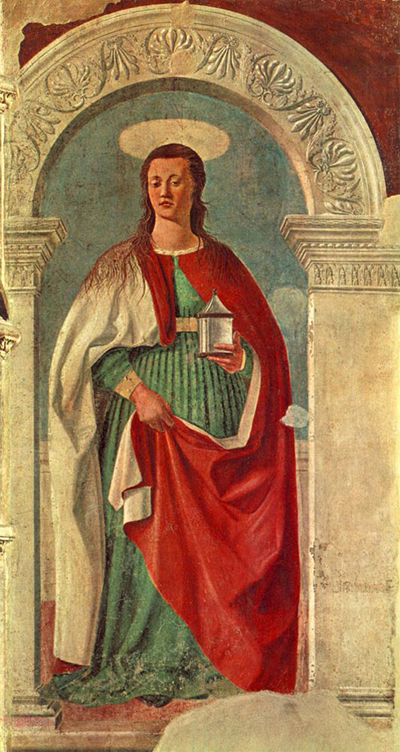
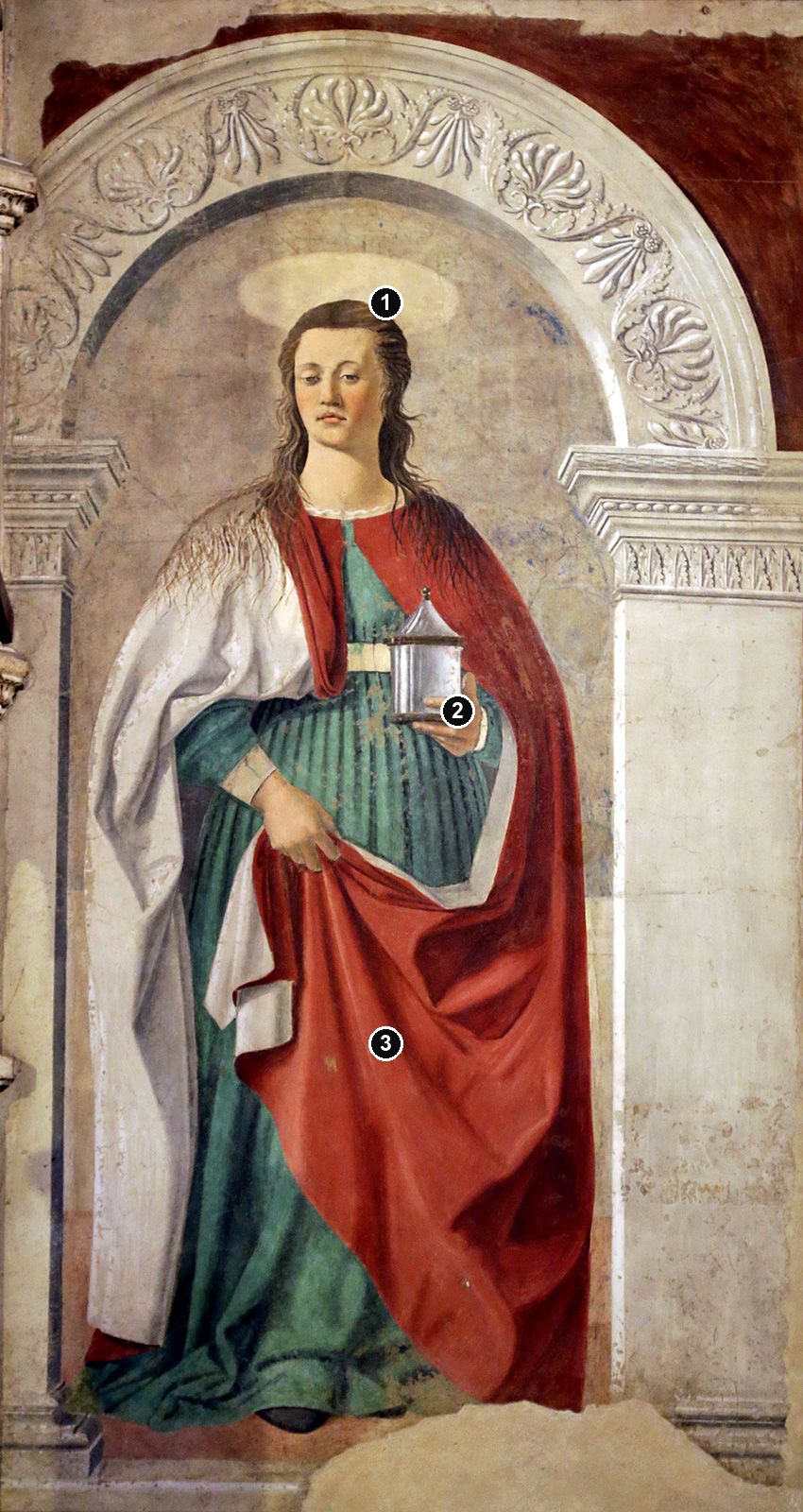
Piero della Francesca painted Saint Mary Magdalen on a wall of Arezzo Cathedral, beside the sacristy door. The saint has a jar in one hand and gathers the folds of her cloak with the other. Her shoulders and the sweep of her mantle nearly fill the painted doorway, yet behind her there is room for an open sky. The fresco rewards two distances. From the nave, the red and white of her cloak and the curve of the arch establish her presence. Closer up, the slight turn of her head and the reflections on the jar make her seem to be arriving at the threshold. [1] [2]
At a Glance
- ArtistPiero della Francesca
- Italian titleSanta Maria Maddalena
- DateAround the early 1460s, a proposed date
- MediumWall fresco with some colour applied to dry plaster
- LocationCathedral of Saints Peter and Donatus, Arezzo, in the left nave beside the sacristy door
- IdentificationMary Magdalene carries a small ointment jar and stands within a painted classical arch
This work across Piero della Francesca’s career
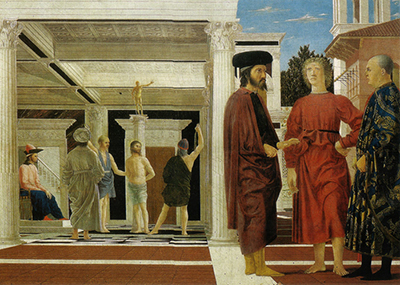
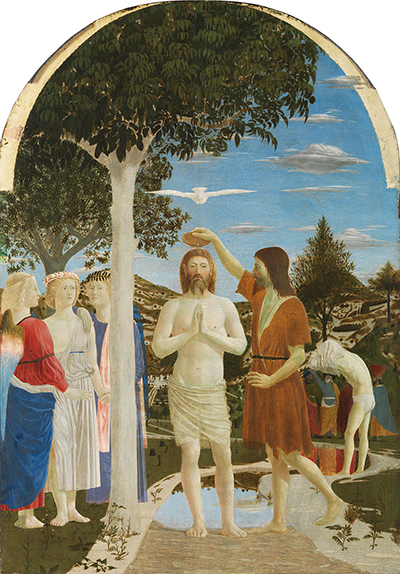
The Baptism of Christ
Probably about 1437–45The History of the True Cross
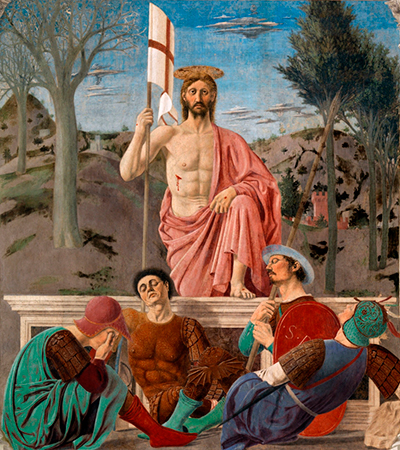
Mid-fifteenth centuryThe Resurrection
About 1458–68 (Opificio)Saint Mary Magdalen (current article)
Around 1460The Flagellation of Christ
1459–60 (GNDM)The Montefeltro Altarpiece
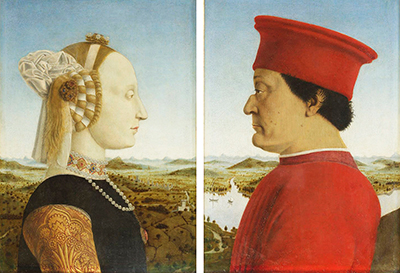
About 1472–74 (Brera)The Duke and Duchess of Urbino
About 1473–75 (Uffizi)The Nativity
Early 1480s (National Gallery)Contents
- A fresco beside the sacristy door
- A woman at the threshold
- The jar and the women in the Gospels
- What survives on the wall
- Piero's two settings in Arezzo
- Annotated details
A fresco beside the sacristy door
The fresco is on the left side of the Cathedral of Saints Peter and Donatus, also known as the Duomo of Arezzo. Look for it next to the sacristy door and the large marble monument to Bishop Guido Tarlati. The monument partly obstructs the view, so its position relative to the fresco is clearer in a photograph taken across the nave than in a closely cropped reproduction. Giorgio Vasari described Piero's Magdalene beside the sacristy door in his life of the artist, published in the expanded edition of the Lives in 1568. His account helps establish the historical location. He gives neither a date of execution nor the patron's name. [1] [2] [3]
Italy's national heritage catalogue identifies the fresco as Santa Maria Maddalena under record 0900219689. Fondazione Federico Zeri catalogues it under Piero's fuller name, Pietro di Benedetto dei Franceschi, and lists dimensions of 190 × 105 cm. The national catalogue gives the same height and a width of 180 cm. The catalogue figures therefore differ. A separate survey by Pietro Barbucci includes the painted imitation-marble panel below the figure and arrives at a height of about three metres for the larger painted ensemble. These figures are best read with their source and, where known, the boundaries of the area measured. [4] [5] [6]
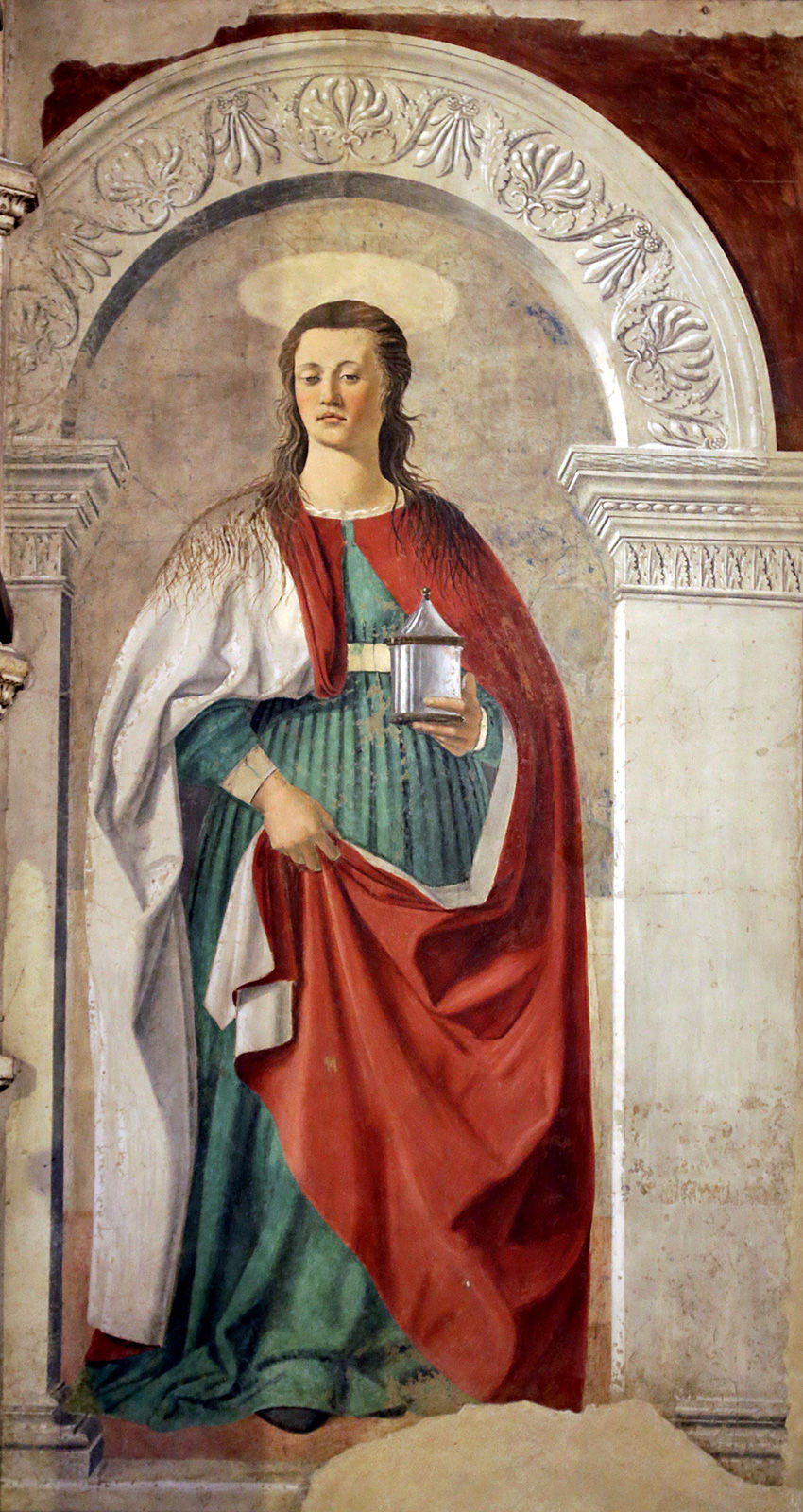
Piero della Francesca, Saint Mary Magdalen, Cathedral of Arezzo. Quino Arnau (Quinok). Image source. CC BY-SA 4.0. Resized from the source. This reproduction uses CC BY-SA 4.0.
A woman at the threshold
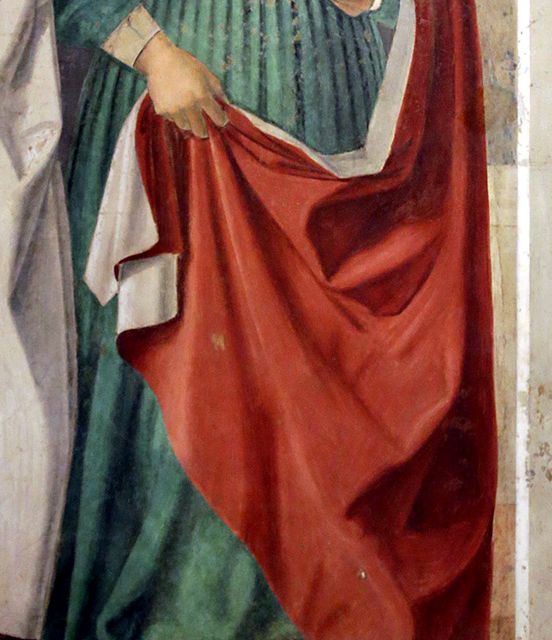
The saint's torso faces into the nave, but her eyes are slightly lowered and her face turns towards the viewer's left. The gesture of her right hand is easy to miss amid the large folds of the cloak. She grips and lifts a length of red fabric across her body, opening the mantle to show its pale lining and freeing her other hand to hold the jar. The green dress provides a quieter field between these two actions. The cloth looks heavy because its weight is legible in the distance between the point she grips and the long folds falling beneath it. Her hands establish both the size of the vessel and the weight of what she is wearing. [6] [7]
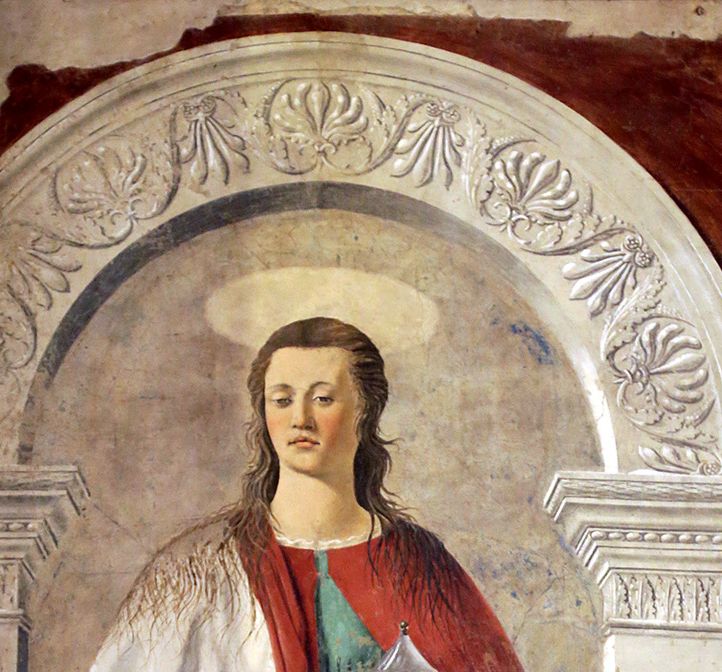
The painted architecture gives that small movement somewhere to happen. The rounded arch is ornamented with a chain of palmettes, stylised leaves that follow its curve. On the better-preserved side, a capital with acanthus leaves and small egg-shaped mouldings turns from a near face to a receding one. Beyond the opening, a low wall gives way to sky. The receding surfaces of the capital and the floor make the shallow opening read as the front of a deeper space. Barbucci traced those architectural edges to a shared vanishing point and used the fresco to test methods that Piero later set out in De prospectiva pingendi. The reconstruction starts from the surviving painting and photographs, with some parts of the opening obscured. [6]
The actual sacristy door gives the much smaller painted portal a scale that a reproduction cannot easily convey. Barbucci proposed that the narrow opening might recall the teachings on the difficult way to salvation in Matthew 7:13–14 and Luke 13:24. He takes the slight forward movement to suggest the instant before the saint's conversion in the Western tradition, as she is about to enter the house where the anointing takes place. The vessel, the step and the size of the door all matter to that reading. The composition also works as an image of the saint simply appearing in a doorway. The immediate surroundings tell us little about what lies on either side. [6]
Annotated Details from Saint Mary Magdalen
The numbered points identify visible features discussed in this article. Return from each detail to the numbered overview. Piero della Francesca, Saint Mary Magdalen, Cathedral of Arezzo. Quino Arnau (Quinok). Image source. CC BY-SA 4.0. The numbered overview and detail crops are adaptations under CC BY-SA 4.0.
Details from SAINT MARY MAGDALEN
Compare the cropped details with the source images above. Notice how their colours, shapes and positions contribute to the larger compositions.
The fictive arch
Carved-looking forms curve around the top of the figure. The halo stays inside the opening, below the larger band of decoration.
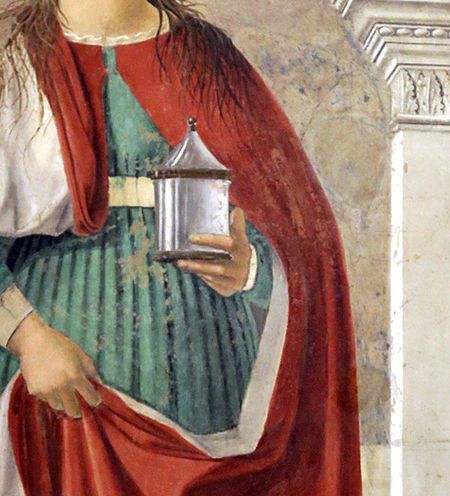
The vessel
The saint carries a small container upright. Its light, straight edges stand apart from the soft shapes of her mantle.
The gathered mantle
The lowered hand lifts the outer cloth. A sharp diagonal in the red drapery crosses the finer folds on the figure’s other side.
The jar and the women in the Gospels
The ointment jar belongs to Mary Magdalene's established imagery. Mark names Mary Magdalene among the women who bring spices to anoint Jesus' body and discover the empty tomb. In John's account, she is present at the Crucifixion and later meets the risen Jesus near the tomb. He calls her by name and sends her to tell the disciples. Luke also names Mary of Magdala as a follower of Jesus, among the women who accompany and support his ministry. [8] [9] [10]
The Gospel accounts of anointing Jesus during his lifetime name their participants differently. In Luke 7, a woman described as a sinner comes into Simon the Pharisee's house, wets Jesus' feet with her tears, dries them with her hair and anoints them. Luke leaves her unnamed. The following chapter introduces Mary Magdalene by name. In John 12, the woman who anoints Jesus' feet at Bethany and wipes them with her hair is Mary, the sister of Martha and Lazarus. Gregory the Great brought these figures together in a reading that became influential in Western Christianity. That tradition helps explain how a single jar could call up several stories for fifteenth-century viewers. At Arezzo, the saint carries the vessel with the lid in place, and her long loose hair offers a second point of recognition. [6] [10] [11] [12]
Piero makes the jar worth looking at even after it has identified the saint. Its rim, rounded body and foot respond to light in different ways. There are sharp pale streaks on the curved surface and a more diffuse brightness deeper in the vessel. Paolo Torriti reads it as rock crystal and draws attention to the light that appears to pass through the jar onto the Magdalene's thumb. The interpretation concerns the material Piero depicts, and the different kinds of highlight distinguish it from the opaque cloth and stone nearby. Look from the jar to her illuminated cheek and then to the white lining, where broad changes of tone follow the folds. A direction of light felt across the whole fresco is concentrated in an object small enough to hold in one hand. [7]
What survives on the wall
The fresco's edges record practical changes to the cathedral. Conservator Guido Botticelli associates part of the loss or concealment on the left with the relocation of Tarlati's monument in 1783. He also records damage low in the fresco from a holy-water stoup installed around 1820 and subsequently removed, and a separate loss on the right associated with a former iron chain. The chain is documented in older photographs. Such alterations help explain why a reconstruction of the architectural frame has to begin with an uneven set of surviving details. They also show why the extensive medieval monument beside the saint, although older than the fresco, belongs to a later arrangement of this wall. [3] [6] [13]
Botticelli treated the fresco in 1994 under the technical direction of Stefano Casciu, after earlier conservation by Leonetto Tintori in the 1960s. Botticelli reports seven giornate, or areas of plaster prepared for a day's fresco work. These sections show how application of the painting surface was divided during execution. Preparatory drawing and work on the dry surface belong to the broader process. The conservator found evidence of spolvero, the use of powdered material passed through pinpricks to transfer a design. The principal colours include red and green earth pigments and a lime white. The blue of the sky was applied to dry plaster, as was the now lost colour of the belt. These findings give a material basis for discussing the colour without treating the present appearance of every painted passage as identical to Piero's original finish. [13]
Piero's two settings in Arezzo
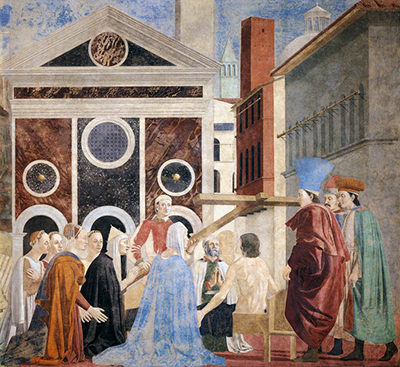
The History of the True Cross occupies the walls of the Bacci Chapel in the Basilica of San Francesco, across the city from the cathedral. The cycle gives Piero room to set episodes against one another over several levels, with figures gathering around the timber of the Cross, figures meeting in formal interiors and armies in the open. The cathedral fresco asks the viewer to attend to a single figure and to the small passage of paint where the jar meets the hand that holds it. Both works show what Piero could do with a figure framed by architecture. In the chapel, buildings also organise narrative scenes. Here, the arch gives the figure enough depth to approach the nave. [1] [6] [14]
The two works are often placed near one another in Piero's career. The city museum network dates the Bacci Chapel campaign broadly between 1452 and 1466. The national catalogue records different proposals for the Magdalen, including dates during the chapel campaign and a suggestion by Philip Hendy that it was painted later than 1466. An early-1460s date is a commonly proposed estimate. Torriti places the fresco in those years and favours a sequence in which it followed the chapel work. The archival searches reported by Barbucci did not recover a commission for the cathedral fresco. The chapel date range provides useful context in Arezzo while leaving the precise relationship between the two projects open. [4] [6] [7] [14]
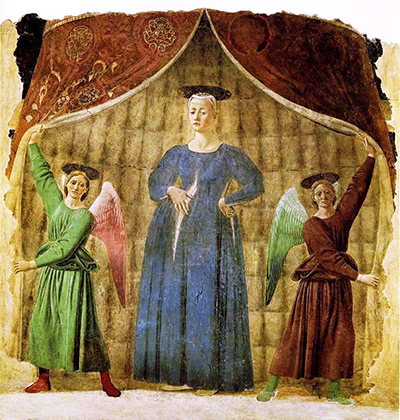
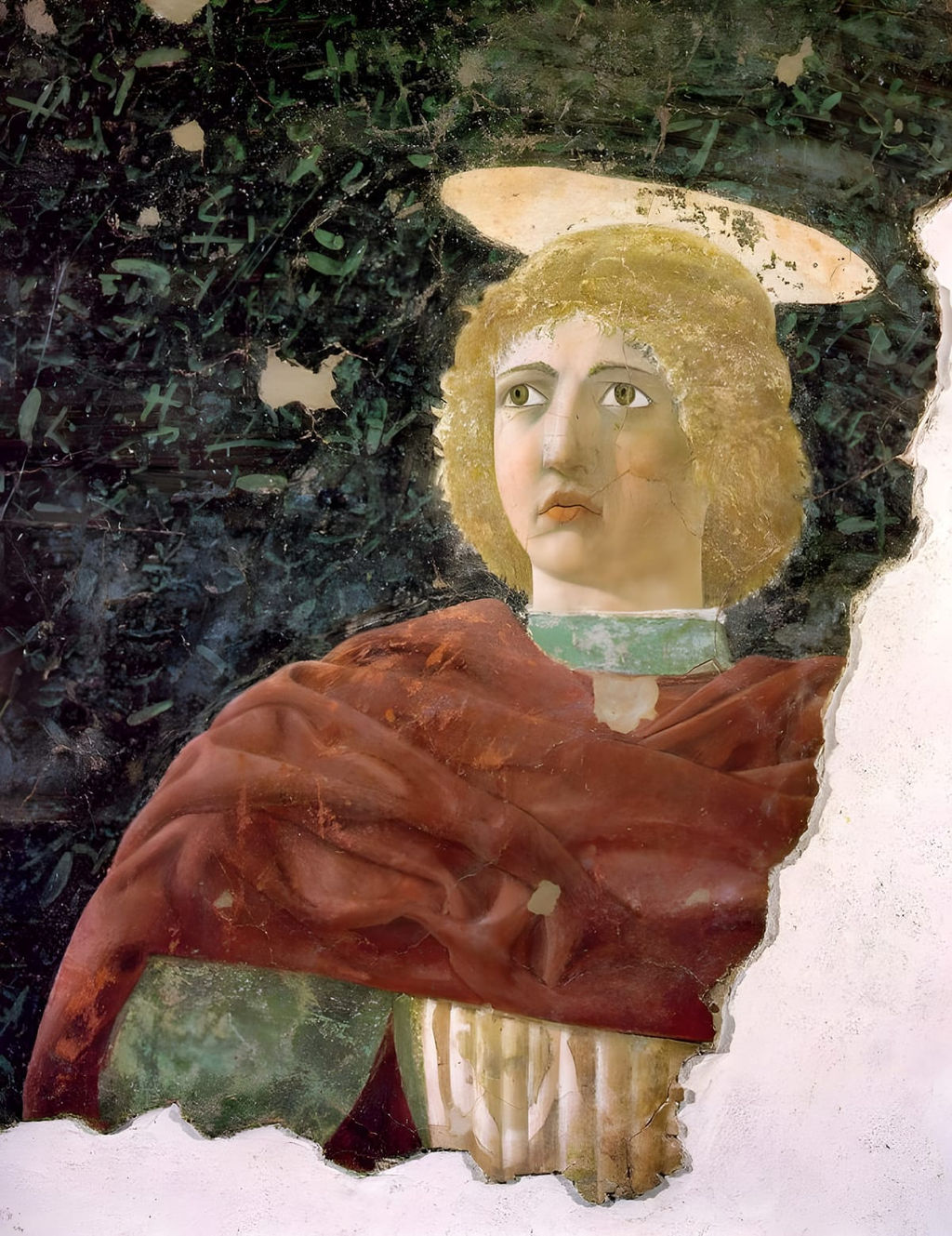
The Madonna del Parto in Monterchi offers another way to see how Piero makes a painted frame serve a figure. Angels part the folds of a canopy to disclose the Virgin, and the lifted fabric marks a moment of revelation. At the cathedral, the Magdalene gathers her own cloak inside an arch that looks as if it were built into the wall. Piero's Saint Julian offers a comparison with another single saint painted on a church wall. The surviving fragment was detached and is now at the Museo Civico in Sansepolcro. In Arezzo, the sacristy doorway and the neighbouring marble monument still form part of the experience of approaching the Magdalen. [13] [15] [16]
The Dutch art historian G. J. Hoogewerff compared the Magdalen with the Virgin in the Bacci Chapel’s Annunciation in 1919. He drew attention to the upright figures and the broad, composed fall of the Magdalen’s cloak. The comparison is especially revealing when you look at the hands. In the Annunciation, the Virgin’s restrained gesture is part of an exchange with Gabriel. At the cathedral, the Magdalene’s hands are occupied with her own clothing and the jar. The two figures can appear equally still at first glance, but they prompt different questions about what is about to happen. [17]
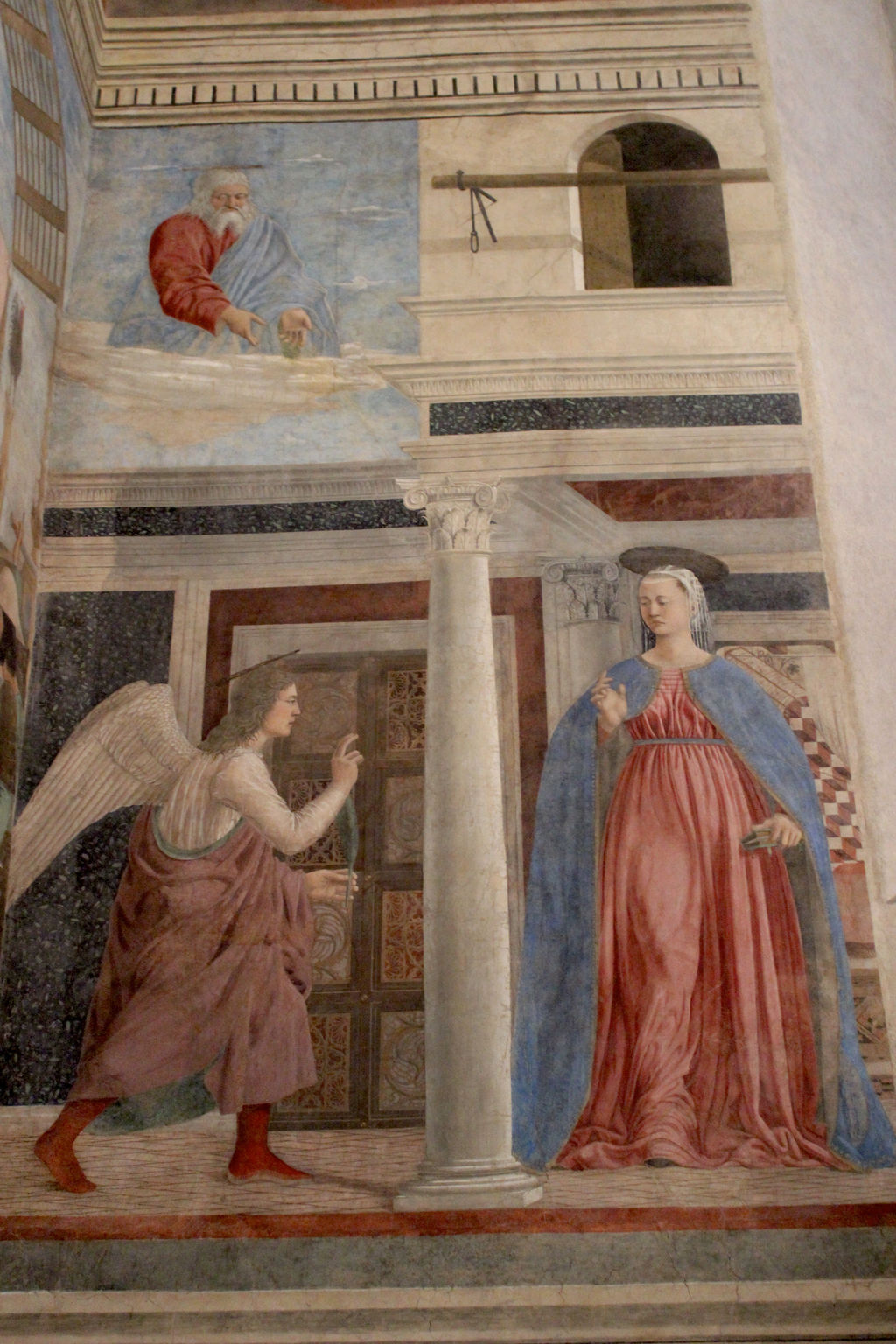
Piero della Francesca, Annunciation, Bacci Chapel, Arezzo. Miguel Hermoso Cuesta. Image source. CC BY-SA 4.0. Resized from the source. This reproduction uses CC BY-SA 4.0.
Browse the artworks
Compare Piero’s frescoes, panels and manuscript figures. The list includes ensembles and separately identifiable panels or scenes. Dates are approximate where the sources differ.
| Name | Date | Medium and source |
|---|---|---|
| The Baptism of Christ | Probably c. 1437–45 | Panel painting Catalogue. |
| The Flagellation of Christ | 1459–60 (GNDM) | Panel painting Catalogue. |
| The History of the True Cross | Mid-fifteenth century | Wall painting Catalogue. |
| Dream of Constantine | Mid-fifteenth century | Wall painting Catalogue. |
| The Duke and Duchess of Urbino | About 1473–75 (Uffizi) | Panel painting Catalogue. |
| The Resurrection | About 1458–68 (Opificio) | Wall painting Catalogue. |
| Brera Madonna | About 1472–74 | Panel painting Catalogue. |
| Annunciation at Arezzo | Mid-fifteenth century | Wall painting Catalogue. |
| Madonna del Parto | About 1450–65 (Monterchi) | Wall painting Catalogue. |
| Polyptych of the Misericordia | Commissioned 1445 | Panel painting Catalogue. |
| The Nativity | Early 1480s (National Gallery) | Panel painting Catalogue. |
| Madonna di Senigallia | About 1474–75 (GNDM) | Panel painting Catalogue. |
| Death of Adam | Mid-fifteenth century | Wall painting Catalogue. |
| Queen of Sheba | Mid-fifteenth century | Wall painting Catalogue. |
| Victory of Constantine | Mid-fifteenth century | Wall painting Catalogue. |
| Battle between Heraclius and Chosroes | Mid-fifteenth century | Wall painting Catalogue. |
| Saint Mary Magdalen | Wall painting Catalogue. | |
| The Augustinian Polyptych | 1454–69 | Panel painting Catalogue. |
| Polyptych of Perugia | About 1467–69 (GNU) | Panel painting Catalogue. |
| Perugia Annunciation | About 1468–70 (national catalogue) | Panel painting Catalogue. |
| St Francis and St Elizabeth | About 1467–69 (GNU) | Panel painting Catalogue. |
| Stigmatisation of St Francis | About 1468–70 (national catalogue) | Panel painting Catalogue. |
| An Augustinian Nun (Saint Monica) | 1454–69 | Panel painting Catalogue. |
| Augustinian Saint | 1454–69 | Panel painting Catalogue. |
| Saint Michael | 1454–69 | Panel painting Catalogue. |
| Saint Nicholas of Tolentino | 1454–69 | Panel painting Catalogue. |
| Saint John the Evangelist | 1454–69 | Panel painting Catalogue. |
| Virgin and Child Enthroned with Four Angels | About 1460–70 (Clark) | Panel painting Catalogue. |
| Portrait of Sigismondo Pandolfo Malatesta | About 1450–51, often proposed. Louvre catalogue range 1450–75. | Panel painting Catalogue. |
| Sigismondo before St Sigismund | 1451 | Wall painting Catalogue. |
| St Jerome and a Donor | 1460s (Accademia); about 1450 also proposed | Panel painting Catalogue. |
| St Jerome in Penitence | 1450, dated on the panel | Panel painting Catalogue. |
| Saint Julian | About 1455–60, often proposed | Wall painting Catalogue. |
| Saint Augustine | 1454–69 | Panel painting Catalogue. |
| Saint Apollonia | 1454–69 | Panel painting Catalogue. |
| Crucifixion from the Augustinian Polyptych | 1454–69 | Panel painting Catalogue. |
| Saint Louis of Toulouse | Wall painting Catalogue. | |
| Burial of the Wood | Mid-fifteenth century | Wall painting Catalogue. |
| Discovery and Proof of the True Cross | Mid-fifteenth century | Wall painting Catalogue. |
| Exaltation of the Cross | Mid-fifteenth century | Wall painting Catalogue. |
| Saint Anthony Raises a Child | About 1467–69 (GNU) | Panel painting Catalogue. |
| Saint Elizabeth Revives a Child | About 1467–69 (GNU) | Panel painting Catalogue. |
| Hercules | About 1470 | Wall painting Catalogue. |
| Portrait of a Boy (possibly Guidobaldo da Montefeltro) | Panel painting Catalogue. | |
| De prospectiva pingendi, Reggio Emilia witness (figures) | Manuscript diagrams Catalogue. | |
| The Interrogation of Judas | Mid-fifteenth century | Wall painting Catalogue. |
| Two prophets, Bacci Chapel | Mid-fifteenth century | Wall painting Catalogue. |
| Saint Clare of Assisi, upper predella | About 1467–69 (GNU) | Panel painting Catalogue. |
| Saint Agatha, upper predella | About 1467–69 (GNU) | Panel painting Catalogue. |
| Lost centre of the Augustinian Polyptych | 1454–69 | Lost panel or panels Catalogue. |
Frequently Asked Questions
Discussion
Look again at the images and ideas explored in Saint Mary Magdalen. These editorial prompts invite your observations.
Reader Insights
Begin with the moving folds of the cloak, then look at the face. How does the lowered gaze affect your sense of the Magdalene's movement?
Compare the narrow painted arch with the actual sacristy door in a view of the cathedral wall. Which details of the painted opening make it seem possible for a figure to pass through?
Follow the light from the face to the lining of the mantle and on to the jar. How does Piero distinguish skin, cloth and a translucent vessel?
Join the Conversation
Share a detail, comparison or question about Saint Mary Magdalen below.
References
- Musei di Arezzo. Piero della Francesca e Giorgio Vasari. City itinerary locating the cathedral fresco by the sacristy and the cycle in San Francesco. View source.
- Giorgio Vasari. Le vite, Giuntina edition, life of Piero della Francesca, 1568. Fondazione Memofonte transcription. View source.
- Diocese of Arezzo-Cortona-Sansepolcro. Fascicolo X, cathedral furnishings and the Tarlati monument. View source.
- Ministero della Cultura. Santa Maria Maddalena, national catalogue record 0900219689. View source.
- Fondazione Federico Zeri, Università di Bologna. Pietro di Benedetto dei Franceschi, Santa Maria Maddalena, artwork record 19106. View source.
- Pietro Barbucci. “Questioni pierfrancescane: la Maddalena di Arezzo”, Predella 49 (2021), especially sections 1–3 and figures 1–2 and 4–11. View source.
- Paolo Torriti. “Piero della Francesca ad Arezzo”, pp. 404–405 and figs. 21–22. Università di Siena research repository. View source.
- United States Conference of Catholic Bishops. Mark 16:1–8. View source.
- United States Conference of Catholic Bishops. John 19:25 and 20:1–18. View source 1. View source 2.
- United States Conference of Catholic Bishops. Luke 7:36–50 and 8:1–3. View source 1. View source 2.
- United States Conference of Catholic Bishops. John 12:1–8. View source.
- Arthur Roche. “Apostle of the Apostles”, Congregation for Divine Worship and the Discipline of the Sacraments, 2016. View source.
- Guido Botticelli. Arezzo: la Maddalena di Piero della Francesca. First-person summary of the 1994 treatment and reference to the 1995 report with Stefano Casciu. View source.
- Musei di Arezzo. Frescoes by Piero della Francesca. Bacci Chapel site and cycle chronology. View source.
- Musei Civici Madonna del Parto. The Artwork. Monterchi fresco and painted canopy. View source.
- Museo Civico di Sansepolcro. San Giuliano and San Ludovico exhibition notice, identifying the detached frescoes. See also the Comune di Sansepolcro's account of the churches. View source 1. View source 2.
- G. J. Hoogewerff. “Piero dei Franceschi,” part II, Elsevier’s Geïllustreerd Maandschrift 29 (1919), pp. 242–243. Digitale Bibliotheek voor de Nederlandse Letteren. View source.
Related Paintings
Saint Julian
Piero della Francesca, Saint Julian, detached fresco in the Museo Civico, Sansepolcro. Image source. Public domain. Resized only; native appearance preserved.