 by Tom Gurney
Tom Gurney BSc (Hons) is an art history expert with over 20 years experience
Published on June 19, 2020 / Updated on October 14, 2023
Email: tomgurney1@gmail.com / Phone: +44 7429 011000
Saint Jerome and a Donor: Introduction
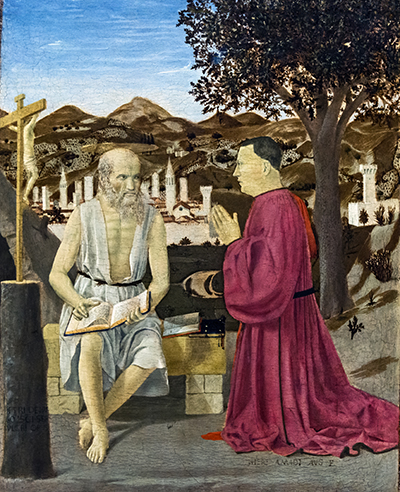
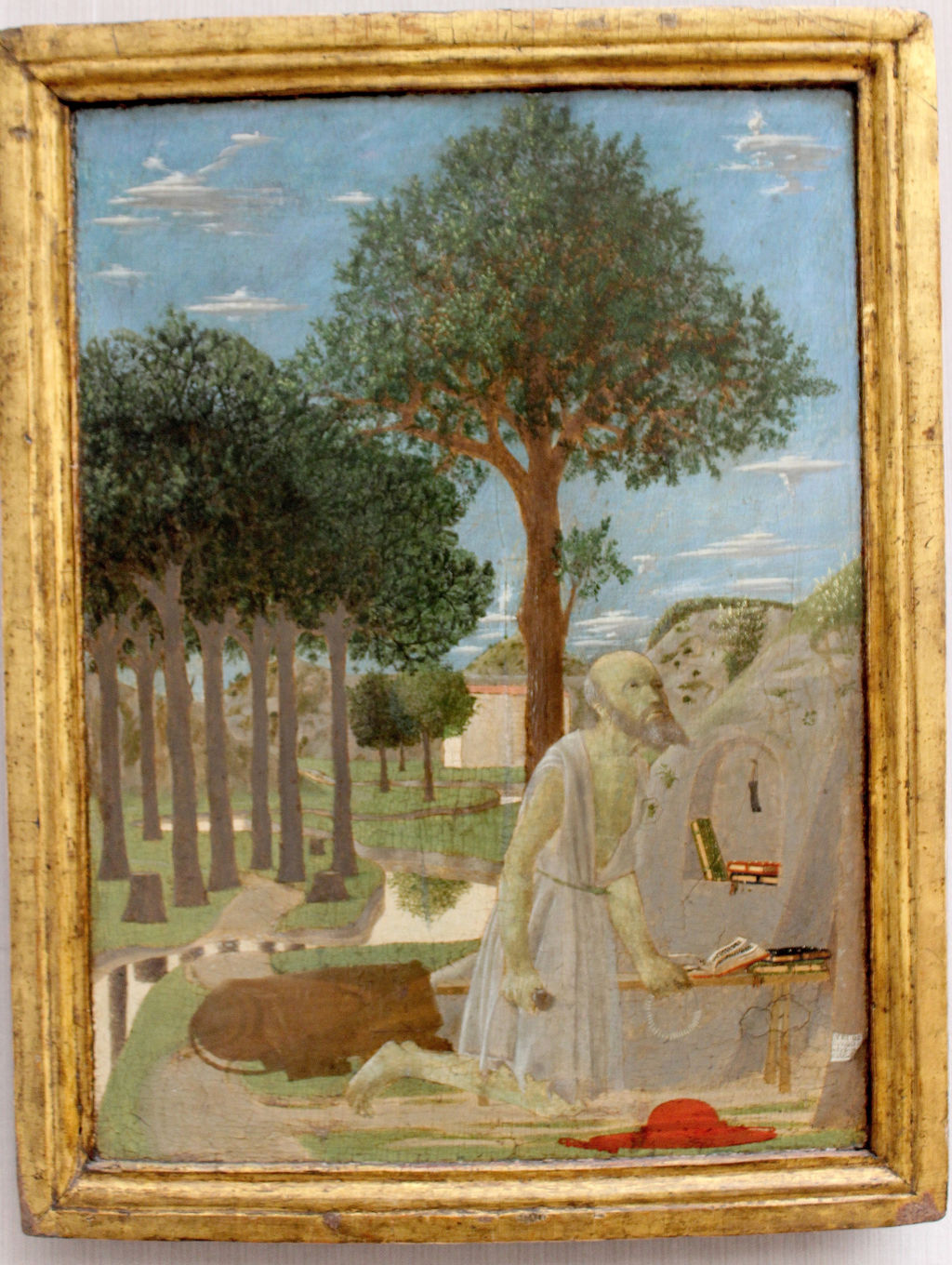
Saint Jerome keeps a finger between the pages as he looks up at the man kneeling before him. The visitor presses his palms together, and the saint stays seated, one leg crossed over the other. That slight pause gives Piero della Francesca’s Saint Jerome and a Donor much of its intimacy. The panel, now in the Gallerie dell’Accademia in Venice, imagines a fifteenth-century worshipper meeting a saint who had lived roughly a thousand years earlier. Piero gives the two men the same ground to occupy and enough room to look each other in the eye. [1] [2]
At a Glance
- ArtistPiero della Francesca [1]
- Italian titleSan Girolamo e un devoto [1]
- Date1460s according to the Accademia, with an earlier estimate around 1450 in the national catalogue [1] [3]
- MediumTempera and oil on poplar panel [2] [4]
- Dimensions49.4 × 42 cm overall, 49.4 × 39.5 cm painted surface [2]
- CollectionGallerie dell’Accademia, Venice, Renier bequest, 1850 [1] [5]
This work across Piero della Francesca’s career
The Baptism of Christ
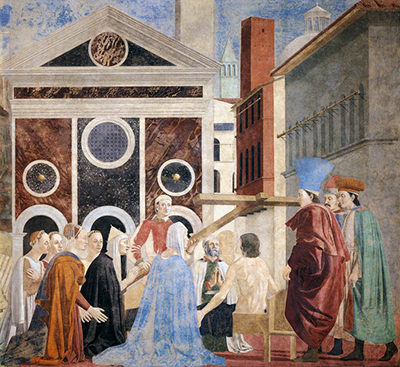
Probably about 1437–45The History of the True Cross
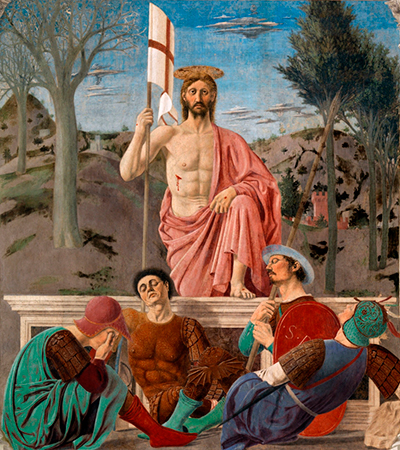
Mid-fifteenth centuryThe Resurrection
About 1458–68 (Opificio)The Flagellation of Christ
1459–60 (GNDM)Saint Jerome and a Donor (current article)
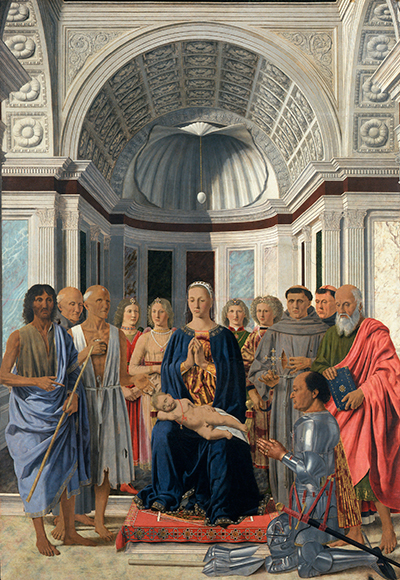
1460s (Accademia); an earlier date has been proposedThe Montefeltro Altarpiece
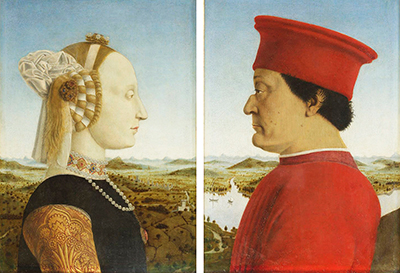
About 1472–74 (Brera)The Duke and Duchess of Urbino
About 1473–75 (Uffizi)The Nativity
Early 1480s (National Gallery)Contents
- Jerome’s outdoor study
- The name beneath the kneeling man
- From the hillside to the town
- What conservation revealed
- The other Jerome and the Venetian tradition
- From the Renier collection to the Accademia
- Annotated details
Jerome’s outdoor study
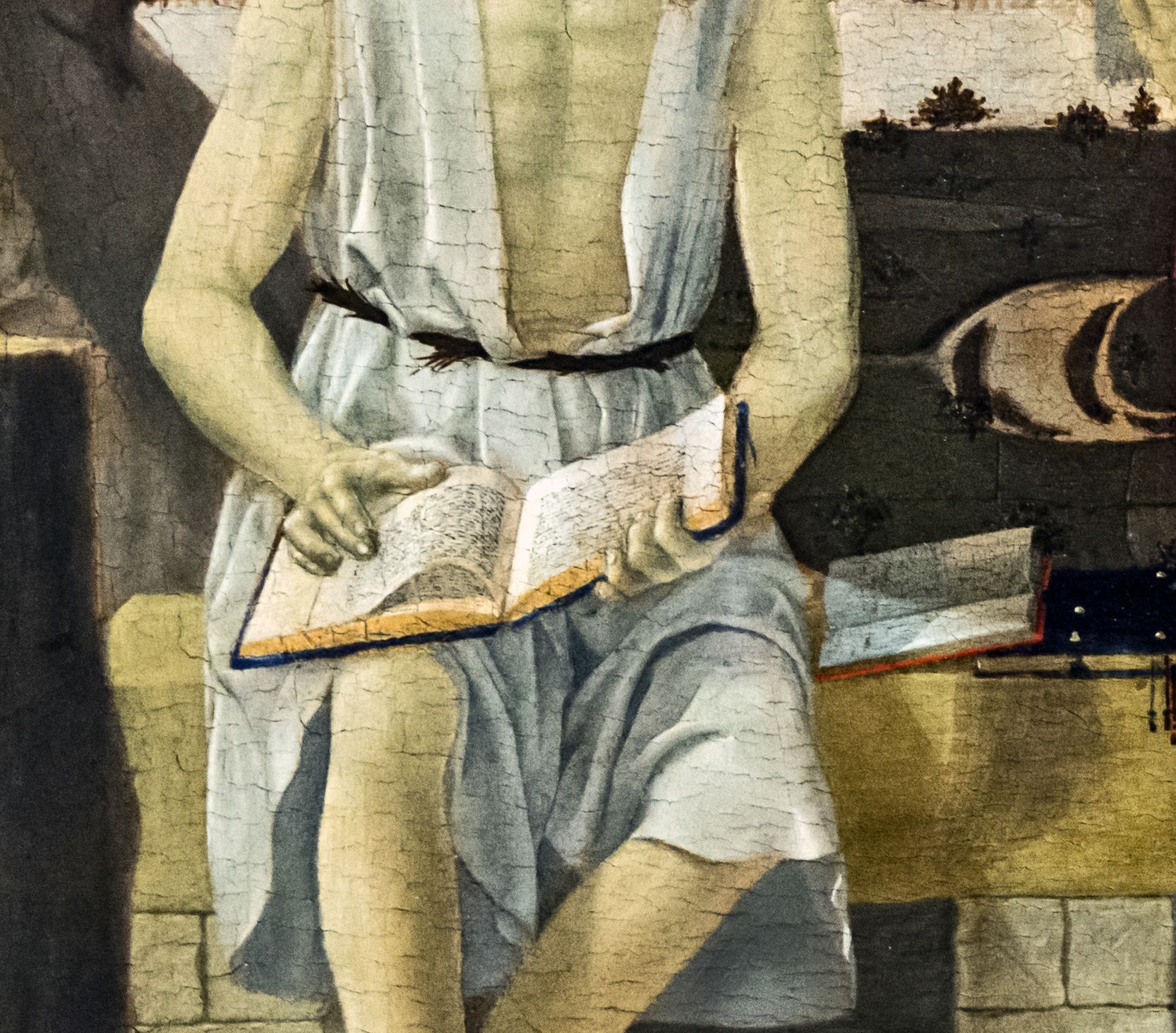
The saint’s tunic is gathered at the waist with thorny branches. His stone bench sits near a cave, and a small crucifix rests against a sawn stump at the left. The austerity of his retreat gives the bound volumes on his bench and in his lap particular weight. Looking from the open book to the nearby volumes, it is easy to imagine him checking one passage against another. Keith Christiansen reads the poised finger and the several books as possible signs of a scholar comparing texts. Jerome’s work on the Latin Bible, associated with the Vulgate, gives that detail a particular resonance. Piero leaves the passage on the open page unidentified. [2] [3]
The rocky dwelling and thorn belt belong to the visual language of the hermit. The books give his solitude a purpose a Renaissance reader would recognise. Piero dispenses with the lion and cardinal’s hat familiar from other images of Jerome. The crucifix is still present, and its small scale rewards the kind of searching look the saint is giving his book. The cut stump and the few possessions Jerome has with him suggest the physical conditions of this life of study. [2] [3]
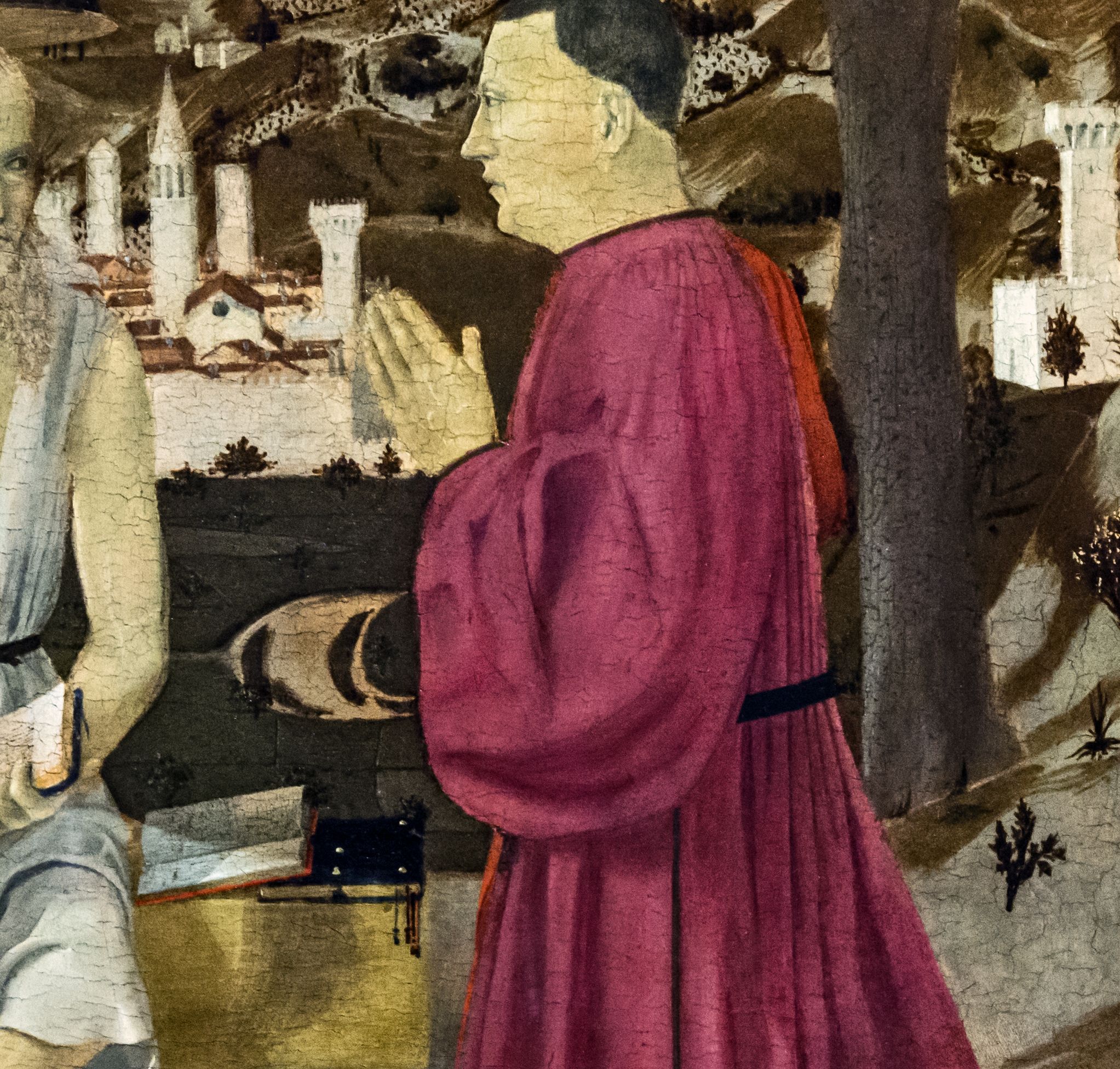
The kneeling man wears a full red gown and a dark cap. His folded hands make his intention clear, while his dress brings the world of the town into the retreat. He is painted on a scale comparable to Jerome’s. His lower position comes from the act of kneeling, and Piero gives his face a clear profile against the landscape. Jerome, seen much more frontally, turns his attention sideways. The viewer can read both faces while the two men look at one another. In a panel about half a metre high, the encounter is large enough to register at once and small enough to invite close inspection of a page edge or a clasped finger. That combination suits private devotion, the use proposed in the Italian national catalogue. The original room and circumstances of display remain unknown. [1] [2] [3]
The name beneath the kneeling man
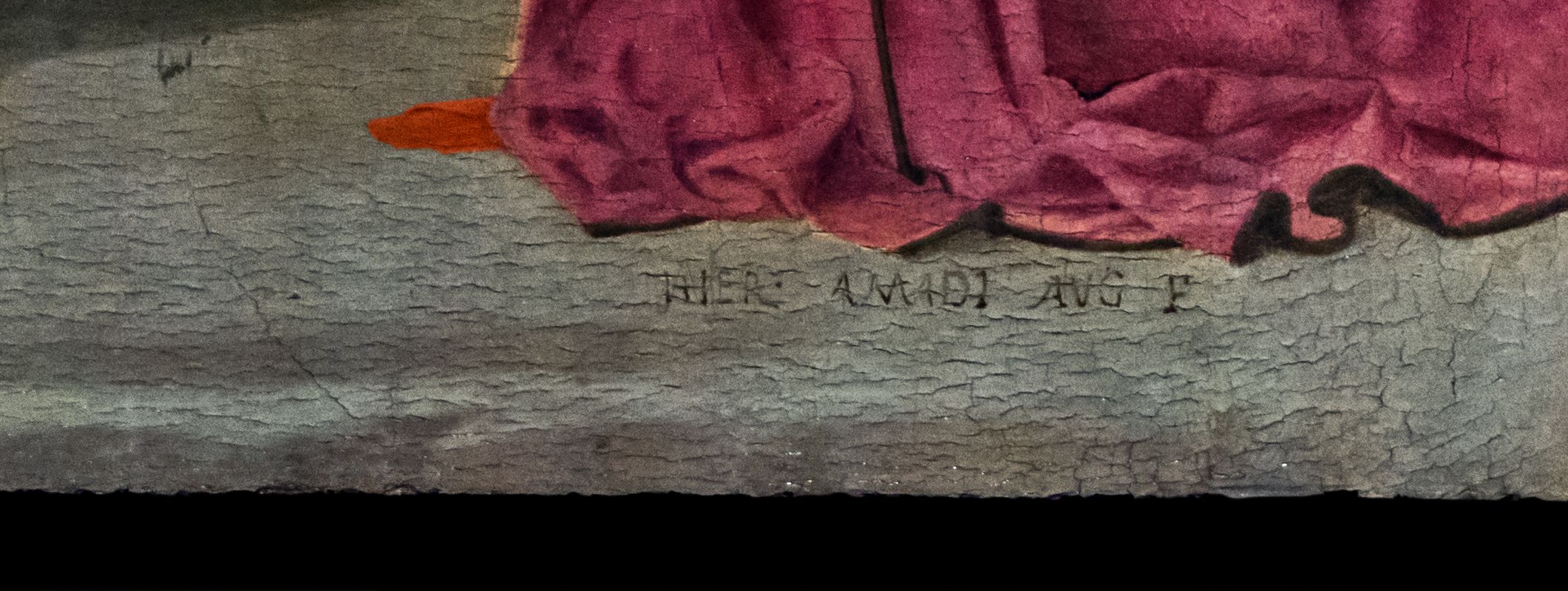
The abbreviated lettering beneath the donor is generally expanded as Hieronymus Amadi Augustini filius, or Girolamo Amadi, son of Agostino. The Accademia identifies him as the likely commissioner. Christiansen connects the inscription to a member of a family from Lucca that had established itself in Venice and prospered in the silk and textile trade. With that identification, the namesake relationship gives the choice of saint a personal logic. Girolamo and Jerome are forms of the same name, and the kneeling man would be asking for the attention of his own patron saint. [1] [2] [3]
The lower inscription was added after the painting was made. Christiansen proposes that the lettering may go back as far as the early sixteenth century and raises the possibility that Girolamo’s son Domenico had it added to preserve his father’s memory. That is a plausible account of the label, and the known family connections lend it some context. James R. Banker has proposed a different sitter, the Sansepolcro lawyer Jacopo Anastagi. The Amadi name therefore belongs in the history of the painting as its traditional and museum-supported identification, with the sitter and commission still open to question. [2] [3] [6]
A second set of letters can be seen on the stump supporting the crucifix. The Italian national catalogue reads this as the artist’s signature, identifying the panel as the work of Piero of Borgo Sansepolcro. Piero’s name is worked into a painted object within the scene. The Amadi lettering sits separately below the donor and belongs to the later history of the panel. The surfaces on which the two names appear help explain why the evidence for the painter and the evidence for the sitter carry different weight. [2] [3]
Annotated Details from Saint Jerome and a Donor
The numbered points identify visible features discussed in this article. Return from each detail to the numbered overview. Piero della Francesca, Saint Jerome and a Donor, Gallerie dell’Accademia, Venice. Didier Descouens. Image source. CC BY-SA 4.0. The numbered overview and detail crops are adaptations under CC BY-SA 4.0.
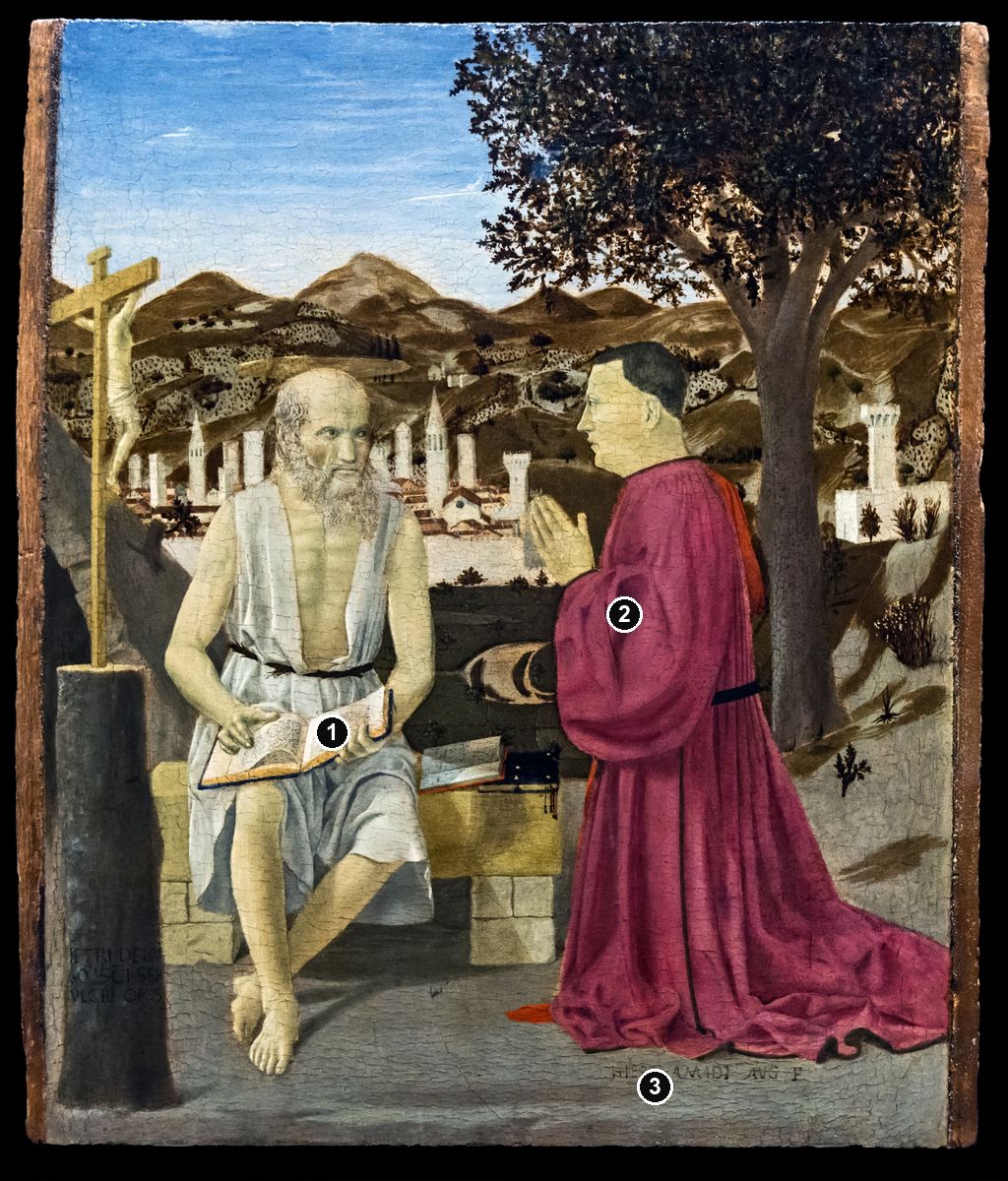
Details from SAINT JEROME AND A DONOR
Compare the cropped details with the source images above. Notice how their colours, shapes and positions contribute to the larger compositions.
Jerome’s open book
The saint holds the book across his knees. One hand rests close to its open leaves, which catch more light than the bench or stone beneath.
The donor’s hands and robe
The donor’s raised hands catch the eye where the fabric turns towards the saint. A little of the green and grey landscape shows between their heads.
The writing on the foreground
Individual marks can be made out beside the hem. Look at the surface from one side to the other before picking out any particular letters.
From the hillside to the town
The ground occupied by Jerome and the visitor is dry and pale. Beyond it the terrain drops into a greener valley, and a road bends towards a walled town. A leafy oak fills the upper right above the donor, while the cut stump anchors the lower left near Jerome. These two trees hold opposite corners of the view together. The road offers a route from one social world to the other. The visitor’s clothes would look quite at home in the town below, and the open route makes his presence on the hillside feel like the end of a walk. [1] [2]
The Accademia notes that the town and hills have been associated with Borgo Sansepolcro, Piero’s birthplace. Christiansen sees an echo of the Tiber valley without treating the view as a literal map. The conservation authors raise Lucca, the Amadi family’s ancestral city, as another possibility. The town’s more immediate role can be seen from the picture itself. Its towers appear between the two heads, so the eye meets the inhabited world even while following the exchange on the hillside. The river valley and receding hills give this brief encounter a much wider setting. [1] [2] [4]
What conservation revealed
The technical examination published by Roberto Bellucci, Cecilia Frosinini and Chiara Rossi Scarzanella identifies the support as poplar and records trimming around the edges. At the sides this mostly affected bare wood formerly covered by the frame. The conservators found traces suggesting the loss at the top may have been greater. A taller original composition would have given the oak more space above the donor, although the extent of the missing image can only be estimated. The present panel measures 49.4 by 42 centimetres, with a narrower painted area. [2] [4]
The bench offers a closer view of Piero at work. The conservators found green paint from the slope under parts of the finished bench and the books set on it. They concluded that Piero extended the bench to the right and added those books after painting had begun. The extension links the saint to the group of volumes and changes how the eye passes from Jerome into the valley. Around the oak, the team also found that Piero built up the foliage leaf by leaf, using several tones of a copper green whose appearance has changed with age. These observations help explain both the density of the canopy and the traces of brighter colour that survive. The conservators also found tempera in the flat foreground and evidence for oil in the town, the sky and the figures’ clothing. The team cautioned against using that mix of media by itself to date the panel. Piero could choose a different handling for bare ground, cloth and distant buildings within the same picture. [4]
A major treatment was carried out at the Opificio delle Pietre Dure in Florence in 2013. The team worked under magnification to reduce the uneven effect of old surface coatings and used limited retouching to ease distractions from abrasion and cracking. After treatment the picture travelled to New York for the Metropolitan Museum of Art’s Piero della Francesca: Personal Encounters in 2014. The exhibition brought both of Piero’s surviving Jerome panels together and gave visitors a chance to compare how each survives in a different format and state of preservation. [2] [4] [7]
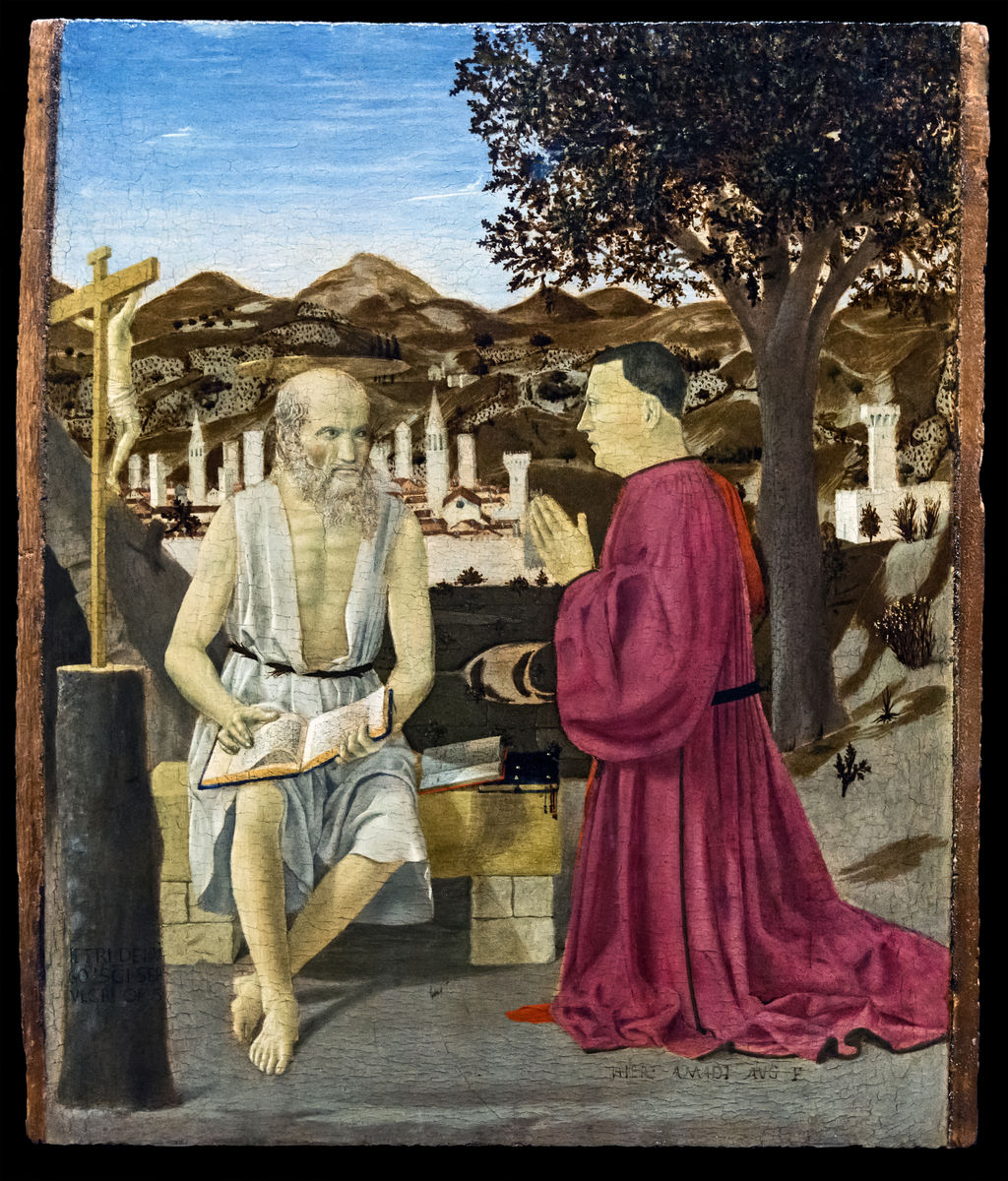
Piero della Francesca, Saint Jerome and a Donor, Gallerie dell’Accademia, Venice. Didier Descouens. Image source. CC BY-SA 4.0. Resized from the source. This reproduction uses CC BY-SA 4.0.
The other Jerome and the Venetian tradition
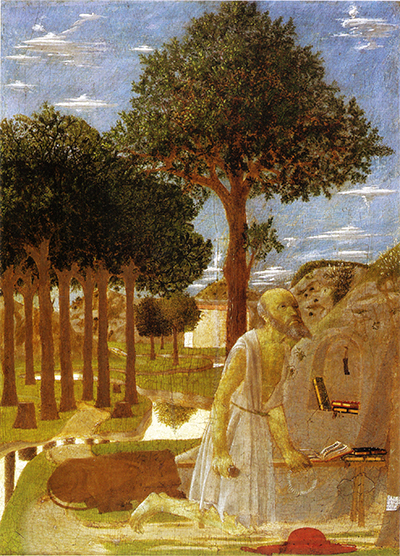
Piero’s Saint Jerome in Penitence is the signed and dated 1450 panel in the Gemäldegalerie, Berlin. There Jerome kneels alone with a stone in his right hand, held ready to strike his chest in penance. A lion is still discernible in the foreground. The Venice panel transfers the kneeling pose to the visitor. The saint stays seated, and the action turns on the raised eyes of someone interrupted in the middle of reading. Both retreats open onto extensive landscapes. In Berlin, the saint’s isolated posture sustains the act of penance. In Venice, the space between the two men gives their meeting its force. Only the Berlin panel has the inscribed date. Venice’s museum places its panel in the 1460s, in line with the Met’s tentative dating of about 1460–64. The Italian national catalogue gives an earlier estimate of about 1450. [1] [2] [3] [8]
Jerome’s outdoor study also appealed to Venetian painters. In Giovanni Bellini’s Saint Jerome reading in a Landscape, now in the National Gallery in London, the saint is absorbed in his book below steep cliffs and the lion accompanies him. Bellini’s later picture shows how a landscape could simultaneously open a view to the distance and give a reader a place of seclusion. Christiansen considers a possible connection between Piero’s panel and Bellini’s treatment of the subject, dependent on Piero’s panel having been visible in Venice at the time. The early whereabouts of the Piero are uncertain. The comparison remains revealing on its own, particularly for the presence of Piero’s kneeling interlocutor. [2] [9]
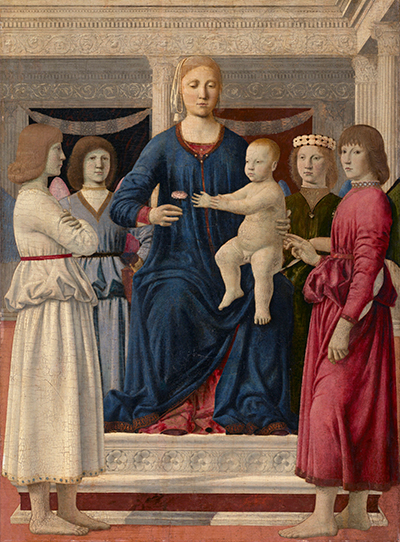
The Virgin and Child Enthroned with Four Angels offers a second comparison within Piero’s paintings. The Clark panel brings its figures together on a shallow architectural stage. The Venice work gives two figures a ledge overlooking the valley and lets a road, a town and a tree tell us something about the distance between their lives. In each picture, the space immediately around the figures helps define their relationship. [2] [10]
Piero della Francesca, Saint Jerome in Penitence, Gemäldegalerie, Berlin. Miguel Hermoso Cuesta. Image source. CC BY-SA 4.0. Resized from the source. This reproduction uses CC BY-SA 4.0.
From the Renier collection to the Accademia
The earliest secure trace cited by Christiansen places the panel with Count Bernardino Renier in Venice in 1812. His widow Felicita Bertrand Helmann followed his testamentary wishes in giving it to the Accademia. The museum’s collection history dates the donation to 1833 and records that it took effect in 1850, the usual accession date. The gift also included a Bellini of the Virgin between two saints. [1] [2] [5]
The Renier gift came as the Gallerie dell’Accademia was growing out of its early teaching collection at the Carità complex. Alongside works that came from religious institutions and acquisitions made for the museum, private gifts such as those of Girolamo Molin, Girolamo Contarini and Felicita Renier helped build the collection. Piero’s small picture entered public view through that process. The record of its nineteenth-century arrival is considerably clearer than that of its first home. [2] [5]
Browse the artworks
Compare Piero’s frescoes, panels and manuscript figures. The list includes ensembles and separately identifiable panels or scenes. Dates are approximate where the sources differ.
| Name | Date | Medium and source |
|---|---|---|
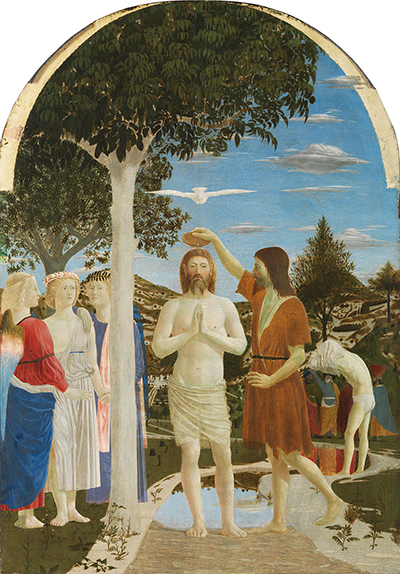
| The Baptism of Christ | Probably c. 1437–45 | Panel painting Catalogue. |
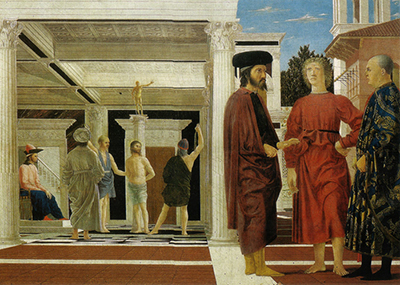
| The Flagellation of Christ | 1459–60 (GNDM) | Panel painting Catalogue. |
| The History of the True Cross | Mid-fifteenth century | Wall painting Catalogue. |
| Dream of Constantine | Mid-fifteenth century | Wall painting Catalogue. |
| The Duke and Duchess of Urbino | About 1473–75 (Uffizi) | Panel painting Catalogue. |
| The Resurrection | About 1458–68 (Opificio) | Wall painting Catalogue. |
| Brera Madonna | About 1472–74 | Panel painting Catalogue. |
| Annunciation at Arezzo | Mid-fifteenth century | Wall painting Catalogue. |
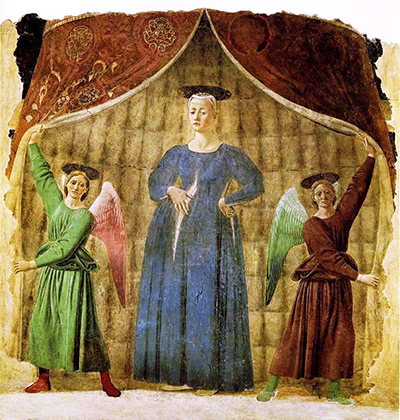
| Madonna del Parto | About 1450–65 (Monterchi) | Wall painting Catalogue. |
| Polyptych of the Misericordia | Commissioned 1445 | Panel painting Catalogue. |
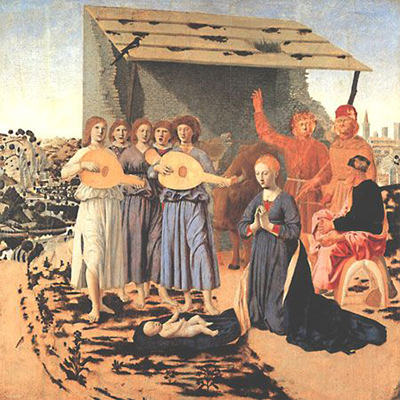
| The Nativity | Early 1480s (National Gallery) | Panel painting Catalogue. |
| Madonna di Senigallia | About 1474–75 (GNDM) | Panel painting Catalogue. |
| Death of Adam | Mid-fifteenth century | Wall painting Catalogue. |
| Queen of Sheba | Mid-fifteenth century | Wall painting Catalogue. |
| Victory of Constantine | Mid-fifteenth century | Wall painting Catalogue. |
| Battle between Heraclius and Chosroes | Mid-fifteenth century | Wall painting Catalogue. |
| Saint Mary Magdalen | Wall painting Catalogue. | |
| The Augustinian Polyptych | 1454–69 | Panel painting Catalogue. |
| Polyptych of Perugia | About 1467–69 (GNU) | Panel painting Catalogue. |
| Perugia Annunciation | About 1468–70 (national catalogue) | Panel painting Catalogue. |
| St Francis and St Elizabeth | About 1467–69 (GNU) | Panel painting Catalogue. |
| Stigmatisation of St Francis | About 1468–70 (national catalogue) | Panel painting Catalogue. |
| An Augustinian Nun (Saint Monica) | 1454–69 | Panel painting Catalogue. |
| Augustinian Saint | 1454–69 | Panel painting Catalogue. |
| Saint Michael | 1454–69 | Panel painting Catalogue. |
| Saint Nicholas of Tolentino | 1454–69 | Panel painting Catalogue. |
| Saint John the Evangelist | 1454–69 | Panel painting Catalogue. |
| Virgin and Child Enthroned with Four Angels | About 1460–70 (Clark) | Panel painting Catalogue. |
| Portrait of Sigismondo Pandolfo Malatesta | About 1450–51, often proposed. Louvre catalogue range 1450–75. | Panel painting Catalogue. |
| Sigismondo before St Sigismund | 1451 | Wall painting Catalogue. |
| St Jerome and a Donor | 1460s (Accademia); about 1450 also proposed | Panel painting Catalogue. |
| St Jerome in Penitence | 1450, dated on the panel | Panel painting Catalogue. |
| Saint Julian | About 1455–60, often proposed | Wall painting Catalogue. |
| Saint Augustine | 1454–69 | Panel painting Catalogue. |
| Saint Apollonia | 1454–69 | Panel painting Catalogue. |
| Crucifixion from the Augustinian Polyptych | 1454–69 | Panel painting Catalogue. |
| Saint Louis of Toulouse | Wall painting Catalogue. | |
| Burial of the Wood | Mid-fifteenth century | Wall painting Catalogue. |
| Discovery and Proof of the True Cross | Mid-fifteenth century | Wall painting Catalogue. |
| Exaltation of the Cross | Mid-fifteenth century | Wall painting Catalogue. |
| Saint Anthony Raises a Child | About 1467–69 (GNU) | Panel painting Catalogue. |
| Saint Elizabeth Revives a Child | About 1467–69 (GNU) | Panel painting Catalogue. |
| Hercules | About 1470 | Wall painting Catalogue. |
| Portrait of a Boy (possibly Guidobaldo da Montefeltro) | Panel painting Catalogue. | |
| De prospectiva pingendi, Reggio Emilia witness (figures) | Manuscript diagrams Catalogue. | |
| The Interrogation of Judas | Mid-fifteenth century | Wall painting Catalogue. |
| Two prophets, Bacci Chapel | Mid-fifteenth century | Wall painting Catalogue. |
| Saint Clare of Assisi, upper predella | About 1467–69 (GNU) | Panel painting Catalogue. |
| Saint Agatha, upper predella | About 1467–69 (GNU) | Panel painting Catalogue. |
| Lost centre of the Augustinian Polyptych | 1454–69 | Lost panel or panels Catalogue. |
Frequently Asked Questions
The books identify Jerome as a scholar and recall his work on the Latin Bible. His finger in the open volume suggests that he has paused mid-reading, and the neighbouring books make it possible to imagine him consulting several texts. Technical examination found that those additional books were painted after work on the surrounding slope had begun. [2] [4]
The other panel is in Berlin’s Gemäldegalerie, which catalogues it as Der heilige Hieronymus. It bears the date 1450. Its Jerome is the lone kneeling figure and holds a penitential stone. [8]
Discussion
Look again at the images and ideas explored in Saint Jerome and a Donor. These editorial prompts invite your observations.
Reader Insights
The pause in the book. Follow the saint’s hand and then his eyes. How would the exchange change if Piero had painted the book already closed? [2]
Join the Conversation
Share a detail, comparison or question about Saint Jerome and a Donor below.
References
- Gallerie dell’Accademia di Venezia, San Girolamo e un devoto. Collection entry and Italian Ministry of Culture presentation. View source 1. View source 2.
- Keith Christiansen, Piero della Francesca: Personal Encounters. Metropolitan Museum of Art, 2013, catalogue no. 3, pp. 32–45. View source.
- Italian Ministry of Culture, San Girolamo e un devoto. National catalogue, record 0500402347. View source.
- Roberto Bellucci, Cecilia Frosinini and Chiara Rossi Scarzanella, “The Restoration and Technical Examination of Saint Jerome and a Supplicant”. In Piero della Francesca: Personal Encounters, pp. 73–81. View source.
- Gallerie dell’Accademia di Venezia, “History of the Collection”. Formation of the collection and the Renier gift. View source.
- James R. Banker, Piero della Francesca: Artist and Man. Oxford University Press, 2014, pp. 33–37. Alternative identification discussed by Ines Ivić in Ars Adriatica, 2021, note 51. View source 1. View source 2.
- Metropolitan Museum of Art, Piero della Francesca: Personal Encounters exhibition announcement. 2014 exhibition checklist and conservation context. View source.
- Staatliche Museen zu Berlin, Der heilige Hieronymus. Gemäldegalerie, inventory 1904. View source.
- National Gallery, Giovanni Bellini, Saint Jerome reading in a Landscape. London, NG281. View source.
- Frick Collection, Virgin and Child Enthroned with Four Angels. Exhibition entry for the Clark Art Institute panel. View source.