 by Tom Gurney
Tom Gurney BSc (Hons) is an art history expert with over 20 years experience
Published on June 19, 2020 / Updated on October 14, 2023
Email: tomgurney1@gmail.com / Phone: +44 7429 011000
An Augustinian Saint, possibly Saint Leonard: Introduction
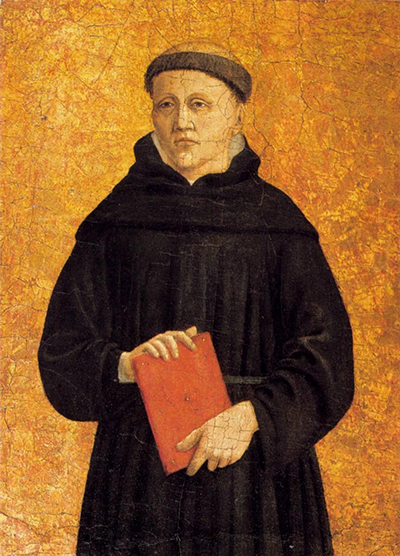
A young friar in a black habit holds a closed red book and turns his eyes to the viewer’s left. This small painting by Piero della Francesca, now in the Frick Collection in New York, belonged to the Augustinian Polyptych, made for the high altar of Sant’Agostino in Borgo San Sepolcro between 1454 and 1469. The Frick exhibited it as An Augustinian Friar (Saint Leonard?). The question mark concerns the friar’s name. Piero’s authorship and the panel’s association with the altarpiece are the basis on which both the Frick and Museo Poldi Pezzoli presented the work. [1] [2] [3]
At a Glance
- ArtistPiero della Francesca [1] [3]
- TitleAn Augustinian Friar (Saint Leonard?) in the Frick’s 2013 exhibition [1]
- Date1454–1469, the customary dates of the commission [1] [3]
- MediumOil and tempera on poplar in the Frick checklist, with a gilded background [1] [3]
- SizeApproximately 40 × 28.2 cm [3]
- CollectionThe Frick Collection, New York, acquired in 1950 [2] [3]
- Original settingHigh altarpiece of Sant’Agostino in Borgo San Sepolcro, probably among the figures on the lateral piers [3] [4]
This work across Piero della Francesca’s career
The Baptism of Christ
Probably about 1437–45The History of the True Cross
Mid-fifteenth centuryAn Augustinian Saint (current article)
1454–69, Augustinian PolyptychThe Resurrection
About 1458–68 (Opificio)The Flagellation of Christ
1459–60 (GNDM)The Montefeltro Altarpiece
About 1472–74 (Brera)The Duke and Duchess of Urbino
About 1473–75 (Uffizi)The Nativity
Early 1480s (National Gallery)Contents
- The friar and his red book
- How far can we identify the friar?
- Two other Augustinian figures from the altarpiece
- Reconstructing the friar’s original setting
- From Sansepolcro to New York and Milan
- Annotated details
The friar and his red book
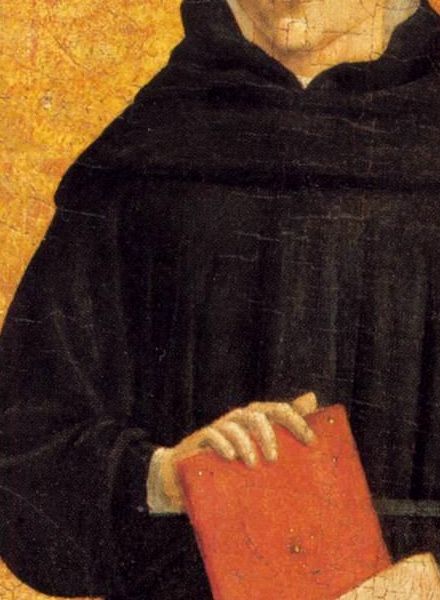
Piero has given the friar only a few things to hold our attention. The cowl falls away from his clean-shaven face and spreads over his shoulders. A muted light models the forehead, the cheek and the rounded chin, giving the head a weight that its small scale might lead us to underestimate. The eyes travel further left than the tilt of the shoulders suggests. Follow that glance and you reach the edge of the panel before you reach anything the friar could be looking at. The direction is clear even as its original destination remains uncertain. [2] [5]
The book draws attention back down into the panel. The red cover has a different intensity from the warm gilding behind the head and the quieter tones of the flesh. Both hands steady the book, and the fingers articulate its edges. It has enough thickness to interrupt the broad surface of the habit. The friar holds it closed and looks away from it, so the scene can suggest attentiveness or contemplation without depicting an act of reading. There is no visible title to tell us which text the painter meant. The book gives the figure a connection to study and devotion. Its colour and its place in the composition make that connection visible from farther away than the fingers or the expression. [2] [5]
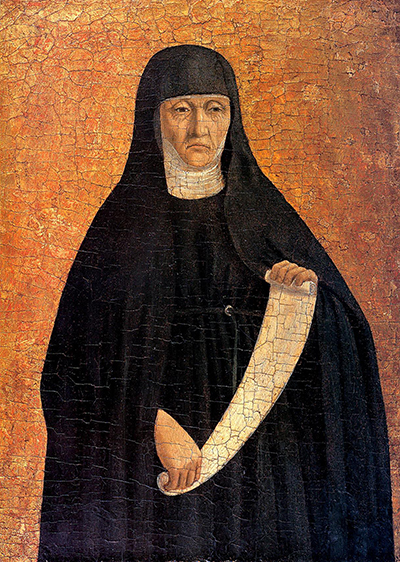
In the Frick’s companion panel, the Augustinian nun traditionally called Saint Monica holds a scroll and turns in the opposite direction. The two pictures are close in size, and both set a dark habit against gold. The scroll can be unfurled and read, while the red volume encloses whatever text it contains. Their poses and objects give them separate characters while allowing the figures to answer one another across the larger altarpiece. The resemblance helps explain why scholars have considered them together, although their joint acquisition by the Frick tells us about their modern history and gives no independent proof of their positions in the original frame. [1] [2] [3]
How far can we identify the friar?
The black habit and tonsure identify the figure with the Augustinian community for which the altarpiece was painted. The book is an attribute in the broad sense, an object associated with the figure. In the same ensemble, Saint Apollonia’s pincers hold the tooth that identifies her through the story of her martyrdom. A closed book can be given to many holy figures, as can the plain habit of a religious order. The Frick’s 2013 title and the Poldi Pezzoli’s detailed 2024 checklist both register this uncertainty. Some of the Milan exhibition’s shorter captions use the name Saint Leonard on its own. [1] [3] [5] [6]
There is a local reason to consider Leonard. Scholarship on Sansepolcro’s religious origins records a tradition that the earliest foundation associated with the town’s abbey was dedicated to him. That makes the name plausible in a painting for the town. The panel itself supplies no clear fetter, the kind of attribute associated with Leonard’s protection of prisoners. A local dedication and a recognisable habit are different kinds of evidence. Neither establishes who the patron or painter had in mind for this figure. [2] [7] [8]
An alternative with a particularly close connection to the church is Blessed Angelo Scarpetti, an Augustinian friar venerated in Sansepolcro. Millard Meiss tentatively named Scarpetti in a 1951 report on the Frick’s new acquisitions. Andrea Di Lorenzo took up the identification in the research surrounding the Poldi Pezzoli’s 1996 reconstruction. Cecilia Pallone discusses the young, beardless figure and the absence of a marked halo or rays around the head. Andrea Czortek relates the panel to the local cult and to another proposed image of Scarpetti showing a friar with a book, itself an uncertain identification. This evidence explains the appeal of the suggestion without settling the question. Pallone also raised the separate possibility of a collaborator’s participation. The two museums exhibit the panel under Piero’s name, and the disagreement about the saint’s identity can stand on its own. [1] [3] [9] [10] [11]
Annotated Details from An Augustinian Saint, possibly Saint Leonard
The numbered points identify visible features discussed in this article. Return from each detail to the numbered overview. An Augustinian Saint, possibly Saint Leonard, The Frick Collection, New York. Image source. Public domain.
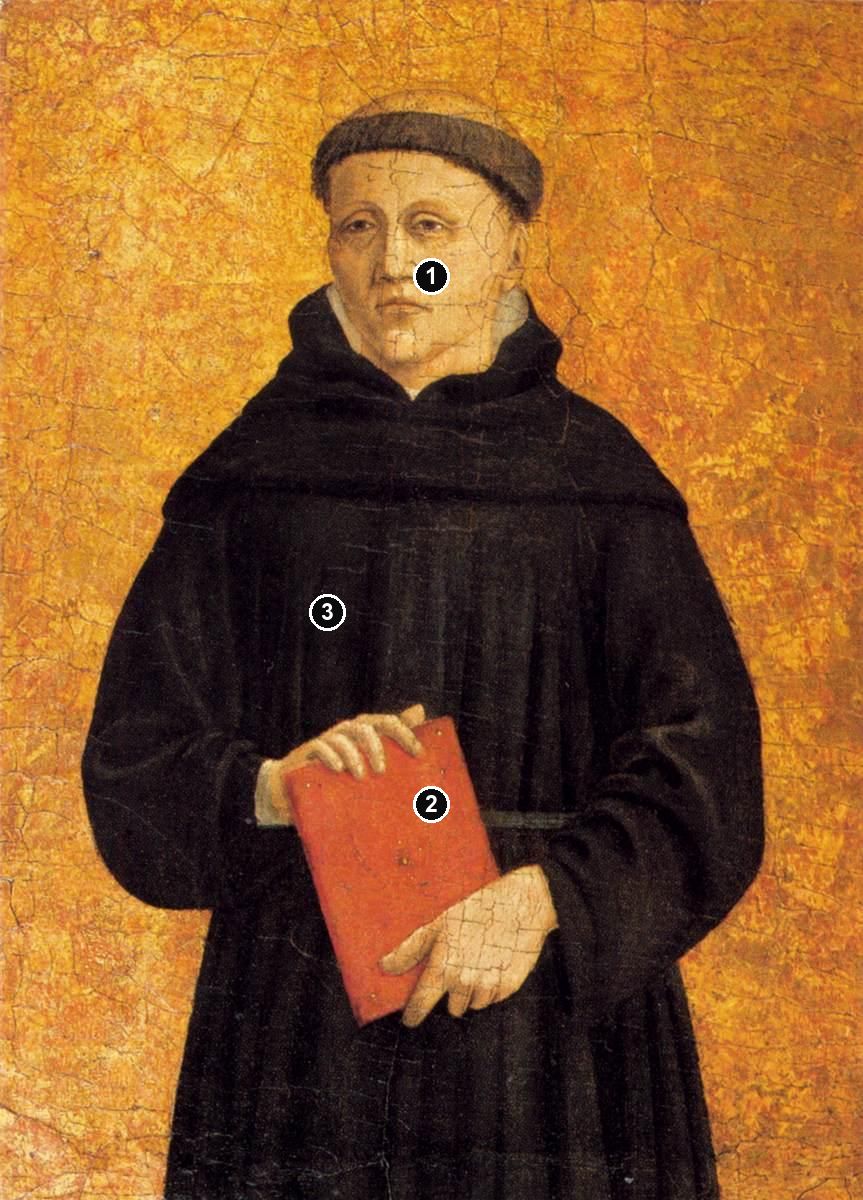
Details from AN AUGUSTINIAN SAINT, POSSIBLY SAINT LEONARD
Compare the cropped details with the source images above. Notice how their colours, shapes and positions contribute to the larger compositions.
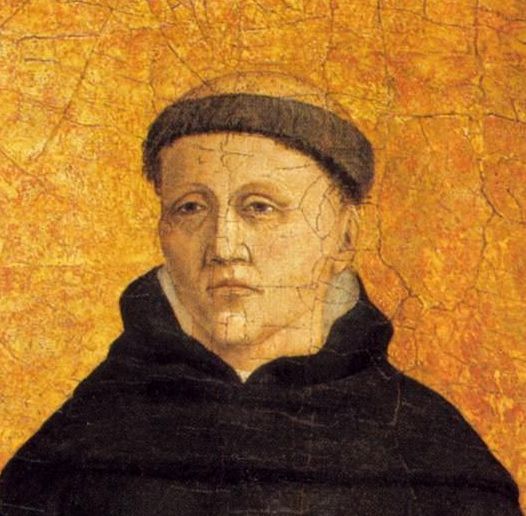
The lowered face
A broad interval of gold surrounds the head. The cap and folded cowl darken the edges of a face modelled with lighter areas around the brow and cheeks.
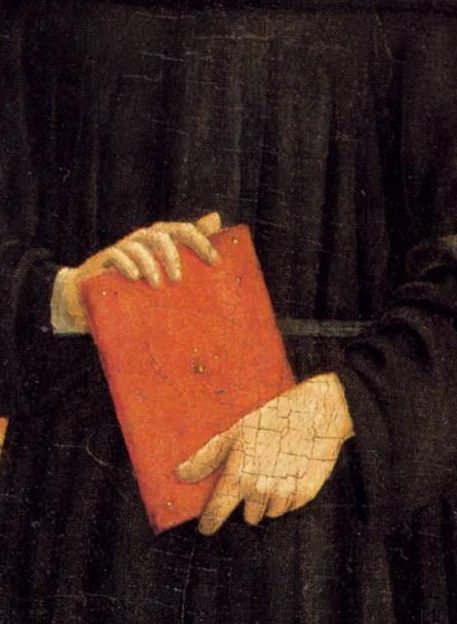
The closed red book
The pale fingers cross over the edges of the book and frame a patch of uninterrupted red on the dark habit.
The dark habit
The fall of the garment disappears into a dark mass around the arms. Slight changes in value make some folds visible next to the gold.
Two other Augustinian figures from the altarpiece
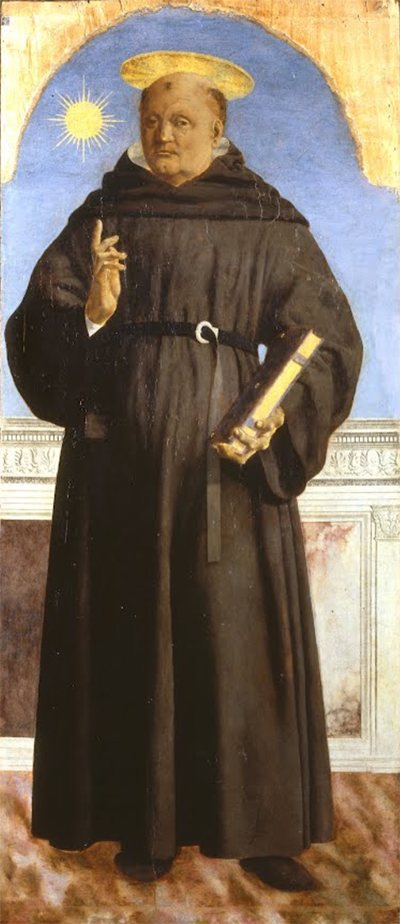
Saint Nicholas of Tolentino, now in Milan, also wears a black Augustinian habit. Nicholas holds a book too, but he gestures towards a star, his identifying attribute. His full-length figure stands against a blue sky and a marble parapet in one of the four large surviving panels from the principal tier. The small Frick friar has a gold background, a youthful face, and two hands occupied with the red volume. The two figures show how Piero could use the same order’s dress at different scales and give the dress a different visual weight in each setting. [2] [3] [4]
The Saint Augustine in Lisbon is the other likely source of confusion because the ensemble is also known as the Saint Augustine Altarpiece. Augustine occupies the far left of the main tier in the published reconstruction. He appears as a bishop, with a mitre, crozier and richly decorated cope. The Frick friar’s panel is about 40 centimetres high, while the 2024 checklist records the Lisbon panel at 135.5 centimetres. Comparing their clothes across those different scales brings out the status and function of each figure. Augustine’s vestments give prominence to the church’s patron saint. The little painting brings one member of the company of holy figures close enough for us to see the pressure of his fingers on a book. [2] [3] [4] [12]
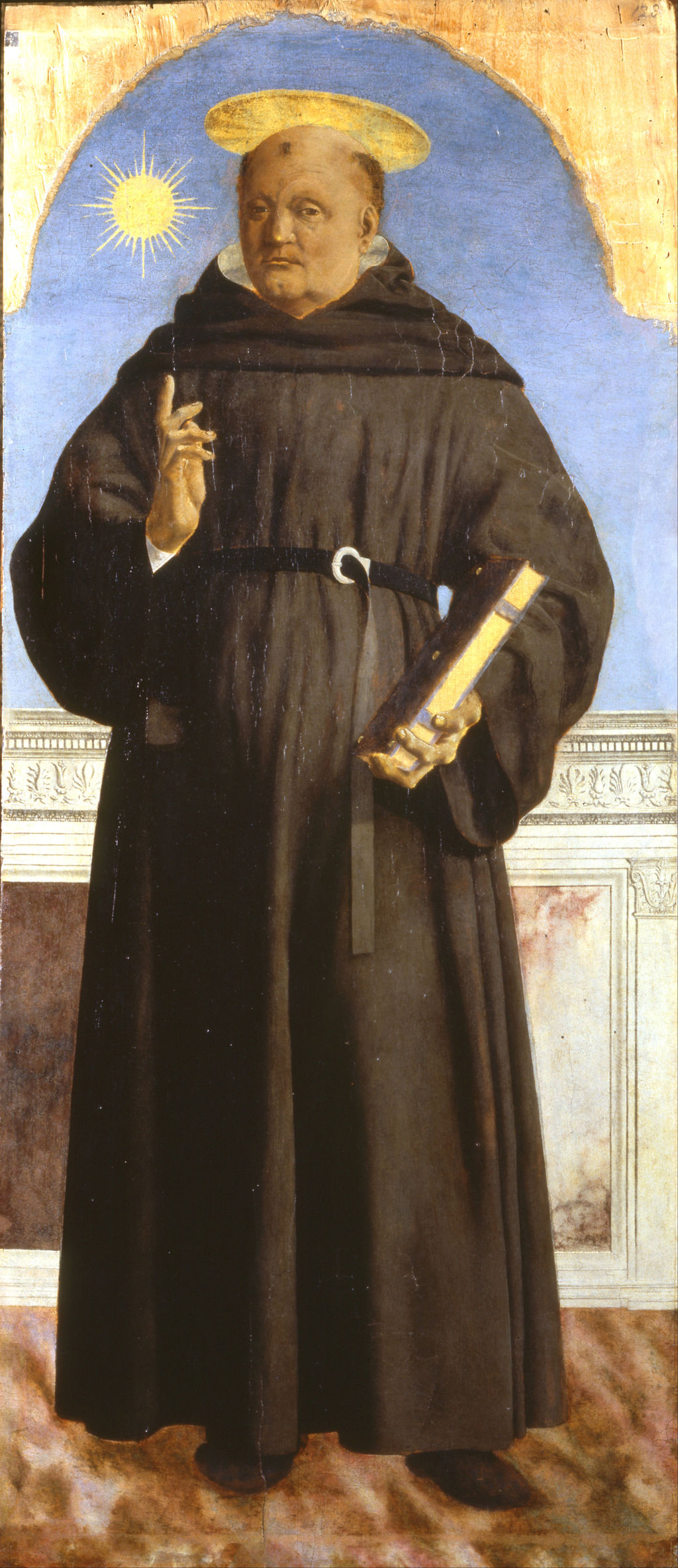
Piero della Francesca, Saint Nicholas of Tolentino, Museo Poldi Pezzoli, Milan. Image source. Public domain. Resized only; native appearance preserved.
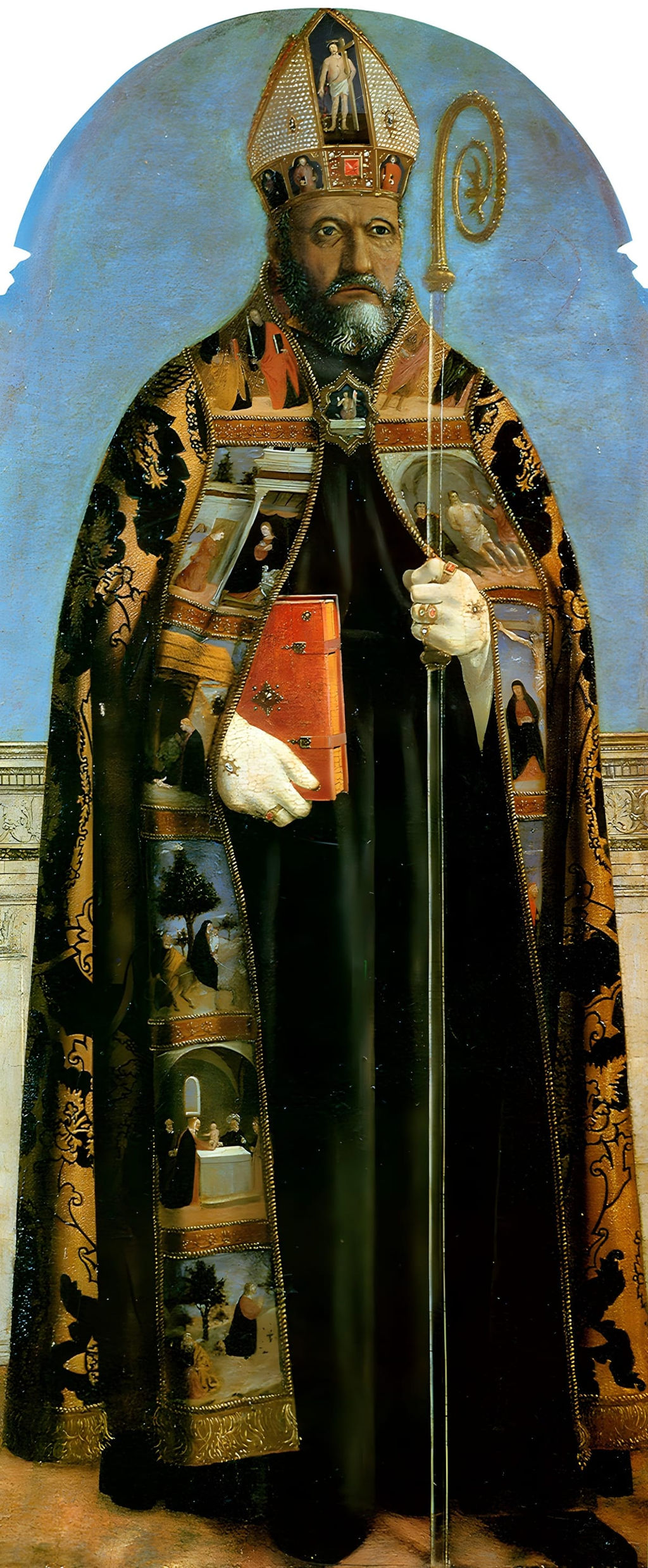
Piero della Francesca, Saint Augustine, surviving panel from the Augustinian Polyptych, Lisbon. Image source. Public domain. Resized only; native appearance preserved.
Reconstructing the friar’s original setting
The altarpiece was commissioned in 1454 and was substantially complete in 1469. The contract provided for Piero to use an existing structure of late-medieval type. The date range identifies the commission to which the friar belongs, while the year Piero painted this individual panel remains unknown. The Frick’s 2013 checklist gives oil and tempera on poplar and records the panel at 15.7 × 11.1 inches. The Milan checklist lists oil and gold on panel and lists 40 × 28.2 centimetres. The dimensions identify the same small painting. The institutional descriptions place different emphasis on the painting medium and gilding. Brüggen Israëls reported that re-examining paint samples from the polyptych showed a predominance of oil. Her summary describes the technique of the ensemble, while the two checklists refer to this particular object. [1] [3] [6]
Even after scholars had associated the friar with the commission, they disagreed over where its frame once held him. In an early account, Millard Meiss placed the small saints above the large figures. The Frick’s 2013 diagram placed the friar low on the right, with the nun across the composition to the left. The Poldi Pezzoli assigns these small saints to the supporting piers at the sides of the altarpiece. The distinction matters because a pier is a structural upright, while the predella is the painted band at the base that included narrative scenes such as the surviving Crucifixion. A low position does not necessarily put a panel in that narrative row. A leftward glance makes good compositional sense for a friar on the viewer’s right. Its direction is one clue among several when the original frame is missing. [2] [3] [4] [11]
The 2024 technical campaign gave the discussion a firmer material basis. Brüggen Israëls reported evidence across the predella and pier panels that Piero applied a fresh gesso preparation over an older one. Gesso is the ground that prepares wood to receive gilding or paint. The older ground beneath it is a physical trace consistent with the contract’s requirement to reuse an existing structure. The researchers also found remnants of pink and blue wings on the neighbouring edges of the large Saint Michael and Saint John panels. Those traces, together with fragments of a mantle and steps, support the reconstruction of a Coronation of the Virgin in the missing centre. The wing fragments tell us what crossed from the centre into the main panels. The layered ground helps explain how the smaller paintings were made. Each finding answers a different question about the ensemble. [3]
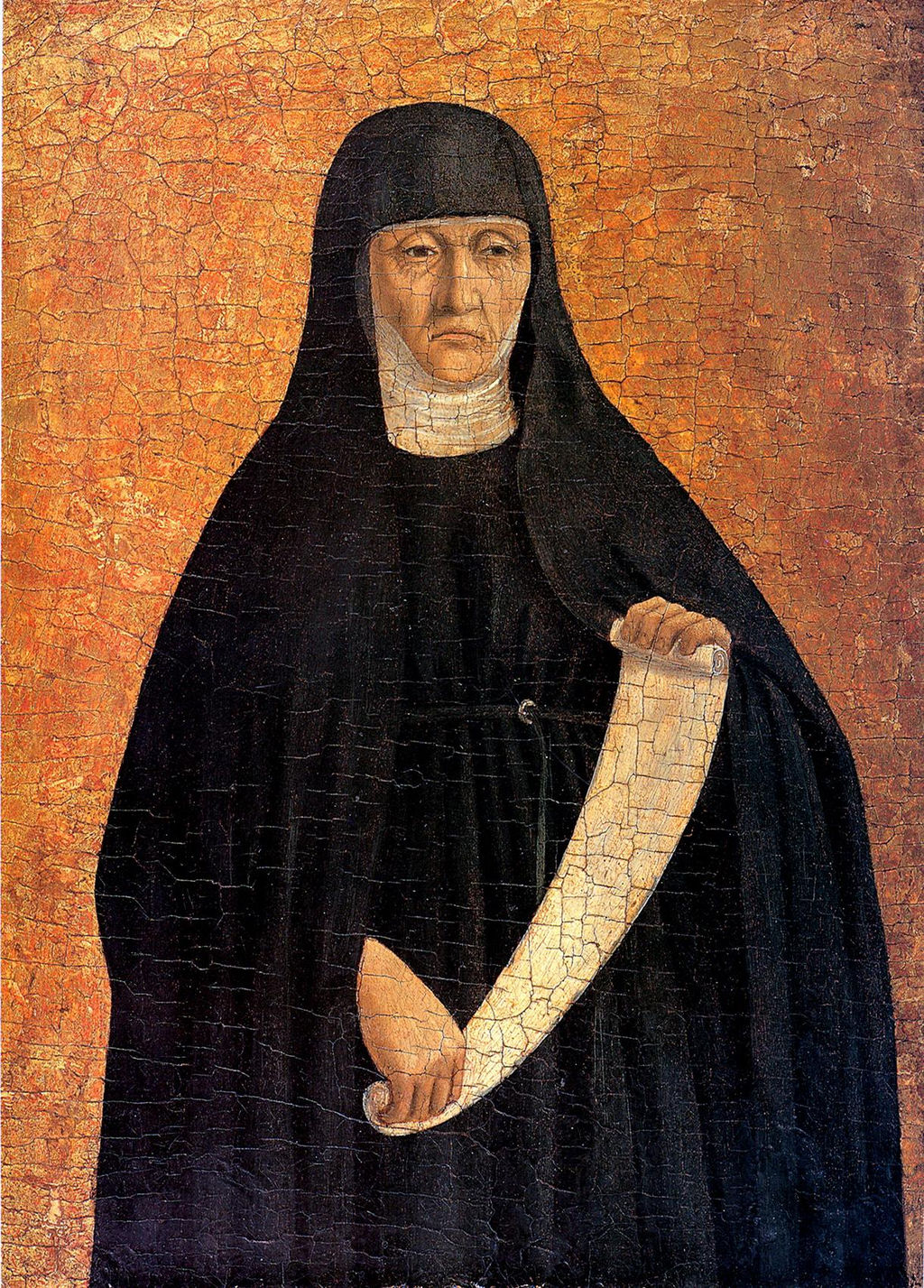
An Augustinian Nun (Saint Monica), from the Augustinian Polyptych, The Frick Collection. Image source. Public domain. Resized only; native appearance preserved.
From Sansepolcro to New York and Milan
The panels dispersed after the altarpiece left its original setting. The National Gallery of Art’s provenance research on Saint Apollonia traces the small saints to the Franceschi Marini collection in Sansepolcro. Nineteenth-century observers described several of them framed together and disagreed about whom they represented. That later grouping helps establish a shared collecting history. The same research records both Frick panels at the Liechtenstein Gallery in Vienna by 1911. They entered the Frick in 1950, fourteen years after the museum acquired Piero’s Saint John the Evangelist. The Crucifixion joined them in 1961. [2] [6]
The Frick displayed six of the eight known surviving altarpiece panels together in 2013. In 2024 the Museo Poldi Pezzoli brought all eight together from five museums, with the centre and much of the base still missing. The reunion restored a sense of the contrast between the full-length saints and the smaller gilded figures. The friar’s presence in the same room as Nicholas and Augustine made the distinctions unusually easy to see. It also restored something that the painting loses in isolation. Standing among paintings made for the same altar, the young friar has a company of figures towards whom his gesture and attention can be read. [2] [3] [5]
Browse the artworks
Compare Piero’s frescoes, panels and manuscript figures. The list includes ensembles and separately identifiable panels or scenes. Dates are approximate where the sources differ.
| Name | Date | Medium and source |
|---|---|---|
| The Baptism of Christ | Probably c. 1437–45 | Panel painting Catalogue. |
| The Flagellation of Christ | 1459–60 (GNDM) | Panel painting Catalogue. |
| The History of the True Cross | Mid-fifteenth century | Wall painting Catalogue. |
| Dream of Constantine | Mid-fifteenth century | Wall painting Catalogue. |
| The Duke and Duchess of Urbino | About 1473–75 (Uffizi) | Panel painting Catalogue. |
| The Resurrection | About 1458–68 (Opificio) | Wall painting Catalogue. |
| Brera Madonna | About 1472–74 | Panel painting Catalogue. |
| Annunciation at Arezzo | Mid-fifteenth century | Wall painting Catalogue. |
| Madonna del Parto | About 1450–65 (Monterchi) | Wall painting Catalogue. |
| Polyptych of the Misericordia | Commissioned 1445 | Panel painting Catalogue. |
| The Nativity | Early 1480s (National Gallery) | Panel painting Catalogue. |
| Madonna di Senigallia | About 1474–75 (GNDM) | Panel painting Catalogue. |
| Death of Adam | Mid-fifteenth century | Wall painting Catalogue. |
| Queen of Sheba | Mid-fifteenth century | Wall painting Catalogue. |
| Victory of Constantine | Mid-fifteenth century | Wall painting Catalogue. |
| Battle between Heraclius and Chosroes | Mid-fifteenth century | Wall painting Catalogue. |
| Saint Mary Magdalen | Wall painting Catalogue. | |
| The Augustinian Polyptych | 1454–69 | Panel painting Catalogue. |
| Polyptych of Perugia | About 1467–69 (GNU) | Panel painting Catalogue. |
| Perugia Annunciation | About 1468–70 (national catalogue) | Panel painting Catalogue. |
| St Francis and St Elizabeth | About 1467–69 (GNU) | Panel painting Catalogue. |
| Stigmatisation of St Francis | About 1468–70 (national catalogue) | Panel painting Catalogue. |
| An Augustinian Nun (Saint Monica) | 1454–69 | Panel painting Catalogue. |
| Augustinian Saint | 1454–69 | Panel painting Catalogue. |
| Saint Michael | 1454–69 | Panel painting Catalogue. |
| Saint Nicholas of Tolentino | 1454–69 | Panel painting Catalogue. |
| Saint John the Evangelist | 1454–69 | Panel painting Catalogue. |
| Virgin and Child Enthroned with Four Angels | About 1460–70 (Clark) | Panel painting Catalogue. |
| Portrait of Sigismondo Pandolfo Malatesta | About 1450–51, often proposed. Louvre catalogue range 1450–75. | Panel painting Catalogue. |
| Sigismondo before St Sigismund | 1451 | Wall painting Catalogue. |
| St Jerome and a Donor | 1460s (Accademia); about 1450 also proposed | Panel painting Catalogue. |
| St Jerome in Penitence | 1450, dated on the panel | Panel painting Catalogue. |
| Saint Julian | About 1455–60, often proposed | Wall painting Catalogue. |
| Saint Augustine | 1454–69 | Panel painting Catalogue. |
| Saint Apollonia | 1454–69 | Panel painting Catalogue. |
| Crucifixion from the Augustinian Polyptych | 1454–69 | Panel painting Catalogue. |
| Saint Louis of Toulouse | Wall painting Catalogue. | |
| Burial of the Wood | Mid-fifteenth century | Wall painting Catalogue. |
| Discovery and Proof of the True Cross | Mid-fifteenth century | Wall painting Catalogue. |
| Exaltation of the Cross | Mid-fifteenth century | Wall painting Catalogue. |
| Saint Anthony Raises a Child | About 1467–69 (GNU) | Panel painting Catalogue. |
| Saint Elizabeth Revives a Child | About 1467–69 (GNU) | Panel painting Catalogue. |
| Hercules | About 1470 | Wall painting Catalogue. |
| Portrait of a Boy (possibly Guidobaldo da Montefeltro) | Panel painting Catalogue. | |
| De prospectiva pingendi, Reggio Emilia witness (figures) | Manuscript diagrams Catalogue. | |
| The Interrogation of Judas | Mid-fifteenth century | Wall painting Catalogue. |
| Two prophets, Bacci Chapel | Mid-fifteenth century | Wall painting Catalogue. |
| Saint Clare of Assisi, upper predella | About 1467–69 (GNU) | Panel painting Catalogue. |
| Saint Agatha, upper predella | About 1467–69 (GNU) | Panel painting Catalogue. |
| Lost centre of the Augustinian Polyptych | 1454–69 | Lost panel or panels Catalogue. |
Frequently Asked Questions
Discussion
Look again at the images and ideas explored in An Augustinian Saint, possibly Saint Leonard. These editorial prompts invite your observations.
Reader Insights
Look at how the friar’s eyes and hands direct your attention in different ways. Where do you look first, and what brings you back?
Compare the two small Frick saints. How do the friar’s bound book and the nun’s scroll alter the effect of their otherwise similar black habits?
Imagine the friar at the base of a pier, then above one of the main saints. What would each placement do to the relationship between the viewer and the figure’s leftward gaze?
Join the Conversation
Share a detail, comparison or question about An Augustinian Saint, possibly Saint Leonard below.
References
- The Frick Collection, Piero della Francesca in America, exhibition image list, 2013, p. 2. View source.
- The Frick Collection, Piero della Francesca in America, exhibition account and reconstruction, 2013, pp. 1–3. View source.
- Museo Poldi Pezzoli, Piero della Francesca. Il polittico agostiniano riunito, exhibition dossier, 2024, checklist pp. 9–11 and Machtelt Brüggen Israëls, Le 5 scoperte del polittico agostiniano riunito, pp. 19–20. View source.
- Museo Poldi Pezzoli, Piero della Francesca, Saint Nicholas of Tolentino, collection entry. View source.
- Museo Poldi Pezzoli, Piero della Francesca. The Augustinian Polyptych Reunited, 2024 exhibition and reconstruction. View source.
- National Gallery of Art, Washington, Piero della Francesca, Saint Apollonia, object record and provenance notes. View source.
- Renana Bartal, The Stone of Sansepolcro: Relic, Image, and the Resurrection of Jerusalem in Tuscany, Codex Aqvilarensis 35, 2019, p. 292. View source.
- London Museum, St Leonard, fifteenth-century object record and account of the saint’s attributes. View source.
- Cecilia Pallone, Il beato agostiniano Angelo Scarpetti da Sansepolcro: vicenda biografica, culto e iconografia, in Gli Agostiniani a Sansepolcro e il beato Angelo Scarpetti, 2009, p. 102. View source.
- Andrea Czortek, Scarpetti, Angelo, Dizionario Biografico degli Italiani, vol. 91, 2018. View source.
- Renaissance News, Projects and News, report by Millard Meiss on the Frick’s recent acquisitions, vol. 4, no. 2, 1951, p. 28. View source.
- National Gallery, London, Piero della Francesca, Saint Michael, collection entry. View source.
Related Paintings
The Augustinian Polyptych
Piero della Francesca, Saint Augustine, surviving panel from the Augustinian Polyptych, Lisbon. Image source. Public domain. Resized only; native appearance preserved.