 by Tom Gurney
Tom Gurney BSc (Hons) is an art history expert with over 20 years experience
Published on June 19, 2020 / Updated on October 14, 2023
Email: tomgurney1@gmail.com / Phone: +44 7429 011000
Saint Michael: Introduction
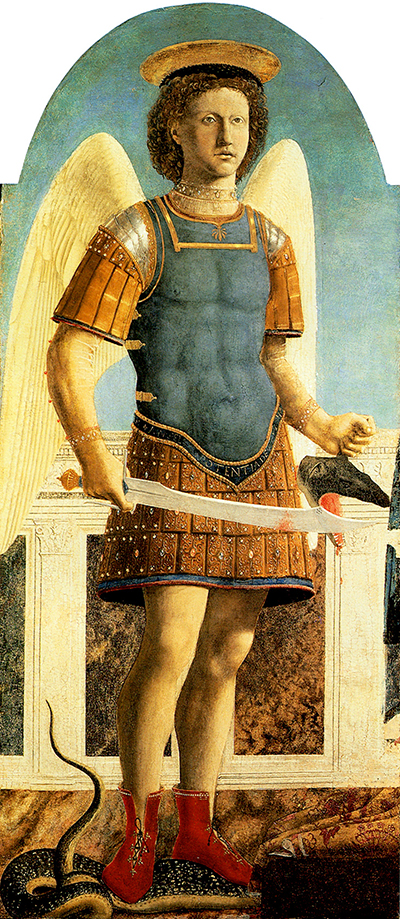
Piero della Francesca shows the Archangel Michael after his victory. His sword is down, the devil’s scaly body is under his red boots and its severed head hangs from his left hand. Behind the archangel’s pale wings, a blue sky opens above a marble parapet. At the bottom right, a patterned mantle and a dark stone step enter the picture from beyond its edge. These fragments tell a second story about the painting, which once occupied the place immediately to the left of the missing centre of Piero’s Augustinian Polyptych. The National Gallery in London bought the panel in 1867 and catalogues it as NG769. [1] [2] [3]
At a Glance
- ArtistPiero della Francesca. [1]
- DateThe altarpiece was commissioned in 1454 and was complete by 1469. [1] [2]
- MediumOil on wood, identified as poplar in the comparative technical study and listed as probably poplar by the National Gallery. [1] [4]
- Dimensions133 × 59.5 cm, as catalogued by the National Gallery. [1]
- CollectionThe National Gallery, London, NG769, purchased in 1867. [1]
- Original positionImmediately left of the lost central compartment of the high altarpiece of Sant’Agostino in Borgo Sansepolcro. [1] [3] [4]
This work across Piero della Francesca’s career
The Baptism of Christ
Probably about 1437–45The History of the True Cross
Mid-fifteenth centurySaint Michael (current article)
1454–69, Augustinian commissionThe Resurrection
About 1458–68 (Opificio)The Flagellation of Christ
1459–60 (GNDM)The Montefeltro Altarpiece
About 1472–74 (Brera)The Duke and Duchess of Urbino
About 1473–75 (Uffizi)The Nativity
Early 1480s (National Gallery)Contents
- The archangel after the battle
- Armour and the effects of oil paint
- A place to the left of the centre
- What the edge preserves
- Annotated details
The archangel after the battle
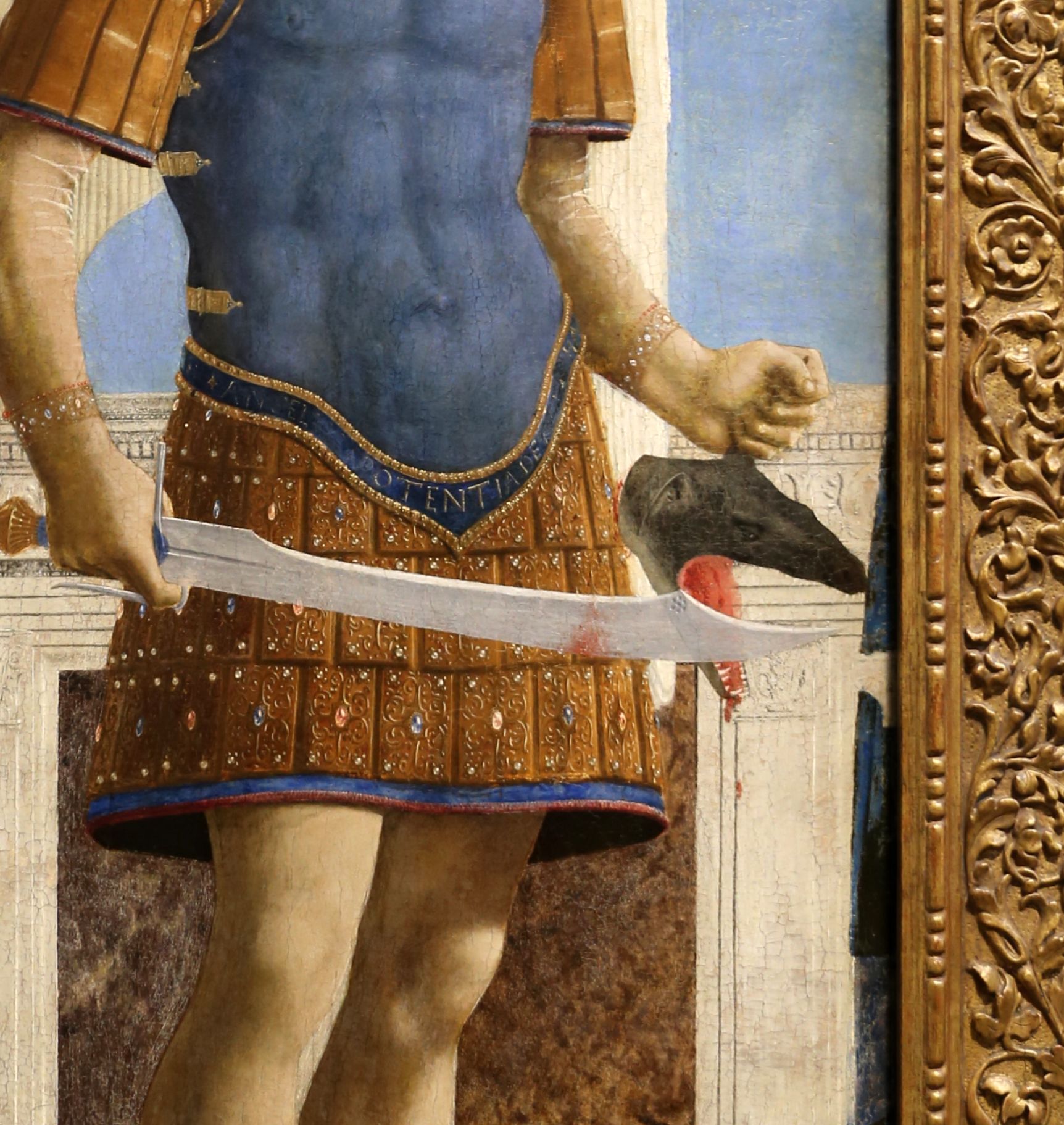
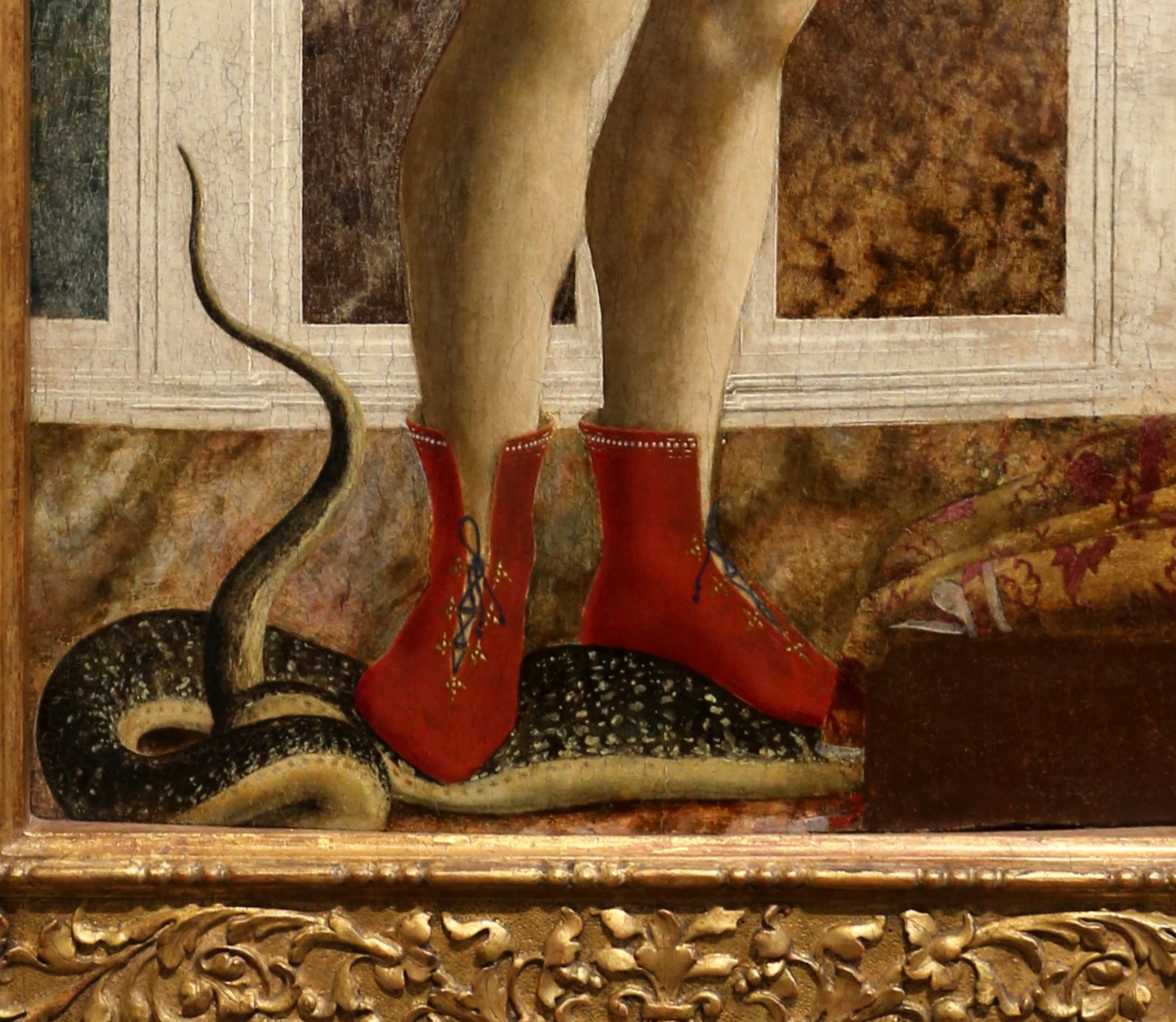
In the Book of Revelation, Michael and his angels fight a dragon that scripture also calls the ancient serpent, the devil and Satan. Piero gives that creature one dark, mottled body, a lighter underside and a tapering tail that rises on the viewer’s left. On the other side, Michael pinches one of the head’s pointed ears. The open jaws show teeth and red flesh. The body and head occupy different parts of the panel, so the eye must travel from his boots to his lifted fist to take in the result of the battle. The young soldier’s composed face and direct, slightly oblique gaze make the horror below it feel all the more deliberate. [1] [2]
Michael’s right hand, on the viewer’s left, holds a broad curved sword across the front of his skirt. Its point rises towards the right edge and a reddish trace marks the blade near the curve. Poldi Pezzoli identifies the form as a storta, a type of curved sword with late medieval as well as classical associations. The museum’s own later examples help explain the shape. Fulvio Cervini’s study of Piero’s painted weapons places such objects in a broader practice of combining antique and contemporary forms. The curved blade and the Roman-inspired armour can therefore belong to the same figure without implying a single historical set of equipment. [1] [3] [5]
Michael rests most of his weight on his left foot, on the viewer’s right. His other leg relaxes, and the slight shift through the hips and torso gives the stance the ease of classical contrapposto. The flat oval of the halo and the wide sweep of the white wings give the head a firm setting, while the curved weapon brings the eye back across the lower half. The two red boots are as bright as anything in the picture. They make the point of contact between the archangel and the serpent unmistakable, even at a distance. In a painting made to stand above a high altar, this distinction between large signals and minute detail matters. The silhouette, wings and sword establish the subject at a glance. A closer look reveals the workmanship of the armour and the creature’s scales. [1] [2]
Armour and the effects of oil paint
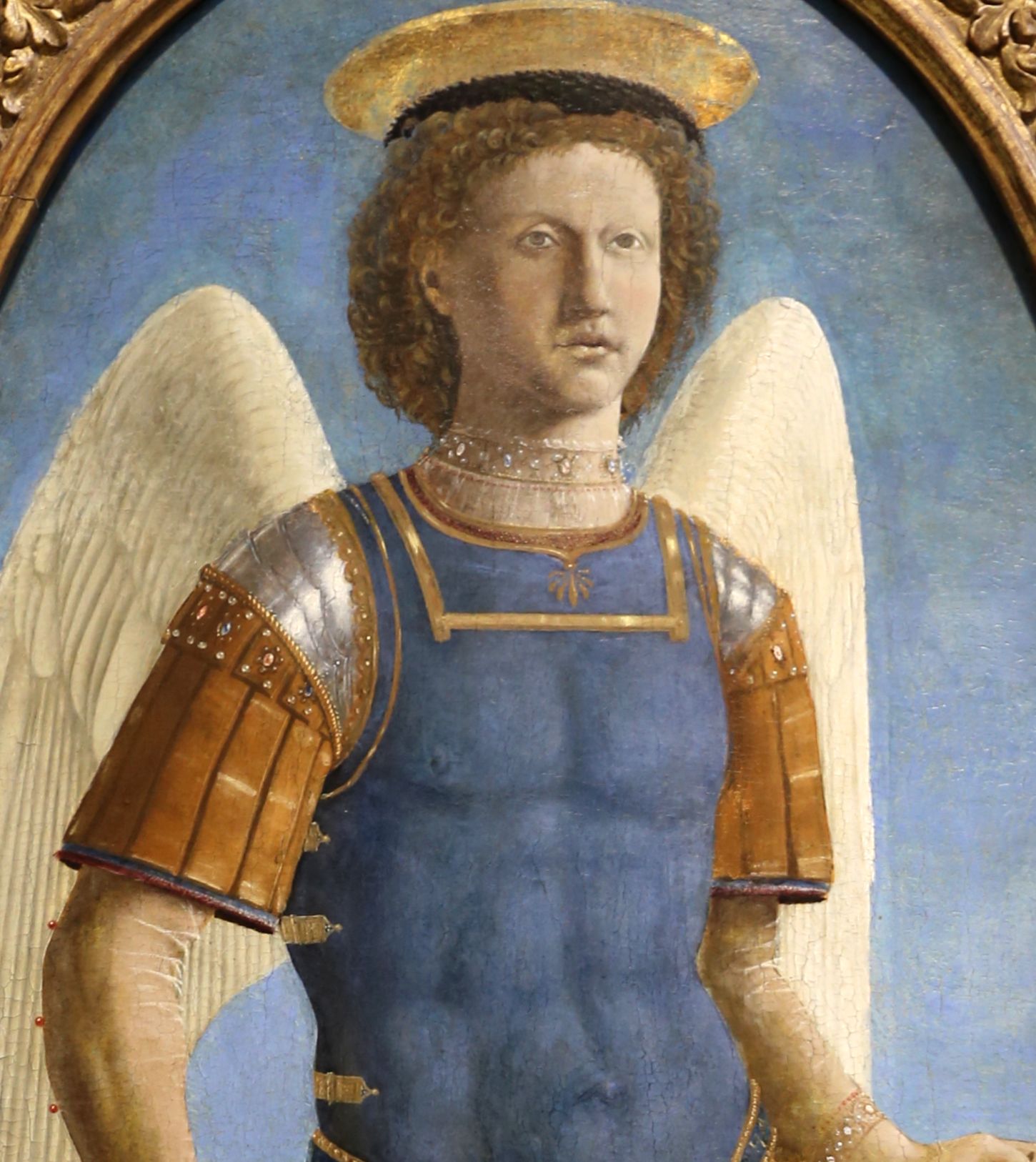
The blue breastplate follows the shape of the chest and abdomen like the muscled cuirass of an ancient commander. Its restrained modelling lets the shoulder pieces do something quite different. Their pale streaks and shorter, sharper highlights suggest metal catching reflections. At the neck and wrists tiny lights pick out bands of jewels, while the shoulder flaps and overlapping skirt panels carry a fine pattern of embellishment. The concentrated highlights make individual stones stand out against the warmer surface. The National Gallery’s imaging record reads a Latin inscription around the armour that names Michael, with a partly uncertain ending, and invokes the power of God. The letters follow the curved lower border of the cuirass, making the declaration part of the thing he wears. [1] [2] [3] [5]
The National Gallery describes the medium as oil on wood, probably poplar, and measures the picture at 133 × 59.5 cm. Roberto Bellucci, writing about examination by the Opificio delle Pietre Dure and its museum collaborators, identified a single broad poplar board for each of the four standing saints. His account records a major alteration to Michael’s support. It was thinned to about 1.5 cm, and the back was subsequently covered with canvas. That canvas belongs to the history of the panel’s support. The image on the front remains an oil painting made on wood. The current outline and thickness are the product of the panel’s subsequent life as well as of its fifteenth-century construction. [1] [4]
The preparations matter as much as the brushwork. In material examined from the polyptych, Bellucci reports a dark grey layer of gypsum and carbon black below the normal gesso preparation, and a layer of oil above the preparation and beneath colour in sampled areas. He suggests that the dark layer may have come from a woodworking practice. It is distinct from the visible blue sky, which is itself an important part of the design. The Milan exhibition team also re-examined earlier paint samples from the altarpiece and reported that oil predominated as a binder. It drew attention to very thin translucent glazes and cited the glitter of Michael’s painted jewels as one of their effects. Those results describe specific samples and effects. They leave room for differences in how Piero laid out and painted individual passages, from a smoothly shaded stretch of sky to a tiny glint in a jewel. [3] [4]
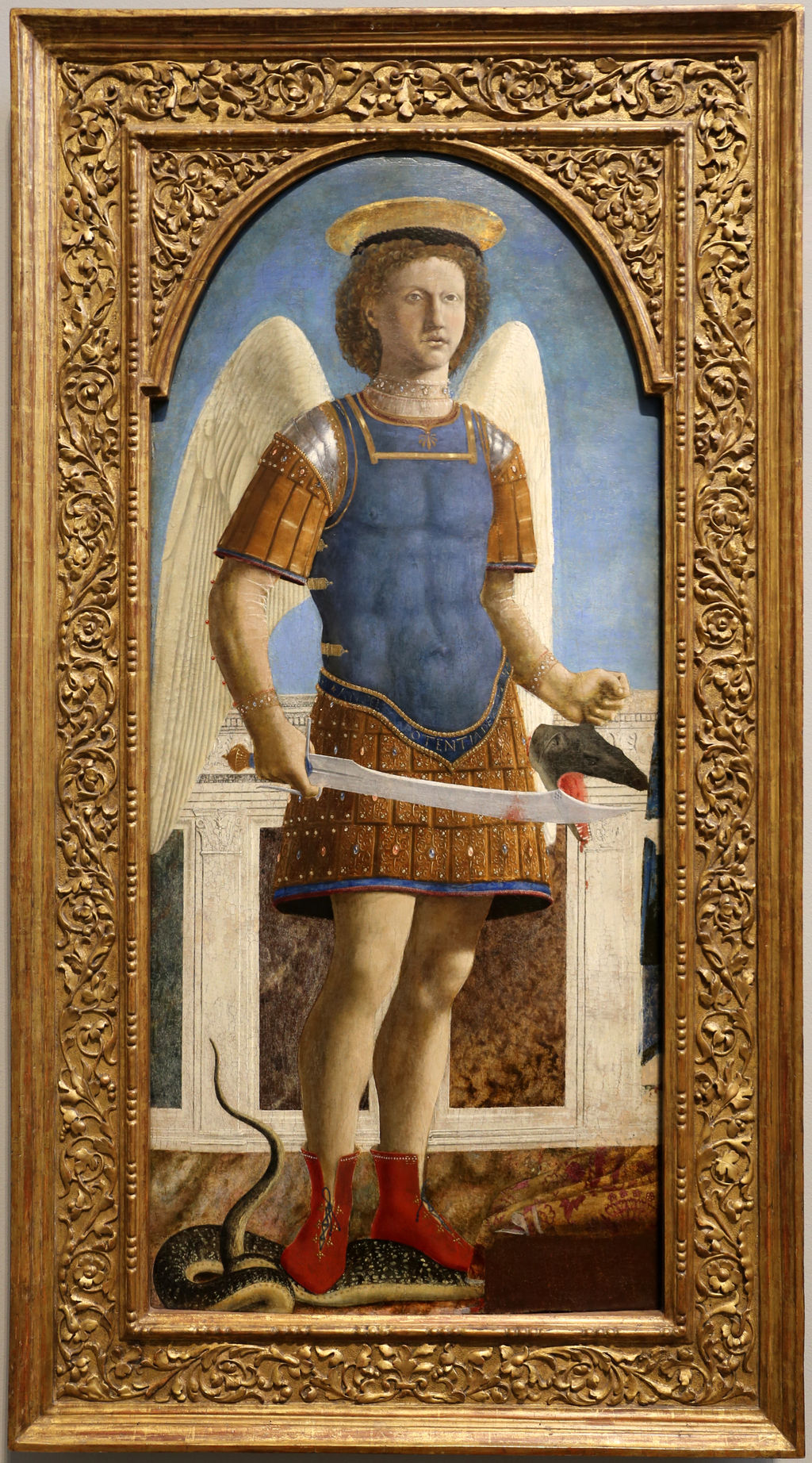
Piero della Francesca, Saint Michael, National Gallery, London. Sailko. Image source. CC BY 3.0. Resized from the source. This reproduction uses CC BY 3.0.
Annotated Details from Saint Michael
The numbered points identify visible features discussed in this article. Return from each detail to the numbered overview. Piero della Francesca, Saint Michael, National Gallery, London. Sailko. Image source. CC BY 3.0. The numbered overview and detail crops are adaptations under CC BY 3.0.
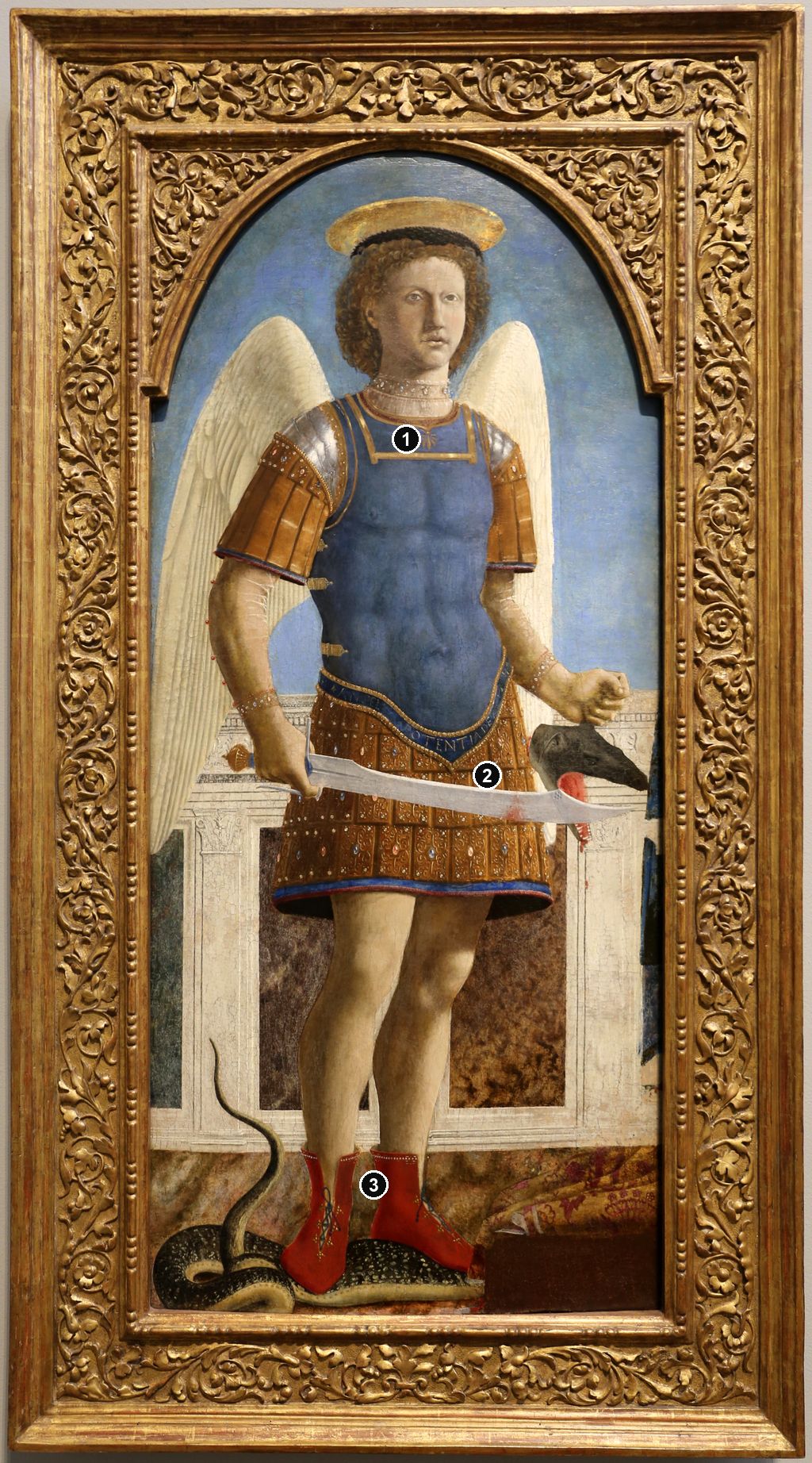
Details from SAINT MICHAEL
Compare the cropped details with the source images above. Notice how their colours, shapes and positions contribute to the larger compositions.
Elaborate mail and armour
Bands and patterned panels interrupt broad areas of blue armour. The nearer shoulder and folded wing remain distinct against the blue ground.
Sword and severed head
The sword follows a long line across the figure. At its far end the dark head reads against the pale support behind the saint.
Boots and dragon
The red boots stand out over a darker animal form close to the ground. Look too at the way its tail curls towards the frame.
A place to the left of the centre
The Augustinian friars and the patron Angelo di Giovanni di Simone contracted with Piero on 4 October 1454 for the high altar of Sant’Agostino in Borgo Sansepolcro. The evidence points to the altarpiece being substantially complete by November 1469, the year the National Gallery uses to date the London panel. A notarial act of 21 May 1470 records Piero’s brother Antonio issuing a final receipt on his behalf to Angelo’s heirs. The records establish the progress of the commission and leave the painting sequence of the individual saints open. [6] [7] The National Gallery suggests Michael’s presence may allude to Angelo’s name and points to the popularity of devotion to the archangel in Sansepolcro, where pilgrims travelled to his shrine at Monte Sant’Angelo in southern Italy. His place near the centre made a saint familiar to the town prominent in the friars’ altarpiece. [1] [2] [3]
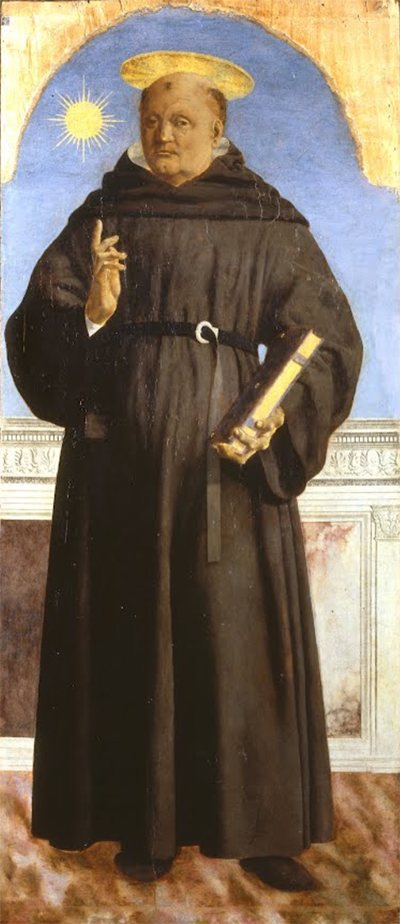
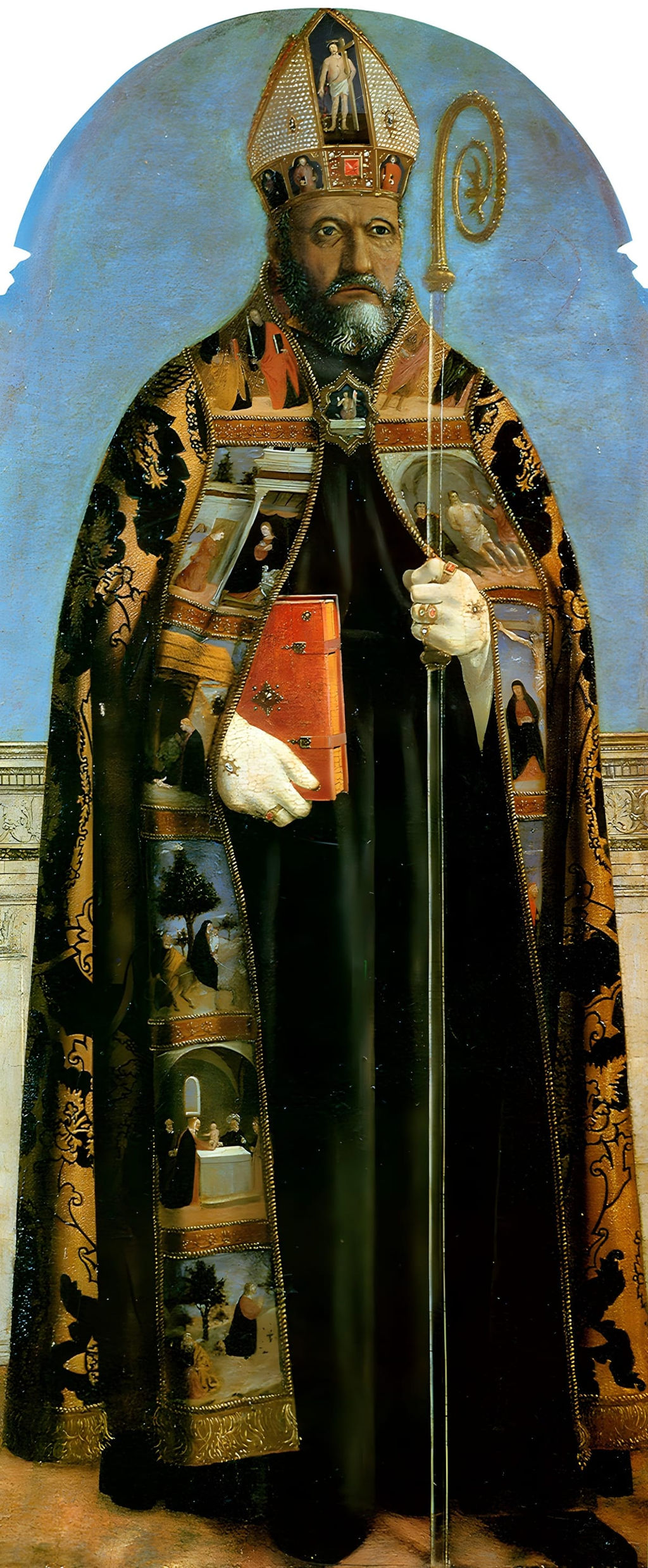
Across the main tier, the order from the viewer’s left was Saint Augustine, Saint Michael, the missing centre, Saint John the Evangelist and Saint Nicholas of Tolentino. Each saint has a different relationship with the viewer. Michael stands on alert. John, now at the Frick Collection, lowers his eyes to the open book and gathers his large red mantle around himself. Nicholas, now at the Museo Poldi Pezzoli, wears the black belted habit familiar to the original Augustinian congregation. His dark clothing makes the silhouette of the body and the way it stands in space especially clear. The bishop Augustine, now in Lisbon, wears a richly patterned cope, a counterpart to the archangel’s extravagantly worked military dress. The figures belong together because the sky, marble panelling and repeating architectural ornaments continue behind them. [1] [3] [8] [9] [10]
The join across the lost centre can also be studied through the marks Piero made before applying colour. Bellucci describes incised lines for the central steps on the facing edges of Michael’s and John’s panels. Extending these lines in a reconstruction brings them together on the base line of the parapet frieze. Combining this vanishing point with the rhythm of the wall’s rectangular panels, the study estimated that the central compartment was about one and a half times the width of an individual side panel. The altered perimeters and the loss of original fastenings complicate that estimate. Even so, the incisions and the repeated pattern show how Piero planned a continuous architectural space across separate pieces of wood. [4]
What the edge preserves
Look just beyond Michael’s left boot, towards the lower right corner. A fold of patterned fabric lies against a dark step. The step also has a counterpart at the facing edge of John’s panel. A nineteenth-century treatment shows how easily such evidence could disappear. Conservator Wendy Partridge documents that Giuseppe Molteni painted over the step and mantle to make Michael read as a complete individual painting. Her published photographs show the panel before and after removal of the overpaint. The exposed details show how the central compartment extended into the archangel’s foreground. [1] [4] [11]
There is another trace at the inner edge. For the 2024 Milan exhibition, the curators reported that stereomicroscopic examination identified minute remnants of pink and blue angel wings along the edges of Michael and John, both of which faced the missing compartment. The wings had extended from the central scene, brushing into its neighbours. The researchers interpret the tiny remnants as evidence that those wing tips were erased when the separated panels began to circulate as individual pictures. Michael’s own two pale wings are plainly visible behind his shoulders and belong to his figure. The evidence for the missing angels comes from the small traces at the seams. It gives a sense of how freely Piero could let a figure in one compartment reach into the space of another. [1] [3]
What did those angels flank? The National Gallery’s account identifies the lost centre as a Virgin and Child, drawing on historical descriptions, and reads the London step and cloth as part of the Virgin’s throne and cloak. In 2013 Nathaniel Silver, James R. Banker and Machtelt Israëls challenged the identification of a Madonna and Child from an 1825 church inventory with the centre of Piero’s altarpiece. Their objection was that companion panels supposedly listed beside it were already documented in a private collection centuries earlier. Their argument removes one apparent identification and leaves the surviving paint to be considered on its own terms. [1] [12]
The 2024 curators favoured a Coronation of the Virgin. In their reading, the fabric looks like crimson brocaded velvet lined with ermine and the steps imitate porphyry, a stone with royal associations. The wings make sense as angels attending a wide central scene in which Mary kneels to receive a crown from Christ. Steps and luxury fabric can belong to several Marian subjects. The argument for a Coronation comes from weighing the evidence together, and the centre itself remains missing. Thus the colours and the joined perspective are more secure than the identification of the precise action that once took place between Michael and John. [3] [4] [12]
The dispersal is itself part of the history of the picture. The Augustinians lost their original church in 1555. The date of dismantling remains disputed. The Poldi Pezzoli places dispersal by the end of the sixteenth century. The National Gallery of Art in Washington dates it to a later period, associating it with damage after the altarpiece’s transfer to another church. Documentation discussed by the Frick curators puts at least Augustine and John in a private collection by 1624 and the four large saints together in a private house in a record of 1680. [3] [12] [7] An account of Michael’s later provenance places it in Milan by 1861 and with Sir Charles Eastlake before its purchase from Lady Eastlake. In 1941 Millard Meiss used the then recently acquired Frick panel to strengthen the connection between the London, New York and Milan saints and the Sansepolcro contract. Kenneth Clark subsequently identified Lisbon’s Saint Augustine as a further part of the ensemble. In 2024 Milan brought together all eight known surviving panels. Seeing them as neighbours again helps recover the purpose of the passages that make such a strong impression in isolation, from the repeated bands of colour behind the saints to the tiny piece of mantle at Michael’s feet. [1] [2] [3] [13] [14] [15]
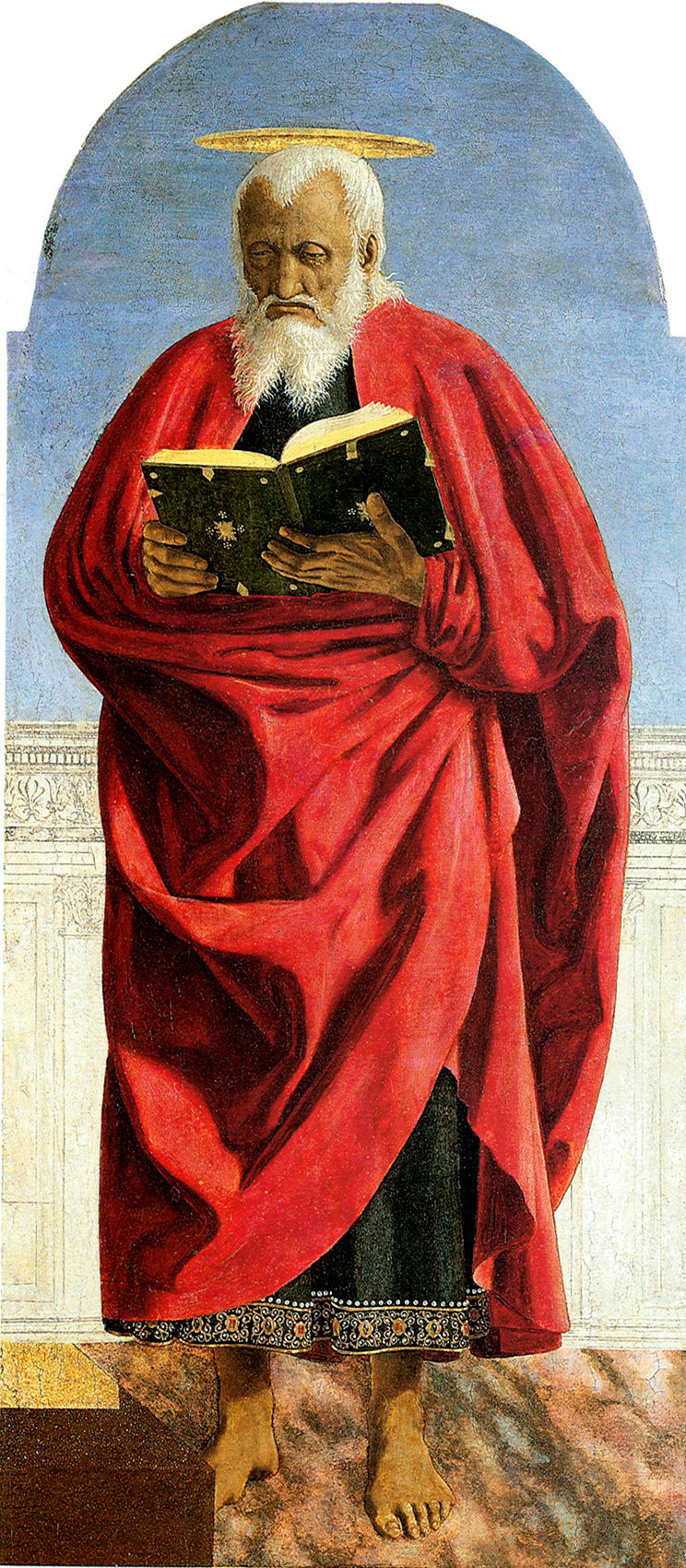
Piero della Francesca, Saint John the Evangelist, The Frick Collection, New York. Image source. Public domain. Resized only; native appearance preserved.
Browse the artworks
Compare Piero’s frescoes, panels and manuscript figures. The list includes ensembles and separately identifiable panels or scenes. Dates are approximate where the sources differ.
| Name | Date | Medium and source |
|---|---|---|
| The Baptism of Christ | Probably c. 1437–45 | Panel painting Catalogue. |
| The Flagellation of Christ | 1459–60 (GNDM) | Panel painting Catalogue. |
| The History of the True Cross | Mid-fifteenth century | Wall painting Catalogue. |
| Dream of Constantine | Mid-fifteenth century | Wall painting Catalogue. |
| The Duke and Duchess of Urbino | About 1473–75 (Uffizi) | Panel painting Catalogue. |
| The Resurrection | About 1458–68 (Opificio) | Wall painting Catalogue. |
| Brera Madonna | About 1472–74 | Panel painting Catalogue. |
| Annunciation at Arezzo | Mid-fifteenth century | Wall painting Catalogue. |
| Madonna del Parto | About 1450–65 (Monterchi) | Wall painting Catalogue. |
| Polyptych of the Misericordia | Commissioned 1445 | Panel painting Catalogue. |
| The Nativity | Early 1480s (National Gallery) | Panel painting Catalogue. |
| Madonna di Senigallia | About 1474–75 (GNDM) | Panel painting Catalogue. |
| Death of Adam | Mid-fifteenth century | Wall painting Catalogue. |
| Queen of Sheba | Mid-fifteenth century | Wall painting Catalogue. |
| Victory of Constantine | Mid-fifteenth century | Wall painting Catalogue. |
| Battle between Heraclius and Chosroes | Mid-fifteenth century | Wall painting Catalogue. |
| Saint Mary Magdalen | Wall painting Catalogue. | |
| The Augustinian Polyptych | 1454–69 | Panel painting Catalogue. |
| Polyptych of Perugia | About 1467–69 (GNU) | Panel painting Catalogue. |
| Perugia Annunciation | About 1468–70 (national catalogue) | Panel painting Catalogue. |
| St Francis and St Elizabeth | About 1467–69 (GNU) | Panel painting Catalogue. |
| Stigmatisation of St Francis | About 1468–70 (national catalogue) | Panel painting Catalogue. |
| An Augustinian Nun (Saint Monica) | 1454–69 | Panel painting Catalogue. |
| Augustinian Saint | 1454–69 | Panel painting Catalogue. |
| Saint Michael | 1454–69 | Panel painting Catalogue. |
| Saint Nicholas of Tolentino | 1454–69 | Panel painting Catalogue. |
| Saint John the Evangelist | 1454–69 | Panel painting Catalogue. |
| Virgin and Child Enthroned with Four Angels | About 1460–70 (Clark) | Panel painting Catalogue. |
| Portrait of Sigismondo Pandolfo Malatesta | About 1450–51, often proposed. Louvre catalogue range 1450–75. | Panel painting Catalogue. |
| Sigismondo before St Sigismund | 1451 | Wall painting Catalogue. |
| St Jerome and a Donor | 1460s (Accademia); about 1450 also proposed | Panel painting Catalogue. |
| St Jerome in Penitence | 1450, dated on the panel | Panel painting Catalogue. |
| Saint Julian | About 1455–60, often proposed | Wall painting Catalogue. |
| Saint Augustine | 1454–69 | Panel painting Catalogue. |
| Saint Apollonia | 1454–69 | Panel painting Catalogue. |
| Crucifixion from the Augustinian Polyptych | 1454–69 | Panel painting Catalogue. |
| Saint Louis of Toulouse | Wall painting Catalogue. | |
| Burial of the Wood | Mid-fifteenth century | Wall painting Catalogue. |
| Discovery and Proof of the True Cross | Mid-fifteenth century | Wall painting Catalogue. |
| Exaltation of the Cross | Mid-fifteenth century | Wall painting Catalogue. |
| Saint Anthony Raises a Child | About 1467–69 (GNU) | Panel painting Catalogue. |
| Saint Elizabeth Revives a Child | About 1467–69 (GNU) | Panel painting Catalogue. |
| Hercules | About 1470 | Wall painting Catalogue. |
| Portrait of a Boy (possibly Guidobaldo da Montefeltro) | Panel painting Catalogue. | |
| De prospectiva pingendi, Reggio Emilia witness (figures) | Manuscript diagrams Catalogue. | |
| The Interrogation of Judas | Mid-fifteenth century | Wall painting Catalogue. |
| Two prophets, Bacci Chapel | Mid-fifteenth century | Wall painting Catalogue. |
| Saint Clare of Assisi, upper predella | About 1467–69 (GNU) | Panel painting Catalogue. |
| Saint Agatha, upper predella | About 1467–69 (GNU) | Panel painting Catalogue. |
| Lost centre of the Augustinian Polyptych | 1454–69 | Lost panel or panels Catalogue. |
Frequently Asked Questions
There are minute remnants of painted wing tips on the sides of Michael and John that once faced the centre. The 2024 curators identified these as parts of angels that extended from the central composition. Along with the steps and fabric, they helped the curators propose a Coronation of the Virgin. The National Gallery’s entry retains the Virgin and Child identification. [1] [3]
Discussion
Look again at the images and ideas explored in Saint Michael. These editorial prompts invite your observations.
Reader Insights
Follow the two red boots, the curve of the tail and the line of the sword. At which point did you realise that the head and the coiled body belong to the same creature?
Compare the long edge of Michael’s panel with John’s corresponding edge. How do the surviving architectural lines change your sense of the empty space between the two figures?
Consider the step, fabric and wing fragments separately. Which tell you about the arrangement of the central scene, and which support a particular subject?
Join the Conversation
Share a detail, comparison or question about Saint Michael below.
References
- National Gallery, London. Saint Michael, NG769, object entry and provenance. View source.
- National Gallery Collection Imaging and Metadata. Saint Michael, NG769, extended object description. View source.
- Museo Poldi Pezzoli. Piero della Francesca. Il polittico agostiniano riunito, 2024 exhibition dossier, especially pp. 12–14, 19–20 and the itinerary on the arms collection. View source.
- Roberto Bellucci. Caro Marco, ancora Piero, 2025, p. 335 and following, publishing the Opificio delle Pietre Dure’s reconstruction research. View source.
- Fulvio Cervini. Sul filo tra antichi e moderni: le armi degli angeli (e degli uomini) secondo Piero, 2024, pp. 69–74, author’s abstract, Università degli Studi di Firenze. View source.
- Italian Renaissance Document Site. Final receipt of 21 May 1470, Archivio di Stato di Firenze, Notarile antecosimiano 12218, c. 71v, transcribed by James R. Banker and revised by Matteo Mazzalupi. View source.
- National Gallery of Art, Washington. Saint Apollonia, provenance and documentary notes on the Augustinian Altarpiece. View source.
- The Frick Collection. Saint John the Evangelist. View source.
- Museo Poldi Pezzoli. San Nicola da Tolentino. View source.
- The Frick Collection. Saint Augustine, from the Museu Nacional de Arte Antiga, Lisbon. View source.
- Wendy Partridge. Philosophies and Tastes in Nineteenth-Century Paintings Conservation, 2006, pp. 19–23, especially figures 2 and 3. View source.
- Nathaniel Silver, James R. Banker and Machtelt Israëls. The Lost Piero, 2013 scholarly exchange on the central panel. View source.
- Millard Meiss. A Documented Altarpiece by Piero Della Francesca, The Art Bulletin, 1941, pp. 53–68. View source.
- Museu Nacional de Arte Antiga. Santo Agostinho, de Piero della Francesca, Boletim do Museu Nacional de Arte Antiga, 1947, p. 214 and following. View source.
- Museo Poldi Pezzoli. Piero della Francesca. Il polittico agostiniano riunito, exhibition record, 2024. View source.
Related Paintings
The Augustinian Polyptych
Piero della Francesca, Saint Augustine, surviving panel from the Augustinian Polyptych, Lisbon. Image source. Public domain. Resized only; native appearance preserved.