 by Tom Gurney
Tom Gurney BSc (Hons) is an art history expert with over 20 years experience
Published on June 19, 2020 / Updated on October 14, 2023
Email: tomgurney1@gmail.com / Phone: +44 7429 011000
Annunciation (Arezzo) by Piero della Francesca: Introduction
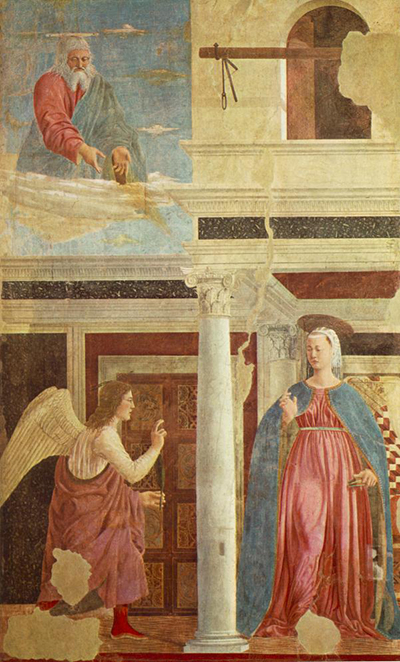
A pale column rises between the angel Gabriel and the Virgin Mary in Piero della Francesca’s Annunciation. Gabriel bends one knee and raises his hand. Mary stands under a porch with a small book in her left hand and turns towards him. Above the angel, God the Father extends his hands from the clouds. The encounter takes place on the lower left of the wall behind the high altar of San Francesco in Arezzo, where Piero painted the History of the True Cross. The scene introduces the human life of Christ into a cycle about the wood of his Crucifixion. [1] [2] [3]
At a Glance
- ArtistPiero della Francesca. [1] [2]
- MediumFresco. [1] [4]
- DateMid-fifteenth century, within the Bacci Chapel commission generally dated 1452–1466. [2] [3]
- LocationLower left of the altar wall as faced from the entrance, Bacci Chapel, Basilica of San Francesco, Arezzo, Italy. [2] [4]
- Companion sceneThe Dream of Constantine, across the chapel window on the lower right. [1] [2] [5]
- SubjectGabriel announces to Mary that she will bear Jesus, as told in Luke 1:26–38. [1] [6]
This work across Piero della Francesca’s career
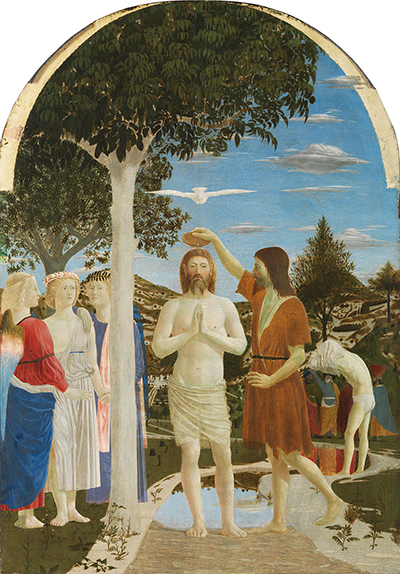
The Baptism of Christ
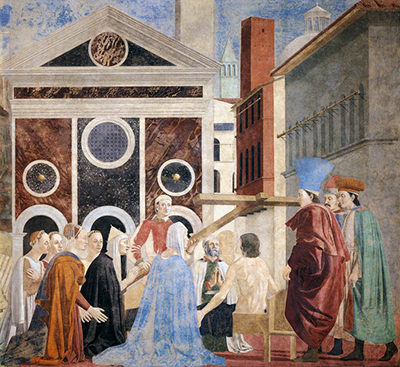
Probably about 1437–45The History of the True Cross
Mid-fifteenth centuryThe Annunciation at Arezzo (current article)
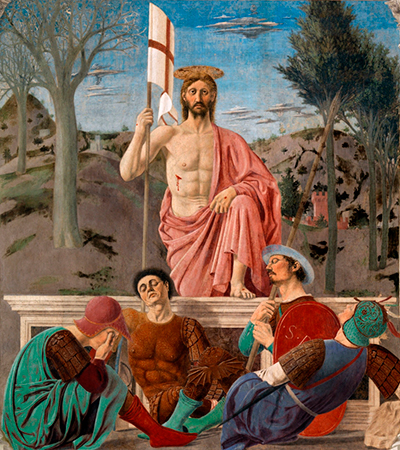
Within the Bacci Chapel campaign, 1452–66The Resurrection
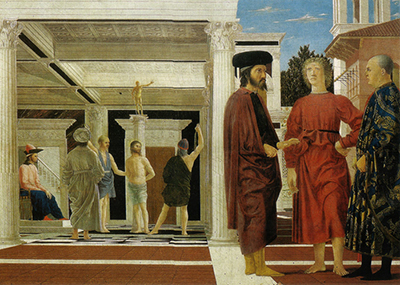
About 1458–68 (Opificio)The Flagellation of Christ
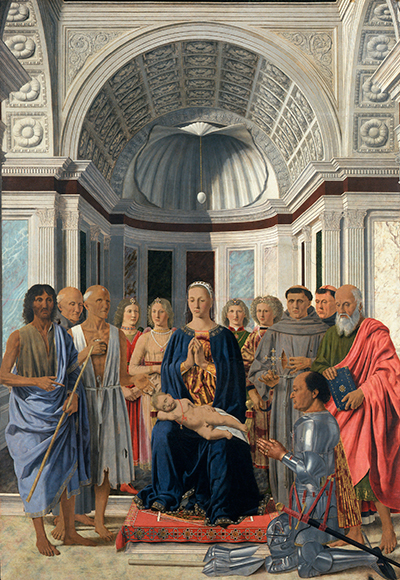
1459–60 (GNDM)The Montefeltro Altarpiece
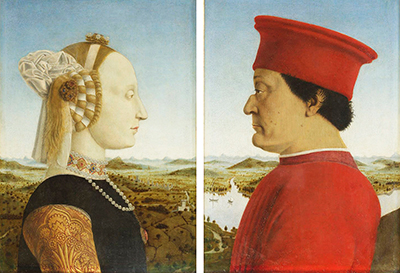
About 1472–74 (Brera)The Duke and Duchess of Urbino
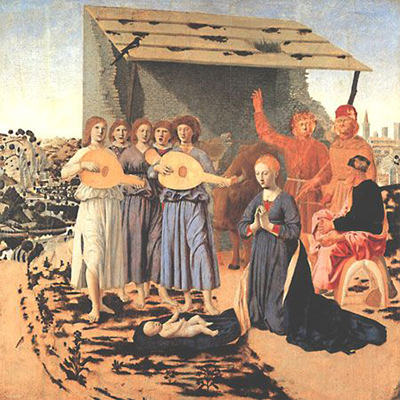
About 1473–75 (Uffizi)The Nativity
Early 1480s (National Gallery)Contents
- Gabriel’s greeting
- The porch, the column and the closed door
- Two kinds of light
- Why the Annunciation is beside the altar
- What the wall and photographs preserve
- The other Annunciation in Perugia
- Annotated details
Gabriel’s greeting
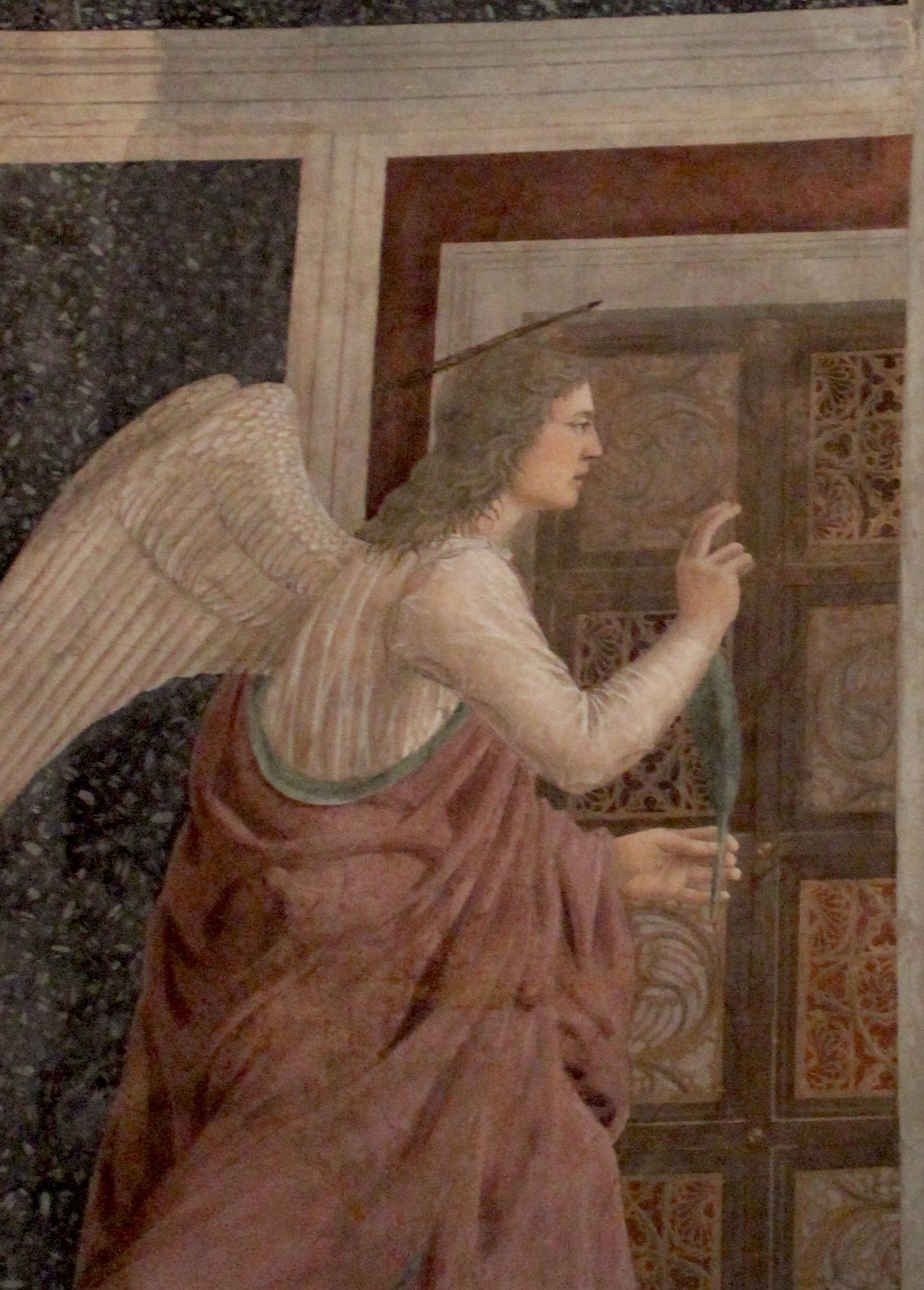
In Luke’s Gospel, Gabriel comes to Mary in Nazareth and tells her that she will bear a son named Jesus. Mary asks how this will happen. Gabriel replies that the Holy Spirit will come upon her, and Mary accepts what has been announced. Piero shows the exchange through the two figures’ bearing and gestures. There is no inscribed dialogue between them. The Gospel gives no description of the house, the book or the branch Gabriel carries. Each of those details belongs to the painter’s account of the encounter. [1] [6]
Gabriel’s wings rise behind his shoulders as he lowers himself towards the Virgin. His lifted right hand makes the greeting visible, while the palm frond in his left hand cuts a fine line across his clothing. The Arezzo museum guide reads the palm as a sign of victory. In a chapel devoted to the Cross, it can also call to mind the victory over death that Christians associate with the Crucifixion. It brings that future event into view through a small object that would be easy to miss from a distance. [1] [3]
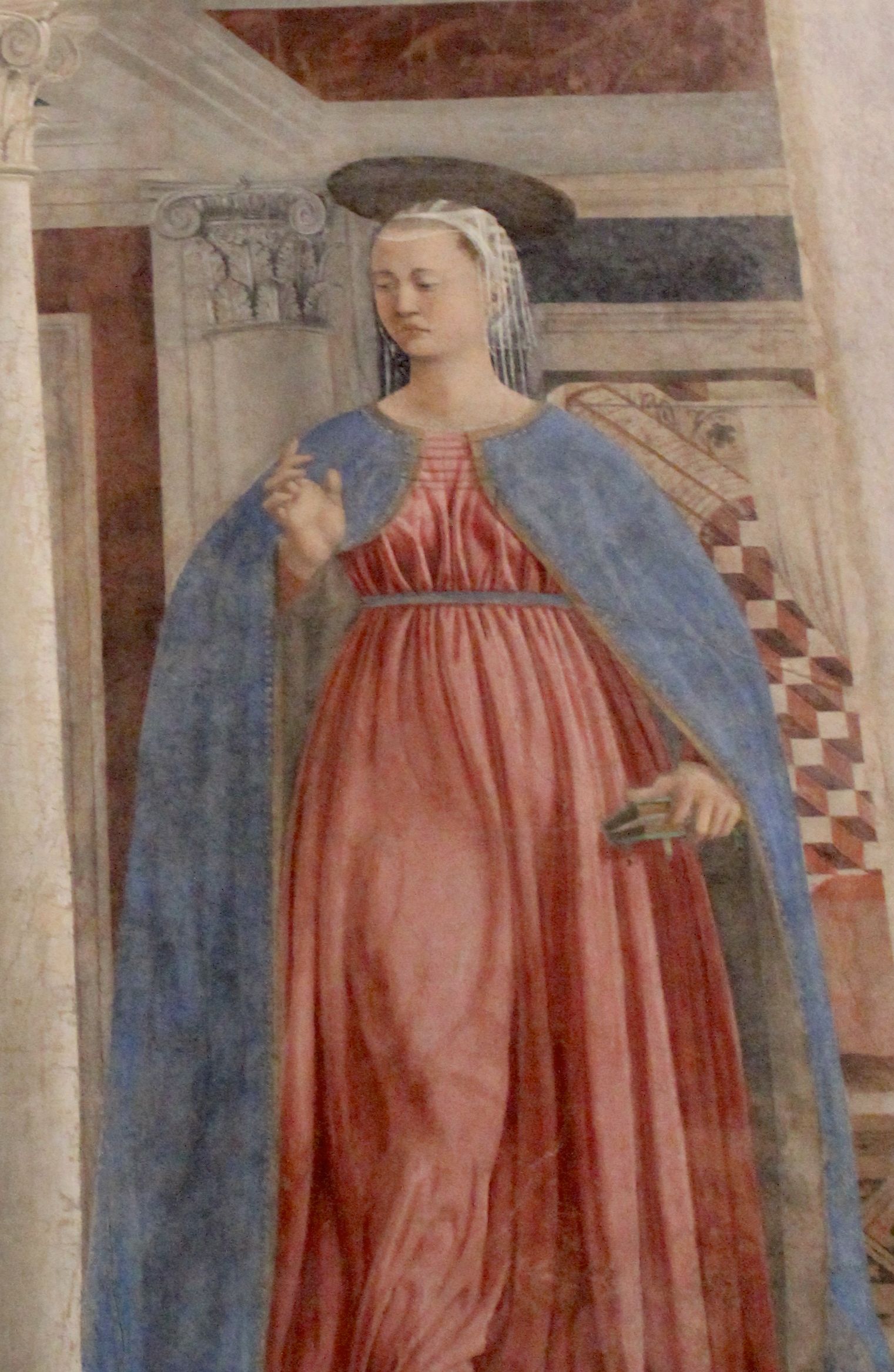
Mary’s response plays out in smaller movements. She keeps her book in hand and turns her head towards Gabriel while the long fall of her clothes preserves the vertical line of her body. The book lets the viewer imagine what she was doing a moment earlier. Its scale makes her appearance especially striking. She has the upright bearing of a monumental figure, yet the object in her hand belongs to the intimate setting of prayer. Her position beneath a roof and Gabriel’s bent posture make their different situations legible across the chapel. [1]
The porch, the column and the closed door
Piero sets the biblical encounter at the threshold of a house with a classical porch. Above Mary, the projecting cornice has enough depth to cast a shadow. A single bright shaft supports the porch at the front and divides the vertical field of the fresco. Gabriel appears in the more open space to the left. Mary stands within the shelter to the right, where the column, walls and opening behind her establish successive depths. The join between those two spaces is also where the figures meet. A greeting can cross the interval even while the support interrupts the view. [1] [7]
The central shaft dominates even though it has little ornament. Its pale surface offers the eye somewhere to rest between the pattern of the clothing and the coloured surfaces of the house. Follow it up from the plinth and the eye reaches the horizontal structure above Mary. Follow the receding edge of that structure and a flat wall begins to read as a porch with room for someone to stand inside it. The patterned surface visible behind Mary adds another turn to the space. Bertelli draws attention to Piero’s use here of a cube pattern that he also points out in the Flagellation of Christ. In the Annunciation, the pattern is glimpsed behind Mary. It rewards a second look after the large figures and column have established the scene. [1] [3] [7]
Beyond Gabriel, a painted opening with a grille has a different character from the shut door on the back wall. The grille breaks the wall into small intervals. The door draws the eye deeper into the house, then stops it. José María Salvador-González interprets the latter as a porta clausa, or closed gate. In the biblical passage behind that interpretation, Ezekiel sees the eastern gate of the sanctuary kept shut because the Lord has passed through it. Medieval hymns applied the image to Mary’s virginity and to the Incarnation. That tradition gives the painted door a possible significance beyond its place in the house. The closed door is visible in the fresco. Its connection to Ezekiel and the hymns is a scholarly interpretation. [7] [8] [9]
Annotated Details from Annunciation (Arezzo)
The numbered points identify visible features discussed in this article. Return from each detail to the numbered overview. Piero della Francesca, Annunciation, Bacci Chapel, Arezzo. Miguel Hermoso Cuesta. Image source. CC BY-SA 4.0. The numbered overview and detail crops are adaptations under CC BY-SA 4.0.
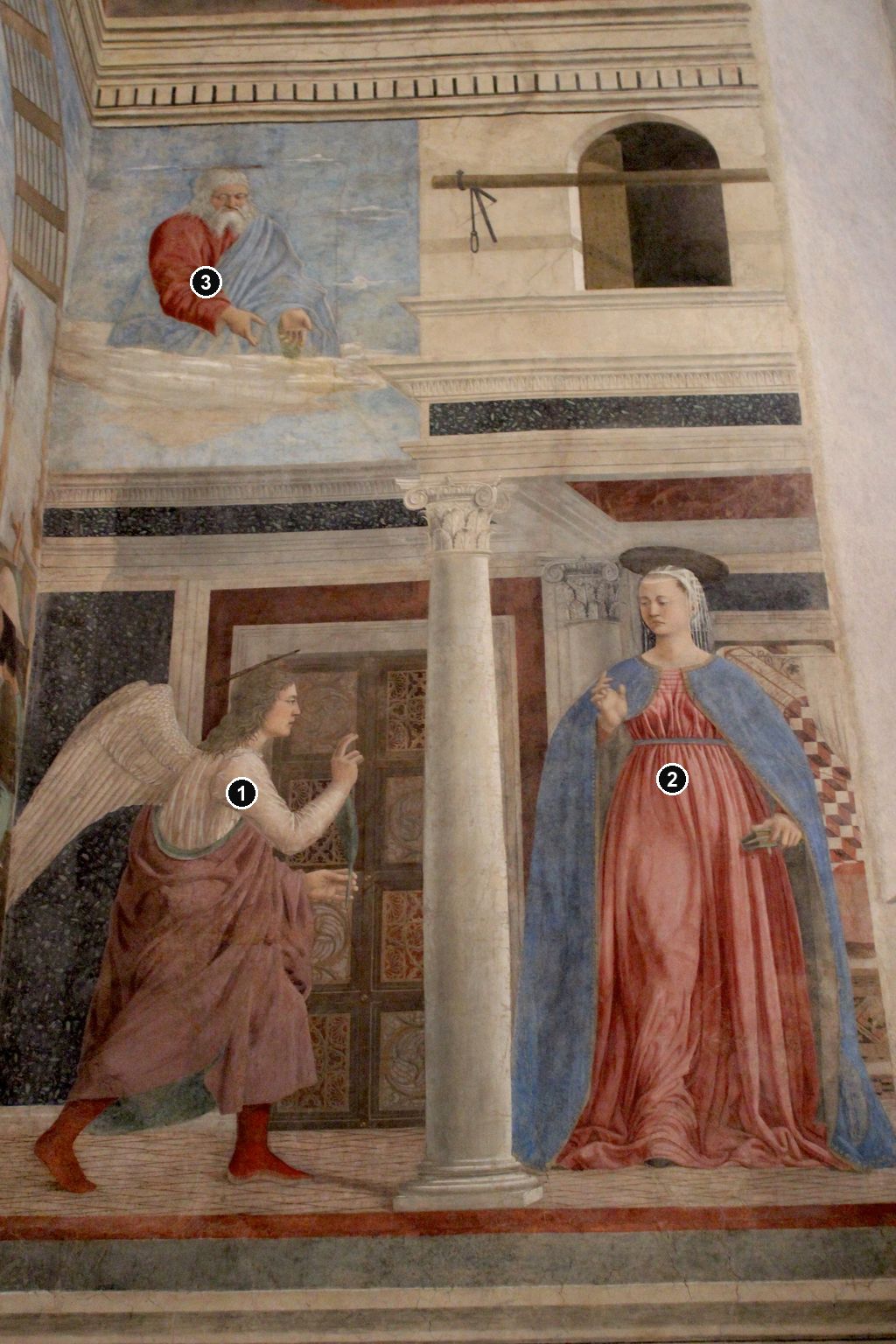
Details from ANNUNCIATION (AREZZO)
Compare the cropped details with the source images above. Notice how their colours, shapes and positions contribute to the larger compositions.
Gabriel’s greeting
Gabriel leans forward and raises his hand. The painted wall and the door behind him continue across his figure towards the column.
The Virgin and her book
Mary turns her head towards Gabriel while holding a small volume against her gown. A dark opening frames her halo and face.
God the Father
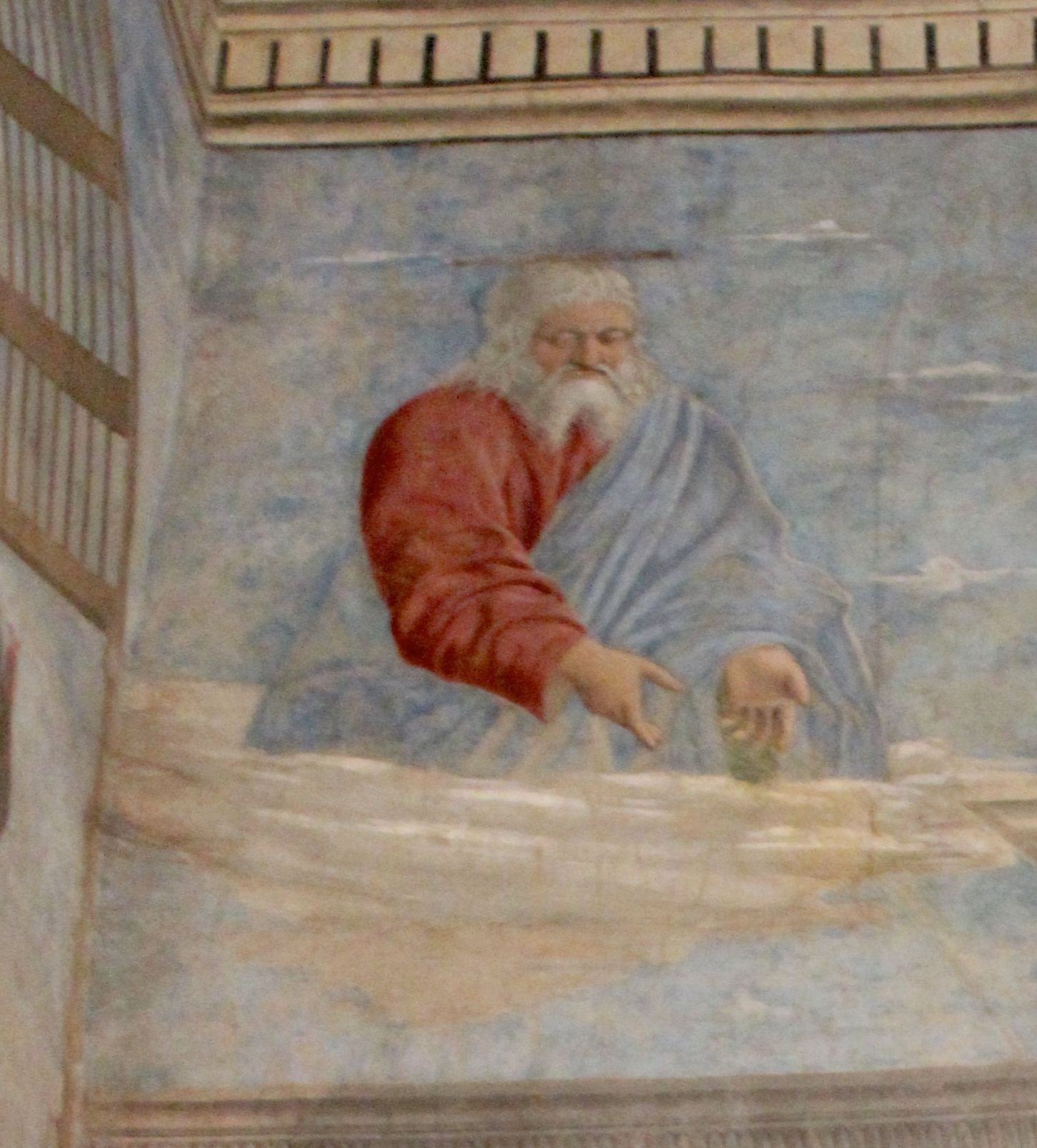
Above the two figures, the bearded figure extends his arms towards the scene through a band of cloud set against blue.
Two kinds of light
Light enters the painted scene from the right. The pale column catches it, and the dark shape cast by the porch behind Gabriel gives a sense of how far the structure projects. These effects help the viewer imagine the scene in ordinary daylight. They also make sense in the chapel, where the real window sits to the right of the fresco, between the Annunciation and The Dream of Constantine. Piero gives the fictive house the kind of illumination a viewer might expect to find on that stretch of wall. The grille behind Gabriel belongs to the house he painted. The tall window beside the fresco belongs to San Francesco. [2] [3] [7]
The divine figure appears above Gabriel on the left. His position therefore gives the viewer a second direction to follow. His hands reach out from the clouds towards Mary while the cast shadows continue to register light from the right. The slant of the porch roof between the upper left and Mary’s side allows the eye to travel from one figure to the other. The association of that passage with the action of the Holy Spirit follows naturally from Luke’s account. The fall of the painted shadows can be read independently as an observation of directional light. [1] [3] [6] [7]
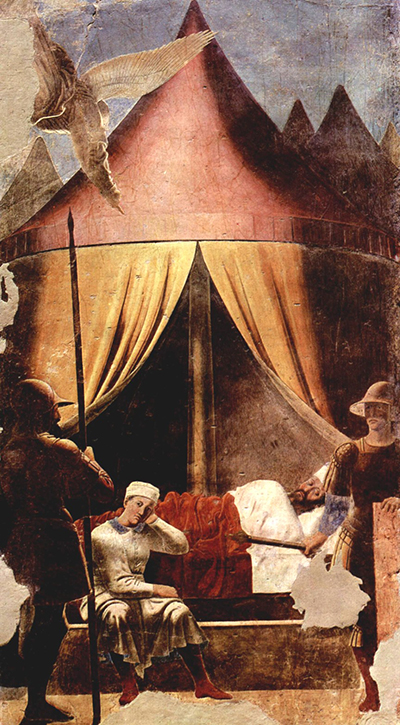
Looking across the real window changes the effect of both scenes. In The Dream of Constantine, a descending angel illuminates the emperor’s tent while the camp is still dark and the sky is beginning to lighten. In the Annunciation, the meeting is held in broad, clear light. The two scenes share a low position on the altar wall. Each shows a message arriving from heaven at a different time of day and in a different setting. The art historian Marilyn Aronberg Lavin reads the pair as announcements with consequences far beyond their immediate recipients. Mary hears of the birth of Christ, while the emperor receives the sign that will lead to the victory of Christianity in the legend. [1] [2] [3] [5]
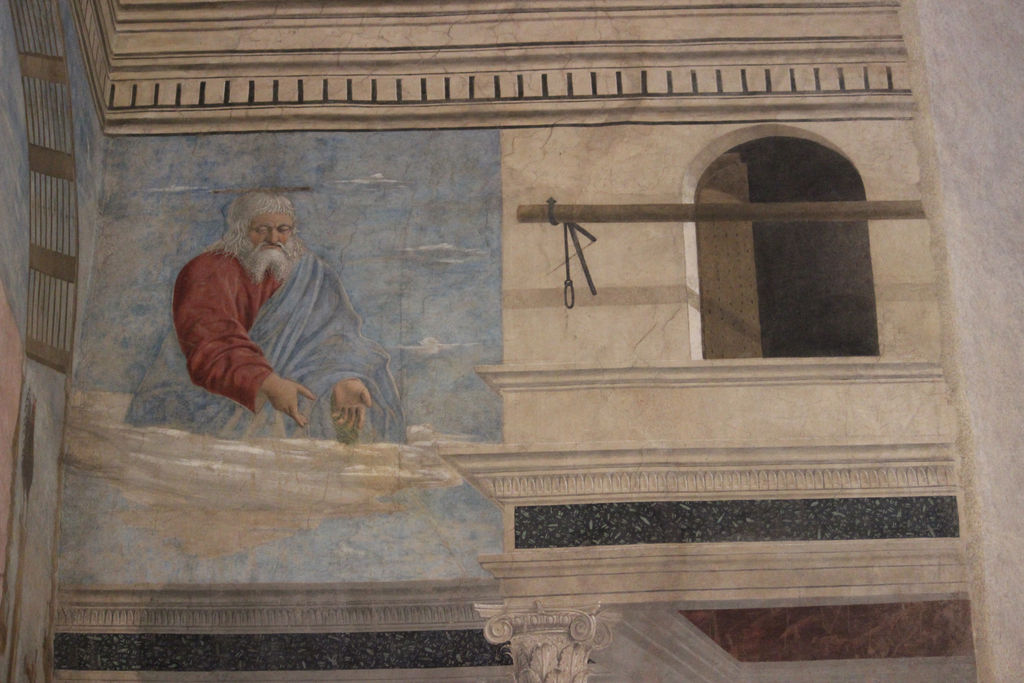
God the Father above Gabriel and Mary, detail of the Arezzo Annunciation. Miguel Hermoso Cuesta. Image source. CC BY-SA 4.0. Resized from the source. This reproduction uses CC BY-SA 4.0.
Why the Annunciation is beside the altar
The underlying story concerns the wood that eventually becomes the Cross and its history as a relic. Piero draws the meeting at Nazareth from Luke and gives it a prominent place within the story of the wood, much of which comes from the Golden Legend. The announcement of Christ’s conception brings the story to the point at which, in Christian teaching, the Son of God takes human flesh. That gives the chapel cycle a way to evoke Christ’s life and death between scenes set centuries apart. [2] [3] [6] [10]
The connection is especially clear if you look from the fresco up to the Death of Adam high on the viewer’s right wall. Piero’s scene there places Adam’s death at the beginning of the story of the wood. In the lower mural behind the altar, an angel announces the conception of the Christ who will die on that wood. The two images bring the beginning of the legend and its Christian meaning into the same room. The painted programme can make this connection through placement, without requiring the viewer to read each scene in sequence. The large wooden Crucifix over the high altar also gives the viewer a visible point of reference for the event the Annunciation anticipates. [2] [3] [5] [11]
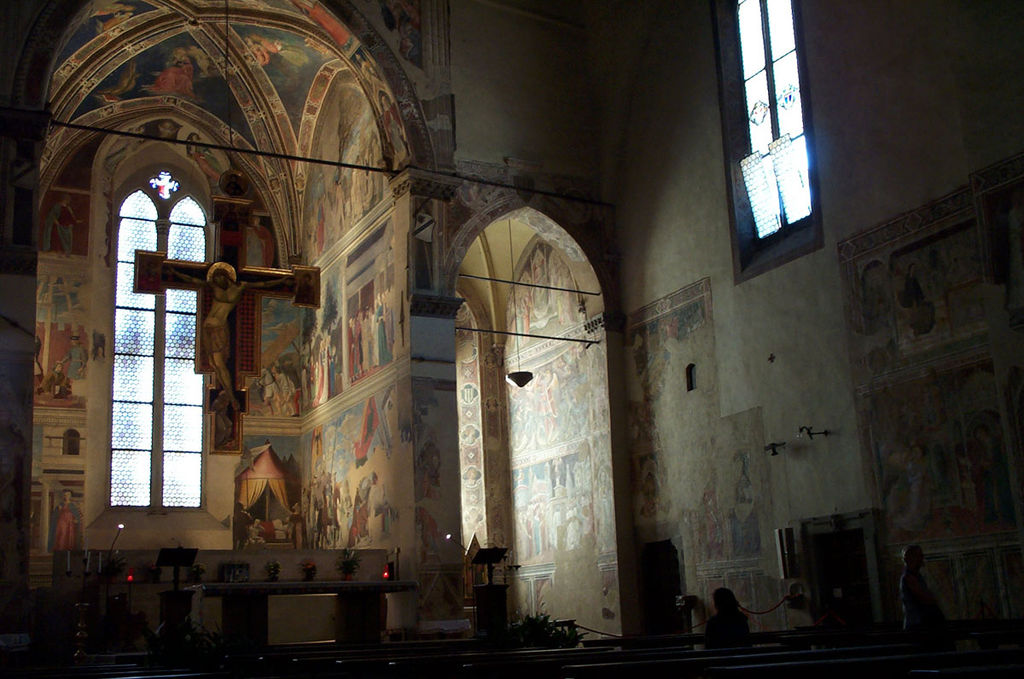
An oblique view of the Bacci Chapel with its window, suspended crucifix and right wall. louis-garden. Image source. CC BY-SA 2.5. Resized from the source. This reproduction uses CC BY-SA 2.5.
What the wall and photographs preserve
The Bacci family’s chapel decoration began under Bicci di Lorenzo, who died in 1452. Piero took over the project, and a commission of December 1466 for a separate banner for the Aretine confraternity of the Annunciation already refers to the completed chapel work. Those dates provide a broad frame for the wall paintings. The banner commission gives a latest date for the cycle as a whole and leaves the precise year of this particular fresco open. [2] [3]
The Italian national catalogue records a glass negative of part of the Annunciation, made by the photographer Perazzo for superintendent Giovanni Poggi’s 1917 campaign after Domenico Fiscali’s restoration. Earlier photographs from 1910 still show metal bars crossing painted fields in the chapel. Structural reinforcement during Fiscali’s campaign changed their appearance, and the catalogue also records changes to painted integrations. It notes that Fiscali filled in part of a tree trunk and a repeat in the floral border. These additions were removed in the 1960s, and the border was integrated again during the later restoration. A photograph can therefore date the appearance of a feature in the restored wall, even when it cannot establish the appearance of that feature in Piero’s day. [4]
A new programme of study began in 1985. Across the chapel, researchers found cracks in the walls, losses of the final plaster coat and areas where salts had reached the surface and the paint was flaking or powdering. The team brought survey images, condition maps and written records together so that conservators could locate observations and treatments on the walls. The method kept the effects of structural movement, the condition of the paint and previous repairs in view together. [12] [13]
Even the term fresco covers several ways of working across the Bacci Chapel. Wet plaster can take up pigment as it sets. Areas painted with a binder behave differently as the surface ages. Drawing on the results of the Arezzo studies, Neville Rowley discusses how Piero also worked with tempera in the cycle and how his practice varied across the walls. That finding belongs to the ensemble. In the Annunciation, the colour of an individual passage, such as the pale column or the finely patterned wall, is evidence of its present appearance. Assigning a technique to either would require examination of that passage. [13] [14]
The other Annunciation in Perugia
Piero painted the same encounter for the top of the Sant’Antonio Polyptych in Perugia, now in the Galleria Nazionale dell’Umbria. At Arezzo, one foreground column and the turn of the porch organise the meeting in a tall strip of wall. The Perugia panel opens a long central colonnade between the figures, with repeated columns diminishing towards a single vanishing point. The effect is easy to recognise even in a small reproduction. In Arezzo the eye rises from the greeting to God the Father. In Perugia the architecture invites the eye to travel into the distance. [1] [7] [15] [16]
Their supports explain much about how the two works were meant to be seen. The Perugia painting crowns a multi-part altarpiece, stacked above the Virgin and Child and saints. The Arezzo fresco sits low on a chapel wall, in a field proportioned to the tall window and its companion scene. Set into that wall, the scene lives at two scales. From across the chapel the upright column, Gabriel’s kneeling figure and Mary’s standing figure carry the story. A closer view reveals the small book, the palm frond and the depth of the painted house. [1] [2] [5] [15]
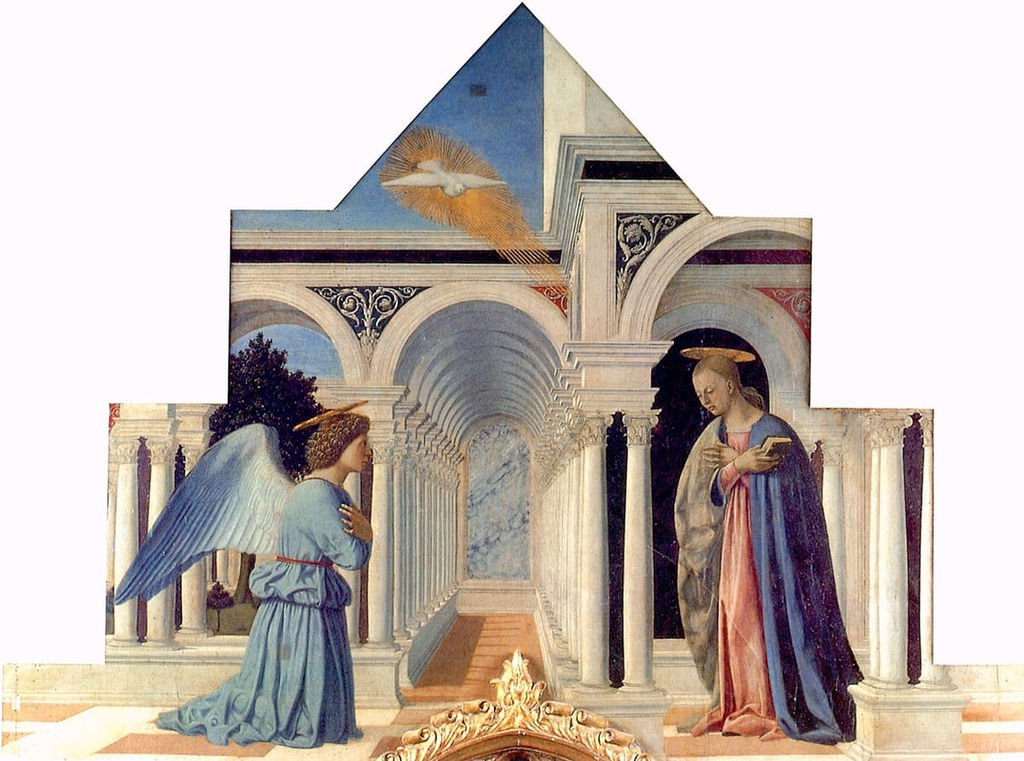
Piero della Francesca, Annunciation, crown of the Sant’Antonio Polyptych, Perugia. Image source. Public domain. Resized only; native appearance preserved.
Browse the artworks
Compare Piero’s frescoes, panels and manuscript figures. The list includes ensembles and separately identifiable panels or scenes. Dates are approximate where the sources differ.
| Name | Date | Medium and source |
|---|---|---|
| The Baptism of Christ | Probably c. 1437–45 | Panel painting Catalogue. |
| The Flagellation of Christ | 1459–60 (GNDM) | Panel painting Catalogue. |
| The History of the True Cross | Mid-fifteenth century | Wall painting Catalogue. |
| Dream of Constantine | Mid-fifteenth century | Wall painting Catalogue. |
| The Duke and Duchess of Urbino | About 1473–75 (Uffizi) | Panel painting Catalogue. |
| The Resurrection | About 1458–68 (Opificio) | Wall painting Catalogue. |
| Brera Madonna | About 1472–74 | Panel painting Catalogue. |
| Annunciation at Arezzo | Mid-fifteenth century | Wall painting Catalogue. |
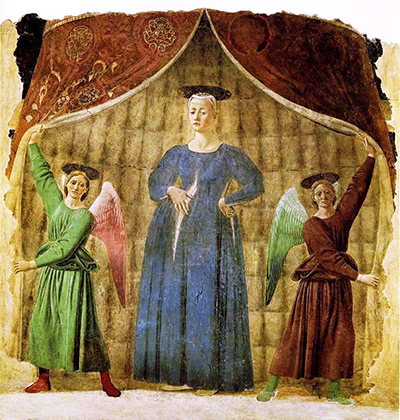
| Madonna del Parto | About 1450–65 (Monterchi) | Wall painting Catalogue. |
| Polyptych of the Misericordia | Commissioned 1445 | Panel painting Catalogue. |
| The Nativity | Early 1480s (National Gallery) | Panel painting Catalogue. |
| Madonna di Senigallia | About 1474–75 (GNDM) | Panel painting Catalogue. |
| Death of Adam | Mid-fifteenth century | Wall painting Catalogue. |
| Queen of Sheba | Mid-fifteenth century | Wall painting Catalogue. |
| Victory of Constantine | Mid-fifteenth century | Wall painting Catalogue. |
| Battle between Heraclius and Chosroes | Mid-fifteenth century | Wall painting Catalogue. |
| Saint Mary Magdalen | Wall painting Catalogue. | |
| The Augustinian Polyptych | 1454–69 | Panel painting Catalogue. |
| Polyptych of Perugia | About 1467–69 (GNU) | Panel painting Catalogue. |
| Perugia Annunciation | About 1468–70 (national catalogue) | Panel painting Catalogue. |
| St Francis and St Elizabeth | About 1467–69 (GNU) | Panel painting Catalogue. |
| Stigmatisation of St Francis | About 1468–70 (national catalogue) | Panel painting Catalogue. |
| An Augustinian Nun (Saint Monica) | 1454–69 | Panel painting Catalogue. |
| Augustinian Saint | 1454–69 | Panel painting Catalogue. |
| Saint Michael | 1454–69 | Panel painting Catalogue. |
| Saint Nicholas of Tolentino | 1454–69 | Panel painting Catalogue. |
| Saint John the Evangelist | 1454–69 | Panel painting Catalogue. |
| Virgin and Child Enthroned with Four Angels | About 1460–70 (Clark) | Panel painting Catalogue. |
| Portrait of Sigismondo Pandolfo Malatesta | About 1450–51, often proposed. Louvre catalogue range 1450–75. | Panel painting Catalogue. |
| Sigismondo before St Sigismund | 1451 | Wall painting Catalogue. |
| St Jerome and a Donor | 1460s (Accademia); about 1450 also proposed | Panel painting Catalogue. |
| St Jerome in Penitence | 1450, dated on the panel | Panel painting Catalogue. |
| Saint Julian | About 1455–60, often proposed | Wall painting Catalogue. |
| Saint Augustine | 1454–69 | Panel painting Catalogue. |
| Saint Apollonia | 1454–69 | Panel painting Catalogue. |
| Crucifixion from the Augustinian Polyptych | 1454–69 | Panel painting Catalogue. |
| Saint Louis of Toulouse | Wall painting Catalogue. | |
| Burial of the Wood | Mid-fifteenth century | Wall painting Catalogue. |
| Discovery and Proof of the True Cross | Mid-fifteenth century | Wall painting Catalogue. |
| Exaltation of the Cross | Mid-fifteenth century | Wall painting Catalogue. |
| Saint Anthony Raises a Child | About 1467–69 (GNU) | Panel painting Catalogue. |
| Saint Elizabeth Revives a Child | About 1467–69 (GNU) | Panel painting Catalogue. |
| Hercules | About 1470 | Wall painting Catalogue. |
| Portrait of a Boy (possibly Guidobaldo da Montefeltro) | Panel painting Catalogue. | |
| De prospectiva pingendi, Reggio Emilia witness (figures) | Manuscript diagrams Catalogue. | |
| The Interrogation of Judas | Mid-fifteenth century | Wall painting Catalogue. |
| Two prophets, Bacci Chapel | Mid-fifteenth century | Wall painting Catalogue. |
| Saint Clare of Assisi, upper predella | About 1467–69 (GNU) | Panel painting Catalogue. |
| Saint Agatha, upper predella | About 1467–69 (GNU) | Panel painting Catalogue. |
| Lost centre of the Augustinian Polyptych | 1454–69 | Lost panel or panels Catalogue. |
Frequently Asked Questions
Discussion
Look again at the images and ideas explored in Annunciation (Arezzo) by Piero della Francesca. These editorial prompts invite your observations.
Reader Insights
Follow the lines of the porch from God the Father down towards Mary. Which edges and gestures draw your eye across the scene?
Compare the two revelations on either side of the chapel window. How does daylight in Mary’s house change the mood of the encounter compared with the flash of light in Constantine’s camp?
How does the small book in Mary’s hand affect your impression of a figure that otherwise looks almost like a statue?
Join the Conversation
Share a detail, comparison or question about Annunciation (Arezzo) by Piero della Francesca below.
References
- Musei di Arezzo and Direzione regionale Musei della Toscana. Frescoes by Piero della Francesca, visitor guide. “Annunciation” and “Constantine’s Dream”. See also the Italian edition. View source 1. View source 2.
- Ministero della Cultura, Catalogo generale dei Beni Culturali. “1452–1466 – Gli affreschi di Piero della Francesca nella Chiesa di San Francesco ad Arezzo”. Chapel arrangement and episode list. View source.
- Carlo Bertelli. “Piero della Francesca”. I classici della pittura, Treccani, 2016. Arezzo chronology, the Incarnation and the altar-wall pairing (cat. 7f and 7q). View source.
- Ministero della Cultura, Catalogo generale dei Beni Culturali. Photographic record 0900644624. Perazzo’s 1917 negative and historical notes on restoration. View source.
- Marilyn Aronberg Lavin et al. “Piero della Francesca On-line: Story of the True Cross, San Francesco, Arezzo (Italy)”. Museums and the Web 2009, Archives & Museum Informatics. Spatial arrangement and interpretation. View source.
- Luke 1:26–38. New American Bible, Revised Edition, United States Conference of Catholic Bishops. View source.
- Fondazione Federico Zeri, Università di Bologna. “Pietro di Benedetto dei Franceschi, Annunciazione”. Artwork record 18971 and photographic documentation. View source.
- José María Salvador-González. “The doctrinal metaphor porta clausa in medieval liturgical hymns and its reflection in the iconography of the Annunciation”. De Medio Aevo 14, no. 1 (2025), 103–128. Fig. 6 and discussion of the Arezzo fresco. View source.
- Ezekiel 44:1–3. New American Bible, Revised Edition, United States Conference of Catholic Bishops. View source.
- Visit Arezzo. “Guide to ‘The Legend of the True Cross’ by Piero della Francesca”. Scene 4. View source.
- Direzione regionale Musei nazionali Toscana. “Basilica di San Francesco”. Site record and high-altar Crucifix. View source.
- Stefano Casciu, Giuseppe A. Centauro and Massimo Chimenti. “The Archival Documentation System: The Computerized Heart of the Restored ‘History of the True Cross’ by Piero della Francesca”. In GraDoc: Graphic Documentation Systems in Mural Painting Conservation. ICCROM, 2000, 208–219. View source.
- Ursula Schädler-Saub. “Dealing with Authenticity in the Conservation and Restoration of Wall Paintings and Architectural Surfaces”. Protection of Cultural Heritage, no. 8 (2019). Section 2, on the Arezzo cycle, begins on p. 308. View source.
- Neville Rowley. Pittura di luce. La manière claire dans la peinture du Quattrocento. Doctoral dissertation, Université Paris-Sorbonne, 2010. Discussion of the Arezzo painting technique and notes 669–677. Centre André-Chastel thesis record. View source 1. View source 2.
- Galleria Nazionale dell’Umbria. “Polittico di Sant’Antonio”. Collection entry for inv. 111–114 and discussion of the crowning panel’s perspective. View source.
- State Hermitage Museum. Piero della Francesca: Monarch of Painting, exhibition publication. Perugia Annunciation identified as the upper part of the Sant’Antonio Polyptych. View source.
Related Paintings
Annunciation (Perugia)
Piero della Francesca, Annunciation, crown of the Sant’Antonio Polyptych, Perugia. Image source. Public domain. Resized only; native appearance preserved.