 by Tom Gurney
Tom Gurney BSc (Hons) is an art history expert with over 20 years experience
Published on June 19, 2020 / Updated on October 14, 2023
Email: tomgurney1@gmail.com / Phone: +44 7429 011000
Virgin and Child Enthroned with Four Angels: Introduction
Mary holds a small pink flower between herself and the infant Christ. He reaches for it with both hands, leaning away from the arm that supports him. At the right, an angel in red looks out of the painting and raises a finger towards the pair. That figure directs us to an exchange small enough to miss among the heavy folds of Mary's blue mantle and the pale stonework of her throne. In Piero della Francesca's Virgin and Child Enthroned with Four Angels, the devotional meaning of a monumental image begins with this ordinary gesture. The Clark Art Institute in Williamstown, Massachusetts, dates the painting to about 1460–70. [1] [2] [3]
At a Glance
- ArtistPiero della Francesca [1]
- DateAbout 1460–70 [1]
- MediumOil, possibly with some tempera, originally on poplar panel and later transferred to a replacement support [3] [4]
- Dimensions107.8 × 78.4 cm [2] [4]
- CollectionClark Art Institute, Williamstown, Massachusetts [1] [2]
- Accession number1955.948 [2]
This work across Piero della Francesca’s career
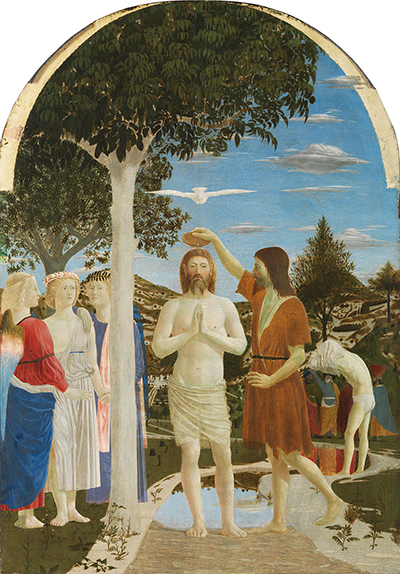
The Baptism of Christ
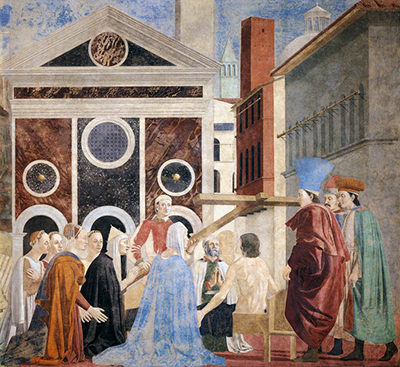
Probably about 1437–45The History of the True Cross
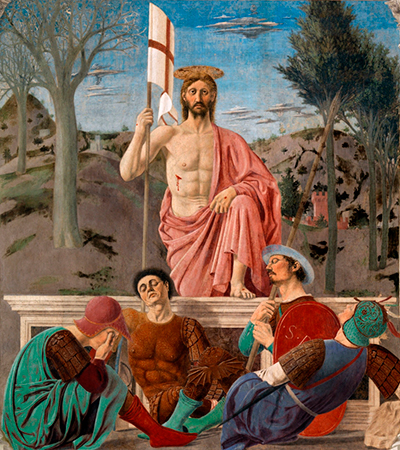
Mid-fifteenth centuryThe Resurrection
About 1458–68 (Opificio)The Flagellation of Christ
1459–60 (GNDM)Virgin and Child Enthroned with Four Angels (current article)
About 1460–70 (Clark)The Montefeltro Altarpiece
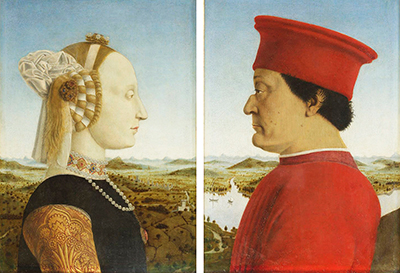
About 1472–74 (Brera)The Duke and Duchess of Urbino
About 1473–75 (Uffizi)The Nativity
Early 1480s (National Gallery)Contents
- The flower and the four angels
- A courtyard glimpsed through the figures
- Poplar, paint and the date
- A family picture or a chapel painting?
- From a private collection to public exhibitions
- Annotated details
The flower and the four angels
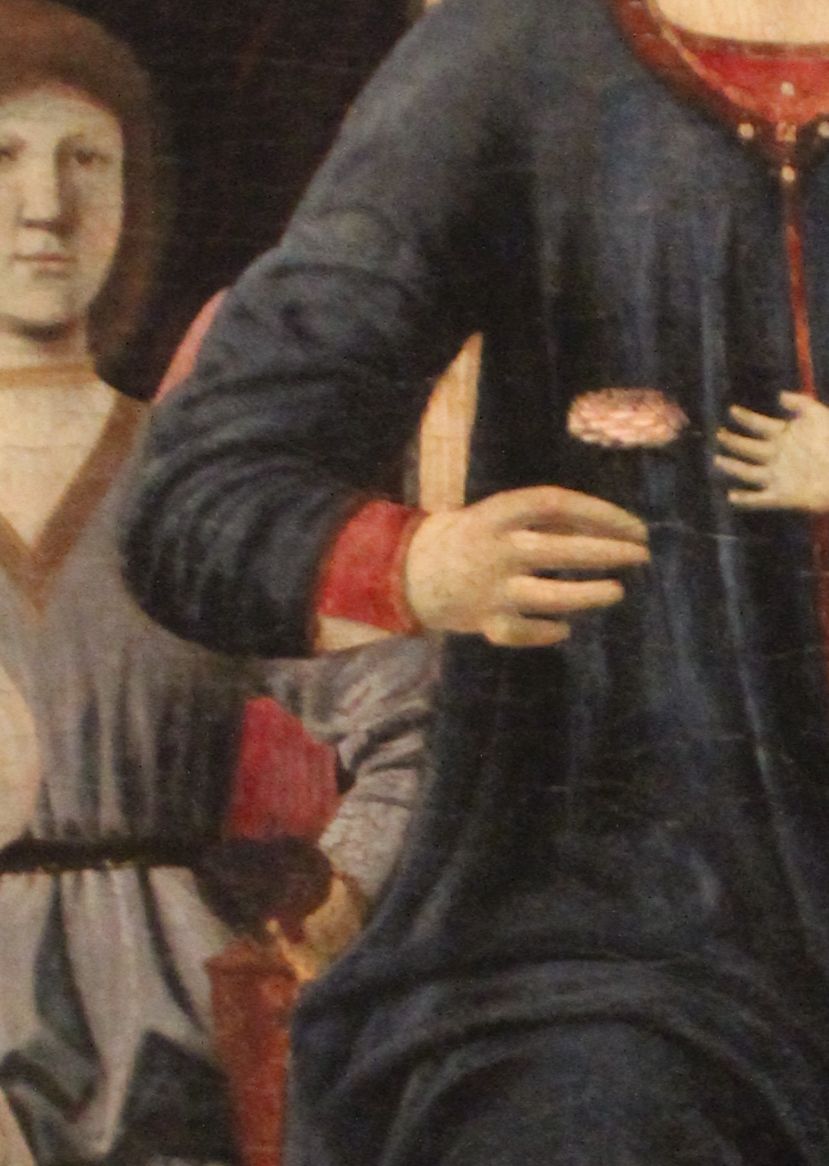
The Frick Collection describes the flower as a rose and interprets it as an allusion to Christ's future suffering. Samuel Y. Edgerton and Thomas J. Loughman identify it as a pink carnation. At the scale of the picture, the slender stalk and the small pink head register before any botanical detail. The child's intent gaze gives the scene the character of an encounter between a mother and an infant. For a viewer who reads the flower as a sign of the Passion, his eagerness carries a second meaning. [3] [4]
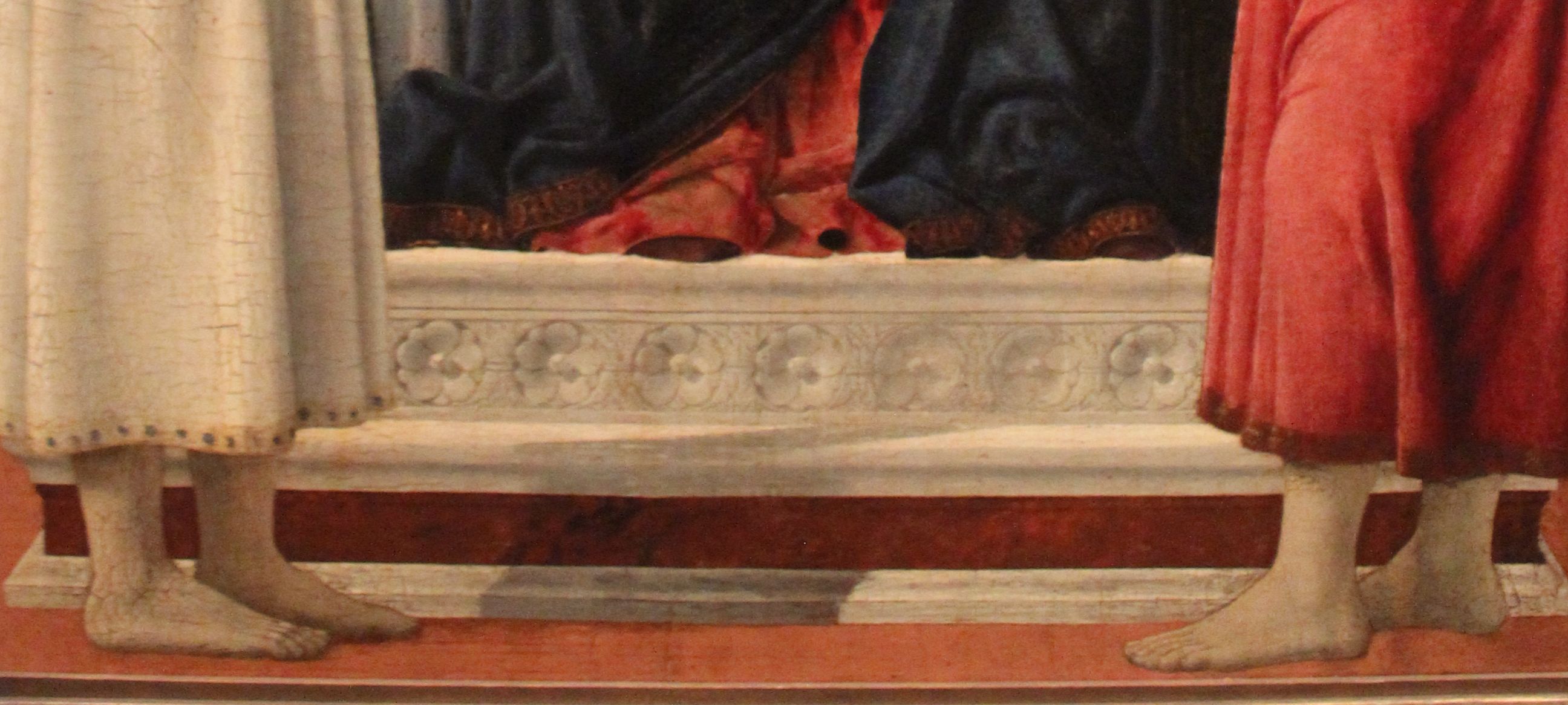
Below the figures, a row of flower shapes runs along the pale stone platform. The blossoms there belong to the architecture and catch the light differently from the flower in Mary's hand. She holds the stem upright, just above the fall of the blue mantle, where the bloom is easy to pick out. Once the eye has found it, the resemblance to the pattern below becomes apparent. The Frick connects the living flower to the carved rosettes. The parallel also works at a practical level for a viewer standing in front of the painting. A detail in the smallest gesture is repeated across one of its broadest surfaces. [3] [4]
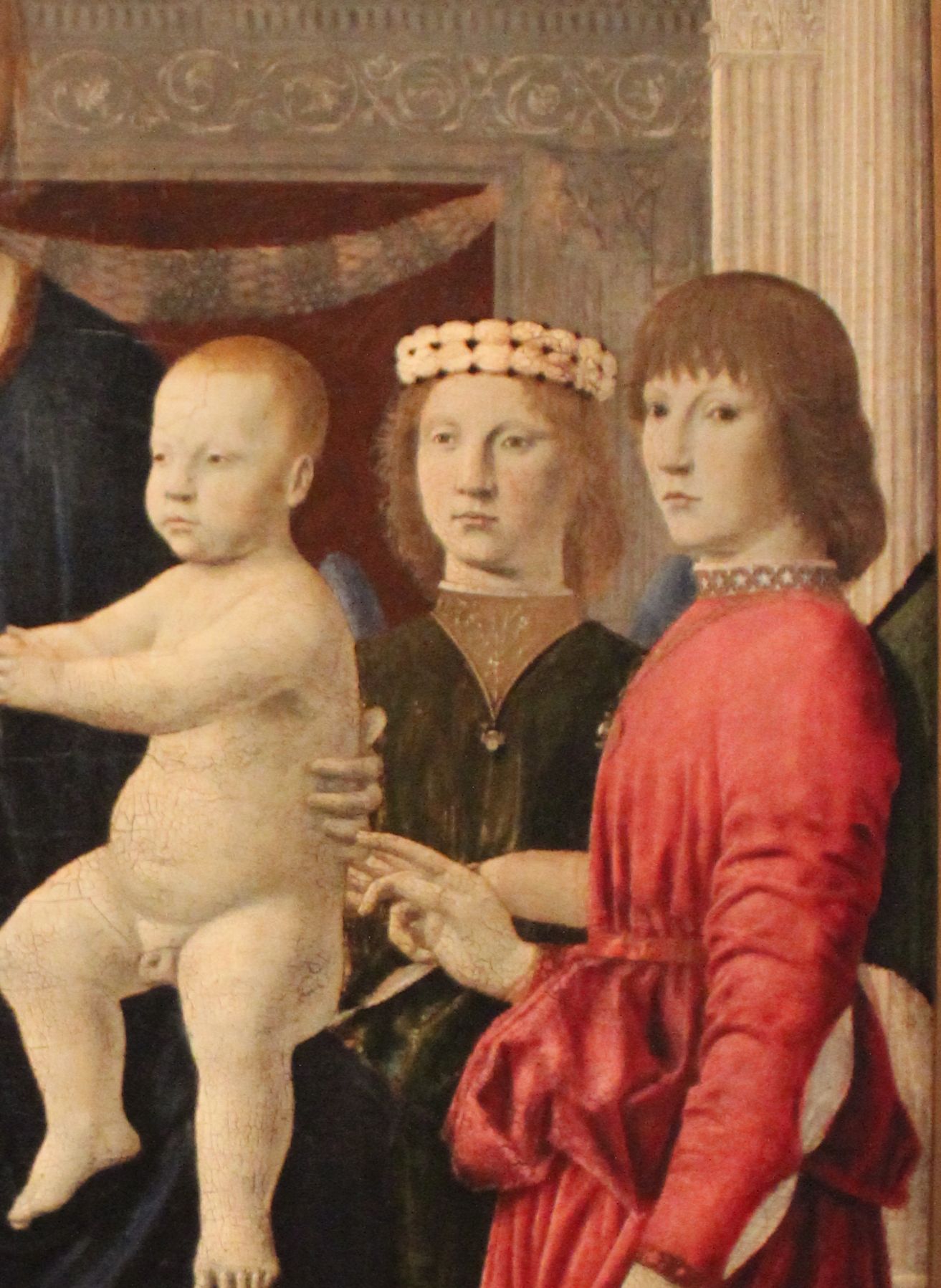
Watch how the angels' positions change the direction of attention. At left, the foreground angel in white turns in profile towards the throne, arms folded. A second face emerges behind this figure and looks out from beneath the dark opening. At right, the foreground angel in red turns towards the viewer while pointing back into the picture. A wreath marks the angel in green behind the throne. The two foreground figures stand with bare feet on either side of the platform, and the other pair appear chiefly as faces and upper bodies. The arrangement gives each side depth while keeping Mary's silhouette legible in the middle. [3] [4] [5]
The gesture of the angel in red is especially effective because it crosses several layers of the scene. The angel's fingers, the green-clad angel's hand and Mary's hand appear close together on the painted surface, although the figures occupy different positions around the throne. Edgerton and Loughman took the overlap as part of a larger argument about how Piero used perspective to suggest a sacred space. At the scale of the gesture, the eye can follow the pointing finger towards the child and then work out, more slowly, which hand belongs to whom. [4]
A courtyard glimpsed through the figures
The painting measures 107.8 by 78.4 centimetres. Piero fits six substantial figures into an upright rectangle, with the front angels' feet near its lower edge and the architectural detail cut off at the top and right. The Frick considers it a notably early use of this format in Borgo San Sepolcro, Piero's home town. Each angel stands in the same field as the Virgin and Child. The grouping reads in depth. Where the white angel's sleeve covers part of the blue-clad attendant, we understand that one stands in front of the other. No painted division or frame interrupts their shared space. [2] [3]
The lower level of the composition is easy to read. The stone dais has enough depth to raise Mary above the two attendants beside it. Her robe falls over the seat and gathers in folds across the platform. The scene behind the bodies takes longer to resolve. At the top right, a moulding turns a corner and a column rises behind the angel in red. There are traces of bases and pavement in the gaps between bodies. Carlo Bertelli reads this as an outdoor setting partly closed off by a portico. Edgerton and Loughman reconstruct an open colonnaded court, much larger than the fragment that Piero lets the viewer see. The Met's exhibition catalogue records that the top edge survives and that the other edges were trimmed only slightly. The narrow glimpse of architecture at the top is close to what Piero intended. [4] [5] [6]
The stone ornaments invite their own closer look. The Met catalogue compares the upper frieze with drawings of Rome's now demolished Arco di Portogallo. It also comments on the unusually large rosettes on the base of the throne. At the top of the painting, bands of decoration shrink in the distance and slip out of view. Below Mary, the individual blooms on the dais remain large enough to distinguish. The two uses of ornament help locate different surfaces in depth. [4] [6]
A tracing made by conservator Sandra Webber in 1984 gives this reading a basis in the painting's physical surface. She recorded fine lines incised into the gesso, the preparation beneath the paint, and distinguished them from areas of damage and restoration. Edgerton and Loughman connect several of the lines to the mouldings above the figures and identify a tiny puncture below Christ's right knee as the likely vanishing point. An eye level there puts the viewer well below Mary's face. The directness of the angel's glance can make us feel close to the scene, even as the rising platform and the low viewpoint place the Virgin above us. The surviving marks reveal how Piero laid out part of the architecture. The full extent and spiritual meaning of the reconstructed courtyard remain matters of interpretation. [4]
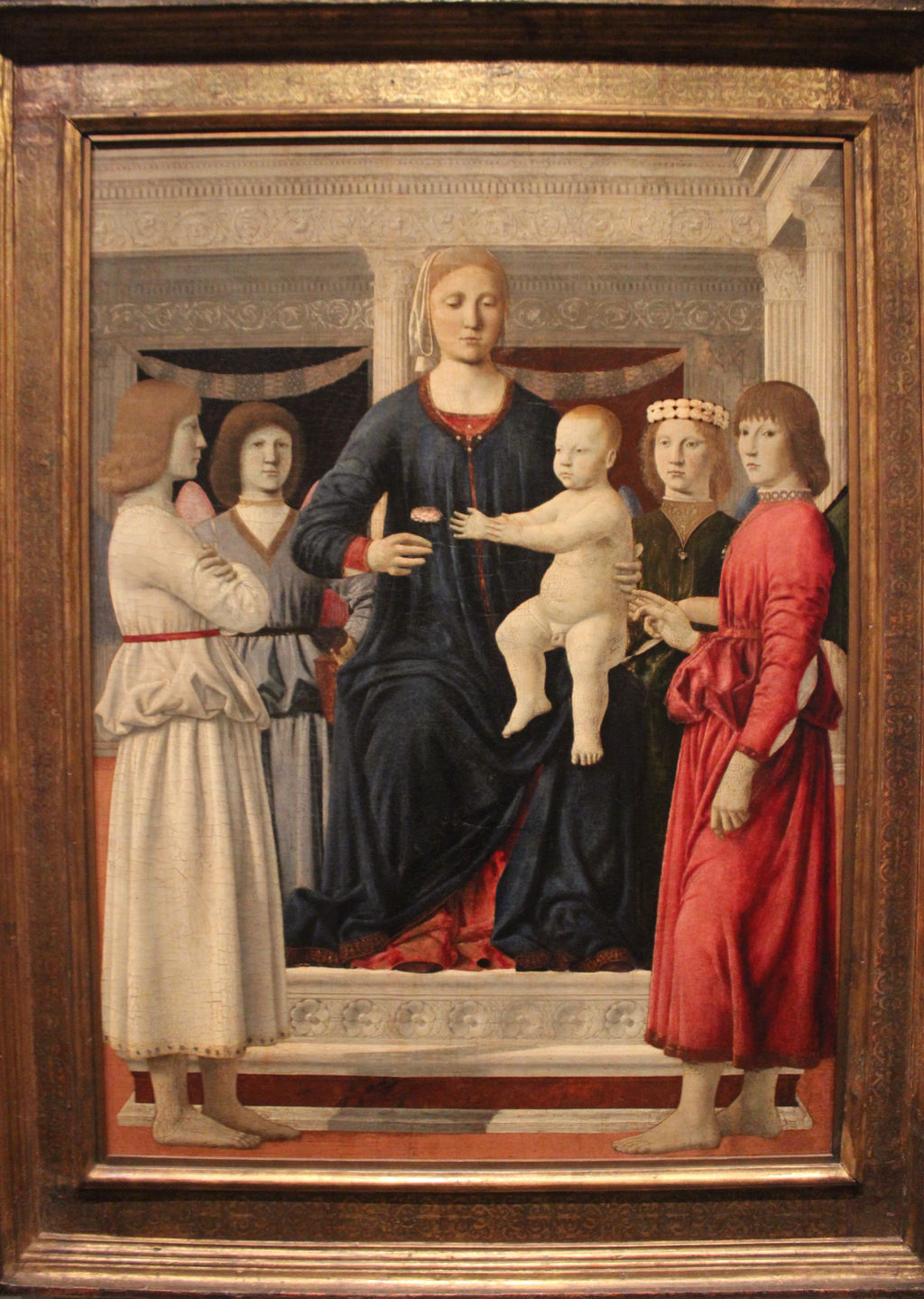
Piero della Francesca, Virgin and Child Enthroned with Four Angels, Clark Art Institute. Miguel Hermoso Cuesta. Image source. CC BY-SA 4.0. Resized from the source. This reproduction uses CC BY-SA 4.0.
Annotated Details from Virgin and Child Enthroned with Four Angels
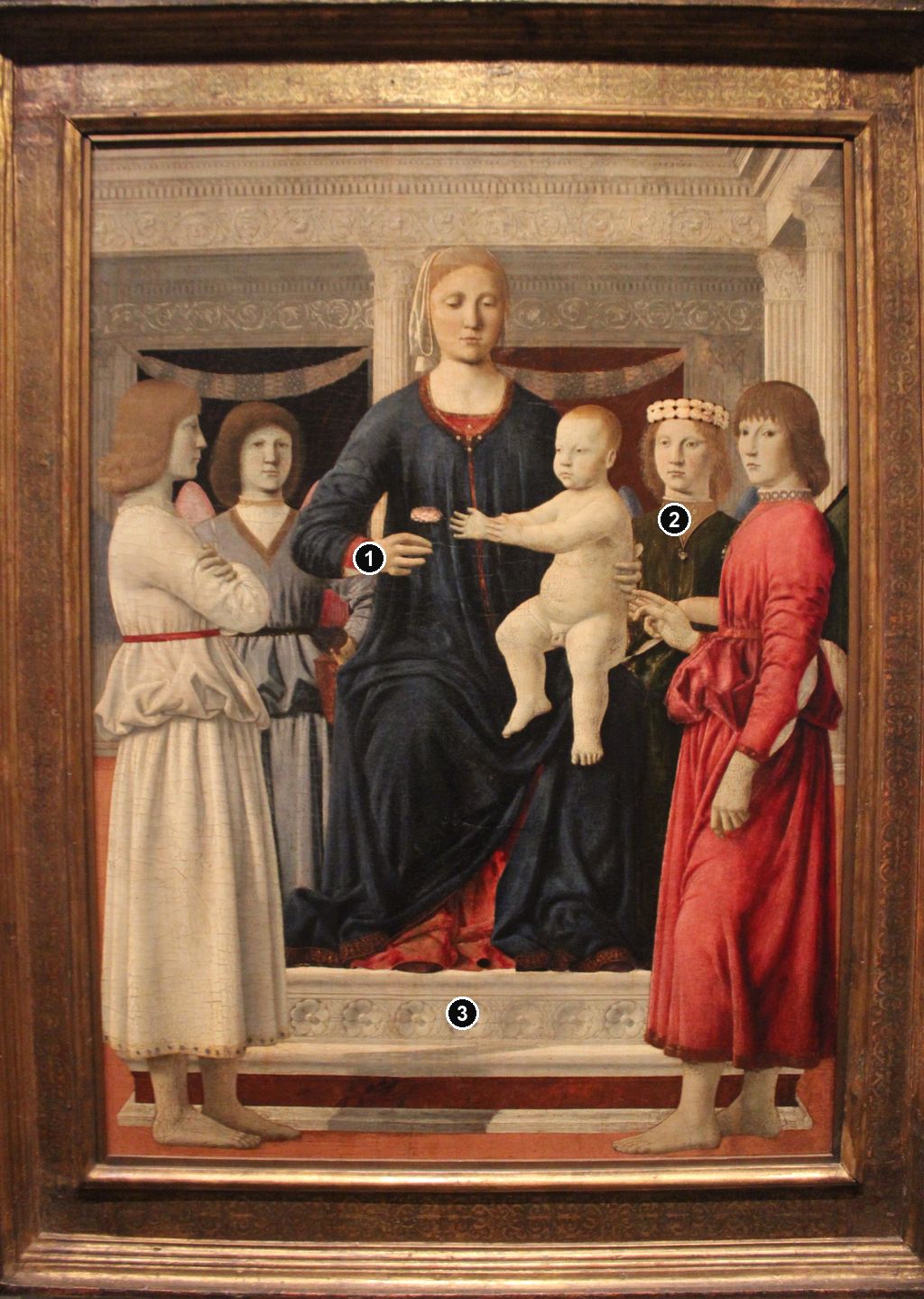
The numbered points identify visible features discussed in this article. Return from each detail to the numbered overview. Piero della Francesca, Virgin and Child Enthroned with Four Angels, Clark Art Institute. Miguel Hermoso Cuesta. Image source. CC BY-SA 4.0. The numbered overview and detail crops are adaptations under CC BY-SA 4.0.
Details from VIRGIN AND CHILD ENTHRONED WITH FOUR ANGELS
Compare the cropped details with the source images above. Notice how their colours, shapes and positions contribute to the larger compositions.
The flower
Mary holds a small red bloom on a thin stem, within reach of the child’s outstretched hand. Sources differ on the flower’s identification.
The angels beside the child
Two angels stand to the right of the Virgin. Changes in the angle of the heads and overlap of bodies create space around the throne.
The raised ledge
The pale ledge is set across the composition in front of Mary. The two foreground angels stand on either side of it, with their feet visible below.
Poplar, paint and the date
Piero painted on three joined poplar boards, using oil and possibly some tempera. By the time conservator William Suhr examined it in 1950–51, insects had tunnelled through the original support and endangered the paint. Suhr transferred the painted surface to a replacement support. The Frick's reference to fabric on a panel describes the painting after that treatment. The cloth and backing visible to a conservator today belong to a different stage of the object's history from the poplar that Piero prepared. [1] [3] [4] [6]
The conservators who contributed to the Met catalogue describe the architecture and paving as passages painted in tempera and identify oil in the modelling of flesh, the blue mantle and the lights on the white angel's robe. The painting's medium therefore varies with the surface Piero wanted to depict. The pale robe, for example, can catch a highlight more softly than the crisp edge of a stone moulding. [6]
Movement along the joins in the poplar also damaged the paint. An X-radiograph studied by Webber showed the effect of a join in the area of Mary's flower-bearing hand, which has been restored. Bertelli discusses a further kind of damage, widespread cracking that he links to the handling and drying of oil-based binders. Both matters affect what a viewer sees. The small distinctions between fingers and stem lie in an area where the surface has changed. The Met catalogue also describes losses in the brocade pattern of Mary's dress. A broad passage that looks comparatively plain today may once have shown much more of its texture. [4] [5] [6]
The Clark's date of about 1460–70 is a useful guide. The Fondazione Federico Zeri catalogues the work within a broader range of about 1460–80. Bertelli interprets the paint handling as evidence of a relatively experimental phase in Piero's use of oil, placing the work before the Montefeltro and Augustinian altarpieces. The contributors to the Met catalogue proposed dates from the 1450s to the 1470s. The painting looks earlier to those who give more weight to the technique and closer to Piero's later devotional pictures to those who place more weight on style and architecture. [1] [2] [5] [6]
A family picture or a chapel painting?
The painting's early history points towards the Gherardi family of Sansepolcro. Edgerton and Loughman suggest that a member of the family commissioned it and propose a private setting in which its perspective could be studied at close quarters. The Frick leaves open both church and residential settings. The Metropolitan Museum of Art's catalogue discusses a 1583 document about reframing a painting by Piero in the possession of Giacomo di Bernardino Gherardi. The short description makes the identification probable, and leaves the subject unspecified. Andrea Di Lorenzo discusses the possibility that the family had retrieved the picture from the chapel of San Leonardo at the Badia during alterations in the late sixteenth century. The chapel had close ties to the family. The surviving documents trace a plausible route from chapel to household, though the original commission remains uncertain. [3] [4] [6] [7]
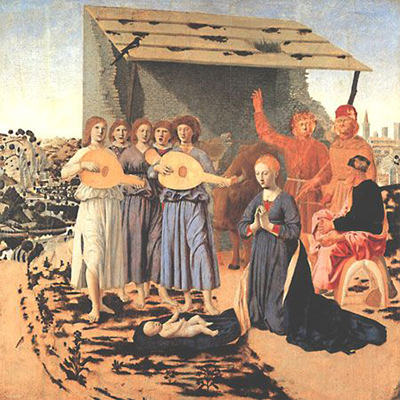
Piero's Nativity is a useful comparison because its association with a domestic building is considerably firmer. It remained in his family's palazzo in Borgo San Sepolcro until 1825. Its nearly square field gives space to the stable, the musicians and the distant landscape around the newborn Christ. The Clark rectangle brings the figures much closer together and concentrates attention on an exchange of looks and gestures. The two pictures show how much variety a single, unified devotional composition could accommodate. [3] [8]
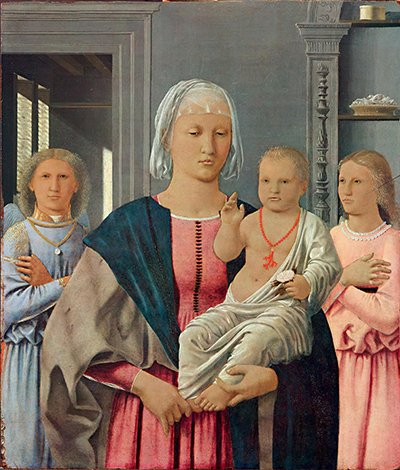
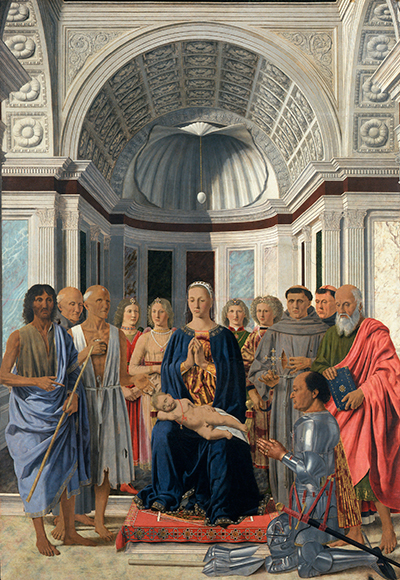
In the Madonna di Senigallia, the child is held up close to the viewer, attended by two angels, and light enters a room through a window behind the group. The child already holds a pale flower. In the Clark painting, Mary still holds out the flower, and the red angel points out the action. The Brera Madonna places Mary and the sleeping child under a high, shell-shaped apse, with saints, angels and a kneeling Federico da Montefeltro. At the Clark, the standing attendants draw our attention into a smaller gathering whose architecture can only partly be seen. [3] [9] [10]
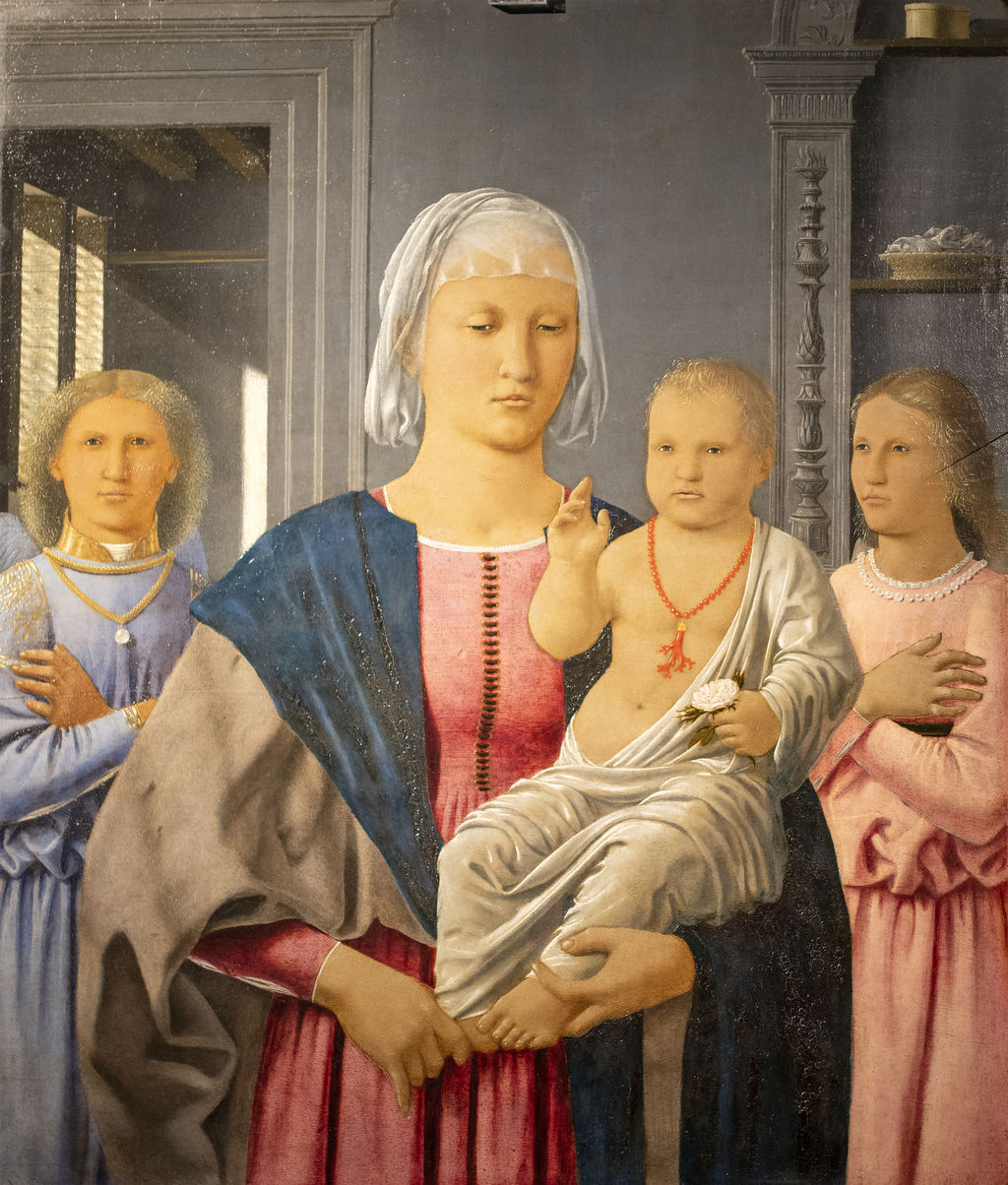
Piero della Francesca, Madonna di Senigallia, Galleria Nazionale delle Marche. Orlando Paride. Image source. CC BY-SA 4.0. Resized from the source. This reproduction uses CC BY-SA 4.0.
From a private collection to public exhibitions
The 2004–05 exhibition on Fra Carnevale in Milan and New York presented the painting in the context of fifteenth-century experiments with architecture. Its appearance in that exhibition prompted a fresh look at the work's history and material. [6] [11]
Sir Walter Trevelyan bought the painting in Florence in 1837 and recorded its connection to the Gherardi collection. It was shown in London in 1870 and 1892. Sterling Clark bought it through Colnaghi in November 1913 and kept it in his residences before it went on view in Williamstown in 1955. The dealers Colnaghi and Knoedler had acquired the painting jointly. Their records show that Clark examined it in person after first seeing a photograph. [2] [4] [6] [12]
Some twentieth-century scholars doubted that Piero himself had painted the picture. The history of attribution partly reflects how the painting could be studied. A black-and-white photograph could show the arrangement of the figures while doing little to convey shifts in colour, the condition of the paint or the distances implied between the figures and columns. [4] [6]
In 2013, the Frick exhibited it alongside six survivors of the Augustinian Polyptych. One benefit of the pairing was the opportunity to compare a devotional group in one continuous field with a composition distributed across a large altarpiece. The surviving Augustinian panels come from a documented commission with a missing centre. The Museo Poldi Pezzoli's 2024 research cited fragments of wings, drapery and steps at the edges of adjoining panels in support of a proposed Coronation of the Virgin for that centre. An earlier suggestion that the Clark painting was that centre had already been rejected in the Met catalogue, which found no physical evidence that the work had formed part of a larger structure. The National Gallery, London, lists the Clark panel as a distinct loan for its announced Piero exhibition. [6] [13] [14] [15]
Browse the artworks
Compare Piero’s frescoes, panels and manuscript figures. The list includes ensembles and separately identifiable panels or scenes. Dates are approximate where the sources differ.
| Name | Date | Medium and source |
|---|---|---|
| The Baptism of Christ | Probably c. 1437–45 | Panel painting Catalogue. |
| The Flagellation of Christ | 1459–60 (GNDM) | Panel painting Catalogue. |
| The History of the True Cross | Mid-fifteenth century | Wall painting Catalogue. |
| Dream of Constantine | Mid-fifteenth century | Wall painting Catalogue. |
| The Duke and Duchess of Urbino | About 1473–75 (Uffizi) | Panel painting Catalogue. |
| The Resurrection | About 1458–68 (Opificio) | Wall painting Catalogue. |
| Brera Madonna | About 1472–74 | Panel painting Catalogue. |
| Annunciation at Arezzo | Mid-fifteenth century | Wall painting Catalogue. |
| Madonna del Parto | About 1450–65 (Monterchi) | Wall painting Catalogue. |
| Polyptych of the Misericordia | Commissioned 1445 | Panel painting Catalogue. |
| The Nativity | Early 1480s (National Gallery) | Panel painting Catalogue. |
| Madonna di Senigallia | About 1474–75 (GNDM) | Panel painting Catalogue. |
| Death of Adam | Mid-fifteenth century | Wall painting Catalogue. |
| Queen of Sheba | Mid-fifteenth century | Wall painting Catalogue. |
| Victory of Constantine | Mid-fifteenth century | Wall painting Catalogue. |
| Battle between Heraclius and Chosroes | Mid-fifteenth century | Wall painting Catalogue. |
| Saint Mary Magdalen | Wall painting Catalogue. | |
| The Augustinian Polyptych | 1454–69 | Panel painting Catalogue. |
| Polyptych of Perugia | About 1467–69 (GNU) | Panel painting Catalogue. |
| Perugia Annunciation | About 1468–70 (national catalogue) | Panel painting Catalogue. |
| St Francis and St Elizabeth | About 1467–69 (GNU) | Panel painting Catalogue. |
| Stigmatisation of St Francis | About 1468–70 (national catalogue) | Panel painting Catalogue. |
| An Augustinian Nun (Saint Monica) | 1454–69 | Panel painting Catalogue. |
| Augustinian Saint | 1454–69 | Panel painting Catalogue. |
| Saint Michael | 1454–69 | Panel painting Catalogue. |
| Saint Nicholas of Tolentino | 1454–69 | Panel painting Catalogue. |
| Saint John the Evangelist | 1454–69 | Panel painting Catalogue. |
| Virgin and Child Enthroned with Four Angels | About 1460–70 (Clark) | Panel painting Catalogue. |
| Portrait of Sigismondo Pandolfo Malatesta | About 1450–51, often proposed. Louvre catalogue range 1450–75. | Panel painting Catalogue. |
| Sigismondo before St Sigismund | 1451 | Wall painting Catalogue. |
| St Jerome and a Donor | 1460s (Accademia); about 1450 also proposed | Panel painting Catalogue. |
| St Jerome in Penitence | 1450, dated on the panel | Panel painting Catalogue. |
| Saint Julian | About 1455–60, often proposed | Wall painting Catalogue. |
| Saint Augustine | 1454–69 | Panel painting Catalogue. |
| Saint Apollonia | 1454–69 | Panel painting Catalogue. |
| Crucifixion from the Augustinian Polyptych | 1454–69 | Panel painting Catalogue. |
| Saint Louis of Toulouse | Wall painting Catalogue. | |
| Burial of the Wood | Mid-fifteenth century | Wall painting Catalogue. |
| Discovery and Proof of the True Cross | Mid-fifteenth century | Wall painting Catalogue. |
| Exaltation of the Cross | Mid-fifteenth century | Wall painting Catalogue. |
| Saint Anthony Raises a Child | About 1467–69 (GNU) | Panel painting Catalogue. |
| Saint Elizabeth Revives a Child | About 1467–69 (GNU) | Panel painting Catalogue. |
| Hercules | About 1470 | Wall painting Catalogue. |
| Portrait of a Boy (possibly Guidobaldo da Montefeltro) | Panel painting Catalogue. | |
| De prospectiva pingendi, Reggio Emilia witness (figures) | Manuscript diagrams Catalogue. | |
| The Interrogation of Judas | Mid-fifteenth century | Wall painting Catalogue. |
| Two prophets, Bacci Chapel | Mid-fifteenth century | Wall painting Catalogue. |
| Saint Clare of Assisi, upper predella | About 1467–69 (GNU) | Panel painting Catalogue. |
| Saint Agatha, upper predella | About 1467–69 (GNU) | Panel painting Catalogue. |
| Lost centre of the Augustinian Polyptych | 1454–69 | Lost panel or panels Catalogue. |
Frequently Asked Questions
Discussion
Look again at the images and ideas explored in Virgin and Child Enthroned with Four Angels. These editorial prompts invite your observations.
Reader Insights
Follow the pointing hand. Where does your eye move when you first meet the red angel's gaze? Compare what the gesture shows you at once with what you find by tracing the overlapping hands.
Look through the gaps. Try to infer the size of the courtyard from the column, the visible paving and the corner at the upper right. How much of that space can you build from the pieces Piero shows?
Compare the two flowers. Find the bloom in Mary's hand and its echo in the rosettes below. How does the repeated form change when it is painted as part of a stone surface?
Join the Conversation
Share a detail, comparison or question about Virgin and Child Enthroned with Four Angels below.
References
- Clark Art Institute Library, Graduate Students' Guide to Resources in Art History, “Finding Images”, entry for the Clark painting. View source.
- Fondazione Federico Zeri, Madonna con Bambino in trono e angeli, work record and photographic archive. View source.
- The Frick Collection, Virgin and Child Enthroned with Four Angels, exhibition object entry. View source.
- Samuel Y. Edgerton and Thomas J. Loughman, “The Spiritual Space of Piero della Francesca's Virgin and Child Enthroned with Four Angels”, I Tatti Studies in the Italian Renaissance 18, no. 1 (2015), pp. 33–60. View source.
- Carlo Bertelli, “La pala di Williamstown”, in Piero della Francesca, Treccani. View source.
- Metropolitan Museum of Art, From Filippo Lippi to Piero della Francesca: Fra Carnevale and the Making of a Renaissance Master, cat. 47, pp. 271–77. View source.
- Andrea Di Lorenzo, “I Pichi di Sansepolcro e le loro commissioni artistiche nel Quattrocento”, in Ripensando Piero della Francesca, pp. 93–94 and notes 60–62. View source.
- National Gallery, London, The Nativity, NG908. View source.
- Ministero della Cultura, Madonna di Senigallia, national catalogue record. View source.
- Pinacoteca di Brera, “The Montefeltro Altarpiece by Piero della Francesca”, collection guide. View source.
- Metropolitan Museum of Art, From Filippo Lippi to Piero della Francesca: Fra Carnevale and the Making of a Renaissance Master, exhibition overview. View source.
- Harriet Reed, “Virgin and Child Enthroned with Four Angels by Piero della Francesca: Colnaghi and Robert Sterling Clark 1911–1930”, in Colnaghi, Past Present Future, pp. 36–38. View source.
- The Frick Collection, Piero della Francesca in America, 2013 exhibition overview. View source.
- Museo Poldi Pezzoli, Piero della Francesca. Il polittico agostiniano riunito, 2024 exhibition dossier, pp. 12–20. View source.
- National Gallery, London, Piero della Francesca exhibition announcement and loan list. View source.