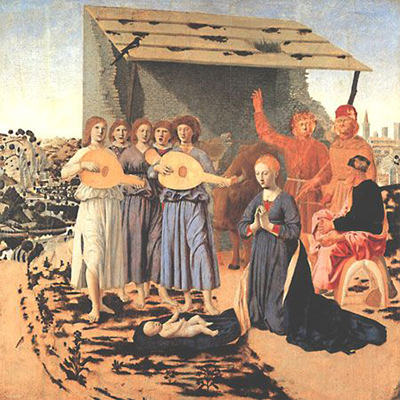
 by Tom Gurney
Tom Gurney BSc (Hons) is an art history expert with over 20 years experience
Published on June 19, 2020 / Updated on October 14, 2023
Email: tomgurney1@gmail.com / Phone: +44 7429 011000
The Duke and Duchess of Urbino by Piero della Francesca: Introduction
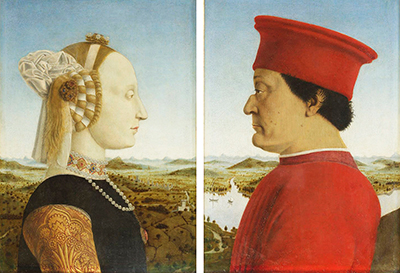
Battista Sforza and Federico da Montefeltro face one another across a narrow gap in Piero della Francesca's Urbino diptych. She wears pearls and a fine veil, while a tall red cap makes his silhouette unmistakable. Behind them, roads, towns and waterways recede into a shared distance. Turn the panels over and the couple appear again, much smaller, riding in opposite directions towards the join. A winged figure crowns Federico and unicorns draw Battista's carriage. The two portraits and the two triumphs belong to the same object, now in the Uffizi in Florence. The museum dates the diptych to about 1473–1475. [1] [2] [3]
Piero gives the couple the same scale and stage on both sides. He also gives them different kinds of distinction. On the portrait faces, Battista's pearls are as carefully observed as the irregularities of Federico's skin. On the reverses, the symbols beside each sitter and the Latin verses beneath the wheels tell us what the court wished to praise. The distinction matters especially for Battista, who negotiated and governed in Federico's absence and whose painted triumph remembers her primarily for piety and self-restraint. [2] [4] [5]
At a Glance
- ArtistPiero della Francesca. [1] [2]
- SittersBattista Sforza (1446–1472) and Federico da Montefeltro (1422–1482). [1] [2]
- DateAbout 1473–1475 in the Uffizi catalogue. [1] [2]
- Medium and dimensionsOil on wood in the Uffizi catalogue, 47 × 33 cm per panel. [1] [2]
- FormatTwo double-sided panels, with facing portraits and allegorical triumphs. [1] [2] [6]
- CollectionUffizi Galleries, Florence, inventory 1890, nos. 1615 and 3342. [1] [2]
This work across Piero della Francesca’s career
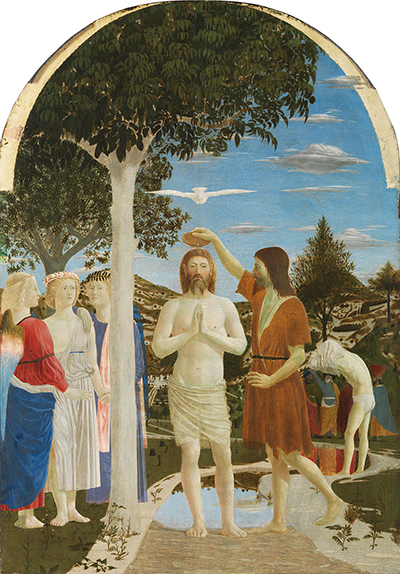
The Baptism of Christ
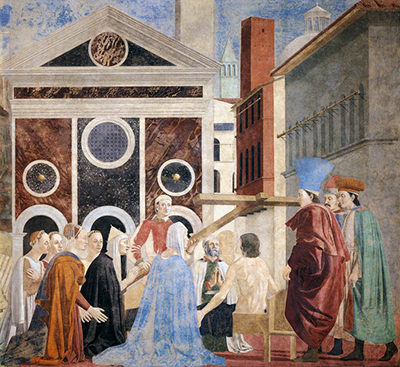
Probably about 1437–45The History of the True Cross
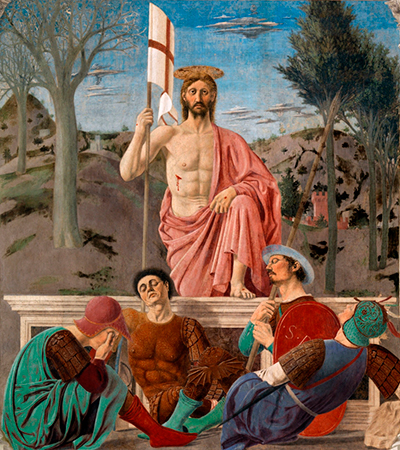
Mid-fifteenth centuryThe Resurrection
About 1458–68 (Opificio)The Flagellation of Christ
1459–60 (GNDM)The Montefeltro Altarpiece
About 1472–74 (Brera)The Duke and Duchess of Urbino (current article)
About 1473–75 (Uffizi)The Nativity
Early 1480s (National Gallery)Contents
- Two panels painted on both sides
- Federico da Montefeltro in red
- Battista Sforza in pearls
- The country behind the sitters
- Federico's triumph
- Battista's triumph
- What the Latin verses say
- Dating the diptych
- What the paint and drawings reveal
- From Urbino to Florence
Two panels painted on both sides
Each wooden panel measures about 47 × 33 cm. The Uffizi catalogues them as oil on wood, with inventory numbers 1615 and 3342 in its 1890 inventory. They sit in a later frame. The arrangement generally reconstructed for the original object is a hinged diptych that shut like a book, with the paired portraits inside and a triumph on the exterior of each leaf. Both faces of each board therefore had a part to play. You could open the diptych to see the couple face to face, then close it to find a different image of each sitter on the outside. [1] [2] [3] [6]
When the portraits are shown together, Battista occupies the left and Federico the right. In the usual side-by-side view of the reverses, Federico's triumph is on the left and Battista's on the right. The landscape and approaching carriages make sense across that reversed order. The open object would have set the portraits side by side for a viewer on one side, and placed the two triumphs side by side for someone looking from the other. The book-like construction helps explain why Piero could make one panel reply to the other even on the backs. The surviving display frame leaves the original fittings and exact manner of use open to interpretation. [2] [3] [6] [4]
That double use invites comparison with a Renaissance medal. Clemente da Urbino's bronze medal of Federico, dated 1468, puts the sitter's profile and a circular inscription on the front and an eagle with symbolic objects on the back. Its portrait already has the characteristic broken line of the nose, while the inscription invokes Caesar and Scipio. Piero likewise gives the viewer a likeness to recognise and a second image to interpret. The medal fits in the hand and contains its portrait within a rim. Piero sets the same profile against a stretch of country that continues beyond the edge of its own panel. The two objects ask the viewer to turn from a recognisable face to an image of the qualities associated with it. Whether Piero drew directly on this particular medal remains open. [1] [4] [7] [8]
Federico da Montefeltro in red
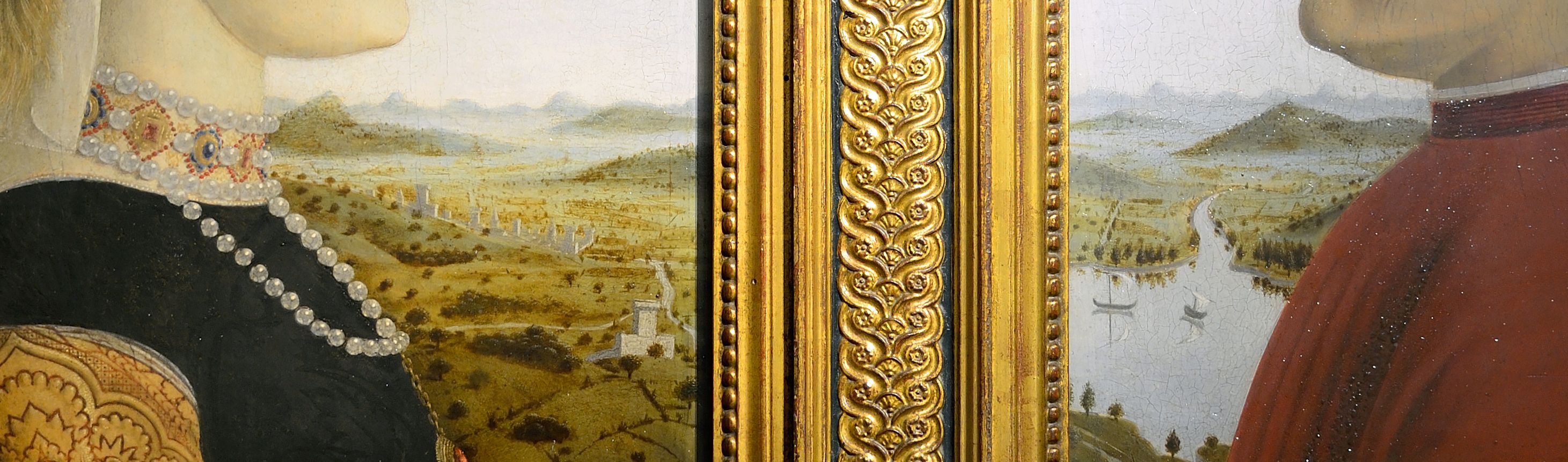
Federico's cap rises well above his brow and its flattened top gives the head a strong horizontal. Dark hair emerges in small, separate curls beneath it. Below, the upper bridge of the nose breaks sharply before the full tip turns down. The cheek carries small raised marks and the skin changes gradually in colour around the eyelid, jaw and chin. A red garment spreads across the bottom of the panel, its broad area of colour giving weight to the bust. Above the hills the silhouette is crisp, while within it the restrained shadows make the flesh look rounded. [1] [2] [3] [4]
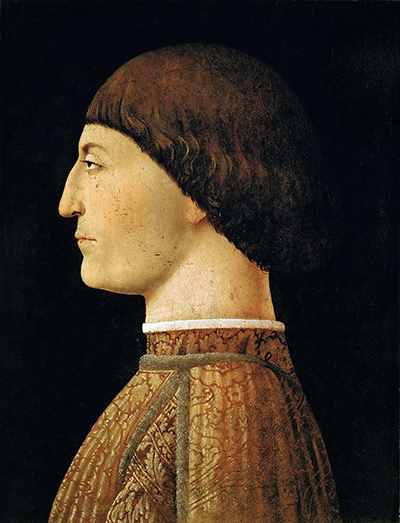
The painting shows Federico's left side. He had lost his right eye following a tournament injury, and the chosen view keeps that eye out of sight while giving the nose its familiar outline. The profile also had an independent appeal. Ancient coins and fifteenth-century medals associated a head in strict profile with rank and lasting recognition. Piero used the form elsewhere for the ruler of Rimini in his Portrait of Sigismondo Pandolfo Malatesta. There, the face and patterned coat are set against darkness. Here the outline is equally decisive, but the pale sky and distant valley make the figure look out over a world with room to move. [1] [2] [4] [7] [9] [10]
Federico became Count of Urbino in 1444 and secured the ducal title in 1474 under Pope Sixtus IV. He earned much of his wealth and standing as a condottiere, a military commander who took service under contract. His career involved alliances and negotiations as well as campaigns. The portrait lets the viewer recognise that man in a cap and gown. On the reverse, Piero supplies the armour, honour and imagery of command that the large profile leaves implied. [2] [4] [11] [7]
Battista Sforza in pearls
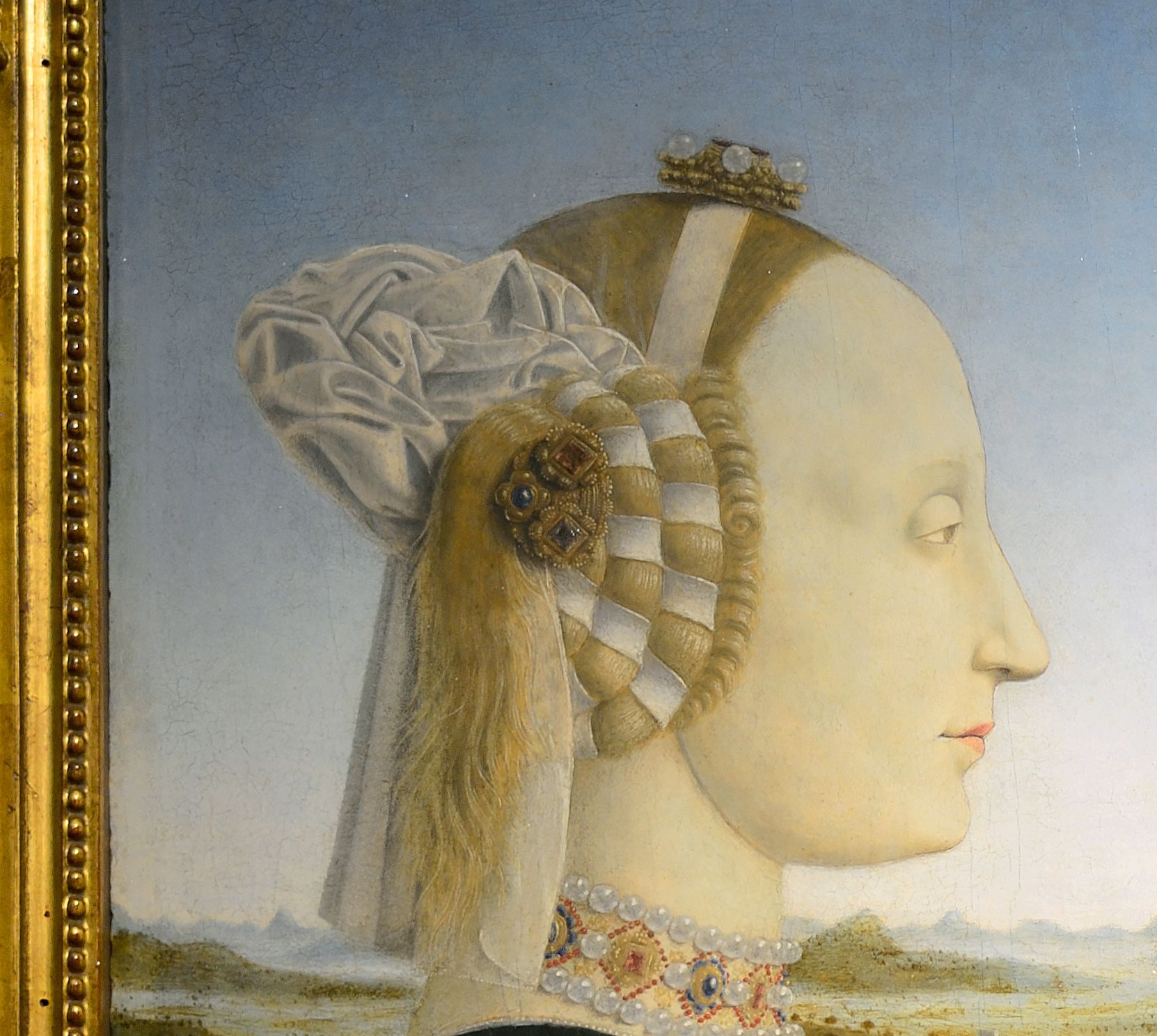
Battista's high forehead and dressed hair define a different outline. Much of her fair hair is drawn back and held in a complicated arrangement of ribbons, jewels and a light veil. At the neck, pearls lead the eye down to a larger pendant across the bodice, and pale spots of light make the individual beads read as spheres. A further line of pearls falls between the outer strands. Below the jewellery the dark dress provides a foil, while the patterned sleeve introduces intricacy at the lower edge. The contour of her brow and nose is clear enough to recognise at a distance. The border of the veil, loose hairs and tiny highlights reward a much closer look. [1] [2] [3] [4]
Battista's skin is strikingly light beside Federico's. Her profile also faces towards the light, whereas his turns more into shade. The Uffizi allows two readings of her pallor. It accords with a Renaissance ideal of female beauty and may also allude to her early death. Bertelli suggested that the recess around the eye could reflect the use of a death mask. This remains a proposal about how the painter obtained or adapted her features. Francesco Laurana's marble bust of Battista in the Bargello offers a comparison from around the same period. The Bargello bust's carved inscription bestows honorific titles on Battista, and the Urbino palace inventories record the sculpture. The museum catalogue also considers it likely that Laurana worked from a funeral mask. The resemblance between the bust and panel leaves their exact relationship uncertain. [1] [2] [3] [12] [13]
Born in Pesaro in 1446, Battista spent part of her childhood at the Sforza court in Milan under the care of Bianca Maria Visconti. Back in Pesaro she studied classical languages, grammar and poetry, with the humanist Martino Filetico brought in to teach her and her brother. Her marriage to Federico in 1460 linked Urbino to the Sforza family. Federico left on military business shortly afterwards. Battista took charge as regent with the assistance of Ottaviano Ubaldini della Carda, sought help from Milan and dealt with pressure from the Malatesta on Montefeltro holdings. In September 1463 she entered Fano beside Federico after its capture for the papacy. That public appearance is one measure of how much the painted book and quiet profile leave outside the frame. [5]
Their son Guidobaldo was born early in 1472. Battista died on 6 July that year, aged twenty-six. In a letter to the captains of San Marino dated the day of her death, Federico reported how deeply the loss had distressed him. She was buried, in accordance with her wishes, at the Poor Clares' convent of Santa Chiara in Urbino. The surviving letter and her burial arrangements provide different kinds of evidence from the diptych. They establish a history of bereavement and religious affiliation against which the imagery of the painted triumph can be read. In a later portrait of Federico and Guidobaldo, probably by Pedro Berruguete, the child holds a baton of command beside his armoured father. There the inheritance of power is given a visible form, just as the diptych makes the marriage behind that inheritance a subject in its own right. [5] [12] [14]
The country behind the sitters
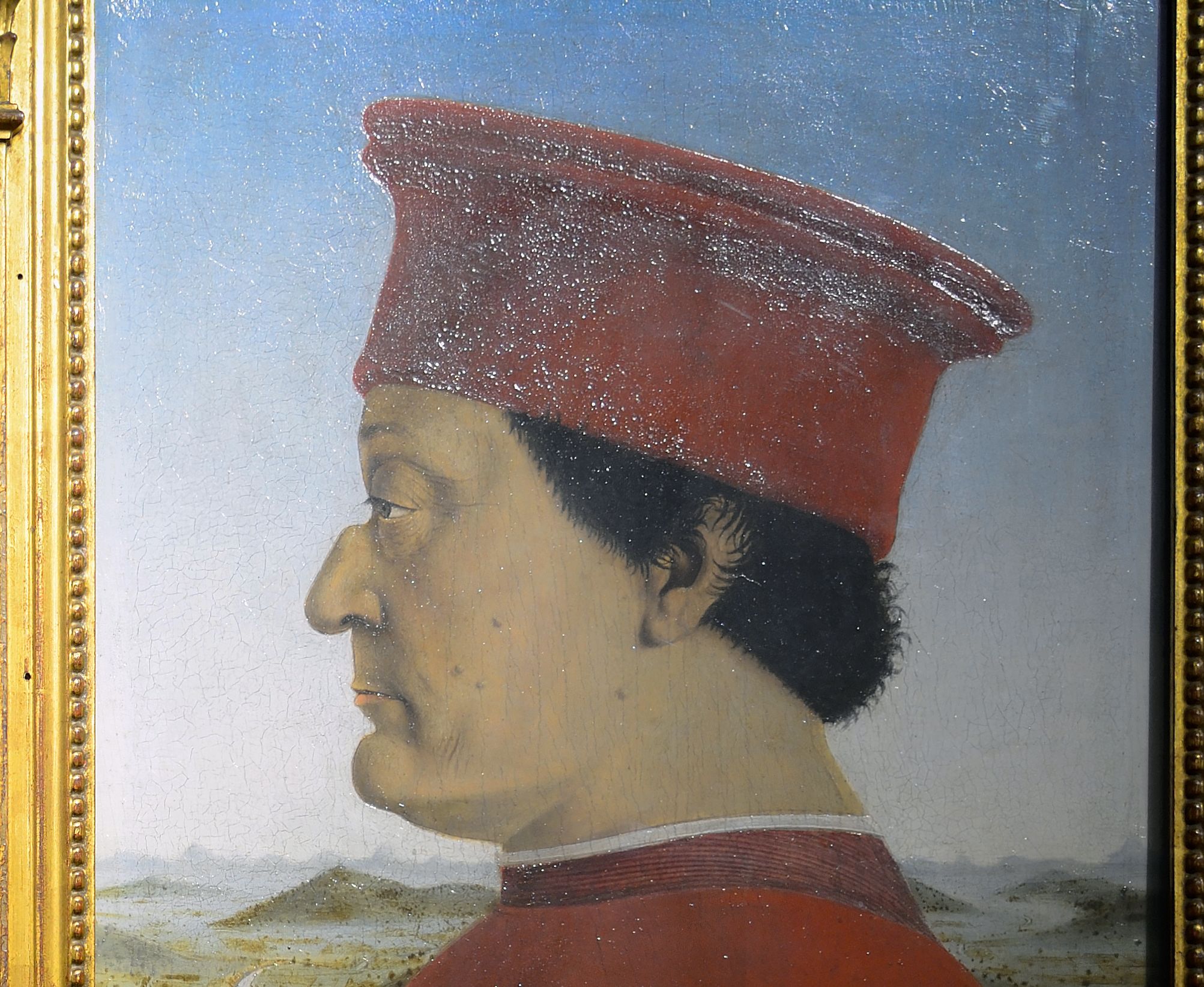
One way to see what Piero has done is to follow the horizon past the two faces. Behind Battista, a fortified settlement breaks the line of a hill, and slopes descend towards open country. Behind Federico, boats with tiny sails pick out the broad surface of the water. Across both panels the farther hills turn blue and their edges soften. The nearer slopes keep more of their greens, browns and details of cultivation. The painter achieves an impression of distance in part by changing colour and sharpness, the effect known as aerial perspective. The heads interrupt the view, but the height of the horizon and the spread of the light let the eye put it back together. [1] [2] [3] [4] [15]
There are two experiences of scale here. The high vantage point lets the viewer see down into valleys and across the roofs of settlements. At the same time, the heads are close enough for a pearl or a blemish to register. Piero provides little middle ground between the front of the picture and the country below. Battista's neckline, for example, can bring the viewer's eye from a pale rim of fabric to a faraway tower in one leap. The Uffizi relates this combination of organised space and concentrated detail to Piero's Florentine formation and his familiarity with Flemish painting. The faces themselves depend on the same light as the country behind them. [1] [2] [3] [4]
The Uffizi understands the setting as the country of the Montefeltro in the Marche. Whether particular hills and waters can be located on a map is a finer question. Olivia Nesci and Rosetta Borchia compared the shapes of slopes and valleys with maps, landforms and historical images. They proposed links to the Metauro and Marecchia valleys, comparing a distinctive ridge behind Battista with the rock of Maioletto and accounting for later changes in its profile. Bertelli read the diptych as an idealised Montefeltro and doubted that Federico's vessel-filled lake could simply be located on the ground. Real formations may inform the painting while Piero arranges distances and boundaries to make the portrait pair work. Seen this way, country roads, walls and boats evoke inhabited and governed territory without requiring every landmark to have a modern equivalent. [1] [2] [3] [15]
Annotated Details from The Duke and Duchess of Urbino
The numbered points identify visible features discussed in this article. Return from each detail to the numbered overview. Battista Sforza and Federico da Montefeltro, the portrait faces of Piero’s Urbino diptych, Uffizi. Livioandronico2013. Image source. CC BY-SA 4.0. The numbered overview and detail crops are adaptations under CC BY-SA 4.0.
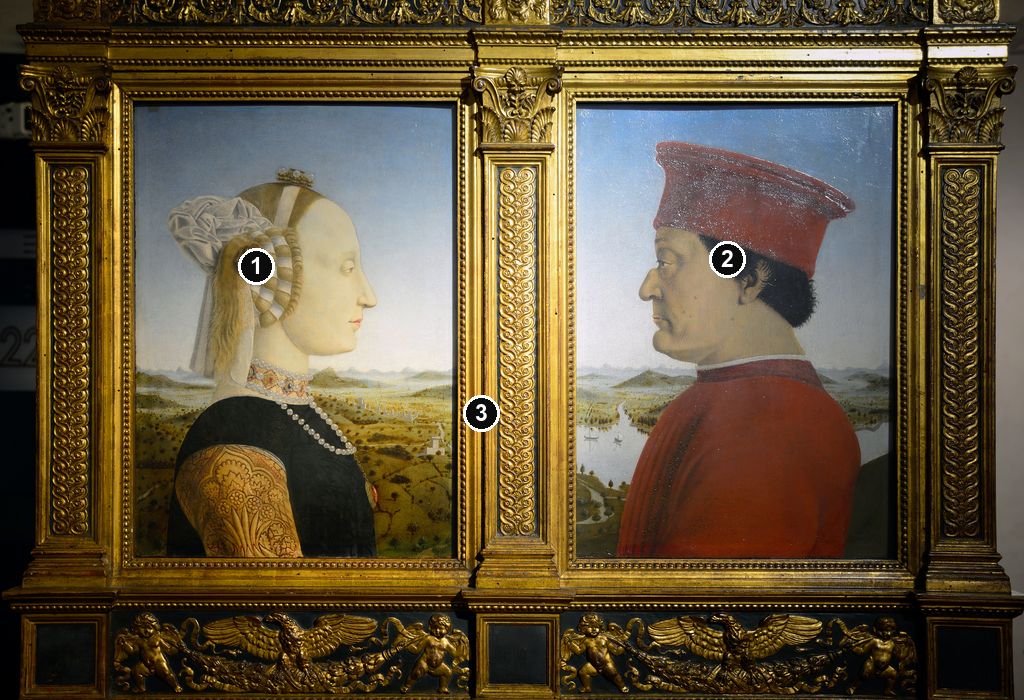
Details from THE DUKE AND DUCHESS OF URBINO
Compare the cropped details with the source images above. Notice how their colours, shapes and positions contribute to the larger compositions.
Battista’s headdress
Pale fabric and pearls articulate the back of Battista’s head. The profile retains a sharp edge against the blue sky.
Federico’s cap and profile
The red cap extends over the forehead and back of the head. The dark silhouette and lighter ridge of the nose remain distinct against the sky.
Landscapes at the frame
Hills and water sit at related heights in the two panels. The present central frame separates the two stretches of country.
Federico's triumph
On the reverse of Federico's panel, two white horses draw a car from left to right along a shelf of bare ground. Federico sits in armour on a folding seat. He holds out a commander's baton with his helmet resting on his knee. Behind him a winged Victory balances on a globe and reaches over him with a crown. A small winged charioteer holds the reins. The white horses catch the light against the pale water and their red harnesses draw the eye towards the other panel. Below, a strip painted to look like stone bears a four-line Latin inscription. The stone-like lettering gives the procession the permanence of a monument. [2] [3] [4] [16]
The four women on the carriage can be read as the cardinal virtues, the moral qualities traditionally named as Justice, Prudence, Fortitude and Temperance. Justice faces the viewer, so her sword and scales are especially useful for identifying the group. Fortitude handles a broken column, and Prudence is recognisable by her double aspect and mirror. The remaining figure is usually called Temperance by association with the other three. The figures make a claim about the way Federico exercises authority. His military success is present in the armour and crown, while the company he keeps connects command with sound judgement, strength and restraint. [2] [4]
The imagery recalls the triumph of an ancient Roman commander, when victory became an occasion for civic display. Renaissance artists adapted that form to show people accompanied by personified virtues, and illustrated versions of Petrarch's Triumphs gave it wide circulation. A more specific proposal relates Federico's procession to the honours he received at Florence in 1472 after the campaign against Volterra. That celebration would have made the ancient vocabulary particularly apt for him. The armoured figure, imagined terrain and virtue figures leave room to read the painting as a general statement of rule, with the Florentine reception a possible point of reference. Margaret Ann Zaho has also proposed that the winged driver and white horses recall Petrarch's Triumph of Love. The triumph can draw on more than one tradition even when its gestures are precise. [4] [11] [17] [16]
Battista's triumph
Battista travels from right to left, carried towards Federico's procession by a pair of brownish unicorns. She looks down at a small book, often described as a breviary. Her attendants gather around the seat, and the rich fabric covering the car gives the group a firm base above its wheel. The unicorns belong to an established pictorial tradition of chastity, especially illustrations of Petrarch. Honouring a wife and mother as chaste invoked fidelity and sexual virtue within marriage. Battista's lowered head and book lend the scene an air of devotion even while the car presents her for public honour. [2] [3] [4] [17] [16]
The front group is generally read as the three theological virtues of Faith, Hope and Charity. Faith's cross and chalice are among the clearest attributes. Charity carries a pelican, which Christian tradition pictured feeding its young with its own blood. This was a familiar emblem of Christ's sacrifice. In the context of Battista's death months after Guidobaldo's birth, it has also been read as an allusion to maternal sacrifice. The pious book and the pelican make those readings possible, while the precise identity of the two attendants behind Battista is less secure. The group on her carriage can be understood without assigning a fixed name to every figure. [2] [3] [4] [5]
Look across the reverses from the white horses to the darker unicorns, and then down towards the water. Piero gives the two processions enough space to be read together, carrying the shape of a broad middle-distance hill across the central join. Like the light in the portraits, the shared ground gives a unity to strikingly different details. The strip of rock under the wheels is seen almost from the side, while beyond it the viewer looks down over a basin with ships and reflections. The jump from the small, legible stage to the deep valley repeats the abrupt change in scale on the portrait faces. [2] [3] [4] [15]
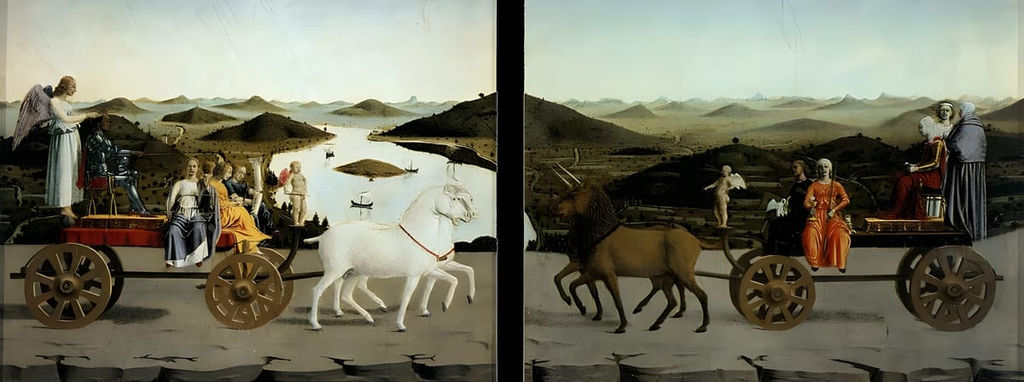
Triumphal processions on the reverse of the Urbino portraits, shown side by side. Image source. Public domain. Resized only; native appearance preserved.
What the Latin verses say
Both inscriptions are four-line poems in a classical metre associated with Sappho and Horace, painted in capitals below the triumphs. Federico's verse describes a man borne in splendid triumph and celebrated by enduring fame for his virtues. It sets him among the greatest commanders and as a worthy bearer of the sceptre. The combination of commander and ruler matches the movement from armour and horses to Justice's scales. The verse directly invokes a sceptre, which supports the general language of sovereignty without supplying the literal title of duke or the date it was conferred. [2] [4] [11]
Battista's verse remembers a woman who maintained moderation when fortune favoured her. It adds that the renown of her great husband's deeds adorns her and that her own fame passes from mouth to mouth. The phrase volitat per ora evokes a line from the epitaph of the Roman poet Ennius, preserved by Cicero, in which he expects to live on through people's speech. Creighton Gilbert also linked the phrase about moderation in prosperity to the Aeneid. Vergil's Turnus exults over captured spoils and forgets how suddenly his fortunes can turn. The memory of Battista offers an example of the restraint that Turnus lacked. Both echoes help explain why the verse can sound like a memorial even as the procession praises her in perpetuity. [4] [5]
Read together, the inscriptions give the two figures different relations to fame. Federico's grows from his own deeds and fitness to rule. Battista has her own moral renown, but the poem places it in a marriage and invokes his accomplishments as part of hers. Her actual duties as regent give this language particular force. An informed reader at Urbino could have known her as an educated correspondent and participant in political affairs and still encountered the historical Battista here through the particular virtues that a court poem chose to celebrate. [4] [5] [12]
Dating the diptych
The Uffizi's dating of about 1473–1475 fits a reading of the object as partly commemorative. Battista had died in 1472, and Federico became duke in 1474. The epigram's past tense and echoes of ancient writing about death and fame are stronger pieces of evidence for the memorial reading than complexion alone. A posthumous triumph still leaves room for a portrait likeness drawn or studied earlier. No known commission fixes a single date for the design, the painting of the two faces and the writing of the inscriptions. Battista's death before the elevation also explains the apparent mismatch in the familiar title. She was Countess of Urbino in life, although the picture has long been called the Duke and Duchess of Urbino. [1] [2] [4] [11] [5]
An earlier reading connects the imagery to the couple's marriage and to Federico's military successes in the early 1460s. Alessandro Angelini proposed a commission around 1462–1463, treating the reverses as celebrations indebted to Petrarch's Triumphs of Fame and Chastity. A fifteenth-century poem by Ferabò also refers to a portrait of Federico by Piero. Its usefulness for dating depends on whether it describes the Uffizi likeness or another image, and on when the poem was written. Frank Zöllner has discussed both an earlier date for the poem and a date around 1474, which he considers more likely. Bertelli associated the reference with the Brera altarpiece. Documentary and visual evidence therefore leave room for more than one chronology. Masumi Ishinabe reads the design as celebrating Federico's honours in 1474 while paying tribute to Battista after her death. His proposal shows how a public moment in Federico's career and the memory of his wife could have prompted the same commission. [3] [4] [17] [18] [19] [8]
What the paint and drawings reveal
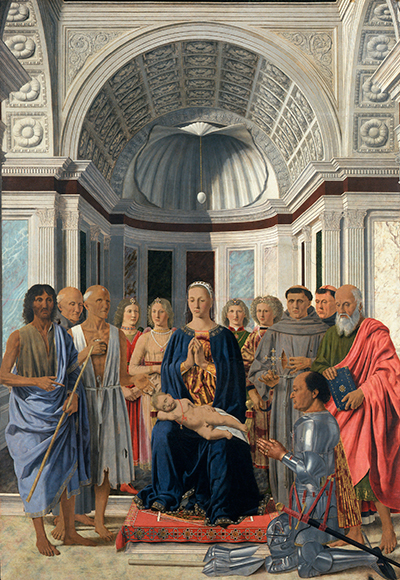
Piero painted Federico again as the kneeling donor in the Brera Madonna, where the same left profile is set beneath a vaulted church interior and the armour catches the light. In a 1997 study, Roberto Bellucci and Cecilia Frosinini used infrared reflectography to compare the drawings beneath the paint of the two heads. In the Uffizi portrait they found a fine preliminary line that traced Federico's profile and helped to locate the features within it. The outlines looked almost identical at first. An overlay at their actual dimensions showed that aligning the eye, mouth or another individual feature shifted the rest out of register. After the researchers resized the Brera image proportionally, the drawings aligned closely. They proposed that Piero worked from a common reference drawing scaled for each commission, making local adjustments as needed. That finding links the two images without establishing which one he completed first. [20] [9]
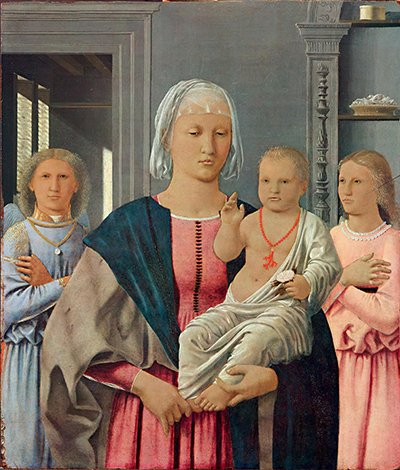
The same investigation notes Edo Masini's 1986 restoration of the diptych and helps explain the differences between catalogue descriptions of the medium. The conservators report oil alone as the pigment binder in the diptych samples analysed, and an oil-rich tempera in an underlying priming layer in some areas. They also note that flesh paint was outside the set of samples, so the exact composition of the faces remains a separate question. The Uffizi's current description is oil on wood, while some other catalogues give tempera or a mixed medium. Piero's effects of light can be compared with the Madonna di Senigallia, in which daylight enters through a window and brings out the textures and volumes of a small interior. In the diptych, the skin, pearls and water provide similarly varied surfaces for light to catch. [1] [2] [6] [20] [21] [19]
From Urbino to Florence
The diptych entered the Florentine collections through Vittoria della Rovere, who inherited the Urbino collection in the seventeenth century and married Ferdinando II de' Medici. The Uffizi connects the diptych's arrival in Florence with this inheritance and marriage. The move brought a portrait of the earlier Montefeltro rulers into the Medici collection by way of the family that had succeeded them in Urbino. The exact room or occasion for which the panels were first intended remains uncertain. The surviving pair retains the means of making that question vivid. Its painted exteriors could be shown to others, while its hinged form could bring two faces together and then fold them away. [1] [2] [6] [4] [22]
By the nineteenth century a viewer could also encounter Battista entirely on her own. The Rijksmuseum holds an 1892 photomechanical print of her portrait from the German publication Klassischer Bilderschatz. Detached in reproduction, Battista's silhouette, costume and light can carry an image by themselves. Seeing the panel as part of the diptych restores the red of Federico's facing figure, the horizon that extends behind him and the scene painted directly behind her. An image that can circulate as a single likeness was built to change as a viewer turned it. [1] [2] [6] [23]
Browse the artworks
Compare Piero’s frescoes, panels and manuscript figures. The list includes ensembles and separately identifiable panels or scenes. Dates are approximate where the sources differ.
| Name | Date | Medium and source |
|---|---|---|
| The Baptism of Christ | Probably c. 1437–45 | Panel painting Catalogue. |
| The Flagellation of Christ | 1459–60 (GNDM) | Panel painting Catalogue. |
| The History of the True Cross | Mid-fifteenth century | Wall painting Catalogue. |
| Dream of Constantine | Mid-fifteenth century | Wall painting Catalogue. |
| The Duke and Duchess of Urbino | About 1473–75 (Uffizi) | Panel painting Catalogue. |
| The Resurrection | About 1458–68 (Opificio) | Wall painting Catalogue. |
| Brera Madonna | About 1472–74 | Panel painting Catalogue. |
| Annunciation at Arezzo | Mid-fifteenth century | Wall painting Catalogue. |
| Madonna del Parto | About 1450–65 (Monterchi) | Wall painting Catalogue. |
| Polyptych of the Misericordia | Commissioned 1445 | Panel painting Catalogue. |
| The Nativity | Early 1480s (National Gallery) | Panel painting Catalogue. |
| Madonna di Senigallia | About 1474–75 (GNDM) | Panel painting Catalogue. |
| Death of Adam | Mid-fifteenth century | Wall painting Catalogue. |
| Queen of Sheba | Mid-fifteenth century | Wall painting Catalogue. |
| Victory of Constantine | Mid-fifteenth century | Wall painting Catalogue. |
| Battle between Heraclius and Chosroes | Mid-fifteenth century | Wall painting Catalogue. |
| Saint Mary Magdalen | Wall painting Catalogue. | |
| The Augustinian Polyptych | 1454–69 | Panel painting Catalogue. |
| Polyptych of Perugia | About 1467–69 (GNU) | Panel painting Catalogue. |
| Perugia Annunciation | About 1468–70 (national catalogue) | Panel painting Catalogue. |
| St Francis and St Elizabeth | About 1467–69 (GNU) | Panel painting Catalogue. |
| Stigmatisation of St Francis | About 1468–70 (national catalogue) | Panel painting Catalogue. |
| An Augustinian Nun (Saint Monica) | 1454–69 | Panel painting Catalogue. |
| Augustinian Saint | 1454–69 | Panel painting Catalogue. |
| Saint Michael | 1454–69 | Panel painting Catalogue. |
| Saint Nicholas of Tolentino | 1454–69 | Panel painting Catalogue. |
| Saint John the Evangelist | 1454–69 | Panel painting Catalogue. |
| Virgin and Child Enthroned with Four Angels | About 1460–70 (Clark) | Panel painting Catalogue. |
| Portrait of Sigismondo Pandolfo Malatesta | About 1450–51, often proposed. Louvre catalogue range 1450–75. | Panel painting Catalogue. |
| Sigismondo before St Sigismund | 1451 | Wall painting Catalogue. |
| St Jerome and a Donor | 1460s (Accademia); about 1450 also proposed | Panel painting Catalogue. |
| St Jerome in Penitence | 1450, dated on the panel | Panel painting Catalogue. |
| Saint Julian | About 1455–60, often proposed | Wall painting Catalogue. |
| Saint Augustine | 1454–69 | Panel painting Catalogue. |
| Saint Apollonia | 1454–69 | Panel painting Catalogue. |
| Crucifixion from the Augustinian Polyptych | 1454–69 | Panel painting Catalogue. |
| Saint Louis of Toulouse | Wall painting Catalogue. | |
| Burial of the Wood | Mid-fifteenth century | Wall painting Catalogue. |
| Discovery and Proof of the True Cross | Mid-fifteenth century | Wall painting Catalogue. |
| Exaltation of the Cross | Mid-fifteenth century | Wall painting Catalogue. |
| Saint Anthony Raises a Child | About 1467–69 (GNU) | Panel painting Catalogue. |
| Saint Elizabeth Revives a Child | About 1467–69 (GNU) | Panel painting Catalogue. |
| Hercules | About 1470 | Wall painting Catalogue. |
| Portrait of a Boy (possibly Guidobaldo da Montefeltro) | Panel painting Catalogue. | |
| De prospectiva pingendi, Reggio Emilia witness (figures) | Manuscript diagrams Catalogue. | |
| The Interrogation of Judas | Mid-fifteenth century | Wall painting Catalogue. |
| Two prophets, Bacci Chapel | Mid-fifteenth century | Wall painting Catalogue. |
| Saint Clare of Assisi, upper predella | About 1467–69 (GNU) | Panel painting Catalogue. |
| Saint Agatha, upper predella | About 1467–69 (GNU) | Panel painting Catalogue. |
| Lost centre of the Augustinian Polyptych | 1454–69 | Lost panel or panels Catalogue. |
Frequently Asked Questions
He had lost his right eye following a tournament injury. The left profile conceals that eye and makes the broken bridge of his nose easy to recognise. The same view fits a Renaissance portrait convention drawn from ancient coins and adopted on medals such as Clemente da Urbino's image of Federico. [1] [2] [4] [7] [9]
Federico rides in armour behind white horses, accompanied by Victory and figures commonly identified as the four cardinal virtues. Battista reads on a car drawn by unicorns, with figures understood as Faith, Hope and Charity among her attendants. The Latin poem below each triumph praises the sitter. [1] [2] [4]
The wedding took place in 1460. A marriage-related commission in the early 1460s has been proposed. The Uffizi dates the diptych to about 1473–1475, and the memorial language of Battista's inscription supports a date after her death in 1472. The original occasion remains uncertain. [1] [2] [4] [5] [17]
Discussion
Look again at the images and ideas explored in The Duke and Duchess of Urbino by Piero della Francesca. These editorial prompts invite your observations.
Reader Insights
Follow the horizon from Battista's panel to Federico's. Which changes of colour or detail make the spaces feel connected across the frame?
Compare Battista's portrait with her triumph. Where does Piero rely on the individuality of her appearance, and where does he rely on attributes such as the book or unicorns?
What would you learn about Federico and Battista from the Latin verses that you would be less likely to infer from their profiles?
Join the Conversation
Share a detail, comparison or question about The Duke and Duchess of Urbino by Piero della Francesca below.
References
- Daniela Parenti, The Duke and Duchess of Urbino Federico da Montefeltro and Battista Sforza, Uffizi Galleries, English collection record. View source.
- Daniela Parenti, I duchi di Urbino Federico da Montefeltro e Battista Sforza, Gallerie degli Uffizi, Italian collection record and views of both triumphs. View source.
- Carlo Bertelli, “Piero della Francesca”, I classici della pittura, Treccani, 2016. See “Il dittico”. View source.
- Michelle Kambi (Michelle Marder Kamhi), The Uffizi Diptych by Piero della Francesca, MA thesis, Hunter College, City University of New York, 1970. See chapters I–IV on the object, portraits, reverses and inscriptions. View source.
- Edoardo Rossetti, “Sforza, Battista”, Dizionario Biografico degli Italiani, vol. 92, 2018. View source.
- Regione Marche, Ritratti e trionfi dei duchi di Urbino, cultural heritage catalogue, no. 11-00000410. View source.
- National Gallery of Art, Washington, Federigo da Montefeltro, Count of Urbino 1444, and Duke 1474 [obverse], Clemente da Urbino, 1468, collection record 1957.14.693.a. View source.
- Masumi Ishinabe, Piero della Francesca, Tohoku University doctoral thesis summary and examination report, pp. 286–287 and 291. See chapter 12 on the medal format and proposed date of the diptych. View source.
- Pinacoteca di Brera, Madonna and Child with Saints, Angels and Federico da Montefeltro, collection record and gallery guide to the Montefeltro Altarpiece. View source 1. View source 2.
- Musée du Louvre, Portrait de Sigismond Malatesta, seigneur de Rimini, collection record RF 1978 1. View source.
- Gino Benzoni, “Federico da Montefeltro, duca di Urbino”, Dizionario Biografico degli Italiani, vol. 45, 1995. View source.
- Tommaso di Carpegna Falconieri, “Una cronaca con documenti”, in Le carte di Federico, Urbino University Press, 2022. See the discussion of documents 5 and 6. View source.
- Ministero della Cultura, Ritratto di Battista Sforza, Francesco Laurana, Museo Nazionale del Bargello, national catalogue record 0900349895. View source.
- Galleria Nazionale delle Marche, Ritratto di Federico da Montefeltro e del figlio Guidobaldo, collection record, with the corresponding dynastic context in the Museo Nacional Thyssen-Bornemisza's Retrato de un niño. View source 1. View source 2.
- Olivia Nesci and Rosetta Borchia, “Il contributo della geomorfologia allo studio di alcuni paesaggi in opere pittoriche del Rinascimento italiano”, Bollettino dell'Associazione Italiana di Cartografia, nos. 136–137, 2009, pp. 203–210. See the illustrated proceedings contribution, especially fig. 5 and the conclusion. View source 1. View source 2.
- Margaret Ann Zaho, Imago Triumphalis, Peter Lang, 2004, pp. 88–93 on the triumphs of Federico and Battista. View source.
- Alessandro Angelini, “Per la cronologia del dittico dei Montefeltro di Piero della Francesca”, Prospettiva, nos. 141–142, 2011, pp. 59–72. Author's abstract and publication record. View source.
- Frank Zöllner, “The ‘Motions of the Mind’ in Renaissance Portraits”, Zeitschrift für Kunstgeschichte, vol. 68, no. 1, 2005, pp. 23–40. See the discussion of Ferabò and note 33. View source.
- Bibliothèque nationale de France, Portrait de Federico da Montefeltro et son épouse Battista Sforza, title authority record giving the date 1467–1472 and the medium as tempera and oil on wood. View source.
- Roberto Bellucci and Cecilia Frosinini, “Ipotesi sul metodo di restituzione dei disegni preparatori di Piero della Francesca”, in La Pala di San Bernardino di Piero della Francesca. Nuovi studi oltre il restauro, 1997, pp. 167–184. See the comparison of the two profiles and the discussion of their painting technique. View source.
- Galleria Nazionale delle Marche, Madonna col Bambino benedicente e due angeli (Madonna di Senigallia), collection record. View source.
- Uffizi Galleries, Portrait of Vittoria della Rovere, and Uffizi collection account of the diptych on Google Arts & Culture, for the dynastic transfer and the diptych's arrival in Florence. View source 1. View source 2.
- Rijksmuseum, Portret van Battista Sforza, anonymous photomechanical print after Piero della Francesca, 1892, collection record RP-P-2022-2621. View source.