 by Tom Gurney
Tom Gurney BSc (Hons) is an art history expert with over 20 years experience
Published on June 19, 2020 / Updated on October 14, 2023
Email: tomgurney1@gmail.com / Phone: +44 7429 011000
The Flagellation of Christ: Introduction
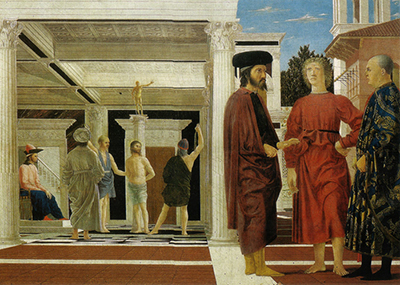
Three men stand in a paved square. Beyond them, under an open colonnade, two men are whipping Christ. The figures nearest us are so much larger than the figures under the roof that it takes a moment to find the episode that gives Piero della Francesca’s painting its name. Once you find it, the courtyard takes on a different character. The three men still have their conversation, but it becomes hard to look at them without wondering whether they know what is happening only a few paces away. [1]
The Flagellation is a tempera painting on a poplar panel in the Galleria Nazionale delle Marche at Urbino. The gallery catalogues it to 1459–60 and gives its dimensions as 67.5 by 91 centimetres. Piero left his name on the step beneath Pontius Pilate’s seat. The patron and original setting are still uncertain. The strong visual connection between the two groups, and the difficulty of explaining what connects them in the story, have kept the painting in dispute for centuries. [1] [2] [3]
At a Glance
- ArtistPiero della Francesca, named in the inscription below Pilate’s seat. [1]
- DateCatalogued by the owning gallery to 1459–60. Other dates have been proposed. [1] [3] [4]
- MediumTempera on a poplar panel, according to the gallery’s medium entry and Brandi’s report on the wood. [1] [2]
- Dimensions67.5 × 91 cm, as catalogued by the Galleria Nazionale delle Marche. [1]
- CollectionGalleria Nazionale delle Marche, Urbino, inventory DE 229. [1]
- Earliest known recordThe Urbino cathedral chapter authorised repair and reframing in December 1717. [3]
This work across Piero della Francesca’s career
The Baptism of Christ
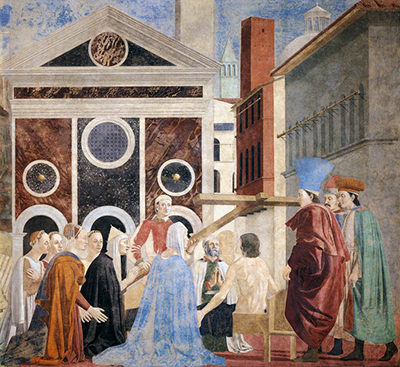
Probably about 1437–45The History of the True Cross
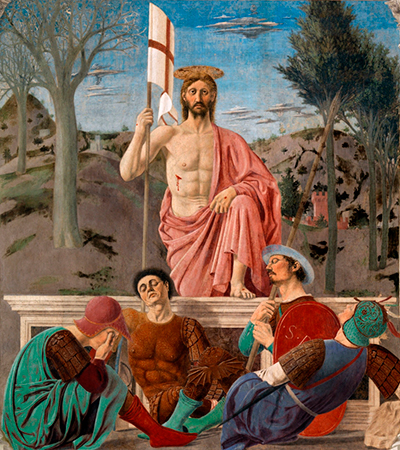
Mid-fifteenth centuryThe Resurrection
About 1458–68 (Opificio)The Flagellation of Christ (current article)
1459–60 (GNDM)The Montefeltro Altarpiece
About 1472–74 (Brera)The Duke and Duchess of Urbino
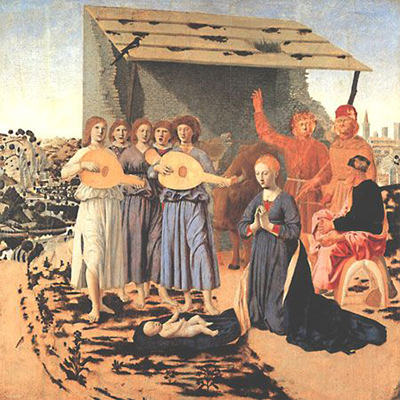
About 1473–75 (Uffizi)The Nativity
Early 1480s (National Gallery)Contents
- At the entrance to the loggia
- How the floor joins two scenes
- Light beneath the roof
- What the panel and its records reveal
- A phrase on a lost frame
- The three men as figures from Urbino and Byzantium
- Two moments from the Passion
- Why the distance between them matters
- Annotated details
At the entrance to the loggia
Start with the tall white column near the middle of the panel. It stands on the edge of the covered hall, just to the left of the three men outside. To follow that dividing line further, look down to the paving and up to the edge of the ceiling. The column is both an architectural support and the boundary between the largest concentration of figures and the deepest part of the picture. You can travel visually from either group to the other without crossing a wall. Yet you have the impression that you are passing from one scene into another. [1] [4]
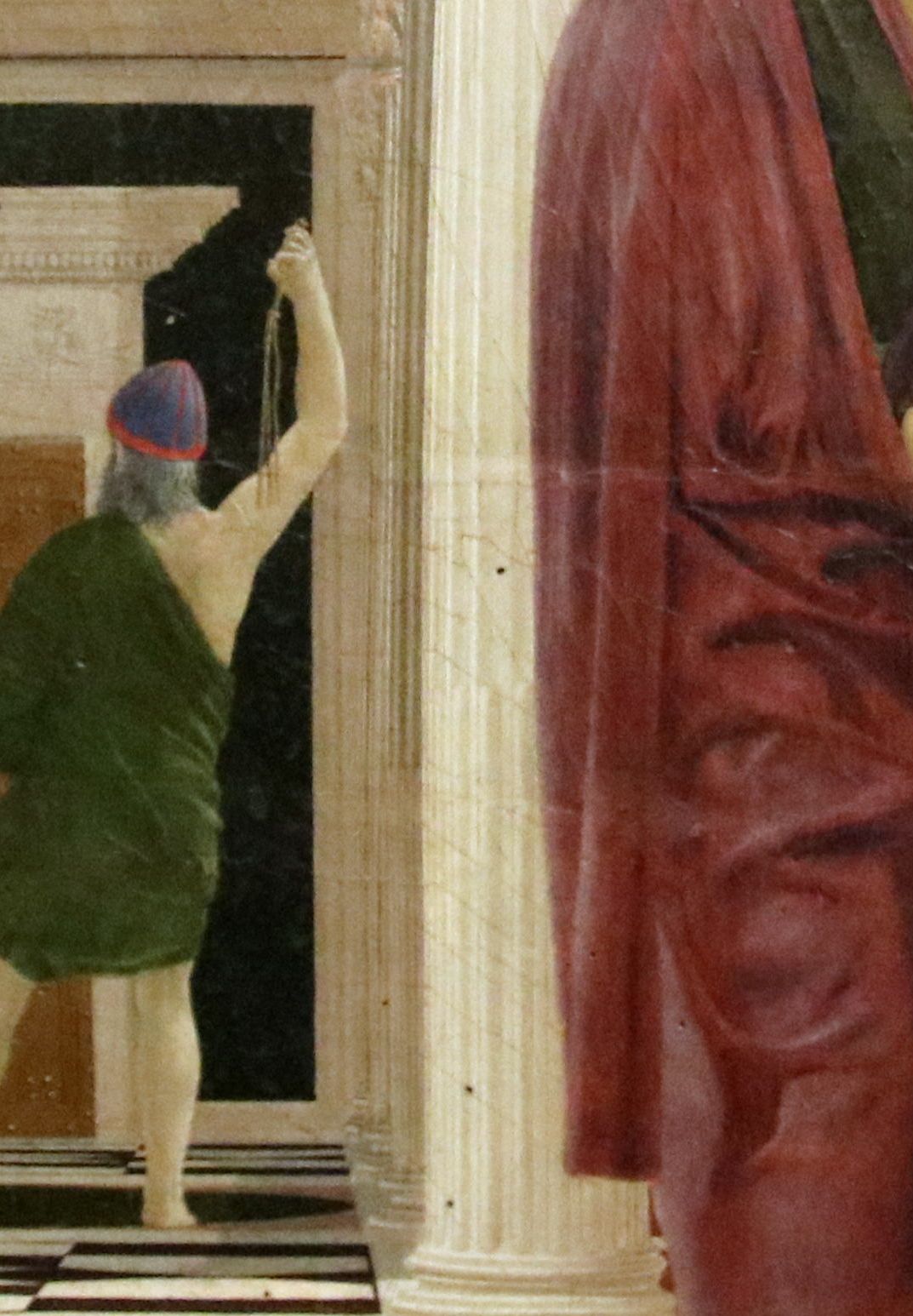
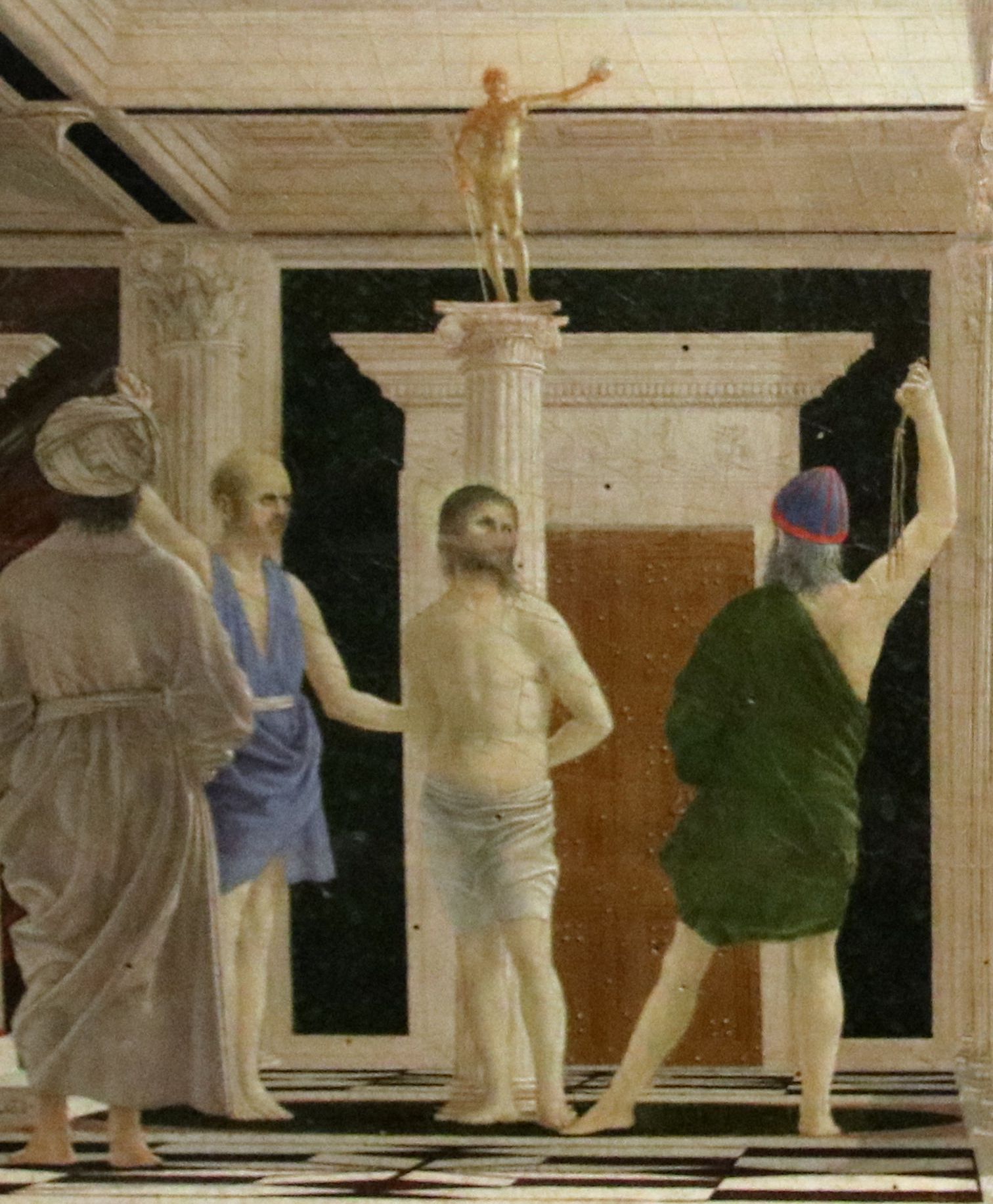
Christ stands farther in, his weight nearly balanced beneath the upright of a column. Above him is a small gold-coloured statue with one arm raised. One of the two men striking him lifts his arm, making a second raised gesture below the statue. At left Pilate watches from his seat, separated from the action by his platform. Another observer stands with his back to us, his head wrapped in a turban. He is the person already inside the picture whose position most resembles ours as viewers. Piero gives him a place close enough to see the scourging, and gives us a view over and around him. [1] [4]
In Matthew’s Gospel Pilate has Jesus scourged before handing him over to be crucified. The Gospel supplies the sequence of events. Piero supplies the patterned stone beneath Christ’s feet, the gilded figure above him and a distribution of witnesses that changes between the hall and the square. There is movement in the torturers’ arms, but there is little sign of it passing from body to body. Pilate remains seated. Christ’s upright body holds its shape. The three men outside face into their own group or towards us. The few forceful gestures stand out because so much else is still. [1] [5]
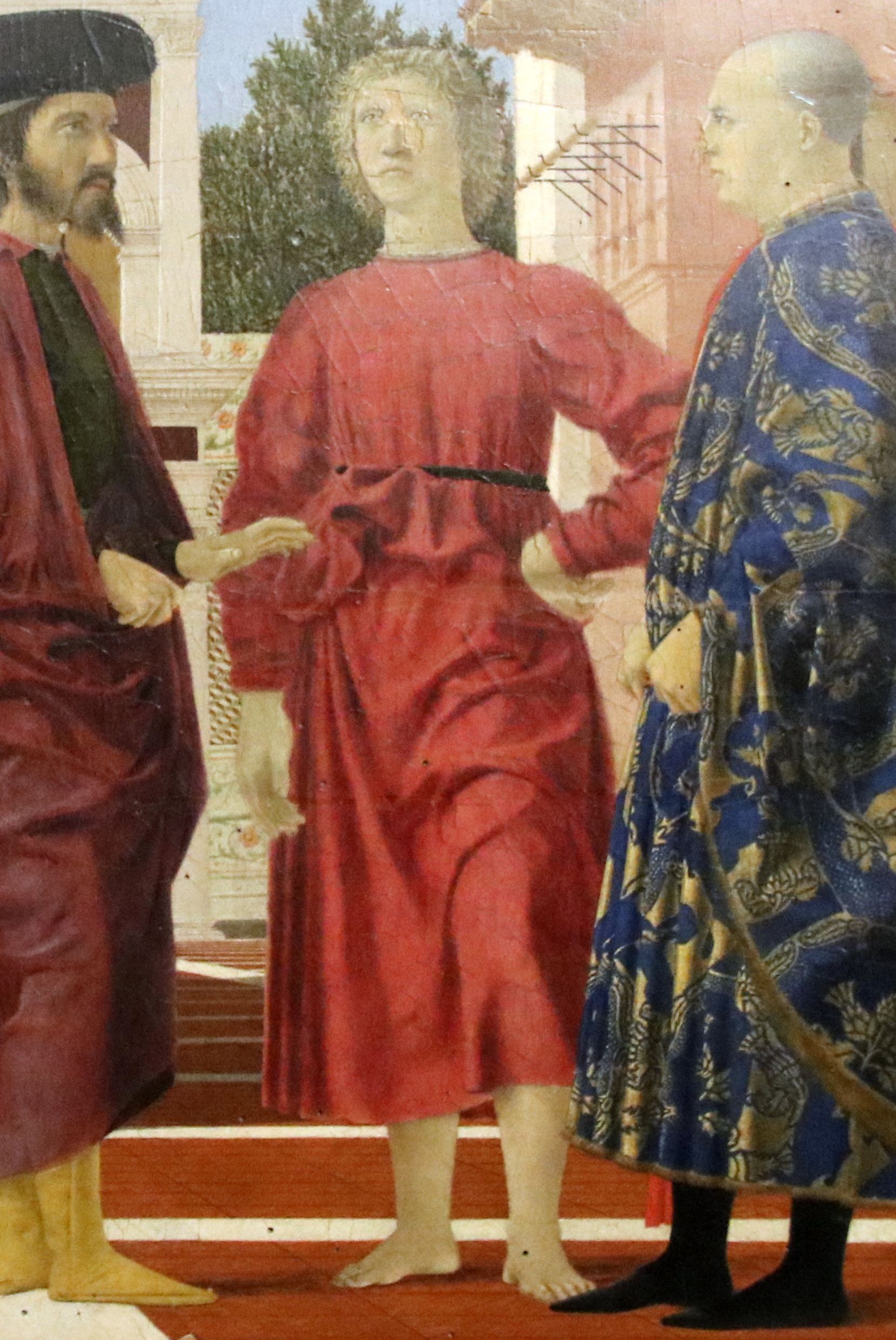
The foreground is more varied than it first seems. The bearded man at the left extends an open hand as if making a point. The fair-haired young man stands barefoot, one hand lowered and the other at his waist. The man at the right presents a clear profile and wears an elaborate blue-and-gold garment. Their feet, hands and clothing offer different clues to their status. The young man’s bare feet draw attention because Piero has put them so close to a richly patterned robe. The three look like a group, but the clues that distinguish them are more legible than the nature of their exchange. A gesture can suggest that someone is speaking without supplying his words. [1] [6]
Take another look at the space around the men’s feet. A wide pale strip begins at the foot of the column and runs to the lower edge of the panel. Behind the men, shorter stretches of pale paving appear again. The glimpses are enough to locate them in the square, but their bodies interrupt a view that would otherwise go much deeper. Under the roof, the spaces between the people are much smaller. They are separated by columns, changes in level and parts of bodies overlapping one another. Piero makes dissimilar kinds of space intelligible in the same glance. [1] [4]
How the floor joins two scenes
Look first at the long straight seams running away from the lower edge. In linear perspective, edges that would be parallel on the ground converge towards a point in the image as they recede. You can test the effect without a diagram. Follow the long edges of a strip in the paving, then follow the side of a ceiling beam that runs in the same direction above it. Both lead your eye back towards the same low region. They approach from opposite directions in the picture, which is part of what makes the dimensions of the room so easy to imagine. [1] [4] [7]
The low vanishing point has consequences for the way people appear. We look up towards the capitals and see a large expanse of ceiling, yet there is also room to see the extensive design of the floor. The foreground men rise well above the level at which the receding lines meet. The room feels lofty even though the panel itself is small. Notice also how the low horizon and the long roof can make the bare paving look like the front of a stage. The low viewpoint belongs to the painted construction. It cannot on its own tell us how high the actual panel was intended to hang. [4] [7]
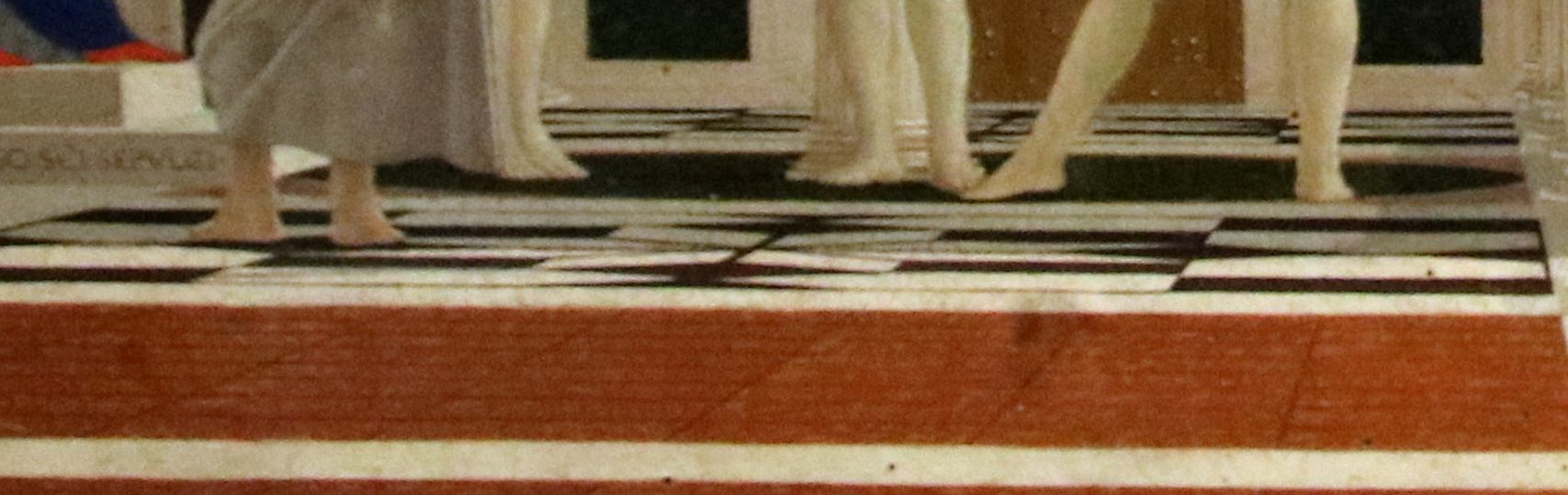
The pavement holds those effects together. The wide strips in the square make the scale of the foreground readily legible. Farther back, on entering the hall, you see a denser design, with contrasting shapes around the column to which Christ is bound. Despite the change in pattern, the stone surfaces do not appear to begin again as if viewed through a separate window. The scale keeps diminishing. Piero can therefore consign the scourging to an apparently distant part of the picture and still make it available to a viewer standing on the same side of the painted world as the three men. [1] [4] [7]
Rudolf Wittkower and B. A. R. Carter published an architectural reconstruction in 1953. Laura Geatti and Luciano Fortunati later approached the picture through a mathematical analysis, and Museo Galileo has shown a virtual reconstruction by Filippo Camerota and Francesco Paolo Di Teodoro with modelling by Fabio Corica. The models bring out features that are easy to miss in the panel, such as the extent of the roof and the recession of the outer street. A reconstruction proceeds from visible clues to a plausible three-dimensional arrangement. Reversing the process can help you see how the original works. It cannot tell you who stood in a fifteenth-century workshop or who first saw the panel. [4] [7] [8]
Museo Galileo also draws a comparison with a problem in Piero’s treatise De prospectiva pingendi, in which he explains how to construct a long area in perspective using the diagonal of a square. The narrow view into the street behind the figures is a reason to try the comparison. The street stays plausible even though the figures and buildings hide much of it. The construction on paper helps explain what Piero knew how to do. There is no reason to treat that example as a preparatory drawing for the Flagellation. More examples of what Piero could construct on paper appear in Piero della Francesca’s mathematics. [4]
Annotated Details from The Flagellation of Christ
The numbered points identify visible features discussed in this article. Return from each detail to the numbered overview. Piero della Francesca, The Flagellation of Christ, Galleria Nazionale delle Marche, Urbino. Mongolo1984. Image source. CC BY-SA 4.0. The numbered overview and detail crops are adaptations under CC BY-SA 4.0.
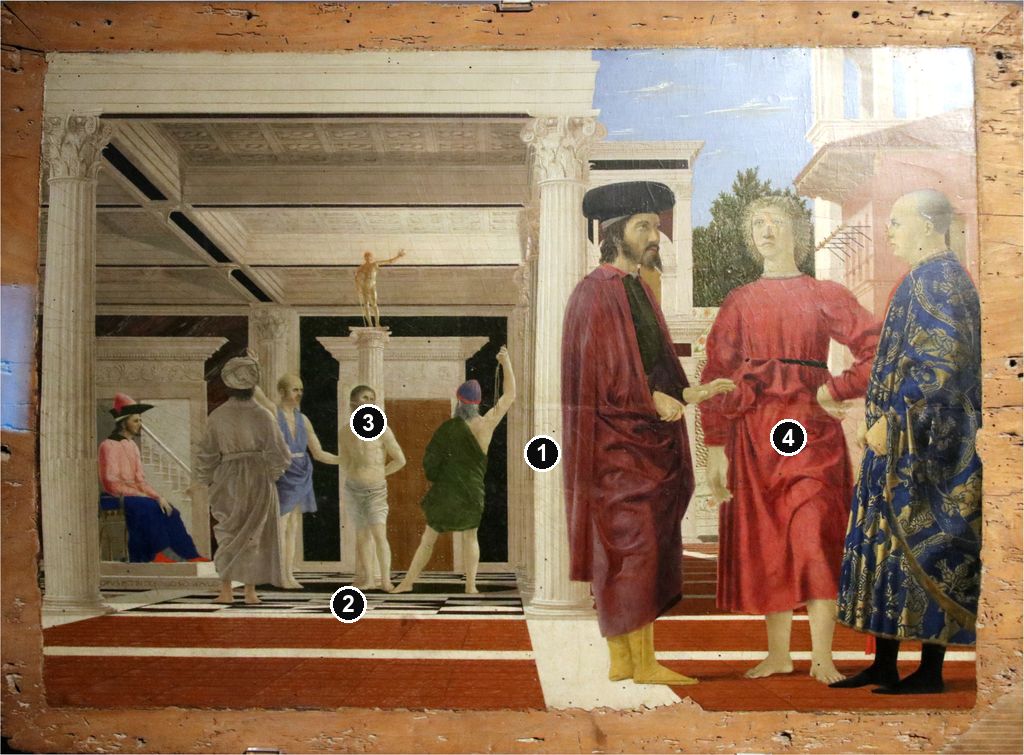
Details from THE FLAGELLATION OF CHRIST
Compare the cropped details with the source images above. Notice how their colours, shapes and positions contribute to the larger compositions.
Threshold and pilaster
The pilaster marks the step from the covered interior to the open foreground and makes the two groups readable at different depths.
Pavement in the interior
Pale and dark rectangles shrink towards the rear. Their repeated intervals help fix the position of each figure.
Column and Christ
Christ stands well behind the threshold. The pale shaft rises past the figure to a small gilded statue.
Foreground group
Faces, gestures and fabrics establish the presence of the three foreground figures. Their historical identities remain debated.
Light beneath the roof
The world outside is lit as a bright day. The three men are modelled clearly and colour separates them from the buildings and sky. Inside, the ceiling has its own conspicuous pattern of light and shade. Follow the succession of bright and shaded surfaces across the underside of the beams. The depth is announced by perspective and made more tangible by the alternating light. Christ’s pale body is small in the whole composition, but its brightness against the darker setting helps you come back to it from the foreground. [1] [4]
The Museo Galileo reconstruction places a localised light inside the loggia on the evidence of shadows from the crossbeams. It also draws attention to Christ’s upward glance in the direction of that part of the scene. An earlier computer study by Robert Tavernor used a new model to revise a previous estimate of the hidden light’s exact position. It is possible to argue about where the effect comes from because the ceiling gives measurable evidence. Whether the effect evokes divine presence, creates a plausible theatrical light, or serves both purposes is a different question. There is no plainly shown lamp at the point proposed by the reconstruction. [1] [4] [9]
Piero’s architecture helps the figures register at different distances. In the near part of the roof, you can see recessed panels in the ceiling. Each smaller compartment interrupts the illusion of a flat overhead surface. Emanuela Ferretti identifies a possible prototype for the ceiling of the marble building in the Propylaea on the Acropolis, described in the fifteenth century by Ciriaco d’Ancona. The Urbino gallery notes affinities with classical decoration in the Ducal Palace. Both are comparisons with identifiable architectural forms. The hall remains a painted invention even if a beam or moulding can be related to a surviving or recorded example. [1] [10]
The Galleria Nazionale delle Marche’s Ideal City offers another comparison. Its central building and long stretches of paving encourage the viewer to imagine walking into the space. The museum catalogues it as the work of a central Italian painter, with a date around 1480–90. In the Flagellation, the deep space directs attention back to bodies. The whereabouts of Christ, the witnesses and the men in the square matter to the sense of the whole. In the Ideal City, it is easier to let your eye continue down an unobstructed run of paving. The comparison is a way of recognising what the foreground group does to the experience of Piero’s architecture. [1] [11]
What the panel and its records reveal
The signature is easy to miss even at a good reproduction size. Look for it under Pilate, near the far left, on the front of a painted stone step. The museum transcribes it as Opus Petri de Burgo S[an]c[t]i Sepulcri, meaning the work of Piero of Borgo San Sepolcro. The words identify the painter through his home town. They supply neither a year nor the name of a patron. Their location matters to the experience of reading them. Like the narrative action, the declaration of authorship takes place well away from the eye-catching group at the front. [1]
The earliest surviving record so far identified is an entry of 4 December 1717 in the records of the cathedral chapter at Urbino. Canon Simon Francesco Ciccarini reported that the panel in the sacristy had split and needed repair and a new frame. He knew it as a work by Piero and believed that figures to one side were portraits of local dukes. Machtelt Brüggen Israëls published the entry in full in 2019. The record establishes the panel’s presence in the sacristy, its condition in 1717 and a local interpretation already in circulation. The canon was writing more than two centuries after the picture was made. [3]
A record of an archbishop’s visit places the repaired panel above Ciccarini’s desk in the sacristy. Brüggen Israëls argues that the wood at the side edges and the traces of how mouldings were originally fitted to the front point to insertion in a larger architectural surround. She proposes a possible connection with the cathedral or an attached chapel. That reading gives physical grounds for asking what the painting was designed to fit and which direction it would be seen from. The recorded eighteenth-century location could still be the result of a move within a building or between rooms. The gallery dates the transfer from the cathedral to the collection to 1915. [1] [3] [6]
The conservation report published by Cesare Brandi in 1954 takes the damage out of the realm of conjecture. The support is made from two horizontal boards. Brandi records that the join had opened and the boards had been glued back slightly out of alignment. The grooves of painted columns no longer matched across the seam. This is a rare case where close examination of the painted architecture helps diagnose a problem in the wood. The column fluting supplies an interrupted line whose original course is apparent on either side of the join. [2]
Brandi’s team examined the back and photographed the front in ordinary, raking and ultraviolet light. The X-rays chiefly helped them assess the join and produced limited results for what the restorers wanted to learn about the paint. On the back, old butterfly-shaped inserts held parts of the wood together and fixed bars had imposed further strain. The team removed the earlier restraints, corrected distortions in the boards and fitted sliding supports. The distinction mattered because the wood needed some freedom to move. The diagnosis came from the behaviour of the object and the marks left by previous repairs. [2]
The paint had its own problems. Uneven coatings and dirt had subdued differences between light and shade. Brandi reproduces a cross-section from the sky in which a later varnish is separated from the colour by a deposit of dirt. Cleaning involved reducing such additions with care, and retouching losses restrainedly. Some small gaps were left unfilled where there was no risk to the paint, and some losses at the join and cracks were made less distracting with watercolour. The report is important to the interpretation of the picture because a lightened varnish and realigned join can clarify the way the design was organised. The treatment does not establish the source of a painted beam of light, or who the people were. [2]
The object survived another disruption in February 1975, when it was stolen from the Urbino gallery along with Piero’s Madonna of Senigallia and Raphael’s La Muta. The Carabinieri recovered all three in March 1976 at Locarno, with the assistance of Swiss police. That episode belongs to the panel’s documented modern history, centuries after its arrival in the cathedral record. It is possible to follow a small painting from one room to another with some precision once there are records of its movements. The gap before 1717 remains. [3] [12]
A phrase on a lost frame
The words often associated with the three men, Convenerunt in unum, mean that they came together. Psalm 2 describes rulers assembling against the Lord and his anointed. Acts 4 applies the passage to the events of Christ’s Passion. Read beside this picture, it can suggest that the conversation in the square has something to do with a conspiracy. A reader who already knows the story of Urbino’s ruling family may find a second possible conspiracy in the words. [1] [3] [13]
There is a difficulty with reading them as Piero’s instructions. In a description of 1822, Luigi Pungileoni recorded the signature but made no mention of such a phrase. Johann David Passavant reported it in 1839. Around that period Johann Anton Ramboux copied the foreground figures in a tracing now at the Städel Museum and transcribed the words with the additional tres, meaning three. The fuller wording seems to direct attention to the group. Brüggen Israëls notes that the phrase had disappeared by 1864 and argues that it probably appeared on a replacement frame. The eighteenth-century record gives us a reason to take the possibility of a later addition seriously. [3] [14]
The phrase is still instructive. It shows that people thought the painted conversation needed explaining and once encountered an inscription apparently offering an explanation. Its usefulness changes depending on how much we can establish about its date. A fifteenth-century inscription might give direct evidence of how the picture was meant to be read. One added when the panel was reframed would tell us how later viewers read it. At present the evidence strongly favours treating the recorded words as part of the picture’s later history. Piero’s surviving signature is a different inscription in a different place. [1] [3]
The three men as figures from Urbino and Byzantium
The cathedral tradition took the men for rulers of Urbino. Early descriptions associate the figures with Federico da Montefeltro, his half-brother Oddantonio and his son Guidubaldo. A subsequent version kept the fair-haired youth as Oddantonio and gave him two advisers, Manfredo del Pio and Tommaso dell’Agnello. Oddantonio and the advisers were killed in 1444. In this reading, the figure in red appears between men implicated in his fate and the innocent person suffering inside the hall gives the murder a religious parallel. One difficulty is that the old identifications changed substantially while the painted faces and costumes stayed the same. Harald Rupfle’s Innsbruck catalogue entry traces a comparable profile with close-cropped hair in several paintings by Piero. Even a distinctive ear or hairline might help trace a recurring figure type without settling whom it portrays. [1] [3] [15]
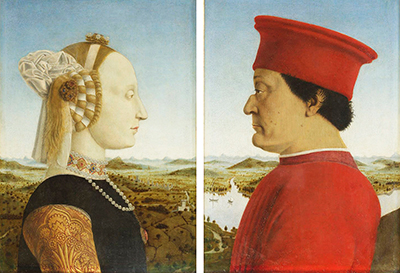
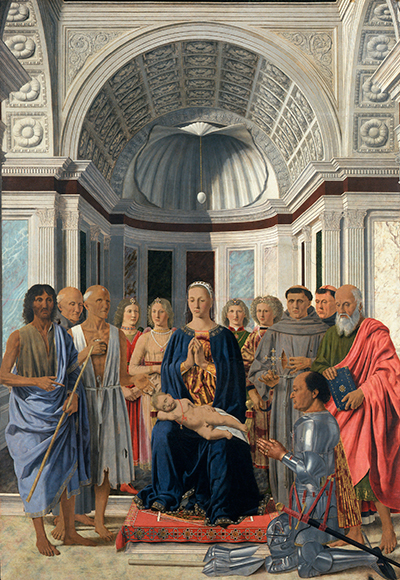
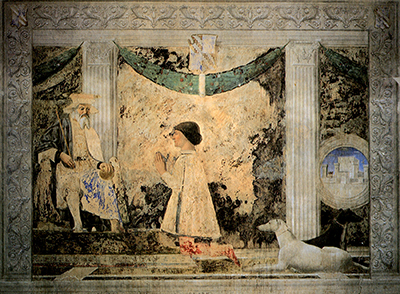
The portraits of Federico and Battista Sforza make a useful comparison. Federico’s profile belongs to a double portrait, and the Uffizi identifies the couple in that setting. He appears at prayer in the Brera Madonna, where his posture and equipment sit within the conventions of a donor image. A profile or a magnificent garment may indicate the standing of a person in courtly society, but there is much less to anchor the identity of a figure who stands in a group with no surviving names attached. In Piero’s fresco of Sigismondo Pandolfo Malatesta at prayer, the relationship of the kneeling ruler to the enthroned saint is explicit in the figure arrangement. The Flagellation gives us no comparable gesture of devotion from its foreground group. [1] [16] [17] [18]
Other historians looked to the eastern Mediterranean. Constantinople fell to the Ottomans in 1453, and in 1459 Pope Pius II convened a meeting at Mantua to seek support for a crusade. Kenneth Clark interpreted the scourging as an image of the suffering of the Church under Ottoman pressure. Later, Thalia Gouma-Peterson proposed that Cardinal Bessarion commissioned the panel for Federico to encourage his participation in a crusade. On this reading, the position of Pilate, the clothes worn by the foreground men and the contrast between activity inside and inaction outside belong to an argument about the duties of Christian rulers. The Urbino gallery’s account favours the political and religious line associated with Clark and still leaves the original commission open. [1]
The seated figure’s dress is a significant part of that argument. Pisanello’s medal of the Byzantine emperor John VIII Palaiologos commemorates the emperor’s visit to Ferrara in 1438 for a council of the Greek and Latin Churches. Its conspicuous profile headgear gives a basis for comparing a period representation of imperial dress with Piero’s choice of costume. The medal names its subject. A resemblance in the painting can show what an artist borrowed or expected viewers to recognise without settling whether he meant them to identify Pilate as John VIII. An argument from costume also has to explain the other end of the painting, where the rightmost man wears a very different kind of luxury clothing. [1] [19]
Carlo Ginzburg joined the geopolitical explanation to the death in 1458 of Federico’s son Buonconte. In his reconstruction the young man is Buonconte, the bearded man is Bessarion and the other adult is Giovanni Bacci. The parallel between an afflicted Church and a bereaved father would give the proposed appeal to Federico a personal force. The theory depends on bringing together circumstantial evidence, including similarities of facial features across works and links between people. It also has to account for why a youth commemorated after death would be shown apparently taking part in a conversation outside Pilate’s hall. His role in the proposed analogy is inferred from the grouping rather than supplied by a surviving commission. [1] [20]
The dates offered by these readings are entwined with what they think the figures represent. A panel responding to the death of Buonconte would belong after 1458. An appeal tied to a particular diplomatic meeting would fall close to the meeting. An Oddantonio memorial could in principle have been painted well after 1444. Museo Galileo captions its reconstruction around 1452, Brüggen Israëls illustrates the panel in her 2019 article as around 1456–57, and the owning gallery catalogues it to 1459–60. These datings need to be weighed on their evidence. They cannot all be treated as successive stages in a documented history. [1] [3] [4]
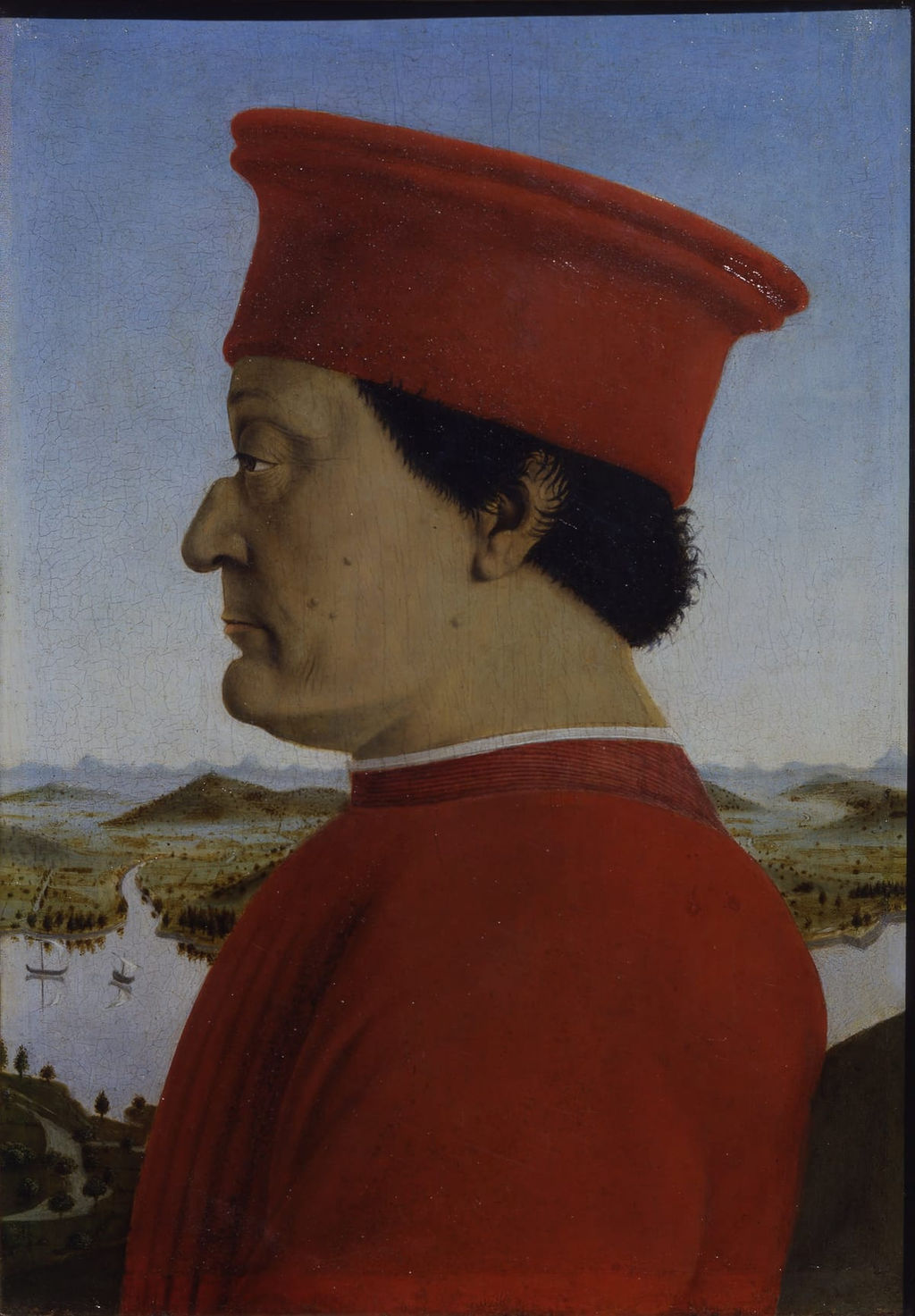
Federico da Montefeltro, portrait face of Piero’s Urbino diptych, Uffizi. Image source. Public domain. Resized only; native appearance preserved.
Two moments from the Passion
The simplest reason for placing people inside and outside the same building may be that the artist wanted to show different moments in the same story. Charles Hope and Paul Taylor proposed that the trio shows the release of Barabbas. Matthew’s account has Pilate release that prisoner and have Jesus scourged. On this interpretation the painting offers two different outcomes in adjacent spaces. The man in the square can walk away. The man under the roof will be handed over to be crucified. The comparison gives the barefoot youth a role within the Passion, even though no written label in the picture identifies him. [3] [5]
There is another way to connect the two parts through the Gospel. Brüggen Israëls sees a scene later in the Passion, in which Joseph of Arimathea asks Pilate for Christ’s body. She identifies the man in the gold-patterned robe as Joseph and proposes that the pattern refers to Ottaviano Ubaldini della Carda through a thistle design associated with his clothing. Her argument uses inventories written in the late fifteenth century, including evidence from the ducal wardrobe. In her reading, the richly dressed figure can refer to a contemporary patron without the painting stepping out of the biblical narrative. She compares the arrangement to the joined episodes in Piero’s Arezzo fresco of the Queen of Sheba, in which the same character appears in two different parts of one design. [5] [6]
The two proposals give different reasons for the young man’s central position. Barabbas is important because he is the prisoner released in Christ’s stead. In the Joseph of Arimathea reading the youth is an assistant. The man in blue and gold then carries the greatest responsibility for the outcome of the exchange outside. A viewer might find either narrative credible from the poses and dress. In each case the argument relies on matching visual details with conventions elsewhere. The bearded man extends his hand with the palm held low. It is easy to imagine him explaining a decision, answering a request or making a point of his own. The gesture works in all those situations. [1] [3] [6]
Why the distance between them matters
Marilyn Aronberg Lavin gives the foreground conversation a central role in her reading. She proposes that the man on the left is explaining the listeners’ relationship to Christ’s suffering. The outward-looking youth and the observer with his back to us inside the building do different things with our attention. One seems to address our part of the picture, while the other offers an example of standing and looking at the scourging. For Lavin, the space between the groups can give force to an act of understanding. [21]
Franck Mercier takes a different direction. His study proposes an Augustinian meditation on time and salvation, in which the geometry and the experience of seeing the past within the present play central roles. The shift in scale between the groups is then part of how the painting makes you think. You can occupy virtually the same space as the three men outdoors while the sacred event is made visible to you at a distance. This approach asks what a viewer is doing when their attention moves from one group to the other. A reading of that kind depends less on finding exact portraits, though it makes its own assumptions about the theological ideas a viewer would bring to the picture. [22]
Some interpretations make ambitious use of physical space beyond the panel as well. Pier Gabriele Molari proposed that the painting formed part of a single arrangement for Federico’s meditation in the Ducal Palace with what are now the Brera altarpiece and the Uffizi portrait panels. His reconstruction relates the painted light to a proposed setting and combines works with distinct surviving histories. It shows how far a theory about original installation can reach. It would require independent evidence that the works were designed to be read together before the comparisons among them could establish that arrangement. [16] [17] [23]
The evidence that survives in Urbino lets us come considerably closer to Piero’s choices than to the occasion that prompted them. A signature, dated sacristy records and a conservator’s account establish where the wood was split and where the name is written. The painted surface makes it possible to follow the route from the square past the column and into the hall. Even after you have considered who might be in conversation, try that route in the other direction. Let your eye leave Christ, follow the paving back out and stop at the barefoot youth. The same connected space that made Christ appear distant now makes a quiet man in the foreground feel uncomfortably close. [1] [2] [3] [4]
Browse the artworks
Compare Piero’s frescoes, panels and manuscript figures. The list includes ensembles and separately identifiable panels or scenes. Dates are approximate where the sources differ.
| Name | Date | Medium and source |
|---|---|---|
| The Baptism of Christ | Probably c. 1437–45 | Panel painting Catalogue. |
| The Flagellation of Christ | 1459–60 (GNDM) | Panel painting Catalogue. |
| The History of the True Cross | Mid-fifteenth century | Wall painting Catalogue. |
| Dream of Constantine | Mid-fifteenth century | Wall painting Catalogue. |
| The Duke and Duchess of Urbino | About 1473–75 (Uffizi) | Panel painting Catalogue. |
| The Resurrection | About 1458–68 (Opificio) | Wall painting Catalogue. |
| Brera Madonna | About 1472–74 | Panel painting Catalogue. |
| Annunciation at Arezzo | Mid-fifteenth century | Wall painting Catalogue. |
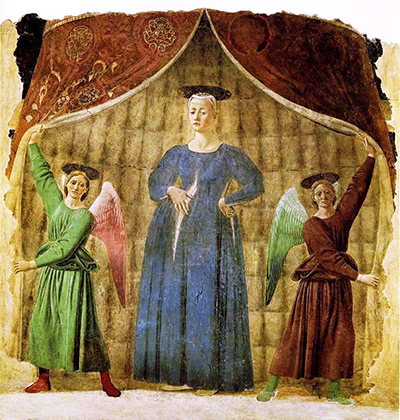
| Madonna del Parto | About 1450–65 (Monterchi) | Wall painting Catalogue. |
| Polyptych of the Misericordia | Commissioned 1445 | Panel painting Catalogue. |
| The Nativity | Early 1480s (National Gallery) | Panel painting Catalogue. |
| Madonna di Senigallia | About 1474–75 (GNDM) | Panel painting Catalogue. |
| Death of Adam | Mid-fifteenth century | Wall painting Catalogue. |
| Queen of Sheba | Mid-fifteenth century | Wall painting Catalogue. |
| Victory of Constantine | Mid-fifteenth century | Wall painting Catalogue. |
| Battle between Heraclius and Chosroes | Mid-fifteenth century | Wall painting Catalogue. |
| Saint Mary Magdalen | Wall painting Catalogue. | |
| The Augustinian Polyptych | 1454–69 | Panel painting Catalogue. |
| Polyptych of Perugia | About 1467–69 (GNU) | Panel painting Catalogue. |
| Perugia Annunciation | About 1468–70 (national catalogue) | Panel painting Catalogue. |
| St Francis and St Elizabeth | About 1467–69 (GNU) | Panel painting Catalogue. |
| Stigmatisation of St Francis | About 1468–70 (national catalogue) | Panel painting Catalogue. |
| An Augustinian Nun (Saint Monica) | 1454–69 | Panel painting Catalogue. |
| Augustinian Saint | 1454–69 | Panel painting Catalogue. |
| Saint Michael | 1454–69 | Panel painting Catalogue. |
| Saint Nicholas of Tolentino | 1454–69 | Panel painting Catalogue. |
| Saint John the Evangelist | 1454–69 | Panel painting Catalogue. |
| Virgin and Child Enthroned with Four Angels | About 1460–70 (Clark) | Panel painting Catalogue. |
| Portrait of Sigismondo Pandolfo Malatesta | About 1450–51, often proposed. Louvre catalogue range 1450–75. | Panel painting Catalogue. |
| Sigismondo before St Sigismund | 1451 | Wall painting Catalogue. |
| St Jerome and a Donor | 1460s (Accademia); about 1450 also proposed | Panel painting Catalogue. |
| St Jerome in Penitence | 1450, dated on the panel | Panel painting Catalogue. |
| Saint Julian | About 1455–60, often proposed | Wall painting Catalogue. |
| Saint Augustine | 1454–69 | Panel painting Catalogue. |
| Saint Apollonia | 1454–69 | Panel painting Catalogue. |
| Crucifixion from the Augustinian Polyptych | 1454–69 | Panel painting Catalogue. |
| Saint Louis of Toulouse | Wall painting Catalogue. | |
| Burial of the Wood | Mid-fifteenth century | Wall painting Catalogue. |
| Discovery and Proof of the True Cross | Mid-fifteenth century | Wall painting Catalogue. |
| Exaltation of the Cross | Mid-fifteenth century | Wall painting Catalogue. |
| Saint Anthony Raises a Child | About 1467–69 (GNU) | Panel painting Catalogue. |
| Saint Elizabeth Revives a Child | About 1467–69 (GNU) | Panel painting Catalogue. |
| Hercules | About 1470 | Wall painting Catalogue. |
| Portrait of a Boy (possibly Guidobaldo da Montefeltro) | Panel painting Catalogue. | |
| De prospectiva pingendi, Reggio Emilia witness (figures) | Manuscript diagrams Catalogue. | |
| The Interrogation of Judas | Mid-fifteenth century | Wall painting Catalogue. |
| Two prophets, Bacci Chapel | Mid-fifteenth century | Wall painting Catalogue. |
| Saint Clare of Assisi, upper predella | About 1467–69 (GNU) | Panel painting Catalogue. |
| Saint Agatha, upper predella | About 1467–69 (GNU) | Panel painting Catalogue. |
| Lost centre of the Augustinian Polyptych | 1454–69 | Lost panel or panels Catalogue. |
Frequently Asked Questions
Their identities are disputed. Proposed readings include members of the Montefeltro circle, people involved in Byzantine affairs and characters from a second episode of the Passion. The earliest cathedral record offers a local identification with ducal portraits, without individual names. [1] [3] [6]
It belongs to the Galleria Nazionale delle Marche at the Palazzo Ducale in Urbino. The gallery records its arrival in 1915 from the cathedral’s sacristy. [1]
Discussion
Look again at the images and ideas explored in The Flagellation of Christ. These editorial prompts invite your observations.
Reader Insights
Look at the panel first with the loggia covered and then with the three foreground figures covered. Which details make you most aware that another scene could be taking place close by?
Compare the figures’ shoes, gestures and sightlines. Which details tell you how they relate to one another, and which would you need to name them?
How does the scene change if the men outdoors belong to a later moment of the Passion? How does it change if they are men from Piero’s own century?
Join the Conversation
Share a detail, comparison or question about The Flagellation of Christ below.
References
- Galleria Nazionale delle Marche, Flagellazione, collection entry DE 229. Object data, full-view image, signature, accession and interpretative history. View source.
- Cesare Brandi, “Restauri a Piero della Francesca”, Bollettino d’Arte 39, no. 3 (1954), pp. 241–58, especially the Flagellazione treatment and figures 1–17. View source.
- Machtelt Brüggen Israëls, “The First Known Record of Piero della Francesca’s ‘Flagellation of Christ’ and the Question of its Inscription”, The Burlington Magazine 161, no. 1395 (June 2019), pp. 488–91, with a transcription of the cathedral chapter entry. Author’s copy. View source 1. View source 2.
- Museo Galileo, La Flagellazione di Cristo, exhibit VI.7, virtual architectural reconstruction by Filippo Camerota and Francesco Paolo Di Teodoro, 3D model by Fabio Corica. View source.
- United States Conference of Catholic Bishops, Matthew 27, especially verses 15–26 and 57–60, New American Bible, Revised Edition. View source.
- Machtelt Brüggen Israëls, “A Sartorial Portrait of Ottaviano Ubaldini della Carda by Piero della Francesca”, The Burlington Magazine 165, no. 1444 (July 2023), pp. 720–37, especially pp. 730–34. View source.
- Rudolf Wittkower and B. A. R. Carter, “The Perspective of Piero della Francesca’s ‘Flagellation’”, Journal of the Warburg and Courtauld Institutes 16, nos. 3–4 (1953), pp. 292–302. View source.
- Laura Geatti and Luciano Fortunati, “The Flagellation of Christ by Piero della Francesca: A Study of Its Perspective”, Leonardo 25, nos. 3–4 (1992), pp. 361–67. View source.
- Robert Tavernor, “Casting New Light on ‘The Flagellation’ by Piero della Francesca”, Computers and the History of Art 6, no. 1 (1996), pp. 13–19. Author abstract hosted by King’s College London’s Centre for Computing in the Humanities. View source.
- Emanuela Ferretti, “L’architettura della Flagellazione”, University of Florence research repository, 2015. View source.
- Galleria Nazionale delle Marche, Ideal City, collection entry. View source.
- Comando Carabinieri Tutela Patrimonio Culturale, exhibition guide on recovered cultural property, entry on the theft and recovery of the Urbino panels. View source.
- United States Conference of Catholic Bishops, Acts 4, verses 25–28, New American Bible, Revised Edition. View source.
- Städel Museum, Drei sich unterhaltende Männer, Johann Anton Ramboux’s tracing of the three foreground men, Sammlung von Umrissen und Durchzeichnungen, vol. 7, leaf 49. View source.
- Harald Rupfle, “Geißelung Christi”, Metapictor research project, University of Innsbruck, especially the catalogue discussion of the right-hand foreground figure. View source.
- Uffizi Galleries, The Duke and Duchess of Urbino Federico da Montefeltro and Battista Sforza, collection entry. View source.
- Pinacoteca di Brera, Madonna and Child with Saints, Angels and Federico da Montefeltro, collection entry, inventory 180. View source.
- Rimini Turismo, Tempio Malatestiano, municipal guide to the building and Piero’s fresco. View source.
- The Metropolitan Museum of Art, Pisanello, Medal: John VIII Palaeologus, collection entry. View source.
- Carlo Ginzburg, The Enigma of Piero, translated by Kate Soper and Martin Ryle (Verso, 2002). Peter Burke’s introduction on the publisher’s site. View source 1. View source 2.
- Marilyn Aronberg Lavin, “Piero della Francesca’s Flagellation: The Triumph of Christian Glory”, The Art Bulletin 50, no. 4 (1968), pp. 321–42. View source.
- Franck Mercier, “Salvation in Perspective: A New Interpretation of Piero Della Francesca’s Flagellation of Christ”, Annales. Histoire, Sciences Sociales, English ed., 72, no. 3 (2017), pp. 489–523, published online 2021. View source.
- Pier Gabriele Molari, “Piero della Francesca: la soluzione dell’enigma della Flagellazione e il ritrovamento dell’affresco perduto”, University of Bologna, AMS Acta research repository, summary and discussion of the proposed Ducal Palace installation. View source.